
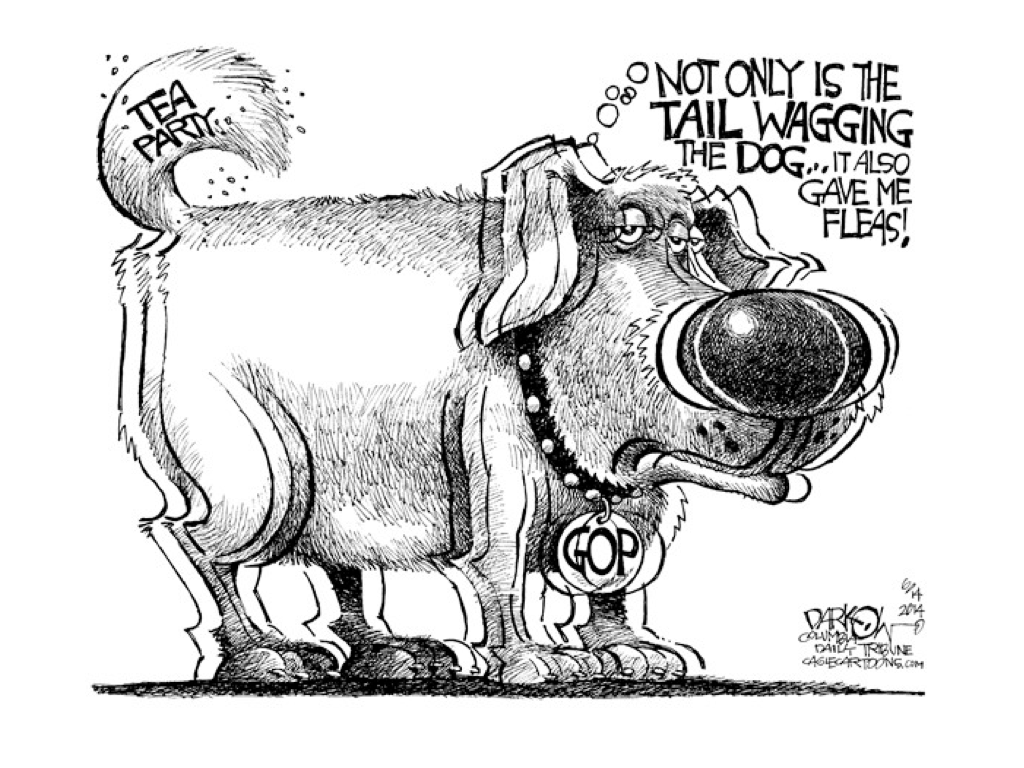
The Problems in Congress Come Not from Gridlock, But from Roadblocks

Republican Party Now.png


Gridlock, as originally defined, refers to a severe traffic jam in a grid of intersecting streets, where cars backed up on the intersecting roads block each other from moving.  No individual car is to blame, but rather all of them together are to blame.  The term is now also commonly used to refer to the inability of Congress to get things done.

But the problem in the US Congress is not really gridlock.  As will be clear from several examples discussed below, a majority in Congress exists for moving important legislation forward.  The problem, rather, is that congressional leaders, who decide what will be voted on and when, have acted to keep such legislation from coming to a vote.  But this is not gridlock.  Rather, it is deliberately placed roadblocks.

Events over the last month show what might be done when such roadblocks are removed. The resignation of John Boehner as Speaker of the House in late September created a narrow window when he could call up legislation for a vote while not being threatened by a minority of just 30 Republican congressmen on a motion to remove him from the Speakership.  He had already removed himself.  As discussed in the previous post on this blog, the traditional practice of straight party line votes for the position of Speaker means that a small group in the majority party (equal to just 30 in the current Congress) could deny the majority party candidate of this post.  A small group of the Republicans in Congress threatened to use this against Boehner should he move legislation forward that they opposed.

Boehner struggled to lead his party under such constraints, and eventually gave up and resigned.  But with that resignation, he was able to negotiate and push through to passage, with strong bipartisan support, a bill that addressed the immediate threat of default on the US debt (current borrowing authority limits would have been reached on about November 2), provided an overall budget framework for fiscal years 2016 and 2017 (with the sequester restrictions eased by $50 billion in FY16 and $30 billion in FY17, equal to a total of just 0.2% of GDP over the two years), and addressed immediate issues arising on Social Security Disability Insurance and on Medicare premiums.

The bill was approved 266 to 167 when put to a vote.  All Democrats voting approved, as did about a third of the Republicans:

Budget and Debt Ceiling Bill – House

Yes

No

Not Voting

Republicans

79

167

1

Democrats

187

0

1

Total

266

167

2


The bill then went to the Senate, where it was also approved by a strong majority (again with all Democrats in favor and about a third of the Republicans):

Budget and Debt Ceiling Bill – Senate

Yes

No

Not Voting

Republicans

18

35

1

Democrats

46

0

0

Total

64

35

1


In perhaps an even more surprising example of what can be done to get around the roadblocks being imposed, the House membership used a discharge petition to force a vote on renewing the US Ex-Im Bank charter.  Successful discharge petitions are rare: Only three times in recent history (since 1985) have they been approved and then led to new legislation.  They require the public signature of 218 congressional members (half of the chamber), and thus require the support of at least some in the majority party even if all of the minority party are willing to sign.  Such maneuvering to force a vote against the wishes of the congressional leadership can and does lead to retaliation by the leadership against the members.  The petition was filed on September 30, with the support of 176 Democrats and 42 Republicans.

The Ex-Im Bank’s charter authority lapsed on July 1.  Reauthorization is required periodically, and never before in its 81 year history has Congress failed to approve this.  A strong majority voted in favor in the Senate in a vote on July 27, with bipartisan support:

Ex-Im Bank Reauthorization – Senate

Yes

No

Not Voting

Republicans

22

28

4

Democrats

42

1

3

Total

64

29

7


Once the vote in the House was forced (it took place on October 27), a strong majority came out in favor, including not only almost all Democrats, but a majority of the Republicans as well:

Ex-Im Bank Reauthorization – House

Yes

No

Not Voting

Republicans

127

117

2

Democrats

186

1

1

Total

313

118

3

The bill, however, is not yet fully passed.  The Senate will now need to reconsider the bill, and despite the earlier strong vote in favor, it is not clear a vote will be held now. Republican Senator Mitch McConnell, the Majority Leader, has said he will not allow a vote to take place, at least on the stand-alone bill passed by the House.  And by attaching the Ex-Im legislation to some other bill McConnell would force it to be returned to the House again, where the leadership could again try to block any vote from being held.

Paul Ryan has now been elected to be Speaker of the House, succeeding John Boehner. Despite these examples of legislation that can move forward in the current congress with bipartisan support provided votes are held, the prospects that Ryan will act differently from Boehner are slim.  Ryan still faces the challenge that just 30 members of his party can choose not to vote for him in future votes for the Speakership, and he would then lose the office.  Indeed, nine members of his party voted for another candidate in the October 29 vote.  And while Ryan at first said that as a condition of becoming a candidate for the Speakership, he wanted agreement to change the House rules so that no future such votes on the Speakership could be held until the start of the next Congress in January 2017, he was not able to secure such a commitment from those who had brought Boehner down, and Ryan then backed down from this demand.

An example where important reform would probably pass with bipartisan support if a vote were held is immigration reform.  The Senate passed a bill on immigration reform (written in part by Senator Marco Rubio, who later denounced his own bill following conservative criticism) by a 68 to 32 majority (with 14 Republicans voting in favor) in June 2013.  But with the conservative criticism, Speaker Boehner refused to bring it up for a vote in the House.  And while it is now more than two years later, with the 2014 elections in between, it is likely that a majority of members in both chambers would still be in favor of immigration reform along the lines of the bill passed in the Senate in 2013.

However, Paul Ryan has publicly announced that he will not allow any such bill to come up for a vote.  And he insists it is Obama’s fault!  In an interview Sunday on CBS’s “Face the Nation”, Ryan said it would be “a ridiculous notion” to work with President Obama on the issue, because Obama is someone they “cannot trust”.  But there is no basis for such a charge.  Obama’s executive orders on immigration have been no different in nature from orders issued by Reagan and the first Bush when they were president.  And no such accusations were leveled against Reagan and Bush then.

But regardless of what one concludes on that issue, why such actions should preclude a vote in the legislative chamber is not at all clear.  Rather, the basic disrespect of the presidential office by Ryan appears to signal that Ryan intends to follow the same path as his predecessor, and allow a minority of about 40 congressmen to dictate what legislation will be brought to a vote, and what will be blocked.  As noted before, the problem is deliberately placed roadblocks, not gridlock.

Jon Huntsman for Speaker of the House!

Jon Huntsman.001


Congress should elect Jon Huntsman for its next Speaker.  Well, perhaps not Jon Huntsman specifically, but some moderate Republican (there are a few) who would appeal not only to those in the Republican Party who want to get things done in Washington, but also to most Democrats, who also want to get things done.  Perhaps Ray LaHood, a former Republican congressman who served as Secretary of Transportation under President Obama, would be a good choice, or even former New York Mayor Michael Bloomberg.  But we are getting ahead of ourselves.  First, we need to discuss why this has come up.

Under pressure from the far right in his party, Speaker of the House John Boehner announced on September 25 that he would resign as Speaker effective the end of October.  Boehner still clearly enjoyed the support of a substantial majority of his party’s members in the House.  But to understand why he ultimately decided he would need to resign or face an embarrassing vote that would remove him, one must understand the rules and customs followed in the House.

Traditionally, the congressional members of each party (Democrats and Republicans) vote in a unified fashion for whomever has been elected the leader of their respective party in the House.  The election of party leader might well be subject to a competitive election among the party members.  But once a party leader is chosen, 100% of the congressional members from that party have traditionally then voted for that leader in the election for the Speaker position.  Thus whichever party has a majority in the House, will elect its leader to the Speaker post.

But there is no rule that one must follow this tradition.  Members of a party can vote for someone else as leader.  And that has become increasingly common in recent years.  Ten Republicans did not vote for Boehner as Speaker in January 2013, and 25 did not in January 2015.  While those numbers seem small, and indeed are small, not many are necessary.  By House rules, the person to be voted Speaker must receive an absolute majority of the “votes cast for a person by name” (thus excluding those absent, as well as excluding those voting “present”).  If the majority party in the House has a majority of only a relatively small number of seats, then a few renegades who decide not to vote for their party’s chosen leader can deny that person the Speakership.

In the current 114th Congress, which was elected in November 2014 and took office in January 2015, Republicans enjoy a quite substantial majority, with 247 seats vs. 188 seats for the Democrats, or a majority of 30 seats.  This is indeed the largest Republican majority in Congress since 1929, when Herbert Hoover was elected president.  But had just 30 Republican members decided not to vote for their party leader (Boehner) to become the Speaker, then he would have been denied the position (assuming all House members are present and vote for a person).

Thus the revolt that led to 24 Republican members to vote for someone other than Boehner (plus one voting “present”) in the January 2015 vote for the Speakership, was significant.  It was, and was clearly intended to be, a warning to Boehner that the minority of the Republican members on the far right of the party were willing to vote against their own leader, if that leader did not act as they wished.

Following up on this threat, Representative Mark Meadows of North Carolina (one of the Republicans who voted for someone other than Boehner) introduced a motion on July 28 to “vacate the chair”.  This could have acted as a vehicle to force a vote on Boehner as Speaker.

Faced with this, Boehner faced the choice of either caving into the demands of the extreme right in his party, or gotten critical legislation passed to allow the government to continue to function from October 1.  Failure to pass such legislation would have been an embarrassment.  The legislation was necessary so that government departments could continue to spend funds with the start of the new fiscal year (as the Congress has not yet passed a budget for the year – a common occurrence).  Democrats supported keeping the government open, as did a substantial share of the Republican majority.  Together they could pass such a bill.  But they are only allowed to vote on measures in Congress that the Speaker chooses to bring up for a vote.  This is what makes the Speakership such a powerful position.  But if Boehner brought up such a bill, members on the extreme right wing of his party made clear that they would vote against Boehner in a vote on the Speakership.  With only 30 such votes necessary for Boehner to lose such a vote (amounting to just 12% of the 247 Republican held seats in the Congress), Boehner was in a bind.  He was being held hostage by a small minority within his party.

Boehner has of course faced this dilemma before.  So far he has chosen to try to work with the extreme right wing.  But as this became more and more difficult, as their demands became more extreme and as their criticism of Boehner grew, ultimately Boehner decided all he could do was resign.  Losing such a vote for the Speakership would be terribly embarrassing.  Better to resign first, and at least go out on your own terms.

Following his resignation, Boehner did indeed bring to a vote a bill to fund the government for almost two and a half months (until December 11).  And it passed easily, by a majority of 277 in favor and 151 opposed.  It received 186 votes in favor from the Democrats (all Democrats who voted) and 91 votes in favor from the Republicans (with 151 opposed).

It appears now that the current Majority Leader Kevin McCarthy will succeed Boehner, through the traditional process.  McCarthy appears in most respects to be similar to Boehner in his approach, although somewhat closer to the right-wing of his party than Boehner was.  But Boehner’s resignation and the expected selection of McCarthy to the Speakership changes little if anything.  There will be the need to pass a budget to fund the government by December 11, or we will once again be in the same situation as this past week.  The extreme right of the Republican members have made clear that they still want what they want, and that if that means shutting down the government, then that is a price they are willing to pay.

Even before December 11, it appears that the government will hit the debt ceiling. Congress sets the debt ceiling, and Treasury Secretary Lew stated in a letter to Congressional leaders on October 1 that they now expect to hit the current ceiling on or about November 5.  Unless Congress acts by then, the US would be forced to default on its financial obligations.  Once again, a broad majority in the Congress, made up of Republicans and Democrats together, would certainly vote in favor of a bill to address this. But they can vote on such a bill only if the Speaker allows a vote on it, and the extreme right wing of the Republican members see this as leverage to get what they want.  By threatening to vote out the Speaker if he does bring up such a bill, they can hold the Speaker hostage to their demands.

Thus there is every reason to expect gridlock to continue, despite Boehner’s resignation and the election of a new speaker such as McCarthy.  Can anything be done?

Yes, the members of congress have it within their power to address this.  Platitudes (such as we will all work together, or will work harder together) will not suffice.  Rather, one needs to address the traditional practices of the current system that empower a small minority within the majority party to hold hostage the Speaker to their demands.

This can be done by going outside the traditional system in the choice for Speaker. There is nothing in the Constitution that requires the Speaker to be a member of Congress.   While the Speaker has historically always been a member, the Constitution does not require this.  All the Constitution says on the institution is in one line at the end of Article I, Section 2, where it states the “House shall choose their Speaker and their Officers”. Anyone can be so chosen.

To change the dynamics, one needs a Speaker who will draw support from the large majority of members who do not represent the extremes of either party.  The Speaker role would change from highly partisan party leader, to a more balanced mediator who seeks a consensus that may well cross party lines to move needed legislation forward.  With Republicans in the majority, the person chosen should be a Republican.  But he or she should be someone who can work with both sides to try to reach a consensus that spans the broad middle ground, thus ending the current system that allows a small minority to hold the Speaker hostage to their demands.

Jon Huntsman might be such a candidate.  He might in particular be appropriate given his recent work as Co-Chair of “No Labels”, a bipartisan group that has proposed a set of process reforms not only to get congress to work, but also the presidency and government more broadly.  I would not necessarily endorse all of these proposals (and some are pretty broad and vague), but thinking along such lines will be necessary if we are to see an end to gridlock in Washington.

The new role of the Speaker would be to seek a broad consensus on issues, crossing party lines, and bringing to the floor measures that will be endorsed by a majority rather than voted up or down on strict party lines.  Voting solely on party lines is a characteristic of parliamentary systems, such as that of the UK.  Such a system works fine to move an agenda forward when the chief executive (the Prime Minister in a parliamentary system) is the head of the majority party in the parliament (or of a coalition that constitutes a majority). But the US Constitution did not establish a parliamentary system.  Rather, it established a system with a separately elected chief executive (the president), who runs the executive branch of government and where the government is made up of three equal and separate branches:  the executive, the legislature, and the judiciary.

Voting solely along party lines, as has become common in recent years in the Congress, works fine in a parliamentary system but not in the system of government established by the US Constitution.  This will not change as long as the Speaker sees his role as primarily that of a partisan leader of his party, rather than as a mediator seeking to produce a consensus on needed legislation with this then passed by a majority of members from both parties representing the middle rather than the extremes.  As long as an extreme can hold the Speaker hostage, he or she will not be able to act as such a mediator spanning the parties.

With such a change to this new type of Speaker, one can foresee a large set of measures passing soon, as a majority in the Congress have been in support.  These include not only necessary upcoming legislation such as for the budget and a bill to raise the debt ceiling, but other items as well.  For example, the previous federal highway funding bill expired in 2009, but since then Congress has not been able to pass any long term extension. Rather, Congress has passed 34 different short term extensions to keep road funding going, and with just these numerous short term extensions, states and localities could not plan in any reasonable way.  The Senate finally passed a longer term (six year) reauthorization this past summer, but the House has yet to act.  There is also a broad consensus on the need for immigration reform, and the Senate passed such a bill in 2013. And if one aimed at achieving a consensus in the middle, rather than appealing solely to one side or the other, one could envisage progress on bills that would address the underfunding and poor management of the VA health system.  One could even see measures to address the high cost of health care (instead of seeking to score political points by calling Obamacare an abomination despite its success in extending insurance cover).

None of this is realistic, of course.  I have no expectation that Washington will change. The point, rather, is that gridlock is not a necessary outcome of the system, but rather a choice that has been made.  Members of Congress have it within their power to change how their Speaker is chosen, and thus ensure the Speaker will abide by the interests of a majority in the Congress rather than a minority in one party.


The Purple Line: New Thinking is Needed to Address Our Transportation Problems

The Washington Post in recent weeks has published a number of pieces, both articles and editorials, on purportedly massive economic benefits from building the Purple Line (a 16 mile light rail line in the Maryland suburbs of Washington, DC).  See, among others, the items from the Post herehere, here, and here.  Their conclusion is based on uncritical acceptance of the results of a consultant’s report which concluded that the funds invested would generate a return (in terms of higher incomes in the region) of more than 100% a year.  But transit projects such as this do not generate such huge returns.  This should have been a clear red flag to any reporter that something was amiss.

As discussed in an earlier post on this blog, the consultant’s report was terribly flawed. There were obvious blunders (such as triple counting the construction expenditures) as well as more complex ones.  While one should not expect a reporter necessarily to have the expertise to uncover such problems, one would expect a good reporter and news organization to have sought out the assessment of a neutral observer with the necessary expertise.  This was not done.

The consultant’s report was so badly done that one cannot conclude anything from it as to what the economic impact would be of building such a rail line.  But more importantly, the report did not even ask the right question.  It looked at building the Purple Line versus doing nothing.  But no one is advocating that we should do nothing.  We have real transportation issues, and they need to be addressed.

The proper question, then, is what is the best use of the scarce funds we have available for public transit.  If an alternative approach can provide better service for more riders at similar or lower cost, then the impact of building the Purple Line versus proceeding with that alternative is negative.  As discussed below and as an illustration of what could be done (there are other alternatives as well), instead of the Purple Line one could provide free bus service on the entire county wide local bus systems.  These bus systems cover poor communities as well as the rich (the Purple Line will pass through some of the richest zip codes in the nation), and for the cost of the Purple Line the bus systems could be expanded to provide free bus service to as many as four times the ridership the Purple Line is projected to carry (with such projections, based on past experience, likely to prove optimistic).  The local bus systems already carry twice the projected ridership of the Purple Line.

With the aim of providing an alternative view to the discussion being carried, I submitted the attached to the Post for consideration as a local opinions column.  The Post decided, however, not to publish it, so I am making it available here.


—————————————————————————————————-

Solving Our Transportation Problems Will Require New Thinking, Not Old White Elephants

As Governor Hogan comes to a decision on the Purple Line, there is increasing pressure from proponents arguing the 16 mile light rail line will yield huge developmental benefits.  A recently released and highly publicized study by the consulting firm TEMS concluded the line would raise incomes by $2.2 billion a year, for a capital cost that TEMS took to be just $1.9 billion (the cost estimate is now higher, at close to $2.5 billion).  Thus the return, TEMS says, will be well in excess of 100% a year.

As the saying goes, when something sounds too good to be true, it usually is.  The TEMS study was badly flawed.  More importantly, it did not address the right question.  What we should be asking is how best to address our very real transportation needs, given the limited public resources available.

There are numerous problems with the TEMS study.  To start with more obvious blunders:  It estimated impacts during the construction period as if the entire Purple Line would be built in Montgomery County, would be built again in Prince George’s, and built again in Washington, DC (even though it will not even touch Washington).  That is, it triple counted the construction expenditures and therefore its income and jobs impacts.  It also assumed that all the inputs (other than the rail cars) would be sourced in Washington or these counties.  But steel rail cannot come from here:  Neither Washington nor its suburbs have any steel mills.

There were more fundamental problems as well.  Among them was the fallacy of cause and effect.  In their statistical analysis, TEMS found that higher income neighborhoods are associated with lower transportation costs.  From this they jumped to the conclusion that lower transportation costs led to those higher incomes.  That is not the case.  Rich people live in Georgetown and, being close to downtown, transportation costs there are relatively low.  But moving to Georgetown does not suddenly make you rich due to low transportation costs.  Rather, one can afford to buy a home in Georgetown if you are already rich.

Perhaps the most basic problem is that TEMS assumed it was either the Purple Line or nothing.  But no one is advocating doing nothing.  We face real transportation issues, and they need to be addressed.  Unfortunately, alternatives have not been seriously examined.  Part of the problem has been narrow-minded thinking that has failed to consider broader alternatives than solely a line on this fixed corridor.

As an example of what might be done, consider the locally run RideOn and TheBus systems in these counties.  These two systems already carry double the projected ridership of the Purple Line.

The annual operating cost of the Purple Line is expected to be $55 million a year.  This is in addition to the $2.5 billion capital cost.  Taking just half of that annual operating cost, net of fares expected to be collected due to the Purple Line, one could cover the full amount currently collected in fares on the entire county-wide RideOn and TheBus systems.  That is, one could provide free bus service on the entire systems for just half of the cost of operating the Purple Line.

Some might say that with zero fares, there would be the “problem” that many more riders will want to take these buses.  But that would be fantastic.  One would need to cover the additional costs, but this could be done.  Note first that filling empty seats on buses costs nothing, and there are a lot of empty seats now.  There is then the second half of the annual operating cost of the Purple Line, and finally the $2.5 billion capital cost.  Taken together, these funds could cover the full costs (including costs covered in county and state budgets) of doubling the scale of the RideOn and TheBus systems.

We can therefore have the Purple Line, serving riders on a narrow 16 mile corridor that runs through some of the most affluent areas of these counties, or for the same cost provide free bus service on systems that could carry four times as many riders.  Furthermore, the bus systems serve not just affluent areas but also the poorest communities of the counties.  For the poor, earning at or close to the minimum wage with perhaps two jobs to get by, daily bus fares of $6 or $8 or more are not insignificant.

We need to be open to broader options for how to address our transportation crisis.  The debate on the Purple Line has not done that.  And by treating the issue as the Purple Line or nothing, proponents are increasing the likelihood that the outcome will be nothing.

—————————————————————————————————

Note on Sources:

a)  The TEMS consultant report, March 2015, commissioned by Montgomery County, Prince George’s County, and the Greater Washington Board of Trade.

b)  Current cost estimates for building and operating the Purple Line, along with ridership projections, are from the most recently issued Federal Transit Administration Purple Line Profile Sheet, November 2014.

c)  Cost and ridership data for the local transit systems (RideOn and TheBus) are from the National Transit Database of the Federal Transit Administration.