
The Price of Oil: Don’t Blame Obama

As the price of oil and gasoline has gone up in recent months, one of the more vociferous charges being made by Republicans is that it is all Obama’s fault.  The allegation is that Obama’s regulatory policies have led to reductions in US oil and natural gas production, which have pushed up the price that people are paying at the pump.  The accusations were originally strongly pushed and developed into a campaign issue by the Murdoch owned Fox News channels, and were then picked up by the Republican presidential candidates.  For example, a FoxNews.com posting on their web site from March 13 is titled “Romney Slams Obama Over Gas Prices”.  A report on the CBS News web site from March 15 is titled “Mitt Romney:  Obama to blame for high gas prices”, and reports on an interview with Fox News where Romney asserted that Obama is “absolutely” responsible for high gasoline prices.

These accusations reflect a good deal of confusion.  Oil prices are determined in global markets.  And the assertion that Obama’s regulatory prices have led to reductions in production of oil and natural gas in the US are simply untrue.  The facts on what is going on can be seen with a few simple graphs.  All the data are from the US Energy Information Agency of the US Department of Energy.
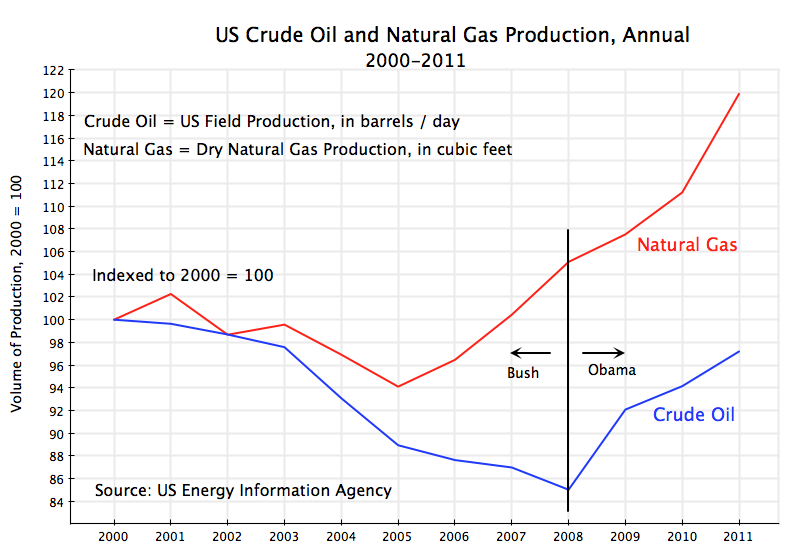
Crude oil production in the US as well as natural gas production have in fact risen since Obama took office.  Indeed, crude oil production had been declining until 2008, the last full year of the Bush administration, and then rose after Obama was inaugurated.  And to show that this is not simply an artifact of using annual totals, one can look at the monthly figures:

The charge that regulations imposed by Obama have cut oil and gas production in the US from what it was before is therefore simply false.  But I also would not argue that the increase in oil and gas production can simply be attributed to new measures under Obama.  Much more has also been going on.  For oil, probably most important has been the increase in global (and hence US) oil prices in recent years, which has induced increased drilling as well as increased production out of existing fields.  The question of why oil prices have risen will be discussed below.

For gas, probably most important has been the development and implementation of the new hydraulic fracturing (“fracking”) method of extracting gas from shale rock basins.  Thus gas production has been increasing since 2005.  By 2011, natural gas production in the US had risen to the highest it had ever been, exceeding the previous peak that had been set back in 1973.  Fracking is controversial due to the environmental impacts, and Republicans have charged that over-zealous federal regulators in the Obama administration have held it back.  But as the graph above shows, production of natural gas has increased sharply.

And since natural gas is a local product with only limited trade overseas (liquified natural gas, or LNG, can be shipped, but the conversion process is expensive), the increased supply in the US has driven down gas prices to the lowest levels since the start of the Bush administration:

With natural gas prices now at these relatively low levels, some of the new gas development projects are indeed being postponed or put on hold.  There is even discussion of major new projects to export US gas to overseas via LNG.  None of this is consistent with the accusation that the Obama administration regulations are holding back natural gas development.  And while Romney and others “slam” Obama for high oil prices, one does not hear praise for the lowest natural gas prices in years.  Note that I am not arguing that Obama should necessarily be so praised.  Indeed, with the environmental issues surrounding fracking, there is a good argument that such gas field development should be more tightly regulated to ensure environmental issues are being appropriately addressed.  I am just noting that Romney and others have been totally inconsistent.

Crude oil production has also increased in the US, as shown in the graphs above.  But the market for oil is different from that for natural gas, as oil can be readily shipped via tankers.  Hence the price of oil is determined in the global market, and one will not see US prices decline when US production increases.  US production of crude oil is a relatively small share of the global total.  There is therefore no reason for oil prices to fall when US oil production increases.  And prices have increased over the last decade:
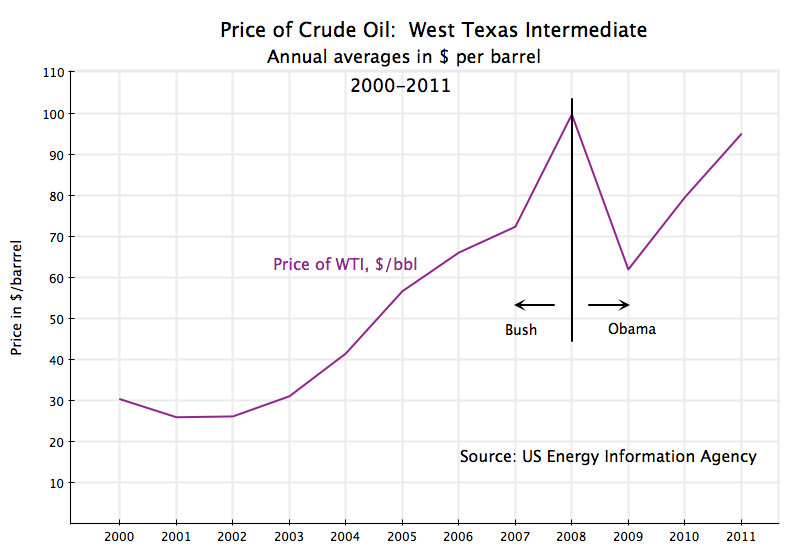
Would it be fair to blame Bush for the increase in oil prices during his presidency, reaching a peak in 2008?  Not really.  The fundamental cause has been global growth, while global oil production has been essentially flat since 2004 or so:
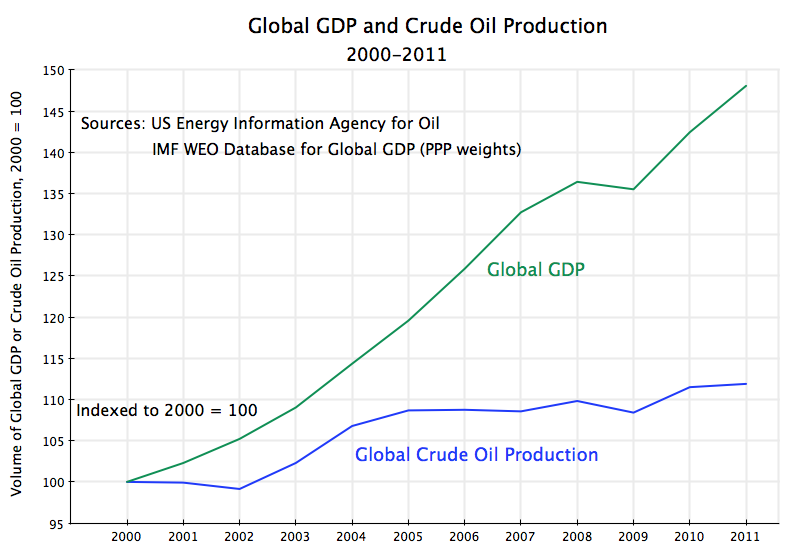
Global oil production, global GDP, 2000 to 2011

With growth in global demand (especially in rapidly growing countries such as China, India, Brazil, and other emerging markets), and essentially flat oil production for over seven years now, it should not be a surprise that crude oil prices, and hence the price of gasoline at the pump, have risen.  And the fallback in oil prices in 2009 can be readily understood in the global downturn of that year, following the 2008 collapse in the US economy.  But as growth in global GDP recovered, so have oil prices.

There is of course much more that could be covered in the story on the oil and gas markets than what has been presented here.  The aim has not been to be comprehensive and detailed.  Rather, the purpose has simply been to show that the charges being made by Romney and others that Obama and over-zealous federal regulators are responsible for declining US oil and gas production, and hence the high price of gasoline at the pump, are simply false and indeed inconsistent with some easily checked facts.
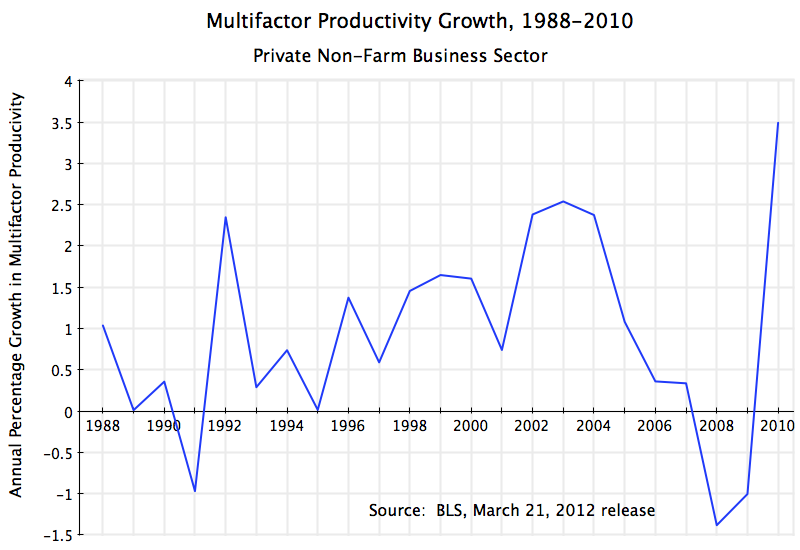
Multifactor Productivity Growth: A Record High in 2010

US Productivity Growth, Non-farm Business Sector, 1988- 2010

The Republican presidential candidates continue to assert loudly that over-bearing new regulatory burdens under Obama have crippled the American economy and account for the slow recovery from the 2008 collapse.  Mitt Romney, in a policy address at the University of Chicago on March 19 for example (see transcript here), asserted that regulatory burdens (in addition to higher taxes, even though taxes have in fact been cut under Obama), were leading to businesses shutting down and jobs disappearing as “Entrepreneurs decide it’s too risky and too costly to invest and to hire.”

New burdensome regulations, if they were a problem, would reduce productivity.  Yet as this blog has noted previously (see here), productivity growth has in fact been quite good during the Obama period.  The productivity concept normally used for such discussion is simple labor productivity, which measures output (GDP) per unit of labor input (either employment or hours of labor).  This productivity concept is useful in part because it can be estimated as soon as one has an estimate of GDP, i.e. each calendar quarter.  But it is not a measure of pure productivity, as output per unit of labor can rise due to several things, including from increased capital investment (more machinery and equipment, which improves productivity) or from changes in the composition of labor (towards more highly educated, and hence more productive, workers).

Multifactor Productivity (also sometimes called Total Factor Productivity) is a measure of productivity that takes into account increased capital availability and other such factors.   The Bureau of Labor Statistics of the US Department of Labor provides an estimate of it, but because it is more difficult to estimate, it only comes out with a major lag.  On March 21, the BLS issued its estimate for 2010.  Only annual estimates are made.  And while the series only goes back to 1987 (and hence has growth rates only from 1988), it is interesting that while Romney and the other Republicans are complaining of a large increased burden on business from regulations under Obama, the BLS found that multifactor productivity grew faster in 2010 than in any year since they started estimating the series in 1988.

The graph above shows the BLS estimates of multifactor productivity (MFP) growth for 1988 to 2010, for the private non-farm business sector.  MFP grew by 3.5% in 2010, reversing the downward trend seen since 2003 and absolute declines in 2008 and 2009.  As noted, the 3.5% increase in MFP in 2010 is the highest in the history of the series.  If Obama’s regulations were stifling businesses, one would not see such an upward bounce in productivity.  The Republican charge is simply not consistent with the facts.

One should also not jump to the opposite conclusion that the upward bounce in productivity in 2010 can be credited totally to regulatory or other reforms instituted by the Obama administration.  It would be consistent with such reforms improving productivity (i.e. the opposite of what Romney and the Republicans have asserted), but it could be due to other factors also.

The truth is that much of the year to year change in productivity can be accounted for by the business cycle.  When economic output is falling, as it was in 2008 and the first half of 2009, productivity will typically fall (or not grow as much as in normal growth years), as businesses lay off labor only with a lag after they find they cannot sell all of their output.  And in an economic recovery, productivity will rise, as businesses also only start to hire new workers with a lag.  The same happens with business investment (and hence the stock of machinery and equipment and other capital available for use), so that capital is underused as economic output falls in a recession and then is more intensively used at the start of a recovery.  Looking forward, it is likely that MFP growth will not be so high in 2011, and indeed might even be relatively low, as businesses started hiring new workers more aggressively in 2011 as the economic recovery continued (albeit slowly, due to still low demand for what they could produce).  But we will not know for another year, when the BLS issues their estimate for MFP growth in 2011.

The productivity data cannot by itself demonstrate conclusively whether or not the record high growth in productivity in 2010 was primarily due to measures implemented by the Obama administration.  But what we do know is that the data is clearly not consistent with the Republican charge that Obama has imposed huge new regulatory burdens which have stifled productivity.

It Does Not Take Many Votes: Participation in the Republican Primaries and Caucuses

The purpose of this blog post is simply to record what the participation rates have been in the 2012 Republican presidential primaries and caucuses, to make the point that the preferences reflect a pretty thin slice of the population.  The percentage shares below are calculated from figures on total votes cast (including for minor candidates, write-ins, uncommitted, and similar categories) as reported in a Wikipedia entry (downloaded on March 14), and figures on state populations and on votes cast in November 2008 from the US Census Bureau.

It is well known that participation rates in primaries and especially in caucuses can be low; the point here is to show how low.  Particularly when one keeps in mind that the winner has rarely received more than 40% of the votes, relatively small organized interest groups have been able to exert a decisive impact on the outcomes, especially in the states holding caucuses.  The groups could be Christian fundamentalists, Tea Party supporters, those wanting unlimited access to guns, or others.  But as a result of the current selection process, such narrow but committed groups can play a decisive role in the selection of our presidential candidates.

It should therefore not be a surprise that successful candidates in such a selection process take positions that cater to such groups.

     votes as a share of: Population 2010 Voted in Nov 2008
ALABAMA Primary 17.4% 28.9%
ARIZONA Primary 9.5% 18.4%
FLORIDA Primary 11.8% 21.0%
GEORGIA Primary 12.4% 21.0%
MASSACHUSETTS Primary 7.1% 11.9%
MICHIGAN Primary 13.3% 20.5%
MISSISSIPPI Primary 13.4% 19.7%
MISSOURI Primary 5.6% 8.9%
NEW HAMPSHIRE Primary 24.3% 35.1%
OHIO Primary 13.8% 21.8%
OKLAHOMA Primary 10.6% 19.0%
SOUTH CAROLINA Primary 17.5% 28.8%
TENNESSEE Primary 11.6% 21.9%
VERMONT Primary 11.6% 18.4%
VIRGINIA Primary 4.5% 7.3%
ALASKA Caucus 2.6% 4.3%
COLORADO Caucus 1.8% 2.9%
HAWAII Caucus 1.0% 2.0%
IDAHO Caucus 4.0% 6.9%
IOWA Caucus 5.3% 8.1%
KANSAS Caucus 1.4% 2.4%
MAINE Caucus 0.6% 0.9%
MINNESOTA Caucus 1.2% 1.8%
NEVADA Caucus 1.7% 3.2%
NORTH DAKOTA Caucus 2.3% 3.5%
WASHINGTON Caucus 1.0% 1.7%
WYOMING Caucus 0.5% 0.8%