
Why Does America’s Infrastructure Cost So Much to Build?

The US chronically underinvests in infrastructure, to the point where even a country as poor as China enjoys a better train system, better airports, better highways and bridges, and more extensive urban subways.

Part of the reason is that taxes in the US are low, so public infrastructure spending gets squeezed.  Comparing the US to the 34 OECD countries and using OECD data (the OECD is a “club” of the main rich countries of the world, along with a few upper middle income countries such as Chile, Mexico, and Turkey), US overall taxes were only 24.1% of GDP in 2009, the most recent year with data published for all OECD members.  This was only seven-tenths of the average for all OECD members of 33.8%.  Taxes in Denmark were the highest, at 48.1%, or double the US level, and living standards in Denmark are excellent with the Danish economy doing well.  It is hard to see how one can assert, as the Republicans repeatedly do, that even slightly higher taxes than the US has now will bring economic ruin.  The only OECD members collecting less in taxes than the US are Chile and Mexico.  That is part of the reason why infrastructure in the US, which was at one time excellent, is now closer to what one finds in Chile and Mexico than what one finds in Europe.

But in addition to spending less, I was struck by two articles in the local section of today’s Washington Post which illustrate the problem of costs.  First, an article on the American Legion Bridge, which carries the northern portion of the Capital Beltway (Interstate 495) over the Potomac River, noted that the bridge opened in December 1962, and cost $2.8 million to build.  This was not a small project.  It opened with six lanes of Interstate Highway, and 48,000 vehicles a day used it in 1965.  Yet it cost only $2.8 million.  This would be equivalent to $21.3 million in today’s prices, using the general CPI index for inflation.

A second article noted that the Klingle Valley Park (a portion of Rock Creek Park, which follows a stream valley leading into Rock Creek) might reopen in a few years.  An old road ran through this park, but the road was closed following a storm twenty-one years ago when portions caved in.  The article was on a recent court decision that dismissed a case by a group wishing to build a new road through that park.  This may now clear the way to proceed with re-opening the park with a hiking – biking trail, which the DC Council approved in 2008, which would follow the route of the old road.  Personally, I strongly support this.

The park is only three-quarters of a mile long.  One would think that building a paved trail (where most portions of the concrete base of the old road still exist) should not cost much. But along with work on new storm sewers to follow this short right-of-way and with some general environmental work, the cost is now estimated at $8 million to $11 million.

Why is it that one could build a major bridge carrying six lanes of Interstate Highway over the Potomac River in 1962 for $21.3 million in today’s dollars, but a hiking-biking trail three-quarters of a mile long, together with some storm sewer and environmental work, will cost fully half as much?  I do not know the answer, but one sees such high prices in all of the major recent infrastructure projects.  Consideration has to be given to how we can build these projects less expensively, or America will remain short of the infrastructure a modern economy requires.
GDP Growth in the Second Quarter of 2012: Even Slower

BEA release of 7/27/12. Seasonally adjusted annualized rates       Percent Growth Contribution to GDP      Growth
2011Q4 2012Q1 2012Q2 2011Q4 2012Q1 2012Q2
Total GDP 4.1 2.0 1.5 4.1 2.0 1.5
A.  Personal Consumption Expenditure 2.0 2.4 1.5 1.45 1.72 1.05
B.  Gross Private Fixed Investment 10.0 9.8 6.1 1.19 1.18 0.76
 1.  Non-Residential Fixed Investment 9.5 7.5 5.3 0.93 0.74 0.54
 2.  Residential Fixed Investment 12.1 20.5 9.7 0.26 0.43 0.22
C.  Change in Private Inventories nm* nm* nm* 2.53 -0.39 0.32
D.  Net Exports nm* nm* nm* -0.64 0.06 -0.31
E.  Government -2.2 -3.0 -1.4 -0.43 -0.60 -0.28
Memo:  Final Sales 1.5 2.4 1.2 1.52 2.38 1.23
    nm* = not meaningful
$ Value of Change in Private Inventories (2005 prices) $70.5b $56.9b $66.3b

The initial estimates for US GDP growth in the second quarter of 2012 were released by the BEA of the US Department of Commerce on July 27, and indicated that a slowly growing economy was growing even more slowly than before.  GDP growth of 4.1% in the last quarter of 2011 (based on revised figures issued on July 27 as well), had slowed to just 2.0% growth in the first quarter of 2012, and then to an estimated 1.5% growth in the second quarter.  The figures are subject to revision, but it is unlikely that the basic story will change significantly.

This slowdown in growth in 2012 had in fact been predicted on this blog in a posting on January 27, when the initial estimates for growth in the last quarter of 2011 were issued.  While growth at the end of 2011 was relatively robust, it was noted there that much of this had occurred due to an increase in private inventory accumulation.  As has been explained in an Econ 101 posting on this blog, it is the change in the change in private inventories which contributes to GDP growth, and that change in the change in private inventories had been large in the fourth quarter of 2011.  Using the figures from the current BEA estimates, the change in private inventories was essentially zero in the third quarter of 2011 (a fall of just $4.3 billion at 2005 prices), but then rose by $70.5 billion in the fourth quarter.  This increase by a net $74.8 billion added 2.53% points to GDP in the fourth quarter, accounting for over 60% of the now estimated 4.1% growth in that period.  Without this (that is, if inventory accumulation had been at the same pace as before), GDP growth would not have been 4.1% but only 1.5% in that period (the growth of final sales).  Since over time the pace of inventory accumulation is relatively steady on average, even though there can be significant swings in any given quarter, it was predicted that GDP growth could well slow in 2012.

That is what happened.  GDP growth slowed to a pace of just 2.0% in the first quarter of 2012 and to an initial estimate of just 1.5% in the second quarter.  There are many other changes going on of course, but the swings in the change in change in inventory accumulation can have a significant impact in any given quarter.  In the first quarter of 2012, the pace of inventory accumulation slowed to $56.9 billion.  This was still positive (inventories grew), but was a slower pace than the $70.5 billion accumulation in the fourth quarter of 2011.  That is, inventories were still growing at a fairly high rate in the first quarter of 2012, but by not as rapid a rate as they had in the last quarter of 2011, so this subtracted from GDP growth.  It subtracted 0.39% points from what GDP growth otherwise would have been (see the figure on Contribution to GDP Growth in the table above).  The initial estimate for the second quarter of 2012 is that private inventories grew by $66.3 billion, which was an increase from the $56.9 billion pace of the first quarter, and so contributed 0.32% points to GDP growth.  But will this continue?

Inventories are held only because of an expectation that the goods will be sold, and businesses do not wish to hold too much in inventories.  Inventory accumulation must be financed, and goods can deteriorate in value if not soon sold (this is especially the case for anything where technology changes rapidly, such as the latest electronic gadgets).  Rapid accumulation of inventories is indeed normally a sign that goods are not being sold as rapidly as the producers of these goods had expected, so a rapid rise in inventories is often a disturbing sign.  Production is still going on, and hence GDP is being generated, but a rapid accumulation of inventories will often then lead producers to cut back on production, and GDP growth will slow or even become negative.

This could happen now.  Private inventories have grown by a total of almost $200 billion in the last three quarters together (at constant prices of 2005), and have not grown by so much over a three quarter period since 2006.  Should producers decide to limit production so that total inventories stay where they are now in the next quarter (and succeed in doing this, as there is unpredictability in what sales will be), inventory accumulation will drop back to zero.  This is not unusual:  As noted above, inventory accumulation was essentially zero (in fact slightly negative) in the third quarter of 2011.  But if this happens, GDP growth would fall by 2.0% points (given the current pace of inventory accumulation) below what it would otherwise be, and could easily push GDP growth into negative territory.

Because of these swings in inventory accumulation from quarter to quarter, it is wise to look at what is happening to final sales.  This will often provide a better picture of what is happening in the basic underpinnings to short run growth.  As seen in the table above, final sales have grown at rates of 1.5%, 2.4%, and 1.2% in the most recent three quarters, respectively.  On average, GDP growth will tend to match these rates over time.  They show that the economy has been fundamentally weak over this period.

And the concerns are not just with what may happen to inventories.  Aside from inventory accumulation, the other elements making up GDP growth all show a weakening in the second quarter of 2012 compared to what their growth had been in the first quarter.  Private consumption expenditure only rose by 1.5% (at annualized rates) in the second quarter, compared to growth at a rate of 2.4% in the first quarter.  Private fixed investment only grew at a 6.1% rate, vs. a 9.8% rate in the first quarter.  Of this, non-residential fixed investment grew at a 5.3% rate vs 7.5% before, and residential fixed investment (a bright spot in the first quarter) slowed to a 9.7% rate of growth vs. 20.5% before.  Net exports (the net between exports and imports) subtracted from growth, and once again, government expenditure contracted and acted as a drag on growth.  As has been discussed before in this blog, if government expenditure had been allowed to grow during the Obama term by as much as it had during the same period under Reagan, the economy would likely now be at full employment.

There is therefore little to be encouraged by in these initial estimates for growth in the second quarter of 2012.  With Europe already in a double-dip recession, as they have foolishly pushed fiscal austerity policies despite their high unemployment, there is a good chance that US growth will slow to below 1%, and quite possibly even to something negative, in the second half of 2012.  Regardless of who should be blamed for this, it is likely that Obama will be the one blamed.

The Long-Term Rise in Federal Debt is Due to the Bush Tax Cuts

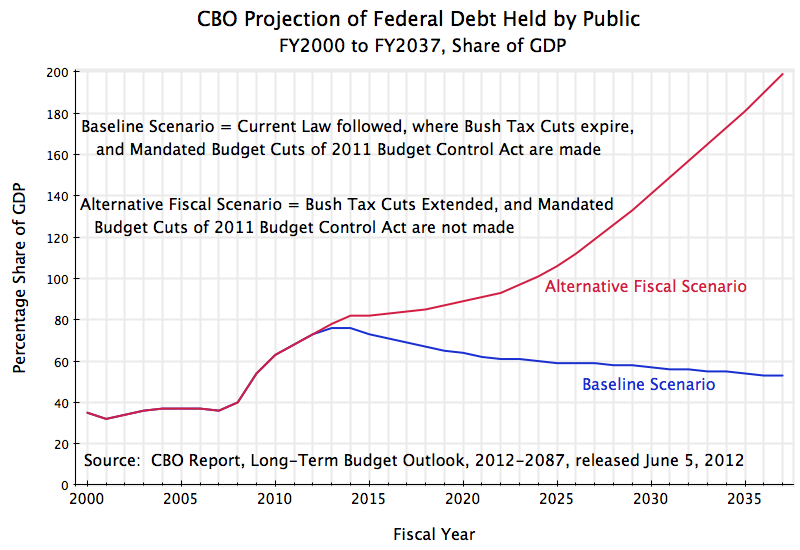
US Federal Government Debt to GDP ratio, CBO long-term projection, 2000 to 2037The Congressional Budget Office released yesterday its regular annual report on the long-term budget outlook for the federal government.  Surprisingly, it did not receive much attention in the press (at least not yet).  But the implications of the projections it has made are important:  They basically indicate that were it not for the Bush Tax Cuts passed in 2001 and 2003, we would not be facing a long-term fiscal problem.  That is, if tax rates were allowed to return to those we had during the Clinton years, along with some near term control on spending, federal government debt as a share of GDP would stabilize and then fall.  And since the economy prospered during the Clinton years, there is no support for the argument that such tax rates would stifle long run growth.

The results are consistent with projections made in a posting on this blog on February 11, 2012.  In that blog, results are shown from calculations (based on underlying CBO numbers) which demonstrated that phasing out the Bush Tax Cuts would lead the federal government debt to GDP ratio to start to fall.  The new CBO numbers, with calculations by their staff rather than myself, back this up.

The figure above shows the CBO projections of federal debt (held by the public) as a share of GDP, for the period FY2000 to FY2037, under two scenarios.  Under CBO’s Baseline Scenario, current law is followed in all respects.  This includes that the Bush Tax Cuts would be allowed to expire (as currently provided by law) at the end of 2012, and that the budget cuts mandated by the 2011 Budget Control Act for the period 2013 to 2022 (if Congress failed to make similar cuts before then) would be implemented.  Medical payments to doctors made by Medicare would also be cut (as per a law passed by the then Republican Congress in 1997, but then over-ridden annually since then), while over the longer term, the growth in medical costs would be moderated through the implementation of measures passed in the “ObamaCare” reforms.

Under the Alternative Fiscal Scenario, the Bush Tax Cuts would all be extended permanently, the 2013 to 2022 mandated budget cuts would not be made, after 2022 budget expenditures would be raised further to historical levels (as a share of GDP), medical payments to doctors would not be cut but rather kept at current levels, and the ObamaCare medical cost reforms would not be implemented, so medical costs would rise compared to the costs in the Baseline Scenario.

The CBO also mechanically extrapolated the underlying numbers under the two scenarios all the way to 2087, but wisely focussed on the period to 2037 (the next twenty-five years).  The longer term numbers are subject to much uncertainty.  The diagram above presents the CBO numbers to 2037.

What is striking is that the figure above shows that under the Baseline Scenario, where current law is followed and in particular the Bush Tax Cuts are allowed to expire, the federal government debt to GDP ratio peaks in 2013 and then immediately starts to fall.  Indeed, the long-term numbers extended mechanically to 2085 indicate that the federal government debt would fall to zero in 2069.  In contrast, the debt to GDP ratio grows explosively upwards under the Alternative Fiscal Scenario.

It was noted above that a number of changes are made in the Alternative Fiscal Scenario compared to the Baseline Scenario, affecting both tax revenues and spending.  However, one can calculate from the underlying data released by the CBO along with its report (in spreadsheet form at the CBO site), that 76% of the higher deficits in the Alternative Scenario over the key period 2013 to 2022 would be due to the lower revenues following from the Bush Tax Cuts.  Higher government spending other than on medical expenditures accounted for 18% of the higher deficits, while higher spending on medical costs (principally for doctors over this period) accounted for only 6% of the higher deficits.

That is, lower revenues due to the Bush Tax Cuts account for three-quarters of the difference in the deficits between what one would have under the Baseline Scenario and what one would have under the Alternative Fiscal Scenario.  Given the extent of the decline in the debt to GDP ratio that one sees under the Baseline Scenario, it is likely that allowing the Bush Tax Cuts to expire would alone suffice to lead that ratio to start to fall in these new CBO scenarios.  My February 11 posting on this blog did find this.  But it should be noted that the new CBO scenarios included other factors as well in its projections, which accounted for one-quarter of the reduction in deficits.  The report does not show a scenario focused exclusively on the impact of the Tax Cuts.

It should be emphasized that no one, and certainly not myself, is arguing that the Baseline Scenario should be followed in all respects.  Doctor payments under Medicare should certainly not be allowed to be cut sharply as they would if the annual “Medicare doc fix” were not extended.  Nor, I would strongly stress, should all the crude and across-the-board spending cuts mandated by the 2011 Budget Control Act  be allowed to go through.

The basic point, rather, is that drastic cuts in entitlement programs such as Social Security and Medicare are not absolutely necessary for the US to achieve budget balance, despite what Mitt Romney, Congressman Paul Ryan, and other Republicans have asserted.  What the CBO scenarios show is that the Bush Tax Cuts have led to the US fiscal debt problem, and that simply allowing these Tax Cuts to expire would likely suffice to fix that problem.  The US debt spirals out of control due to the Bush Tax Cuts.

To fix a problem, it is important to know the source.  The CBO scenarios make clear that the primary source of the exploding federal government debt is the Bush Tax Cuts.  And while I would not advocate an immediate re-instatement of tax rates to their previous levels, since the economy remains weak, phasing out the Bush Tax Cuts over the next few years would suffice to resolve the fiscal problems we face.