The High Concentration in US Health Care Expenditures, and Some Implications

Concentration of Health Spending, 2009

A.  Concentration of US Health Care Costs

Previous blog posts in this series on health care have reviewed how the US spends far more than other countries yet achieves only mediocre results, how the prices charged for similar medical treatments can vary enormously even for hospitals that might be physically across the street from each other, and how this fragmentation and other factors in the US health care market have led to profits and compensation for at least some top individuals that can be enormous.

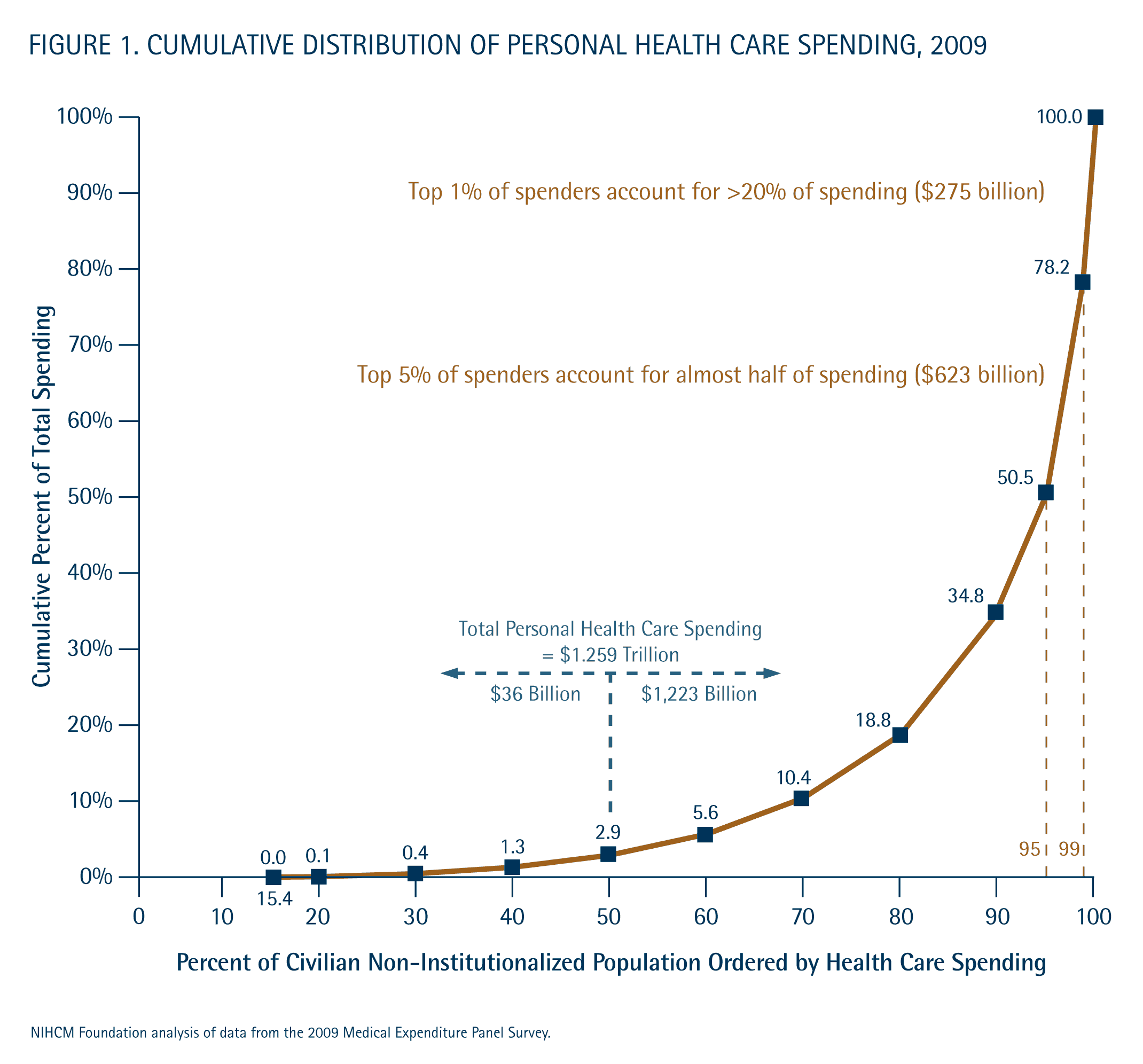
One other characteristic that needs to be understood before we go into the economics of the health insurance market and possible reforms, is the extremely high degree to which health costs are concentrated on a relatively small number of patients.  The graph above is copied from a July 2012 analysis of the National Institute for Health Care Management, and is based on data taken from the 2009 Medical Expenditure Panel Survey (MEPS) of the US Department of Health and Human Services.

As shown in that graph, just 5% of the US population accounted for close to 50% of all US health care spending (for treatment of patients) in 2009.  The top 1% of the population alone accounted for 22% of health care spending.  And the bottom 50% of the population accounted only for less than 3% of the spending.

It should not be surprising that health care spending is concentrated.  That is why we carry health insurance.  Insurance is to cover costs that may be high in some given year but are also, and hopefully, relatively infrequent and affect only a few of the population.  But the degree of concentration may be surprising to some, and the implications of such concentration on the design of an appropriate health financing reform have often been ignored.

Before we go into some of those implications, a few other facts are relevant.   First, the graph above on concentration of costs covers expenditures over the course of one calendar year.  There will be less concentration when one looks at the costs over several years, since for at least some individuals there will a treatment in one year which will hopefully cure the condition and lead to less need for treatment in future years.

But there is actually still a high degree of persistence in such spending from year to year.  Using data from the 2008 and 2009 Medical Expenditure Panel Surveys, Dr. Steven Cohen and William Yu reported in a 2012 note that 20% of those in the top 1% of spending in 2008 were again in the top 1% in 2009, even though by construct they were only 1% of the population.  They also found that 38% of those in the top 5% in 2008 were again in the top 5% in 2009.  And there were similar over-representations in the other groups.  That is, there is significant continuity in costs incurred from one year to the next.  The very sick tend to remain so and continue to require costly care.

Second, part of the reason for this continuity is that a very high proportion of costs are incurred for the treatment of chronic conditions.  Specifically, and also based on Medical Panel Expenditure Survey data (this time from the 2006 survey), an analysis by Dr. Gerard Anderson of Johns Hopkins found that 84% of total US health care spending is for treatment of individuals who have chronic conditions such as diabetes or heart disease.  These conditions carry over from one year to the next, and are rarely completely cured.

B.  Implications for Health Insurance Reform

This concentration of costs, with a high share coming from the need to treat chronic conditions, has important implications when considering any health care financing reform.  Specifically, it makes it clear that the reform needs to focus on the treatment of the high cost individuals, in particular those with chronic conditions.  That is where the spending is, and therefore that is where one will need to focus for there to be significant savings.  As noted above, the bottom 50% of the population accounts for only less than 3% of health care spending.  Even if such expenditures were cut in half, the savings would only be 1.5% of total health care spending.  In contrast, the costs in treating the top 1% is over 20% of US health care spending.  If these costs could be cut by just 7%, one would generate more savings than cutting the costs of the bottom 50% of the population by half.  And just a 15% cut in the costs of the top 1% would save more than the complete elimination of all medical spending for the bottom 50%.

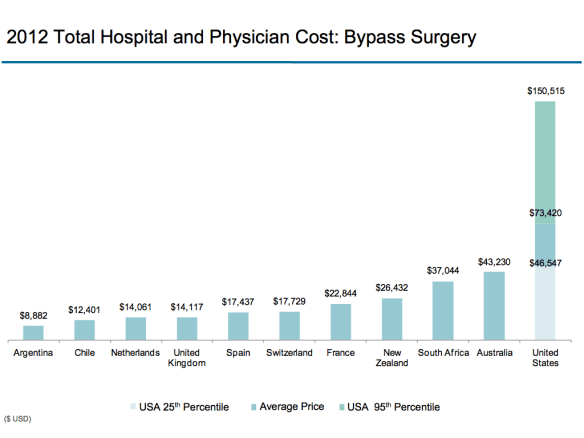
Thus it is clear that one needs to focus on the expensive treatments and the care of those with chronic conditions.  That is where the money is being spent.  And as was documented in the earlier blog post on the variation in health care prices, the differences in prices for such health care procedures can be huge.  For a heart bypass operation, for example, the median price charged in the US in 2012 was $73,420.  But the cost was less than $46,547 in 25% of the cases.  At the other extreme, the costs were over $150,515 in 5% of the cases.  A system which would bring down the high end prices to just the current median, or better to the levels that are adequate in a quarter of the cases, would lead to huge savings.

But while this need to focus on the costs of the high-end procedures would seem clear, much of the conservative critique of the US health care insurance system is focused on trying to achieve savings among those at the opposite end of this spectrum.  That is, the conservative critique is that US households wastefully consume “too much” in health care services, because (they assert) the households do not face the full price of the care.  With insurance, the households pay only the coinsurance rate (after the deductible) of possibly 20%, and in many cases pay no coinsurance rate at all.

Thus conservatives recommend moving US households onto high deductible insurance plans, where the patients pay 100% of the costs up to the deductible amount, and then have insurance only for costs above this (i.e. catastrophic care plans).  The presumption is that patients then will not go to see doctors unless they really need to, as they will be paying the full cost until the deductible is used up, and will be careful to keep costs down when they do see a doctor.

The problem with this is that while this might lead to fewer doctor visits for those in the population whose health care costs are less than their deductible each year, it will do nothing for those whose medical costs are high.  They will have already used up their deductible anyway.  And as noted above, due to the concentration of health care costs on a relatively small share of the population, the savings on the rest will not matter much.  The bottom 50% of the population accounts for only less than 3% of health care costs.

But the results can be far worse.  Avoiding seeing a doctor early, when one suspects some medical issue but are not sure (as we are not doctors), can lead to far higher costs later if that condition develops into something serious.  A doctor’s visit is not costly (the average in 2011 according to the MEPS was $230), but a cancer that develops or a heart condition left untreated can lead to extremely costly treatment later.  While some of the high deductible health insurance plans will try to avoid this by covering things like routine annual check-ups outside of the deductible (and under Obamacare they are now required to do this for a specific list of such routine check-ups and tests), not all such checks are covered.  What an individual needs depends on that individual, and basic rules that apply to all will only cover a portion of these.

Conservatives have, however, used tax law to encourage a shift of consumers onto such high deductible health insurance plans.  The initial push was the creation of the Medical Savings Account in 1996, championed by the conservative Republican Congressman Bill Archer of Texas.  These are now called Archer MSAs.  These plans were primarily for the self-employed, and provided substantial tax advantages for an individual to use them.  In 2003, during the Bush administration, these were then substantially extended to the current program of Health Savings Accounts.

There are substantial tax advantages to such accounts.  Funds placed in them and used for medical expenses are not subject to income tax, and the investment income earned on the sums in the accounts are similarly not taxed (broadly similar to an IRA).  And these tax advantages will accrue primarily to those in the higher income tax brackets (the rich) and those who expect to spend less than the deductible each year (the relatively healthy and those who are younger).  The funds placed in these accounts also generate substantial fund management fees (generally 1 to 2% of assets annually) for the banks and other financial institutions who manage them.

Thus there are now important vested interests in maintaining such Health Savings Accounts, and Obamacare never fully addressed the issue given the political challenges.  Health Savings Accounts still exist, and while the standards set under Obamacare for an adequate health insurance plan limit total out-of-pocket expenses, plan deductibles can still be high (although not as high as existed before in some insurance plans).  Total out-of-pocket expenses (and hence the deductible) can now be no higher than $6,350 for an individual and $12,700 for a family, but this is still a lot.

But high deductible health insurance plans have failed in bringing down the high cost of medical care in the US, as they never addressed where the problem lies.

Vested Interests in Health Care: Spectacular Profits and Earnings for At Least Some Insurers and Providers

Cigna share price, Dec 1, 2003 to Dec 16, 2013.001

Ten-Year returns:  CIGNA = 361%;    S&P 500 Index = 70%

A.  Introduction

Earlier posts in this series on health care have documented how incredibly expensive the US health care system is (with costs almost $1 trillion more than would be the case if the US spent as a share of GDP what the second highest spending country does), and that the prices for the same procedure at different hospitals can vary by a factor of ten or even more.  Future posts will explore why this is the case.  But at this point it is worth reviewing how this US system of nominally competing private health insurance companies and health care providers nevertheless produces winners with truly astounding profits and personal compensation for those at the top.

The focus here will be on some of the numbers, documenting how at least some individuals and firms are doing very well in this non-transparent, non-competing, system.  The final section will add how this is taking place not because such insurers and health care providers are especially efficient at what they do, but rather because they are able to take advantage of a system of great inefficiency and waste.  And such winners now have a vested interest in keeping this badly functioning system in place.

B.  Spectacular Profits and Earnings of At Least Some Insurers and Providers

1)  To start, one can look at the stock market returns to investors in the major private health insurance companies.  The graph at the top of this post shows the ten year return (from December 2003 to December 2013) on an investment in the health insurer Cigna.  Such an investment would have received an overall ten year return of 361% (not counting dividends, which would have added to this).  That is, an investment of $10,000 in December 2003 would have grown to $46,100 by December 2013 (plus dividends).  Over this same period, the S&P 500 index (the generally used index of the overall stock market in the US, and shown as the orange line in the graph) would have grown by a pretty good 70%.  The Cigna return was more than five times as much.

2)  Other publicly traded health insurance companies have also done well.  Over this same ten year period, an investor would have received a return of 145% from an investment in Wellpoint, a return of 171% from an investment in UnitedHealth, a return of 318% in Aetna, and a return of 352% in Humana.  All of these are well in excess of the S&P 500 index return over this period.

3)  Wendell Potter, a former head of communications at two of the top health insurers (Humana and Cigna) who is now decidedly anti-insurance, presents in his 2010 book Deadly Spin figures on how much health insurance executives have been compensated.  Citing other sources that drew on corporate filings, he noted (page 139) that in 2007 the CEOs at the ten largest publicly traded health insurance companies received a combined total compensation of $118.6 million (an average of $11.9 million each).  From other corporate filings with the SEC, Potter noted (page 141) that between 2000 and 2008, the ten largest publicly-traded health insurers paid their CEOs a total of $690.7 million.  And in 2009, Wellpoint alone employed 39 executives who each collected total compensation exceeding $1 million.

4)  But annual compensation of even $10 million or more can substantially undercount what the CEOs of these health insurers ultimately receive.  According to a filing with the SEC, the Chairman and CEO of the health insurer Cigna retired at the end of 2009 with a retirement package worth $110.9 million.

5)  But the retirement package of the Cigna CEO was not the most generous among his peers.  The embattled CEO of UnitedHealth Care stepped down in late 2006 after being forced by the SEC to forfeit stock options worth $620 million.  The stock options in the company had been illegally backdated to make them especially profitable.  However the CEO was allowed to keep stock options worth $800 million, which was in addition to the $520 million he received in compensation from UnitedHealth while he ran the company from 1991 to 2006.  That is, this one individual received total compensation worth over $1.3 billion during his tenure as head of this private health insurer.

6)  Hospital providers have also done well.  Steven Brill, in his widely read article titled “Bitter Pill” published in Time Magazine in February 2013, calculated that in 2010 the prestigious MD Anderson Cancer Center in Houston, a non-profit that is formally part of the University of Texas system, had an operating profit of $531 million in fiscal year 2010.  This was equal to 26% of its revenue of $2.05 billion that year, which is a very generous margin for a service industry.

7)  Brill also noted the the total compensation of the president of the MD Anderson Cancer Center was $1.845 million that year (plus he earned more from other interests).  And he reported that six administrators at the Memorial Sloan-Kettering Cancer Center in New York earned over $1 million each at that one institution.

8) To coincide with the Steven Brill article, Time published figures on returns being earned by other major non-profit hospitals in the US.  The operating profits of the ten largest such hospitals (as measured by number of beds) varied from $118 million to $770 million (in the most recent year for which data is available).  The CEOs of these hospitals received between $2.1 million and $6.0 million in compensation from the hospitals (plus in general earned more from other interests as well):

Health - Profits & CEO Compensation at Non-Profit Hospitals, 2010.001

It should be added that not all hospitals are profitable.  The point, rather, is that at least some are highly profitable.

9) Using records that must be filed with the government each year, the California Nurses Association found that 100 executives at non-profit hospitals in California earned over $1 million each in 2010.  Four hospital groups accounted for 69 of these 100 high-earning executives, with the Sutter Health Network alone accounting for 28.  The top CEO compensation was $7.7 million in that year, and four CEOs earned $4 million or more.

C.  Yet Waste and Inefficiency is High

High profits and earnings could perhaps be justified if they were a consequence of highly efficient operators, providing an important service at low cost.  But that is not the case in the US:

1)  Overall Costs:  First, as has been noted before and discussed in the earlier blog post cited above, the US health care system is by far the most expensive in the world, with spending as a share of GDP which is 50% higher than in the second most costly country.  With almost $3 trillion being spent on health care in the US this year, that implies the US expenditures are about $1 trillion more than they would if it were spending (as a share of GDP) what the second highest country was spending.  And the US is spending $1.4 trillion more than it would if the US spent what the average OECD country does.

Yet as that blog post also noted, the results the US gets from such high spending are mediocre at best.  The infant mortality rate in the US is higher than in any other OECD country other than Mexico, Turkey, and Chile.  And life expectancy is only higher than in several OECD members with far lower income from Eastern Europe and Latin America.

If the US had an efficient health care system, it would not be spending so much for such poor results.

2)  Hospitals:  At least certain hospitals and their CEOs receive high incomes, as noted above, but there is no indication that this comes from being especially efficient.  Rather, the market in which they operate is highly fragmented, and as was documented in an earlier blog post, the variation in the prices they receive for similar medical procedures can vary by a factor of ten (or even more) between them.

As any economist will tell you, a normal market should not function that way.  In a normal market, one would not see much variation among prices (and what variation there is would be linked to some assessment of quality by the purchaser).  Economists call this the Law of One Price.  In such a market, profits will be earned by a provider who can provide the service at a lower cost (by being more efficient) and then selling it as this one price.  Furthermore, these more efficient producers, earning a higher profit than others who must also sell at this same price, will then expand to provide more of the product or service at this profitable price (profitable to them).  They will gain market share at the expense of the less efficient.  The price will drop, and over time the less efficient will be driven from the market, leaving the more efficient providers selling at what would then be a lower price than before.  In the end, only the most efficient providers will survive, and will earn a normal profit similar to that earned elsewhere and in other industries.

This process clearly does not happen in the market for health care provision.  Future blog posts will discuss why.  But briefly, the wide variation in prices makes it possible for even high cost medical providers to survive and even to thrive, and rewards those who are skillful at managing within this fragmented system.  It also rewards hospitals and other medical providers who enjoy market power vis-a-vis the insurer (by being one of only a few providers of this service within the region, for example by a hospital chain that might dominate the local market).  They will then be able to demand a high price, which the insurers (and ultimately the patient) will have little choice but to agree to.  Insurers, from their side, similarly seek to dominate any given local market.  Which side gains the upper hand depends on which is more successful in gaining market power against the other.

3)  Pharmaceuticals:  The pharmaceuticals industry also illustrates how an ability to exploit the rules in the system can lead to lead to big, indeed gargantuan, profits.  A good example was described in a recent Washington Post article, on the use of an expensive drug produced by Genentech for the treatment of age-related macular degeneration (AMD).  AMD is the most common cause of blindness among the elderly.  The Genentech drug, called Lucentis and developed through genetic engineering, is currently the most effective treatment for AMD.  Essentially the same drug, called Avastin for this purpose and also made by Genentech, is used for the treatment of certain cancers.  It can also be used to treat AMD, and many doctors notes it does this equally well as it is really the same drug.  But Lucentis costs $2,000 per dose, while Avastin, when used in the dosage required for AMD, only costs $50 to $60 per dose.

Why would any doctor then use Lucentis rather than Avastin for the treatment of AMD?  Because Genentech has only sought and obtained formal FDA approval for the use of Lucentis for AMD, while deliberately not applying to the FDA for the approval of Avastin for this purpose (it is, however, FDA approved for certain cancer treatments).  And in their compensation from Medicare for treating their elderly patients for AMD, the doctors will enjoy a much higher return from using Lucentis rather than Avastin since Medicare pays them a certain mark-up over cost.  This mark-up will be far higher in absolute terms for using Lucentis.  But by using Lucentis, the Washington Post calculates that Medicare has spent $5.7 billion more over the last five years than it would had Avastin been used.  Genentech has benefited enormously by its decision not to seek FDA approval of Avastin for treatment of AMD.

4)  Private Health Insurers:  Private health insurers, and their CEOs, have enjoyed often staggering returns, as noted above.  Such high returns could perhaps be seen as justified if these insurers provided their services efficiently and at low cost.  However, the costs incurred by private health insurers (and passed on to their clients) are high.

Figures on the net cost of private health insurers (i.e. administrative costs plus profits) are provided in the files on US health care costs issued each year by the Centers for Medicare and Medicaid Services (CMS).  The most recent data available go through 2011.  The “net costs” of private health insurers include all costs other than what the health insurers pay out to medical service providers on patient claims, and includes not only staff and office costs but also profits.  For brevity, this will sometimes be referred to simply as admin (or administrative) costs.

For 2011, the admin costs by private health insurers on private health insurance plans totaled $110.3 billion.  The benefits paid out under these plans came to $786.1 billion.  Thus the admin costs (including profits) amounted to 14.0% of the benefits paid.

The CMS data also provides such costs for Medicare.  The direct expenditures by government for administering this health insurance for the elderly totaled $8.2 billion in 2011, with benefits paid out of $521.6 billion, for a ratio of admin costs to benefits paid of 1.6%.  However, this would be a misleading figure as a substantial portion of Medicare is now administered by private health insurers under the Medicare Advantage program.  This program was expanded significantly in the 1990s and again with the passage of new legislation during the Bush administration, and in 2011 accounted for 25.3% of Medicare enrollees (see the table on page 168 of the May 2013 Medicare Trustees Annual Report).

The CMS data shows that private health insurers spent $24.5 billion in administering these Medicare Advantage programs.  One can then allocate Medicare payments to beneficiaries in proportion to the number of enrollees under either traditional government administered Medicare (74.7%) or under the privately administered Medicare Advantage (25.3%).  Assuming that the government’s $8.2 billion of admin costs was used solely for the programs it administered directly (even though a share would have been required to oversee the Medicare Advantage program), one can calculate the admin cost shares for the directly government administered side of Medicare, and for the Medicare Advantage program.

The result is that in 2011, the admin cost of the directly government managed portion of Medicare (for the 74.7%) came to 2.1% of benefits paid.  But for the privately administered side under Medicare Advantage (for the 25.3% enrolled there), the private admin costs alone came to 18.6% of benefits paid.  That is, private administration of Medicare programs was over nine times as expensive as direct government administration of such programs.

Future blog posts will discuss further why private administration of health care insurance is so expensive.  It is not simply profits, even though private health insurers have been substantially profitable.  It is also high costs from a business model that benefits from incurring costs to select a pool of insured clients who are relatively more healthy and hence are less likely to make insurance claims, and to deny claims when they can.

D.  Conclusion

Private health insurers and at least certain of the major health care providers have been hugely profitable in recent years, with the heads of these organizations often earning very large sums.  But such high profits and compensation have not been earned as a result of keeping down costs.  Costs in the US are especially high by international standards.  Rather, the high profits and compensation of those individuals at the top of their organizations have been made possible by a fragmented system, with little competitive pressure to bring down costs and prices.  The high returns go to those who are skillful at managing within such a system.

These high returns to at least some of the key players also creates powerful vested interests who benefit from a continuation of this high cost system.  Thus it should not be a surprise that powerful interests fear any major reform in the health care system, such as under Obamacare.  Even Obamacare, in the compromises it was forced to make in order to secure passage by Congress, was modest.  It focused on extending the availability of health insurance to those currently without insurance, with most of these to be enrolled in plans from the private health insurers.  There was no move to a single payer system such as from extending Medicare to the entire population, nor not even a public health insurance option which would be allowed to compete with the private health insurers.  There were only limited measures to try to contain health costs.  While it is still early, these limited measures appear to be having a positive effect on lowering costs, but they are not revolutionary.

More fundamental changes will be needed to bring down health care costs.  These will be explored in future blogs in this series on health care.

————————————

Update on January 9, 2014:  Following my posting of the blog above, Dr. Alex Horenstein of the Department of Economics at the University of Miami brought to my attention a paper he has prepared (with co-author Manuel Santos, also of the University of Miami) which addresses some of these same issues.  It comes to broadly similar conclusions on the high profitability of the health care and health insurance sectors, but is a much more rigorous piece than this blog post.  While portions of the Horenstein – Santos paper are fairly technical, and the piece is still a working paper that may be modified, there is a good deal of additional material on these issues in the paper and some readers may find it of interest.

The Widely Varying Prices Charged for Common Health Procedures: A Sure Sign of a Market Not Working

Health Prices 2012 - Cost per Hospital Day -2.001


A.  Introduction

Advocates for the current private health insurance system in America assert that through such a market of competing private insurers, and only through such a market, will we see health care that is provided efficiently and at the lowest possible price, with gains for all participants.  If such a market were working at all well, one would see little variation around one low price for a specific health care treatment.  Competition would drive high prices down, or such providers would soon lose all their business.  But this has not happened at all.

Competition that would lead to uniform low prices for health care provision is clearly not functioning in the US.  Later blogs in this series on health care in the US will review several reasons for why this is the case.  In this blog we will only review a number of statistics and studies that document it.  What is truly astounding is the degree to which the prices vary, and the focus of this blog post will be on this variation.  But a comparison to the prices charged in other countries for the same procedures will also document how the US prices are far higher than elsewhere.

There will be a lot of numbers and graphs in this post, which some might find tedious.  But it should be possible to read through them quickly.  What I am continually amazed by is the extent to which the prices being charged for often expensive medical procedures can vary so dramatically from one provider to the next.  With the concern over the high cost of medical care in the US, one would have thought that there would be pressure to bring these prices into line with one another.  But clearly there is not.

A couple of points before we start.  First, it is critically important to be clear when reviewing such prices on the distinction between the list prices that hospitals might charge for a particular treatment (the so-called “chargemaster rates”), and what hospitals actually receive from the insurers for those treatments.  The chargemaster rates can easily be double the latter, and indeed can often vary by far more (even by a factor of ten, as we will see below).  Insurance companies negotiate discounted rates with hospital providers who are included within their network of “preferred providers”, and pay that discounted rate.  But the chargemaster rates can still be important, in particular for those without insurance.  The chargemaster rates will also apply to those patients for whom that hospital will be an out-of-network provider.  As a result, if you are insured but have a medical emergency for which you are taken to the nearest hospital, and that hospital is not in your insurer’s negotiated network, you can face enormous bills.

Second, some of the studies and data sets now available provide information on the prices paid by (or charged to) individual patients, while others compare the average prices paid at (or charged at) individual hospitals for the same procedures.  The latter information is easier to collect, and can lead to findings such as that the average price for some procedure at some hospital is double that for the same procedure at another hospital that might be literally across the street.  However, the prices actually paid on individual cases are generally of greater interest, as the hospital wide averages will have averaged away some of the variation.

Finally, I should be clear that medical treatments are highly individualized, and that any two cases will rarely be exactly the same.  Therefore, one should expect some variation in prices.  However, there are standard medical treatments for specific conditions, and while there will be some variation, it is hard to see how prices can vary by a factor of ten or more.

B.  Prices Paid in the US for Selected Treatments, With a Comparison to Other Countries

One of the best sources of price comparisons for standard health procedures is a report issued each year by the International Federation of Health Plans, an international association of health insurers.  The most recent report is for 2012, and compares the prices paid in the US with those in other countries (where they have sufficient comparable data) for a series of specific treatments.  The prices shown are of actual prices paid by the insurers, and the US data come from over 100 million actual claims processed.

Due to the wide variation in the prices for the US, the report provides not simply the average price paid, but also the price at the 25th percentile (meaning 25% of the cases had prices lower than this, and 75% higher) and at the 95th percentile (so 95% were lower, with 5% even higher).  Showing the ranges from the 25th to 95th percentiles is helpful as the data are not then driven by a few extreme, and possibly peculiar, outliers.  But keep in mind that 25% of the cases will still be at prices below this range, and 5% will be at prices higher than this range.  There is not such wide variation in other countries (and in some countries no variation at all), so only the average prices are shown for them.

The graph at the top of this post shows the cost per hospital day of simply staying in a hospital room.  The cost of treating the medical condition leading one to be in the hospital is charged separately.  The cost of each hospital day (in terms of the discounted rate that the insurers actually paid, not the chargemaster rate that the hospital charged and what an uninsured patient would have been expected to pay) was an average of $4,287 per day in the US.  Why the cost for this is so high, which is only for a bed in a room (typically shared with another patient in the same room), a small bathroom, some very bad meals, and sometimes a chair for a guest, is not clear.  There is of course also monitoring equipment, which might well be expensive (but which is standard and lasts for years), plus the cost of a portion of a nurse’s time (where nurses are however not paid that well in the US).  But it is still difficult to understand why the cost per day of a period in a hospital, simply for the room and associated services, should be so high.

Other countries providing comparable care and with similar wages as in the US do not charge nearly as much.  The closest is Australia, with a price of $1,472 per day, but this is only one-third of the US average rate.  The cost is only $853 per day in France and only $476 per day in Spain. The range among the countries with data are between $429 and $1,472, before the jump to the US average rate of $4,287.

Furthermore, while the average US rate is $4,287 per day, the daily rates paid in 2012 in 5% of the cases were greater than $12,537 per day, almost three times as high.  At the other end, the charges paid in 25% of the cases were less than $1,514 per day.  Why the rate at the 95th percentile of $12,537 should be over eight times the rate at the 25th percentile, is not clear.  And even this 25th percentile rate in the US is still greater than the average rate in the next highest country (Australia), and over 50% higher than the average rate in any of the other countries shown.  It is over three times the average rate in Spain.

The International Federation of Health Plans report for 2012 cited above and from which this graph comes has similar graphs for 28 different health care services, including for treatments such as certain surgeries, for several diagnostic tests, and for selected drugs.  A sample will be presented here, but the reader may wish to refer to the original report for more.

An angiogram is a standard medical scan, often used for heart patients.   A form of x-ray, it is done to determine whether certain blood vessels are fully or partially blocked (such as surrounding the heart) or possibly enlarged (as an aneurysm).  It is a common procedure, but the costs in the US can vary from $173 (at the 25th percentile) to over 14 times as much at $2,430 (at the 95th percentile), with an average of $914.  The costs in other countries vary from as little as $35 (in Canada) to $378 (in Chile):

Health Prices - Cross Country set of 7, 2012.001

An angioplasty is a procedure to widen or open up a narrowed or blocked artery, normally of those surrounding the heart.  A guide wire is threaded through the arteries to the point of narrowing, with a small balloon (usually) at the tip then inflated to widen the artery at that point.  This is typically done to prevent a heart attack from a narrowing of the arteries that supply blood to the heart.  The average price paid for this in the US in 2012 varied from $16,533 at the 25th percentile, to almost four times as much at $61,649 at the 95th percentile, with an average of $28,182.  The prices for the same procedure in other countries varied only from $2,851 in Argentina and $5,295 in Switzerland, to $14,366 in the UK.  None were as high as the rate in the US at the 25th percentile, and ranged from half the US average rate (in the UK) to only one-tenth the US average rate (in Argentina):

Health Prices - Cross Country set of 7, 2012.007

Heart bypass surgery is a major operation, where blood vessels are taken from some other part of the body (where they can be safely removed, due to other blood flow) and used as a graft to divert blood around a blockage in an artery that feeds blood to the heart.  The costs paid for such procedures in the US in 2012 varied from $46,547 at the 25th percentile to $150,515 at the 95th percentile, with an average of $73,420.  The costs varied in other countries between $8,882 (in Argentina) and $43,230 (Australia), all of which were below the rate in the US at the 25th percentile:
Health Prices - Cross Country set of 7, 2012.006

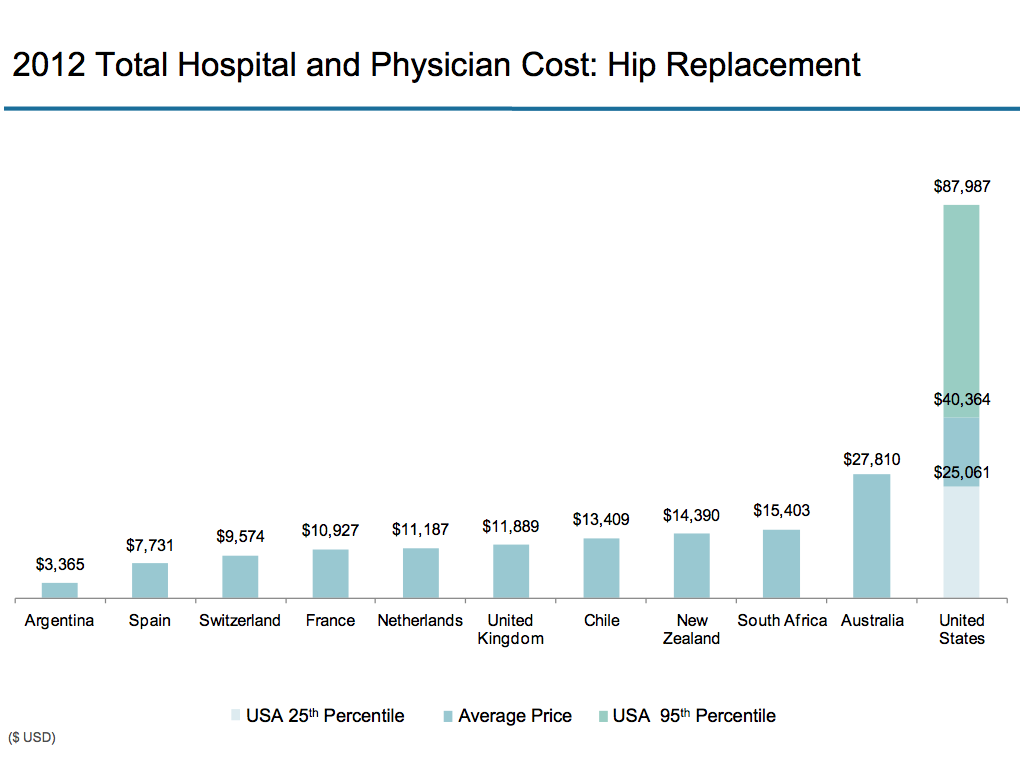
Proceeding more quickly through a selection of the other graphs, a similar pattern of wide variation in the costs paid for a procedure in the US, with far lower and more similar costs in a range of other countries can be found for hip replacement procedures:

Health Prices - Cross Country set of 7, 2012.004

For knee replacement surgery:

Health Prices - Cross Country set of 7, 2012.005

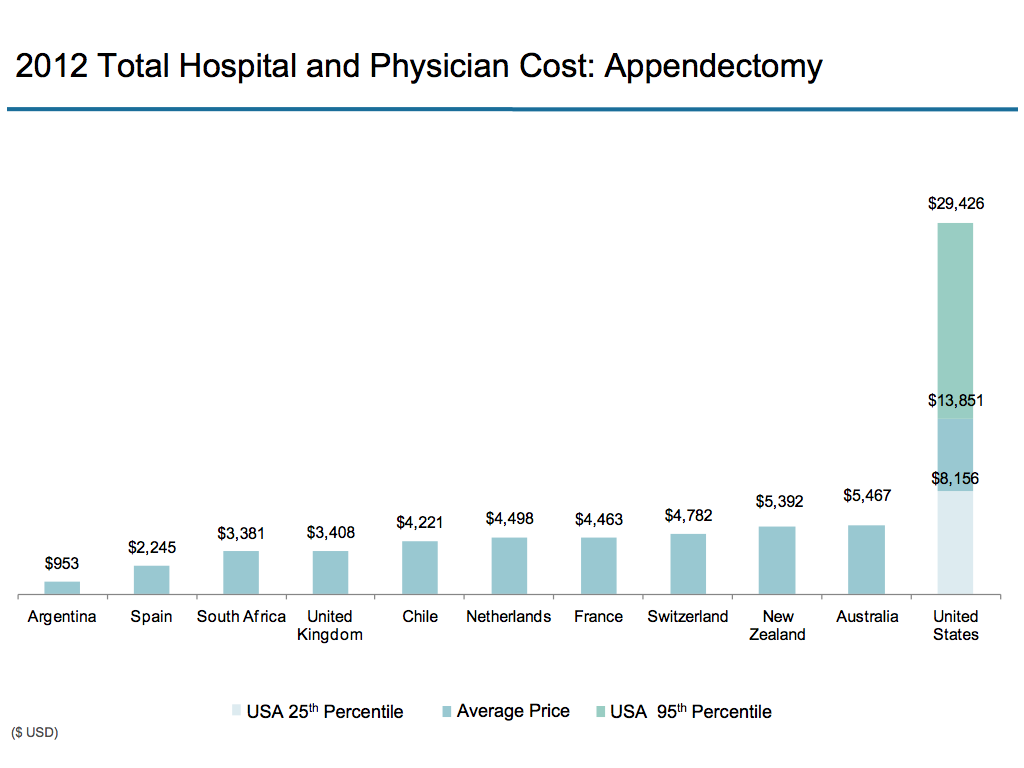
For an appendectomy:

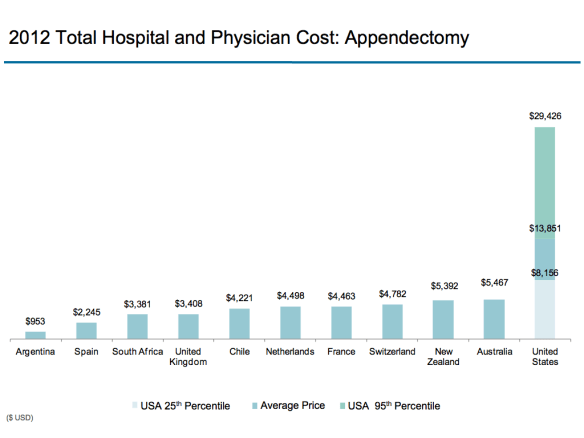
Health Prices - Cross Country set of 7, 2012.003

And for a CT scan of the head:

Health Prices - Cross Country set of 7, 2012.002

C.  Variation in Prices Paid in the State of Massachusetts

Another good source of such data was provided by the state of Massachusetts, in a report issued in 2011 and made public as part of the health care reforms implemented to extend health insurance to all of the population under the reforms signed by then Governor Romney (and which later served as a model for the Obamacare reforms).  The information is now a bit dated, covering health care prices paid between July 1, 2008 and June 30, 2009, but is comprehensive.  It comes from reports filed by the five major private health insurers in Massachusetts, who cover 79% of the privately insured population in the state.

The data is of prices actually paid by the insurers (not the chargemaster rates of the hospitals), and includes the minimum and maximum prices paid as well as the average.  While it would have been better to show the figures for the 25th and 95th percentiles as in the graphs above (or some similar range), the Massachusetts figures are of special interest since they classify the medical conditions treated by an index of severity.  In this way one can see the extent to which more complex cases might explain the high prices at the maximum.

One again sees a range of charges paid that are truly astounding.  The severity of the underlying condition has only a limited impact on the charges:

Massachusetts Health Care
       Prices Paid   Ratio
Procedure: Severity Minimum Average Maximum Max/Min
Knee Replacement 1  $5,202 $21,040 $50,726 9.8
2  $7,599 $22,743 $59,302 7.8
3 $16,069 $30,736 $59,252 3.7
Hip Replacement 1  $5,423 $22,626 $44,867 8.3
2  $9,612 $25,235 $63,908 6.7
3 $10,528 $34,572 $59,252 5.6
Acute Myocardial 1 $1,068 $12,854 $23,935 22.4
     Infarction 2 $2,351 $16,988 $68,695 29.2
3 $2,858 $20,137 $56,256 19.7
4 $4,705 $41,605 $87,905 18.7
Appendectomy 1 $1,781 $7,762 $20,188 11.3
2 $2,342 $11,399 $37,718 16.1
Caesarian Delivery 1 $3,244 $7,859 $15,915 4.9
2 $2,828 $9,388 $20,424 7.2
3 $3,621 $13,266 $26,018 7.2
4 $9,600 $19,156 $30,660 3.2
Vaginal Delivery 1 $1,810 $5,225 $11,066 6.1
2 $2,182 $5,884 $12,177 5.6
3 $2,812 $7,656 $20,446 7.3

D.  The Cost of a Service Needed Immediately – The Case of Appendicitus

Some treatments can be planned ahead, and hence one is then able to choose which hospital to go to.  A child birth for example, or a hip or knee replacement, can be planned ahead, and one can then choose a hospital from within your insurer’s network of preferred providers, or based on price or other considerations.  Even a heart or cancer surgery is rarely necessary immediately, even if it should be done fairly soon, so one can choose one’s doctor or hospital for the surgery.

There are, however, also emergencies, where one needs the treatment immediately.  An example is acute appendicitus, where one will often go by ambulance to the nearest emergency room, and have the surgery to remove the appendix within hours or otherwise face risks up to and including death.  In such cases one cannot make a careful selection of doctors and facilities even if one knew the prices which would be charged.  And if you are uninsured, or are taken to the nearest emergency room in a hospital which happens not to be in your insurer’s network, you could face staggeringly large bills.

Dr. Renee Hsia (an emergency room doctor practicing in California) with co-authors, published a study in 2012 in the medical journal JAMA Internal Medicine that used California data to look at what hospitals charge for treatment of acute appendicitus.  Such California data is now made publicly available, and the authors examined the prices charged for uncomplicated episodes of treatment (by restricting the analysis to cases where discharge was routine and to home, with fewer than four days of hospitalization, and only for patients aged 18 to 59).  The data was for 2009, and there were a total of 19,368 cases.  And as the focus here was on emergency care, the prices examined were the chargemaster prices that the hospitals charged, not the discounted rates they may have negotiated with the various health insurers.

Despite the care taken to restrict the analysis to broadly similar uncomplicated cases, the price variation found was enormous.  The lowest observed charge was $1,529, while the highest was $182,955, or almost 120 times as much.  The median charge was $33,611.  It is difficult to see how such a range of charges can be justified.

E.  Finding the Cost of a Health Procedure Before the Treatment

The studies reviewed above looked at the cost of health care services ex post –  that is, the charges due after the services were provided.  But for prices to be useful in guiding choices on where, and indeed in some cases whether, to obtain some health treatment, one needs to know the prices before the service is provided.  This can be difficult to find out.

A study published also in JAMA Internal Medicine, in March 2013, surveyed hospitals to try to determine before the treatment what the cost of a common procedure (a total hip replacement) would be.  A non-technical summary can be found here.  The researchers first chose two hospitals in each of the 50 states plus Washington, DC, at random among orthopedic hospitals operating in each state, and added to this sample the 20 hospitals ranked highest among orthopedic hospitals in the US in the US News and World Report ratings.  They thus had a sample of 122 hospitals.

They then called each hospital, up to five separate times, and asked how much it would cost for such a total hip replacement operation.  The script they used was that they were requesting what the lowest bundled price would be (including for the services of the physician) for such a procedure for their 62 year old grandmother, who did not have health insurance but had the means to pay out of pocket.  In the cases of hospitals who would quote only a fee for the hospital services and not for the physician, they then called a sample of orthopedic surgical practices with rights at those hospitals to try to find the additional cost for the physician’s fees only.

Despite the repeated calls (up to five times) to each hospital, they were only able to obtain a full bundled price for such a surgery at 9 of the 20 top-ranked hospitals and 10 of the 102 hospitals chosen by state, for a total of just 16%.  Contacting the physician groups separately, they were able to determine the prices that would be charged for an additional 3 of the top-ranked 20 hospitals, and an additional 54 of the 102 hospitals chosen by state.  This brought the total to a more respectable 62%.  This means that hospitals could provide such cost estimates if they wanted to.  But apparently many do not.

The resulting range in prices quoted was enormous.  For the cases where prices could be determined, the prices among the top 12 of the 20 hospitals ranged from $12,500 to $105,000, while the prices among the 64 of the 102 hospitals chosen by state ranged from a similar $11,100 to $125,798.

F.  The GAO Report on Price Transparency, and Cost Estimates Provided by Aetna

The importance of price transparency for health care has been increasingly recognized in recent years.  Choosing lower cost alternatives, and indeed the incentive for hospitals and other providers to offer lower cost choices, depends on patients being able to know what the charges will be.  The studies reviewed above show that it is possible for hospitals to provide such estimates.  But they are still difficult to obtain.

A September 2011 report of the Government Accountability Office (GAO) provides a good summary of the issues.  While now over two years old and hence somewhat dated in an area that is changing rapidly, the GAO report discusses the increasing attention being paid to price transparency.  It noted (citing other sources) that as of January 2011, at least 25 states had price transparency initiatives to provide health care prices on publicly accessible websites, and that as of June 2011, at least 30 states had proposed or enacted some from of price transparency legislation.  But the price information being made publicly available varied widely in quality and usefulness.  Most were incomplete and presented in a way which was not terribly helpful.

The GAO noted several arguments made by insurers and health care providers for why such information could not be obtained.  One is that a health care treatment can be complex and highly individualized, so one will not know beforehand what the cost will be.  Hospitals also argued that while they might know what their own costs would be, they would not know what the fees would be from physician and other providers making use of their hospital facilities.  Finally, some argued there could be legal issues.  The negotiated rate between a hospital and an insurer is a contractual obligation, and some would assert secrecy in such contracts.  Both parties might well want others not to know what their agreed rates were, and hence would insist on secrecy clauses being included.  A hospital might not want another insurer to know that they had agreed on a lower price with one insurer than with another, while an insurer might not want another hospital to know that they had agreed to pay a higher price at one hospital than another.  And indeed, some argued that anti-trust law required such secrecy.

While the GAO did not present a position on these arguments, their validity is questionable.  First, it is recognized that treatments costs can differ by patient, but this would not preclude providing average costs for some procedure, which can be taken as an indication (when comparing costs at one hospital to another) of what the relative costs are likely to be.  It is also the case that a number of procedures and diagnostic tests are quite standard, so one cannot attribute to individual patient factors prices which vary by a factor of ten between two providers.  It should also be noted that prices for cosmetic surgery, which is typically not covered by insurance, can be and typically are provided to patients beforehand.  Why is it that one can find out (and indeed be guaranteed) the precise cost of a breast enhancement, but not a similarly complex surgical procedure?

On the separation of costs between hospitals and physicians:  If one can obtain them individually, then one can simply add them up.

Finally, the argument that anti-trust law prohibits price transparency is also odd.  If this were a valid concern, then the prices of everything would be kept secret.  A retailer would not be allowed to post a price for milk, as that would allow other retailers to find out what price he is charging, and then choose to price their own milk accordingly.  The proper response to possible collusion is transparency and competition, not secrecy and closed networks.  (In later blogs in this series on health care, I will discuss how this can be used as a basis for transforming the system.)

Despite these purported difficulties, the GAO report noted that one private insurer is now providing such price information, in a form relevant to their customers.  That insurer was Aetna.  I am not sure whether other insurers are also now providing such information, but Aetna happens to be my own insurance administrator (chosen by my former employer for administering its health insurance plan for retirees).  I therefore had access to the “Cost Estimator” provided by Aetna on its web site, which provides individualized cost estimates based on my particular health insurance plan (including prices I would individually be liable for based on my remaining deductible for the year and co-insurance rates).

The cost estimates provided by Aetna are for a sample of specific medical procedures, as well as for a range of diagnostic and other tests, and for fees of individual doctors classified by medical specialty.  Prices are not available for all providers, for reasons that are not given but which I assume are related to negotiated contract secrecy clauses.  However, for the procedures and tests I examined, a fairly substantial number was normally available.  The number of procedures shown were quite limited however, at only 15 standard ones.  This was for the Washington, DC, metropolitan area, and might vary by locale.  A map on the web site showed where Aetna cost estimates were available across the US, broken down by county.  It showed coverage in 48 of the 50 states (not Vermont or Hawaii), and in most, but not all, of the counties in the remaining states.  Eleven states had coverage for the entire state, and in several other states only minor areas were missing.

For this test, I examined the cost of a total knee replacement at hospitals within twenty miles of my home in Washington, DC.  Rates were available for 14 hospitals, but not for six others that are in the Aetna network.  Several of the six not included are among the larger hospitals in the area, and their lack of a price might be due to contract secrecy clauses.

The recorded prices for this procedure, for both the list price (the chargemaster rate) and the Aetna negotiated rate were as follows:

Charges for Total Knee Replacement
Aetna Cost Estimator, accessed Dec 18, 2013
Hospital: List Price Aetna Rate
A  $56,442.45  $6,150.56
B $123,677.50 $11,739.50
C  $46,444.94 $26,065.72
D  $81,225.54  $8,491.99
E  $55,110.09 $35,903.61
F  $53,929.03 $33,778.72
G  $71,713.35 $21,526.38
H  $44,358.91 $23,708.68
I  $39,172.87 $26,102.93
J  $88,362.42 $50,290.64
K  $58,270.15 $39,936.70
L  $65,972.45 $44,394.00
M  $74,519.42 $57,067.00
 $40,773.14 $23,641.16
Maximum $123,677.50 $57,067.00
Minimum  $39,172.87  $6,150.56
Ratio Max/Min 3.2 9.3

As observed elsewhere, the ranges in the prices for both the list prices and the Aetna negotiated rates were enormous.  The highest list price was $123,677.50 and the lowest only $39,172.87.  The Aetna negotiated rates varied between $57,067.00 and $6,150.56.

A few curious things:  Despite their magnitudes, the prices were made available down to the penny.  And while the prices shown above on December 18, when I checked again on December 19 for some further information, most of the prices had changed.  Most of the changes were extremely small (a few tens of dollars or less) but some changed by thousands of dollars.  Also, prices were no longer shown for three of the hospitals (but price information did become available for one other hospital not shown on the December 18 list).  I am not sure why there were these changes, and it is possible my research coincided with an annual or other periodic revision.

The software was also quite bad.  I suspect it was written by programmers drawn from the same pool of professionals that specialize in health care software, and who wrote the software for the Obamacare health insurance exchanges.  When it worked, it was fine.  But it was extremely slow and unpredictable (screens would lock up, or when one asked for the details on the price from Hospital A, say, it would instead provide the details for Hospital B, and for Hospital C when one tried again, and so on in some random process).  But once one learned the quirks, with patience it would work.

Given this huge range of prices for the Aetna negotiated rates (with the highest price over nine times the lowest), would I choose one of the lower prices?  Not necessarily, as the price I would personally pay out of pocket would be much less, and would vary very little.  The precise amount would depend on how much of my annual deductible I had used in the year (and I have not used much this year), my coinsurance rates for the procedure, and how close I would be to my annual cap on health expenditures before insurance would cover 100%.  For all by two of the 14 cases above, I would be at or close to my annual cap, and hence the price I would face would not differ significantly.  But the difference in cost paid by my insurance at the negotiated rate would be, between the maximum and the minimum price, over $50,000.

G.  Conclusion

The prices charged in the US for health care procedures are not only high, but vary enormously.  If American health care were a truly competitive market, one would not see prices that can vary by a factor of ten or more between the highest and the lowest for what should be comparable treatments.

This is only possible because current actors in the system benefit from it.  There are benefits to be had from a lack of price transparency and the highly variable prices that this makes possible.  Future blog posts in this series on health care will look at the evidence for such benefits for at least some of the key actors, and will discuss why this can be the case.