
The Impact of the Fiscal Austerity Program in the UK: A Comparison to the US and to the Great Depression

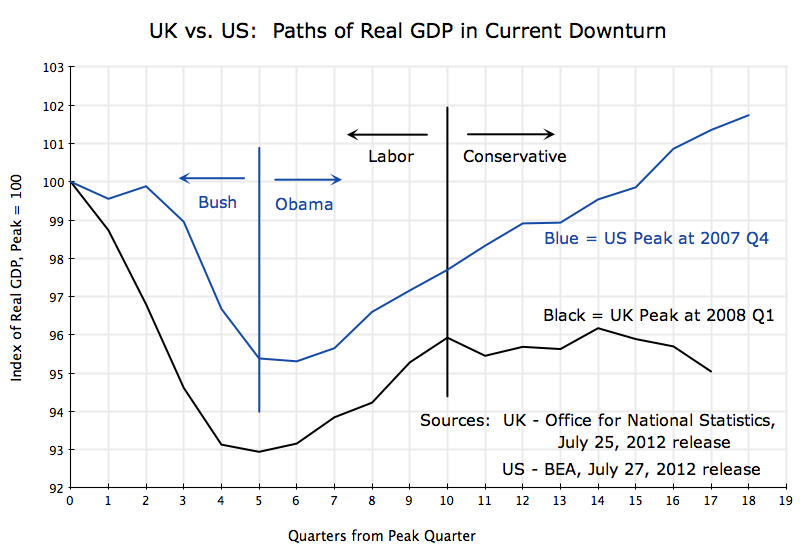
UK and US real GDP, comparison of growth since 2008 downturn by quarter

Both the US and the UK released last week (on July 25 by the UK Office for National Statistics, and on July 27 by the US Bureau of Economic Analysis) their initial estimates for GDP growth in the second quarter of 2012.  Both were disappointing:  The estimated US growth was a positive 1.5% at an annual rate, down from growth of 2.0% in the first quarter and a now estimated 4.1% in the last quarter of 2011.  But the UK figure was abysmal, showing growth at a negative 2.8% at an annual rate.   (The headline figure commonly quoted in the UK was a negative 0.7%, but the tradition in the UK is to express this on a quarter on quarter basis.  It comes to four times this, or a negative 2.8%, when annualized.  In the US, the figures are traditionally expressed on an annualized basis.)

The US growth figures were discussed in a post on this blog yesterday.  The focus in this post will be on the UK numbers, and in particular the path followed by the UK in the downturn that was sparked by the US financial collapse in 2008, in the last year of the Bush administration.  Comparison to the path followed in the US economy is especially interesting as both countries have followed similar aggressive monetary policies (with independent Central Banks pushing short term interest rates essentially to zero, plus the use of quantitative easing to provide ample liquidity to the economy), both have independent floating currencies (unlike the economies tied together with a common currency in the Eurozone), and both moved aggressively at the onset of the crisis to keep large banks from failing through official loans which were later repaid.

But there is one important difference, and this sets up a natural experiment which is rarely possible in economics.  Following elections in May 2010, a Conservative Party led government in the UK (in coalition with the Liberal Democrats as a minority partner) moved to an aggressive austerity focused fiscal policy, with major cut-backs in government spending.  With other policy factors being similar, one can see what the impact of such a fiscal austerity program will be, not only in comparison to what was happening immediately before in the UK, but also in comparison to a US economy which was otherwise following similar policies.

In the UK parliamentary system, the fiscal austerity program was passed via an Emergency Budget in late June 2010.  Such a dramatic change in policy is possible in a parliamentary system as the ruling government will always enjoy a majority in Parliament (perhaps in coalition with other parties), so Parliament will not hold up the program of the government as it can in the US congressional system.  Indeed, in the US now a minority of 40% of Senators will veto any measure they wish due to abuse of Senate rules (rules which are not reflected in any way in the US Constitution, which does not call for a super-majority of 60% to pass such measures).  These Senate rules have been in place for a century and a half, but until recently were used only in rare exceptional circumstances.  This use of these Senate rules have blocked Obama from implementing many, although not all, of the programs he has sought.

The graph above shows the path of GDP growth in the UK and in the US by calendar quarters from the pre-recession peaks in GDP (set equal to 100).  This peak was in the fourth quarter of 2007 for the US, and in the first quarter of 2008 for the UK.  The downturn started in the US.  The UK economy then dropped further and faster, as the financial sector was at the center of the collapse and the financial sector (with London as the most important international center) is a larger share of the UK economy than it is in the larger and more diversified US economy.

The US economy began to recover soon after Obama was elected and was able to pass and start to implement the fiscal stimulus package (along with aggressive measures by the US Fed and other actions).  The UK economy also began to turn around at about the same time.  The Labor Party Government under Gordon Brown was following similar measures as were being implemented under Obama in the US.  Both economies then began to grow, at roughly similar rates.

But then the UK held the May 2010 elections, which the Labor Party lost.  The Conservatives (in coalition with the Liberal Democrats) took control of the Parliament and of the government.  David Cameron became Prime Minister.  He immediately announced that an aggressive austerity budget would be drawn up and implemented, and it was, starting in the summer of 2010.  This was the tenth quarter from the pre-recession peak for the UK of the first quarter of 2008.

The impact has been clear and stark, as shown in the diagram above.  The economy reached a peak in its recovery in the tenth quarter, but then the recovery stopped.  The UK economy has now fallen for three straight quarters, going into a double-dip recession.  The US economy, in contrast, has continued to grow.

The UK fiscal austerity package has clearly been a failure.  The economy stopped growing when that program began.  The Conservative Party argument in favor of their austerity package was that it would induce “confidence” among investors, and that their increased investment would off-set the cut-backs in government.  This has not happened, despite ample liquidity in the markets and interest rates that are at historical lows.  The alternative view, which I share, is that investors will invest to expand capacity only if they see a market for what they would then be able to produce, and only if they do not have an existing excess of capacity to produce it without further investment.  Fiscal austerity will reduce that market, not expand it.  To argue that contractionary fiscal policies will be expansionary is just wrong and is inconsistent with the facts.  Contractionary policies are contractionary.

The austerity program has also failed in its announced aim of rapidly bringing down the fiscal deficit at a faster pace than was forecast before.  With the economy flattening out and then declining, tax revenues have fallen below what was anticipated.  After close to a year and a half of experience under their fiscal austerity program, the Conservative Government had to admit last November that their plan to bring down the budget deficit to zero would require two more years than they had originally said.  Since then the economy has deteriorated even further, with GDP falling for three calendar quarters now rather than merely remaining flat.  The date by which their avowed aim of budget balance will be achieved will have receded even further.  The austerity program has failed even by its own objective of seeking to bring down the deficit rapidly.

These results are important for the US.  Mitt Romney and the Republican Party in the US have argued for a fiscal austerity program similar in nature to what the Conservative Party is implementing in the UK.  But the UK results have been abysmal.  Even business leaders gathered in London for meetings surrounding the Olympics now underway, have called for David Cameron and his Conservative Party to reconsider his fiscal program, according to a report in today’s Financial Times.  The Cameron Government has argued that the 2.8% decline in GDP in the second quarter was in part a consequence of special factors (the celebration of the Queen’s Diamond Jubilee and unusually wet weather; but celebrations normally spark growth, and one would have thought that the UK knows how to cope with wet weather).  It also may well be the case that the Olympic Games now underway in London will lead to growth in the third quarter due to high tourist and other expenditures linked to the games.  But even discounting such special factors, one cannot hide the abrupt flattening out and then decline in the economy since the fiscal austerity program was initiated.  The contrast to the US path is stark.

Finally, it is of interest to compare the 2008 downturn and aborted recovery in the UK to the path the UK economy followed in the 1930s, during the world-wide Great Depression.  As seen in the graph below, the UK path is now well below where it was at the same point during the recovery from the 1930 downturn.  Economic performance in the UK is worse now than it was during the Great Depression.  The record of the austerity program in the UK, a program that the Repubicans want to duplicate in the US, has been truly terrible.

UK real GDP, comparison of growth since 2008 and during Great Depression, by quarter

Failure to Keep Up Gasoline Taxes Has Crippled Highway Construction

US federal gasoline tax, 1959 to 2011, in nominal terms, constant real terms, and as a constant share of gasoline price, in dollars per gallon

As I write this in late June, 2012, Congress is once again in a crisis mode over extension of the Highway Trust Fund Reauthorization bill.  The last long term authorization expired in September 2009.  Since then, there have been nine temporary extensions, usually for three months each.  If no extension is passed by Congress and signed by Obama by June 30, the Federal government will no longer be able to reimburse State governments for its share of highway projects underway, no new construction or maintenance projects would start, and 3,500 federal workers (mostly in the Federal Highways Administration) would be furloughed.

Right now (on June 28) it appears Congress will pass legislation tomorrow to reauthorize the highway spending for a little over two years (to the end of FY2014).  A compromise was reached among the key negotiators yesterday, which resolved the immediate stumbling blocks.  For example, the Republican House had tried to attach controversial and unrelated additional measures to this high priority bill to require approval of the Keystone XL oil pipeline (even though the environmental review of the recently revised route has not been done), and to declare that coal ash should not be treated as hazardous waste (despite what scientists might say on it being hazardous).  But these additional provisions were dropped.  In the bill as now drafted, federal expenditures would continue at the current rate of $54 billion a year in nominal terms.  But the compromise legislation still provides no long term solutions to the key issues.

The fundamental issue is money.  The basic problem is that while everyone recognizes the critical need to build up and maintain our highway and other transport infrastructure, there has been an unwillingness to raise the taxes needed to pay for it.  Republican leaders today repeatedly cite Eisenhower and the Interstate Highway System that was launched under Eisenhower as exemplars of what America should do.  But the Republican leaders have been completely unwilling to consider setting gasoline tax rates at the levels they were in real terms under Eisenhower when the Interstate Highway system was launched.

The problem is that while the system of funding centers on use of taxes on gasoline (and other fuels, such as diesel) to pay for the highway improvements, the fuel taxes are structured to fall steadily over time in real terms.  The fuel taxes have been set in terms of some fee per gallon sold (currently 18.4 cents per gallon for gasoline), but these taxes are not then adjusted for inflation.  The current 18.4 cents per gallon rate was set in 1993, but general prices are now more than 50% higher than they were then.  Hence general construction costs will be higher by about this much, and the money raised will not go as far as it did back then.  Hence needed projects do not get funded, congestion increases, maintenance is neglected, and our highways and bridges deteriorate and fall apart (sometimes dangerously so, with bridges collapsing).  Highways in America were once the best in the world, but no more.

The graph above shows what federal gasoline taxes have been since 1959, in dollars per gallon.  The data is from the Energy Information Agency of the US Department of Energy and from this special report of the US Department of Energy, coupled with a history of gasoline taxes from the Federal Highway Administration, and inflation data from the Bureau of Labor Statistics.  There are also fuel taxes at the state and sometimes local level, which will be in addition to the federal taxes, and these taxes are significant.  But the focus here is on the federal tax, as it is the federal tax which funds the federal government payments for highway construction and maintenance.

Federal gasoline taxes were in fact originally imposed in June 1932 by President Herbert Hoover, at a rate of 1.0 cents per gallon (equivalent to 16.2 cents in prices of 2011) which was raised to 1.5 cents in June 1933 (equivalent to 25.4 cents in current prices) and then reduced to 1.0 cents again in 1934.  But these taxes were considered part of general government revenues, and were not earmarked to be used solely for highway construction and maintenance.

This changed during the Eisenhower Administration, with the approval in 1956 to build the new Interstate Highway system.  Gasoline taxes were raised to 3.0 cents per gallon (they were at 2.0 cents at that point), with these taxes and other taxes (on other fuels as well as on rubber for tires and on sales of new trucks) allocated to a new Highway Trust Fund.  The Highway Trust Fund would be used to fund the federal share of the new Interstate highways and other federal highway projects (and later, under Reagan starting in 1983, a share would be used for mass transit projects).  As construction ramped up, the tax was raised to 4.0 cents per gallon in 1959.

A tax of 4.0 cents per gallon in 1959 would be equivalent to a tax of 30.2 cents per gallon today, in current (2011) prices.  But while there were several increases in the fuel tax (to 9.0 cents in 1983 under Reagan, to 14.1 cents in 1990 under the first Bush, and to 18.4 cents in 1993 under Clinton), the increases did not suffice to make up for inflation.  And since 1993, the tax has not been changed, and hence has diminished in real terms because of inflation.

The graph above shows in the green line what the fuel tax would have needed to have been (in terms of the current prices of the year) to have kept it steady in real terms at the level of 1959 under Eisenhower.  The actual fuel tax (the red line) is always below that, and sometimes far below, as it is now.  With such a gap, it should not be surprising that there is a shortage of funds to pay for highways, and their now decrepit state not a surprise.

Another way to structure the tax would have the tax as a constant percentage of the price of gasoline.  Regular sales taxes are always set as a percentage share of the value of what is bought, and there is no reason in principle why fuel taxes could not be also.

The graph above shows in the blue line what the tax on gasoline would have been had it been set at the percentage share that 4.0 cents per gallon represented in 1959.  That share was 12.9% (based on the average retail gasoline price of the year).  There is more volatility in this line, as gasoline prices have been volatile, especially in recent years.  For 2011, the tax would have averaged 45.5 cents per gallon.  This is well above the actual 18.4 cents rate.  However, the tax rate would have been lower between 1993 and 2000 and again in 2002.

While there is some logic to structuring the fuel tax as a constant percentage share of the price of gasoline, a major drawback is that fuel tax revenues are needed for highway construction and maintenance, and the costs of building or maintaining highways is not closely linked to the price of gasoline, but rather to general prices.  Adjusting the fuel tax rate for general inflation rather than for the price of gasoline (as is implicitly being done with the tax at a constant share of the price of gasoline) will be more likely to produce revenues linked to the cost of construction.  One can see from the diagram at the top that had the fuel tax been set at a constant share of gasoline prices, the rate would have been almost the same in 2002 as in 1980, over two decades earlier.  Yet the general price level was more than double (117% higher to be more precise) in 2002 than in 1980.

In FY2011, the Highway Trust Fund received $36.9 billion in revenues (from all sources).  Had gasoline taxes been adjusted for inflation so that they represented in 2011 what they were under Eisenhower in 1959 (and assuming similar adjustments in the taxes on other fuels and other items such as tires), the Trust Fund would have received $60.5 billion in revenues.  This would have been an increase of $23.6 billion, or 64%.  (I am assuming for simplicity that the higher tax rates would not have led to a lower volume of fuels purchased.  The volumes purchased would probably have been reduced some, but in general in the US, gasoline and other fuel use is fairly insensitive in the short run to such price changes.)

Highway Trust Fund revenues of $60 billion would have more than fully funded the $54 billion per year that is currently being spent, and would continue to be spent under the draft reauthorization bill that might pass tomorrow.  But everyone agrees that the $54 billion level of spending is far below what is needed.  A 2009 report by the commission established by Congress to examine the issue, the National Surface Transportation Infrastructure Financing Commission, estimated that federal government spending on what is now being covered by the Highway Trust Fund would need to total between $92 billion and $119 billion per year (over the period 2008 to 2035, in 2008 constant dollars), simply to maintain the system as it is now.  For the system to improve, federal spending would need to total between $118 billion and $150 billion per year.

Hence even $60 billion per year would not suffice, even though this is far higher than the $36.9 billion collected in FY2011.  A case could be made that the tax per gallon should be higher than what it was in 1959 in real terms during Eisenhower’s Presidency.  Many would argue the tax should be a dollar per gallon or even more, both to fund the needed highway improvements, and to cover the pollution and congestion costs that result from gas users not paying to cover the costs they impose on others.  A tax of a dollar per gallon would raise $200 billion per year at current (2011) usage rates, but presumably (and hopefully) usage would be reduced somewhat with a tax on use at this level.  But even if usage fell 25% (the fall would likely be less), revenues would still total $150 billion per year, or enough to cover fully even the high end of the estimated $118 to $150 billion range cited above on how much needs to be spent for the highway system to improve.

But touching the current 18.4 cents per gallon gasoline tax rate is considered politically impossible, and that may well be correct.  Hence dedicated revenues for highways falls each year in real terms, and what is spent to maintain and improve highways is kept well below what is needed.  It was noted above that the current reauthorization bill constrains spending to just $54 billion a year.  With revenues from the gasoline (and related fuels, tires, and new truck sales) coming to less than this ($36.9 billion in FY2011), the difference has to be found from other sources.

The current reauthorization bill illustrates the types of tricks that are used.  Some funds will come from the Leaking Underground Storage Tank Trust Fund.  I know nothing about that fund, but suspect it does not have an excess of money.  A bigger part will come via a change in accounting rules that corporations would now be able to use for their pension obligations for their workers.  The easier rules would allow underfunded pension obligations to become even more underfunded.  The result is that the corporations would then be able to show a higher near term profit, as they would not need to record the same level of transfers to the pension funds.  The corporations want this.  And with the higher profits, there would be higher corporate profit taxes paid to the government, and the government would then count this as revenues to cover the highway expenditures.

This is of course short-sighted.  The pension obligations will remain, and will simply become even more underfunded than they are now.  Eventually this will need to be covered, unless the corporation goes bankrupt and reneges on its pension obligations.  If it does, the Pension Benefit Guarantee Corporation (PBGC) would be responsible for covering at least part of these pensions.   But the PBGC already has greater obligations than it has funds to cover them.  While the highway reauthorization bill will also authorize a rise in PBGC fees, it will also count these fees as part of the “additional” revenues to fund the highway construction.

As the saying goes, “this is no way to run a railroad”.  Or fund building of highways.

Republican Tax Plans, Part 4: Romney Goes for Even Larger Tax Cuts, Mostly for the Rich

Average tax rates by household income level, Republican tax proposals, Romney tax plans
Mitt Romney, the now all but certain Republican nominee in this year’s presidential race, presented not one, but two, comprehensive tax plans this campaign season.  Romney’s original plan was released in September, 2011, and the implications for who would pay lower taxes (the rich, and especially the very rich), and in a few cases higher taxes (poor people with income up to about $30,000, in comparison to what they would pay if the Bush tax cuts were extended), was discussed in a blog posting on January 7.  It was noted there that while the rich would see very large cuts in their taxes (leading to an increased federal deficit of $600 billion per year by 2015), Romney’s tax proposals were in fact the least extreme of those of his competitors in the Republican primaries (see the analysis at the postings on December 26, 2011, and on January 25, 2012, in addition to the January 7 post).

Faced with these competing proposals for even deeper cuts in taxes, Romney felt compelled to announce a revised tax plan on February 22, which was even more right-wing than the one he had proposed the preceding September.  This was consistent with Romney’s history of changing positions based on what is politically opportune at the moment.  For completeness, it is of interest to add this second Romney plan to the analysis of the other tax proposals, including his own earlier one, to see how they compare.

The average tax rates under Romney #2 that would be paid by households at various income categories has therefore been added to the standard graph above.  As with the earlier blogs, this presents graphically the careful calculations done by the Tax Policy Center, using their tax microsimulation model (based on actual tax return data) to determine the taxes that would then be due for households of various income categories as a result of what was being proposed.  While the diagram has now become fairly cluttered, hopefully it is still clear enough to follow.  I wanted to present the two Romney plans in the context of both each other and of the other Republican plans.

Compared to the other Republican plans, Romney’s new proposal would still generally leave taxes higher than the others would for most households (Cain is an exception, with his hugely regressive tax proposals, and Perry would have left taxes higher than Romney for those making up to $200,000 but would have cut them by even more for the very rich).  But compared to his earlier proposal, Romney would now cut taxes by even more, especially on the rich and very rich.  Compared to current law (under which the Bush tax cuts are scheduled to expire in 2013), Romney would now provide those making more than a $1 million per year in income an average reduction in their taxes of $390,000 each year, vs. a reduction of “only” about $290,000 in his earlier proposals.

The Romney #2 proposals lead to greater benefits for the very rich not simply because with their higher income they pay more in taxes, but also because he now focuses his proposed tax reductions even more heavily on the rich.  Whereas in Romney #1, those making more than $1 million each year would see their taxes reduced by 26%, under Romney #2 he would reduce the taxes of his wealthy colleagues making over $1 million by 35%.  In contrast, poor households with total household income in the range of $40 to $50,000 would see a tax reduction of 13% under Romney #1 and only 19% under Romney #2.  There is no rationale for why the super rich should see not simply a larger absolute reduction in the taxes they would need to pay, but also a greater proportional reduction in their taxes.

And if one is worried, as the Republican candidates say they are, about the fiscal deficit, then one must not ignore that these major tax cuts will lead to a huge increase in the deficit.  The Tax Policy Center estimates that if implemented, the Romney # 2 plan would reduce fiscal revenues by $900 billion in 2015.  This is 50% more than the loss of an estimated $600 billion under Romney #1.  And of the $900 billion lower revenues, well over half ($505 billion) would be a transfer to those making more than $200,000 per year, and over a quarter ($236 billion) would be a transfer to households making over $1 million per year.

Romney insists he will not cut defense expenditures.  Indeed, he says he will increase defense spending over what Obama would.  But total non-defense discretionary government expenditures in 2015 are only projected to be $572 billion in 2015 according to the baseline projections of the neutral Congressional Budget Office (January 31, 2012, report).  Even if all such government expenditures were cut to zero, the deficit would still rise under Romney #2 by $330 billion.  The only alternative would be to cut Social Security, Medicare, Medicaid, and other such programs, which primarily benefit the poor and middle class.  If so, Romney is proposing to cut such programs in order to benefit primarily the rich and super-rich.

To be fair, Romney does say he would also propose to close some tax “loopholes”, but he refuses to say which he would propose to close or reduce, and by how much.  He has said openly it would not be politically expedient to be clear on this before the election.  But he has said that he would keep certain of the more common tax deductions, such as the exclusion for home mortgages for primary homes, and would actually increase certain of these tax expenditures, by cutting further the already low taxes on capital gains and dividends, and by extending further certain corporate tax breaks (such as on overseas income).  If one does this, it is impossible to raise anything close to $900 billion a year by cutting or reducing other tax expenditures.

Romney has presented himself as the serious, businessman, candidate.  Yet he chose to revise his initial tax plan and propose an even more radical plan focused on tax cuts for the rich as part of his (ultimately successful) campaign to secure the Republican nomination for the presidency.  While consistent with Romney’s history of adopting positions based on what is politically expedient at the moment, a plan that would increase deficits by $900 billion a year by 2015 cannot be seen as serious.