The Rate of Economic Growth and the Budget Gap: Returning to the Long-Term Average Growth Rate Would Eliminate It

Long Run US GDP per Capita Growth (1870-2088) in logarithms

Larry Summers published an op-ed yesterday (appearing in Reuters, the Financial Times, the Washington Post, and probably elsewhere) in which he makes the important point that the current budget impasse is focussed on the wrong issues.  The discussion, at least as publicly expressed, has focussed on what is seen as needed to deal with the fiscal deficit and the resulting public debt.  Even the Republican attempt to end ObamaCare was ostensibly about cutting the government deficit (even though the CBO concluded that the opposite would happen, as they found that the ObamaCare reforms will reduce the deficit, rather than increase it).

Yet this focus on near term and projected budget deficits is misguided.  As Summers notes, under current policies the public debt to GDP ratio is falling, and is projected to continue to fall into the 2020s.  The recently issued Long-Term CBO budget projections indicate that while the debt ratio would then start to rise (primarily driven by expected higher health care costs), there is a good deal of uncertainty in those projections.

Specifically the CBO figures show that it would not take much, in terms of either higher revenues or lower spending, to keep the public debt to GDP ratio flat.  Higher revenues or lower spending or some combination of the two, of 0.8% of GDP over the next 25 years or 1.7% of GDP over the next 75 years, would suffice.  This is consistent with an earlier post on this blog, which showed that if the Bush tax cuts had not been extended for almost all households, the projected debt to GDP ratio in the CBO numbers would fall rapidly.

But projections of revenues or of spending are highly uncertain.  Projected health care spending has been coming down steadily in recent years, for example, in part due to the slow economy, but also in part as a result of the efficiency gains and cost reductions that the ObamaCare reforms are leading to.  With these lower costs, the CBO has been steadily reducing the projected costs to the government budget from Medicare, Medicaid, and other such health programs.  In the recent CBO report, for example, the projections of government spending on health care programs in the 2030s were reduced by 0.5% of GDP from what the CBO had projected just one year earlier.  Going back further, the CBO projections for government spending on health care in 2035 were over 1% of GDP lower in the projections recently issued than in the projections published in June 2010.

This should not be interpreted as a criticism of CBO.  Their projections are probably the best available.  Rather, the point is that these projections are inherently hard to do, and the uncertainty surrounding them should not be ignored.  Yet the politicians often ignore precisely that.

Furthermore and perhaps most importantly, the projected budget deficits and resulting public debt to GDP ratios depend critically on the rate of growth of the economy.  The CBO uses a fairly detailed and reasonable model to project this (based on projected labor force growth, investment in capital, and productivity growth).  However, it is probably even more difficult to project GDP than to project future spending levels and tax revenues for any given level of future GDP.  But Summers notes the critical sensitivity of the projected future deficits to the projected growth in GDP.  He states “Data from the CBO imply that an increase of just 0.2 percent in annual growth would entirely eliminate the projected long-term budget gap”.

One can calculate from the data made available with the CBO report their projected growth of real per capita GDP.  For 2013 to 2088, it comes to 1.60%  year.  A previous post on this blog noted the remarkable constancy of the rate of growth of real per capita GDP since at least 1870 of 1.9% a year (or 1.87% a year at two digit precision).  That earlier post noted that real per capita GDP in the US, despite large annual variations and even decade long deviations (such as during the Great Depression, and then during World War II), has always returned to a path of 1.87% growth since at least 1870.  That path even did not shift when there were even substantial deviations, such as during the Great Depression.  Rather, the economy always returned to the same, previous, path, and not one shifted up or down.

This is truly remarkable, and no one really knows the reason.  The path can be seen as a trend growth of capacity (based on labor available and capital invested, coupled with the technology of the time), but why this should path should have grown at 1.87% a year in the late 1800s; in the early, mid and late 1900s; and all the way into the 21st century, is not known.

Since we do not know why the economy has always returned to this one path, we need to be careful in looking forward.  Still, it is noteworthy that the CBO projections imply that the economy will now slow, to just 1.60% real per capita GDP growth over the next 75 years.  This CBO path is substantially lower than the path of 1.87% growth that has ruled for the last 140 years in the US.

The graph at the top of this post shows the path of GDP per capita projected by the CBO (which one should note is a year by year projection, which just averages out to 1.60% per year over the full period), along with an extension of the 1.87% path that has ruled since at least the 1870s.   The graph is adapted from my earlier post (although now converted to prices of 2005 whereas the earlier one was in prices of 1990; this does not affect the rates of growth).  It is expressed in logarithms, since in logarithms a constant rate of growth is a straight line.

It is not clear why there should be this deceleration to 1.60% from the 1.87% rate of growth the economy has followed over the last 140 years.  Mechanically, one can ascribe the deceleration to what the CBO assumes for the rate of growth of technological progress.  But projecting growth in technology over a 75 year period is basically impossible, as the CBO notes.

The deceleration over the next 75 years has a very important implication, however.  The CBO found in its sensitivity analysis that a rate of growth that is just 0.2% faster will suffice to close the budgetary gap, even if one does not take any new measures to raise revenues or cut government spending.  Hence a return to the previous historical growth path of 1.87% a year from the 1.60% rate the CBO projects, or a difference of 0.27%, will more than suffice to close the budgetary gap.

The policy implication is that with such sensitivity to the growth in GDP, we should be focussed on measures to raise growth, rather than short term budgetary measures that will act to reduce growth.  The economy has suffered from government austerity since 2010, which has held back growth.  Government has been cutting spending, thus undermining demand in an economy with high unemployment and close to zero interest rates, where more labor is not employed and more is not produced because the resulting products could not then be sold due to the lack of demand.  As an earlier post on this blog noted, if government spending had been allowed to grow simply at the historic average rate (and even more so if it had been allowed to grow as it had under Reagan), the US would by now be back at full employment.

Over the medium term, Summers notes that both conservatives and liberals agree that growth should be raised, and on the types of measures which should help this.  More investment, both public and private, is required rather than less.  Research and development, both public and private, is important.  More effective education is also required.

I would agree with all of these.  But to be honest, since we do not really understand why the economy always returned to the 1.87% growth path over the last 140 years, it would not be correct to say we can be sure such measures will be effective.  However, what we can say with confidence is that measures that hinder the recovery of the economy, as the government spending cuts have been doing, will certainly hurt.
Multifactor Productivity Growth: A Record High in 2010

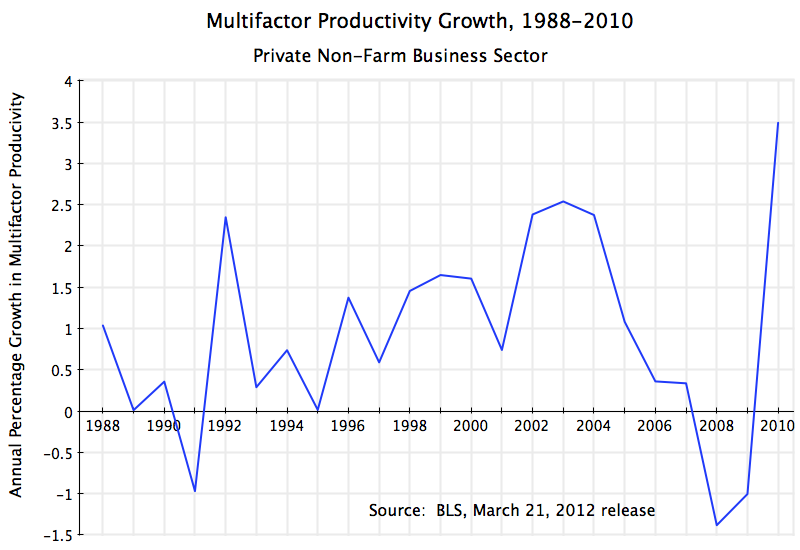
US Productivity Growth, Non-farm Business Sector, 1988- 2010

The Republican presidential candidates continue to assert loudly that over-bearing new regulatory burdens under Obama have crippled the American economy and account for the slow recovery from the 2008 collapse.  Mitt Romney, in a policy address at the University of Chicago on March 19 for example (see transcript here), asserted that regulatory burdens (in addition to higher taxes, even though taxes have in fact been cut under Obama), were leading to businesses shutting down and jobs disappearing as “Entrepreneurs decide it’s too risky and too costly to invest and to hire.”

New burdensome regulations, if they were a problem, would reduce productivity.  Yet as this blog has noted previously (see here), productivity growth has in fact been quite good during the Obama period.  The productivity concept normally used for such discussion is simple labor productivity, which measures output (GDP) per unit of labor input (either employment or hours of labor).  This productivity concept is useful in part because it can be estimated as soon as one has an estimate of GDP, i.e. each calendar quarter.  But it is not a measure of pure productivity, as output per unit of labor can rise due to several things, including from increased capital investment (more machinery and equipment, which improves productivity) or from changes in the composition of labor (towards more highly educated, and hence more productive, workers).

Multifactor Productivity (also sometimes called Total Factor Productivity) is a measure of productivity that takes into account increased capital availability and other such factors.   The Bureau of Labor Statistics of the US Department of Labor provides an estimate of it, but because it is more difficult to estimate, it only comes out with a major lag.  On March 21, the BLS issued its estimate for 2010.  Only annual estimates are made.  And while the series only goes back to 1987 (and hence has growth rates only from 1988), it is interesting that while Romney and the other Republicans are complaining of a large increased burden on business from regulations under Obama, the BLS found that multifactor productivity grew faster in 2010 than in any year since they started estimating the series in 1988.

The graph above shows the BLS estimates of multifactor productivity (MFP) growth for 1988 to 2010, for the private non-farm business sector.  MFP grew by 3.5% in 2010, reversing the downward trend seen since 2003 and absolute declines in 2008 and 2009.  As noted, the 3.5% increase in MFP in 2010 is the highest in the history of the series.  If Obama’s regulations were stifling businesses, one would not see such an upward bounce in productivity.  The Republican charge is simply not consistent with the facts.

One should also not jump to the opposite conclusion that the upward bounce in productivity in 2010 can be credited totally to regulatory or other reforms instituted by the Obama administration.  It would be consistent with such reforms improving productivity (i.e. the opposite of what Romney and the Republicans have asserted), but it could be due to other factors also.

The truth is that much of the year to year change in productivity can be accounted for by the business cycle.  When economic output is falling, as it was in 2008 and the first half of 2009, productivity will typically fall (or not grow as much as in normal growth years), as businesses lay off labor only with a lag after they find they cannot sell all of their output.  And in an economic recovery, productivity will rise, as businesses also only start to hire new workers with a lag.  The same happens with business investment (and hence the stock of machinery and equipment and other capital available for use), so that capital is underused as economic output falls in a recession and then is more intensively used at the start of a recovery.  Looking forward, it is likely that MFP growth will not be so high in 2011, and indeed might even be relatively low, as businesses started hiring new workers more aggressively in 2011 as the economic recovery continued (albeit slowly, due to still low demand for what they could produce).  But we will not know for another year, when the BLS issues their estimate for MFP growth in 2011.

The productivity data cannot by itself demonstrate conclusively whether or not the record high growth in productivity in 2010 was primarily due to measures implemented by the Obama administration.  But what we do know is that the data is clearly not consistent with the Republican charge that Obama has imposed huge new regulatory burdens which have stifled productivity.

Employment in the Recession: The Problem is Slow GDP Growth, Not Productivity

I.  Introduction

The recovery in employment has been exceedingly weak in the on-going, but slow, recovery from the 2008 collapse.  The recovery of GDP has been weak as aggregate demand has simply not been there to absorb increased production.  Household consumption has been weak following the collapse of the housing bubble, and monetary policy has been pushed to the limit with Fed interest rates now almost zero but the economy still in a liquidity trap.

The one instrument that could have been used to create demand for output and hence employment would have been increased fiscal expenditures.  But as noted in a March 3 posting on this blog, total government spending (including that from state and local governments) has been flat or falling since Obama was inaugurated.  Indeed, that blog found that if fiscal expenditure had been allowed to grow as fast as it had in the Reagan years following the downturn that began in July 1981, GDP at the end of 2011 would have been close to full employment output.

The oft repeated Republican alternative view, however, is that the slow recovery in GDP and jobs has been due to overbearing new regulations, and not due to fiscal drag or some other demand side issue.  Indeed, Republicans have argued strongly that government expenditures should be cut even further.  They have asserted that the recovery in jobs has been weak due to expensive and excessive new regulations instituted by the Obama administration, which have deterred businesses from creating jobs.  While more than a bit confused, as we will see below, the argument is that these new regulations have hurt productivity, so businessmen could not profitably employ new workers and hence did not hire new workers.

A convenient summary of this view appeared today in the Washington Post, in the “Right Turn” column of the conservative columnist/blogger Jennifer Rubin (link here to the on-line version).  She wrote:  “Get Obama out of the way — and with him Obamacare, the Dodd-Frank legislation, a chunk of discretionary spending and the planned tax hikes — and instead put in place his agenda — tax cuts, entitlement reform, reduced regulation, and domestic energy development — and the economy will take off.”  The argument falls apart if these measures, and the rest of what has been done during Obama’s period in office, did not result in a collapse in productivity.

This blog will look at whether there is any factual support for this Republican alternative view on the cause of the slow recovery in employment.  Did productivity go down after Obama took office?  What path has productivity taken over the course of this downturn, and how does this compare to the paths taken in previous downturns?  And in reviewing this, we will examine the confusion in this argument on the links between productivity and job growth.

II.  GDP and Employment Growth in the Downturns

To start, it is helpful to see what the paths of GDP and employment have been in this downturn, and in comparison to previous downturns.  The path of real GDP was shown in the March 3 blog cited above, and is repeated here for convenience:

As was noted before, the path of GDP recovery has been especially slow following the 2008 financial collapse.  GDP fell sharply in the first five quarters of the downturn, in the last year of the Bush presidency and into the quarter that Obama was inaugurated (the first quarter of 2009).  GDP stabilized soon after Obama took office and then started to grow, but has since grown only slowly.  The recovery has been the weakest of any among the six recessions in the US of the last four decades.  The earlier blog noted that this can be explained by weak demand for output, due to government spending that has been flat or falling since Obama took office, and exacerbated by the collapse of the housing market.

With the weak growth of GDP, it should not be surprising that employment growth in this weak recovery has been exceptionally weak as well:

Employment fell sharply in the year before Obama took office, more than in any of the other downturns of the last forty years.  And then, despite the stabilization of GDP, employment continued to fall through 2009 before stabilizing.  But the recovery in employment since then has been poor.  This employment path has been by far the weakest of any of the six downturns of the last forty years.

III.  Labor Productivity in the Downturns

Can this weak recovery in employment in the current downturn be explained by poor productivity growth (a result of excessive regulation), as the Republican argument asserts? Has the path of labor productivity also been an outlier in the current downturn?

Actually, the path of labor productivity has been well within the paths seen in the other downturns:

Labor productivity did in fact fall at first, during the last year of the Bush presidency, although this was not uncommon among the downturns.  The fall while Bush was still president was relatively high, but similar to the downturns seen after November 1973 (Nixon/Ford) and July 1981 (Reagan).

But it is interesting to note that labor productivity began to rise quite rapidly immediately after Obama took office.  I would not argue that this was entirely due to Obama, especially in the first few months of his term.  I am merely pointing out that there is no basis for the assertion that Obama instigated regulations hurt productivity and hence job growth (under the Republican argument) after he took office.

This becomes even more clear if one re-bases the series so that labor productivity in the fifth quarter after the start of a downturn is set equal to 100:

Starting from when Obama took office (in the fifth quarter after the start of the downturn), labor productivity growth has been high, and indeed grew at about the same rate as that seen following the 1981 downturn (during the Reagan presidency).  Productivity growth during these two recoveries were not only similar but also the most rapid by a significant margin among the six downturns tracked.  The main difference between the two is that productivity growth has slowed in the current cycle over roughly the last year (i.e. starting in quarter 13), while it continued to grow at that point in the recovery from the downturn that began in July 1981.  But the difference is not large, and one should not draw strong conclusions from it.

It is a firmly held position in Republican dogma that the “reforms” instituted by Reagan of deregulation, cuts in taxes, undermining of labor unions, and other such measures, led to a miracle of productivity growth from which the economy still benefits.  I noted in an earlier posting (see here) that productivity and output growth in the US was in fact slower in the 30 years following Reagan than in the 30 years before.  Over a long term perspective, Reagan was not such a miracle.  And from the diagram above, we see that over the short term, starting from the same point in the business cycle (five quarters after the peak), the record in terms of productivity growth for the vilified Obama is basically the same as for the sanctified Reagan.

It is not a coincidence that the employment picture finally started to improve in 2011, precisely when productivity growth, which had been strong, started to level off.  And this points to the basic confusion in the Republican argument, which some of you may have already seen.  By basic arithmetic, the number of employees one needs to produce a given amount of output depends on productivity, but depends on it negatively.  That is, if productivity has increased, one needs fewer workers to produce a given amount of output.  If one can only sell so much of output due to slack demand, and if productivity growth is strong, then employment growth will be weak.  This has been the story of the recovery during the Obama term, and it is only in the last year, when the pace of productivity improvement slowed, that one has seen a more steady increase in the number of employed.

Productivity growth is due to many factors, and for the economy as a whole it will not change quickly due to any policy action.  It will vary over the course of the business cycle, as seen in the diagrams above, where it will normally (although not necessarily always) fall at the onset of the downturn (as firms will usually be slow to lay off workers as demand for output slows), and then rise significantly once the recovery begins (as firms will usually also be slow to hire additional workers as demand for output increases, but instead use existing workers more).

The current downturn and recovery was not that much different, although the swings were more extreme this time as the downturn was more extreme.  But what was different in the current cycle is that in the recovery (as discussed in the March 3 blog posting), demand from government spending did not increase as it had in previous recoveries, but rather was flat and then fell.  Furthermore, demand from housing construction was extremely depressed, due to the size of the housing bubble and subsequent collapse.  Recovery in GDP, and hence in employment, has therefore been slow.

IV.  Conclusion

There is no factual support for the Republican assertion that overbearing new regulations from the Obama administration has led to weak job growth, due to the negative impact of such regulations on productivity.  Indeed, the argument is quite confused, since for any given level of output, higher (not lower) productivity means fewer workers are needed to produce that output, which hurts immediate job growth.

The path of labor productivity in the current downturn and recovery has in fact been within the bounds seen in other downturns and recoveries in the US over the past four decades.  If anything, productivity fell somewhat more sharply than in most of the others during the last year of the Bush presidency, and more rapidly than most of the others after Obama took office.  And it is this relatively rapid growth of labor productivity during the Obama term, coupled with weak GDP growth (due to fiscal drag and the collapse in housing) which explains the weak recovery in employment.

It should be emphasized that productivity growth is good over the longer term, as it leads to a higher level of output and hence overall income at the full employment level of GDP.  But when the economy is operating at less than full employment GDP, higher productivity will translate into fewer jobs than otherwise.  The way to resolve this is to bring the demand for output back up to the level of output that could be produced if all resources (in particular labor) were fully utilized.  It is a terrible waste, as well as a human tragedy, to allow such unemployment when the needs are so great.