
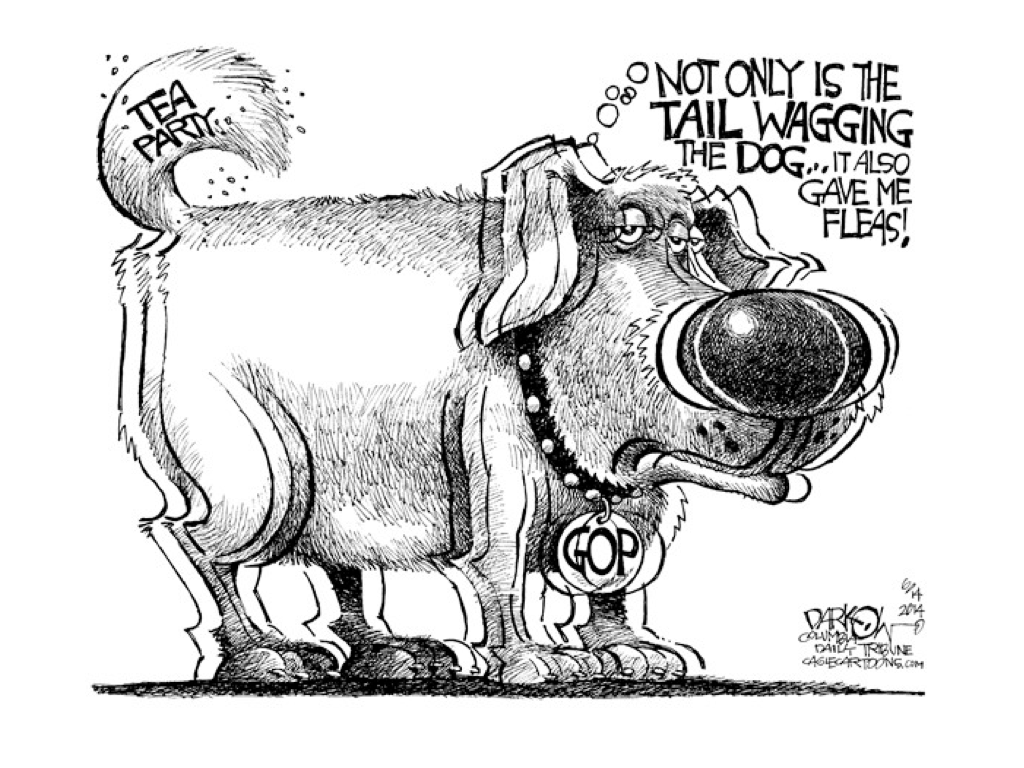
The Problems in Congress Come Not from Gridlock, But from Roadblocks

Republican Party Now.png


Gridlock, as originally defined, refers to a severe traffic jam in a grid of intersecting streets, where cars backed up on the intersecting roads block each other from moving.  No individual car is to blame, but rather all of them together are to blame.  The term is now also commonly used to refer to the inability of Congress to get things done.

But the problem in the US Congress is not really gridlock.  As will be clear from several examples discussed below, a majority in Congress exists for moving important legislation forward.  The problem, rather, is that congressional leaders, who decide what will be voted on and when, have acted to keep such legislation from coming to a vote.  But this is not gridlock.  Rather, it is deliberately placed roadblocks.

Events over the last month show what might be done when such roadblocks are removed. The resignation of John Boehner as Speaker of the House in late September created a narrow window when he could call up legislation for a vote while not being threatened by a minority of just 30 Republican congressmen on a motion to remove him from the Speakership.  He had already removed himself.  As discussed in the previous post on this blog, the traditional practice of straight party line votes for the position of Speaker means that a small group in the majority party (equal to just 30 in the current Congress) could deny the majority party candidate of this post.  A small group of the Republicans in Congress threatened to use this against Boehner should he move legislation forward that they opposed.

Boehner struggled to lead his party under such constraints, and eventually gave up and resigned.  But with that resignation, he was able to negotiate and push through to passage, with strong bipartisan support, a bill that addressed the immediate threat of default on the US debt (current borrowing authority limits would have been reached on about November 2), provided an overall budget framework for fiscal years 2016 and 2017 (with the sequester restrictions eased by $50 billion in FY16 and $30 billion in FY17, equal to a total of just 0.2% of GDP over the two years), and addressed immediate issues arising on Social Security Disability Insurance and on Medicare premiums.

The bill was approved 266 to 167 when put to a vote.  All Democrats voting approved, as did about a third of the Republicans:

Budget and Debt Ceiling Bill – House

Yes

No

Not Voting

Republicans

79

167

1

Democrats

187

0

1

Total

266

167

2


The bill then went to the Senate, where it was also approved by a strong majority (again with all Democrats in favor and about a third of the Republicans):

Budget and Debt Ceiling Bill – Senate

Yes

No

Not Voting

Republicans

18

35

1

Democrats

46

0

0

Total

64

35

1


In perhaps an even more surprising example of what can be done to get around the roadblocks being imposed, the House membership used a discharge petition to force a vote on renewing the US Ex-Im Bank charter.  Successful discharge petitions are rare: Only three times in recent history (since 1985) have they been approved and then led to new legislation.  They require the public signature of 218 congressional members (half of the chamber), and thus require the support of at least some in the majority party even if all of the minority party are willing to sign.  Such maneuvering to force a vote against the wishes of the congressional leadership can and does lead to retaliation by the leadership against the members.  The petition was filed on September 30, with the support of 176 Democrats and 42 Republicans.

The Ex-Im Bank’s charter authority lapsed on July 1.  Reauthorization is required periodically, and never before in its 81 year history has Congress failed to approve this.  A strong majority voted in favor in the Senate in a vote on July 27, with bipartisan support:

Ex-Im Bank Reauthorization – Senate

Yes

No

Not Voting

Republicans

22

28

4

Democrats

42

1

3

Total

64

29

7


Once the vote in the House was forced (it took place on October 27), a strong majority came out in favor, including not only almost all Democrats, but a majority of the Republicans as well:

Ex-Im Bank Reauthorization – House

Yes

No

Not Voting

Republicans

127

117

2

Democrats

186

1

1

Total

313

118

3

The bill, however, is not yet fully passed.  The Senate will now need to reconsider the bill, and despite the earlier strong vote in favor, it is not clear a vote will be held now. Republican Senator Mitch McConnell, the Majority Leader, has said he will not allow a vote to take place, at least on the stand-alone bill passed by the House.  And by attaching the Ex-Im legislation to some other bill McConnell would force it to be returned to the House again, where the leadership could again try to block any vote from being held.

Paul Ryan has now been elected to be Speaker of the House, succeeding John Boehner. Despite these examples of legislation that can move forward in the current congress with bipartisan support provided votes are held, the prospects that Ryan will act differently from Boehner are slim.  Ryan still faces the challenge that just 30 members of his party can choose not to vote for him in future votes for the Speakership, and he would then lose the office.  Indeed, nine members of his party voted for another candidate in the October 29 vote.  And while Ryan at first said that as a condition of becoming a candidate for the Speakership, he wanted agreement to change the House rules so that no future such votes on the Speakership could be held until the start of the next Congress in January 2017, he was not able to secure such a commitment from those who had brought Boehner down, and Ryan then backed down from this demand.

An example where important reform would probably pass with bipartisan support if a vote were held is immigration reform.  The Senate passed a bill on immigration reform (written in part by Senator Marco Rubio, who later denounced his own bill following conservative criticism) by a 68 to 32 majority (with 14 Republicans voting in favor) in June 2013.  But with the conservative criticism, Speaker Boehner refused to bring it up for a vote in the House.  And while it is now more than two years later, with the 2014 elections in between, it is likely that a majority of members in both chambers would still be in favor of immigration reform along the lines of the bill passed in the Senate in 2013.

However, Paul Ryan has publicly announced that he will not allow any such bill to come up for a vote.  And he insists it is Obama’s fault!  In an interview Sunday on CBS’s “Face the Nation”, Ryan said it would be “a ridiculous notion” to work with President Obama on the issue, because Obama is someone they “cannot trust”.  But there is no basis for such a charge.  Obama’s executive orders on immigration have been no different in nature from orders issued by Reagan and the first Bush when they were president.  And no such accusations were leveled against Reagan and Bush then.

But regardless of what one concludes on that issue, why such actions should preclude a vote in the legislative chamber is not at all clear.  Rather, the basic disrespect of the presidential office by Ryan appears to signal that Ryan intends to follow the same path as his predecessor, and allow a minority of about 40 congressmen to dictate what legislation will be brought to a vote, and what will be blocked.  As noted before, the problem is deliberately placed roadblocks, not gridlock.

Jon Huntsman for Speaker of the House!

Jon Huntsman.001


Congress should elect Jon Huntsman for its next Speaker.  Well, perhaps not Jon Huntsman specifically, but some moderate Republican (there are a few) who would appeal not only to those in the Republican Party who want to get things done in Washington, but also to most Democrats, who also want to get things done.  Perhaps Ray LaHood, a former Republican congressman who served as Secretary of Transportation under President Obama, would be a good choice, or even former New York Mayor Michael Bloomberg.  But we are getting ahead of ourselves.  First, we need to discuss why this has come up.

Under pressure from the far right in his party, Speaker of the House John Boehner announced on September 25 that he would resign as Speaker effective the end of October.  Boehner still clearly enjoyed the support of a substantial majority of his party’s members in the House.  But to understand why he ultimately decided he would need to resign or face an embarrassing vote that would remove him, one must understand the rules and customs followed in the House.

Traditionally, the congressional members of each party (Democrats and Republicans) vote in a unified fashion for whomever has been elected the leader of their respective party in the House.  The election of party leader might well be subject to a competitive election among the party members.  But once a party leader is chosen, 100% of the congressional members from that party have traditionally then voted for that leader in the election for the Speaker position.  Thus whichever party has a majority in the House, will elect its leader to the Speaker post.

But there is no rule that one must follow this tradition.  Members of a party can vote for someone else as leader.  And that has become increasingly common in recent years.  Ten Republicans did not vote for Boehner as Speaker in January 2013, and 25 did not in January 2015.  While those numbers seem small, and indeed are small, not many are necessary.  By House rules, the person to be voted Speaker must receive an absolute majority of the “votes cast for a person by name” (thus excluding those absent, as well as excluding those voting “present”).  If the majority party in the House has a majority of only a relatively small number of seats, then a few renegades who decide not to vote for their party’s chosen leader can deny that person the Speakership.

In the current 114th Congress, which was elected in November 2014 and took office in January 2015, Republicans enjoy a quite substantial majority, with 247 seats vs. 188 seats for the Democrats, or a majority of 30 seats.  This is indeed the largest Republican majority in Congress since 1929, when Herbert Hoover was elected president.  But had just 30 Republican members decided not to vote for their party leader (Boehner) to become the Speaker, then he would have been denied the position (assuming all House members are present and vote for a person).

Thus the revolt that led to 24 Republican members to vote for someone other than Boehner (plus one voting “present”) in the January 2015 vote for the Speakership, was significant.  It was, and was clearly intended to be, a warning to Boehner that the minority of the Republican members on the far right of the party were willing to vote against their own leader, if that leader did not act as they wished.

Following up on this threat, Representative Mark Meadows of North Carolina (one of the Republicans who voted for someone other than Boehner) introduced a motion on July 28 to “vacate the chair”.  This could have acted as a vehicle to force a vote on Boehner as Speaker.

Faced with this, Boehner faced the choice of either caving into the demands of the extreme right in his party, or gotten critical legislation passed to allow the government to continue to function from October 1.  Failure to pass such legislation would have been an embarrassment.  The legislation was necessary so that government departments could continue to spend funds with the start of the new fiscal year (as the Congress has not yet passed a budget for the year – a common occurrence).  Democrats supported keeping the government open, as did a substantial share of the Republican majority.  Together they could pass such a bill.  But they are only allowed to vote on measures in Congress that the Speaker chooses to bring up for a vote.  This is what makes the Speakership such a powerful position.  But if Boehner brought up such a bill, members on the extreme right wing of his party made clear that they would vote against Boehner in a vote on the Speakership.  With only 30 such votes necessary for Boehner to lose such a vote (amounting to just 12% of the 247 Republican held seats in the Congress), Boehner was in a bind.  He was being held hostage by a small minority within his party.

Boehner has of course faced this dilemma before.  So far he has chosen to try to work with the extreme right wing.  But as this became more and more difficult, as their demands became more extreme and as their criticism of Boehner grew, ultimately Boehner decided all he could do was resign.  Losing such a vote for the Speakership would be terribly embarrassing.  Better to resign first, and at least go out on your own terms.

Following his resignation, Boehner did indeed bring to a vote a bill to fund the government for almost two and a half months (until December 11).  And it passed easily, by a majority of 277 in favor and 151 opposed.  It received 186 votes in favor from the Democrats (all Democrats who voted) and 91 votes in favor from the Republicans (with 151 opposed).

It appears now that the current Majority Leader Kevin McCarthy will succeed Boehner, through the traditional process.  McCarthy appears in most respects to be similar to Boehner in his approach, although somewhat closer to the right-wing of his party than Boehner was.  But Boehner’s resignation and the expected selection of McCarthy to the Speakership changes little if anything.  There will be the need to pass a budget to fund the government by December 11, or we will once again be in the same situation as this past week.  The extreme right of the Republican members have made clear that they still want what they want, and that if that means shutting down the government, then that is a price they are willing to pay.

Even before December 11, it appears that the government will hit the debt ceiling. Congress sets the debt ceiling, and Treasury Secretary Lew stated in a letter to Congressional leaders on October 1 that they now expect to hit the current ceiling on or about November 5.  Unless Congress acts by then, the US would be forced to default on its financial obligations.  Once again, a broad majority in the Congress, made up of Republicans and Democrats together, would certainly vote in favor of a bill to address this. But they can vote on such a bill only if the Speaker allows a vote on it, and the extreme right wing of the Republican members see this as leverage to get what they want.  By threatening to vote out the Speaker if he does bring up such a bill, they can hold the Speaker hostage to their demands.

Thus there is every reason to expect gridlock to continue, despite Boehner’s resignation and the election of a new speaker such as McCarthy.  Can anything be done?

Yes, the members of congress have it within their power to address this.  Platitudes (such as we will all work together, or will work harder together) will not suffice.  Rather, one needs to address the traditional practices of the current system that empower a small minority within the majority party to hold hostage the Speaker to their demands.

This can be done by going outside the traditional system in the choice for Speaker. There is nothing in the Constitution that requires the Speaker to be a member of Congress.   While the Speaker has historically always been a member, the Constitution does not require this.  All the Constitution says on the institution is in one line at the end of Article I, Section 2, where it states the “House shall choose their Speaker and their Officers”. Anyone can be so chosen.

To change the dynamics, one needs a Speaker who will draw support from the large majority of members who do not represent the extremes of either party.  The Speaker role would change from highly partisan party leader, to a more balanced mediator who seeks a consensus that may well cross party lines to move needed legislation forward.  With Republicans in the majority, the person chosen should be a Republican.  But he or she should be someone who can work with both sides to try to reach a consensus that spans the broad middle ground, thus ending the current system that allows a small minority to hold the Speaker hostage to their demands.

Jon Huntsman might be such a candidate.  He might in particular be appropriate given his recent work as Co-Chair of “No Labels”, a bipartisan group that has proposed a set of process reforms not only to get congress to work, but also the presidency and government more broadly.  I would not necessarily endorse all of these proposals (and some are pretty broad and vague), but thinking along such lines will be necessary if we are to see an end to gridlock in Washington.

The new role of the Speaker would be to seek a broad consensus on issues, crossing party lines, and bringing to the floor measures that will be endorsed by a majority rather than voted up or down on strict party lines.  Voting solely on party lines is a characteristic of parliamentary systems, such as that of the UK.  Such a system works fine to move an agenda forward when the chief executive (the Prime Minister in a parliamentary system) is the head of the majority party in the parliament (or of a coalition that constitutes a majority). But the US Constitution did not establish a parliamentary system.  Rather, it established a system with a separately elected chief executive (the president), who runs the executive branch of government and where the government is made up of three equal and separate branches:  the executive, the legislature, and the judiciary.

Voting solely along party lines, as has become common in recent years in the Congress, works fine in a parliamentary system but not in the system of government established by the US Constitution.  This will not change as long as the Speaker sees his role as primarily that of a partisan leader of his party, rather than as a mediator seeking to produce a consensus on needed legislation with this then passed by a majority of members from both parties representing the middle rather than the extremes.  As long as an extreme can hold the Speaker hostage, he or she will not be able to act as such a mediator spanning the parties.

With such a change to this new type of Speaker, one can foresee a large set of measures passing soon, as a majority in the Congress have been in support.  These include not only necessary upcoming legislation such as for the budget and a bill to raise the debt ceiling, but other items as well.  For example, the previous federal highway funding bill expired in 2009, but since then Congress has not been able to pass any long term extension. Rather, Congress has passed 34 different short term extensions to keep road funding going, and with just these numerous short term extensions, states and localities could not plan in any reasonable way.  The Senate finally passed a longer term (six year) reauthorization this past summer, but the House has yet to act.  There is also a broad consensus on the need for immigration reform, and the Senate passed such a bill in 2013. And if one aimed at achieving a consensus in the middle, rather than appealing solely to one side or the other, one could envisage progress on bills that would address the underfunding and poor management of the VA health system.  One could even see measures to address the high cost of health care (instead of seeking to score political points by calling Obamacare an abomination despite its success in extending insurance cover).

None of this is realistic, of course.  I have no expectation that Washington will change. The point, rather, is that gridlock is not a necessary outcome of the system, but rather a choice that has been made.  Members of Congress have it within their power to change how their Speaker is chosen, and thus ensure the Speaker will abide by the interests of a majority in the Congress rather than a minority in one party.


Some Thoughts on the Midterm Elections in the US

The Democrats clearly did terribly in the midterm elections on November 4.  Here are some thoughts on some (not all) of the factors behind this:

1)  Turnout is the “name of the game” in US elections, and the Democrats did badly at getting their normal supporters to go to the polls and vote.  Only an estimated 36% of those eligible to vote in the US actually voted this time, 11% below the 41% rate estimated for the 2010 midterms.  One traditionally thinks of elections as if voters go to the polls regardless, with the issue then being whether their choice will be candidate A or candidate B.  Under such circumstances, a successful campaign strategy is to focus on how best to convince those voters to vote for you rather than your opponent.  An appeal to the voters who are politically in the middle would then be, under such conditions, a good strategy.

But most Americans do not vote.  The winner is then the candidate most successful at convincing those who would vote for him or her, to actually take the trouble to vote.  The need is to get those who would vote for you to overcome the hurdles they must go through to cast their ballot.  They are more likely do this the more committed they are to the candidate and what he or she represents.

2)  Obama, and Democrats generally, did a poor job at making such an appeal.  Possibly the clearest example of this was Obama’s decision (under pressure from several Democratic candidates for the Senate, most of whom then lost) to postpone any announcement of executive actions he would take on immigration reform – actions which would not require new legislation.  Obama publicly promised to make such an announcement this past summer, but then decided to postpone any such announcement until after the election.  This then led to strong criticism by many Hispanics, including heckling at some of his speeches, and a reduction in support from Hispanics.  This was manifested in part by a reduced share of the Hispanic vote going to Democrats, but even more in a reduction in Hispanics going to the polls at all.  The result will now be a Senate more averse to immigration reform than before.  But the reaction by Hispanics is understandable.

The strategy did not pick up many, if any, moderate votes.  But it did lead to a key constituency to be less interested in overcoming the hurdles that exist in the US (and increasingly exist:  see below) to go out and vote.

One can point to issues that have disappointed other key constituencies as well. Significant groups of Obama supporters were disappointed by his (so far) non-decision on the Keystone pipeline (he has not approved it, but nor has he decided against it); his extension of the Bush tax cuts for all but the extremely rich (which has weakened the fiscal accounts, with this then strengthening those opposed to the government spending that would have accelerated the recovery and reduced unemployment); his failure to prosecute aggressively those on Wall Street who through fraud sold mortgage-backed securities that misrepresented the financial capacity of many of those receiving such mortgages, which led directly to the 2008 financial crisis; the support provided to those Wall Street banks and other financial institutions then to rescue them from this crisis, while home-owners who were sold such mortgages received only limited, and in the end ineffectual, help; and more.

I would not argue that these positions did not reflect Obama’s genuine beliefs.  While conservative pundits have labeled him a far-left socialist, or worse, Obama has in fact governed from the middle.  But such positions then had the effect of leading many with more liberal views not to see a reason to go to the polls.

Obamacare provides a further example.  It has successfully reduced the number of uninsured in America by over ten million so far, and has been the most important health care reform in the US since Medicare was passed in 1965.  But it has been criticized by those on the left as an overly complex program.  As they note, it was a plan first conceived by the conservative Heritage Foundation in 1989.  Republicans in Congress in 1993 then championed this plan, with its individual mandate, as their counter-proposal to the health reform plan of the White House task force led by Hillary Clinton.  Many Obama supporters would have preferred the simpler approach of a health care plan built on extending Medicare to the full population (a single-payer system).  The problems with the launch of the Obamacare exchanges in October 2013 affirmed for many that such a simpler plan would have been better.

The Obamacare system that works through private insurance companies may have been necessary politically, to get any health care reform passed through congress.  It was politically in the middle, derived from a plan first pushed by Republicans.  But it disappointed many liberals as overly complex and more costly than an extension of Medicare to all would have been, while picking up few votes from voters in the middle.

3)  Voter suppression works, and can be decisive in close elections.  A wave of more restrictive voting measures were enacted following the 2010 elections, in those states where Republicans took (or kept) control of both the governorship and both houses of their legislatures.  Courts have ruled against some of the new voting restrictions, while others were merely postponed.  Such new measures, which vary by state, were in place in 21 states for the first time in a midterm election in 2014.

The measures all act to increase the hurdles to voting.  They can have a particularly discriminatory impact on the poor and many minorities.  Voter ID requirements may not matter much to someone with a car and driver’s license, but if you are poor and do not own a car, and hence have had no need for a driver’s license, the burden can be significant.  And the intent of such laws was made especially clear in Texas, where a license to carry a handgun is counted as a valid ID for voting, while a state-issued photo ID at the University of Texas for an in-state student is not.

It is difficult to impossible to estimate the impact that raising the hurdles to voting has had on voter participation.  A recent study by the GAO estimated that in two states examined (Kansas and Tennessee), the result may have been a reduction in voter participation of about 2 to 3%.  If all this impact is focussed on one side of potential voters (e.g. poor who would vote for Democrats) in an otherwise evenly divided state, the impact would be to reduce the votes on one side by 4 to 6%.  This is huge, and could be decisive in many contests.

Two prominent states that introduced significant new voting hurdles since 2010 were North Carolina and Florida.  Republican Thom Tillis, who as speaker of the state House of Representatives pushed through the new voting measures, beat Senate incumbent Kay Hagan by a narrow 49.0% to 47.3%.  He may well owe his win to the new hurdles.  And Republican Governor Rick Scott of Florida signed into law new voting restrictions as well as implemented executive actions that made voting more difficult.  He won over his challenger (former governor Charlie Crist) by a margin of just 48.2% to 47.1%.

While it is impossible to say with certainty that the new hurdles were the deciding factors in these races, they figures are so close that they very well could have been.

4)  Obamacare has succeeded in its primary objective of making it possible for more Americans to obtain health insurance.   But the politics of whether such progress will translate into net votes in favor of politicians who supported it are not straightforward.

In the US, before Obamacare, roughly 85% of the population (using round numbers, but sufficient for the illustrative purposes here) had health insurance, whether through government programs such as Medicare and Medicaid, or through private insurance normally obtained via your employer.  About 15% of the population had no such health insurance cover, and the primary aim of Obamacare was to make it possible for this 15% to obtain health insurance coverage.

While making it possible for this 15% to obtain health insurance is an indisputable gain to the 15%, they of course only make up 15% of the total.  The other 85% already have health insurance, and health insurance coverage is of course important to all of us.  But with the complexities of the Obamacare reforms, the 85% who already with health insurance cover can understandably be worried whether Obamacare might have an adverse impact on them.  It won’t, and there will indeed be gains for most of them (health insurance policies must now meet certain minimum standards, including the provision of coverage for routine annual check-ups without a deductible, coverage for adult children up to the age of 26, an end to denial of coverage for pre-existing conditions, and other measures).  Only a relative few of the very rich will now pay more in taxes to cover in part the cost of subsidies that will make it possible for those of lower income to afford coverage.

But with the complexities of the Obamacare reforms, plus the anti-Obamacare campaigns by certain political groups (such as a number supported by the Koch brothers), as well as by Fox television and a number of radio talk programs (such as Rush Limbaugh), it is not surprising that people within the 85% may worry.  Access to health care is important to all of us, and if Obamacare would, in some unclear fashion but based on what critics are asserting, lead to loss of coverage within the 85%, one can understand the concerns.  And with the 85% far outnumbering the 15%, it would not take a very high share of the 85% to oppose Obamacare, under the mistaken belief they will be harmed in some unknown way, to offset the positive reactions among the 15% now able to obtain affordable health care.

There can be a similar political arithmetic in other areas as well.  Falling unemployment will matter a good deal to those now able to get jobs, but they constitute a relatively small share of the labor force.  After all, an unemployment rate below 6% (as it is now) means that more than 94% have jobs.  And if those with jobs are told that the measures being taken to spur growth will have an adverse effect on them (such as the assertions, completed unsupported by any facts on what has happened to inflation thus far, that the Fed’s monetary policy will lead to hyperinflation), the political gains from bringing down the unemployment rate may be more than offset by the worries of the 94%.


There were many reasons for the poor showing of the Democrats in the November 4 midterms.  The factors discussed above are only a few, and perhaps not even the most important ones.  But they did contribute.