
Chart 1
Update – August 5, 2025: In the initial version of this post, I mistakenly said that businesses are required by law to participate in the Current Employment Statistics (CES) survey of the Bureau of Labor Statistics (BLS) – the survey that the BLS jobs numbers are based upon. This is not correct. While participation is required in certain states under state laws, there is no federal law on this. The post below has been corrected to reflect this and has added material on the participation rates.
On August 1, the Bureau of Labor Statistics (BLS) released its estimate of net job growth in July. The news was not good. Net job growth in July was just 73,000, where growth in the number of jobs in health care and social assistance alone came to 73,300. That is, net job growth for everything else was essentially zero, indeed negative.
But more surprising and concerning than the disappointing growth in July, the updated BLS estimate of total job growth in May was reduced by 120,000 to just 5,000, while the estimate for June was reduced by 133,000 to just 14,000. The initial job growth estimates for May and June were a healthy 139,000 and 147,000, respectively. Now, both figures are close to nothing.
Revisions to the monthly job estimates are both automatic and routine. The BLS always revises the estimates for the most recent two months as each new monthly report is released, as it updates its estimates based on more complete data sent to it by employers who are covered in its Current Employment Statistics (CES) survey. The CES sample includes approximately 121,000 businesses and government agencies at approximately 631,000 individual worksites – covering a total of about one-third of all nonfarm payroll jobs. The BLS estimates then rely on timely reporting from these employers.
Participation by employers who have agreed to take part in the survey is high. While not mandated by federal law (although it is in certain states by state law), approximately 94 to 95% who have agreed to be part of the survey then respond by the time of the final release of the employment estimates (based on response rates over the past year). But not all respond immediately, and some cannot.
The figures reported are of the number employed by the establishment at some point during the payroll period that covers the 12th day of each month. These are reported along with figures on the compensation paid by the firm (in dollars) and the total hours worked (and separately the total overtime hours worked). The firm will not know what these will be until the payroll period is over. If the payroll period is one week, or even usually two weeks, the firm should be able to file its report (which is normally done online) in time for its data to be included in the initial estimate of employment that the BLS issues each month. But if the payroll period is for the full month, then by definition the BLS will not have that firm’s data in time for its initial employment estimate of that month. The BLS thus issues a revised estimate the next month, and then also the following month, as further data arrives. This is all standard.
The BLS does, however, arrive at an estimate each month for total employment – despite still having only partial reports from its survey – by imputing values for the missing data based on past patterns and relationships. On average those initial estimates are very good, with the later revisions sometimes higher and sometimes lower. The average revision since 1979 has been less than 0.01% of the number employed. In absolute value terms (i.e. in terms of just the revisions themselves, not whether they were positive or negative), the average revision was a still very small 0.05%.
The BLS thus updates its job estimates for any given month at the time of its next monthly report and then again at the time of the monthly report after that, based on the more complete reports it has received by then. There is also an annual revision of the monthly figures, issued each January, based on updated control totals for overall employment and its composition broken down by such factors as the size of the firm, the sector, and so on. These control totals are obtained from periodic census information. The process followed for that annual revision was described in an August 2024 post on this blog.
All this is standard and routine, and follows a methodology that was developed years ago. Furthermore, it is automated and done by computer, with only a cursory review of the numbers by staff at the end. The BLS is also fully transparent on the revisions it makes. One can find on this webpage on the BLS site all the monthly revisions (from both the initial estimate to the second, and from the second to the third), month-by-month, back to January 1979.
Trump paid no attention to this. Faced with the reality of disappointing jobs numbers for the last several months, Trump decided that the best course of action was to shoot the messenger. He fired the well-respected and professional head of the BLS, Dr. Erika McEntarfer, asserting (with a clear lack of understanding) that McEntarfer was somehow manipulating the numbers for political reasons. Trump had also asserted in August 2024 that the BLS under Commissioner McEntarfer had manipulated the annual revision of the benchmark control totals released at that time (which happened also to be a downward revision). The control totals are released every August, prior to the detailed sectoral and monthly figures then released in the coming January. See my August 2024 blog post on that episode.
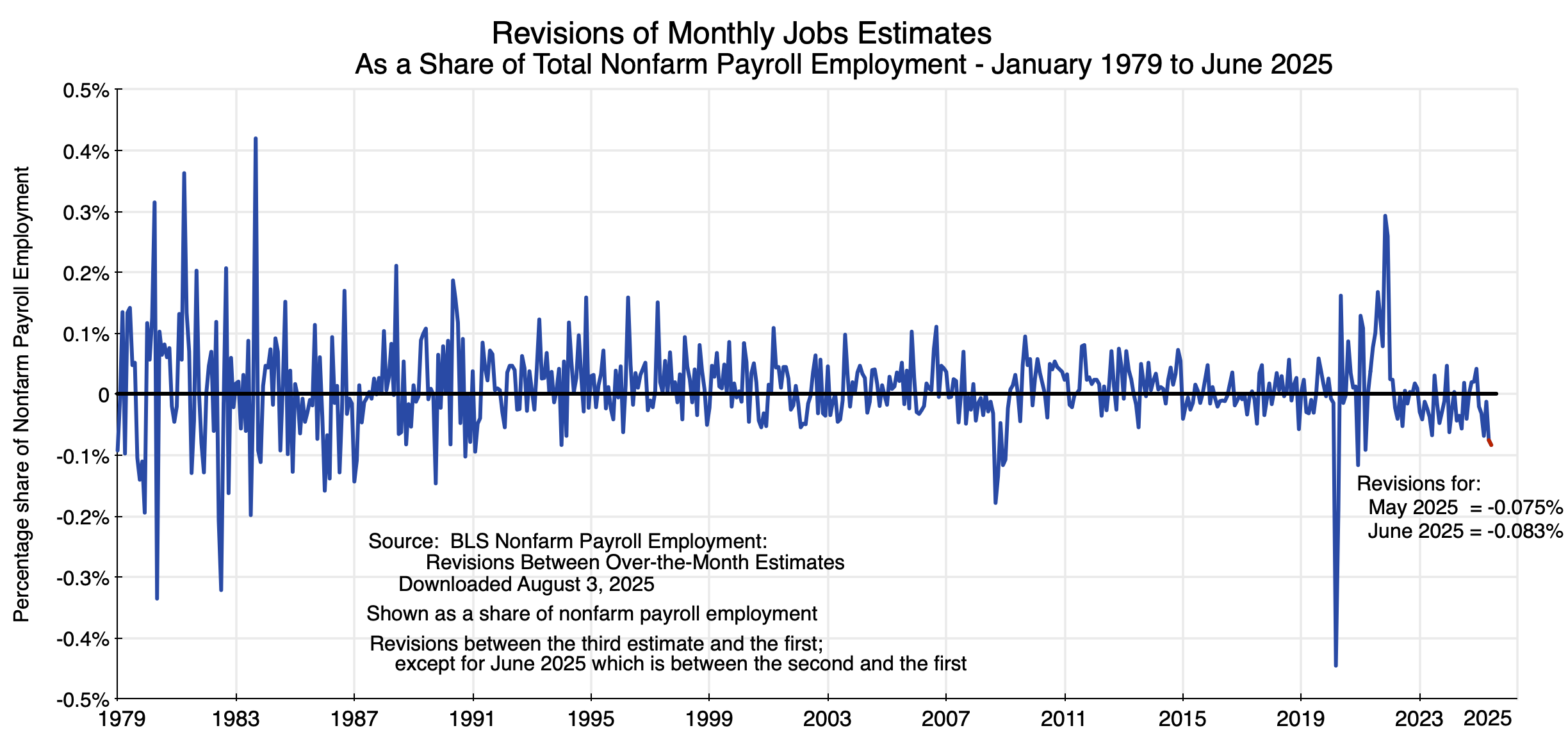
Trump also does not understand that the revisions – while significant – are far from unprecedented in size. The chart at the top of this post shows the revisions to the monthly figures (defined as the difference between the third estimate and the first, with the sole exception for the June 2025 estimate which is between the second estimate and the first), as a share of the overall number employed in the economy. It is shown as a share of total employment in order to make meaningful comparisons over time, as there are now 80% more employed in the US than there were in 1979. The figures for May and June 2025 are shown in red at the far right in the chart, although the red may be hard to see.
The first thing to note from the chart is how small the revisions mostly are, especially over the last quarter century. Unless there are major economic disruptions underway or soon to be underway (such as from the Covid crisis in 2020 and the recovery from it in 2021, from the 2008/09 Great Recession, and earlier in the years at the end of the Carter presidency and the first term of Reagan, when the economy went through two separate recessions), the range of the revisions is almost always well less than +/- 0.1% of the number employed. This is extremely small. Keep in mind that the BLS arrives at its estimates of total employment each month from a zero base, where it asks its (rather large) sample of business establishments how many people they currently employ. The estimates are not based on a survey asking, for example, what the change in employment at their establishment may have been.
The May and June 2025 revisions were reductions in estimated employment of 0.075% and 0.083% of total employment, respectively. These were major revisions, but certainly far from unprecedented. Plotting the revisions onto a histogram with bins of 0.05%, we have:
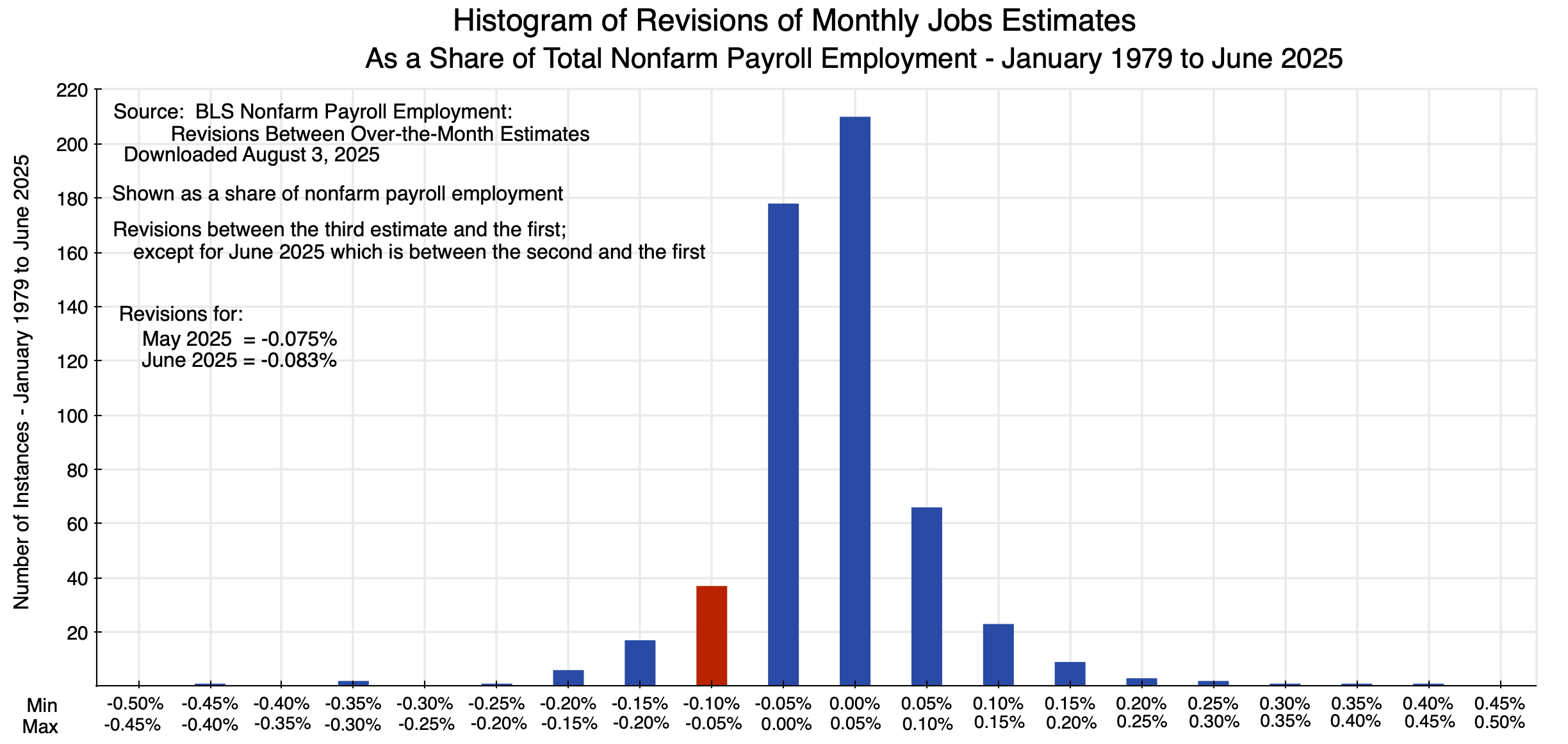
Chart 2
The May and June revisions fit into the -0.10% to -0.05% bin. There were a total of 37 monthly cases that fit in that group in the 558 months from January 1979 to June 2025, and there were also 27 monthly cases where the reductions were greater. That is, revisions similar in magnitude to, or greater than, those in May and June have happened in about 11% of the monthly cases since 1979.
There is no evidence that the BLS or its head Erika McEntarfer somehow manipulated these estimates to arrive at figures that Trump did not like. Indeed, it would probably be impossible, given how automated the process is. That does not mean, however, that a new Trump appointee to head the BLS would not be able, over time, to redesign the process in order to give Trump something closer to the numbers he wants. This will need to be watched closely.
Until recently, the first groups that would be advised of any changes in its methodology that the BLS was considering would have been two advisory panels of outside professionals. The panels were made up of individuals from universities, research institutes, and private businesses, who were impartial professionals and were not paid (other than for travel expenses). Those panels – the BLS Technical Advisory Committee and the BLS Data Users Advisory Committee – were, however, dismissed in mid-March by the then new Trump administration.
There were concerns when the panels were dissolved that the Trump administration had plans to politicize the process by which basic economic data is gathered, with the aim of ensuring only flattering figures are released. The firing of the Commissioner of the BLS appears to be a further step in that process.
 An Economic Sense
You must be logged in to post a comment.