Chart 1
A. Introduction
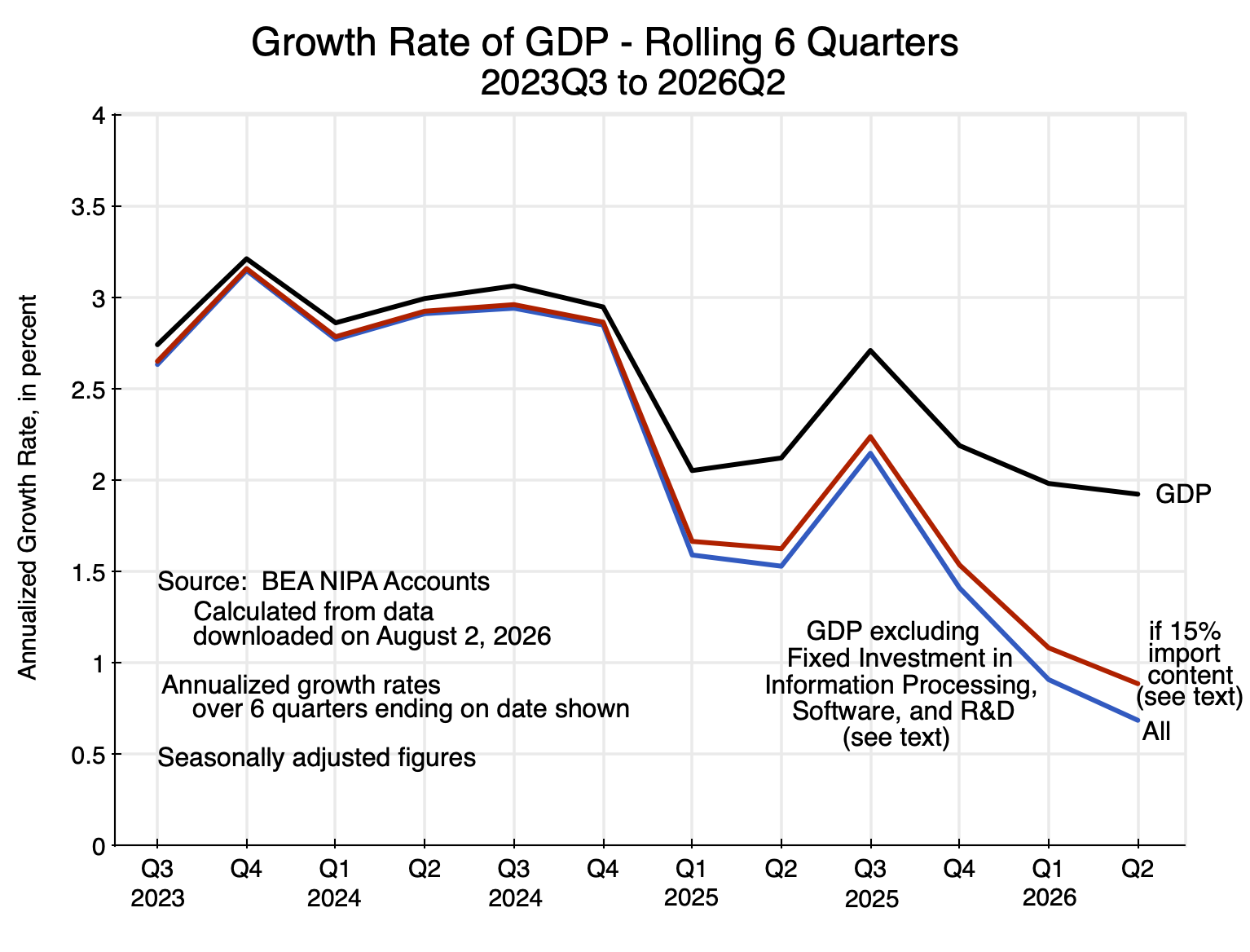
Economic growth has weakened under Trump, with GDP growth falling to below 2% at an annual rate in the year and a half since he took office. GDP grew at a rate of close to 3% in the last year and a half of Biden’s term in office. Furthermore and importantly, much of the GDP growth during Trump’s second term can be attributed to the sharp increase in investments in equipment for information processing and related items – the AI boom.
While the import content of AI-linked investments is significant, one can get a sense of the direct impact on GDP of those investments under reasonable assumptions. As will be discussed below, the growth in GDP other than production for AI-linked fixed investments has been less than 0.9% at an annual rate during Trump’s second term, when account is taken of the estimated import content of that investment. It would be less than 0.7% if the import content of AI-linked investment is ignored (as many do).
This poor record should not be surprising. Trump has enacted numerous policies – often hastily – that critics have noted would harm growth. They have. Section G below will briefly discuss some of the more prominent among them. But the primary focus of this post will be on the data, and in particular on data now available with the release on July 30 of the initial estimates from the BEA of the NIPA (i.e. GDP) accounts for the second quarter of 2026.
The GDP figures for the second quarter are also of interest as they show what happens when domestic demand grows more rapidly than the limits of what domestic supply can provide as capacity limits are reached. GDP is a measure of supply, i.e. of domestic production (which is why it is called Gross Domestic Product). It grew at an annual rate of just 1.5% in real terms in the second quarter. But domestic demand grew substantially faster. Final sales to domestic purchasers grew at a rate of 3.1%. These final sales are the sales for personal consumption, for fixed investment, and for government spending on goods and services, and could grow faster than supply only because the trade deficit increased and inventories were drawn down. That is, sales came from greater imports and out of inventories that had been produced in the past.
With unemployment low (at a 4.1% rate in July – higher than under Biden but still low by historical standards), the economy was not able to produce much more despite the increase in demand. A slowing economy while demand is growing faster is a recipe for overheating. And there are indications that inflation is indeed rising as a consequence, even aside from the compounding factor of the higher energy prices resulting from Trump’s decision to start a war with Iran.
Section B will first look at what has happened to growth in GDP in the first year and a half of Trump’s second term, with this compared to what it was in the last year and a half of Biden’s term. It has slowed substantially, from growth at a 3% pace under Biden to below a 2% pace now. Furthermore, and as noted above, much of this growth can be attributed to fixed investments related to the AI boom. Growth in everything other than production for the AI boom has slowed by substantially more.
Why did growth in GDP (i.e. growth in production) slow? Section C of this post will start to address this by examining what has happened to fixed investment under Trump. While AI-related investment has boomed, fixed investment in everything but the AI-related investments has gone down in absolute terms during Trump’s term. Instead of growing – as a healthy economy needs – such investment is now 8% below where it was in the fourth quarter of 2024 – the last full quarter of Biden’s term. This affects the supply of capital.
Section D will then look at the growth – and recent decline – in the labor force. The labor force is shrinking under Trump in contrast to modest growth under Biden. Trump’s aggressive policies to deport migrant workers have been an important factor behind this.
Section E looks at the balance between aggregate supply (GDP) and aggregate domestic demand (Final Sales to Domestic Purchasers). The difference is the trade balance and the net change in inventories. The more rapid growth in domestic demand in the second quarter of 2026 than the growth in domestic supply had to be met by a larger trade deficit (higher imports) and a drawdown of inventories. This is a sign of an economy that is overheating. Inventories can only be drawn down to the extent there are inventories to draw from; it cannot continue forever. And while a trade deficit can be sustained as long as foreign lenders are willing to fund it (and the US has had a significant trade deficit since the mid-1980s – they began under Reagan), the increase in the deficit is a sign of an economy reaching the limit of what it could produce domestically during the period.
This is an early sign of an economy that is overheating, due here to a combination of rapid domestic demand growth with a weakening of the economy’s ability to supply that demand. It is also directly counter to Trump’s claims that his tariff policies will lead to a sharp reduction in the trade deficit (as well as a stronger economy, he asserts). He has the economics of this wrong, and the consequences are clear in the data.
An overheating economy is reflected in the inflation numbers. These are reviewed in Section F of this post. Inflation is now rising, and the turning point on this began already in the fall of 2025, well before the war on Iran was launched. The war then led to a sharp rise in energy and certain other prices, which has compounded the underlying problem. This has resulted in real wages falling. Living standards for most have diminished, with Disposable Personal Income faltering already in late 2025 and falling in 2026.
Why has growth in GDP weakened? Section G of the post will list a few of the policies under Trump that have hurt growth. Section H will present some scenarios of what might happen now, and Section I will conclude.
B. Growth in GDP
GDP growth has weakened. While there is substantial volatility in the quarter-to-quarter changes, a rolling average over six quarters will smooth those out to show the trends. Growth (at annual rates) fell from about 3% during the later years of Biden’s term in office to less than 2% during the first year and a half of Trump’s second term. See the chart at the top of this post.
Furthermore, much of that 2% growth was driven by the boom in AI-related investments. The entire rest of the economy has been growing even more slowly. Based on a reasonable estimate of the growth resulting from production to support the boom in AI-linked investments, the rest of the economy has been growing at a rate of below 0.9%.
To clarify a point of possible confusion: The 0.9% growth rate refers to growth in the supply of production for everything included in GDP other than production for the AI-linked investments. The estimate of the impact of the AI-linked investments does not refer here to growth that might result from the demand-side impact on GDP of such investments. An increase in investment can spur GDP growth by increasing consumer and other demands for output in the standard Keynesian way in times when unemployment is high and production is constrained by aggregate demand. But production is not now demand constrained (as will be discussed in Section E below) while unemployment (at 4.1% in July) is low by historical standards.
The question being addressed here is the growth of all that is included in GDP other than production for the AI-linked investments. That figure is a better estimate of the impact Trump has had on economic growth than the growth in overall GDP. The AI boom is a consequence of developments that have been underway over a decade or more, and are now materializing in massive investments for data centers and related items to support the further development of the AI models and to make available their services.
The National Income and Product Accounts (NIPA, often loosely referred to as the GDP accounts) do not specifically provide line item figures for investments dedicated specifically to the provision of AI services. This is, of course, not surprising; AI is new. However, the NIPA accounts do provide estimates for fixed investment in equipment for information processing purposes, as well as for investment in software and in research and development (R&D). While there have long been such investments, much of the increase in such investments since early 2025 is likely due to investments that are linked to what was needed to support the new AI systems.
This will nevertheless likely overestimate the investments just for AI, as there will be new investments in those categories for purposes other than AI. Acting in the other direction, the line items shown in the NIPA accounts are solely for equipment produced for such investments (plus investment in software and R&D). AI-linked investments will also include investments in structures, which are a separate category in the NIPA accounts. There are also supporting investments in areas such as new power generation capacity (AI is creating a huge demand for additional power), new water systems, fiber optic cable networks to connect them all, and more.
Treating the investments in information processing equipment, software, and R&D as “AI-linked” investments is therefore a shortcut and certainly imperfect. But it will suffice for the purposes here, which is to give a sense of the extent to which the growth in GDP has been due to such investment, and how limited growth has been outside of that narrow area.
An additional difficulty is that the figures on investment and the other items in the GDP accounts do not (and cannot) show to what extent imports are a source of supply (directly or indirectly) for those expenditures. Imports are taken into account for overall GDP by simply adding up all of the demands (i.e. for consumption, total investment including in inventories, government spending, and exports) and then subtracting total imports. But it is impossible to come up with good estimates of the extent to which imports accounted for the supply of the items that were used to satisfy some specific demand, especially in some indirect way. One knows, for example, how much fuel was imported in total to supplement the domestic supply of fuels, but it is impossible to know how much of the fuel used directly and especially indirectly to produce some specific item was imported rather than domestically supplied.
We do know, however, that a substantial share of the expenditures to build the new data centers are imported. The semiconductor chips required are almost all imported (from Taiwan for processors and Korea for memories), as is a substantial share of the specialized equipment. But the cost to build a new data center is more than just the cost of the chips. Furthermore, one should not count the gross cost of an imported semiconductor chip used in such centers. Much of that cost goes back to the American firms that designed them. Nvidia – the source of the graphical processing unit chips used in the data centers – enjoys a gross margin of 75%. That means that of $100 in revenues from its sales of chips and other products, the cost to it of the goods it sold (e.g. what it paid to TSMC in Taiwan to fabricate the chips, which were then imported) was just $25. The gross cost of the chips imported will be $100, but $75 of this is earned by Nvidia to cover its costs to design the chips and as profits accruing to it as an American firm. Taking this into account, the net import cost was only $25, not the value at the “list price” of $100.
Furthermore, while a significant share of the cost of building the AI data centers is accounted for by imports, there has also been a substantial increase in related investments in the production of software and in R&D. Imports do not play a major role in the production of either of these. Together, they accounted for 70% of the investment that increased sharply in the AI boom. Investment in “Information Processing Equipment” was just 30% of the total.
Thus, assuming (probably on the high side) that 50% of the cost of the investment in new data centers (the Information Processing Equipment) comes from imports, and essentially no imports for the 70% accounted for by the investments in software and R&D, the import share of what was invested as a result of the AI boom would be 15%. That is, 85% of the cost would be domestically supplied.
The chart at the top of this post shows total GDP growth during this period, and then the growth in GDP for everything other than what was produced for the investments going into the AI boom. Based on the estimate of a 15% import content in the production of what was invested in the AI-linked investments, the growth in GDP in everything other than for the AI investments has been at an annual rate of less than 0.9% during Trump’s term in office so far. Ignoring the import content (and thus implicitly setting it at zero), the growth rate would have been less than 0.7%. Either is a substantial fall from the approximately 3% rate under Biden.
Furthermore, despite its recent rapid growth, domestic production for the investments in information processing equipment, software, and R&D only accounted for 8% of GDP in the second quarter of 2026. That is, the “rest of the economy” is 92% of GDP. This 92% of GDP has grown at a rate of only 0.9% since Trump began his current term in office.
Why this fall in growth? Supply comes from production using capital and labor, and both are declining.
C. Fixed Investment
Capital is produced by new fixed investment. While overall fixed investment has grown by a total of almost 7% over the year and a half in Trump’s second term (4.5% at an annual rate), all of the growth was due to the rapid growth in investments for the AI boom. Those rose by over 23% during that period (15.0% at an annual rate). Fixed investment in everything else in the economy actually fell by 7.4% (a fall of 5.0% at an annual rate):
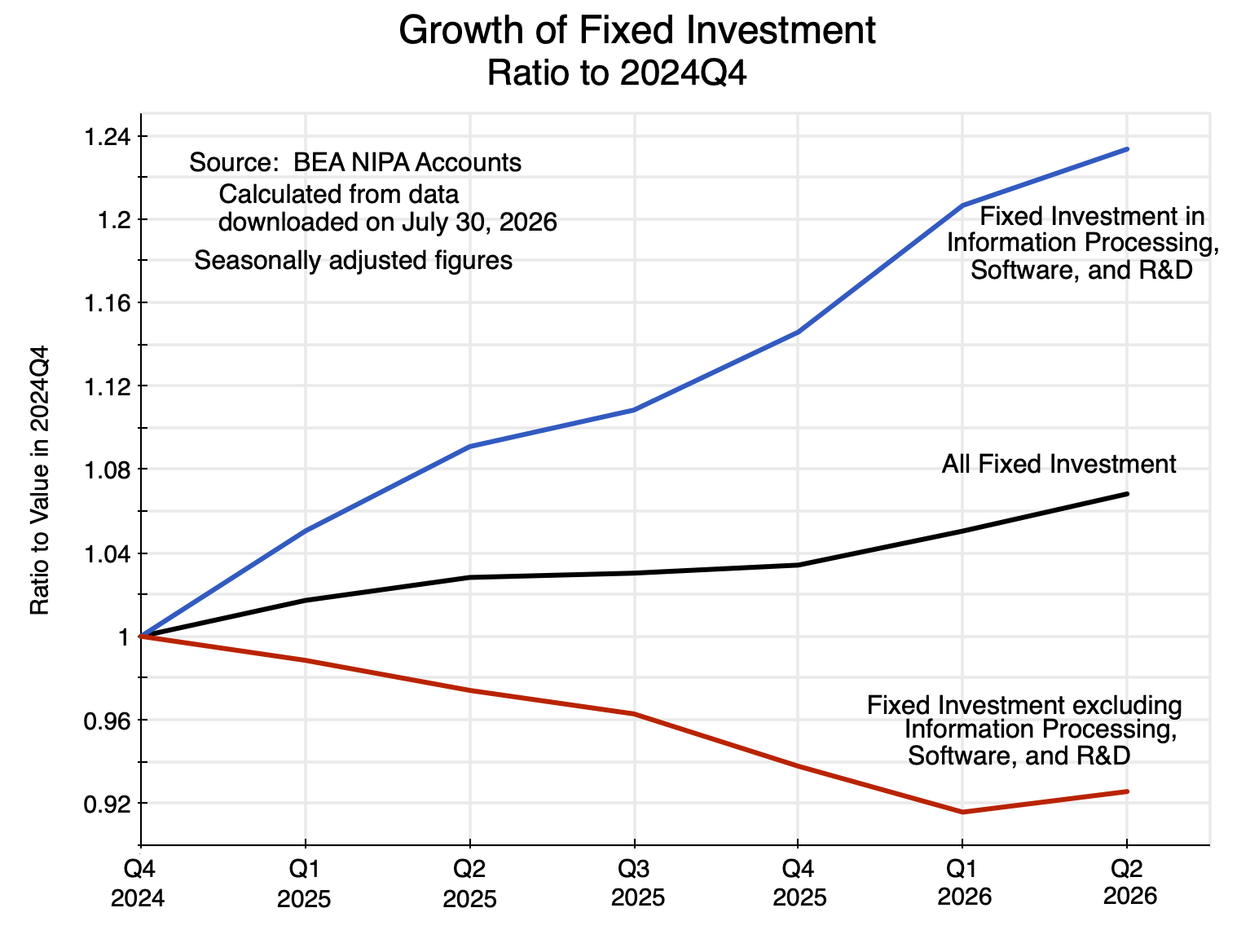
Chart 2
Other than the investments in the items linked to developing and providing the new AI services, investment has performed poorly under Trump – indeed terribly. Investment in residential structures (housing) fell in every quarter but one during this year and a half, and by the second quarter of this year was 5.3% below where it was in the last quarter of Biden’s term in office. Investment in nonresidential structures (i.e. commercial real estate, offices, warehouses, factories, etc.) was even worse: It fell in every quarter since Trump returned to office, and is now almost 8% below where it was at the end of Biden’s term. All other investment items (primarily other equipment) fell in three of the six quarters and rose in three, and ended up at just 0.95% above where it was under Biden.
The result is that the supply of capital for all of the economy other than for providing AI services is now well less than what it would have been had investment been sustained as it had under Biden. Over 2023 and 2024, total fixed investment grew at an annual rate of 3.3% while investment in all but the AI-linked investments grew at a 3.0% rate. These supported and were consistent with GDP growth during the period of about 3%. Under Trump, investment other than for AI fell.
D. Labor Force
Labor is the other source of supply. And there is now less of it to support the American economy:
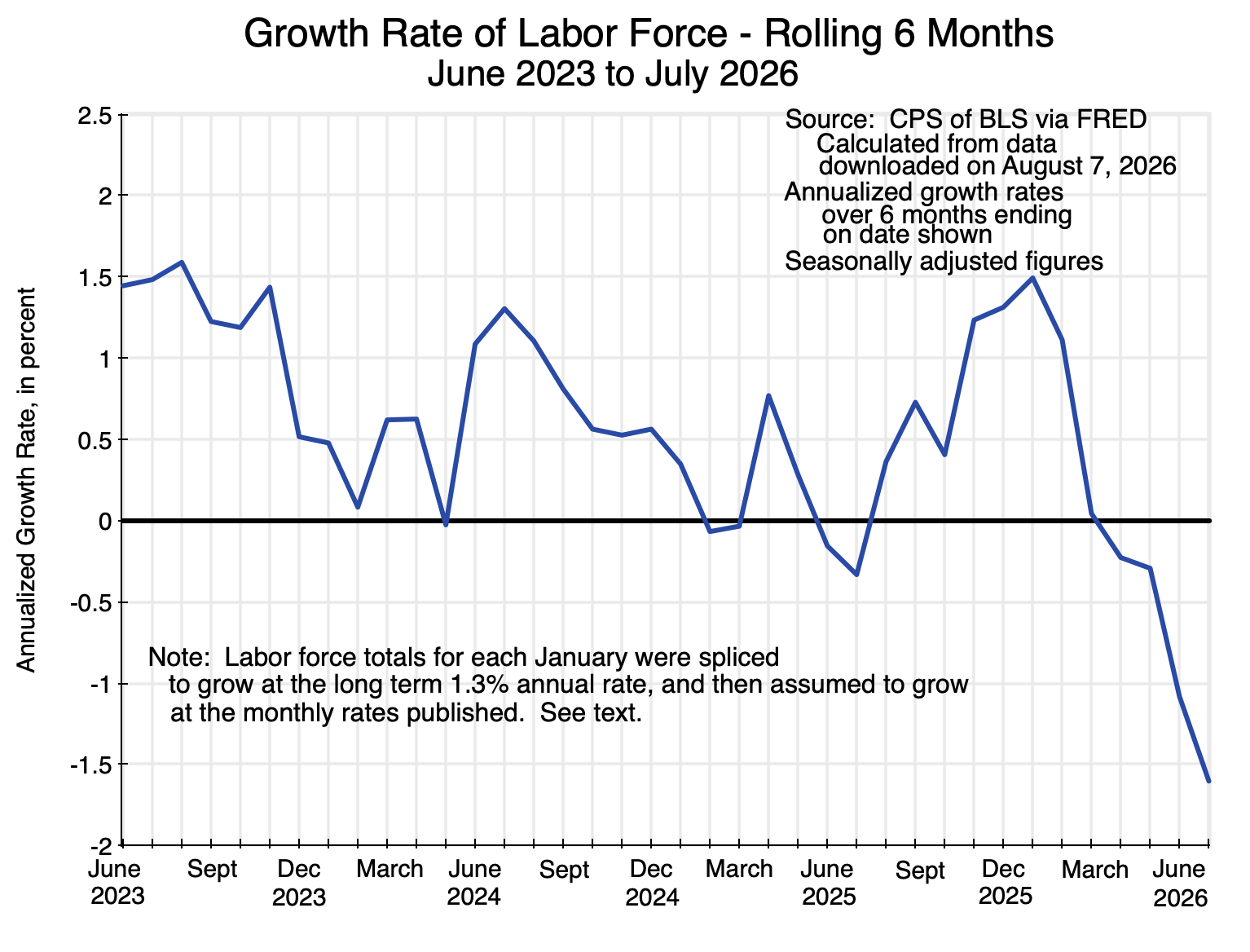
Chart 3
The chart shows the estimated growth in the total labor force in the US on a rolling 6-month basis. A person is considered to be in the labor force if they are employed or, if unemployed, have been actively looking for work at some point during the four weeks leading up to and including the week of the survey.
Comparisons over time of labor force statistics are, however, complicated by the fact that they derive from figures in the Current Population Survey (CPS) of households of the BLS. The issue is that the population weights used to derive US-wide estimates from the set of households surveyed are updated every January. But the BLS does not then go back and revise the estimates issued before. Thus there will always be a “jump” in the estimates (up or down) in the January figures from those of December. That means one cannot properly estimate growth rates for the labor force for periods that straddle December to January (although many analysts ignore the issue and do it anyway).
This is in contrast to the approach taken in the Current Employment Statistics Survey (CES) of the BLS – its survey of business establishments (both public and private) from which it derives estimates of total non-farm employment. Those employment estimates are updated on a regular annual cycle to produce figures that are comparable across time.
For Chart 3 above on the labor force, I adjusted the CPS data by in essence splicing the series in each January from 2022 onwards by assuming the growth in the labor force in that month was simply the long-term rate of growth between December 2022 and December 2025. That rate was 1.30% (in annual terms). The growth in the labor force in every other month but January was as recorded in the CPS data. This smoothed the series by removing the jumps each January and substituting for that month – and that month only – the overall rate of growth since December 2022. Without the splicing in this manner, the jump in the labor force estimates would have been up in two of the four years and down in two of the years. The spliced series provides a better sense of the trends in the size of the labor force, and will suffice for the purposes here.
Furthermore, keep in mind that the six-month growth rate for the period ending in July 2026 is the growth rate from January to July. That period is not affected by whatever adjustment was made to smooth out the December to January jump when new population weights were introduced. And from January to July of this year the total labor force fell at an annual rate of 1.6%, consistent with the trend seen in the chart for the prior months.
A declining labor force has significant implications for how fast GDP can grow. Without additional labor, GDP can grow only as fast as productivity does, and that is limited. Since the start of Trump’s second term in office, labor productivity (the ratio of GDP to workers employed) has on average grown at an annual rate of 1.6% – down some from the 1.9% rate in the final year and a half of Biden’s term. If the labor force is falling at a rate of 1.6% a year – as it is now – then at a 1.6% rate of productivity growth, GDP will not grow at all. And if one assumes the labor force will now stop falling and remain flat, GDP could grow at only a 1.6% rate if that rate of productivity growth is sustained. That is still about half the rate of growth in GDP achieved in the last year and a half of Biden’s term (and also half of what it was in Biden’s full term).
It is not surprising that there has been a sizable fall in the size of the overall labor force this year. The Trump administration has moved aggressively against migrant workers, incarcerating and deporting many. Of those not detained, many have withdrawn from the labor force in order to keep a lower profile. And the actions taken against migrants are not only against those who have not been given official status. Roughly three-quarters of the migrant population in the US has legal status. However, the Trump administration has sharply curtailed the number of new applicants they are approving for some form of legal status, while also removing or curtailing the legal status of many who had had it before (such as those with asylum or refugee status). All of these actions have led to a reduction in the number of workers in the labor force.
This is coming on top of the aging of the native-born population, with an increasing share moving into their normal retirement years. The consequence of this demographic shift is that while the native-born adult population has been growing at a rate of between 0.7 and 0.8% per year (calculated over a period starting before the Covid disruptions, when there were sharp fluctuations in the recorded data), the labor force of the native born population has been growing at a rate of just half that – between 0.3 and 0.4% per year (based on BLS data). That rate is expected to fall further in the coming years. Workers are needed, and Trump is deporting them.
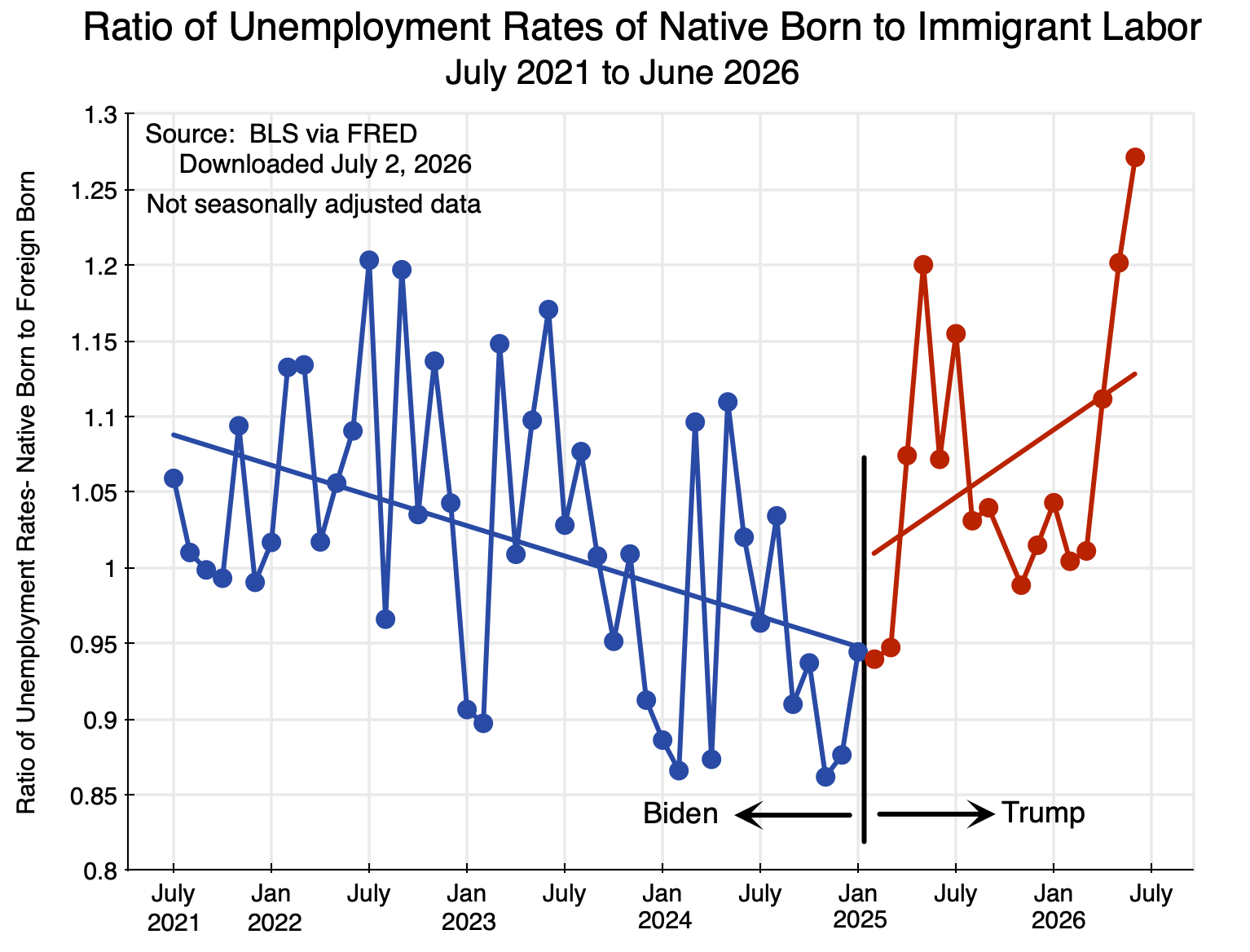
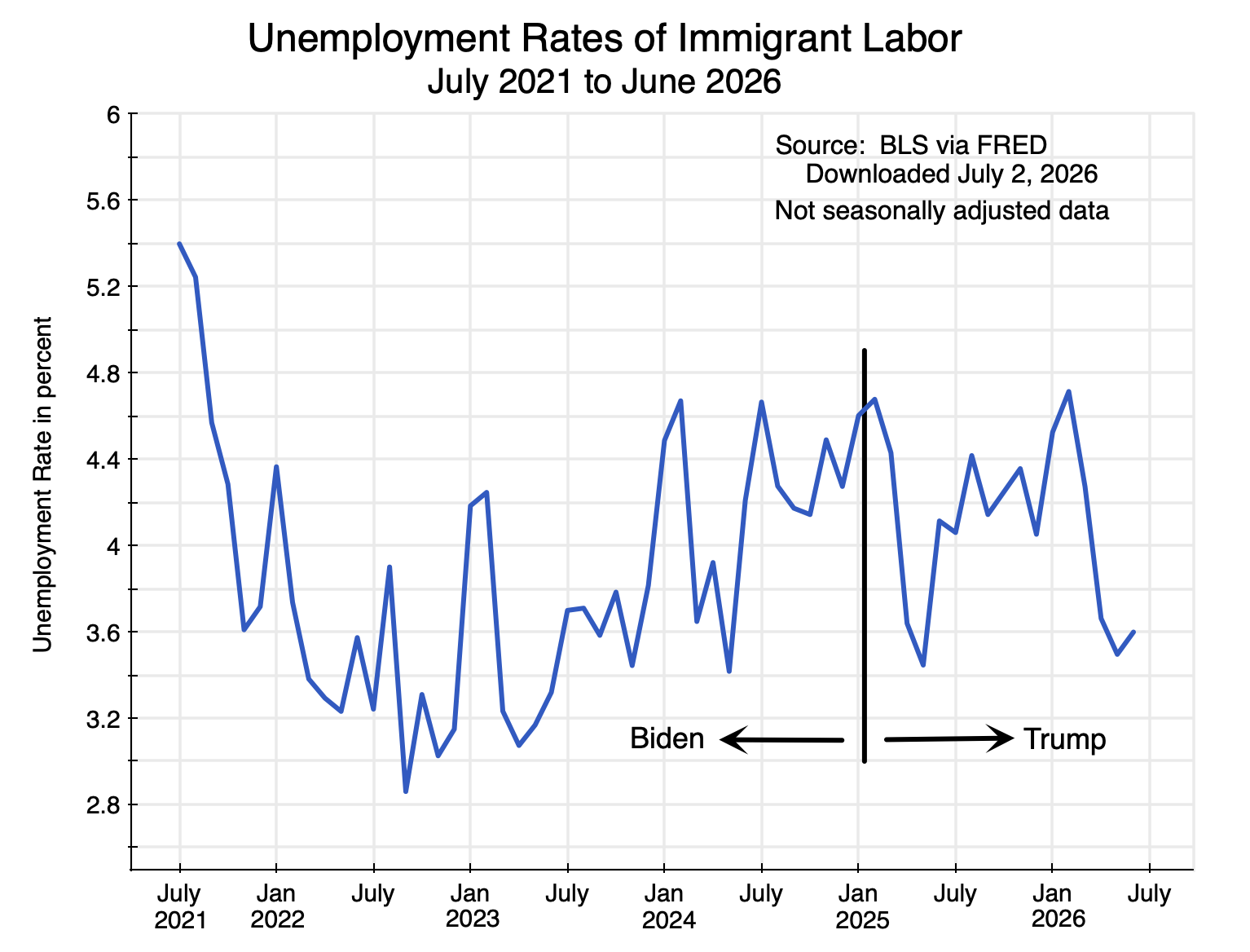
Migrant workers contribute to the economy. The value of their work in a market system (and as measured in the GDP accounts) is greater than what is paid to them in wages. Furthermore, removing them from their jobs has not led to a reduction in unemployment of native-born workers. That is, the jobs they had are not now being taken up by previously unemployed native-born labor. Their unemployment rate as of July, while low at 4.6% for the native-born population and 4.1% overall, was lower under Biden. Removing migrant workers has led to a smaller labor force and thus the contribution they make to the economy.
E. Demand is Growing Faster Than Supply
GDP growth, as discussed above, has weakened significantly under Trump. GDP is a measure of domestic production (i.e. supply). While often measured through the demand components of GDP (since what is produced will be sold, once one takes into account changes in inventory levels), GDP is not itself equal to demand.
One can, however, easily arrive at a measure of aggregate demand by adding up the estimates for Personal Consumption Expenditures (expenditures by households on consumption items), for Private Fixed Investment, and for Government Spending on goods and services. This is known as “Final Sales to Domestic Purchasers” and differs from GDP in that it leaves out changes in inventories (hence the use of the term “Final”) and also the trade balance (i.e. Net Exports, or Exports minus Imports, and hence the term “Domestic Purchasers”). A drawdown of inventories will add to the flow of supply produced domestically in the period, as will the net amount obtained through the trade deficit (with an increase in net supply by exporting less or importing more).
Expansions in aggregate demand can lead to an expansion in domestic supply in the standard Keynesian way when there is available extra capacity to produce those goods and services as well as labor that can be hired. But there are limits to what can be produced domestically, including limits on how much labor can be newly hired when an economy is at or close to full employment. At times such as those, an increase in aggregate demand will not be met by a similar increase in aggregate domestic supply, but rather by increased pressure to draw down inventories and to run a larger trade deficit by exporting less and especially (and usually) by importing more.
This is what was observed in the accounts for the most recent quarter. Final Sales to Domestic Purchasers rose at a 3.1% rate, but domestic supply (GDP) could not keep up and rose at only a 1.5% rate:
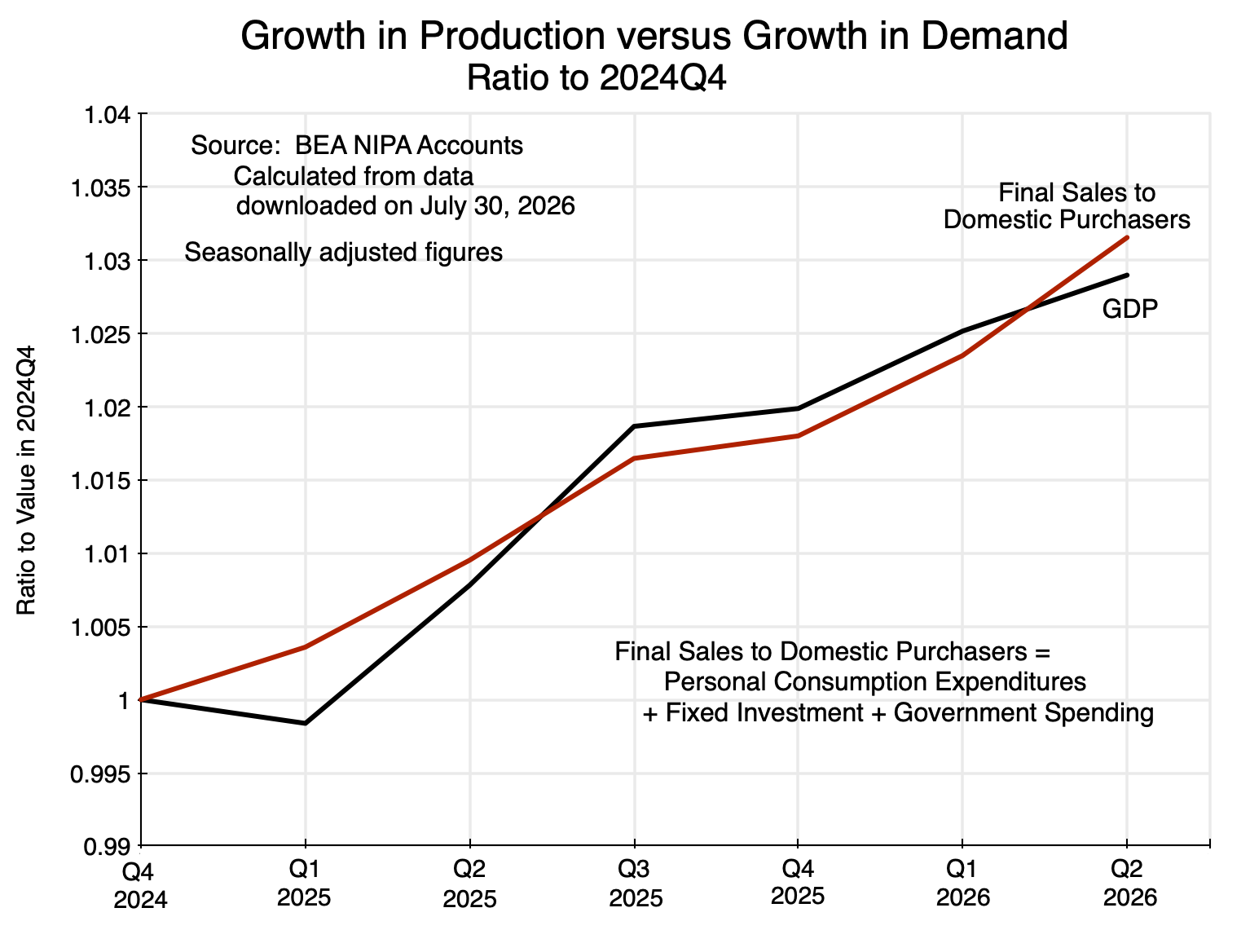
Chart 4
The chart shows the increases in demand (Final Sales to Domestic Purchasers) and domestic supply (GDP) – all in real terms – during Trump’s current term in office. They will normally move roughly in parallel. The fall in GDP in the first quarter ot 2025 was mostly due to the anticipation that Trump would soon be charging high tariffs on imports (which he did), leading firms to accelerate their purchases of imports to get ahead of the anticipated tariffs (with a resulting major increase in the trade deficit in the period), along with a cut back in purchases from domestic suppliers to balance this.
Note, however, that while the curves in the chart cross in the second quarter of 2026, no special significance should be assigned to that fact alone. They are both drawn relative to their levels in the fourth quarter of 2024, and there was already a trade deficit in that period. Indeed, the US has run significant trade deficits since the 1980s when, under Reagan, there were large tax cuts as well as major increases in government spending (primarily for the military).
Rather, the point to note is that the increase in Final Sales to Domestic Purchasers (demand) in the second quarter of this year was significantly greater than the increase in GDP (supply). To meet that higher demand, the economy had to draw down inventories and run a larger trade deficit. The relatively weaker growth of GDP (of just 1.5%) is a sign that domestic production could not keep up with the increase in domestic demand.
Not surprisingly, White House officials as well as at least some news reports misinterpreted this and treated the relatively rapid growth in demand as a sign of strength in the economy. Demand did, indeed, grow. But supply could not keep up. That is what happens when an economy starts to overheat. And when an economy overheats, inflation rises.
F. Inflation is Rising, and Real Wages and Personal Income Are Falling
Inflation has gone up this year, driven in part by the high oil and gas prices resulting from Trump’s decision to start a war against Iran. But inflation in fact started to rise last fall, well before the attacks against Iran were launched on February 28.
Inflation rates over rolling six-month periods work well for finding turning points. There is too much statistical noise in one-month only changes, while changes over twelve months (i.e. year-on-year) are too long before changes in trends are recognized. Yet most analysts and news reports focus on the one-month and twelve-month changes.
Based on the six-month rolling change in prices, increases in the price indices for Personal Consumption Expenditures (both overall and core, where the core price indices exclude food and energy) were mostly within the range of 2.5 to 3.0% at annual rates through most of 2025 (with a few exceptions on each side). They were also about that, on average, in the last two years of Biden’s term. But the rate of increase of both price indices then started to go up in the six-month periods ending in January and especially February 2026. Note that prices for these indices are recorded as of the middle of each month, so the first set of prices following the February 28 start of the war on Iran are reflected in the March figures:
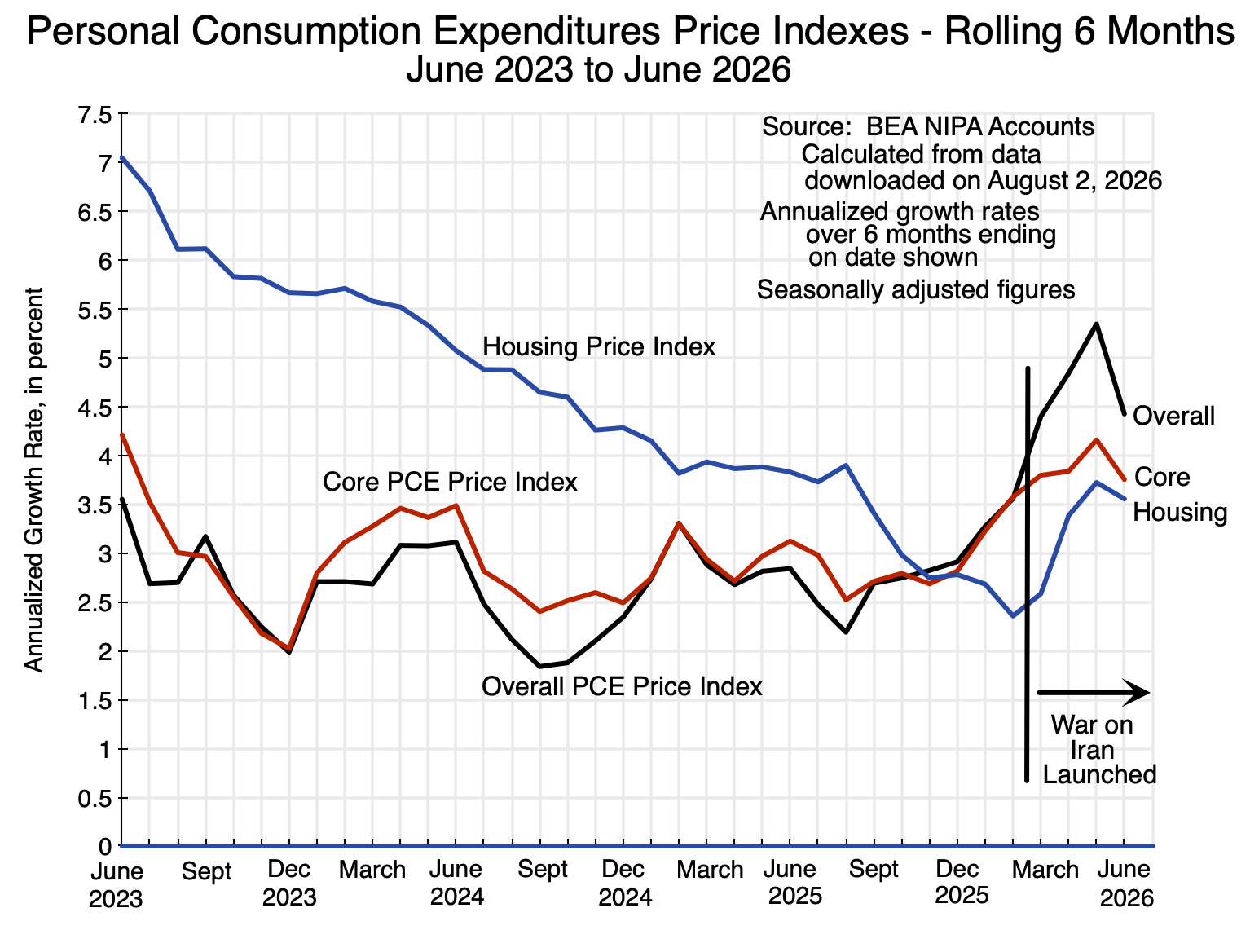
Chart 5
Note also that inflation in the price index for Housing had been falling steadily from at least 2023. Housing has a significant weight in the PCE price indices (15% in the overall PCE price index and 17% in the core PCE price index – see the discussion in this earlier post on this blog), so it matters. But the housing price index also changes with a lag, as it is estimated from surveys of rental households on their cost of renting similar housing. Rental contracts are typically set in the US for a 12-month period. Inflation in the price index for Housing, as measured, continued to fall into 2026, and in fact fell below the rates for the overall and core PCE price indices. This acted to moderate somewhat the rise in those indices in late 2025 and early 2026. But then inflation in the price index for Housing soon started to rise as well, confirming the general upward pressures seen on prices.
A consequence of the rise in inflation has been a fall in real wages:
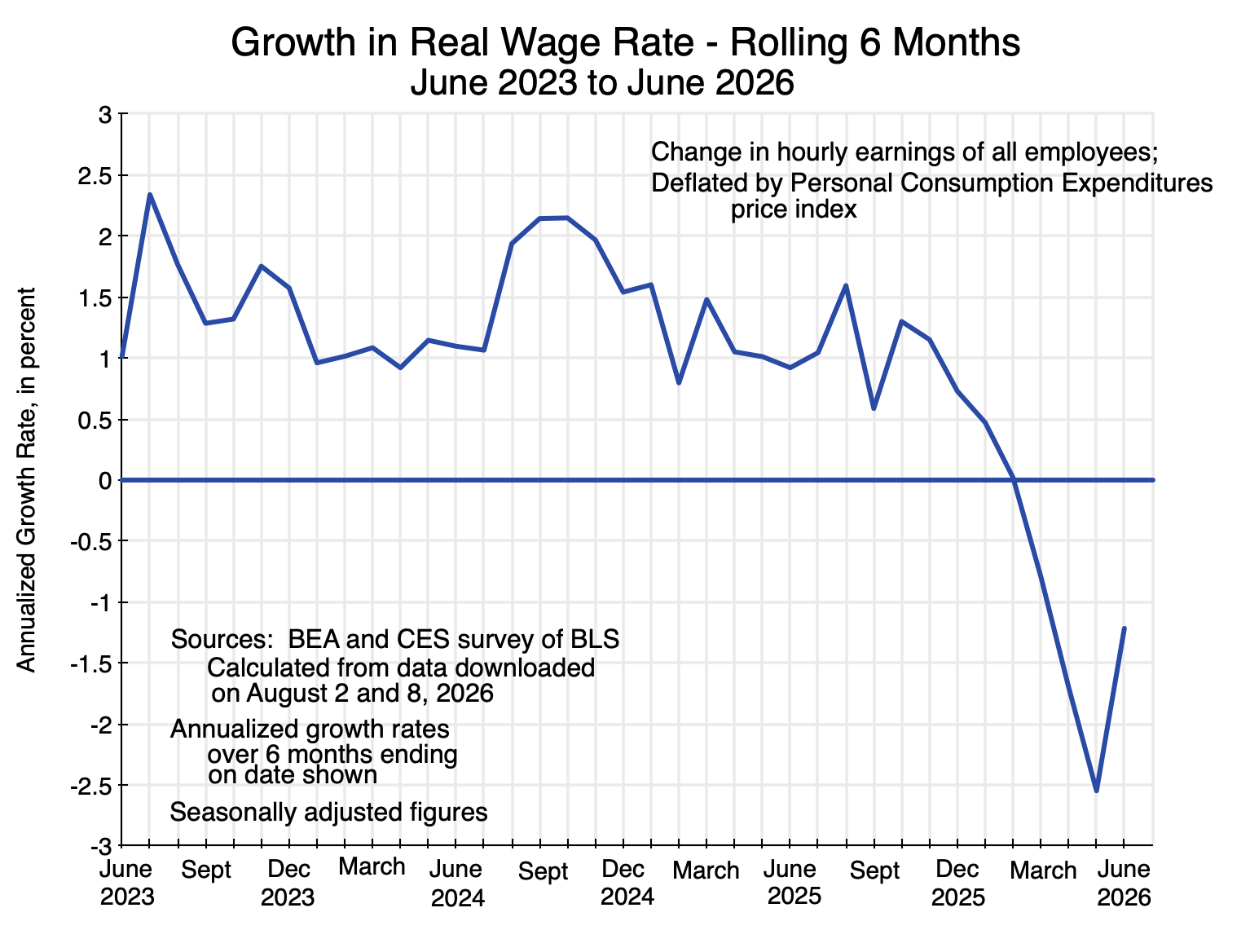
Chart 6
Real wages were rising in the last two years of the Biden administration, but in 2026 wages have not kept up with rising prices and have fallen in real terms. Should wage demands now rise to try to offset this, there is a danger that the economy could end up in a wage-price spiral.
The result has also been a fall in real per capita Disposable Personal Income:

Chart 7
Real Disposable Personal Income had been steadily rising as Biden left office, and continued upward in the early part of Trump’s term. But it already started to falter in late 2025 (notably before the Iran war had its impact on prices) and is down in 2026. (Disposable Personal Income is Personal Income after personal taxes are paid and transfers – such as Social Security – are received. It is deflated in the NIPA accounts by the PCE price index.)
Inflation will increase when an economy is operating at full capacity and full employment, and there is pressure from demand rising by more than supply. That is consistent with what is observed here. Demand – at least through the second quarter of 2026 – has grown at a relatively rapid pace. But supply has not kept up, and is indeed slowing. Given what Trump has done, that is not surprising.
G. Trump’s Policies Are Hurting Growth
Why has growth weakened? The purpose here is not to provide an in-depth analysis, but rather just to summarize a few of the more obvious examples of decisions that have hurt growth and increased costs:
a) High, arbitrary, and often capricious tariffs have been imposed on essentially everyone, including on imports from nations that had been the closest allies of the US. Many were announced by Trump in late-night posts on his social media accounts. Trump also often soon changed them to something else – also often announced via social media. Not only did they violate international trade treaties that the US had negotiated and approved over decades, many were also clearly illegal under US law. But it took some months for the cases to wind through the courts to an eventual final decision.
Tariffs have an immediate impact on prices. They are in essence a sales tax, paid by the American firms importing the items and then passed on (to the extent they can) to American households. Trump has insisted that foreign exporters are bearing the cost of the tariffs (by reducing the prices they charge by that amount, he asserts), but careful empirical studies of the actual data have found this not to be the case. While theoretically possible, a recent careful study found that US firms and households are bearing 96% of the cost of Trump’s tariffs. Other studies have had similar findings.
In addition, with high but variable and uncertain tariffs facing them, firms are in a poor position to plan on how much to invest and in what. They cannot be sure how much they will be paying in tariffs on what they need to import, nor what price they will be able to charge for what they produce. It is thus not surprising that investment in everything other than items related to the AI boom has declined under Trump (as seen in Chart 2).
b) Trump’s aggressive policies against migrant workers have reduced the labor force. But labor is needed in an economy. And removing migrants from the labor force has not led to increased employment of native-born workers: Their unemployment rate – while relatively low (4.6% as of July 2026) – is higher than what it was during Biden’s term.
With less labor, less can be produced. But what is produced with labor has a value greater than what is paid in wages in a market system (and as measured in the GDP accounts), so the cost is borne not just by those taken away from the workforce. The result is slower growth.
c) The war Trump started against Iran on February 28 has also hurt the economy. It led to increases in the cost of not just oil (crude and refined products), but also items such as natural gas (LNG), petrochemicals, fertilizers and fertilizer components, and other such products due both to direct war damage and to a drastic reduction in shipments through the Strait of Hormuz. While the US is also a producer of many of these, US firms and households will still pay higher prices for such products (and for the products that these are used as inputs to) as the prices are determined globally for such goods.
d) Trump has also brought in blatant clientelism, where favored firms and friends can benefit greatly while unfavored firms are punished. There have been several avenues for this. One has been “donations” by firms to special projects Trump has initiated. An example is the building of a grandiose new ballroom on the grounds of the White House, where as of last November over 37 firms and individuals had donated $300 million. There have also been massive amounts raised in various Political Action Committees sponsored by Trump, where already in August 2025 Trump said on his social media platform that over $1.5 billion had been raised since his November 2024 election. This is unprecedented for a president in his second term. And there have been numerous examples of direct payments coinciding with favorable treatment in legal cases, presidential pardons, and similar actions by the administration.
Trump and his immediate family have gained unprecedented wealth during his new term in office. Only rough estimates are possible, however, as Trump has been far less transparent than prior presidents on his finances. Prior presidents released their tax returns, for example, but Trump has refused. A minimum estimate is possible based on a mandatory financial disclosure, but that disclosure only provides figures in ranges, such as $5 million to $25 million, $25 million to $50 million, and anything above $50 million. But based on what was provided in the disclosure, reporters at The New York Times concluded that Trump brought in a minimum of $2.2 billion in 2025.
Firms and wealthy individuals may well feel obliged with this presidency to make such payments. They have good grounds to fear punishment if they don’t. But the impact of such clientelism – where the favored firms then benefit from government contracts directed to them, special exemptions in the new tariff regime, special tax treatment, and so on – is harmful to the economy as a whole.
e) While the impact will be in the next year or two, a particularly perverse example of the policies of this administration has been its use of taxpayer funds to stop work that was underway on a series of offshore wind power projects. The Trump administration at first sought to halt all offshore wind power generation projects then under development by claiming “national security” issues. After a judge rejected this, the administration adopted an approach where it would use taxpayer funds to pay the energy companies to abandon their projects. With the recent announcement (on August 6) of another such deal, the Trump administration has paid five firms close to $4 billion to walk away from offshore wind projects in development.
The projects would have added a total of 23,900 MW (megawatts) of generation capacity. To put this in perspective, the US added a total (in gross terms) of 53,000 MW of generation capacity in all forms of power generation in 2025. The 23,900 MW of the canceled projects would have been 45% of all that was added in the country in 2025. That power is desperately needed, as the data center expansion requires massive amounts of new power and those demands are driving up power costs for everyone. And wind projects – once built – have close to no marginal cost to run as they do not burn fuels.
It is not only offshore wind power projects that this administration has sought to block. It is also blocking onshore wind projects – projects that provide especially inexpensive (as well as clean) power. It has, for example, simply refused to provide the once routine approvals needed to ensure there are no national security issues (which, while rare, could then be addressed through design changes). A total of 29,000 MW of additional power generation capacity (a further 55% of the total new capacity added in the US in 2025 from all power sources) was being blocked in this way. The Defense Department simply did nothing, thus holding up these desperately needed additions to US power capacity. On August 6, a judge (appointed by Trump in 2019) ruled that the Defense Department could not simply sit on the applications and had to carry out its responsibility to provide the mandated reviews.
In response to criticisms such as those above, Trump has claimed that a boom is underway. Indeed, in a signed column published in the Wall Street Journal (titled “My Tariffs Have Brought America Back”), Trump asserted that “more than $18 trillion” in new investment commitments have been made by foreign nations in trade deals negotiated in response to his tariff threats. He noted that such a number is so large that it is “unfathomable to many”.
It is, indeed, unfathomable. It is also totally unrealistic and will never be done. But suppose that it were. While a time frame has not been provided, assume the $18 trillion would be invested over six years, and hence would amount on average to $3 trillion in new foreign investment into the US each year.
To make such investments, foreign investors need dollars, and they can only obtain the dollars by exporting more to the US (i.e. the US importing more) or by importing less from the US (i.e. the US exporting less). The US trade deficit would have to increase. The broadest measure of the foreign trade balance is the current account balance, which in addition to trade in goods and services, includes payments for items such as earnings on capital that US nationals have invested abroad.
The current account balance for the US in 2025 was a deficit of $1.2 trillion (in the BEA estimates). If there were to be an additional $3 trillion each year in net new foreign investment into the US financed from abroad, this would need to grow to $4.2 trillion. That is, the current account deficit would have to more than triple, from a level that Trump already considers to be far too high. This is just basic economics, but evidently no one on Trump’s staff has explained this to him.
H. Scenarios
What may happen going forward? Four scenarios are worth considering. They are ranked here in order from what is probably the most likely (at least for the near term) to the least likely:
a) Continue similar to now, but with some easing in the growth of demand to align better with the slower growth in supply:
Growth in GDP could continue at a relatively slow pace. This would be sustainable provided the growth in aggregate demand slowed similarly rather than increase at a faster pace (as it did in the second quarter, when demand grew at a 3.2% rate while supply – GDP – grew at a 1.5% rate). Price pressures would then subside.
The largest component of demand is Personal Consumption Expenditures. It was equal to 68% of GDP in the second quarter of 2026, and grew at a 3.2% annual pace in the quarter in real terms. But real Disposable Personal Income fell in the second quarter at a rate of 1.7%. With Personal Income falling while expenditures rose, the Personal Savings Rate (defined as a percentage of Disposable Personal Income) fell to just 2.8% in the second quarter (and 2.7% in the month of June only). This is only half of the 5.4% savings rate in 2024, and even further below the pre-Covid rate in 2019 of 7.3%.
The Personal Savings Rate cannot go much lower, and indeed should be expected to rise. Even if incomes do not continue to fall in real terms, it is likely that consumption expenditures will need to be pulled back to something more sustainable. This would reduce the growth in aggregate demand, which would bring it into better balance with the slower growth in supply.
The Fed could also help bring demand growth in line with the slower growth in supply by raising interest rates. But the new chair of the Fed – Kevin Warsh – was nominated by Trump in large part due to his promise to reduce (not raise) interest rates. Trump has repeatedly called for lower interest rates, not recognizing (and with his economic advisors evidently not telling him) that lower interest rates would increase further the pressure for higher prices. It is difficult to say how soon Warsh will openly admit that he (and Trump) are wrong, and that interest rates should go up and not down.
b) Demand continues to grow faster than supply:
If the growth in demand continues to exceed the growth in supply, one should expect both a larger trade deficit and greater pressure on prices. This can be sustained as long as foreigners are willing to fund that trade deficit and the higher rate of inflation is tolerated. However, that higher rate of inflation might well lead to greater pressure from labor for wage increases to offset the higher prices, with a resulting wage-price spiral.
This is a recipe for stagflation. Supply is not growing all that fast and might fall further behind demand if the efforts by labor to protect living standards lead to disruptions. But prices are already rising at a relatively rapid pace compared to what they have in recent decades; labor may become increasingly active to try to protect its real living standards; and prices could then rise even faster.
c) The AI boom is a bubble that bursts:
Much of the growth in GDP – such as it is – is accounted for by the growth in what is being produced for the boom in AI investments. Whether that boom in AI investments is sustainable has been questioned by some. The amounts being invested are massive, and announced plans are far greater.
And even if the AI investments turn out to provide AI services that are found to be valuable to the economy as a whole, it is not clear that the firms providing those AI services will profit by enough to cover the cost of those investments. Booms and then busts in new technologies have happened repeatedly over the years, from the 19th-century boom in railway investments up to the boom and then collapse in the internet bubble of 1999/2000. The product may well be valuable, but with increased supply the price of what the new technology provides comes down and the investing firms may end up bankrupt.
This would lead to equity prices falling and possibly crashing, and a resulting cutback in consumption expenditures (by investors in those equities) on top of a rapid fall in AI-linked investments. The impact would likely be far less than what happened in 2008/2009 as a result of the collapse in the housing bubble – as mortgage securities were far larger relative to the size of the economy than investments in the AI firms are. But it could be similar to the recession in 2001 that followed the bursting of the internet bubble, when the unemployment rate rose from below 4% (in 2000) to a peak (in 2003) of 6.3%.
Price pressures would be relieved, but at the cost of higher unemployment.
d) Trump reverses his policies:
Finally, there could be a scenario where Trump recognizes the imbalances in the economy and the harm being done to growth by his policies. There would then be a reversal of the policies listed above.
But the likelihood of that is next to zero.
I. Conclusion
Growth has slowed under Trump. What may happen next is not clear, and there are a range of possible scenarios, as described above.
But while growth is on a downward trend, that does not mean that exceptionally fast growth in estimated GDP is not possible in any given quarter. There is substantial volatility in the estimated quarter-to-quarter growth rates for a number of reasons. For example, overall GDP growth averaged 1.9% (at an annual rate) over the six quarters of Trump’s second term. But the growth rates of those six quarters taken individually were (in order): -0.6%, 3.8%, 4.4%, 0.5%, 2.1%, and 1.5%. The range was from a low of -0.6% to a high of 4.4%. This volatility can be due not just to policy issues during the period, but also the impacts of idiosyncratic factors (such as from weather events) as well as statistical noise. Hence it is better to focus on the trends.
The reduction in the pace of overall GDP growth since Trump took office also masks that much of that growth was due to production for the massive new investments in AI-linked data centers and related items such as software. Taking out an estimate of the production for that, growth in the entire rest of the economy grew at a pace of just 0.9% since Trump’s second term started. And that “rest of the economy” is 92% of the total economy. Even after the rapid recent growth in the AI-linked investments, the production for that investment (as estimated above) currently accounts for just 8% of GDP.
This is now a two-track economy, where those firms (and their employees) working in the development and supply of AI services are doing well (often exceptionally well, financially), while the rest of the economy is lagging. There have certainly been spillovers from the investments linked to AI to the rest of the economy (which is overall stimulative, although also with negative impacts such as on power prices), but even with that spur, growth outside of production for AI investments has weakened markedly.
The slowdown is not surprising, as discussed above. The Trump administration has aggressively pushed policies that have deterred investment (leading to the slump in investment not linked to AI – Chart 2 above), and reduced the labor force (Chart 3). It should not then be surprising that the growth in supply (GDP) has diminished. But the growth in domestic final demand has been high this year – outstripping supply (Chart 4) – thus leading to greater pressure on prices (Chart 5), and a resulting fall in real wages (Chart 6) and in real personal incomes (Chart 7).
Worst of all, although not surprising: there is no sign that Trump recognizes this. In early August, for example, Trump asserted at a speech in Las Vegas “The economy’s the greatest economy we’ve ever had by far.”
Until the problems are recognized, nothing will be done to address them.




You must be logged in to post a comment.