
Chart 1
This post will provide a short update to the earlier post on the weakening of GDP growth since Trump took office in January 2025, with attendant signs of the economy overheating. The BEA released on October 29 its initial estimate (its “advance estimate”) of GDP growth in the third quarter of 2026, and earlier, on September 30, it released revisions to the GDP accounts for the past five years – a regular updating that it does annually.
The updated GDP estimates released on September 30 indicate real GDP grew marginally faster in the six quarters leading up to the second quarter of 2026 (i.e. over the course of Trump’s presidential term), with growth at an annual rate of 2.1% versus 1.9% estimated before. Growth in the second quarter of 2026 was somewhat faster than earlier estimated for that quarter alone (at an annual 2.2% rate versus 1.5% estimated before). And the recently released figures for growth in the third quarter of 2026 show estimated growth in the quarter of a robust 3.4% at an annual rate.
While these revisions and new estimates have been positive, they are also modest and have not changed the basic story on the slowdown in growth during Trump’s presidential term. The story remains one where AI-linked investments have been driving the growth that there is; overall growth has nonetheless slowed since Biden was in office; and growth in the entire rest of the economy not part of the AI-linked investments has slowed especially sharply.
Furthermore, while the growth in GDP (a measure of what the economy has produced, i.e. supply) has slowed, demand has grown significantly faster – especially in 2026. That has led to the need to import more and/or export less, i.e. to an increase in the trade deficit. That deficit has now hit a record high level.
This illustrates well the fundamental fallacy and confusion in the argument made by Trump and his officials that high tariffs will reduce the nation’s trade deficit, and indeed bring it all the way (they assert) to zero. As discussed in the earlier post on the Trump economy (and analytically in this post from 2018, during Trump’s first presidential term), the fundamental determinant of the foreign trade balance of an economy is the balance between aggregate supply and aggregate demand (what an economy produces versus what those in the economy purchase), or equivalently in terms of the savings/investment balance. Tariffs may affect which specific items are purchased and from which countries, but they do not play a direct role in the balance between aggregate supply and aggregate demand.
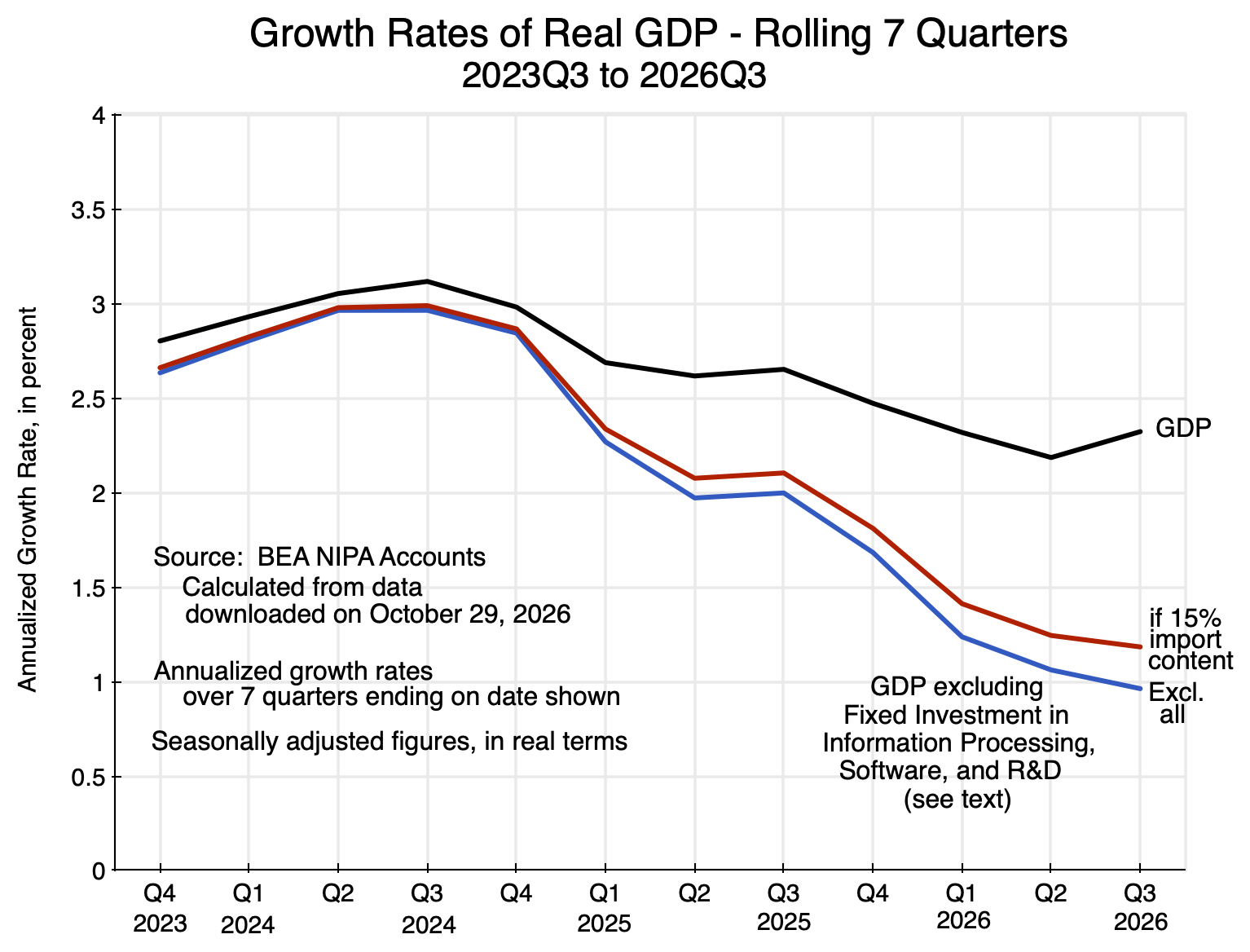
To start, the chart at the top of this post shows the growth in GDP in the updated estimates on a rolling 7-quarter basis (the number of quarters Trump has been in office) from late 2023 to now. In the seven quarters leading up to the end of Biden’s term in office, real GDP grew at an annual rate of 3.0%. In the seven quarters since Trump took office, it slowed to 2.3%.
Furthermore, much of this growth was directly tied to the boom in AI-linked investments – investments which became significant in 2025 and rose more sharply in 2026. The GDP accounts provide estimates of private fixed investment in information processing equipment, in software, and in research and development. While such investments will cover more than that linked to AI, much of the increase in those investments in the last two years has been due to the investments made to develop and operate the new AI systems (e.g. in new data centers). They still leave out associated investments for those data centers, such as for additional power generation, water supplies, and other needed inputs, leading to an underestimation of AI-linked investment. But part of what will be needed for such AI-linked investments will also be imported (such as high-end semiconductor chips) rather than domestically supplied. As discussed in the earlier post, a rough estimate is that perhaps 15% of what is spent is supplied by imports.
Based on this 15% estimate, real GDP in all of the economy other than that directly linked to investments in the new AI systems fell from a rate of 2.9% in the seven quarters leading up to the end of Biden’s term, to just 1.2% since Trump took office. That is a fall of almost 60%.
There are a number of reasons for this, as discussed in the earlier post. One is that private fixed investment in everything other than investments supporting the AI boom has gone down:
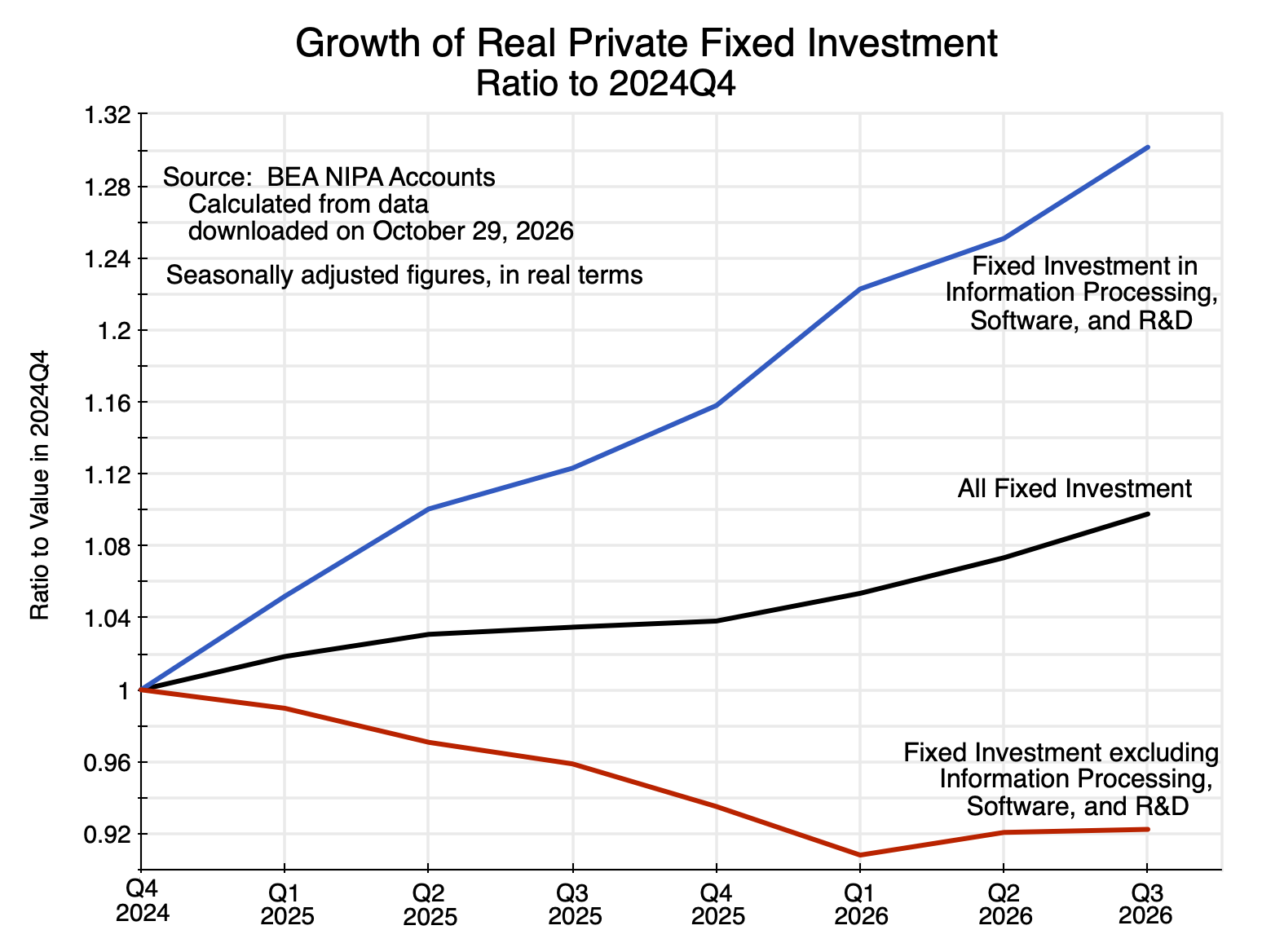
Chart 2
While such investments have stabilized so far in 2026, they are still 8% lower in real terms than what they were in the fourth quarter of 2024, at the end of Biden’s term. Trump’s policies have simply been bad for investment. While total private fixed investment is now 10% higher than where it was at the end of 2024, this is only because AI-linked investments are 30% higher.
While growth in aggregate supply has slowed, growth in domestic demand has exceeded it, especially in 2026:
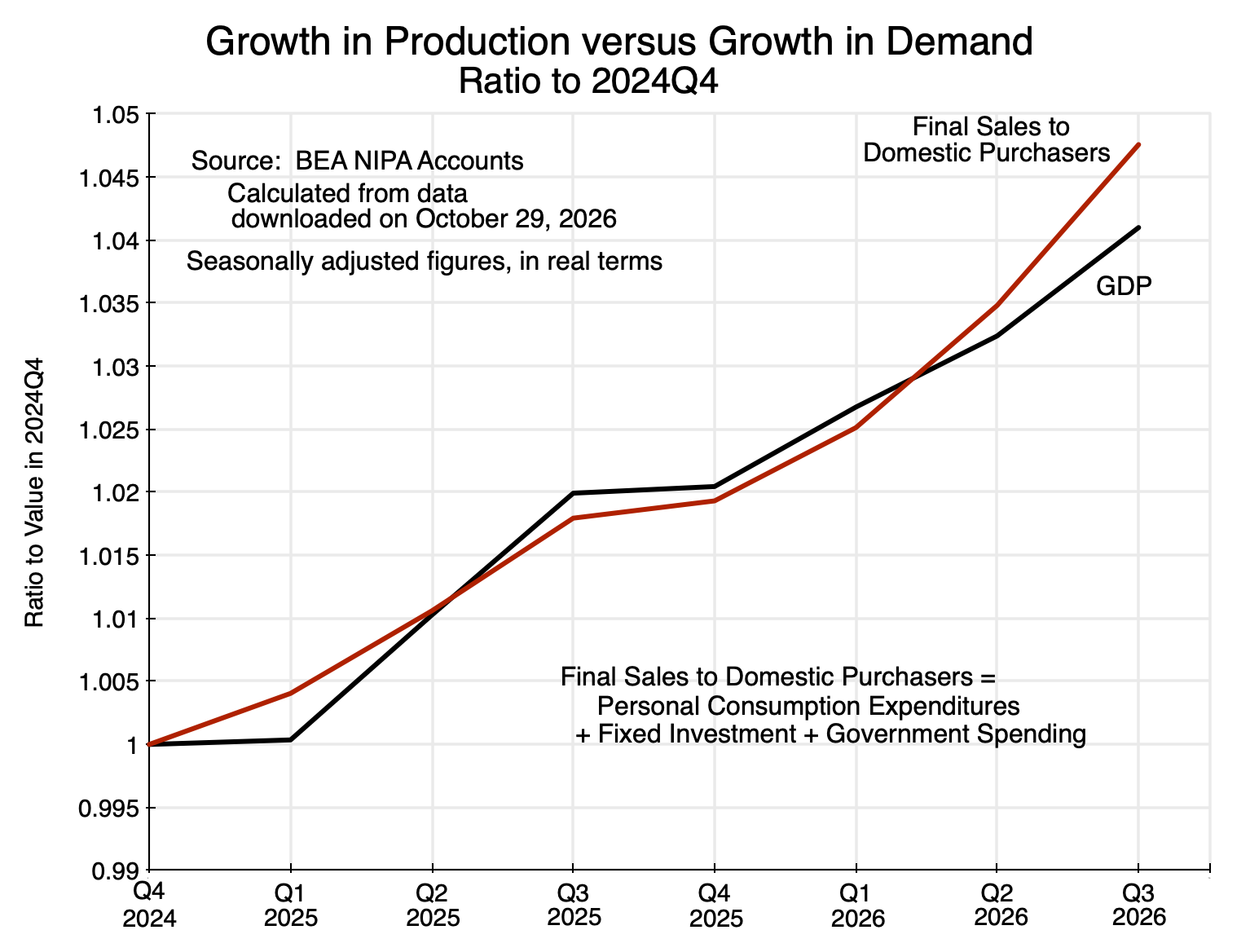
Chart 3
Domestic final demand has grown more rapidly than supply, especially in this second year of Trump’s presidential term. As discussed in the earlier post, GDP is a measure of supply. Final sales to domestic purchasers can exceed what is domestically supplied (i.e. GDP), but only by importing more, by exporting less, or by drawing down on existing inventories. In the second quarter of 2026, the gap was filled in part by a substantial drawdown of inventories. However, that led to low inventory working levels, and in the third quarter of 2026 they were not (and likely could not be) drawn down further. Indeed, inventories were replenished modestly.
This left the gap to be filled by importing more or exporting less. There was some of both. Real imports rose at an annual rate of 19.7% while real exports fell at an annual rate of 5.7%. The result was a larger trade deficit:
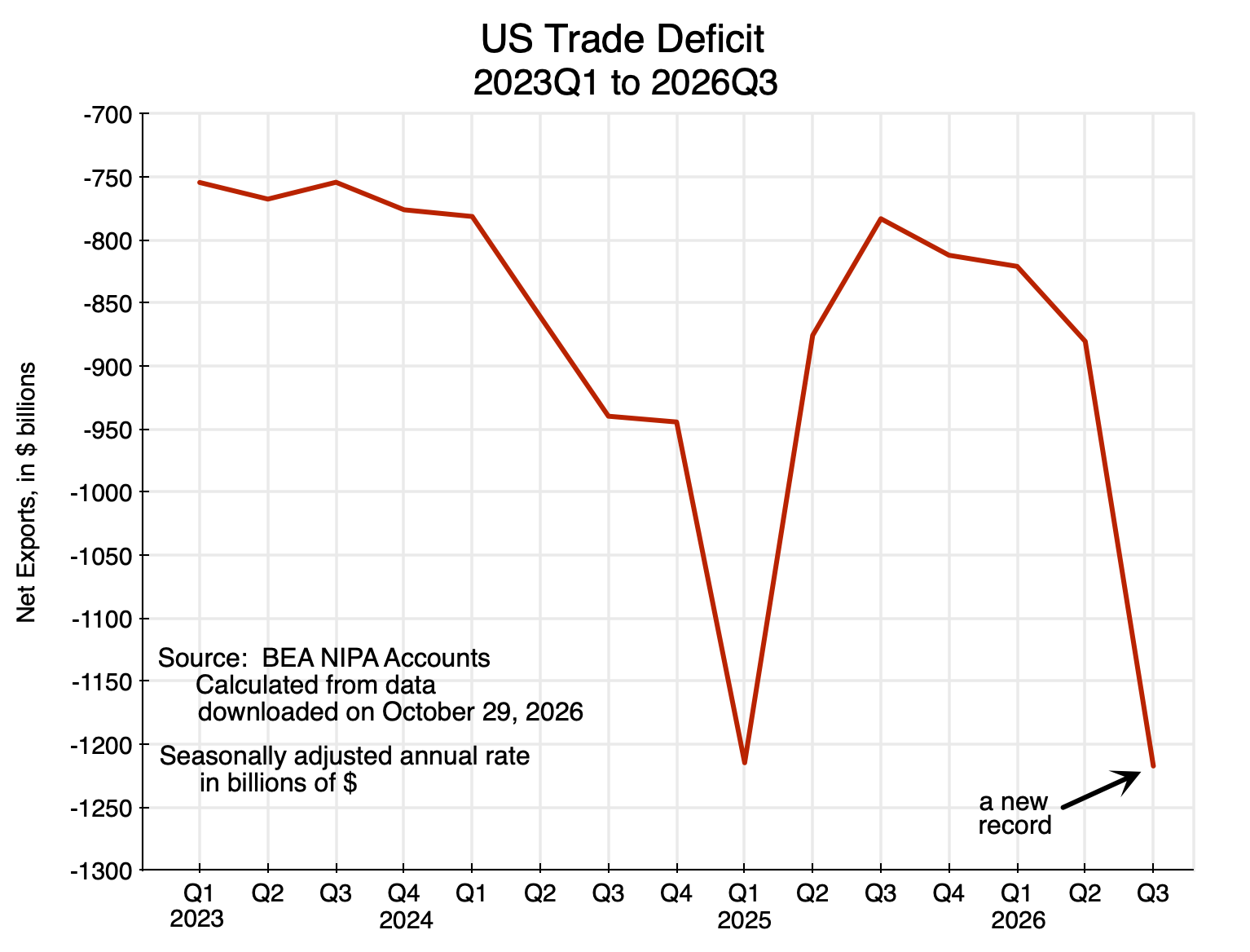
Chart 4
The trade balance as estimated in the NIPA accounts fell to a record deficit (in current dollar terms) in the quarter: a deficit of $1.22 trillion. This is marginally higher than the previous record in the first quarter of 2025, when importers accelerated their purchases in order to stock up before Trump raised tariffs. That then led to lower imports in the rest of 2025 as those stocks were drawn down. But now in 2026, imports have grown to record high levels due to the imbalance between aggregate demand and aggregate supply.
This is an indication of an economy that is overheating. Supply is not keeping up with demand, leading to the need to import more and export less. Drawing down inventories was an additional source of supply in 2025 and in the first half of 2026, but appears now to no longer be an option.
Trump does not understand that tariffs do not have a direct effect on this overall balance. And evidently none of his advisors are willing to explain that to him (assuming they understand the point themselves).
But Trump frequently does like to say that he has been number one in numerous areas. He can now truthfully say that under no previous president has the trade deficit been as high as it is now – well into the second year of his current term.


You must be logged in to post a comment.