Red States vs. Blue States: Lower Incomes and Less Growth in Texas

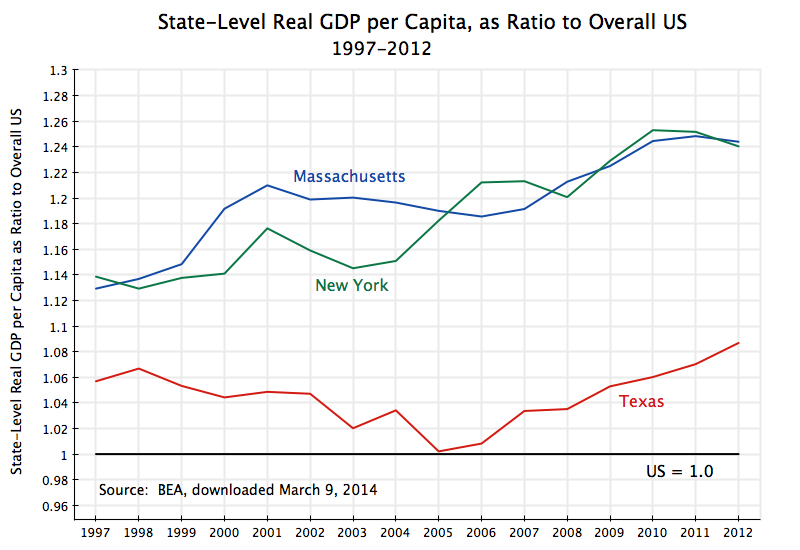
State-Level Real GDP per Capita as Ratio to US, 1997-2012

A.  Introduction

Texas Governor Rick Perry’s speech on March 7 to the annual CPAC (Conservative Political Action Conference) meetings was described by various news web sites as “a barn burner address” that wowed the conservatives, as “a rousing speech that was one of the best-received of the conference so far”, as a “fiery speech that ignites CPAC”, as a speech that brought “the audience to its feet and eliciting loud cheers”, and that “received huge applause throughout his rousing speech”.

Rick Perry has been Governor of Texas for more years than any other governor in Texas history.  He was elected Lieutenant Governor in 1998, and became governor in December 2000 when George W. Bush resigned to become President of the US.  Perry was then elected governor in his own right three times (in 2002, 2006, and 2010), the first Texas governor to be elected to three four-year terms.  He is not now running for a further term, and thus will step down following the election later this year.  It is widely assumed he will once again seek the Republican nomination for the Presidency in 2016, and many interpret his CPAC address as confirming this.  He is well known for the failure of his 2012 campaign seeking the Republican nomination, when he quickly went from front-runner to quitting following a series of goofs.  The best known was in one of the debates with the other Republican contenders, when he said he would close three cabinet level departments in the federal government but could only remember two, in his famous “oops” moment.

Perry’s speech at CPAC set forth what will likely be a major theme of his upcoming presidential campaign:  the contrast between the great performance (in his view) of red states (conservative states that generally vote Republican) and the terrible performance of blue states (liberal states that generally vote Democratic).  As the longest-serving governor of the premier red state of Texas, it is not surprising that Perry would say this.  But what has the performance actually been?

B.  Real GDP per Capita

The graph at the top of this post presents one key measure:  real GDP per capita, presented as a ratio to the US average.  Texas is shown (in red), along with two of the top blue states:  Massachusetts (in blue) and New York (in green).  The figures are calculated from data issued as part of the GDP accounts by the Bureau of Economic Analysis (BEA), which provides such data at the state level GDP on an annual basis (with 2012 the most recent available).  The current series goes back only to 1997, before which the state-level figures were calculated on a different basis, and thus are not directly comparable to the later figures.  But 1997 is also the year before Perry was elected Lieutenant Governor, so it provides a suitable starting point.

As the graph shows, real per capita GDP was substantially higher in Massachusetts and New York than in Texas in all of these years.  Indeed, per capita GDP in Texas actually fell relative to that for the US as a whole from 1998 to 2005 (meaning growth in Texas was slower than in all of the US over this period), after which it started to recover.  The oil boom resulting from the sharp escalation in oil prices from the middle of the last decade was certainly a factor helping Texas in recent years.

And it is not only in terms of real income levels where Texas has lagged.  Texas has also lagged Massachusetts and New York in terms of overall growth since 1997.  Real per capita GDP rose by 30.4% in Massachusetts over 1997 to 2012 and by 28.9% in New York, but only by 21.7% in Texas:
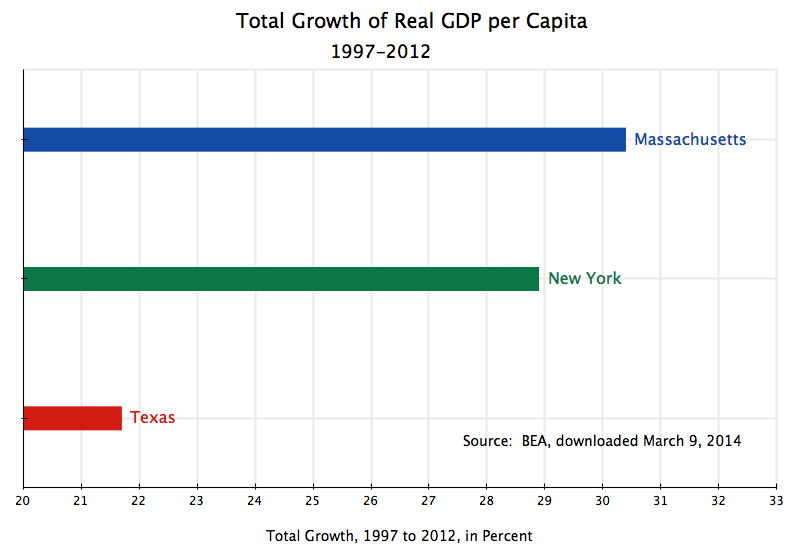
State-Level Growth of GDP per Capita, 1997 - 2012

C.  Personal Income per Capita

GDP per capita is the broadest measure of income generating activities in a state, but not all of GDP goes to households.  Part will go to corporations (and not distributed to households via dividends).  It therefore is also of interest to look at per capita personal income by state, again relative to that for the US  as a whole:
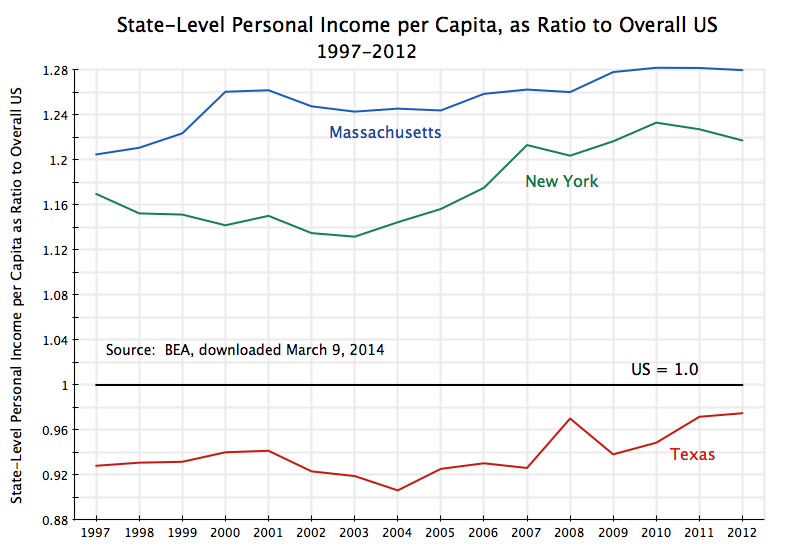
State-Level Personal Income as Ratio to US, 1997-2012

Once again one finds this measure of income to be far higher in the blue states Massachusetts and New York than in the red state of Texas.  But what is different and interesting is that personal income per capita in Texas is seen to be also below personal income per capita for the US as a whole.  A higher share of GDP generated in Texas goes to corporations than is the case for the US as a whole.  GDP per capita in Texas is somewhat above the US average (although not as much above as in Massachusetts or New York), but personal income per capita, once one subtracts the share going to corporations, is lower in Texas than for the US as a whole.

D.  Conclusion, and Re-Nationalizing the Postal Service

Conservatives, including not surprisingly Governor Perry, hold up Texas as the ideal which they want the nation to emulate.  But GDP per capita is lower in Texas than in the blue states of Massachusetts and New York, and has grown by less in Texas than in Massachusetts or New York over at least the last fifteen years.  In addition, personal income per capita is not only lower in Texas than in Massachusetts or New York (and very much lower), it is even lower than the US average.  Corporations account for a disproportionate share of incomes earned in Texas.

Perry closed his speech to CPAC, to cheers and loud rounds of applause, by declaring that the federal government should “Get out of the health care business, get out of the education business”.  Presumably this means Perry wishes to end Medicare, and that federal government assistance to students and schools up to and including universities should also end.  It is not clear, however, he has thought this far ahead on the implications of what he is calling for.  Calling for the end of Medicare, as conservatives have in the past, is not currently a popular position.

But while Perry said the federal government should “get out” of health and education, one area where he appeared to call for expanded federal responsibility was in the running of the postal system.  The proper federal focus, as established in his reading of the constitution, should be on defense, foreign policy, and to “deliver the mail, preferably on time and on Saturdays”.

The constitution does indeed call on the federal government to ensure postal services are made available.  But while this was done through a cabinet level department under the US President for many years, since 1971 the postal service has been run as a government-owned but independent establishment, run like a private corporation with its own board.  It is not fully clear what Perry means by arguing the federal government should return to its original mission vis-a-vis postal services, but the implication appears to a be reversal of its 1971 conversion from a cabinet level department to an independent agency run along private lines.  That would be an odd position for a conservative.  But I suspect he has not really thought this through.

Growth in France and the US: The Bottom 90% Have Done Better in France

France vs US, 1980-2012, GDP per capita overall and of bottom 90%

A.  Introduction

Conservative media and conservative politicians in the US have looked down on France over the last decade (particularly after France refused to join the US in the Iraq war, and then turned out to be right), arguing that France is a stagnant, socialist state, with an economy being left behind by a dynamic US.  They have pointed to faster overall growth in the US over the last several decades, and average incomes that were higher in the US to start and then became proportionately even higher as time went on.

GDP per capita has indeed grown faster in the US than it has in France over the last several decades.  Over the period of 1980 to 2007 (the most recent cyclical peak, before the economic collapse in the last year of the Bush administration from which neither the US nor France has as yet fully recovered), GDP per capita grew at an annual average rate of 2.0% in the US and only 1.5% in France.

But GDP per capita reflects an average covering everyone.  As has been discussed in this blog (see here and here), the distribution of income became markedly worse in the US since around 1980, when Reagan was elected and began to implement the “Reagan Revolution”.  The rich in the US have done extremely well since 1980, while the not-so-rich have not.  Thus while overall GDP per capita has grown by more in the US than in France, one does not know from just this whether that has also been the case for the bulk of the population.

In fact it turns out not to be the case.  The bottom 90%, which includes everyone from the poor up through the middle classes to at least the bottom end of the upper middle classes, have done better in France than in the US.

B.  Growth in GDP per Capita in France vs. the US:  Overall and the Bottom 90%

The graph at the top of this post shows GDP per capita from 1980 to 2012 for both the US and France.  The figures come from the Total Economy Database (TED database) of the Conference Board, and are expressed in terms of 2012 constant prices, in dollars, with the conversion from French currency to US dollars done in terms of Purchasing Power Parity (PPP) of 2005.  PPP exchange rates provide conversions based on the prices in two respective countries of some basket of goods.  They provide a measure of real living standards.  Conversions based on market exchange rates can be misleading as those rates will vary moment to moment based on financial market conditions, and also do not take into account the prices of goods which are not traded internationally.

Real GDP per capita (for the entire population) rose for both the US and France over this period, and by proportionately somewhat more in the US than in France.  These incomes are shown in the top two lines in the graph above, with the US in black and France in blue.  GDP per capita in France was 83% of the US value in 1980, and fell to 72% of the US by 2012.

But the story is quite different if one instead focuses on the bottom 90%.  The GDP per person of those in the bottom 90% of the US and in France are presented in the lower two lines of the graph above.  The figures were calculated using the distribution data provided in the World Top Incomes Database, assembled by Thomas Piketty, Emmanuel Saez, and others, applied to the GDP and population figures from the TED database.  The US distribution data extends to 2012, but the French data only reaches 2009 in what is available currently.

The Piketty – Saez distribution data is drawn from information provided in national income tax returns, and hence is based on incomes as defined for tax purposes in the respective countries.  Thus they are not strictly comparable across countries.  Nor is taxable income the same as GDP, even though GDP (sometimes referred to as National Income) reflects a broad concept of what constitutes income at a national level.  But for the moment (the direction of some adjustments will be discussed below), distributing GDP according to income shares of taxable income is a good starting point.

Based on this, incomes (as measured as a share of GDP, and then per person in the group) of the bottom 90% in France were 88% of the US level in 1980.  But this then grew to 98% of the US level by 2007, before backing off some in the downturn.  That is, the real income of the bottom 90%, expressed purely in GDP per person, rose in France over this period from substantially less than that for the US in 1980, to very close to the average US income of that group by 2007.  And since one is talking about 90% of the population, that is all those other than the well-off and rich, this is not an insignificant group.

C.  Most of the US Income Growth Went to the Top 10%

Figures on the growth of the different groups, and their distributional shares, show what happened:

France US
GDP per Capita, Rate of Growth, 1980-2007
  Overall 1.5% 2.0%
  Bottom 90% 1.4% 1.0%
Share of GDP, 1980
  Top 10% 31% 35%
  Bottom 90% 69% 65%
Share of GDP, 2007
  Top 10% 33% 50%
  Bottom 90% 67% 50%
Share of Increment of GDP Growth, 1980-2007
  Top 10% 36% 62%
  Bottom 90% 64% 38%

As noted before, overall GDP per capita grew at a faster average rate in the US than in France over this period:  2.0% annually in the US vs. 1.5% in France.  But for the bottom 90%, GDP per capita (for the group) grew at a rate of only 1.0% in the US while in France it grew at a rate of 1.4% per year.  The French rate for the bottom 90% was almost the same as the overall average rate for everyone there, while in the US the rate of income growth for the bottom 90% was only half as much as for the overall average.

Following from this, income shares did not vary much over the 1980 to 2007 period in France.  That is, all groups shared similarly in growth in France.  In contrast, the top 10% in the US enjoyed a disproportionate share of the income growth, leaving the bottom 90% behind.

In 1980 in France, the top 10% received 31% of the income generated in the economy and the bottom 90% received 69%.  With perfect equality, the top 10% would have had 10% and the bottom 90% would have had 90%, but there is no perfect equality.  The US distribution in 1980 was somewhat more unequal than in France, but not by much.  In 1980, the top 10% received 35% of national income, while the bottom 90% received 65%.

This then changed markedly after 1980.  Of the increment in GDP from growth over the 1980 to 2007 period, the top 10% received 36% in France (somewhat above their initial 31% share, but not by that much), while the bottom 90% received 64%.  The pattern in the US was almost exactly the reverse:  The top 10% in the US received fully 62% of the increment in GDP, while the bottom 90% received only 38%.  As a result of this disproportionate share of income growth, the top 10% in the US increased their overall share of national income from 35% in 1980 to 50% in 2007.  Distribution became far more unequal in the US over this period, while in France it did not.

The data continue to 2012 for the US, but the results are the same within roundoff.  That is, the top 10% received 62% again of the increment of GDP between 1980 and 2012 while the bottom 90% only received 38%.  For France the data continue to 2009, but again the results are the same as for 1980 to 2007, within roundoff.

With this deterioration in distribution, the bottom 90% in the US saw their income grow at only half the rate for the economy as a whole.  The top 10% received most (62%) of the growth in GDP over this period.  In France, in contrast, the bottom 90% received close to a proportionate share of the income growth.  For those who make up the first 90%, economic performance and improvement in outcomes were better in France than in the US.  Only the top 10% fared better in the US.

D.  Other Factors Affecting Living Standards:  Social Services and Leisure Time

In absolute terms, even with the faster growth of real incomes of the bottom 90% in France relative to the US over this period, the bottom 90% in France came close to but were still a bit below US income levels in 2007.  They reached 98% of US income levels in that year, and then fell back some (in relative terms) with the start of the 2008 downturn.

But the calculations discussed above were based on applying distributional shares from tax return data to GDP figures.  For income earning comparisons, this is reasonable.  But living standards includes more than cash earnings.  In particular, one should take into account the impact on living standards of social services and leisure time.

Social services include services provided by or through the government, which are distributed to the population either equally or with a higher share going to the poorer elements in society.  An example of a service distributed equally would be health care services.  In France government supported health care services (largely provided via private providers such as doctors and hospitals) are made available to the entire population.  Since individual health care needs are largely similar for all, one would expect that the bottom 90% would receive approximately 90% of the benefit from such services, while the top 10% would receive about 10%.  If anything, the poor might receive a higher share, as their health conditions will on average likely be worse (and might account for why they are poor).  For other social services, such as housing allowances or unemployment compensation, more than 90% will likely accrue to the bottom 90%.

Taking such services into account, the bottom 90% in France will be receiving more than the 67% share of income (in 2007) seen in tax return data.  How much more I cannot calculate as I do not have the data.  The direction of change would be the same in the US.  However, one would expect a much lower impact in the US than in France because social services provided by or through the government are much more limited in the US than in France.  While Medicare provides similar health care as one finds in France, Medicare in the US is limited to those over 65, while government supported health care in France goes to the entire population.  And the social safety net, focussed on the poor and middle classes, is much more limited in the US than in France.

In addition, economists recognize that GDP per capita is a only crude measure of living standards as it does not take into account how many hours each individual must work to obtain that income.  Your living standard is higher if you can earn the same income but work fewer hours as someone else to receive that income, as the remaining time can be spent on leisure.  And there is nothing irrational to choose to work 10% fewer hours a year, say, even though your annual income would then be 10% less.  The work / leisure tradeoff is a choice to be made.

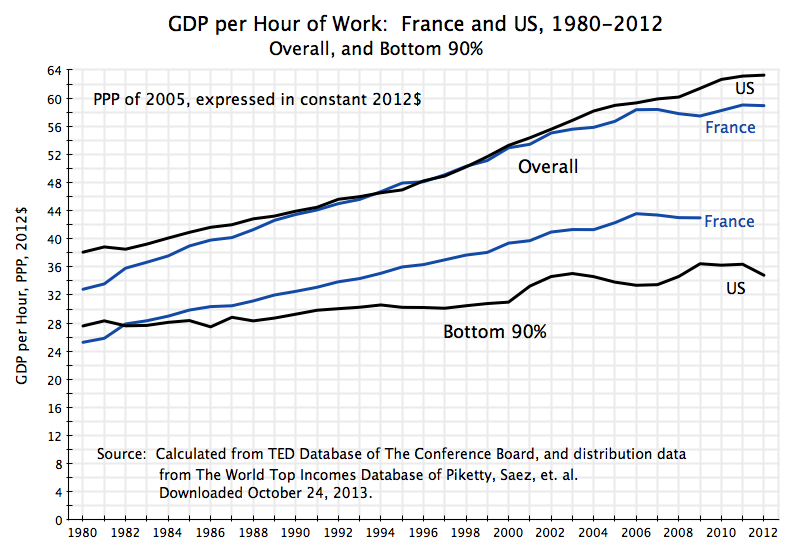
GDP per capita may often be the best measure available due to lack of data on working hours, but for the US and France such data are available (and are provided in the TED database referred to previously).  One can then calculate GDP per hour of work instead of GDP per capita, both overall and (using the same distributional data as above) for the bottom 90%.  The resulting graph for 1980 to 2012 is as follows:

France vs US, 1980-2012, GDP per hour overall and of bottom 90% (Autosaved)

By this measure, overall GDP per hour of work in France was similar to that of the US in the 1990s, but somewhat less before and after.  Overall GDP per capita was always higher in the US over this full period (the top graph in this post), and by a substantial 20% (in 1980) to 38% (in 2012).  Yet GDP per hour worked never varied by so much, and indeed in some years was slightly higher in France than in the US.

But for the bottom 90%, income received per hour of work has been far better in France than in the US since 1983.  By 2007, GDP per hour worked was 30% higher in France than in the US for the bottom 90%.  This is not a small difference.  French workers are productive, and take part of their higher productivity per hour in more annual leisure time than their US counterparts do.

E.  Summary and Conclusions

The French economic record has been much criticized by conservative media and politicians in the US, with France seen as a stagnant, socialist, state.  Overall GDP per capita has indeed grown faster in recent decades in the US than in France, averaging 2.0% per annum in the US vs. a rate of 1.5% in France.  While such a difference in rates might appear to be small, it compounds over time.

But the picture is quite different if one focusses on the bottom 90%.  This is not a small segment of the population, but rather everyone from the poor up to all but the quite well off.  Growth in average real income of this group was substantially faster in France than in the US since 1980.  While overall growth was faster in the US than in France, most of this income growth went to the top 10% in the US, while the gains were shared more equally in France.

Furthermore, when one takes into account social services, which are more equally distributed than taxable income and which are much more important in France than in the US, as well as leisure time, the real living standards of the bottom 90% have not only grown faster in France, but have substantially surpassed that of the US.

For those other than those fortunate enough to be in the top 10%, living standards are now higher, and have improved by more in recent decades, in France than in the US.

The Rate of Economic Growth and the Budget Gap: Returning to the Long-Term Average Growth Rate Would Eliminate It

Long Run US GDP per Capita Growth (1870-2088) in logarithms

Larry Summers published an op-ed yesterday (appearing in Reuters, the Financial Times, the Washington Post, and probably elsewhere) in which he makes the important point that the current budget impasse is focussed on the wrong issues.  The discussion, at least as publicly expressed, has focussed on what is seen as needed to deal with the fiscal deficit and the resulting public debt.  Even the Republican attempt to end ObamaCare was ostensibly about cutting the government deficit (even though the CBO concluded that the opposite would happen, as they found that the ObamaCare reforms will reduce the deficit, rather than increase it).

Yet this focus on near term and projected budget deficits is misguided.  As Summers notes, under current policies the public debt to GDP ratio is falling, and is projected to continue to fall into the 2020s.  The recently issued Long-Term CBO budget projections indicate that while the debt ratio would then start to rise (primarily driven by expected higher health care costs), there is a good deal of uncertainty in those projections.

Specifically the CBO figures show that it would not take much, in terms of either higher revenues or lower spending, to keep the public debt to GDP ratio flat.  Higher revenues or lower spending or some combination of the two, of 0.8% of GDP over the next 25 years or 1.7% of GDP over the next 75 years, would suffice.  This is consistent with an earlier post on this blog, which showed that if the Bush tax cuts had not been extended for almost all households, the projected debt to GDP ratio in the CBO numbers would fall rapidly.

But projections of revenues or of spending are highly uncertain.  Projected health care spending has been coming down steadily in recent years, for example, in part due to the slow economy, but also in part as a result of the efficiency gains and cost reductions that the ObamaCare reforms are leading to.  With these lower costs, the CBO has been steadily reducing the projected costs to the government budget from Medicare, Medicaid, and other such health programs.  In the recent CBO report, for example, the projections of government spending on health care programs in the 2030s were reduced by 0.5% of GDP from what the CBO had projected just one year earlier.  Going back further, the CBO projections for government spending on health care in 2035 were over 1% of GDP lower in the projections recently issued than in the projections published in June 2010.

This should not be interpreted as a criticism of CBO.  Their projections are probably the best available.  Rather, the point is that these projections are inherently hard to do, and the uncertainty surrounding them should not be ignored.  Yet the politicians often ignore precisely that.

Furthermore and perhaps most importantly, the projected budget deficits and resulting public debt to GDP ratios depend critically on the rate of growth of the economy.  The CBO uses a fairly detailed and reasonable model to project this (based on projected labor force growth, investment in capital, and productivity growth).  However, it is probably even more difficult to project GDP than to project future spending levels and tax revenues for any given level of future GDP.  But Summers notes the critical sensitivity of the projected future deficits to the projected growth in GDP.  He states “Data from the CBO imply that an increase of just 0.2 percent in annual growth would entirely eliminate the projected long-term budget gap”.

One can calculate from the data made available with the CBO report their projected growth of real per capita GDP.  For 2013 to 2088, it comes to 1.60%  year.  A previous post on this blog noted the remarkable constancy of the rate of growth of real per capita GDP since at least 1870 of 1.9% a year (or 1.87% a year at two digit precision).  That earlier post noted that real per capita GDP in the US, despite large annual variations and even decade long deviations (such as during the Great Depression, and then during World War II), has always returned to a path of 1.87% growth since at least 1870.  That path even did not shift when there were even substantial deviations, such as during the Great Depression.  Rather, the economy always returned to the same, previous, path, and not one shifted up or down.

This is truly remarkable, and no one really knows the reason.  The path can be seen as a trend growth of capacity (based on labor available and capital invested, coupled with the technology of the time), but why this should path should have grown at 1.87% a year in the late 1800s; in the early, mid and late 1900s; and all the way into the 21st century, is not known.

Since we do not know why the economy has always returned to this one path, we need to be careful in looking forward.  Still, it is noteworthy that the CBO projections imply that the economy will now slow, to just 1.60% real per capita GDP growth over the next 75 years.  This CBO path is substantially lower than the path of 1.87% growth that has ruled for the last 140 years in the US.

The graph at the top of this post shows the path of GDP per capita projected by the CBO (which one should note is a year by year projection, which just averages out to 1.60% per year over the full period), along with an extension of the 1.87% path that has ruled since at least the 1870s.   The graph is adapted from my earlier post (although now converted to prices of 2005 whereas the earlier one was in prices of 1990; this does not affect the rates of growth).  It is expressed in logarithms, since in logarithms a constant rate of growth is a straight line.

It is not clear why there should be this deceleration to 1.60% from the 1.87% rate of growth the economy has followed over the last 140 years.  Mechanically, one can ascribe the deceleration to what the CBO assumes for the rate of growth of technological progress.  But projecting growth in technology over a 75 year period is basically impossible, as the CBO notes.

The deceleration over the next 75 years has a very important implication, however.  The CBO found in its sensitivity analysis that a rate of growth that is just 0.2% faster will suffice to close the budgetary gap, even if one does not take any new measures to raise revenues or cut government spending.  Hence a return to the previous historical growth path of 1.87% a year from the 1.60% rate the CBO projects, or a difference of 0.27%, will more than suffice to close the budgetary gap.

The policy implication is that with such sensitivity to the growth in GDP, we should be focussed on measures to raise growth, rather than short term budgetary measures that will act to reduce growth.  The economy has suffered from government austerity since 2010, which has held back growth.  Government has been cutting spending, thus undermining demand in an economy with high unemployment and close to zero interest rates, where more labor is not employed and more is not produced because the resulting products could not then be sold due to the lack of demand.  As an earlier post on this blog noted, if government spending had been allowed to grow simply at the historic average rate (and even more so if it had been allowed to grow as it had under Reagan), the US would by now be back at full employment.

Over the medium term, Summers notes that both conservatives and liberals agree that growth should be raised, and on the types of measures which should help this.  More investment, both public and private, is required rather than less.  Research and development, both public and private, is important.  More effective education is also required.

I would agree with all of these.  But to be honest, since we do not really understand why the economy always returned to the 1.87% growth path over the last 140 years, it would not be correct to say we can be sure such measures will be effective.  However, what we can say with confidence is that measures that hinder the recovery of the economy, as the government spending cuts have been doing, will certainly hurt.