The Price of Oil: Don’t Blame Obama

As the price of oil and gasoline has gone up in recent months, one of the more vociferous charges being made by Republicans is that it is all Obama’s fault.  The allegation is that Obama’s regulatory policies have led to reductions in US oil and natural gas production, which have pushed up the price that people are paying at the pump.  The accusations were originally strongly pushed and developed into a campaign issue by the Murdoch owned Fox News channels, and were then picked up by the Republican presidential candidates.  For example, a FoxNews.com posting on their web site from March 13 is titled “Romney Slams Obama Over Gas Prices”.  A report on the CBS News web site from March 15 is titled “Mitt Romney:  Obama to blame for high gas prices”, and reports on an interview with Fox News where Romney asserted that Obama is “absolutely” responsible for high gasoline prices.

These accusations reflect a good deal of confusion.  Oil prices are determined in global markets.  And the assertion that Obama’s regulatory prices have led to reductions in production of oil and natural gas in the US are simply untrue.  The facts on what is going on can be seen with a few simple graphs.  All the data are from the US Energy Information Agency of the US Department of Energy.

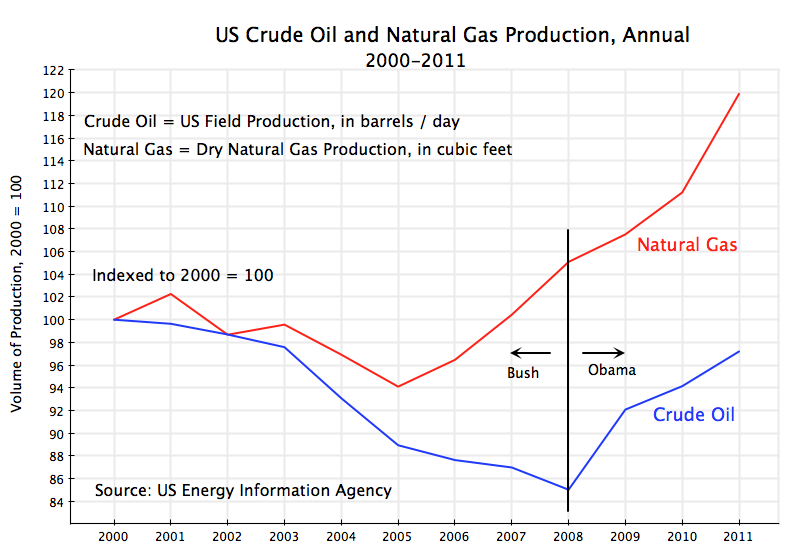
Crude oil production in the US as well as natural gas production have in fact risen since Obama took office.  Indeed, crude oil production had been declining until 2008, the last full year of the Bush administration, and then rose after Obama was inaugurated.  And to show that this is not simply an artifact of using annual totals, one can look at the monthly figures:

The charge that regulations imposed by Obama have cut oil and gas production in the US from what it was before is therefore simply false.  But I also would not argue that the increase in oil and gas production can simply be attributed to new measures under Obama.  Much more has also been going on.  For oil, probably most important has been the increase in global (and hence US) oil prices in recent years, which has induced increased drilling as well as increased production out of existing fields.  The question of why oil prices have risen will be discussed below.

For gas, probably most important has been the development and implementation of the new hydraulic fracturing (“fracking”) method of extracting gas from shale rock basins.  Thus gas production has been increasing since 2005.  By 2011, natural gas production in the US had risen to the highest it had ever been, exceeding the previous peak that had been set back in 1973.  Fracking is controversial due to the environmental impacts, and Republicans have charged that over-zealous federal regulators in the Obama administration have held it back.  But as the graph above shows, production of natural gas has increased sharply.

And since natural gas is a local product with only limited trade overseas (liquified natural gas, or LNG, can be shipped, but the conversion process is expensive), the increased supply in the US has driven down gas prices to the lowest levels since the start of the Bush administration:

With natural gas prices now at these relatively low levels, some of the new gas development projects are indeed being postponed or put on hold.  There is even discussion of major new projects to export US gas to overseas via LNG.  None of this is consistent with the accusation that the Obama administration regulations are holding back natural gas development.  And while Romney and others “slam” Obama for high oil prices, one does not hear praise for the lowest natural gas prices in years.  Note that I am not arguing that Obama should necessarily be so praised.  Indeed, with the environmental issues surrounding fracking, there is a good argument that such gas field development should be more tightly regulated to ensure environmental issues are being appropriately addressed.  I am just noting that Romney and others have been totally inconsistent.

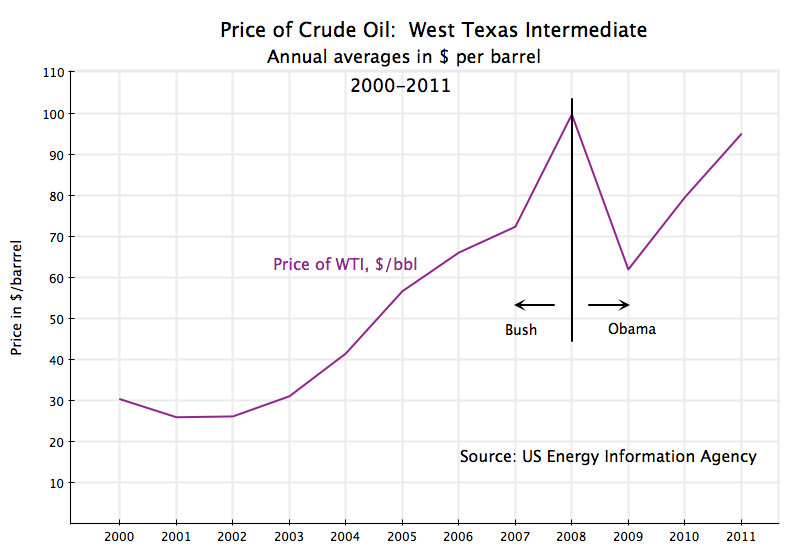
Crude oil production has also increased in the US, as shown in the graphs above.  But the market for oil is different from that for natural gas, as oil can be readily shipped via tankers.  Hence the price of oil is determined in the global market, and one will not see US prices decline when US production increases.  US production of crude oil is a relatively small share of the global total.  There is therefore no reason for oil prices to fall when US oil production increases.  And prices have increased over the last decade:

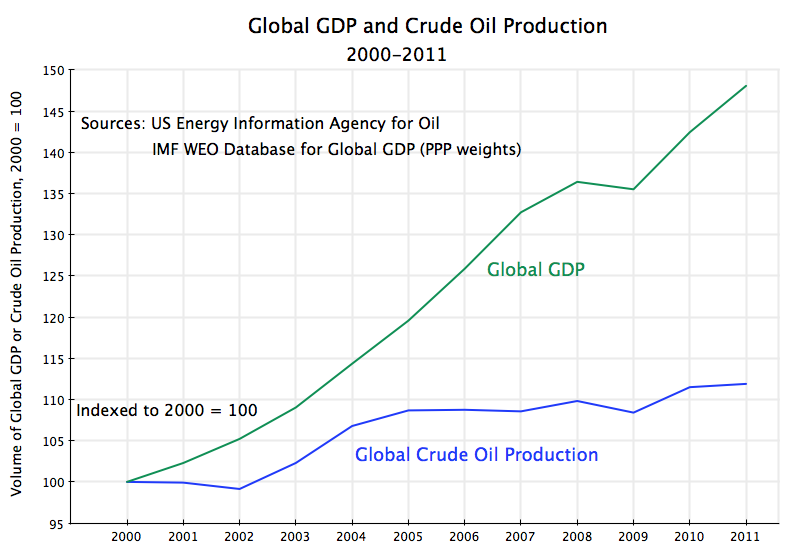
Would it be fair to blame Bush for the increase in oil prices during his presidency, reaching a peak in 2008?  Not really.  The fundamental cause has been global growth, while global oil production has been essentially flat since 2004 or so:

Global oil production, global GDP, 2000 to 2011

With growth in global demand (especially in rapidly growing countries such as China, India, Brazil, and other emerging markets), and essentially flat oil production for over seven years now, it should not be a surprise that crude oil prices, and hence the price of gasoline at the pump, have risen.  And the fallback in oil prices in 2009 can be readily understood in the global downturn of that year, following the 2008 collapse in the US economy.  But as growth in global GDP recovered, so have oil prices.

There is of course much more that could be covered in the story on the oil and gas markets than what has been presented here.  The aim has not been to be comprehensive and detailed.  Rather, the purpose has simply been to show that the charges being made by Romney and others that Obama and over-zealous federal regulators are responsible for declining US oil and gas production, and hence the high price of gasoline at the pump, are simply false and indeed inconsistent with some easily checked facts.

Social Security: The Issues Can Be Solved

I.  Introduction

The Social Security system has been the most successful social program of the US of the past century.  Poverty among the elderly was common before Social Security.  Such poverty is now rare.  Enacted in 1935, the Social Security system has provided retirement and retiree survivor benefits to all, and has provided disability benefits to those who became disabled.  While not generous in its benefits, Social Security acts as a minimum safety net for all, and as guaranteed pension income that supplements other sources of retirement savings.  The system has been fully paid for through a dedicated payroll tax, at a rate currently of 12.4% on wage earnings of up to $106,800 per year (as of 2011; it is adjusted annually to reflect average wage growth in the economy).  While the tax is formally paid half by the worker and half by the employer, in reality all comes from worker wages.

But this popular, successful, and self-standing program will be under stress in the years ahead.  While this has commonly been attributed to the stress caused by the upcoming retirement of the baby boomers, we will see below that the fundamental issue is rather longer life expectancies.  Longer life expectancy a good thing, but it needs to be paid for.  There will indeed be difficulties if nothing is done, and this has led, not surprisingly, to apocalyptic warnings by the Republican presidential candidates.  Advocating for an end to Social Security as a government-run minimum safety net retirement program, the Republican candidates have forecast disaster.

The most clear was Texas Governor Rick Perry, who in the September 7, 2011, GOP debate stated that “it [Social Security] is a monstrous lie.  It is a Ponzi scheme to tell our kids that are 25 or 30 years old today, you’re paying into a program that’s going to be there.”  Congressman Ron Paul had earlier, in the 2008 campaign, said (referring to the younger generation): “… there’s no money there, and they’re going to have to pay 50 years and they’re not going to get anything.”  While the other Republican candidates did not go so far as to call it a Ponzi scheme, the impression conveyed remained that if nothing is done, Social Security payments to retirees would collapse to nothing once the Social Security Trust Fund ran out.  If nothing is done, on current projections this would happen in  2038.

All this reflects a fundamental misunderstanding of what the Social Security system is, how it operates, and what can be done to ensure its continued viability.  Actually, there are a number of options on what can be done to ensure continued viability.  This note will review a few.  They are not that extreme, as the problem is not really that great.

It is also true that while the problem of Social Security finances can be fairly easily resolved, major issues do exist with the other major entitlement program, Medicare and other health care costs borne through the government budget.  These will require more fundamental reforms of the health care financing system in the US.  The Obama reforms make a start on this, and are a step in the right direction, but do not go far enough.  But health system financing is not the issue being addressed in this note here.

II.  The Deficit if Nothing is Done

To start, one needs too look at what Social Security revenues and benefits (as currently set) have been and are expected to be:

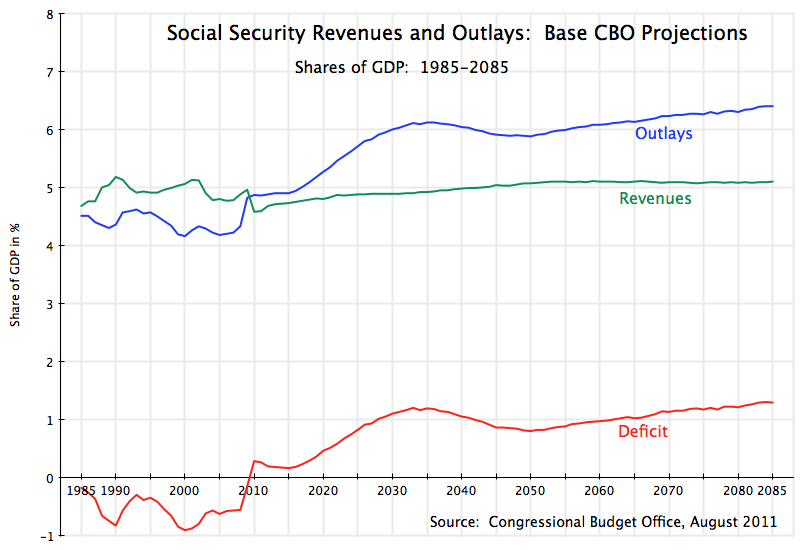
The historical data and the projections come from the Congressional Budget Office, in an August 2011 report.  Long term projections are necessary, but are of course subject to a good deal of uncertainty.  Up until 2009, more was paid each year in payroll taxes for Social Security (for both retirement and disability) than was paid out in benefits.  The Social Security Trust Fund (an account at the US Treasury) grew each year.  But starting in 2010, with an expansion in the number of citizens enrolling in Social Security benefits (with many taking early retirement in the 2008 downturn and then slow recovery, with unemployment high), outlays bumped up while revenues bumped down, and the expected cross-over between outlays and revenues was brought a few years earlier than had been expected before.  The bumps around the trends are clear in the diagram.

Going forward, outlays are expected to rise to about 6.1% of GDP by about 2035, with revenues then of about 4.9% of GDP, leading to deficits of about 1.2% of GDP.  But it is interesting and important to note that outlays are then expected to be largely steady as a share of GDP for at least the next 50 years, and maybe longer, falling a bit at first and then rising a bit.  Revenues are expected to rise by a small amount over time, to about 5.1% of GDP by 2052, and then be flat.  Deficits will fluctuate within a relatively narrow band of about 1% of GDP after 2035.  This is important.  Politicians opposed to Social Security have conveyed the impression that Social Security deficits will rise steadily over time forever, and thus that the problem is not solvable in the current system.  That is not the case.  The deficits will grow to about 1% of GDP, which is of course significant, but then they are expected to stay at roughly that level for the foreseeable future after that.

III.  Dealing with a Deficit of 1% of GDP

The deficit of 1% of GDP each year does need to be addressed.  But to put the 1% in perspective, note that the cost of the Bush tax cuts (as estimated by the Congressional Budget Office) is currently about 2.5% of GDP, and is expected to rise to 2.7% of GDP by 2021.  By simple extrapolation, the losses from the Bush tax cuts would be around 3% of GDP by 2030.  Hence one could cover the entire deficit in the Social Security accounts by foregoing only one-third of the Bush tax cuts.  [Two points:  1)  Note that it is not necessary that Social Security outlays have to be covered 100% by the Social Security payroll tax, even though that has been the case until now.  One could cover it also by general tax revenues.  Indeed, the special 2% point cut in Social Security payroll tax rates enacted for 2011 and 2012 with the objective of spurring employment is being covered by transfers from general tax revenues to the Social Security Trust Funds.  And 2) While in a previous blog posting, I had noted that ending the Bush tax cuts would by itself resolve the US fiscal deficit issue (over at least the next decade), it is not double-counting to also note this would resolve the deficits in the Social Security system.  The Social Security accounts are consolidated with the general US government accounts, and thus the 1% of GDP deficit in the Social Security system is part of the overall fiscal deficit that is at issue.]

Note also that if nothing is done, benefits paid out under Social Security to retirees and the disabled would not immediately drop to zero should the Social Security Trust Fund be depleted.  On current projections, the balance in the Trust Fund would, if nothing is done, drop to zero in about 2038.  But in those years, Social Security revenues would still come to 5.0% of GDP each year.  Hence benefits equal to 5.0% of GDP would still be paid.  This would require a scaling back of benefits of about 18 to 19% in those years relative to what would be due.  While it would be irresponsible and inexcusable for the politicians to have allowed it to get to that point, scaling back of benefits by 18 to 19% is quite different than saying they would then drop to nothing, as Governor Perry and Congressman Paul asserted.

What could be done to cover the 1% of GDP deficit?  As noted above, such a deficit could be covered by general tax revenues.  It would not be that much, and indeed equal only to one-third of the revenues that would be lost in those years should the Bush tax cuts be extended, as all the Republican presidential candidates have vociferously argued for.  Indeed, the Republican candidates have all set forth proposals for even far larger tax cuts than these, as was discussed in a past post.  If the country can afford such tax cuts, any one of which would be a large multiple of the revenues required to cover Social Security obligations, then it can afford what is needed to cover Social Security.

But setting aside for now the option of covering the Social Security deficit from other revenue sources, what would be the options should they be constrained purely to the current Social Security system itself?  By definition, they could then come only from three possible sources:  lower administrative costs, higher payroll tax rates, or lower benefits.  We will take up each in turn.

a)  Lower Administrative Expenses?

Social Security administrative costs in 2010 were only 0.9% of what was paid out in benefits in that year.  And they have been at about this level, of below 1% of outlays, each year since 1990.  They are even lower for the retirement component, at only 0.6% of benefits paid in the year, while somewhat more (at 2.3%) for the disability component, as disability requires closer monitoring and more complicated assessment of cases.

These administrative costs are incredibly low.  It is important to keep in mind that these are costs compared to annual outlays.  Private retirement programs, as annuities or managed through 401k’s or similar programs, will typically have annual expenses of 1 to 2% of assets.  Assuming even a highly generous rate of return on assets of 10% a year, admin expenses of 1 to 2% of assets will eat up 10 to 20% of returns and hence benefits.  Social Security admin expenses of just 0.9% (and 0.6% on the retirement component) is far superior to the 10 to 20% cost that private plans charge.  The Government run Social Security system is incredibly efficient, and one should not expect to be able to reduce the admin expenses significantly further.

b)  Increase Revenues?

The second option is to increase the payroll tax rate.  There is no reason why this cannot be done, and indeed the payroll tax rate was increased 21 times in the 40 years between 1950 and 1990.  But since 1990, i.e. for over 20 years now, the payroll tax rate has never been changed, but rather held constant at 12.4%.  The Social Security deficit problem that has now appeared is largely due to this.

Base case projections plus three scenarios were examined:

The diagram shows the ratio of the size of the Social Security Trust Fund to the benefits paid out each year, all as a share of GDP.  The calculations were done based on the data accompanying the August 2011 CBO report cited above.  Interest earned in the Trust Fund (at the rate for US Treasuries) was accounted for.  In all scenarios, benefits were left as projected by the CBO, even though under the current benefit formulas, benefits would adjust if payroll tax collections are.  That is, I am assuming that the benefit formulas would be adjusted so that benefits would remain neutral, at the levels projected in the base case despite higher payroll tax collections in the scenarios.

In the base case (shown in green with the square symbols), the Trust Fund ratio will reach a peak of 17.5% of GDP in 2012, but will then fall if nothing is done until reaching zero in about 2038.  At that point it will be falling by about 1% of GDP each year (equal to the annual deficit, as discussed above).  Unless supplemented by general tax revenues (which could be done, as noted above), or by a payroll tax rise, benefits would need to be scaled back by about 18 or 19% to reflect the 5.0% of GDP payroll tax collections expected for those years with the current tax rates.  The question is what rate of payroll tax would be necessary so that benefits would not need to be crudely scaled back by such an amount.

To help understand what is going on, in the first scenario we look at a case that helps explain why Social Security finances have deteriorated.  As has been noted in previous posts, wage compensation has lagged profits in recent years, and in particular over the last decade.  As a consequence, the wage share of GDP has fallen.  Since the Social Security payroll tax is on wages up to some limit (with that limit adjusted annually based on average wage rates), the smaller share of wages in GDP has translated into a smaller share in GDP of payroll subject to the Social Security tax.  Prior to 2000 (back to at least 1985, when the CBO data starts), this ratio had always been close to 40% of GDP, and in 2000 it was equal to exactly 40.0%.  It was still at 40.2% of GDP in 2001, but then it fell significantly, to 37% of GDP by 2010, where the CBO expects it to remain (+/- about a half percent) to at least 2085.

Scenario 1 looks at the case where we assume the taxable wage share had remained at 40% of GDP from 2001 onwards.  With benefits unchanged, this alone would extend the date the Trust Fund ratio would fall to zero, from the year 2038 in the base to 2063, or 25 years later.  That is, part of the reason the Social Security Trust Fund is in difficulty is the compression in wages subject to the payroll tax (to the benefit of profits and high income workers) over the last decade.  Without this compression (and leaving benefits unchanged), the Trust Fund would be sustained even at the current payroll tax rate for a further 25 years.

But countering this wage compression cannot be accomplished by some administrative rule.  It is what it is, for complex reasons.  Scenario 2 then examines what increase in the payroll tax would lead to a similar 25 year extension of the life of the Trust Fund before it would be depleted.  Scenario 2 shows that an increase in the payroll tax rate from the current 12.4% to just 13.5%, starting in 2012, would suffice to do this.  Such an increase in the payroll tax rate is not so large.

A payroll tax increase to a 13.5% rate in Scenario 2 would still not be a permanent solution, however. The Trust Fund ratio would be falling in 2065, and would continue to fall if nothing further is done.  Scenario 3 then looks at what the payroll tax rate would need to be to put the system in balance, with the change only made in 2038.  Until 2038, the Trust Fund would be allowed to be brought down from its current high balance.   Scenario 3 shows that a payroll tax rate of 14.8% (from 12.4% until 2038) would do this.  The system would then be roughly in balance, until at least 2065 (on current CBO projections).

An increase in the payroll tax rate from 12.4% to 14.8% is a bit less than a 20% increase in the rate.  It is no coincidence that raising revenues from 5% of GDP projected in the base case to the 6% of GDP required to cover scheduled benefits is also 20%.  They are basically the same thing.  But an interesting question is why did such a 20% gap open up.  The special Social Security Commission chaired by Alan Greenspan, established by President Reagan in December 1981 and reporting back in January 1983, proposed changes in the payroll tax rate and other measures to allow the Social Security Trust Fund to suffice to cover expected benefits for a 75 year period, i.e. to 2058.  On current projections, it is now expected to suffice for only 55 years (from 1983 to 2038).  One cause of this, as considered above as Scenario 1, is the compression of wages as a share of GDP that Americans have experienced since 2000.  Without this (although leaving benefits unchanged), the Trust Fund would be projected to last until 2065.

The unexpected compression in wages may therefore explain why changes are now required to cover a projected Social Security deficit.  But an additional, and more fundamental cause, is lengthening life expectancies.  This will be addressed next below.

c)  Reduce Benefits?

Social Security pays retirement benefits from retirement age (originally age 65, but currently 67 for those born in 1960 and later, and where reduced benefits can be obtained as early as age 62) until death.  But expected lifetimes have grown.  Some observers have noted that life expectancy was just 62 in 1935, when Social Security was passed (with a retirement age of 65), and is now 75.  While true, these are not really the numbers needed.  The increase in life expectancy has been largely driven by reductions in infant mortality, and those who die in infancy never enter the work force.

Rather, one needs to look at the likelihood that those entering the work force will live to retirement age, plus the remaining life expectancy for someone who has reached retirement age.  While technically one needs to look at the full distribution of probabilities, two figures will suffice for the purposes here:  the percentage of the population at age 21 who will survive to age 65, and the average remaining life expectancy for someone who has reached age 65.   In 1940, 57% of those aged 21 were expected to survive to age 65, and for those reaching 65 the average remaining life expectancy was 14 years.  Thus, Social Security retirement benefits were on average expected to cover 8 years of benefits (= 57% of 14 years).  But by 2010, this had more than doubled to 17 years.  That is, even with constant retirement benefits paid each year, the total expected to be paid out will have more than doubled.

Longer life expectancy is of course a good thing.  But the extra costs need to be covered.  But if one rules out use of general tax revenues, and rules out also any changes in the payroll tax rate, and with admin costs that are already minimal, all that is left is to cut benefits.

But benefits are already low, as Social Security simply provides a low floor level of income sufficient to keep most out of poverty, and not much more.  The average Social Security retirement benefit paid in 2011 was only $14,124, and was less for lower income workers.  These cannot go lower without putting the elderly who depend on Social Security into poverty.

One might also consider raising the normal retirement age, thus reducing the number of years expected to be covered by Social Security.  But while average expected lifetimes (and hence the expected number of years under Social Security) have risen, most of this increase in recent decades has been among higher income workers.  Lower income workers, who depend most on Social Security, have not seen such an increase in life expectancy.  A study by Hilary Waldron of the Social Security Administration, published in the Social Security Bulletin, vol. 67, no. 3, 2007, found that the average expected remaining lifetime of a male aged 65 rose from 15.5 years to 21.5 years (an increase of 6.0 years) between 1977 and 2006 for someone in the top half of the wage distribution, but only from 14.8 years to 16.1 years (an increase of 1.3 years) for someone in the bottom half of the wage distribution.

Thus while remaining life expectancies at age 65 have risen, this has mostly been due to the increases by those enjoying relatively high incomes.  It would be perverse then to penalize lower income workers by reducing their already low benefits, to cover the costs associated with more years of payments to those enjoying increased years of life expectancy at the upper end of the income distribution.

Should one therefore choose to cut benefits to cover the Social Security deficit, the cuts should be focused on those at the higher income levels.  The distribution formula for retirement benefits under Social Security is already modestly progressive, and it could be made more progressive.  One could also do this by coupling an increase in the normal retirement age with a more progressive distribution of benefits, with the extent of this increased progressivity sufficient to ensure lower income workers are not penalized by the improvement in living standards that those with higher income have mostly enjoyed.

d)  The Republican Proposals to Privatize Social Security

Before closing, a few words should be said on the Republican proposals to privatize Social Security.  Social Security as a pay-as-you-go public minimum pension scheme would be ended, and instead the funds would be directed to individually managed private retirement accounts, similar to IRA’s or 401k’s.  But this would mean:

1)  There would no longer be a minimum floor income that all Americans would be able to count on in their old age.  Social Security provides this minimum floor.  And for almost all Americans, Social Security is only one of several sources of income they receive in their retirement:  It is a supplement to income received through company pension plans, tax-advantaged savings through IRA’s and 401k’s and similar programs, and other savings they have built. There is nothing that blocks those enrolled in Social Security also to save via these other forms for their retirement, and indeed such savings is strongly encouraged.  But under the Republican proposals, the Social Security pillar in the set of alternative savings schemes would be eliminated, and would no longer exist as a safety net for all.

2)  By moving the revenues now going to Social Security to self-managed investments such as 401k’s, one will be forcing people to take on the risks of 401k’s.  Those whose 401k’s were invested in the equity markets know how risky this can be, following the crash of 2008.

3)  Savings invested through the equivalent of 401k’s will have to pay the administrative costs of such investments, which are an order of magnitude higher than they are for Social Security, as was discussed above.  Admin expenses for Social Security retirement programs are only 0.6% of benefits paid.  For private investments, the share will depend on the returns, but could easily be 10 to 20% of benefits.  The only beneficiaries of these Republican proposals would be the private investment management companies, who would enjoy fees an order of magnitude greater than the costs Social Security incurs.

4)  Finally, redirecting payroll taxes from Social Security to new privately-directed accounts would lead to a fiscal crisis, as the Government would lose revenues equal to about 5% of GDP, while benefits to existing retirees (and those soon to retire) would need to continue.  None of the Republicans have said how this increase in the deficit of 5% of GDP would be covered.

The different Republican plans differ in detail, but are largely similar in their outline.  The most absurd is the one proposed by Newt Gingrich, where he would provide a guaranteed floor income to all, equal to what Social Security now pays.  While this would seemingly address the first point noted above (of no more a minimum floor income in retirement), Gingrich says nothing on how the cost of this would be covered.  Not only would he redirect the 5% of GDP in payroll taxes away from the Social Security system, but he would also take on a commitment to provide up to 6% of GDP for the benefits that would be due under Social Security, should the private investments fail.  The potential gap would be 11% of GDP.  It would be a fiscal disaster to ignore this.

IV.  Conclusion

In summary:

1)  If nothing is done, the Social Security system will be running a deficit that will rise to about 1% of GDP by 2030.  But while significant, this deficit is then forecast to remain at roughly this level until at least 2085 on current projections.  Such a deficit is manageable.

2)  The deficit has increased due to lengthening life expectancies (in particular by upper income people) and due to the compression in wages seen since 2000.

3)  If nothing is done, then on current projections, the Social Security Trust Fund will be drawn down to zero by 2038.  But that does not mean Social Security payments to retirees and the disabled would then have to drop to zero, as Republican presidential candidates have stated.  There would still be on-going payroll tax revenues of about 5.0% of GDP, which would cover benefits reduced by 18 to 19% from their scheduled levels.

4)  A deficit of 1% of GDP could be resolved by:

a)  Use of general tax revenues.  The 1% of GDP would be covered simply by scaling back the Bush tax cuts by one-third.

b)  An increase of the payroll tax rate.  An increase in the rate from the current 12.4% to  a rate of 14.8% from 2038 onwards would suffice.

c)  One could also in principle cut benefits, but this is not recommended.  The benefits are already low, and provide a minimum floor income for the elderly as a safety net.  If benefits were to be cut, they should be cut for the higher income recipients (who have mostly enjoyed the increase in life expectancy that is stressing the system) rather than the lower income recipients.

5)  The Republican proposals to privatize the system would end Social Security as a minimum safety net for all Americans, would expose everyone to market risks, and would be fiscally irresponsible as revenues equal to 5% of GDP would be lost.  The only beneficiaries would be the private investment management companies who would supervise the new accounts, and who charge fees an order of magnitude higher than the administrative costs of the Social Security Administration.

A Comprehensive Mortgage Refinancing Program

Introduction

The US economy is stuck, with only weak growth.  While the 2008 economic collapse was stopped and then partially reversed through a number of bold government programs (including TARP, the Troubled Asset Relief Program launched under Bush, and the Obama stimulus package), the economy is now growing at too slow a rate to see a significant and sustained reduction in the still high rate of unemployment anytime soon.  The economy is operating far below potential, with a consequent huge loss in what living standards could be.  And the personal human cost of high unemployment is severe in itself.

A primary reason for this continued slow growth is the badly functioning housing market.  Housing prices (see this post) built up in a bubble in the middle of the last decade, reaching a peak in early 2006, and then collapsed.  With the collapse of that bubble, losses built up in US banks and in the US financial system more broadly, leading most spectacularly to the bankruptcy of Lehman Brothers.  The TARP program as well as very aggressive actions by the US Federal Reserve Board succeeded in stabilizing the banks.  But homeowners also lost when the housing price bubble burst, with many now owing more on mortgages than the current value of the mortgaged house itself.

These mortgage holders cannot refinance at the lower interest rates now available on the market, unless they can come up with cash at the time of the refinancing to pay off the balance of the old mortgage in excess of what their new mortgage could be (now normally only 80% of the current home value).  If they do not have such cash, they must struggle to pay the mortgage at the old, higher, interest rates that were obtained when they bought their house during the bubble years (or when they may have refinanced at that time to a higher mortgage amount, or taken out a home equity line of credit on the then higher home value).  Similarly, they cannot sell their house and move to a new location (perhaps in pursuit of a new job opportunity) without bringing cash to the table at the time of closing.

Hence such homeowners remain stuck.  As a consequence, the housing market is not performing as it normally would.  To be blunt, the housing markets, and as a consequence the economy more generally, are constipated.  Economists refer to this as a balance sheet recession, as households (in this case) face financial obligations (their mortgages) in excess of the value of the assets they hold (their homes).  Households hunker down, and try to service their expensive mortgages while trying to save enough to get out of their negative net worth position.  But this can take a long time, and meanwhile the overall economy stagnates.  Japan suffered such a balance sheet recession following the bursting of its asset bubble in 1989 (although for Japan the problem was centered in the corporate sector).  It took more than a decade to recover from this, and to a degree the problem in Japan continues.

One can take a fatalistic approach and say there is not much that can be done.  The Treasury Secretary Timothy Geithner, in an interview with the Wall Street Journal published in its November 21, 2011, edition, appears to take this view.   Asked by the interviewer: “Which happens first?  The economy picks up and housing recovers, or a bottoming and slight recovery in housing helps the economy?”  Geithner responded:  “You can’t engineer a recovery in housing that can lift the broader economy.  It has to be the other way around.”

If true, this would be unfortunate, as the economy will not recover as long as housing is in difficulty.  The purpose of this note is to set out a program which, while ambitious, would be feasible, and which would help unlock those households now facing mortgages that are greater than their homes are worth, and with this unlock the housing markets and the economy more generally.  The scale of the program, as will be detailed below, would be similar in scale to TARP and related programs, which succeeded in stabilizing the banks.  There is a need now to stabilize the households who have similarly suffered from the bursting of the housing bubble, with a similar commitment.

I have labeled the proposal the Comprehensive Mortgage Refinancing Program (CMRP).  The first section below will present the basics of the program, through a simple numerical example.  The section that follows will then elaborate on some of the specifics in how it would work.  I will then present the numbers on how many mortgages would be eligible and the savings these homeowners would enjoy, and aggregate figures on the total costs.  Finally a concluding section will discuss the impact on each of the various entities that would be affected (the households, the lenders, and government), and how each would benefit from the program.  There is a shared interest by each in participating, but leadership by government will be necessary to make it happen.

CMRP in Summary

The program would be built around a government loan (not a grant) to the home owners to allow the mortgage balance to be brought down to 80% of the current estimated home value.  Specifically, all household borrowers with a mortgage balance in excess of 80% of their current home value could participate, if they choose.  It would not be compulsory.  If they do, the house would be appraised, and their existing mortgage balance would be refinanced at a 4% interest rate (approximately the current market rate for 20 or 30 year fixed rate mortgages), for 80% of the home value by the existing mortgage holders and for the remaining amount as a loan on the same terms from the government.  Should the home owner decide to sell his property, perhaps some years hence, the mortgage holders would be repaid (as long as the home is sold for more than the mortgage, which was set at 80% of the value of the home when the program was launched).  The government would be repaid half of any gain above the 80% (half in order to preserve an incentive for the home owner to try to get a good price), while the remaining amount would be treated as a personal loan on the same terms, to be repaid over time.

There are many details still to be covered, but it would be helpful first to present this with a simple numerical example.  Assume that the current value of the home is $200,000, but that the mortgage on it is $250,000.  In common usage, the homeowner is “underwater” by $50,000.  Eighty percent (80%) of the home value is $160,000.  Under CRMP, the mortgage would be refinanced with the existing mortgage holder (or holders, if there is a second lien or a home equity line) providing a new 30 year mortgage at 4% on the $160,000, while the government would provide a loan on the same terms (4%, 30 years) of $90,000.

If the house is then sold for $200,000, the $160,000 mortgage would be paid off, while the government would receive $20,000 (half the difference between the sale price and the $160,000 mortgage), with the remaining $70,000 balance on the government loan to be repaid on the same terms (30 years, 4%) as if it were now a personal loan.  The homeowners could take out the $20,000 and use it as a downpayment on a new home, or could prepay the government if they wish.

Elaboration on the Program

Some of the specifics:

  1. The lender with the first lien on the home (and normally the largest single lender) would cover all the closing costs involved (including the cost of the appraisal by an independent professional firm, chosen by the government) as well as all the administrative costs involved both initially and over time.  No points would be charged on the new mortgage either.  The lenders will benefit greatly by this program, and can absorb such costs.
  2. The program would only be for households where the mortgage is for their principal residence.  The program is not designed to rescue businessmen or others who speculated on a continual rise in home prices during the bubble, nor for the lenders to such speculators.
  3. The program is also not designed for borrowers who cannot cover the debt service on these loans.  It is designed for those households who are servicing their debt, perhaps with difficulty but servicing it nevertheless.  They will gain as the new mortgage terms will be at 4%, versus the higher rates that they currently pay (probably normally in the 6 to 7% range, as these rates were typical during the bubble, or possibly even higher if they took out loans at low initial rates which then stepped up after a few years to higher rates).  There are, unfortunately, also households who cannot afford the homes they moved to even at a 4% rate.  Such cases need to be addressed on an individual basis, where there will be foreclosures as well as major losses to the mortgage holders who made such irresponsible loans.  Other programs exist to help in such cases, but this is not the objective of the proposed CRMP.
  4. The new loans from the government ($90,000 in the example) would be for 30 years at a fixed 4% rate, with the same level payments as for a 30 year fixed rate mortgage.  But one might include an incentive to pre-pay such loans, so that they do not last for decades unless truly needed.  One might include an automatic increase in the rate by say 1% point in year 10, 1% point again in year 15, and so on.  Even with a modest 2% annual inflation in home prices on average from their current level, prices would be 22% higher in 10 years and 35% higher in 15 years.  Homeowners could refinance at that point with a regular commercial mortgage, if beneficial to them, and repay the government obligation.
  5. The seniority of the creditors (i.e. the holders of the first lien, the second lien, any home equity credit lines, etc.) would be kept as they are now.  In the initial refinancing to 80% of the current home value (i.e. to the $160,000 in the example, from the $250,000 initial exposure), each lender will have a proportional reduction in their exposure.  But then if the house is sold for less than $160,000 (or whatever the current mortgage balance would be at some future date, after some period of repayment), there would be losses taken by these mortgage holders, in the order of their seniority as now.  That is, the mortgage holder with a first lien would be paid first, then those with a second lien, and so on.  The holders of these second liens and home equity lines will still benefit a great deal under this program, as the government has in effect already paid them the difference between the initial total mortgage exposure and the 80% home value ($90,000 in the example).  Plus there will not be further losses unless home prices fall by a further 20% from where they are now (as the new mortgages will be 80% of the current value).  But to the extent there are such further major losses, they will bear this.

The Overall Magnitude

An important question to address is what might be the scale of such a program, in terms of the amounts to be refinanced and what the government share of this would be.  The best data from which one can compute this is provided by CoreLogic, a private firm that provides analytical and consulting services on real estate.  They maintain a comprehensive state-by-state data base with estimates of the numbers of mortgages that are underwater, and by how much.  The figures can be worked out from numbers quoted in their most recent press release, available here.

Specifically, CoreLogic estimates that as of the third quarter of 2011, 22 million mortgage borrowers in the US have loans which are greater than 80% of their current home values.  This would define the pool of potential participants under CRMP.  Of the 22 million, CoreLogic estimates that 10.7 million face a mortgage loan greater than 100% of their current home value (i.e. are underwater), with 6.3 million of these having only a first lien on the home, while the remaining 4.4 million have a first lien as well as a second lien (or more).

For the 6.3 million underwater with only a first lien, the average mortgage balance was $222,000, and they were underwater by an average of $52,000, thus implying that their average estimated home value was $170,000.  For the 4.4 million with also a second or other liens, the average mortgage balance was $309,000, and they were underwater by an average of $84,000, implying an average estimated home value of $225,000.  I assumed that the average home value of those 11.3 million with loans between 80 and 100% of their home value, was the same as the weighted average of the homes underwater (equal to about $192,600), and that on average the mortgage balance outstanding on these homes was halfway between the 80 and 100% bounds.

From these numbers, one can calculate that the total mortgage balance outstanding in the US in excess of 100% of the underlying home value, is $699 billion.  In addition, a further $630 billion is outstanding on the mortgage amounts between 80 and 100% of the home values (including all of the 22 million homes with mortgages in excess of 80% of the home values).  Hence the total amount that the government might possibly need to lend, if there is 100% participation by all such eligible mortgage borrowers, would be $1,329 billion.  And the amounts that the lenders would need to provide (for the uniform 80% mortgages) would be $3,390 billion, down from their current exposure of $4,719 billion (where the government share makes up the difference).

These would be the maximum exposures.  However, it is doubtful that 100% of home mortgage borrowers would participate.  The reasons would be various, but would include the requirement that only mortgages on principal personal residences would be eligible.  In addition, CoreLogic noted that in its data, only 69% of the 22 million home mortgage borrowers with outstanding loans greater than 80% of their current home value, have mortgages at interest rates of 5% or more.  It would be these home owners, with high interest rate mortgages, who would gain the most from participation in the proposed program.

While it is impossible to say with any certainty how many mortgage borrowers would choose to participate (a reasonable guess might be somewhere in the 50 to 75% range), for the purposes here, I will assume that 69% do.  Therefore, the outstanding loans to be made by the government to the households would total $917 billion (69% of $1,329 billion), while the new 80% mortgages from the private lenders would total $2,339 billion (69% of $3,390 billion).

A $917 billion program from the government to benefit homeowners and unlock the housing market is of course huge.  But it is similar in scale to the potential exposure the government took on under TARP and related programs to stabilize the banking system.  TARP itself was approved for up to $700 billion, although substantially less was in the end used.  Similar US Federal Reserve Board support to AIG and to JP Morgan for the Bear Stearns purchase totaled $140 billion.  There has also been approved purchases by the US Treasury of equity in Fannie Mae and Freddie Mac of up to $400 billion.   These programs have thus totaled $1,240 billion, plus there were a number of smaller programs.

But it should also be noted that while the potential government losses totaled this $1,240 billion, the actual losses so far have been small.  The US Fed has not lost anything on its programs, including programs that provided massive liquidity support to the banks.  The current estimate of the net cost of TARP to the government is only $19 billion, mostly on programs to support housing where recovery of the funds was never anticipated.  The Government in fact made a significant profit on TARP funds lent to the banks.

Indeed, the main anticipated cost to government of these programs to stabilize the financial system is expected to come from losses in the support provided to Fannie Mae and Freddie Mac.  The Congressional Budget Office expects that these losses will total $389 billion over the next ten years.  To the extent the CRMP proposal being made here is implemented, these losses to Fannie Mae and Freddie Mac would likely be reduced.

One also needs to note that while the government would make loans to the home owners of an estimated $917 billion, these loans would be made at an interest rate of 4% initially (and then possibly bumped up by a percentage point in years 10, 15, and so on, until the loans are paid off).  But the current cost of a 10-year US Treasury bond is less than 2.0%  (indeed only 1.90% as of this writing).  Thus the US Treasury will be earning a positive spread on these loans, where one should note that all administrative expenses under this program would be covered by the primary mortgage lender.  But there will still be defaults, and it is not possible to predict with any certainty how large these will be.

Overall, however, the positive spread the government will earn on the loans that are repaid, plus the savings in terms of reduced losses by Fannie Mae and Freddie Mac, make it possible that the final net cost to government will be small, as it was on TARP.  Plus there will be the broader benefits to the economy from a program to unlock the housing markets, which will in turn lead to more tax revenue to the government.

Finally, the individual home owners will benefit from the lower interest rates on the refinanced mortgages.  While no portion of the loan is being forgiven, they will now pay at a uniform 4% rate rather than the higher rates they are paying currently.  The savings to them will depend on what their current mortgage rates are, and these will vary.  The rates will also be higher on second liens and on home equity lines than on mortgages holding a first lien, and will vary based on whether they have fixed or floating rate loans, step-up payments due, and so on.

But to illustrate, for an average mortgage outstanding of $214,400 (the weighted average in the CoreLogic data cited above), and assuming their current interest rate is 6 1/2% on a 20 year fixed rate loan, the savings would be $6,900 per year in moving to a 30 year fixed rate loan at 4%.  This is a savings of 36%, and would total $152 billion (about 1% of GDP) for all the households.  This in itself would provide a substantial boost to the economy, as much of this will likely be spent.  And for the households that are underwater, and who have second liens and/or home equity lines in addition to a first mortgage, where the average mortgage is $309,000, the savings would be $9,950 per year.

Conclusion:  The Impact on Each Party

It is important to recognize that each of the major groups involved in CRMP would benefit from its implementation:

  1. The home owners who cannot now refinance their mortgage because the mortgage is greater than 80% of the current value of their home, will be able to refinance at 4%, the current market rate.  They will not only realize regular monthly savings compared to what they currently often have to struggle to pay, but they will also be able to sell their house, should they now wish, perhaps to move to a different part of the country to pursue a job opportunity.  This will also help unlock the housing market, with attendant broader benefits to all the home owners in the country.
  2. Mortgage lenders would with CRMP face fewer mortgage defaults and losses from foreclosures.  And losses from foreclosures are normally much more than simply the excess of the mortgage amount over the estimated current home value, as foreclosed homes typically sell at a significant further discount, plus there are substantial legal and other costs in going through the foreclosure process.  Hence they will welcome a government program where the government provides a personal loan to cover the amount of the mortgage in excess of 80% of the current home value.  It is true that such lenders would prefer the home owners to continue to pay at the above market interest rates of perhaps 6 1/2% or so that they are locked into, but they also recognize that many such borrowers will soon choose to walk away from these mortgage commitments.
  3. And while the Federal Government will take on substantial new debt to fund the loans it will make, the net cost in the end is likely to be small.  It will lend the funds at a positive spread, and while there will be costs from defaults, government will also gain from lower losses incurred by Fannie Mae and Freddie Mac.  There will also be higher tax revenues from a better functioning economy, due to a better functioning housing market and as consumer spending rises in a sustainable way.

But while a program such as CRMP makes sense, it is difficult to see in the current political environment that something of this nature will be implemented.   The country’s vision has become too narrow, with no willingness to take bold actions.  As a result, it is much more likely that one will see the slow and unsteady recovery typical of balance sheet recessions where little is done to cure the underlying structural problems.