Federal Government Expenditures Under Obama: Close to Flat, in Contrast to the Big Increases of His Republican Predecessors

Federal Government Budget Real Expenditures, Government Outlays, Reagan, Bush Sr., Clinton, Bush, Jr., Obama

There is perhaps no more firmly held view in Republican (and especially Tea Party) circles than that federal government expenditures have exploded under Obama.  But it is simply not true.  Previous analysis in this blog has shown that total government expenditures (including state and local) traced over the course of each business cycle in the US since the mid-1970s, rose less during the Obama period than in any of the others.  Indeed, that analysis indicated that if government spending under Obama had been allowed to increase as much as it did under Reagan following the 1981 downturn, then we would now likely be at or close to full employment.

But when President Obama noted in a speech in Iowa on May 24 that the pace of federal spending had grown at the slowest pace in his term of any presidency in sixty years, the remarks were met with widespread incredulity in the press and on the internet.  Given the repeated Republican attacks asserting the opposite, many did not believe it could be true.

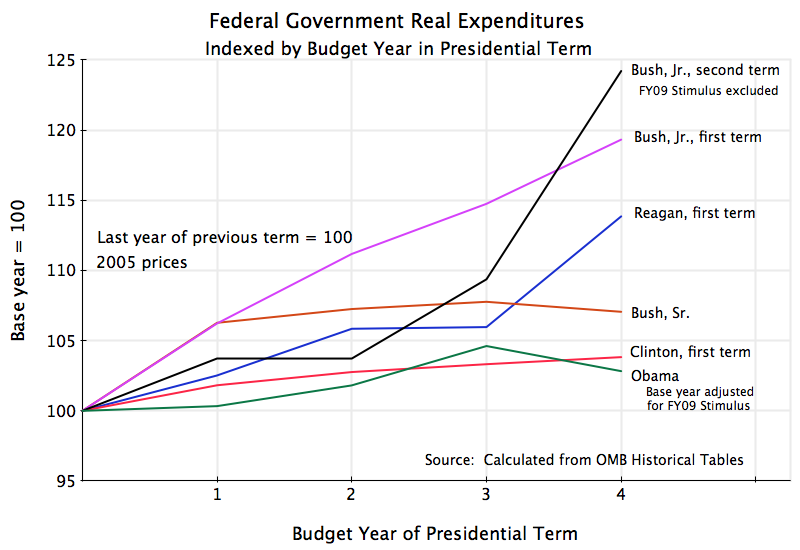
But it is true.  The graph above shows the levels of real federal spending in the first terms (and Bush’s second term) of each president since Reagan.  Growth in real federal spending in each presidential term prior to that was also higher than under Obama, going back to Eisenhower.  (Under Eisenhower there was a fall in real spending, as Korean War expenditures, at a peak when he took office, came down as the war ended.  There was an even larger fall during the Truman term as World War II came to an end.  But these cases are not terribly relevant.)

The figure above shows real federal spending levels in each presidential term since Reagan, indexed with the year preceding their first budget set equal to 100, and then showing the levels in real (inflation-adjusted) terms for the four budget years of their presidencies.  Only the first terms are shown for two term presidents other than Bush Jr., to make it comparable to the Obama term thus far, to reduce clutter in the figure, and because it made no real difference (increases during the second Reagan and Clinton terms were in the middle of the ranges shown above, with four-year increases of 7% and 8% respectively).

Federal government spending under Obama has been largely flat, increasing by less than a total of only 3% in real terms by his fourth budget year (FY13, where I used the budget proposal made to Congress in February by Obama for this figure; any actions by Congress will likely result in further cuts, not increases, in this).  The only recent president with spending at all close to this was Clinton in his first term, when spending rose by a total of 4% in real terms.  The biggest spending increases by far were by Bush, Jr., in both his first and second terms.  Real spending rose by 19% in Bush’s first term, and by 24% in his second term (even adjusting for spending approved as part of the FY09 Stimulus package:  see the technical note below).  Reagan, revered for his small government conservatism, oversaw an increase of 14% in real government spending during his first term.

The Democratic presidents Obama and Clinton have therefore kept federal government spending tightly under control, while the Republican presidents of Reagan and especially Bush, Jr., oversaw large expansions in real federal spending.  Obama’s conservatism on this has certainly hurt the economy at a time when unemployment remains high due to a lack of demand in the aggregate for what such labor could produce.  But he has been criticized, without any basis in fact, for the opposite.

———————————————–

Technical Note

It is important to be aware that budget (or fiscal) years do not coincide with presidential terms.  Presidents are inaugurated in January, while budget years start in October.  A president therefore takes office with a budget year already one-third over, Congressional appropriations already set (or at least largely set), and little ability, with rare exceptions, to influence spending in the year they take office.

Thus in the figure above, the base year of expenditures (set equal to 100) will be the budget year in the middle of which a president took office, and the final year will be the budget year underway at the end of his term.  The figures are calculated from data in the Historical Tables issued by the Office of Management and Budget.

The one exception where a president has had a major impact on spending levels in his first year would be spending under the Stimulus package that Obama signed into law, which was approved on February 17, 2009.  This package provided for a total of $971 billion in measures, but $420 billion of this was for tax cuts, and $551 billion for spending.  Of this $551 billion in spending, only $114 billion (according to the most recent estimates of the Congressional Budget Office) was spent in FY2009, approximately as planned.  The figure above adjusts for this, with the $114 billion (equal to $103 billion in 2005 prices) taken out of the fourth year of the Bush second term expenditures, and with the same amount also used to adjust the base year of the Obama expenditures.  Without these adjustments, federal government expenditures in the Bush second term would have gone up by a total of 28% (rather than 24%), and Obama’s expenditures by his fourth year would have declined by 0.5% (rather than increasing by 3%).

Republican Tax Plans, Part 4: Romney Goes for Even Larger Tax Cuts, Mostly for the Rich

Average tax rates by household income level, Republican tax proposals, Romney tax plans
Mitt Romney, the now all but certain Republican nominee in this year’s presidential race, presented not one, but two, comprehensive tax plans this campaign season.  Romney’s original plan was released in September, 2011, and the implications for who would pay lower taxes (the rich, and especially the very rich), and in a few cases higher taxes (poor people with income up to about $30,000, in comparison to what they would pay if the Bush tax cuts were extended), was discussed in a blog posting on January 7.  It was noted there that while the rich would see very large cuts in their taxes (leading to an increased federal deficit of $600 billion per year by 2015), Romney’s tax proposals were in fact the least extreme of those of his competitors in the Republican primaries (see the analysis at the postings on December 26, 2011, and on January 25, 2012, in addition to the January 7 post).

Faced with these competing proposals for even deeper cuts in taxes, Romney felt compelled to announce a revised tax plan on February 22, which was even more right-wing than the one he had proposed the preceding September.  This was consistent with Romney’s history of changing positions based on what is politically opportune at the moment.  For completeness, it is of interest to add this second Romney plan to the analysis of the other tax proposals, including his own earlier one, to see how they compare.

The average tax rates under Romney #2 that would be paid by households at various income categories has therefore been added to the standard graph above.  As with the earlier blogs, this presents graphically the careful calculations done by the Tax Policy Center, using their tax microsimulation model (based on actual tax return data) to determine the taxes that would then be due for households of various income categories as a result of what was being proposed.  While the diagram has now become fairly cluttered, hopefully it is still clear enough to follow.  I wanted to present the two Romney plans in the context of both each other and of the other Republican plans.

Compared to the other Republican plans, Romney’s new proposal would still generally leave taxes higher than the others would for most households (Cain is an exception, with his hugely regressive tax proposals, and Perry would have left taxes higher than Romney for those making up to $200,000 but would have cut them by even more for the very rich).  But compared to his earlier proposal, Romney would now cut taxes by even more, especially on the rich and very rich.  Compared to current law (under which the Bush tax cuts are scheduled to expire in 2013), Romney would now provide those making more than a $1 million per year in income an average reduction in their taxes of $390,000 each year, vs. a reduction of “only” about $290,000 in his earlier proposals.

The Romney #2 proposals lead to greater benefits for the very rich not simply because with their higher income they pay more in taxes, but also because he now focuses his proposed tax reductions even more heavily on the rich.  Whereas in Romney #1, those making more than $1 million each year would see their taxes reduced by 26%, under Romney #2 he would reduce the taxes of his wealthy colleagues making over $1 million by 35%.  In contrast, poor households with total household income in the range of $40 to $50,000 would see a tax reduction of 13% under Romney #1 and only 19% under Romney #2.  There is no rationale for why the super rich should see not simply a larger absolute reduction in the taxes they would need to pay, but also a greater proportional reduction in their taxes.

And if one is worried, as the Republican candidates say they are, about the fiscal deficit, then one must not ignore that these major tax cuts will lead to a huge increase in the deficit.  The Tax Policy Center estimates that if implemented, the Romney # 2 plan would reduce fiscal revenues by $900 billion in 2015.  This is 50% more than the loss of an estimated $600 billion under Romney #1.  And of the $900 billion lower revenues, well over half ($505 billion) would be a transfer to those making more than $200,000 per year, and over a quarter ($236 billion) would be a transfer to households making over $1 million per year.

Romney insists he will not cut defense expenditures.  Indeed, he says he will increase defense spending over what Obama would.  But total non-defense discretionary government expenditures in 2015 are only projected to be $572 billion in 2015 according to the baseline projections of the neutral Congressional Budget Office (January 31, 2012, report).  Even if all such government expenditures were cut to zero, the deficit would still rise under Romney #2 by $330 billion.  The only alternative would be to cut Social Security, Medicare, Medicaid, and other such programs, which primarily benefit the poor and middle class.  If so, Romney is proposing to cut such programs in order to benefit primarily the rich and super-rich.

To be fair, Romney does say he would also propose to close some tax “loopholes”, but he refuses to say which he would propose to close or reduce, and by how much.  He has said openly it would not be politically expedient to be clear on this before the election.  But he has said that he would keep certain of the more common tax deductions, such as the exclusion for home mortgages for primary homes, and would actually increase certain of these tax expenditures, by cutting further the already low taxes on capital gains and dividends, and by extending further certain corporate tax breaks (such as on overseas income).  If one does this, it is impossible to raise anything close to $900 billion a year by cutting or reducing other tax expenditures.

Romney has presented himself as the serious, businessman, candidate.  Yet he chose to revise his initial tax plan and propose an even more radical plan focused on tax cuts for the rich as part of his (ultimately successful) campaign to secure the Republican nomination for the presidency.  While consistent with Romney’s history of adopting positions based on what is politically expedient at the moment, a plan that would increase deficits by $900 billion a year by 2015 cannot be seen as serious.

Taxes are the Lowest in Over a Half Century: But Low Taxes Have Spurred Neither Growth nor Jobs

US Federal Government Revenues as Share of GDP, 1960-2011, Federal Taxes, Federal Receipts

A.  Introduction

Personal income tax returns in the US were due last week.  With taxes on most people’s mind, blog postings on taxes in the US are perhaps timely.  This initial post will focus on how much has been paid in taxes in recent years, and whether there is any evidence for the assertion that high taxes have slowed economic growth and job creation.  Although it may not feel like it to those have just paid their taxes, the share of taxes in GDP has been at record lows during the Obama administration.  Subsequent posts will look at some of the idiocies in the tax code that we as filers face each year, and then at reforms to the tax code, both relatively straightforward (within the current basic structure) and more fundamental.

B.  Taxes Have Been at Historic Lows

As noted in a recent posting on this blog, Mitt Romney has repeatedly asserted that high taxes under Obama, due to tax increases under Obama, have led to the disappointing recovery from the 2008 economic collapse.  Mitch McConnell, the Republican leader in the Senate, has stated repeatedly in recent years (here is one example) that the US fiscal problem is “because we spend too much, not because we tax too little”.  And the new Republican term for the super-rich is that they are the “job creators”, and that therefore taxes on them need to be kept low and cut even further so that they will then “create” new jobs through some kind of trickle-down process.

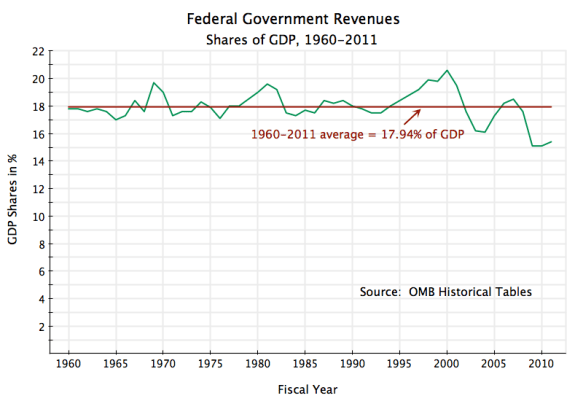
Yet taxes as a share of GDP are the lowest in over a half century in the US (and in fact since 1950).  The graph at the top above shows total federal government revenues as a share of GDP, going back a half century to 1960.  Taxes (from all sources, not just individual income taxes) averaged almost 18% of GDP over this period, but began a clear downward trend from 2001.  The data is from the historical tables made available by the Office of Management and Budget, with data that goes all the way back to the founding of the republic in 1789.

The Bush tax cuts of 2001 and 2003 account for the change in trend.  With this change in trend, coupled with the effects of the 2008 economic collapse and then the further tax cuts (not tax increases) signed into law by Obama (discussed below), taxes as a share of GDP reached a low of just 15.1% of GDP in FY2009.  And with the tax cuts under Obama, taxes as a share of GDP remained at just 15.1% in FY2010, at 15.4% in FY2011, and are projected to be just 15.8% of GDP in FY2012.

Such a low tax take is unprecedented in the post-World War II United States.  Since 1950, taxes were never below 16% of GDP for any individual yearn prior to 2009, despite a number of economic downturns, much less so low for four years straight.  It is hard to see how our problems are from taxing “too much” when taxes are the lowest they have been in over 60 years.

Taxes collected in FY09 were low in part due to the 2008 economic collapse.  But the economy has been in recovery since the middle of CY2009, albeit weakly.  Despite this recovery, and in contrast to the experience in previous cyclical downturns, fiscal revenues have remained at record lows.  Average fiscal revenues over the three year period of the year of the economic trough plus the following two years were only 15.2% of GDP in the current downturn.  The similar average fiscal revenues over such three year periods in the other five economic downturns of the past four decades were 17.9% of GDP.  Cyclical factors cannot explain the current extremely low levels of taxes as a share of GDP.  Rather, taxes have been so low due to the downward structural trend that began with the Bush tax cuts, compounded then by further tax cuts signed by Obama.

As was noted in the earlier posting on this blog on Romney’s economic policy address, between February 2009 and February 2012 Obama signed into law almost $1.5 trillion of tax cuts.  For convenience, here is the table shown in that post, although with the Payroll Tax cuts now consolidated into one line:


Tax Cuts Signed Into Law by Obama    
  Date Signed Amount ($b)
A.  Tax Provisions in 2009 Stimulus Package 2/17/09 $420.0
B.  2010 Tax Cut Package, excl Payroll Tax Cut 12/17/10 $769.3
C.  2011 and 2012 Payroll Tax Cuts 12/17/10, 12/23/11, and 2/22/12 $227.1
D.  Other – Various Dates in 2009 and 2010 various $64.2
TOTAL   $1,480.6

The $1.5 trillion cost estimate is from figures posted by the bipartisan Committee for a Responsible Federal Budget, which in turn came from estimates obtained from either the Congressional Budget Office or the Joint Committee on Taxation of the US Congress.  One can also obtain from these sources estimates of how much of the tax cuts would occur by fiscal year, and the estimate, when added up, is that $1.4 of the $1.5 trillion in cuts were in fiscal years 2009 to 2012.  These are estimates, made before the fact and subject to uncertainty, but suffice for the basic point here.

Taking these tax cuts as estimated by fiscal year, expressed as a share of GDP, one finds:

      Impact of 2009-2012 Obama Tax Cuts
Taxes/GDP:  Actual 2009-2012 Tax Cuts Enacted Taxes/GDP If No Tax Cuts
FY09 15.1% 0.8% 15.8%
FY10 15.1% 2.1% 17.2%
FY11 15.4% 2.9% 18.3%
FY12 proj. 15.8% 3.2% 19.1%

The tax cuts were large, especially from FY2010 onwards.  While taxes as a share of GDP would still have been a relatively low 15.8% of GDP in FY2009 (reflecting the downturn which reached its trough that year), taxes in the subsequent years would have been close to what they have normally been since 1960 (an average of almost 18% of GDP).  That is, while taxes as a share of GDP were low in FY2009 largely due to the downturn, they have since remained at historically low levels largely due to the tax cuts signed by Obama.

Critics will of course state immediately that without the tax cuts signed by Obama, GDP recovery would have been even slower.  This is true, given the recession.  But a reduction of GDP of two or three percent or more, while of course not to be welcomed, would not have had a major impact on these figures on GDP shares of taxes.  The denominator would have just been reduced from 100% to 98 or 97%.  Furthermore, a reduction in the denominator would (by simple arithmetic) have raised, not lowered, the GDP shares of taxes.

While a more complete modeling exercise would have been desirable, it would still have been a model and subject to all the limitations and criticisms any model will have.  The point being made here is just the simple one that the tax cuts signed by Obama were big, and that they were the primary factor leading to the historically record low shares of taxes in GDP during Obama’s term, especially from FY2010 onwards.

C.  Do Lower Taxes Lead to Faster Growth in GDP or Jobs?

Mitt Romney and the Republican Party leaders also repeatedly assert that cuts in taxes, including on the rich, will lead to faster growth in both output (GDP) and jobs.  The super-rich now have the new name of “job creators”.  But is there any historical evidence to support this?

The following table shows for the US by decade, since the 1960s, the average collection of taxes as a share of GDP, growth in GDP and in jobs over the decade, and the average highest tax bracket on ordinary income in the tax code (the rate the super-rich will pay on ordinary income) in the decade:

Taxes/GDP Period Avg GDP Growth Rate Jobs Growth Rate Highest Tax Bracket – Period Avg
1961-1970 18.0% 4.3% 2.8% 78.4%
1971-1980 17.9% 3.2% 2.5% 70.0%
1981-1990 18.2% 3.2% 1.8% 44.2%
1991-2000 18.8% 3.3% 2.0% 37.9%
2001-2010 17.1% 1.6% -0.2% 35.8%
Bush term:
2001-08 17.6% 2.2% 0.2% 36.0%

Sources:  Taxes/GDP and GDP growth calculated from OMB Historical Tables; Job growth from Bureau of Labor Statistics; and Highest tax bracket from Tax Policy Center.

Taxes as a share of GDP did come down, and were at their lowest of any decade, in the 2001-2010 period.  The decade average for the highest tax bracket was also the lowest.  But while GDP grew by between 3.2% and 4.3% a year in the preceding four decades, growth fell to just 1.6% a year in the decade with the lowest taxes.  Job growth was between 1.8% and 2.8% a year in the preceding four decades, but fell to a negative 0.2% when taxes on the “job creators” were at their lowest.  The bottom line of the table also shows the figures for just the Bush term of 2001 to 2008, before the full effects of the 2008 downturn were felt, to show that these results are not simply a consequence of the downturn in the final years of the decade, weighing down the decade long results.

Such a comparison across periods is simplistic, of course.  There is much else going on.  But there is no evidence here that the Bush tax cuts, and the recent tax cuts keeping taxes low, have led to a long-term structural rise in the growth rate of the economy, or of the jobs being generated.  The evidence that exists is completely inconsistent with this, and indeed by itself it consistent with the opposite.

D.  Conclusion

To summarize:

1)  Taxes as a share of GDP are now at record lows, and have been since Obama took office.

2)  Other than in FY2009, when the economy was at its trough following the 2008 collapse, the record low share of taxes as a share of GDP has been largely due to a series of very large tax cuts signed by Obama.  That is, the shares of taxes have remained at record lows largely due to policy, and not due to the weak economy.

3)  There is no evidence from US history of the past half century which would suggest that lower tax collections or a lower tax bracket for the super-rich will lead to a higher growth rate for the economy or for jobs.  In fact, the downward trend in taxes since the Bush tax cuts of 2001 and 2003 has been associated with the lowest decade long growth rates of GDP or jobs of the past half century.

A previous posting on this blog showed that the US public debt problem (with a rising public debt to GDP ratio) is fully due to the impact of the Bush tax cuts.  That blog posting showed that simply be phasing out the Bush tax cuts from 2014 onwards, the public debt to GDP ratio would be brought back down over time, rather than grow explosively (if there is no change to current policy).  The Bush tax cuts by themselves account for the US fiscal problems of at least the next decade.

With record low tax collection as a share of GDP, with the downward trend in tax collection a consequence of the Bush tax cuts of 2001 and 2003, with subsequent extensions of these tax cuts signed by Obama along with other major tax cuts passed as part of the stimulus package and in payroll taxes leading to record low tax collections in the US as a share of GDP, and with no evidence that the lower taxes of the past decade have led to higher long term growth rates of the economy or of jobs, it is difficult to see how the current economic difficulties are due to taxes that are too high.  To deal with a problem, one must first recognize its origins.  The Bush tax cuts were a disaster for the economy, and restoring tax rates (over time, once the economy is in a more solid recovery) to what they were in the 1990s would solve America’s fiscal problems.