The Fiscal Multiplier: Econ 101

A.  Introduction

The “fiscal multiplier” (often referred to as just the “multiplier”) is simply the ratio of how much aggregate GDP will increase for a unit increase of fiscal spending.  Hence if fiscal spending increases by say $100 and aggregate GDP increases by $200 in response, the multiplier is equal to 2.  The concept is also often applied similarly to tax cuts of some dollar amount.

Under conditions where there is significant unemployment in an economy, an increase in government spending can be expected to have a multiple impact on GDP.  There will be a direct contribution to GDP from the increased production to provide for the demand from government, but also an indirect contribution as those being paid for the initial goods (whether newly employed workers or suppliers of inputs to the production of the good) will in turn spend at least some portion of their higher incomes on other goods or services in turn.  And this process will continue in further rounds.

While the concept is simple, the multiplier in practice is difficult to measure.  It is not a constant, but rather a definitional concept whose value will vary depending on the specific economic circumstances of the time and place.  It has also been controversial, as some economists both historically and even currently do not believe it is possible for an economy to be functioning at less than full employment.  For such economists, higher production from an increase in demand is not possible since the economy is already at full employment, and the multiplier must then always and everywhere be uniquely equal to zero.

But most economists recognize that it is possible for the economy to be at less than full employment.  This is especially clear today in most of the developed world, including in the US, Europe, and Japan, with unemployment high in each of these countries or regions.

The real debate, then, is about the size of the multiplier in a particular situation – whether it is low or high.  If low, then fiscal stimulus will not have much of an effect on increasing GDP, while fiscal austerity will not lead to a big reduction in GDP.  If high in contrast, fiscal stimulus will be quite effective in raising GDP, while fiscal austerity will lead to big reductions in GDP and consequent large increases in unemployment.

Recent work at the IMF, a conservative institution, on the size of the multiplier has brought this debate into the general news.  In particular, in June the IMF published a self-evaluation of the IMF supported (as well as EU and ECB supported) economic program in Greece.  It noted there (on page 21) that the fiscal multipliers assumed in that program turned out, based on actual experience, to have been too low.  This self-criticism was picked up in the general press, and many have questioned how the IMF (and the others) could have gotten this so wrong.

But judging the size of the multiplier in a particular place and in particular circumstances is not easy.  This Econ 101 blog post will discuss why the multiplier will vary in different countries and in different country circumstances.  And while it might be understandable how the multiplier might be misjudged ex ante in some concrete case, what is outrageous is not that initial misjudgment.  What is outrageous is that the policies that had been taken based on that earlier misjudgment were not then revised or reversed to reflect what had been learned.

B.  Why the Multiplier Will Vary

As noted above, the multiplier is not a constant, equal to the some particular value in all countries and under all circumstances.  Rather, it is a concept, expressing a relationship (between changes in GDP and changes in government spending) which will in general vary across different economies and across different circumstances in any particular economy.  Hence even if one had a good estimate of what it might be in one particular country under particular circumstances, one should not assume it would have that some value in another country or even in the same country under different circumstances.

Specifically, one should expect:

1)  The multiplier will vary across countries, depending on the size and structure of those countries:  In a large country such as the US, an increase in spending (both direct and indirect) will be met primarily by supplies originating in the US.  The multiplier will then be relatively large.  In contrast, higher spending in a small and open economy, such as Monaco to take an extreme example, will be met primarily by supplies originating elsewhere.  The multiplier will then be relatively small.   Most economies are in between these two in size, and one would expect the multiplier then also to be in between these two in size.

Note that this will depend not only on the size of the economy, but also its economic structure (the type of goods produced within that economy, as opposed to imported) and the nature of its trade regime.  Some economies are more open than others.

2)  The multiplier will vary depending on the current state of the economy – how far or close the economy is to full employment:  If unemployment is significant, an increase in demand can be met with an increased supply of goods, and an increase in employment of workers to produce those goods.  The multiplier will be relatively high.  In contrast, if the economy is at a time of close to full employment, an increase in demand for certain goods can only be met by reduced production of something else (with a shift in jobs from the latter to the former), so overall output might not rise by much.  In such circumstances the multiplier will be relatively low.

Hence if one had a good estimate of the multiplier in some particular economy at a point in time when the economy was close to full employment, one would greatly underestimate what the multiplier would be in that same economy at a different time when unemployment was high.

3)  The multiplier will vary depending on the form of the fiscal stimulus:  Fiscal stimulus programs can take the form of spending on newly produced goods (such as infrastructure), or on transfer programs to households (such as higher or extended unemployment benefits), or on tax cuts or tax rebates.  But while each might have a similar direct dollar impact on the fiscal deficit, the impact on GDP could vary widely.

Direct government expenditures on newly produced goods, such as new roads or school buildings, will likely have the largest impact on GDP.  The newly produced goods will, with certainty, be produced, and such product is a direct component of GDP (GDP stands for Gross Domestic Product).  And those newly employed to produce such goods (e.g. construction workers) will also then spend most or even all of their new earnings on goods they need.  The multiplier will be high.

The multiplier will also likely be relatively high on transfer programs that go to the unemployed and others who are relatively disadvantaged, as they will spend what they receive on goods that they and their family very much need. The multiplier will be less on transfer programs that benefit those who are better off (such as certain farm subsidies, for example, when they mostly benefit large and relatively well-off corporate farms), as such individuals or firms will likely save a higher share of such receipts.

And the multiplier might be quite small for tax cuts or tax rebates that go to upper income households, as they will likely save much of what they receive.

Hence the size of the multiplier will depend on the nature of the fiscal stimulus program.  Programs focussed on the direct production of goods, especially labor-intensive goods (such as the building and maintenance of much of infrastructure), or on transfers to the relatively less well off, can be expected to have a relatively high multiplier effect.  Programs focussed on transfers or subsidies going to the relatively well off, or tax cuts that accrue primarily to the relatively well off, can be expected to have a relatively low multiplier effect.

4)  The multiplier will vary depending on whether the stimulus (or austerity) programs are temporary or expected to be sustained:   Temporary tax cuts or tax rebates are a common component of stimulus programs, in part because they can be implemented quickly and easily.  However, households receiving a temporary tax cut or a one-time rebate will normally simply save a high share of what is distributed to them (or use the funds to pay down outstanding debt they might have).  The multiplier will then be relatively low or even negligible, as there would be little increased demand for goods to be produced.

5)  The multiplier will vary depending on the direction of change:  Many make the simplistic assumption that if the multiplier has some value for an increase in spending or for a tax cut, one will see the same value for the multiplier for a decrease in spending or a tax increase.  But there is no reason to assume this will be the case.  People will in general respond differently if facing an increase in income (such as from a tax cut) or a decrease (such as from an equal tax increase).  With a tax cut, the households might simply save most of what they receive, resulting in a low multiplier.  But with a tax increase (which one might see as part of an austerity program, for example), the households might be forced to scale back their consumption to pay the higher taxes, resulting in a relatively high multiplier when going in this downward direction.

Similarly, the multiplier impact when a worker is newly hired as a result of a stimulus program will likely be different than the multiplier impact when a worker is laid off as a result of an austerity program.  The multiplier impact is likely to be substantially greater (in the negative direction) when workers are laid off as such workers will likely be forced to scale back their consumption substantially.

6)  The multiplier will vary depending on the policy response of others:   While the government might launch a stimulus program, other economic actors might respond with policy changes of their own.  For example, a Central Bank might raise interest rates when the government launches a stimulus program, due perhaps to a concern on inflation (possibly a mis-guided concern, but nonetheless what they are acting on).  Raising interest rates would lead to a cut in investment, and hence the impact of the stimulus program on GDP might be constrained.  The multiplier would then be low.

Importantly, the ability of the Central Bank to respond by lowering interest rates to a cut-back in government spending, to offset what would otherwise be the contractionary effects of such a cut-back, is important to recognize and take into account.  In times like the present in the US, Europe, and Japan, when the interest rates set by the Central Bank are essentially at zero and cannot go lower, a cut-back in government spending cannot be offset by a cut in interest rates (interest rates are already as low as they can go), and the multiplier will be relatively high.  The fiscal contraction will lead to a large reduction in GDP.  In contrast, if the fiscal contraction is delayed until the economy is closer to full employment, with interest rates then positive and significant, the impact on GDP of a cut-back in government spending can be offset at that point by the Central Bank lowering interest rates, and output will not then fall.  The multiplier will at that point be close to zero.

This has extremely important implications for the design of fiscal adjustment programs.  There may well be a need eventually to reduce public debt to GDP ratios, by cutting back on government spending or increasing taxes.  But if this is done when there is significant unemployment and the Central Bank controlled interest rates are at or close to the zero lower bound, then the fiscal austerity programs will reduce demand and lead to a large fall in GDP (and consequent further rise in unemployment).  One should instead maintain fiscal demand until the economy has recovered sufficiently that one is close to full employment and interest rates are no longer at or close to zero.  At that point, a cut-back in government spending (or an increase in taxes) can be offset by the Central Bank through its management of interest rates, and GDP need not then fall.

Unfortunately, the US, Europe, and until recently Japan, have been doing the opposite since 2010.

The financial markets are another economic actor which can have an impact.  For example, in economies where the foreign exchange rate floats, the foreign exchange markets might respond to a stimulus program with a devaluation of the foreign exchange rate.  This devaluation would make exports more competitive (thus spurring production of exports), and imports more expensive (thus encouraging production of domestic substitutes for what had been imported), which would be expansionary.  The multiplier in such circumstances would then be relatively high.

7)  The multiplier will vary depending on the time frame:  So far we have not made any note of the time dimension, and have implicitly treated all the responses as taking place simultaneously.  But the time dimension does matter, as it takes time to implement programs, and then time for the multiple round responses to work themselves out.  Hence one should be clear on whether one is referring to the multiplier as the response in, say, the current quarter of a year, or over the next year, or over the next several years, or what.  The multiplier will be relatively low if measured as the impact on GDP in the current quarter, fairly large over the next year, and then begin to diminish thereafter.  And one then needs to be clear if one is referring to the multiplier in terms of the impact on GDP only within a certain period, or the cumulative impacts over a multi-year range.

C.  Conclusion

The multiplier is important, and a good deal of work has been done over the years to try to measure what it might have been in a particular time and place.  But factors such as those listed above have not always been taken into account when economists (including at the IMF) and analysts have sought to apply those results.

It has unfortunately been the case, for example, that estimates of the multiplier found when the economy was close to full employment, were then assumed to be similar when the economies at some later time were in a downturn and far from full employment.  Or cross-country differences have been ignored when the multiplier found for some small economy, say, was assumed to apply equally to a large economy.  Or the multiplier that might apply in an expansion resulting from a stimulus program was then assumed to apply similarly in a contraction resulting from an austerity program.  Or no attention was paid to how the multiplier will differ in a stimulus program depending on whether one is looking at new infrastructure work, or transfer programs, or tax cuts.  Or the multiplier for tax cut programs was treated as the same whether the tax cuts were going to the relatively poor or the relatively rich.

This has not always been the case.  Some economists and analysts have been careful.  But there has also been a lack of attention to these issues.  This does not mean one should ignore the multiplier, but rather that one needs to work with care.

Eurozone Unemployment at Record High: The Consequence of Austerity Programs

Eurozone Unemployment Rate, Dec 2007 to March 2013

As reported in the recent release from Eurostat, Eurozone unemployment rose again in March to a record 12.1%.  This is the highest rate ever for the Eurozone, and indeed the highest rate since at least 1983 (the earliest date for unemployment data reported by Eurostat) for the underlying countries.

Austerity programs do increase unemployment, despite what senior European officials have said.  On this, one might recall the famous assertion in June 2010 of Jean-Claude Trichet, then head of the European Central Bank, that austerity programs would be expansionary and lead to job creation.  As was discussed in an earlier post on this blog, in a June 2010 interview with La Repubblica (the largest circulation newspaper in Italy), Trichet said:

Trichet:  … As regards the economy, the idea that austerity measures could trigger stagnation is incorrect.

La Republicca:  Incorrect?

Trichet:  Yes …

And in an interview a month later in the newspaper Libération of France:

Libération:  Do the austerity plans announced amid monumental disarray by the Member States pose the risk of killing off the first green shoots of growth?

Trichet:  It is an error to think that fiscal austerity is a threat to growth and job creation. …

At the urging of Trichet, other European officials, and especially German government officials, most of Europe then began to reverse the stimulus programs of late 2008 and 2009  –  programs that had stopped and then reversed the free fall resulting from the 2008 economic and financial collapse.

Exactly one year after Trichet made his famous assertion, unemployment rates in the Eurozone began a steady upward march, which have continued ever since.

The Impact of the Budget Sequester: There Are Better Ways to Cut the Debt

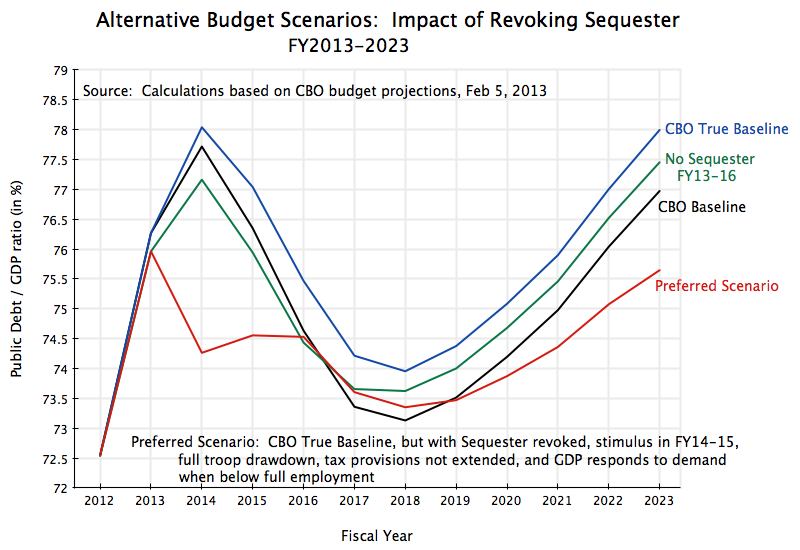
Alternative Budget Scenarios, FY13-23

A.  Introduction – The Impact of the Bush Tax Cuts

The budget sequester, the across the board budget cuts that Republicans in Congress insisted on in August 2011 as a condition for allowing the public debt ceiling to be raised, entered into effect on March 1.  While there were some immediate impacts, the primary effects will start a month to two later as government employee furloughs begin to go into effect and public procurement contracts are cancelled or are not signed when they otherwise would have.  Fiscal drag will grow, aggregate demand in the economy will be reduced, and growth in both output and employment will be less than they otherwise would have been.  And this hit is coming when there have been signs that the US had started to enter into a more robust recovery, with the housing market starting to recover and consumer demand growing.  The sequester will now slow this down, and possibly reverse it.

The argument for the sequester was that such budget cuts were necessary to bring down the public debt.  Public debt as a share of GDP has indeed grown sharply in recent years.  But as was discussed and analyzed in a posting on this blog from more than a year ago, this issue arose not because of government spending under Obama, but rather because of the Bush tax cuts, the spending on the Afghan and Iraq Wars (the first wars in US history which were not paid for at least in part by tax hikes, but rather purely by borrowing), and the economic and financial collapse that began in 2008, in the last year of the Bush Administration.  That blog shows that without the Bush tax cuts and without the unfunded wars, but still assuming the 2008 downturn happened (thus reducing public revenues while increasing expenditures that rise in a downturn such as for unemployment compensation) and including all the spending of the Obama years (other than for the wars), public debt at the end of FY2012 would have been only 32% of GDP instead of 73%.

The difference between a public debt ratio of 32% of GDP and a ratio of 73% of GDP is not small.  The Bush tax cuts (mostly) and the unfunded wars (to a still significant, but lesser, extent) certainly weakened the US fiscal position.  Without that increase in the debt due to those two decisions, there might have been less pressure on Obama to cut back on government spending, with the resulting fiscal drag that has slowed the recovery.

Looking forward, that blog post also showed that even with the history of the Bush tax cuts, the unfunded wars, and the effects of the 2008 downturn, a phasing out of the Bush tax cuts (thus returning to the rates of the Clinton years) would have led to a steady fall in the public debt to GDP ratio from FY2014 to at least FY2022.

Unfortunately, the Bush tax cuts have now been made permanent for all but the richest 1% of the population.  As a direct consequence of this, the public debt to GDP ratio will not now see a steady fall (to at least FY2022) as it otherwise would have.  The graph above shows what the CBO now projects the public debt to GDP ratio will be under its baseline scenario, along with calculations I did (based on numbers provided in the CBO report and its accompanying data files) under several alternative scenarios.

B.  CBO Baseline and CBO True Baseline

The CBO Baseline scenario presents, as the CBO is required to do, its projections of what the budget and debt will be assuming current law is followed.  In this scenario, the CBO projects that the public debt to GDP ratio will peak at 77.7% of GDP in FY2014, and then fall to a trough of 73% of GDP in FY2018 before starting to rise again.  It would reach 77% of GDP in FY2023.

This longer term dynamic, with its renewed rise in the public debt to GDP ratio after FY2018, is primarily driven by two factors:

  1. The permanent extension of the Bush tax cuts for 99% of the population, which reduces sharply government revenues (by 2 1/2% of GDP now, rising to 3% of GDP in the 2020s and more beyond, for the full Bush tax cuts, as discussed in this blog post).  As noted above and discussed in the cited blog post from a year ago, if the Bush tax cuts had been phased out, the public debt to GDP ratio would have been falling to at least FY2022.
  2. The CBO’s projection that government health care costs (primarily for Medicare and Medicaid) will continue to rise as a share of GDP as general health care costs rise in the US, and (to a lesser extent) due to the aging of the population.  The reforms achieved through ObamaCare will reduce Medicare expenses by a significant amount as more of the currently uninsured become insured (since the uninsured cannot cover the full cost at hospitals of their treatment, so hospitals must shift a portion of those costs onto what they charge Medicare, as discussed in this blog post).  But there is a need for more such savings, which reduce costs while they maintain delivery of currently covered services.

As noted, the CBO is required to present in its Baseline scenario the consequences of current law, including that certain expenditures will continue beyond FY2013 as the law provided for in FY2013 (although adjusted for inflation).  This can lead to some perverse assumptions, which the CBO recognizes but is not allowed to change its Baseline to reflect.  However, the CBO does provide the data needed so one can make such adjustments.  Specifically, the scenario labeled “CBO True Baseline” in the graph above reflects:

  1. The assumption that a portion of the special appropriation enacted in January for Hurricane Sandy relief will not be repeated each year going forward.  This will lead to $353 billion in lower federal expenditures than CBO had to assume in its Baseline over the ten year period of FY2014-23 (including lower debt service following from the consequent lower debt).
  2. The assumption that overseas troops (primarily in Afghanistan) will continue to be drawn down, from 115,000 in FY2012 and 85,000 in FY2013, to a projected 60,000 in FY2014 and 45,000 in FY2015 and after.  The CBO assumes there will still be a significant number of such special combat troops overseas after FY2015, but not as many as now.  This will lead to savings of $693 billion over ten years.
  3. But increasing costs is the assumption that the so-called “Medicare Doc Fix” will continue.  Under a law originally passed in 1997, Medicare payments to doctors would be cut according to a formula.  But that law has been overridden each year since 2002, and everyone expects that will continue.  If it were not, payments to doctors would be slashed by 27% this year.  Continuing the override, the ten year cost to the budget would be $167 billion.
  4. Also increasing the deficit, by reducing revenues, is CBO’s assumption that a large set of 75 different corporate tax “provisions” (others might call them loopholes) will continue to be extended, rather than allowed to expire as per current law.  The cost of extending these tax provisions over the ten years is an estimated $1,142 billion.

Making these four changes, will have the net effect of adding $263 billion to the ten year deficit.  This is, however, a more realistic estimate of the baseline.  The resulting public debt to GDP ratio would be 78% of GDP in FY2023, rather than 77%.

C.  Impact of Revoking the Sequester in FY2013-16

There are many scenarios one could run against these baselines.  For the graph above I have shown two.

The first alternative scenario looks at the impact of revoking the sequester in fiscal years 2013 to 2016.  The rest is as in the CBO Baseline.  While not a primary focus of the CBO budget work, the CBO forecasts that the economy will recover only slowly from the current downturn (in part precisely because of the fiscal drag from the budget cuts that have been and are being implemented), and will only reach full employment production in FY2017.  The CBO then assumes the economy will grow from that point forward at the rate of growth of potential GDP (what GDP would be at full employment), which it projects based on its projections of growth in the labor supply and productivity.

The No Sequester FY13-16 scenario revokes the sequester in those four fiscal years, and includes the impact of such extra spending in creating demand for production, assuming a multiplier of two.   With this modest boost to GDP (higher growth rates of 0.6% points in FY13 again in FY14, and then about the same as in the CBO Baseline), tax revenues will also rise.  The projection also assumes that 33% of this additional GDP growth will provide resources to reduce the deficit, either through additional tax revenues (mainly) or by reducing certain government expenditures such as for unemployment compensation (to a lesser extent).  The 33% is a rough estimate of the impact of these two together.  They will offset part of the impact on the deficit of the cost of the extra expenditures if the sequester is revoked.

Due to the modestly faster recovery of GDP if the sequester is revoked in those years when the economy is operating at less than full employment, the debt to GDP ratio is in fact lower in fiscal years 2013 to 2016 than it is in the CBO Baseline, despite the higher government spending.  It hits 77.2% of GDP in FY2014 rather than the 77.7% of GDP in the CBO Baseline.  This illustrates how austerity policies (the sequester) have a perverse impact on the public debt to GDP ratio in the near term when an economy is functioning at less than full employment, due to a lack of demand.

The revocation of the sequester in FY13-16 will, however, lead to a somewhat higher debt than in the baseline, under the stated assumptions.  And from FY2017 onwards GDP is already at its potential level at full employment and cannot go higher.  Hence the debt to GDP ratio will be higher from FY2017 onwards, by about a half percentage point of GDP.  But that would then be the time to cut back on government spending if one is concerned about the public debt to GDP ratio.  That is, do not cut back further on demand when it is already insufficient, leading to higher unemployment.  Rather, the time to reduce government demand, if the debt ratio is of concern, is when the resources in the economy are fully employed and will be used for other purposes and not left idle.  Cutting back on such demand for workers when resources are idle, with unemployment high, simply leads to even higher unemployment.

D.  Preferred Scenario

Many alternative scenarios could be constructed.  I will just show one here, based on the CBO numbers and without looking at more fundamental changes.  This scenario starts with the CBO True Baseline, but makes the following changes:

  1. The sequester is revoked in all years.  This will increase expenditures by $1,223 billion over ten years (including the impact on debt service).
  2. Rather than cutting spending, as in the sequester, one instead boosts government spending in fiscal years FY2014 (by $400 billion) and FY2015 (by $250 billion).  These levels were chosen as such extra spending will, under the stated assumptions, boost growth sufficiently to bring the economy back to full employment and then keep it there, in the years when there would otherwise be high unemployment.
  3. Rather than draw down overseas troops only to 45,000 from FY2015 and after, as in the CBO True Baseline, the Preferred Scenario brings down troops faster and further, to only 5,000 from FY2015 and after.  This will save a further $702 billion over ten years, above the savings of $693 billion CBO estimates will be achieved by bringing overseas troops down to 45,000.
  4. The CBO True Baseline assumes that the 75 different corporate tax provisions will be extended when they would otherwise expire under current law (mostly this year and next), at a budgetary cost of $1,142 billion over ten years.  The Preferred Scenario assumes these will not be extended.

Under the Preferred Scenario, the public debt to GDP ratio falls sharply in FY2014, despite the extra spending and indeed a higher fiscal deficit, because of the boost to GDP bringing it to full employment levels.  Commentators often forget that the debt to GDP ratio depends not only on what the debt is, but also what GDP is.  The sharp fall in the debt to GDP ratio also holds in FY2015 (compared to the Baseline scenarios), because of the boost to GDP, but by FY2016 and FY2017 the ratio is close to that in the Baseline scenarios as GDP approaches the ceiling of its potential level in the CBO projections, and cannot go higher.

Going forward, with GDP at the ceiling of its potential level, the debt to GDP ratio follows a lower path than it does under the CBO Baseline (or True Baseline) scenarios.  The reason is that in those years the savings from the lower troops deployed overseas in combat, plus the additional revenues from not extending the 75 corporate tax provisions, leads to lower deficits and lower debt growth.  It is in such periods, when the economy is operating at full employment (by CBO assumption), that one should focus on reducing deficits if the debt to GDP ratio is of concern.

The debt to GDP ratio nevertheless starts to rise again after FY2018 in the Preferred Scenario, as it does in all the scenarios.  The blog post from last year cited above noted that phasing out the Bush tax cuts would have led to a declining debt to GDP ratio until at least FY2022.  But with the extension of the Bush tax cuts for 99% of the population this will now no longer hold from FY2018.

The primary reason these debt to GDP ratios ultimately turn up is the continuing rising cost of health care unless something is done.  And note this is not because government provided health care through Medicare is more expensive than health care provided through private insurance.  For similar risk populations, Medicare is indeed more efficient and cheaper to provide than private health insurance.  The CBO estimated that in 2007, private insurance of Medicare beneficiaries cost the government 12% more than traditional Medicare would have.

The problem rather is that health care costs are rising, and while there are savings through government programs such as Medicare, these savings are not enough to offset the expected long term rise in health care costs unless something further is done to reduce the costs.

E.  Conclusion

The debt to GDP ratio has risen in recent years as a consequence of the Bush tax cuts, the unfunded wars in Iraq and Afghanistan, and the economic collapse of 2008 with the subsequent slow recovery.  But as high as it has risen, it is now foolish to follow austerity programs, such as the sequester, with unemployment still excessively high.  These austerity measures serve just to hold back the economy, and will increase, not decrease, the near term debt to GDP ratio over what it would have been without such fiscal drag holding back growth.  A program of fiscal stimulus sufficient to bring the economy back to full employment would indeed lead to a sharp reduction in the debt to GDP ratio over the next few years.

Longer term, there is a rise in the debt to GDP ratio in all the scenarios after FY2018, due to a rise in health care costs unless something is done to reduce these costs.  The problem is not that government supported health care funded through Medicare or Medicaid is more expensive or less efficient than private insurance funded health care – the government programs are indeed cheaper and more efficient.  The problem is health care cost itself in the United States.  But that is an issue I hope to address in future posts on this blog.