The Strong Recovery in Employment Under Obama

Unemployment Rates - Obama vs Reagan

A.  The December Jobs Report

The Bureau of Labor Statistics released on Friday its regular monthly report on employment.  Job growth was once again strong.  Total jobs (nonfarm payroll employment, to be precise) rose by a solid 252,000 in December, and the unemployment rate came down to 5.6%.  Total jobs rose by an even higher (and upwardly revised) 353,000 in November and by an also upwardly revised 243,000 in October (the two most recent monthly figures are always preliminary and subject to revision).  These are all good numbers.  The 353,000 figure for job gains in November was the highest monthly figure in over nine years.

The overall job gain in 2014 came to 2.95 million.  This was the highest annual total since 1999.  Private sector jobs rose by 2.86 million in 2014.  This was the highest annual gain in private jobs since 1997.  Government jobs (federal, state, and local) also grew, although only by 91,000 and equal to just 3% of the overall growth in jobs of 2.95 million.  But at least it was positive and stopped being the drag on growth it had been before through repeated cuts.  Government jobs had been cut each and every year since 2009, reducing American jobs by 702,000 between 2009 and 2013.

B.  Obama’s Performance on Unemployment, Compared to Reagan’s

While the pace of improvement has accelerated in the past year, the Obama record on jobs has in fact been a good deal better for some time than he has been given credit for.  Critics said that Obama’s policies, both as a consequence of the passage of the Obamacare health reforms and from his use of government regulatory powers, would (they asserted) constrain job growth and keep unemployment high.  These critics look to the Reagan presidency as a model, with the belief that there was a rapid fall in unemployment following his tax cuts, attacks on unions, and aggressive deregulatory actions.  This adulation continues.  A recent example was a column by Stephen Moore (Chief Economist of the Heritage Foundation) published in the Washington Post just two weeks ago (and which a number of commentators, including Paul Krugman, noted was full of errors).

But how do the Obama and Reagan records in fact compare?  The graph at the top of this post shows the path the rate of unemployment has taken during Obama’s presidency, and for the same period during Reagan’s presidency.  Both curves start from their respective inaugurations.

Unemployment under Reagan was high when he took office (at 7.5%), although on a downward trend.  But it then rose quickly (peaking at 10.8%) followed by a fall at a similar pace, before leveling off at a still high 7 to 7 1/2%.  It then fell only slowly for the next two and a half years, by a total of just 0.6% points.  The recovery in terms of the unemployment rate lacked strong staying power.

The pattern was different under Obama.  While unemployment was also high when he took office (7.8%), it was rising rapidly as the economy was losing 800,000 jobs a month.  It rose to a peak of 10.0% nine months later, before starting a fall that has continued to today.  The pace of the reduction was relatively steady over the years, but accelerated in 2014.  Over the last two and a half years, the unemployment rate has been reduced by 2.6% points, far better than the 0.6% reduction for the comparable period under Reagan.

As a result, the unemployment rate is now 5.6% under Obama, versus 6.6% at the same point in Reagan’s tenure.  By this measure, performance has been better under Obama than it was under Reagan.  The 5.6% rate under Obama can also be compared to Mitt Romney’s statement in 2012, during his presidential campaign, that adoption of his policies would bring the unemployment rate down to 6% by January 2017.  Romney viewed this as an ambitious goal, but achievable if one would follow the policies he advocated.  It was achieved under Obama already by September 2014.  One did not hear, however, any words of congratulations from Romney or others in the Republican Party to mark that success.

Of possibly more interest in the debate about the response to the respective policy regimes of Obama vs. Reagan, was the flattening out of unemployment under Reagan at the still high level of 7.5% or close to it in mid-1984.  If his “supply-side” policies were going to be effective in bringing down unemployment, this was the period when they should have been working.  The tax cuts had been passed, and the regulatory and other policies of the Reagan administration were being implemented and enforced.  But unemployment was trending down only slowly.  In contrast, unemployment was falling rapidly for the same period in the Obama presidency, with the pace of reduction indeed accelerating in 2014.  There is absolutely no evidence that Obamacare, actions to protect the consumer or the environment, the application of government regulations under Obama, or even “policy uncertainty” (a new criticism of Obama that was given prominence during the 2012 campaign), have acted to slow job growth.

C.  A Few More Points

1)  Why did unemployment rise rapidly from mid-1981 to late-1982 (to 10.8%), and then fall at almost the same rapid rate from that peak to mid-1984?  This had less to do with the policies of Reagan than of those of Paul Volcker, then Chairman of the Federal Reserve Board (and a Jimmy Carter appointee).  Volcker and the Fed raised interest rates sharply to bring down inflation, with the federal funds rate (the interest rate at which banks lend funds on deposit at the Fed to each other; it is the main policy target of the Fed) reaching over 19% at its peak.  Inflation came down, the Fed then reduced interest rates, and the economic downturn that the Fed policy had induced was then reversed.  Unemployment thus rose fast, and then fell fast.

2)  Has the fall in the unemployment rate under Obama been more a reflection of people dropping out of the labor force than a recovery in jobs?  No.  A previous post on this blog looked at this issue, and found that labor force participation rates have been following their long term trends.  There is no evidence that labor force participation rates have made a sudden shift in recent years.

3)  Why has the pace of improvement in the unemployment rate accelerated in 2014?  As earlier posts on this blog have noted,  Obama is the only president in recent history where government spending has been cut in a downturn.  The resulting fiscal drag pulled back the economy from the growth it would have achieved had government spending, and its resulting demand for goods and services and hence jobs to produce those goods and services, not been cut.

But this finally turned around in 2014.  Congress finally agreed to a budget deal with Obama, and state and local governments saw spending stabilize and then start to rise as the recovery got underway and boosted tax revenues.  The result is shown in this chart, copied from an earlier post whose focus was on austerity policies in Europe:

Govt Expenditures, Real Terms - Eurozone and US, 2006Q1 to 2014 Q2 or Q3

Total US government expenditures (federal, state, and local; in real terms; and for all purposes, including both direct purchases of goods and services and for transfers to households such as for Social Security and Medicare), turned around in the first quarter of 2014 and began to rise.  Government spending had previously been falling from mid-2010.  With that turnaround in government spending, GDP rose by 4.6% (at an annualized rate) in the second quarter of 2014 and by 5.0% in the third quarter.  Much more was going on, of course, and one cannot attribute all moves in GDP growth to what has happened to government spending.  But the turnaround in government spending meant that this component of GDP stopped acting as the drag on growth that it had been before.

Jobs then grew in 2014 at the most rapid rate since 1999, and unemployment fell.  The unemployment rate of 5.6% is the lowest since 2008, the year the economy entered into the economic collapse that marked the end of the Bush administration.

D.  How Much Further Does Unemployment Need to Fall to Reach Full Employment?

The 5.6% rate is not yet full employment.  While it might appear to some to be a contradiction in terms, there will always be some unemployment in an economy, even at “full employment”.  There will be frictions as workers enter and leave jobs, mismatches in skills and in geographic location, and so on.  But the 5.6% rate is still well above this.

Historically, the US economy was often able to achieve far lower rates of unemployment and not see excessive upward pressure on wages and prices.  The unemployment rate was at 4.4% in 2006/07, at 3.9% in 2000, and at 4.0% or below continuously from late 1965 through to early 1970 (and reached 3.5% or below for a full year from mid-1968 to mid-1969).  It even dipped to a post-war low of 2.5% in 1953, although few would say that the conditions then would apply to now.

Based on such historical measures, the unemployment rate could still be reduced substantially from where it is now before the labor market would be so tight as to cause problems.  Economists debate what that rate might be at any given time, but personally I would say that a reasonable target would be no higher than 4 1/2%, and perhaps as low as 4%.

But rather than try to predict what the full employment rate of unemployment might be, one can follow a more operational approach of continuing to push down the rate of unemployment until one sees whether upward wage and price pressures have developed and become excessive.  That is how the Fed operates and determines what policy stance to take on interest rates.  And there is absolutely no sign whatsoever that there is such upward wage or price pressure currently, with the unemployment rate of 5.6%.

As a number of the news reports on the December BLS employment report noted, while unemployment has come down, estimated hourly earnings in December also fell by 5 cents from the previous month (to $24.57 for all private non-farm jobs, from $24.62 the previous month).  Such a one-month change is not really significant, and could be due to statistical fluctuations (as the data comes from a survey of business establishments).  But what is significant is that average hourly earnings in recent years have only kept pace with low inflation of less than 2% a year.  In real terms, wages today are almost exactly the same as they were in late 2008.  This has been the case even though labor productivity is about 10% higher now than in late 2008 (this figure is an estimate, as the GDP figures for the fourth quarter of 2014 have not yet been reported).  In a properly functioning labor market, real wage growth will be similar to labor productivity growth.  But high unemployment since the 2008 downturn has weakened labor’s bargaining position, leaving real wages flat.

Government policy, including actions by the Fed, should be to keep the expansion going at as fast a pace as possible until unemployment has fallen so low that one sees upward pressures on wages and hence prices.  As I noted above, I would not expect to see that until the unemployment rate falls below 4 1/2%, and quite possibly below 4%.

The Impact of Austerity Policies on Unemployment: The Contrast Between the Eurozone and the US

Unemployment Rates - Eurozone and US, Jan 2006 to Oct 2014

A recent post on this blog looked at the disappointing growth in the Eurozone since early 2011, when Europe shifted to austerity policies from its previous focus on recovery from the 2008 economic and financial collapse.  There has indeed been no growth at all in the Eurozone in the three and a half years since that policy shift, with GDP at first falling by about 1 1/2% (leading to a double-dip recession) and then recovering by only that same amount thus far.  The recovery has been exceedingly slow, and prospects remain poor.

The consequences of the shift to austerity can be seen even more clearly in the unemployment figures.  See the chart above (the data comes from Eurostat).  Unemployment in Europe rose sharply starting in early 2008 and into early 2009.  But it then started to level off in late 2009 and early 2010 following the stimulus programs and aggressive central bank programs launched in late 2008.  Unemployment in the US followed a similar path during this period, and for similar reasons.

But the paths then diverged.  After peaking in early 2010 at about 10% and then starting to come down, the unemployment rate in the Eurozone switched directions and started to rise again in mid-2011.  It reached 12.0% in early 2013 and has since come down slowly and only modestly to a still high 11.5% currently.  In the US, in contrast, the unemployment rate reached a peak of 10.0% in October 2009, and has since fallen more or less steadily (with bumps along the way) to the current 5.8% (as of October 2014).  It has been a slow recovery, but at least it has been a recovery.

This divergence began in 2010, as Europe shifted from its previous expansionary stance to austerity.  Influential Europeans, in particular German officials and Jean-Claude Trichet (then the head of the European Central Bank) argued that not only was austerity needed, but that austerity would be expansionary rather than contractionary.  We now see that that was certainly not the case:  GDP fell and unemployment rose.

The most clear mark of that shift in policy can be found in the actions of the European Central Bank.  ECB interest rates had been kept at a low 0.25% for its Deposit Facility rate (one of its main policy rates) for two years until April 2011.  The ECB then raised the rate to 0.50% on April 13, and to 0.75% on July 13, 2011.  But European growth was already faltering (for a variety of reasons), and it was soon recognized by most that the hike in ECB interest rates had been a major mistake.  Trichet left office at the end on his term on November 1, replaced by Mario Draghi.  On November 9 the ECB Board approved a reversal.  The Deposit Facility rate was cut to 0.50% that day, to 0.25% a month later on December 11, and to 0.00% on July 11, 2012.

Fiscal policy had also been modestly expansionary up to 2010, as monetary policy had been up to that point, but then went into reverse.  Unfortunately, and unlike the quick recognition that raising central bank interest rates had been a mistake, fiscal expenditures have continued to be cut since mid-2010.

Germany in particular called for cuts in fiscal spending for the members of the Eurozone, and forced through a significantly stricter set of rules for fiscal deficits and public debt to GDP ratios for Eurozone members.  Discussions began in 2010, amendments to the existing “Stability and Growth Pact” were approved on March 11, 2011, and a formal new treaty among Eurozone members was signed on March 2, 2012.  The new treaty (commonly referred to as the Fiscal Compact) mandated a balanced budget in structural terms (defined as not exceeding 0.5% of GDP when the economy was close to full employment, with a separate requirement of the deficit never exceeding 3% of GDP no matter how depressed the economy might be).  Financial penalties would be imposed on countries not meeting the requirements.

The result was cuts to fiscal expenditures:

Govt Expenditures, Real Terms - Eurozone and US, 2006Q1 to 2014 Q2 or Q3

Government fiscal expenditures in the Eurozone had been growing in real terms in line with real GDP up to 2008, at around 2 to 3% a year.  With the onset of the crisis, fiscal expenditures at first grew to counter the fall GDP.  But instead of then allowing fiscal expenditures to continue to grow even at historical rates, much less the higher rates that would have been warranted to offset the fall in private demand during the crisis, fiscal expenditures peaked in mid-2010 and were then cut back.  By 2014 they were on the order of 14 to 15% below where they would have been had they been allowed to keep to their historical path.  This has suppressed demand and therefore output.

The path of US real government expenditures is also shown on the graph.  Note that government expenditures here include all levels of government (federal, state, and local), and include all government expenditures including transfers (such as for Social Security).  Government expenditures for the Eurozone are defined similarly.  The US data comes from the BEA, while the Eurozone data comes from Eurostat.

Government expenditures in the US also peaked in 2010, as they had in the Eurozone, and then fell.  This has been discussed in previous posts on this blog.  But while US government expenditures fell after 2010, they had grown by relatively more in the period leading up to 2010 than they had in the Eurozone, and then fell by relatively less.  They have now in 2014 started to pick up, mostly as a consequence of the budget deal reached last year between Congress and President Obama.  State and local government expenditures, which had been severely cut back before, have also now stabilized and started to grow as tax revenues have begun to recover from the downturn.  And in part as a result, recent GDP growth in the US has been good, with real GDP growing by 4.6% in the second quarter of 2014 and by 3.9% in the third quarter.

The fiscal path followed in the US could have been better.  An earlier post on this blog calculated that GDP would have returned to its full employment level by 2013 if government spending had been allowed to grow merely at its historical rate.  And the US could have returned to full employment by late 2011 or early 2012 if government spending had been allowed to grow at the more rapid rate that it had under Reagan.

But with the fiscal cuts, unemployment has come down only slowly in the US.  The recovery has been the slowest of any in the US for at least 40 years, and fiscal drag by itself can account for it.  But at least unemployment has come down in the US, in contrast to the path seen in Europe.

The (Lack of) Recovery in the Employment to Population Ratio: Not the Concern It Might Appear to Be

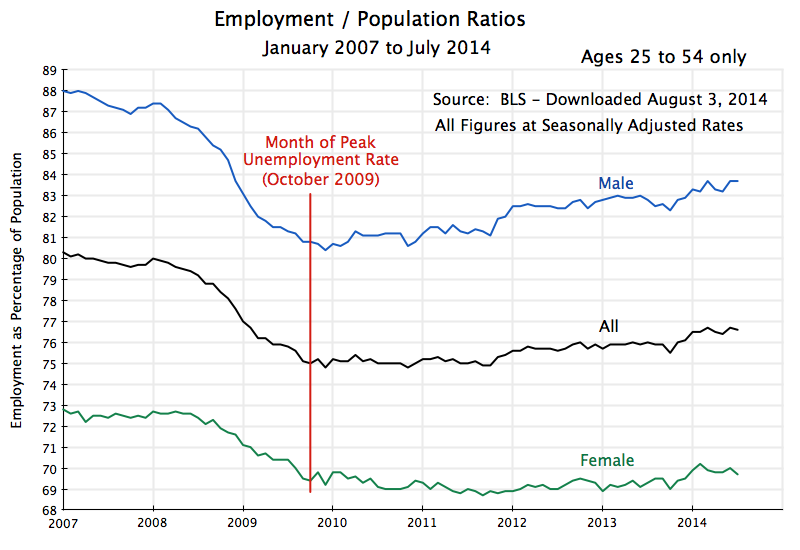
Employment to Population Ratios, Jan 2007 to July 2014

Unemployment Rates, Ages 25 to 54, Jan 2007 to July 2014A.  Introduction

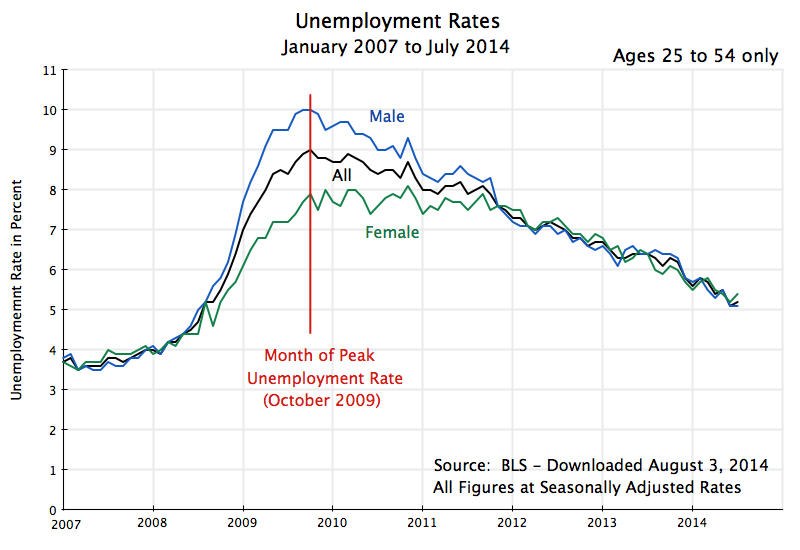
A critically important policy question is how close the US economy now is to full employment.  The unemployment rate has been falling, albeit slowly, from a peak of 10.0% in October 2009, to a current 6.2% as of mid-July (ticking up from 6.1% in June, but a 0.1% change is not statistically significant).  That is, the unemployment rate has come down by a bit less than 4% points from its peak.

However, some have noted that one does not see such a recovery if one focusses on the employment to population ratio.  Excellent analysts, such as Paul Krugman and Brad DeLong, have argued that one should.  If the unemployment rate has come down by close to 4% points, then the employment to population ratio should have gone by almost the same in percentage points unless people are dropping out of the labor force.  [It will not go up by exactly the same amount in percentage points since the base for the employment to population ratio is population while the unemployment rate is expressed as a share of the labor force.  But, all else equal, they will be close.  One could make the relationship exact by expressing the unemployment rate in terms of the share of population rather than share of the labor force, but this is not how the unemployment rate is normally reported.]

If the employment to population rate has not recovered by the same amount (in percentage points) as the unemployment rate has, then by arithmetic this is only possible if the labor force participation rate has come down.  The concern is that the pool of unemployed is coming down not because people are finding jobs (which would then be seen in a rising employment to population ratio), but rather because they are dropping out of the labor force after trying, but failing, to find a decent job (thus lowering the labor force participation rate).

There are of course demographic factors as well to take into account to explain what might be happening to the labor force participation rate, in particular the increasing share of the baby boom generation that is reaching normal retirement age.  One way to do this is to focus the analysis on the prime working age group of those aged 25 to 54 only.  All the charts in this post therefore do this.  But even with this refinement, the apparent concern remains:  The employment to population ratio does not show the same recovery that one sees in the falling unemployment rate.  What is going on?

B.  Recent Years

The chart at the top of this post shows the employment to population ratios from January 2007 to July 2014, for those aged 25 to 54, and for everyone together as well as for males and females separately.  The chart below it shows the unemployment rates for these same groups.  The data all come from the Bureau of Labor Statistics.  The peak unemployment rate was hit in October 2009, after which there was a fairly steady recovery.  [The month to month fluctuations mostly reflect statistical noise.  The employment, unemployment, and labor force participation figures are all based on surveys of households, and there will be statistical noise in any such surveys.]

For the group as a whole (male and female), the unemployment rate for those aged 25 to 54 rose by about 5% points between late 2007 / early 2008 and its peak in October 2009.  Over this period the employment to population ratio fell by a similar 5% points.

But this relationship then broke down going forward.  Over the two years between October 2009 and October 2011, for example, the unemployment rate for those aged 25 to 54 fell by 1.1 percentage points, dropping to 7.9% from 9.0% at the peak (for this age group).  But the employment to population ratio hardly moved.  And between October 2009 and the most recent figures (for July 2014), the unemployment rate came down 3.8% points, while the employment to population ratio rose by only 1.6% points.

The question for policy makers is whether the 3.8% fall in the unemployment rate is a reasonable measure of how far the economy has recovered from the 2008 collapse, or the 1.6% recovery in the employment to population ratio is.  As noted above, both the unemployment rate and the employment to population ratio deteriorated by 5% points during the 2008 collapse and follow-on into 2009.  If the 3.8% recovery in the unemployment rate is the right indicator, then we would have retraced about three-quarters of the fall (3.8/5.0 = 0.76).  But if the 1.6% recovery in the employment to population ratio is the right indicator, then we are less than one-third of the way (1.6/5.0 = .32) back.  This is a huge difference.

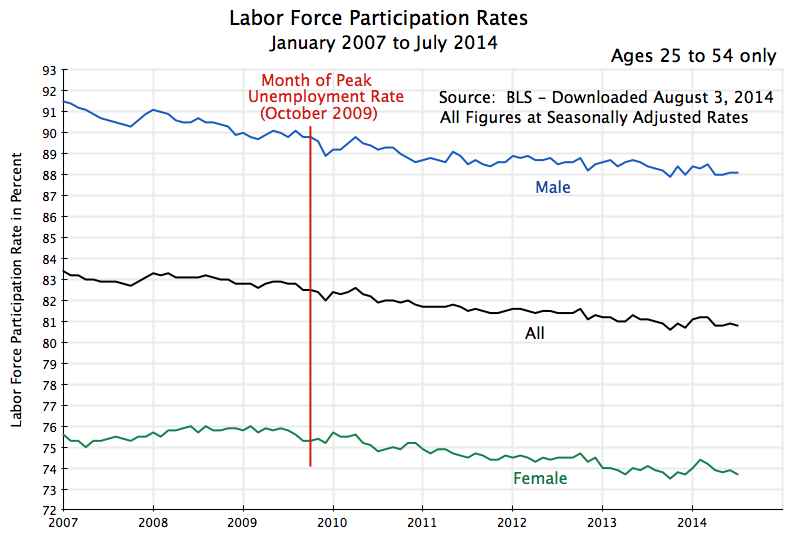
Since the difference between the two measures must be reflected, by arithmetic, in a declining labor force participation rate, one needs to look there to see what is going on.  For the January 2007 to July 2014 period, the picture is:

Labor Force Participation Rates, Jan 2007 to July 2014

The rates are all falling after October 2009, for males and females, and hence for the two combined.  What is interesting is that they appear to be falling at a fairly steady pace throughout the period (aside from the month to month squiggles that are mostly statistical noise).  And for males, the rate appears to be falling at a broadly similar pace before October 2009.  The trend is not so clear for females before October 2009, whose rate may have been rising until a few months before October 2009.  This then leads to little change in the overall rate for males and females combined, but the period is so short that the trends are not clear.

C.  A Longer Term Perspective

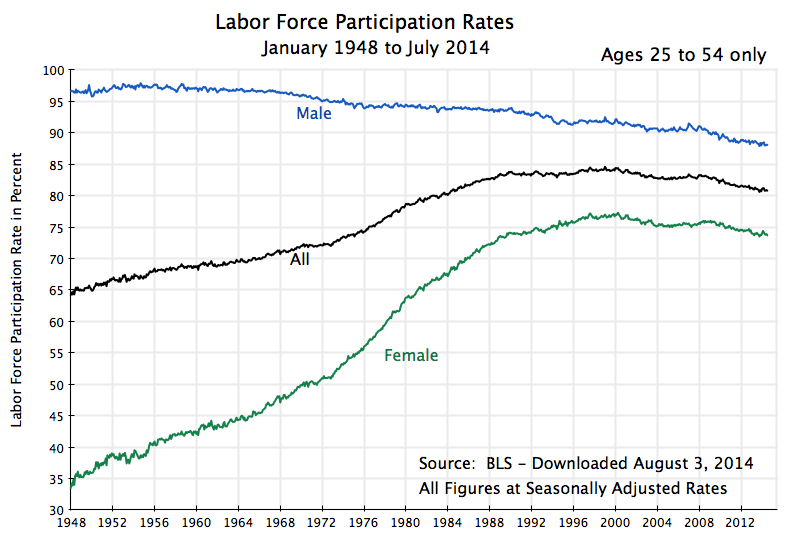
When one then takes a longer view, the trends do become clear:

Labor Force Participation Rates, Jan 1948 to July 2014

Going back to 1948 (the first year in the BLS series for all these labor market indicators), one sees a pretty steady fall in the labor force participation rate for males from around the mid-1950s (with the squiggles in the curves due to statistical noise), and a strong rise in the female labor force participation rate from the initial year with data (1948) to around 2000.  There was some acceleration in the rise for females in the 1970s, and then a deceleration from the early 1990s, leading to a leveling off around 2000.  Since then, the labor force participation rate for females has fallen, on a path that appears to parallel the similar fall in the rate for males, but at 14 to 15% points lower.

The data are consistent with the broader socio-economic story we have of the labor market in the post-World War II period.  Male labor force participation rates are quite high, but have fallen some over time.  Female rates started very low but then grew, and grew at an especially rapid rate starting in the 1970s.  Female labor market participation rates then reached maturity and leveled off around 2000, after which the female rates paralleled the downward path of the male rates, but at a certain distance below.

In this longer term perspective, the decline in the labor force participation rates since 2009 therefore does not appear to be unusual, but rather a continuation of the longer term trend.  There have been some small fluctuations around the long term trends in recent years that appear to coincide with the business cycle (in particular for the female rates), but they are small and dominated over time by the long term trends.  There have also been similar fluctuations in the participation rates in the past (such as in the mid-1990s) that did not coincide in the same way with the business cycle, as well as large business cycle changes in the past that did not show such fluctuations (such as during the big downturn in the early 1980s at the start of the Reagan presidency, that did not lead to such fluctuations in the labor force participation rates).

The implication of this analysis is that the reported unemployment rates are a better indicator of the state of the labor market than the employment to population ratio is.  The fall in the labor market participation rates in recent years has not been something new, driven by the 2008 economic downturn, but rather a continuation of the trend seen in these rates over the longer term.

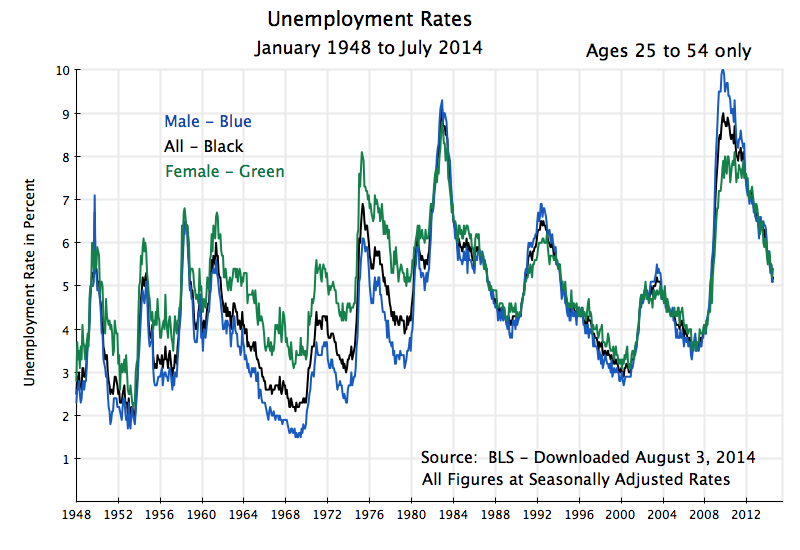
Looking at unemployment rates for this age group going back to 1948 provides a useful perspective on what to expect for it:

Unemployment Rates, Jan 1948 to July 2014

Unemployment rates continue to be high in mid-2014.  Even though they have retraced about three-quarters of the deterioration in 2008/2009 (more for males, less for females), they are, at 5.2% currently (for males and females together) still well above the unemployment rates for this group of about 4% in late 2007 /early 2008, and of only 3 1/2% in late 2006 / early 2007.  And the unemployment rate for this group was only 3.0% in late 2000, at the end of the Clinton years.

There is therefore still a significant distance to go before the economy will have returned to full employment.  But the improvement since October 2009 is substantial, and is real.

D.  Implications of the Long Term Trends for Aggregate GDP

Finally, while the employment to population ratio might not be a good indicator of how much slack there is in the labor market in the short run, there are long term implications of the trends noted above.  Specifically, while the overall labor force participation rate rose steadily from 1948 (the earliest year for which we have this data) to about 2000, this was entirely due to the strong rise in the female rate over this period.  The male rate was falling, steadily but slowly.  Once the female rate peaked in the year 2000 and then began to fall at a rate similar to that for males, the overall rate began to fall.  There is no indication this will be reversed any time soon.  Indeed, the degree to which the female rate is now paralleling the male rate suggests that this really is a “new normal”.

A falling labor force participation rate is not necessarily an indication of something bad in itself.  It might reflect increased prosperity, which is being enjoyed by choosing not to work but to retire early, or to attend university or post-graduate education programs in your 20s, or to stay at home and raise a family.  But to the extent it reflects lack of free choice, such as being fired in your 40s or 50s and then not being able to find a job, or to remain a perpetual student due to lack of job opportunities, or to stay at home due to the unavailability of affordable child care, the implications are different.  But it is well beyond the scope of this blog post to dig into this deeper.

But there will be important long term implications of declining labor force participation rates on long term GDP growth.  With fewer in the labor force, aggregate GDP growth will be less.  Note that this does not imply growth in GDP per capita (or more precisely, GDP per worker) will be less.  GDP per worker is a function of productivity growth.  But with fewer workers than otherwise, aggregate GDP growth will be less.

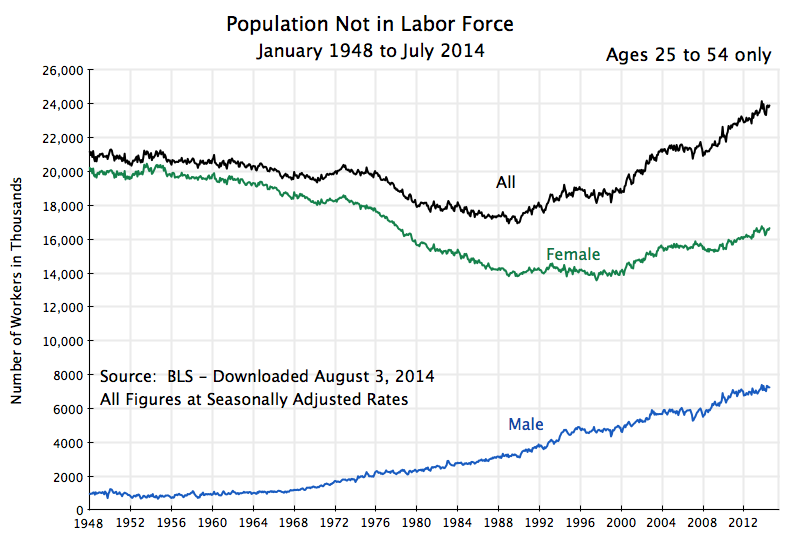
Two final charts, then, to close this blog post.  The first shows the absolute number of people in the ages 25 to 54 population cohort, who are not in the labor force:

Population Not in Labor Force, Jan 1948 to July 2014

The number of males in this age group not in the labor force has been growing steadily since the late 1960s.  The number of females not in the labor force fell until around 1990, was then flat for a decade, and then began to grow.  Overall, the number aged 25 to 54 not in the labor force started to grow around 1990, and has continued to grow since.

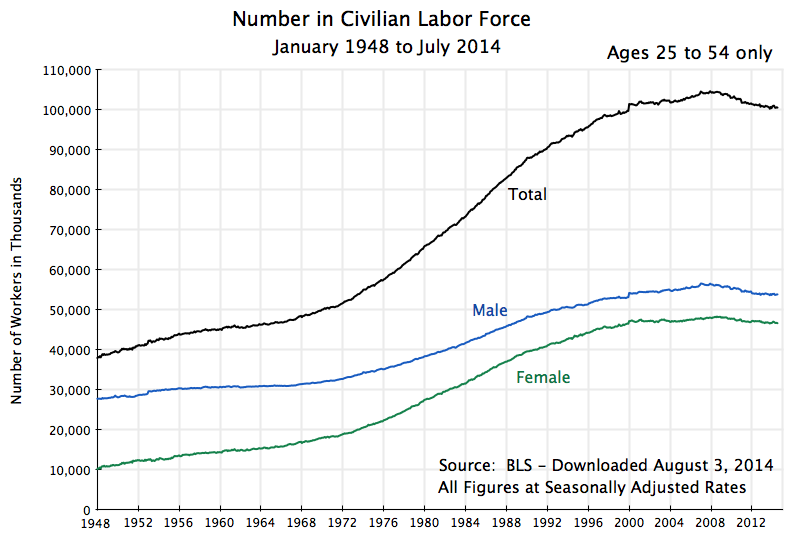
Looking at the numbers of those in the 25 to 54 age group in the labor force:

Labor Force Number, Jan 1948 to July 2014

Due to a growing population in this age group (baby boomers, for example, but others as well), and the growing labor force participation rates of females until 2000, the total labor force in this group rose from the starting year (1948) until 2008.  It grew especially fast in the 1970s, 80s, and 90s.  But the absolute size of the labor force (in the 25 to 54 age group) then started to fall from 2008.  This is a historic change for the US, and based on the fall in labor force participation rates discussed above, as well as slowing population growth, should be expected to continue.  While GDP growth per capita (or per worker) might continue to grow as it has in the past (and it has grown at a remarkably consistent 1.9% a year since 1870 in the US, as discussed in this earlier blog post), one should expect aggregate GDP growth to slow.

E.  Summary and Conclusion

The unemployment rate has fallen substantially since hitting its peak in October 2009, but one does not see a similar recovery in the employment to population ratio.  The labor force participation rate therefore has to have fallen.  However, it does not appear that this fall in the labor force participation rate has been driven by the economic downturn, where high unemployment and poor job prospects led workers to drop out of the labor force on a widespread basis.  Rather it appears largely to be a continuation of longer term trends, that become clear when one separates out the paths for male and female labor force participation rates.

The implication is that the unemployment rate is probably a good indicator of how much slack there is in the labor force.  The unemployment rate has retraced about three-quarters of the rise during the 2008/2009 downturn, but is still high.  And it is substantially higher than what was seen as possible in late 2006 / early 2007, and especially the rate achieved in late 2000.

But there are longer term implications.  The analysis suggests that we should not expect much of a recovery in the labor force participation rate when the economy finally returns to full employment.  Rather, the labor force participation rate is on a downward slope, and has been since the year 2000 (when the female rates reached maturity).  This is likely to continue.  The result is that the absolute size of the labor force in the prime working age years of 25 to 54 should be expected to continue to fall for the foreseeable future.  Japan and most of the European economies have already been facing this.  While GDP per worker, which is driven by productivity change, need not necessarily slow, one should expect growth in aggregate GDP to be less than what one saw in the past.  The ability to adapt to, and manage in, this new economic environment remains to be seen.