The Republican Campaign to Shift the Blame for the Sequester To Obama: If You Don’t Want It, Pass a Simple Bill To End It

John Boehner Obamaquester

It appears increasingly likely that the Congressionally mandated severe and across-the-board budget cuts, known as the sequester, will begin on March 1.  Serious negotiations are not underway, Congress is only back in session now after having been gone for most of the past two weeks, and public statements are not focused on negotiating an agreement but rather on shifting blame.  Should the sequestration budget cuts go into effect, not only will critical federal functions be suspended, but the sudden cuts in spending levels will likely push the country back into recession.  As was noted in an earlier posting on this blog, cuts in Government spending were already the primary cause for a fall in GDP in the fourth quarter of 2012 (according to the initial estimate, which may be revised).  More broadly, had government spending been allowed to rise following the 2008 downturn as it had during the Reagan presidency following the 1981 downturn, we would now likely be at full employment.

The situation is serious, but the new assertion by the Republican leadership that the sequester is there only at the insistence of Obama is almost farcical.  As part of this campaign, Speaker Boehner has staged events for the cameras such as that pictured above, behind a podium labeled with the hashtag “#Obamaquester”, and in front of a clock marked as “Countdown to #Obamaquester”.  Boehner is now asserting that the sequester is only there due to “the president’s demand”, and he refers to the cuts as “the president’s sequester”.

Even some of Boehner’s Republican colleagues find it absurd to try to blame Obama for the sequester.  For example, Representative Justin Amash, a conservative Republican from Michigan (who voted against the bill that set up the sequester mechanism) said:  “I think it’s a mistake on the part of Republicans to try to pin the sequester on Obama.  It’s totally disingenuous.  The debt ceiling deal in 2011 was agreed to by Republicans and Democrats, and regardless of who came up with the sequester, they all voted for it.  So, you can’t vote for something and, with a straight face, go blame the other guy for its existence in law.”

With these new assertions from Boehner and similar assertions from colleagues such as Congressman Paul Ryan (the Republican Chair of the Budget Committee in the House), it may be of interest to review briefly the history of how the sequester mechanism came to be:

  1. The sequester’s origin came from the strategic decision by the key Republicans in Congress in early 2011 to use the routinely required authorization to raise the public debt ceiling as leverage to force through drastic cuts in the budget.  Eric Cantor, the then new Republican House Majority Leader, was the principal architect and proponent of the strategy, which he proposed in January 2011 at a closed-door retreat of Republican congressional members in Baltimore.  He was soon stating publicly that the Republican controlled Congress should not approve an increase in the debt ceiling without drastic spending cuts.  
  2. What this meant was that they would hold the economy hostage to their budget demands, as a refusal to raise the debt ceiling would force the US to default on its debt.  While speeches and pontificating are routine whenever Congress has had to approve an increase in the nominal public debt ceiling, never before had such demands been attached to this approval.
  3. And default on the US public debt would be serious.  US Treasury Bonds are held as risk-free assets both in the US and around the world, and are indeed the foundation of the modern international monetary system.  The impact of default on such assets cannot be predicted with certainty, as it has never happened before, but the consequences could quite possibly throw the global economy into a downturn that would make the 2008 collapse look mild. 
  4. [As an aside:  While I am not a lawyer, the constitutionality of a refusal by Congress to raise the debt ceiling (and hence force a default on the public debt) looks to me to be questionable.  The Fourteenth Amendment to the Constitution (passed in 1866, following the American Civil War) reads in its Section 4:  “The validity of the public debt of the United States, authorized by law, including debts incurred for payment of pensions and bounties for services in suppressing insurrection or rebellion, shall not be questioned.”  In their oath of office, Congressmen pledge to uphold the Constitution.  They cannot then take actions (or defer taking action) which would violate the Constitution by forcing a direct default on the public debt.  However, as noted above, I am not a lawyer, and obtaining such Congressional approval for increases in the debt ceiling has been customary since substantial borrowing needs developed during World War I.]
  5. As the country was coming increasingly close to breaching the existing debt ceiling in July 2011, negotiations were underway at many levels in Washington.  I will not try to review them all here, but the most senior were direct negotiations between Obama and Speaker Boehner.  These talks broke up when Boehner was not able to convince his Republican congressional colleagues to support an approach that included even a relatively small share of revenue increases along with larger expenditure cuts.  In fact, Boehner had to reverse himself twice from tentative agreements he had reached with the President, as he could not get backing from sufficient numbers of his Republican colleagues in Congress.  At the time, Boehner stated publicly that the President had negotiated in good faith.  But in his op-ed piece in the Wall Street Journal this month, Boehner now says the opposite, and asserts the talks failed because the President had reversed his position.
  6. As the deadlines approached and it became clear that agreement would not be possible on a specific set of spending cuts and revenue increases, Jack Lew, then the head of the Office of Management and Budget in the White House (and soon likely to be US Treasury Secretary), suggested consideration of a mechanism that had been used in the 1980s, in budgetary negotiations during the Reagan term.  In its final form and as passed by Congress, the mechanism established a Joint Committee made up of 12 members of the Senate and Congress (split evenly between Republicans and Democrats), who would by a certain date (November 21, 2011) develop a plan to achieve $1.2 trillion in deficit reduction (over 9 years) through a combination of spending cuts and revenue increases.  If the Joint Committee could not reach agreement, an automatic cut in spending of $109 billion per year over nine fiscal years (FY2013-21) would be required, split evenly between Defense and non-Defense programs.  These automatic across-the-board cuts were known as the “sequester”, and were deliberately crude and draconian to serve as an inducement to the Joint Committee to reach an agreement on more palatable means to achieve a similar reduction in the deficit.
  7. The mandate of the Joint Committee was to reach agreement on measures that would reduce the deficit by $1.2 trillion over ten years.  Such measures could include both spending reductions and revenue increases.  And the revenue increases could be achieved not only by raising tax rates, but also by closing tax loopholes, cutting expenditures that are implemented via tax subsidies, and/or broadening the tax base.  But the Joint Committee never reached an agreement, as Republicans refused to agree to any revenue measures at all.
  8. At the time, Boehner, Paul Ryan, and other Republicans praised the sequester mechanism as a means to force what they were seeking.  Boehner famously said in a CBS interview on August 1, 2011, that he had gotten “98%” of what he wanted.  Ryan emphasized and praised the sequester mechanism in an interview on Fox News on August 1.  Following his recent reversal now to criticize the sequester, a YouTube video was even put together showing a series of Ryan statements over the years in favor of sequester mechanisms (including this one specifically) and statutory spending caps.  And a Power Point presentation put together by Boehner when he made the case to his Republican colleagues to vote in favor of the bill that established the sequestration mechanism, makes clear his approval of it at the time.
  9. Obama, in sharp contrast, had always wanted a clean bill authorizing an increase in the public debt ceiling, without additional conditions added on.  It is indeed rather absurd to think that Obama would want to see a bill passed that would deliberately tie his hands.  Obama had proposed alternative approaches to reducing the deficit, including in his FY2013 budget (in great detail) and during the negotiations with Boehner.  Obama still stands by these proposals.  But while the Republicans assert that Obama has not offered any such plans, the issue is rather that the Republicans have rejected the plans Obama has offered.
  10. Jack Lew only suggested the option of the sequester mechanism as a fallback if no agreement is reached, late in the negotiations when it became clear that agreement on a specific set of spending cuts and revenue increases would not be possible.  But Obama and Lew would have greatly preferred a clean bill without any such conditions.  It is absurd to say, as Boehner now does, that the sequester mechanism is there only because it was something Obama “insisted upon in August 2011”.

The automatic sequester will cut government expenditures by $85.3 billion over the remainder of the fiscal year, from March 1 to September 30, 2013.  If nothing is done, there would be further cuts of $109.3 billion in each of the next eight fiscal years to FY2021.  The $85.3 billion cut over seven months would be equal to roughly 1% of the seven month GDP.  With a multiplier of two, this would by itself drive down GDP by 2% from what it would be otherwise.  The Congressional Budget Office estimates that the US economy is producing at about 5 1/2% below what it potentially could be producing at full employment.  An additional 2% reduction would be significant.

Agreement is difficult in Washington, particularly in the current political environment.  But if Boehner, Ryan, and others now hold to the view that the sequester is a bad idea, there is a simple solution.  All that they would need to do would be to pass a simple bill which revokes it.  Obama would certainly sign it.  The budgetary mechanism would then revert to the standard process, and that standard process could be followed to determine whether certain public expenditures should be cut and by how much, and whether revenues should be increased by closing loopholes, cutting tax subsidies, raising rates, or some other approach.

But there is nothing that requires the sequester mechanism.  If Boehner, Ryan, and the others do not want it, they can pass a simple bill to end it.

Homicides by Firearms in the US: An International Comparison of Homicides and Criminality Rates

Homicides by Firearms Across Countries

Introduction

It is well known that the rate of homicides due to firearms is higher in the US than in other developed countries.  What some might not realize is how much higher.  But some then argue that while the US rate of homicides by firearms might be high, homicides can be carried out by other weapons, such as knives and clubs, and that when one takes these into account, the overall homicide rates are similar.  This is simply not true.  Some also argue that the US suffers from especially high criminality for social, cultural, economic, or whatever reasons, and that homicide rates in the US are just similarly high.  This is also simply not true.

This blog post will examine these assertions through a series of simple charts.

Homicides by Firearms

First, the chart above shows the rate of homicides due to firearms in the US as compared to Japan, the UK, France, Germany, Ireland, New Zealand, and Iceland.  The data comes from the UN Office of Drugs and Crime, as part of its 2011 Global Study on Homicide.  The figures are for 2008, the most recent year for which data were available for most of the countries on the list (2007 for France)

Japan, the UK, France, and Germany were chosen as other large, developed, countries with per capita incomes comparable to that of the US.  All are members of the OECD, the “club” of developed countries that, among other activities, share data and analyses.  Ireland, New Zealand, and Iceland (also OECD members) were added for reasons that will become clear below.  Briefly, these three countries plus the UK had the highest rates of overall criminality among the 26 OECD members, which make them interesting comparators.

As the chart above shows, homicides by firearms are tiny in the comparator countries relative to what they are in the US.  The US rate in 2008 was over 3.6 homicides per 100,000 population.  As was noted in a previous posting on this blog, this rate had come down by almost half during the 1990s.   But a 3.6 rate pales in comparison to rates of only 0.009 in Japan, 0.06 in the UK and France, 0.2 in Germany, 0.5 in Ireland, 0.2 in New Zealand, and exactly zero in Iceland (where there no homicides at all in 2008).  Put another way, the rate in the US was 424 times higher than it was in Japan, and about 60 times higher than in the UK and France.

Homicides by Any Method

But perhaps a higher rate of homicides by firearms in the US is being offset by higher rates of homicide by other means in the other countries?  If so, then all the overall homicide rates would be comparable across the countries.  But no, this is not happening:

Homicides by All Methods Across Countries

The overall US homicide rate of about 5.5 still remains far above the rates of between 0.5 and 1.3 in the other countries (and of exactly zero in Iceland).

Homicides by Means Other Than Firearms

Looking at the rate of homicides by means other than firearms:

Homicides by non-Firearms Across Countries

Here the rates are at least comparable to each other.  While the US rate remains the highest, at a rate of 1.8 per 100,000, the rates for the others are between 0.5 and about 1.25 (other than the rate of zero for Iceland).  But there is no basis for the argument made by some gun advocates in the US that if one restricted access to guns, that the homicides would take place anyway, but by means of knives and clubs and other weapons.  One does not see this in the other countries.  Firearms are not substituting for other weapons in the homicide rate.  The data rather are consistent with firearms adding to the rate of homicides by other methods, leading to a very high overall rate for the US.

Victims of All Crime

But perhaps the US is a country with a particularly high rate of criminality?  If so, the high homicide rate might be explained by an also high rate of overall crime.  But this is not the case:

Crime Victimization - All Crimes, Across Countries

The number of victims of crimes in the US (as a share of the population) is in the middle of the range for this set of comparator countries.  In the US, about 17.5% of the population had been the victim of a crime (burglary, theft, robbery, sexual assault, other assault or threatened assault) over the preceding 12 months.  The rates were between 10 and 13% in Japan, France, and Germany, but between 21 and 22% in the UK, Ireland, New Zealand, and Iceland.  These latter four countries had the highest rates of any countries in the sample of 26 OECD countries with data.  The overall OECD average was 15.5%.  The US rate ranked #17 of the 26 countries.

[These data come from an international sample survey undertaken periodically with UN support, that covered 30 countries in 2004/2005 (the most recent available).  This International Crime Victims Survey asked a statistically valid sample of individuals in each country a range of questions on whether they had been a victim of a crime (broken into a number of categories) over the previous 12 months.  The data here comes through the OECD, which posted it in convenient spreadsheet form.]

Criminality in the US, in terms of the number of victims as a share of the population, is therefore somewhat above the OECD average, but is by no means the highest.  Nine of the 26 OECD countries were worse.  The four worst countries were the UK, Ireland, New Zealand, and Iceland.  But as seen in the chart at the top of this post, their rates of homicide by firearms are tiny compared to the rate in the US.  Relatively higher rates of criminality are not associated with higher rates of homicides by firearms.  The same holds true for homicides by any method.

Victims of Assault

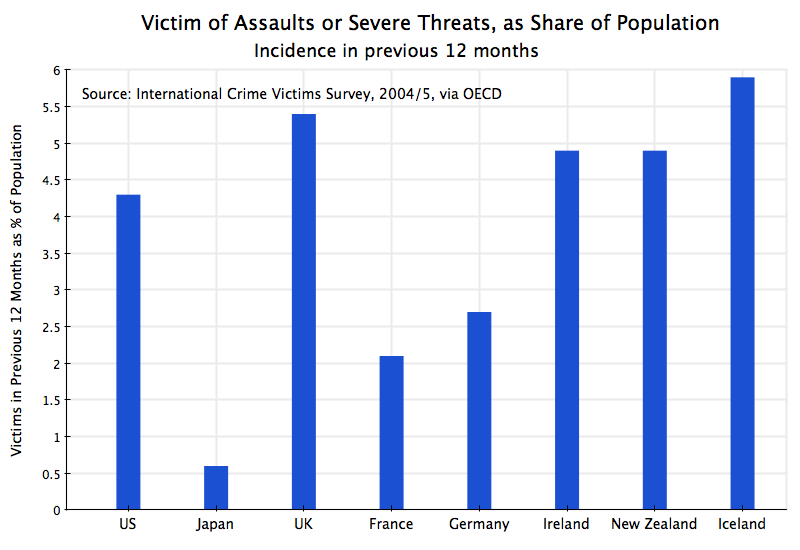
It might also be argued by some that it is not the overall rate of criminality that matters to homicides, as this includes crimes such as burglary where the victim is not present.  Rather, they might argue, it is the rate of assault or the threat of assault that matters, as it is here where homicides might occur.  But there is no evidence to support this either:

Crime Victimization - Assaults & Threats, Across Countries

The US rate of 4.3% is again by no means the highest rate among the OECD members.  The UK, Ireland, New Zealand, and Iceland again all have higher rates (of 4.9 to 5.9%).  These latter four countries are again the worst four among the 26 OECD members.  The US rate of assault is well within the range for the OECD countries, yet its homicide rate by firearms is far higher.  And countries with higher rates of assault have far lower rates of homicide.

Conclusion

To conclude, the rate of homicides in the US by firearms is incredibly higher than the rate seen in other OECD countries.  This cannot be explained by a substitution of firearms for other weapons which would have been used anyway to commit the homicide, nor can it be explained by an especially high rate of criminality in the US.  There are more victims of crimes as a share of the population in other OECD countries, who nevertheless have far lower homicide rates.

The easy availability of firearms in the US, instead of the tight controls seen in other developed countries, certainly has something to do with this.

Impact of the 1994 Assault Weapons Ban on Homicide Rates and Mass Shootings

US Murder Rates, 1980 to 2010Mme. Marie Curie (Nobel Laureate):  “Nothing in life is to be feared, it is only to be understood.  Now is the time to understand more, so that we may fear less.”

[Note:  An update to this post, with more recent data as well as a discussion of what should be done for a more effective ban, was posted on this blog on March 17, 2018.]

Introduction

The horrific shootings at Sandy Hook Elementary in Connecticut in December, in which 20 school children aged 6 and 7 died, led to an outcry for effective measures to stop this from happening again.  The gun control measure most commonly called for was reinstatement of the ban on assault weapons (the type of weapon used in the Sandy Hook shooting) that Congress had passed in September 1994.  The law had a 10 year sunset provision, and with the more conservative political climate in 2004 during the Bush Administration, efforts to renew the law were blocked.  Hence it expired in September 2004.  The mother of the Sandy Hook shooter was then legally eligible to purchase an assault weapon, and her son used the one she had at their home to kill the 20 school children, after he first shot his mother.

But did the 1994 Assault Weapons Ban law have an effect on homicides in the US, and separately on mass shootings?  This note will review what we might be able to say from simple trends over time.

US Homicide Rates Fell in the 1990s

The chart above shows US homicide rates between 1980 and 2010, with a breakdown (for 1980 to 2008) of the number of homicides as a result of the use of any gun, by handguns only, and by all other guns.  Other homicides could be through the use of knives or other objects.  The source is a report dated November 2011 on homicide trends in the US over 1980 to 2008, prepared in the Bureau of Justice Statistics of the US Department of Justice, and is the most recent such report available from this source.

The chart shows that homicides did indeed decline sharply over the 1994 to 2004 period that the law was in effect (more precisely, September 13, 1994, to September 12, 2004).  The overall homicide rate in the US was 9.5 deaths per 100,000 population in 1993, and this fell to a rate of 5.6 in 2005.  The homicide rate from use of guns fell from 6.6 in 1993 to 3.8 in 2005.

While these homicide rates are an improvement over what they had been, keep in mind that compared to other developed countries, the rates are still abysmal.  Based on UN assembled data for 2010 (or the most recent year available), the total homicide rates were just 1.2, 0.8, 1.1, and 0.4 for the UK, Germany, France, and Japan respectively, and the homicide rates by firearms were only 0.1, 0.2, 0.1, and 0.0 for the four countries (where the rate in Japan rounded to 0.0 per 100,000 population as there were only 11 homicides in Japan in 2008, the most recent year with data available in the UN report on this; in 2008, the US had 11,030 homicide deaths by firearms.  Japan has strict gun controls.).

But can one attribute this fall in the homicide rate to be a consequence of the Assault Gun Ban then in effect?  From just the relationship found in the chart, not really.  There was much else going on during this period which could and probably did also have an impact on homicide rates.  In addition, one can see in the chart that the decline in homicide rates began before the new law went into effect, and that the large fall then bottomed out around 2000, after which there was a small rise.  Furthermore, one does not see a jump back to previous rates once the ban was allowed to expire in September 2004.  Looking at this relationship over time, a stronger case could probably be made that the drop in the homicide rate was more due to the totality of measures implemented during the period of the Clinton presidency, from January 1993 to January 2001.  This fits well the observed period when the homicide rate dropped.  But here again, there was much else also going on which could affect the homicide rates, including at the level of state and local governments.

Mass Shootings, 1982 to 2012

It is also arguable that the metric used above (the overall homicide rate) is not the metric that should be used when assessing whether the Assault Gun Ban helped.  The Assault Gun Ban only affected one category of gun (semi-automatic weapons), and highly imperfectly at that (which will be discussed below).  Most murders are done with simple handguns.  Particularly with the Sandy Hook shooting of school children very much in mind, can one say whether the 1994 Assault Gun Ban may have reduced the number of, and severity of, mass shootings?

Following the Sandy Hook shooting, Mother Jones magazine recently updated a data set it had earlier prepared (after the Aurora theater shootings) on mass shootings in the US since 1982.  Using specific criteria to define what to include as a mass shooting (four or more people shot in a single incident; one shooter; the shootings occurred in a public place; and some other factors and with some specified exceptions), Mother Jones provides a well documented data set concluding that there were 62 mass shootings meeting its criteria over this period.  They provide brief descriptions of each event, what weapons were used, the number of fatalities and the number of those wounded, and other relevant data.

Based on this data set, the following graph shows the number of mass shooting incidents in each year from 1982 to 2012:

Mass Shootings, Number by Year, 1982-2012

The number of mass shootings meeting the specified definition averaged 1.5 each year between 1982 and 1994, and possibly might have been rising in the period leading up to 1994 (I say possibly as the number of events are small, and it is not clear this is statistically significant).  The annual average was about the same, at 1.6 per year, between 1995 and 2004, but with this average brought up by a high number in 1999 (the year of the Columbine High School shooting, but where there were five mass shootings in total), and to a lesser extent in 1998 (with three mass shootings).  The numbers were low in the other years.  After the Assault Gun Ban expired, the frequency went up, reaching 3.4 per year on average between 2005 and 2012, with an especially high number (seven) in 2012.

The data set also has the numbers over time on the number of fatalities and of all victims (including those wounded):

Mass Shootings, Fatalities and Total Victims, 1982-2012

Using the numbers underlying this figure, over 1982 to 1994 the number of fatalities in mass shootings averaged 8.5 per year and the number of total victims (including those injured) averaged 18.2.  Over the period 1995 to 2004, the number of fatalities fell somewhat to 6.4 per year while the total number of victims fell to 13.2.  The averages were higher than otherwise in this period due to the spikes in 1999 (the year of Columbine) and to a lesser extent 1998.  The numbers then went higher in the period 2005 to 2012, after the Assault Weapons Ban expired, to 9.2 fatalities per year and 16.7 total victims per year.  2012 was a particularly bad year.

But with the limited number of years and small number of incidents involved each year, it is difficult to say whether there were significant changes over time, and in particular whether the fatalities fell significantly during the period the Assault Weapons Ban was in effect.  Were it not for 1999, and to a lesser extent 1998, the number of annual fatalities and victims would have fallen sharply during the period of the Assault Weapons Ban, and then risen again after it was abandoned.  But 1999 and 1998 did occur, so it is hard to say whether the impact was significant.

The underlying numbers also indicate that over the period as a whole, 73% of the weapons used in the mass shootings (and there were typically multiple weapons used in each mass shooting) were either semi-automatic handguns or long-barreled assault weapons.  Both were in principle banned under the Assault Weapons Ban, but only the manufacture and sale of new such weapons were banned –  the existing stock remained.  Such weapons accounted for 67% of the weapons used in the mass shootings between 1982 and 1994, for 74% of the weapons during the period of Assault Weapons Ban was in effect, and for essentially the same share of 75% in the period 2005 to 2012 when the law had expired.  There was no significant change during the period of the Assault Weapons Ban.

Limitations of the Assault Weapons Ban Law

The evidence is therefore not clear whether the 1994 Assault Weapons Ban had a significant effect.  But part of this is certainly a consequence of the “ban” being extraordinarily weak.  While the law was controversial, and some attribute the loss of the Congress by the Democrats to a resurgent Republican Party that year (when Newt Gingrich became Speaker) to passage of the act, the act itself did little to “ban” assault weapons, despite the title.

First of all, the law only affected the manufacture and subsequent sale of newly produced assault weapons.  The existing stock of such weapons would remain, and could be sold or transferred between owners.  In anticipation of the law, manufacturers flooded the market with a huge supply of newly produced weapons.  Second, the law defined “assault weapons” in a highly specific way.  As an advocacy group later noted, gun manufacturers soon found they could circumvent the law with what were little more than cosmetic changes to the existing arms.  Finally, while the Assault Weapons Ban also limited the manufacture and sale of newly produced high capacity ammunition magazines (limited to ten rounds or less), the manufacturers also ramped up production of these clips and flooded the market in the period before the law went into effect.  The high capacity clips were still widely available in 2004.

With these limitations in the law, it is not surprising that it is difficult to determine with any confidence whether the law had an effect on homicides and mass shootings.  And it appears as I write this, that President Obama is likely to propose tomorrow, January 16, a new assault weapons ban as a center piece of his initiative to reduce gun violence.  I would certainly welcome this.  But for the law to be effective, it will be very important that it take into account and remedy the limitations that made the 1994 Assault Weapons Ban so weak.  And I do not expect that the current Congress will do this.

The Need for Serious Analysis and Research

It is also clear that the limitations that have been placed on serious research on the causes of gun violence has to end.  These were discussed in a previous posting on this blog.  As discussed there (and also see a recent summary here), the limitations on research have been imposed by a conservative Congress at the instigation of the NRA.

A good recent summary of the problem is provided in an open letter to Vice President Biden (as chair of the Commission on Gun Violence) signed by a senior group of 108 professors and analysts from prominent universities and institutions.  Despite the importance of gun violence to our health, the US Centers for Disease Control and Prevention (CDC) has been effectively blocked from sponsoring research on understanding the issue, and the CDC and the US Bureau of Alcohol, Tobacco, Firearms, and Explosives (ATF) have not been allowed even to assemble and disseminate relevant data.

As a consequence, high level review commissions have been forced to say, honestly, that we simply do not know what the impact of various possible gun measures might be.  Comprehensive reviews in 2003 by the CDC and in 2004 by the National Research Council of the National Academies of Sciences had to conclude that the research has not been done, nor even the data assembled to permit such research to be done, to determine what might be effective in curbing gun violence.  And as the CDC report notes in its up front summary:  “insufficient evidence to determine effectiveness should not be interpreted as evidence of ineffectiveness.”  They both called for further work, but I am not aware of a similar commission and review since 2003/2004, which itself is indicative.

It is extremely important to keep in mind that while we do not have adequate analysis which can allow us to say with any certainty what measures might be taken to reduce gun violence, that does not mean that measures to control the availability of firearms will not be effective.  We do, after all, see the lower homicide rates, and especially the far lower homicide rates by firearms, in countries that have controlled access to firearms, such as most of Europe and Japan.  Figures are cited above.  And it is not true that the overall level of crime is especially high in the US.  According to statistics issued by the OECD, the overall crime rate in the US, as well as the rate of criminal assaults and threats, are in the middle of the ranges for the 26 OECD members reviewed.  Where the US stands out is not in criminality, but in homicides resulting from criminality.

The easy availability of guns certainly has something to do with this.

Update:  An observant reader noted that in my original post I had mistakenly referred to Sandy Hook Elementary as Sandy Hill Elementary.  I have corrected that in the above.  My thanks to that reader.