
Murder Rates, the NRA, and Households With Loaded Firearms


Murder Rate vs Firearms in HH, by State, 2002

Following the shooting at Sandy Hook Elementary School in Connecticut on December 14, in which 28 died including 20 school children aged 6 or 7, there has been a renewed call for more humane gun laws.  The early sense was that with such a tragedy, even the National Rifle Association (NRA) would be willing to work with others on measures to reduce the likelihood of this happening again, including measures to regulate access to military-style assault weapons and high capacity gun clips, which have no use other than mass slaughter.

Instead, in a press conference on December 21, the NRA came out forcefully against any measures that would limit access to such weapons or indeed any weapons.  They instead blamed violent video games and movies for such shootings, and called for armed guards to be posted in every school in the country.

The NRA remains unwilling to acknowledge that easy access to guns is associated with higher murder rates.  But the graph above shows that there is indeed a positive association.  It shows the relationship between the share of households in each state with a loaded firearm in the home and the murder rate in that state.  (The loaded firearm data comes from the 2002 BRFSS survey, discussed extensively below, while the murder rate data comes from the Uniform Crime Reporting Statistics of the US Department of Justice.  Note also that about two-thirds of murders in the US are done with firearms, so the graph above includes murders through other means as well.)  Despite the fact that the murder rate will be a result of many complex and different factors, the clear positive correlation with loaded firearms in the households is significant.  (Technically, the slope of the simple linear regression line is positive, with a t-statistic of 3.75.  At such a t-statistic, there is more than a 99.9% probability that the relationship is statistically true.)

I would hasten to add that while the relationship is statistically highly significant, such a simple analysis cannot tell us what the causation is.  That is, while easy availability of a loaded firearm in the household may be leading to more murders, it is also possible that states with a high murder rate will see a larger share of households keeping a loaded firearm in their home.  The extremely simple analysis here cannot discriminate between these two possibilities.

Clearly more careful work is needed on such questions, and I am sure there have been efforts at this elsewhere.  However, for an issue as important as this, where tragedies such as the Sandy Hook Elementary School shooting recur with disturbing regularity, the availability of such analysis is tragically limited.  And a major part of the reason is the lack of good data.

The lack of good data is not an accident.  You see on the graph above that the relationship shown is for 2002 – ten years ago.  The reason is that such state level data on firearm ownership is not readily available.  The figures for the graph above came from the Behavioral Risk Factor Surveillance System (BRFSS) survey for 2002 (the firearm results in the 2002 survey are discussed in this article).  The BRFSS is an annual survey, organized by the Centers for Disease Control and Prevention (CDC) in Atlanta, and is focussed on health.  It addresses issues of health status, health care access, personal behaviors that affect health status (such as exercise and diet), and the use of screenings (e.g. for cancer) and other health services.  The survey is a huge one (240,735 randomly selected adults answered the 2002 survey), and needs to be so large to be able to get valid state-level results.

The 2002 BRFSS survey had three questions on firearms ownership:  whether there was a firearm in the home, whether it was loaded, and whether it was unlocked as well as loaded.  The 2001 survey had only one question on firearms (whether there was a firearm in the home), and the 2004 survey had the same three questions as the 2002 survey.  No other BRFSS survey, before or since, has had questions on firearms access.  The BRFSS questionnaires are available here.

Why have the surveys on firearm ownership been so limited, despite the importance of the issue to the health of Americans?  The CDC has long sponsored research on the impact on health of factors such as smoking, seat belt use, and until the mid-1990s on the presence of firearms.  There were a number of interesting studies, including a widely read one published in 1993 in the New England Journal of Medicine that found that presence of a firearm in a household did not lead to greater protection for the residents, but actually increased the likelihood of an homicide by a factor of 2.7.

However, rather than responding to such scientific study by closer examination of the issue by experts, the NRA responded by having its supporters in Congress cut the CDC budget by the amount being spent on such research, and by inserting into its appropriation bills (still to this day) the requirement that “None of the funds made available for injury prevention and control at the Centers for Disease Control and Prevention may be used to advocate or promote gun control.”  (See the references here, here, and here.)  This would be analogous to the tobacco industry succeeding in blocking government support for research work on the health impacts of smoking.

The NRA and its allies in Congress have also deliberately constrained the ability of the Bureau of Alcohol, Tobacco, Firearms and Explosives to control illegal access to firearms through limiting the ATF budget, by formal constraints written by Congress into ATF legislation, and by blocking the approval in the Senate of any nominee for ATF Director.  The requirement of Senate approval of nominees to the post was only added recently, under the legislation that moved the ATF to the US Department of Justice from its previous position in the US Treasury.  This was part of the package of legislation that followed the 9/11 tragedy (which, among many other changes, created the new US Department of Homeland Security).  But since then, Senators have blocked the approval of any nomination of an ATF Director, blocking the nominees of both Bush and Obama.  As a result, the ATF has only had an Acting Director since 2006.  The legislated constraints on the ATF also include blocking it from releasing anything other than aggregate data to the public.  The ATF is not even allowed to computerize its own gun records.  Instead, paper files in cardboard boxes have to be used for the gun traces that the ATF is requested to do routinely by local law enforcement whenever a gun is recovered from a crime scene.  It is impossible to say how many criminals have gone free as a result.

And these legislative initiatives of the NRA to block research, to block assembling data to allow such research, and to hinder the enforcement of existing laws to solve crimes where guns were involved, have continued.  An article today in the Washington Post reported on the success of the NRA in inserting language into the Affordable Care Act (ObamaCare) which restricts doctors from asking patients on the ownership, possession, storage, or use of firearms or ammunition, and prohibits the government or anyone else from assembling or maintaining data on this (see pages 766 and 767 of this file of the text of the Affordable Care Act for the exact language).

With it impossible to assemble relevant data and with research hindered, the NRA can therefore say with a straight face that conclusive evidence does not exist that shows that controls on access to weapons lead to fewer homicides.  And as in the December 21 NRA press conference referred to above, the NRA can claim gun control efforts cannot work, while simultaneously asserting that a cause of the violence is violent video games and movies.

At this press conference, the NRA argued that the way to address gun violence such as the tragedy at Sandy Hook Elementary is to post armed guards in all of our schools.  With over 130,000 public and private schools (elementary through high school), that would be a lot of guards and loaded guns.  Such guards would need to have their weapons always close, with their fingers near the trigger, ready to fire on a moment’s notice on anyone they feel suspicious, before a would be shooter would have a chance to shoot the guard first.

And if this is what we need to do for our schools, then presumably the NRA also believes we need guards with loaded weapons at all our movie theaters (Aurora, Colorado, 12 dead), at our shopping malls (Portland, Oregon, 3 dead; Omaha, Nebraska, 9 dead), in every building on all our college campuses (VPI, 33 dead; University of Texas, 17 dead), at any meetings we have with our Congressional representatives (shooting of Congresswoman Gifford, 6 dead), at our community centers (Binghamton, New York, 14 dead), at cafeterias (Killeen, Texas, 23 dead), at fast food restaurants (McDonalds in California, 22 dead), and at other scenes of mass shootings in recent years, including our churches, synagogues, temples, and mosques; at hotels, cafes and restaurants, supermarkets, department stores, post offices, hair salons, Christian prayer rallies, and commuter trains; and at any work location where there may be a disgruntled worker.

The only thing we can be certain about with such a plan is that shooting deaths would rise.
Romney’s Proposal to Cut to Zero the Taxes on Income from Wealth for those Making Up to $200,000

Having just watched the second presidential debate between President Obama and former Governor Romney, I want to make a quick point on Romney’s tax proposals that have not been much commented upon.

It is well known that Romney has proposed a tax plan where he would cut all individual income tax rates by 20%.  It is accepted by all, including Romney, that this by itself would cut tax revenues by about $5 trillion over ten years, but that Romney then says he would also cut certain (but unspecified) tax deductions and other preferences in the tax code so as to raise back that $5 trillion and thus make the overall plan revenue neutral.

While this has been much discussed (and the impossibility of doing this without increasing taxes on the middle classes has been noted by neutral observers, including the Tax Policy Center, a group that Romney himself had praised during the Republican primaries), certain other aspects of his tax proposals have been less discussed.  One, which Romney highlighted in the debate tonight, would be that he would cut to zero the income earned from dividends, interest, and long term capital gains, for all households earning up to $200,000 a year.

Note what this implies.  Suppose you are someone who has $4 million in wealth.  Perhaps you inherited this from someone, or struck it rich in the stock market, or won the lottery.  And suppose you are earning a modest 5% on this $4 million from dividends plus interest plus long term capital gains.  You would then be receiving $200,000 a year from this wealth.  While perhaps not really rich, the income is good enough for you, so you do not work.  Under Romney’s proposal, you would pay zero in federal taxes.

In contrast, suppose you work for a living, earning $100,000 a year (or half of what the better off individual described above earns simply from his wealth).  You would pay Social Security and Medicare taxes at a rate of 15.3% on this (total, including the half that is nominally is “paid by” the employer, which all analysts, including Republican ones, agree comes out of worker wages).  You would also be in the middle of the 25% tax bracket currently for federal income taxes, which would fall to 20% under Romney’s proposal to cut all rates by 20%.

Even ignoring the additional taxes you would pay under Romney’s proposal to reduce or eliminate certain (but unspecified) tax deductions and tax preferences, the individual earning $100,000 a year would pay taxes at a marginal rate of 35.3% ( = 15.3% + 20%).  But the wealthy individual, with $4 million in wealth making $200,000 a year would pay absolutely zero.

How can this be considered fair?

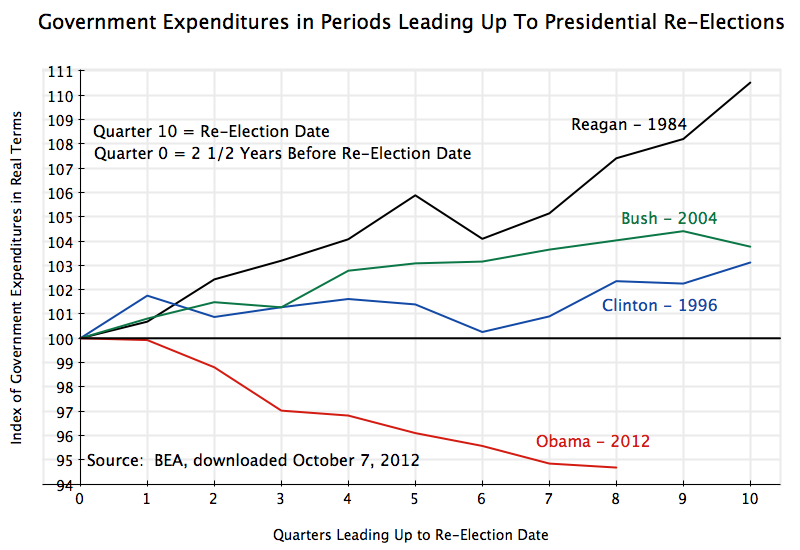
Government Expenditures Leading Up To Presidential Re-Elections: Falling Under Obama, While Rising for Others

US Government expenditures before Presidential re-elections, Reagan, Clinton, Bush, Obama

Despite the continued rhetoric that government expenditures have exploded under Obama, the truth is the opposite.  Government expenditures have been contracting in the period leading up to the election.  This contraction has led to slower economic growth and has hurt Obama’s re-election chances.

Previous posts on this blog (here, here, and here) have looked at the paths of government expenditures and government employment from either presidential inauguration dates or around business cycle peaks.  This post will look at the paths leading up to re-election dates.

The figure above shows the path government expenditures have followed in the 2 1/2 years leading up to the presidential re-election dates, for Obama as well as Reagan, Clinton, and the second Bush.  The data is taken from the GDP accounts, and shows real government expenditures on consumption and investment, a component of GDP.  They come from the Bureau of Economic Analysis of the US Department of Commerce.  Note that this is all of government, including state and local.  We do not yet have data yet for the third quarter of 2012 (the initial estimate will be released later in October) nor obviously for the fourth quarter.  But the pattern is clear.

Government expenditures (including state and local) have been falling steadily and sharply under Obama in the period leading up to the re-election date, and as of the second quarter of 2012 were over 5% below where they were in the second quarter of 2010.  At the comparable point under Clinton they were over 2% higher, under Bush Jr. they were 4% higher, and under the conservative idol Reagan they were 7 1/2% higher.  Stated another way, government spending under Obama as of the second quarter of 2012 would have had to been 13.4% higher to have matched where it was under Reagan.

Government expenditures continued to rise rapidly under Reagan.  By the date of the 1984 election, the expenditures were 10 1/2% higher in real terms than 2 1/2 years before.  While Reagan is praised as a small government conservative, his re-election was helped immensely by this rapid growth of government.  This growth in government spending led to growth in demand for the production that could be provided from the then unemployed workers, and sparked the recovery from the 1981/82 downturn.  Unemployment reached a peak of 10.8% in late 1982 under Reagan, substantially higher than the peak of 10.0% under Obama.  But with government then expanding under Reagan, rather than contracting as under Obama, the unemployment rate fell rapidly under Reagan to 7.3% in September 1984, vs. 7.8% under Obama in September 2012.

The impact of the growth in government under Reagan instead of the contraction under Obama can be estimated using the GDP accounts issued by the BEA.  The growth of GDP can be broken down into the contributions to that growth from the individual components making up GDP, one of which is government spending.  During the ten quarters from mid-1982 to the last quarter of 1984, GDP growth averaged 5.2% at an annualized rate under Reagan.  This was indeed a good rate of growth from the sharp downturn experienced in 1981/82 at the start of the Reagan term.  Of this 5.2% rate of growth, the growth in government spending accounted for 0.85% points.  In contrast, the rate of growth under Obama from mid-2010 to the second quarter of 2012 (the most recent period with data) was 2.0% (annualized), well below the 5.2% rate of growth under Reagan.  But Obama’s growth was dragged down by a contracting government, by 0.55% points.  The figures are summarized in the following table:

Impact of Govt growth at level of other president
Govt contribution to GDP growth (annualized) GDP growth (annualized) Direct Impact Multiplier of Two
Reagan – 1982Q3 to 1984Q4 0.85% 5.2% 3.8% 2.4%
Obama – 2010Q3 to 2012Q2 -0.55% 2.0% 3.4% 4.8%
difference 1.40%

With government growth adding 0.85% points of GDP growth under Reagan, but subtracting 0.55% points under Obama, the net difference is 1.40% points of growth.  If government spending under Reagan had fallen as it had under Obama (that is, had the contribution been 1.4% points less), the rate of growth of GDP under Reagan leading up to the election would have been only 3.8% annualized due to the direct impact alone, and only 2.4% with a multiplier of two on such expenditures.  Looked at from the base of what growth was during the Obama period, growth (from the direct impact alone) would have been at a 3.4% rate had government been allowed to expand during the Obama term at the rate it had under Reagan, and growth would have been at a 4.8% rate with a multiplier of two.

Put another way, if government spending had declined during the Reagan period at the rate it had during Obama’s term, the estimated resulting growth rate of 2.4% a year (assuming a multiplier of two) would have been similar to the 2.0% rate seen under Obama.  Symmetrically, if government spending during the Obama period had been allowed to grow as it had under Reagan, the estimated resulting growth rate of 4.8% would have been similar to the 5.2% seen under Reagan.  These resulting growth rates are similar for each.  The different paths followed for government spending can by itself account for the differences in the growth rates observed between the Reagan and Obama periods, when government spending rose under Reagan but fell under Obama.

A final issue to address is whether the fall in government spending under Obama since mid-2010 is a reflection of a sharp jump early in his administration (due perhaps to the stimulus package or whatever), from which a decline would be easy.  This is not the case.  Government spending in the second quarter of 2010 was 3.9% higher (total, not annualized) than it was in the fourth quarter of 2008, the last quarter of Bush.  The total growth under the similar period under Reagan was 2.8%.  The difference is just 1.1%.  But as noted above, government spending was 13.4% higher by the second quarter of 1984 than it was at the same point in the Obama term.  The 1.1% is minor compared to this 13.4%.

The stories being told on the efficacy of the Obama and Reagan policies might therefore be quite different if one recognizes that despite the rhetoric, government expanded under Reagan while it contracted under Obama.  Had government spending grown during the Obama term at the pace it had during the Reagan term, the economy would have grown similarly fast.  Obama could then be running similar “Morning in America” ads as Reagan did, rather than explaining that while America has been heading in the right direction, there is much more to do.