Don’t Blame a Lack of Job Growth on the Free Trade Agreements

Jobs in the Motor Vehicle Sector, 1967 to 2014, ver 2


June 20, 2016:  This is a slightly revised version of the original post, where the blue curve on the chart above has now been drawn to show solely the impact of productivity growth, rather than productivity growth and net import growth combined.  This is simply for clarity, and the points made all remain the same.  There was then minor editing of the text to reflect this new presentation. 

Summarizing the main result:  Productivity growth over the period 1967 to 2014 was almost 19 times more important to the number of jobs in the auto sector in 2014 than would have been the case had net imports somehow been driven to zero.

A.  Introduction

It has been repeatedly said in the current US presidential campaign that the various free trade agreements the US has signed in recent decades have led to a decimation of jobs in manufacturing.  And it has been largely left unchallenged.  The assertion has come not only from Donald Trump on the right (the expected Republican nominee, as the other candidates have dropped out), but also from Senator Bernie Sanders on the left.  And it has been made so often, and without a response from others, that many might well believe it to be true.  It is presented as something obvious and spoken of as “everyone knows …”.

But it is not true.  First of all, the assertion itself is confused on many levels.  If it were true that never negotiating a free trade agreement would have led to millions of more jobs than would have been the case without the trade agreements, who would have filled those jobs if the economy is at, or close to, full employment?  Second, the whole point of trading is that there will be shifts across sectors.  There may be a decline in production in a sector where imports will rise, but there will then also be a rise in production in a sector where exports will grow.  While this might not be fully off-setting, to leave out any such offset is a mistake.

But if one ignores such higher level issues, what might have happened to jobs in just one sector if imports were somehow cut off by raising trade barriers?  The prime example most often cited is the US auto industry.  This blog post will look at what has in fact happened to jobs in the sector in recent decades, what the impact would have been had there been no imports, and what happened as a result of productivity growth.

The bottom line is that even under generous assumptions of what would have happened if imports had been restricted, such cuts in imports would not have had a very big impact on jobs in the sector.  Rather, jobs in the auto industry have been largely flat over the past half century not because of imports, but because productivity has increased.  And productivity growth is a good thing.

B.  Jobs in the US Motor Vehicle Sector, and the Impact of Imports

The chart at the top of this post shows (as the curve in black) what has happened to US jobs in the motor vehicle sector since 1967.  The data comes from the US Bureau of Economic Analysis, as part of its National Income and Product Accounts (NIPA), and covers the period from 1967 (the first year in this data series) to 2014 (the most recent year with job figures).  “Jobs” are defined as the number of persons engaged in production in the sector, counted in terms of full time equivalent employees and including any self-employed in the sector.  The sector is Motor Vehicles, and includes vehicle bodies, trailers, and parts.

The number of jobs in the sector was largely flat over much of the period, fluctuating generally in the range of 0.9 to 1.3 million, but somewhat less over the last decade (a consequence of the 2008 collapse of the economy and then slow recovery).  The number of jobs in the sector fell from 1,057,000 in 1967 to 872,000 in 2014, a fall of 17%.

[Technical note on the jobs data:  The BEA changed its categorization of jobs in this sector in 2000, and only provided overlapping data for the three years 1998 to 2000 for both the new and old definitions.  For the period prior to 1998, I rescaled the jobs figures to reflect the average proportional change shown in the 1998 to 2000 figures.  Strictly speaking, the earlier data is not directly comparable to the figures from 1998 onwards, but for the purposes here, the approximation is adequate.]

What would the number of jobs have been had imports been cut off?  While many things would likely change as a result of policy measures that somehow ended all imports (and would depend on precisely what measures were taken), a generous set of assumptions to make would be that all that was previously imported would now be made domestically, and that despite what would likely be higher costs, total sales from the sector would nonetheless remain unchanged.  We will make those assumptions, and also assume that average productivity would remain unchanged.  And imports will be measured by net imports, i.e. gross imports minus gross exports of the sector, as cutting off all imports would likely lead to exports from the sector being similarly cut.

Under such assumptions, the number of jobs in the sector would be as shown in the red curve on the chart at the top of this post.  By construction, there would be more jobs in the sector, as sales and productivity would be unchanged but all the production would now be domestic.  But not only would the result be a relatively modest increase in jobs in any given year, the absolute number of jobs would also be flat over the period as a whole. The number of jobs in the sector would be 1.1 million after rounding in 1967 and still 1.1 million in 2014 (although with fluctuations in the intervening years).

Cutting off imports would not have led to a big growth in jobs in the auto sector over this period.  It would not even have led to a modest growth over the period as a whole.

C.  The Impact of Productivity Growth

If not imports, why then has employment in the sector largely been unchanged for most of this close to half century, and indeed declined by 17% from the start to end points? Output grew by a lot.  Motor vehicle sector domestic output in 2014 was 4.5 times higher than what it was in 1967 (in real terms).  Yet employment was less.

The reason, of course, is productivity growth.  One needs far fewer workers now to build a car than what was needed in 1967.  There has been widespread growth in the use of robotics to substitute for many in the traditional production line, as well as other measures to reduce the number of workers needed to make each car.  The result is that output per worker (productivity) was 5.4 times higher in 2014 than what it was in 1967 (in real terms), based on the BEA figures.  Hence the number of workers needed and employed fell from the 1,057,000 in 1967 to 872,000 in 2014 (the same ratio, within roundoff, as the ratio of 5.4 to 4.5).

What if this productivity growth had not occurred?  If costs and sales had remained the same as otherwise (not likely, but assume that for the purposes here), one would then have needed a sharp increase in the number of workers to produce in 2014 what could be produced with the productivity of 1967.  The number of workers that would then have been needed is shown as the blue curve (the top one) in the chart above.

With no productivity growth, but all else the same as otherwise, one would have had to employ far more workers in the sector to produce the autos and other motor vehicles sold. Put another way, the reason there has been no growth in the number of jobs in the sector over the last half century is not because of imports, but because of productivity growth. The impact of imports, even under generous assumptions, has been minor in comparison.

And productivity growth is a good thing, not a bad.  For real incomes to improve, productivity must go up, not stagnate.  There are, however and most certainly, important issues with how the gains to that productivity growth is being distributed.  As earlier posts on this blog have discussed, median real wages have been basically stagnant since around 1980, and the gains to growth since around 1980 have gone fully to the extremely rich.

What might be done about this maldistribution of the gains to productivity growth is an extremely important, but separate, issue.  That is where the policy debate should focus.  A set of measures that might be taken to address the sharp increase in inequality in the decades since Reagan was president was discussed in this earlier post on this blog. Limiting imports is not one of them.  The most important measure for the issues here would be active fiscal policy to keep the demand for labor at close to full employment levels.  Only then will labor have the bargaining power needed to ensure wages rise in line with productivity growth.

D.  Conclusion

Free trade agreements signed by the US in recent decades have been harshly criticized in this year’s presidential campaign, by candidates both on the right (Donald Trump) and on the left (Bernie Sanders).  They take as a given that the agreements have led to a huge loss of jobs in the sectors where trade is possible.  But that is simply not the case.  The auto sector is often taken as the pre-eminent example of how American industry has been harmed by exposure to competition from imports.  But as discussed above, even under extreme assumptions on what would follow if imports were cut off, the impact on jobs would be small.  Rather, the reason there are not more jobs in the sector now than there were in 1967 is because the productivity per worker is now much higher.  And higher productivity is a good thing.

This is not to say that there are are no possible issues with the trade agreements.  There are.  But the concern I have is not with measures that move towards free (or at least freer) trade, but rather with measures that will do the opposite.  For example, a problem with the Trans-Pacific Partnership (negotiated between the US and 11 other Pacific rim countries, but which is still to be ratified or not by Congress), is the provision that would extend the patent protection enjoyed by US pharmaceutical companies to the 11 other countries, thus constraining their access to generic drugs.  This is the creation of a trade impediment, not a move towards freer trade.

But it is incorrect to blame the free trade agreements signed in recent decades for the lack of job growth in sectors such as autos.  Jobs in that sector have been flat or declining because worker productivity is now much higher than it was before.  One needs fewer workers to make each car.  There are certainly issues, extremely important issues, with how the gains to that productivity growth have been distributed, but restricting imports would not address them.

The Impact of the Reagan and Bush Tax Cuts: Not a Boost to Employment, nor to Growth, nor to the Fiscal Accounts

Private Employment Following Tax Law Changes

A.  Introduction

The belief that tax cuts will spur growth and new jobs, and indeed even lead to an improvement in the fiscal accounts, remains a firm part of Republican dogma.  The tax plans released by the main Republican presidential candidates this year all presume, for example, that a spectacular jump in growth will keep fiscal deficits from increasing, despite sharp cuts in tax rates.  And conversely, Republican dogma also holds that tax increases will kill growth and thus then lead to a worsening in the fiscal accounts.  The “evidence” cited for these beliefs is the supposed strong recovery of the economy in the 1980s under Reagan.

But the facts do not back this up.  There have been four major rounds of changes in the tax code since Reagan, and one can look at what happened after each.  While it is overly simplistic to assign all of what followed solely to the changes in tax rates, looking at what actually happened will at least allow us to examine the assertion underlying these claims that the Reagan tax cuts led to spectacular growth.

The four major changes in the tax code were the following.  While each of the laws made numerous changes in the tax code, I will focus here on the changes made in the highest marginal rate of tax on income.  The so-called “supply-siders” treat the highest marginal rate to be of fundamental importance since, under their view, this will determine whether individuals will make the effort to work or not, and by how much.  The four episodes were:

a)  The Reagan tax cuts signed into law in August 1981, which took effect starting in 1982. The highest marginal income tax rate was reduced from 70% before to 50% from 1982 onwards.  There was an additional round of tax cuts under a separate law passed in 1986, which brought this rate down further to 38.5% in 1987 and to 28% from 1988 onwards. While this could have been treated as a separate tax change episode, I have left this here as part of the Reagan legacy.  Under the Republican dogma, this should have led to an additional stimulant to growth.  We will see if that was the case.  There was also a more minor change under George H.W. Bush as part of a 1990 budget compromise, which brought the top rate partially back from 28.0% to 31.0% effective in 1991.  While famous as it went against Bush’s “read my lips” pledge, the change was relatively small.

b)  The tax rate increases in the first year of the Clinton presidency.  This was signed into law in August 1993, with the tax rate increases applying in that year.  The top marginal income tax rate was raised to 39.6%.

c)  The tax cuts in the George W. Bush presidency that brought the top rate down from 39.6% to 38.6% in 2002 and to 35.0% in 2003.  The initial law was signed in June 2001, and then an additional act passed in 2003 made further tax cuts and brought forward in time tax cuts being phased in under the 2001 law.

d)  The tax rate increases for those with very high incomes signed into law in December 2012, just after Obama was re-elected, that brought the marginal rate for the highest income earners back to 39.6%.

We therefore have four episodes to look at:  two of tax cuts and two of tax increases.  For each, I will trace what happened from when the tax law changes were signed up to the end of the administration responsible (treating Reagan and Bush I as one).  The questions to address are whether the tax cut episodes led to exceptionally good job growth and GDP growth, while the the tax increases led to exceptionally poor job and GDP growth. We will then look at what happened to the fiscal accounts.

B.  Jobs and GDP Growth Following the Changes in Tax Law

The chart at the top of this post shows what happened to private employment, by calendar quarter relative to a base = 100 for the quarter when the new law was signed. The data is from the Bureau of Labor Statistics (downloaded, for convenience, from FRED).  A chart using total employment would look almost exactly the same (but one could argue that government employment should be excluded as it is driven by other factors).

As the chart shows, private job growth was best following the Clinton and Obama tax increases, was worse under Reagan-Bush I, and abysmal under Bush II.  There is absolutely no indication that big tax cuts, such as those under Reagan and then Bush II, are good for job growth.  I would emphasize that one should not then jump to the conclusion that tax increases are therefore good for job growth.  That would be overly simplistic.  But what the chart does show is that the oft-stated claim by Republican pundits that the Reagan tax cuts were wonderful for job growth simply has no basis in fact.

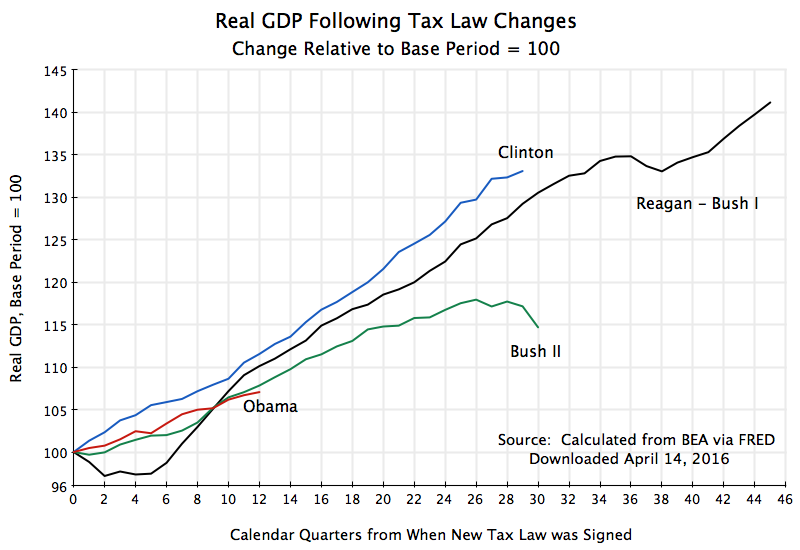
How about the possible impact on GDP growth?  A similar chart shows (based on BEA data on the GDP accounts):

Real GDP Following Tax Law Changes

Once again, growth was best following the Clinton tax increases.  Under Reagan, GDP growth first fell following the tax cuts being signed into law (as the economy moved down into a recession, which by NBER dating began almost exactly as the Reagan tax cut law was being signed), and then recovered.  But the path never catches up with that followed during the Clinton years.  Indeed after a partial catch-up over the initial three years (12 calendar quarters), the GDP path began to fall steadily behind the pace enjoyed under Clinton.  Higher taxes under Clinton were clearly not a hindrance to growth.

The Bush II and Obama paths are quite similar, even though growth during these Obama years has had to go up against the strong headwinds of fiscal drag from government spending cuts.  Federal government spending on goods and services (from the GDP accounts, with the figures in real, inflation-adjusted, terms) rose at a 4.4% per annum pace during the eight years of the Bush II administration, and rose at a 5.6% rate during Bush’s first term.  Federal government spending since the late 2012 tax increases were signed under Obama have fallen, in contrast, at a 2.8% per annum rate.

There is therefore also no evidence here that tax cuts are especially good for growth and tax increases especially bad for growth.  If anything, the data points the other way.

C.  The Impact on the Fiscal Accounts

The argument of those favoring tax cuts goes beyond the assertion that they will be good for growth in jobs and in GDP.  Some indeed go so far as to assert that the resulting stimulus to growth will be so strong that tax revenues will actually rise as a result, since while the tax rates will be lower, they will be applied against resulting higher incomes and hence “pay for themselves”.  This would be nice, if true.  Something for nothing. Unfortunately, it is a fairy tale.

What happened to federal income taxes following the changes in the tax rates?  Using CBO data on the historical fiscal accounts:

Real Federal Income Tax Revenues Following Tax Law Changes

Federal income tax revenues (in real terms) either fell or at best stagnated following the Reagan and then the Bush II tax cuts.  The revenues rose following the Clinton and Obama tax increases.  The impact is clear.

While one would think this should be obvious, the supply-siders who continue to dominate Republican thinking on these issues assert the opposite has been the case (and would be, going forward).  Indeed, in what must be one of the worst economic forecasts ever made in recent decades by economists (and there have been many bad forecasts), analysts at the Center for Data Analysis at the conservative Heritage Foundation concluded in 2001 that the Bush II tax cuts would lead government to “effectively pay off the publicly held federal debt by FY 2010”.  Publicly held federal debt would fall below 5% of GDP by FY2011 they said, and could not go any lower as some federal debt is needed for purposes such as monetary operations.  But actual publicly held federal debt reached 66% of GDP that year.  That is not a small difference.

Higher tax revenues help then make it possible to bring down the fiscal deficit.  While the deficit will also depend on public spending, a higher revenue base, all else being equal, will lead to a lower deficit.

So what happened to the fiscal deficit following these four episodes of major tax rate changes?  (Note to reader:  A reduction in the fiscal deficit is shown as a positive change in the figure.)

Change in Fiscal Deficit Relative to Base Year Following Tax Law Changes

The deficit as a share of GDP was sharply reduced under Clinton and even more so under Obama.  Indeed, under Clinton the fiscal accounts moved from a deficit of 4.5% of GDP in FY1992 to a surplus of 2.3% of GDP in FY2000, an improvement of close to 7% points of GDP.  And in the period since the tax increases under Obama, the deficit has been reduced by over 4% points of GDP, in just three years.  This has been a very rapid base, faster than that seen even during the Clinton years.  Indeed, the pace of fiscal deficit reduction has been too fast, a consequence of the federal government spending cuts discussed above.  This fiscal drag held back the pace of recovery from the downturn Obama inherited in 2009, but at least the economy has recovered.

In contrast, the fiscal deficit deteriorated sharply following the Reagan tax cuts, and got especially worse following the Bush II tax cuts.  The federal fiscal deficit was 2.5% of GDP in FY1981, when Reagan took office, went as high as 5.9% of GDP in FY1983, and was 4.5% of GDP in FY1992, the last year of Bush I (it was 2.5% of GDP in FY2015 under Obama).  Bush II inherited the Clinton surplus when he took office, but brought this down quickly (on a path initially similar to that seen under Reagan).  The deficit was then 3.1% of GDP in FY2008, the last full year when Bush II was in office, and hit 9.8% of GDP in FY2009 due largely to the collapsing economy (with Bush II in office for the first third of this fiscal year).

Republicans continue to complain of high fiscal deficits under the Democrats.  But the deficits were cut sharply under the Democrats, moving all the way to a substantial surplus under Clinton.  And the FY2015 deficit of 2.5% of GDP under Obama is not only far below the 9.8% deficit of FY2009, the year he took office, but is indeed lower than the deficit was in any year under Reagan and Bush I.  The tax increases signed into law by Clinton and Obama certainly helped this to be achieved.

D.  Conclusion

The still widespread belief among Republicans that tax cuts will spur growth in jobs and in GDP is simply not borne out be the facts.  Growth was better following the tax increases of recent decades than it was following the tax cuts.

I would not conclude from this, however, that tax increases are therefore necessarily good for growth.  The truth is that tax changes such as those examined here simply will not have much of an impact in one direction or the other on jobs and output, especially when a period of several years is considered.  Job and output growth largely depends on other factors.  Changes in marginal income tax rates simply will not matter much if at all. Economic performance was much better under the Clinton and Obama administrations not because they raised income taxes (even though they did), but because these administrations managed better a whole host of factors affecting the economy than was done under Reagan, Bush I, or Bush II.

Where the income tax rates do matter is in how much is collected in income taxes.  When tax rates are raised, more is collected, and when tax rates are cut, less is collected.  This, along with the management of other factors, then led to sharp reductions in the fiscal deficit under Clinton and Obama (and indeed to a significant surplus by the end of the Clinton administration), while fiscal deficits increased under Reagan, Bush I, and Bush II.

Higher tax collections when tax rates go up and lower collections when they go down should not be a surprising finding.  Indeed, it should be obvious.  Yet one still sees, for example in the tax plans issued by the Republican presidential candidates this year, reliance on the belief that a miraculous jump in growth will keep deficits from growing.

There is no evidence that such miracles happen.

The New Public Restroom Laws: Just How Do They Plan to Enforce Them?

Public Restroom Sign.001

There have been a spate of recent legislative proposals that aim to ban transgender Americans from using the public restrooms consistent with the gender they identify with. North Carolina, after careful consideration that lasted all of one day (the bill was introduced at 10:00 am, debated, voted on, approved, and then signed by Republican Governor Pat McCrory that same evening) has gone the furthest so far.  This emergency bill not only explicitly restricts the bathrooms to be used by transgender men and women but also specifically bans any local North Carolina jurisdictions from passing ordinances that would protect gays, lesbians, and transgender persons from discrimination.

The new laws in North Carolina as well as in several other states go well beyond the bathroom issues, to provide legislated approval to explicit, open, and blatant discrimination against gays, lesbians, and transgender men and women, as long as the claim is made that this is being done in the name of religious beliefs.  This is a serious concern, and it is sad but telling that leaders of the main organized religions in the US have not spoken out against such measures.  Most Americans are not bigots.  But this blog post will be limited to the narrow issue of bathroom use, and specifically to the question of how, precisely, do they plan on enforcing the new statute?

The new North Carolina law specifies that each person will only be allowed to use a public restroom in conformity with what they call their “biological sex”.  They define “biological sex” as the sex (male or female) stated on the person’s birth certificate.  To enforce this and protect the public from someone of a different “biological sex” making use of a facility, it would appear that North Carolina would need to post a policeman (or policewoman) at the entrance to each public restroom in the state (including in schools).  I do not see how that is possible.

But assuming that police were so posted, would they then challenge each male entering a men’s restroom and each female entering a women’s restroom to show their birth certificate to prove they were identified as male or female, respectively, to enter said restroom?  Most of us do not carry our birth certificates with us.  Furthermore, at least in my case one could barely read what is on it (as the ink, from an old style photocopier of more than a half century ago, is now basically a large smudge).

In the absence of a birth certificate, would they then insist on a physical inspection of anyone seeking to enter the facility to ensure they were of the “correct” sex?  And precisely what would be covered by said inspection?

But let’s assume that the policeman (or woman) successfully blocked in the name of safety a transgender man or woman from access to a restroom from which they are now forbidden by law.  Or that the transgender man or woman, being a law abiding citizen, followed the new law and sought to take care of their business in the women’s restroom for the transgender man or men’s restroom for the transgender woman.  The women in the women’s restroom would see a person entering who might well look, in terms of external appearance, like a man. He would dress like a man, have the hair style of a man, and might even be sporting a beard.  And similarly the transgender woman entering the men’s restroom might well have the external appearance of a woman.

This, I suspect, might be disconcerting for those present.  Indeed, I suspect that more than a few would immediately shout for the police.  And I am not sure that a statement that they are just seeking to abide by the new law of the State of North Carolina would immediately reassure them.

In any case, the new law would provide excellent cover to a criminal who was in fact seeking to enter a restroom to assault someone there of the opposite sex.

A few seconds thought by the legislators who passed this law, or by the governor who signed it, would have led them to see this.  But this assumes their intent was in fact to keep transgender men and women from using the facility consistent with the sex they identify with (as they certainly have, peacefully and quietly, ever since public restrooms came into existence).  Such intent was probably not the case, and certainly not for any who thought about it, as they knew there would be no way to enforce such a measure. Rather, the aim was to harass and belittle those who are transgender, as well as gays and lesbians in the law as a whole, treating them as not being the equal in terms of their rights to what others enjoy as American citizens.