
Chart 1
The BLS released on September 11 its report on inflation as measured by the CPI for the month of August 2026. Inflation remains elevated. It led to prices of futures contracts in the financial markets that predict with near certainty that the Fed will raise short-term interest rates by a quarter point at its upcoming September 15 and 16 Board meeting (technically of the Fed’s Open Market Committee, but often simply referred to as the Board). The implicit probability of a quarter-point increase – as reflected in the prices of the contracts traded – was 87.3% as of the end of trading on Friday, September 11.
The implications are interesting. Should the Fed decide not to raise its target rate by a quarter point, the financial markets will be surprised and may react violently. But should the Fed decide to raise its target rate by a quarter point, Trump may react violently. And the recently appointed chairman of the Fed, Kevin Warsh, will be in the middle.
Furthermore, there could be significant implications for the upcoming midterm elections, which will be less than seven weeks away. An increase in interest rates will confirm for voters that inflation is indeed of concern. But failure to raise interest rates may be interpreted as the Fed caving into political pressure from Trump. And the next meeting of the is scheduled for October 27 and 28. An increase in interest rates at that point – should it become blindingly obvious by then that such is needed – would be less than a week before the election.
There are good arguments for why the Fed should raise interest rates now. Inflation remains elevated well above its 2% target. The European Central Bank raised its key policy rate by a quarter point on September 10, and the Bank of Japan (which already raised its policy rate by a quarter point in June) is expected to raise its rate by another quarter point next week.
But the August inflation report gives opponents of a rate increase room to argue otherwise. It basically shows inflation continuing at the rate it has been at for some months now. That rate is elevated, certainly, and the counter-argument would be that, with it becoming clear that inflation will not fall on its own, the Fed should not continue to delay in the hope that inflation will come down on its own.
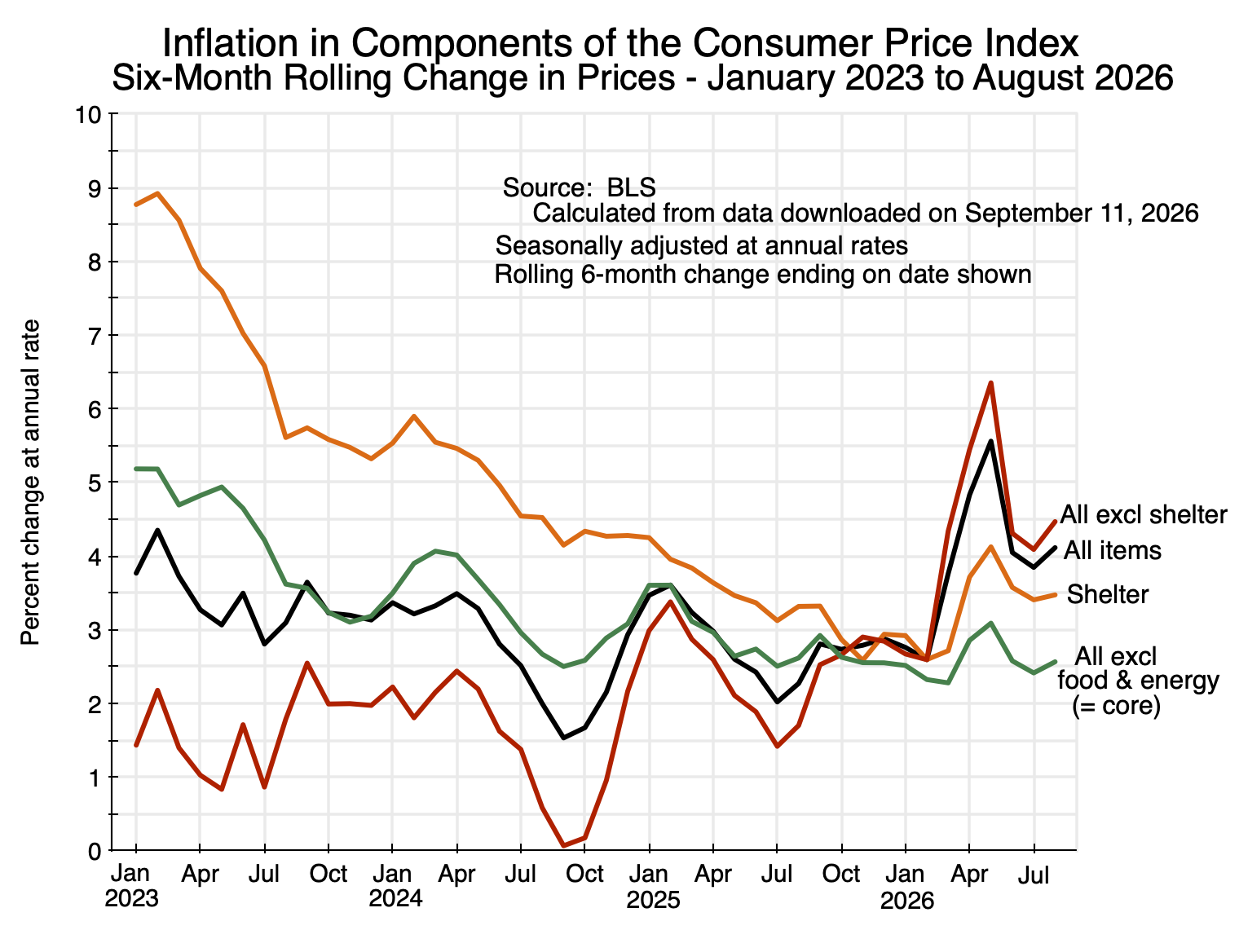
The chart at the top of this post shows the path inflation has taken since January 2023, using six-month rolling average rates to smooth out month-to-month volatility. The rates shown are for the six-month periods ending on the dates shown, for the overall CPI index, for the core index (i.e. excluding food and energy), for shelter only, and for the overall index excluding shelter. The rates jumped when Trump started his war against Iran on February 28, 2026, although they had already started to rise more modestly in late 2025. Interestingly, the price of shelter (as measured in the CPI index) also rose significantly starting in the six-month period ending in April 2026.
Not surprisingly, the increase in energy prices led the way following the start of the war:
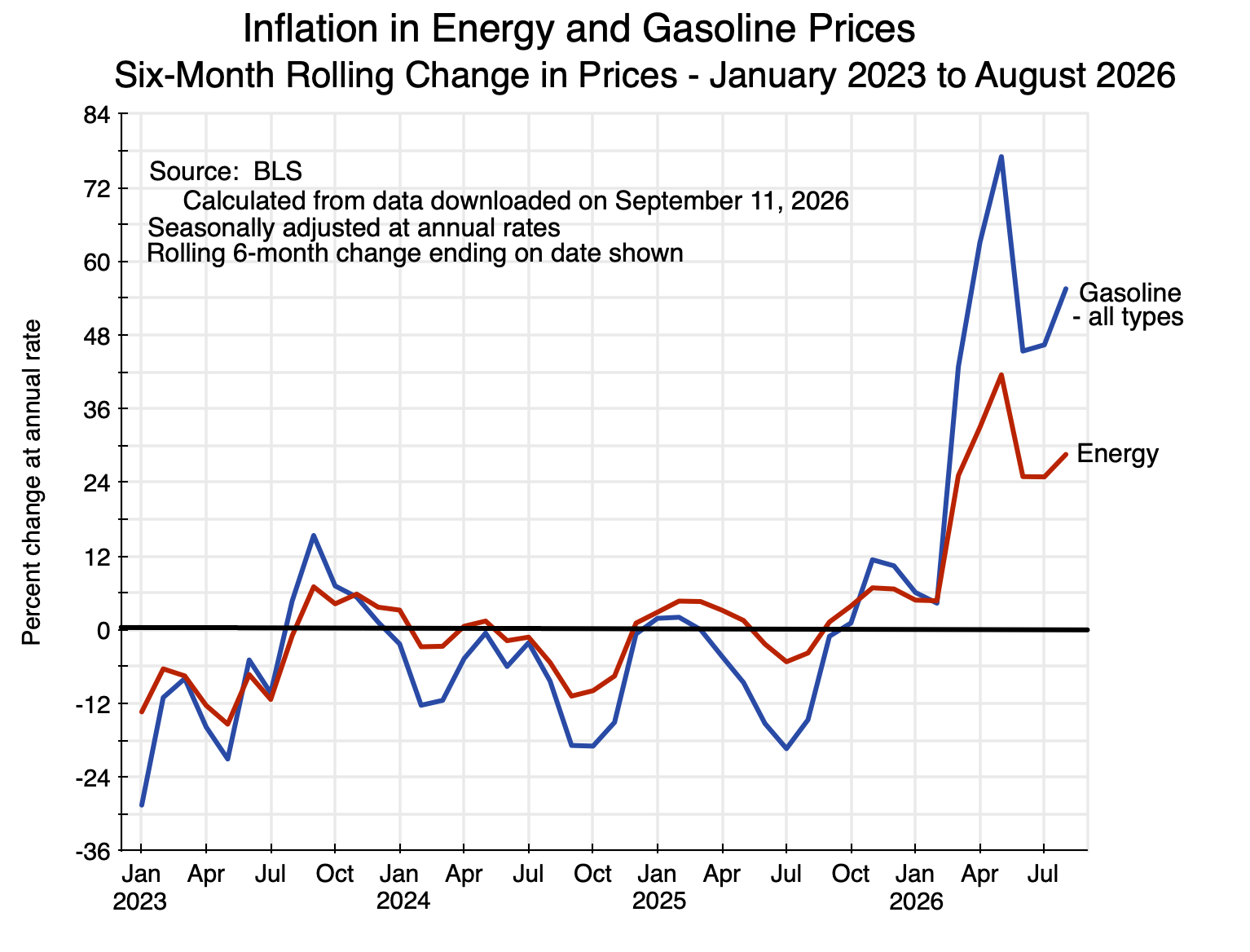
Chart 2
This is on a separate chart as the vertical scale would otherwise be so large it would be difficult to follow the changes in the overall inflation indices. Energy includes all forms of energy – including electricity – purchased by households, including not only fuels for their vehicles but also for heating and cooling their home as well as other purposes. Gasoline is a sub-component of the overall index for energy.
Note also that these are all seasonally adjusted figures. The Energy Information Agency (EIA) provides figures on the actual average retail prices (i.e. not seasonally adjusted) of gasoline and other fuels. The BLS uses these as the basis for its CPI estimates. The average price for all grades of gasoline sold nationwide in mid-February was $3.057 per gallon. It rose to $4.182 as of mid-August. The inflation figures reported by the BLS are for the prices as of the middle of each month (the week that includes the 15th of the month).
The overall CPI inflation rate remained elevated, at 4.1% as of the six-month period ending in August. This is well above the rate of 2 1/2 to 3% for most of mid to late 2025. But note that the core rate of inflation – i.e. inflation for all items other than food and energy – has been around 2 1/2% for the six-month periods ending in June, July, and August. That rate is also similar to what it was in most of 2025. While still above the 2.0% target, inflation of 2.5% is a lot closer to that target than a rate of over 4%.
This should not be taken – in my view – as meaning inflation is not a concern. Inflation as measured by the core price index for Personal Consumption Expenditures (PCE) in the GDP accounts has been substantially higher. The Fed prefers to focus on that estimate as a measure of inflation over the core CPI. The figures (through June) were discussed in the prior post on this blog. The August estimate will not be released until September 30, but inflation in the core PCE price index was 3.5% for the six months ending in July. That is well above the 2.5% rate for the core CPI.
Still, the Fed Board has the CPI estimates for August and does not yet have the PCE price indices. If Kevin Warsh wants to argue interest rates should not be raised, he could focus on the core CPI figures as a rationale, saying they do not show inflation to be excessively high.
This could present an opening for a decision by the Fed to leave its target interest rate unchanged. If it does, then as noted above, the financial markets might react violently, as this would be a major surprise given the strong expectation (reflected in the price that futures contracts are trading at) that the Fed’s interest rate target will be raised.
We will see what happens on September 16. The Fed will announce its decision at 2:00 pm ET.
===============================================================
Update on September 16, afternoon:
As expected by the markets, the Fed raised its short-term interest rate target by a quarter of a percentage point. The initial market reaction was neutral (the increase was as expected), but then declined modestly while Fed Chair Kevin Warsh held his post-meeting news conference and made clear that inflation is indeed of concern – and perhaps more of a concern than the markets realize.
Trump also responded as expected: he was mad. At 4:38 pm he posted on his social media site “Truth Social”:
Interest Rates in the United States should be 1%, or less, because we are the Best Credit in the World — BY FAR. Our Country is BOOMING with new Investment! If we stopped Trading with every country that we have a Deficit with, which is most of them, we would make, at least, 1.5 Trillion Dollars a year. The word “Deficit” is nothing more than a fancy word for LOSS. We are “carrying” almost every country in the World, and that cannot go on any longer. LOWER THE INTEREST RATES FOR THE UNITED STATES OF AMERICA, AND FAST! President DONALD J. TRUMP
It is another sign that the president of the United States is completely unhinged, with no understanding of basic economics.


You must be logged in to post a comment.