
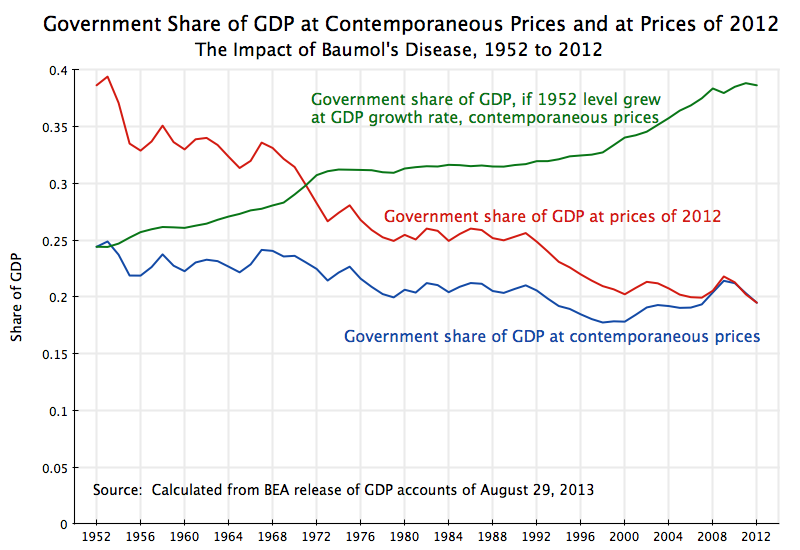
The Big Squeeze on Government: Consequences of Baumol’s Cost Disease

Government Share of GDP and Baumol's Disease, 1952 to 2012

A.  Introduction

A point on which all agree, whether conservative or liberal, Republican or Democrat, is that the cost of government keeps rising.  Whether it is the cost of building new roads or new military jet fighters, or the cost of schools or health services, the cost now is much more than in the past.  And this is not simply general inflation.  The cost of government services has risen at a significantly faster pace than general inflation.

This is true.  But what is not generally recognized if the fundamental cause, nor the implications as we as a nation have struggled to maintain government services.  The fundamental cause is not waste and corruption, nor lazy government workers.  Rather, it lies in the nature of the goods and services used for the public services the government provides.

This blog post will first review the facts on what has happened to expenditures on government goods and services (which for brevity, will hereafter often simply be referred to as government goods) over the past 60 years.  The 60 year period is taken so as to encompass most of the post-World War II period, but to begin once the numbers had stabilized from the very high levels during the war and the immediate post-war fluctuations.

The post will then review the fundamental cause, drawing on the work that has come to be called “Baumol’s Cost Disease”.  The post will discuss how this applies to the government sector, and the implications.

B.  The Share of Government Expenditures in GDP

The share of government spending in GDP has declined over the last 60 years, from almost 25% of GDP in 1952 to less than 20% in 2012, a fall of a fifth.  It is shown as the blue line in the graph at the top of this post.  [Note:  The definition of “government spending” used here is for government as it appears in the GDP demand accounts.  It includes all level of government – federal, state, and local – but only includes direct government spending on goods and services.  Hence it excludes government transfers payments, such as for Social Security or farm subsidies.  Transfer payments are spent by those receiving the funds.]

A fall of a fifth is a significant reduction in the government share.  But it does not show the true extent of the fall, as such GDP share calculations are based on the prices of each given year.  One also needs to know how much one received in real terms for what was spent, and this depends on how prices have changed.

The GDP accounts issued by the BEA do include estimates of the changes in the relative prices of the different components of the GDP accounts.  Over the 60 years from 1952 to 2012, the GDP deflator (the index of inflation for all the goods and services making up GDP) rose at an annual average rate of 3.3%.  Over this same period, the deflator for government spending rose at a somewhat higher rate of 4.1% a year.  This might seem to be only modestly higher, and for a short period it would be.  But compounded over 60 years, this difference in inflation rates cumulates to a difference of 58% in the prices of goods and services used for government vs. goods and services used in overall GDP.

With this relative price change, it now (in 2012) on average costs 58% more (compared to 1952) to produce goods to be used for government expenditures, than it does to produce goods for overall GDP.  Since GDP is also our income (i.e. what we as a nation receive for what we produce), it takes a higher share of our income today to buy the same real goods used for government expenditures as it would have at the relative prices of 60 years ago.

Put another way, to get the same real goods used for government expenditure in 2012 as one would have gotten at the relative prices of 60 years ago, one will now have to spend 58% more.  Or if one spends the same dollar amount adjusted for general (GDP) inflation, one will receive only 1/1.58 = 63% as much.

This impact is huge.  We are indeed receiving far less now in government services for a given dollar expenditure than we would have at the relative prices of 1952.

One way to view this is to ask how much would we have spent as a share of GDP in 1952, for the same real level of goods used for government in that year, if the prices then were instead the relative prices we had in 2012.  The result is the red line in the graph at the top of this blog.  The same goods used for government in 1952 would, at the prices of 2012, have been equivalent to expenditures of 39% of GDP in that year.

Over time, this red line then fell.  It fell in part because the share of GDP used for government (in the contemporaneous prices of each year) was reduced over time and by a fifth by 2012, but more importantly also because the relative prices of the goods used for government provided services rose by 58% over the period.  The government share fell until it reached just 19 1/2% of GDP in 2012.  That is, correcting for the fact that prices of goods used for government were rising (relative to other prices) over time, in addition to the cut-back in the share at contemporaneous prices by a fifth, real government expenditures in terms of GDP share were only half as much in 2012 (19 1/2% of GDP) as what they were in 1952 (39% of GDP).

This fall by half is huge, and explains why we seem to get less and less from our government expenditures (whether on roads, or for military equipment, or in schooling), even though government spending as a share of GDP only fell by a fifth when measured in the current prices of each year.

Another way to look at this would be to ask what government spending would be now, if it had been allowed to grow over the 60 years at the same pace as GDP grew.  If there had been no relative price change, then at equal rates of growth the share of government in GDP would not have changed.  But with the relative price changes, a higher share of GDP would have been spent on government to provide such a bundle of goods for government. The fact that we spent less than that is a measure of how much government spending has been squeezed.
The result is the green curve in the graph at the top of this post.  It shows what would have been spent on goods used for government in each year, if government spending had grown at the same rate as GDP in that year, and valued in the prices of each year.  From 1952 to 2012, real GDP grew at an average rate of 3.1% a year (note this is total, not per capita, GDP).  Real government spending grew only at a rate of 1.9% a year over that period.  Cumulated over 60 years, the difference in growth rates meant that GDP grew by a total of twice as much as government did.  And the goods used for government provided services would have totaled 39% of GDP in 2012 at this constant growth share, or double the 19 1/2% of GDP actually spent in 2012.
[Note:  It is not a coincidence that the 39% of GDP in 2012 on the green line is the same as the 39% of GDP in 1952 on the red line.  The red line figure shows what the spending would have been at the government share in 1952 but at 2012 prices.  The green line figure projects forward this same 1952 share, leaving it unchanged relative to GDP in real terms, and in 2012 shows what this share would then have been at 2012 prices.  But the paths between 1952 and 2012 will differ, and are not mirror images.]
Whichever way one looks at it, this reduction by half in the government share is a huge squeeze on public services.  It goes a long way to explaining why our roads are so much more inadequate now compared to decades ago, with extreme congestion and poor repair.  It explains why our state universities are charging so much more in tuition, while state support has declined.  It explains why what we receive today in public services simply is not what it used to be.  But why have these costs of goods for public use risen so much faster than the cost of other goods?


C.  Baumol’s Cost Disease

What has come to be called Baumol’s Cost Disease (or sometimes simply Baumol’s Disease) was developed by William J. Baumol (then Professor of Economics at Princeton), together with William G. Bowen (then also Professor of Economics at Princeton, and later President of Princeton) in the mid-1960s.  They were engaged in a research project looking at why the cost of tickets to live performances of the fine arts had to rise continually, at rates above the general inflation rate, and yet still could not keep up with costs.  A recent re-statement of the issue (but with a particular focus on health care), is provided in the 2012 book by Baumol and others, titled “The Cost Disease:  Why Computers Get Cheaper and Health Care Doesn’t”.

In a nutshell, the fundamental cause of the cost problem is that labor productivity, while perhaps rising in all sectors, will not rise as fast in some sectors as in others.  The sectors where labor productivity rises relatively less fast will face increasing costs, as labor in such sectors will need to be paid more, due to competition for such labor from those sectors where productivity is rising faster.  Yet those sectors with the relatively slower productivity growth will not be able to offset that rising cost of labor with a rate of productivity growth that is as high as that enjoyed by the other sectors.  If we still want or need what the sectors with the relatively slower productivity growth produce, we will need to pay a higher relative price to cover those higher costs.

This is clear in the example of the performing arts.  A Mozart string quartet that required four performers 20 minutes to play in 1780, still required four performers 20 minutes to play in 1966, or in 2013.  Their productivity has not grown at all in over two centuries. Such performers could instead be employed in other sectors, and paid at increasing rates over time there, as labor productivity rose in those other sectors.  If they are going to be employed still to perform Mozart, they will need to be paid more, even though their productivity in playing a Mozart string quartet has not risen in centuries.

Baumol’s Cost Disease will arise whenever productivity growth in the sector being examined is less than productivity growth in the rest of the economy.  There has been a good deal of discussion recently of the implications of this in health (as for example in the Baumol “The Cost Disease” book cited above), as well as in education (explaining why university tuition has steadily risen at a pace greater than general inflation).  But it applies generally for sectors where the goods produced are labor intensive or hand crafted.

Much of the goods and services used by government for the services it provides are of this nature.  Roads, for example, are custom made for the specific site; military jet fighters (and most high tech military equipment generally) are made by highly skilled technicians in small batches of a perhaps a few dozen a year; elementary school teachers teach in classes that are similar in size now as they were 60 years ago; public health workers need to examine patients one on one; and public safety workers (police, firemen, prison guards, and other security workers) provide what they do by their direct presence; and so on.  Teachers, health care workers, and public safety workers, plus military personnel and postal workers facing similar issues, account for most public sector employees (keep in mind we are referring to all levels of government in this note).  And by its nature, the work of those in general public administration (“bureaucrats”) is also highly labor intensive.

It should be emphasized that productivity growth in the provision of government services has not been zero or negligible.  There have been efficiency gains in the government sector.  But the important point for Baumol’s Cost Disease is not that the productivity growth in that sector is zero, but rather that it is simply something less than the rate of productivity growth in other sectors.

And the nature of what government provides makes it impossible to match the productivity growth rates that one has seen most spectacularly in goods such as microchips and hence computers, but more generally in manufacturing and agriculture.  Government services, like many services, have had improvements in productivity, but at rates that simply cannot match the pace of productivity growth possible elsewhere.

Hence, because of Baumol’s Cost Disease the relative price of government services should be expected to go up over time.  This is precisely what has been observed.  There is no reason to attribute this rise in the relative price to allegations of corruption or lazy government workers.  It is of course possible that corruption and lazy workers exist, but for this to have caused the rise in the relative price over time one would need to make the case that corruption and lazy workers are not only worse now than before, but that they have become steadily worse over time.  There is no evidence that supports this.

It is also important to note that while the relative price of government services has risen over time in the past, with this also expected to continue going forward, this does not imply that we as a society will be unable to afford the government services at the higher relative price.  Labor productivity is growing, in the government sector as well as in the rest of the economy, and hence the cost in terms of labor time of the goods of government as well as this cost in the rest of the economy are both getting cheaper.  Hence we can afford to devote a higher share of GDP to government services over time, if we so choose, as the relative cost of government services rises.  And since what government provides, whether in education and health services, or infrastructure, or security and national defense, are all important, we should want to ensure they are adequately provided.

There is therefore nothing wrong for the share of government in GDP to rise over time, as Baumol’s Cost Disease will predict will happen if the services government provides are important.  They would need to be paid for, through higher taxes, but as the society grows richer from the productivity growth in both the government and non-government sectors, we can afford this.  The only problems that arise come from not recognizing this.

D.  Implications, and Conclusion

Since the implications of Baumol’s Cost Disease for government services has generally not been recognized, there are indeed problems.  There has been a tremendous squeeze on government, leading to government services that are an embarrassment for a rich country.  As the numbers above indicate, we are now spending only half as much on government in real terms as we would have had government been allowed to grow at the same pace as GDP since 1952.

Note that this is not an argument that government spending should have been twice as much in 2012 as it was.  This would have matched the real share that it was in 1952, and therefore is an indicator of how much government has been squeezed over this period, but the 1952 benchmark is arbitrary.  And with the 58% higher relative price for government goods over this period, it would be rational to try to scale back on the expenditures for the now more expensive goods.  But cutting back by half is extreme. Rather, the argument made here is that one should be making a well-considered decision at any point in time on whether particular government expenditures (whether for education, or for police, or for military jets) are worthwhile at the price of the time.  If so, one should do it.  But one should not subject total government expenditures to some arbitrary cap, and say that expenditures under that cap are fine while expenditures over that cap should not be allowed.  Since the higher prices over time (due to Baumol’s Cost Disease) reflect differential but still positive productivity growth rates, we can afford those higher government expenditures if we so choose.

Unfortunately, much of the budget discussion in recent years has focussed precisely on setting some fixed cap on government expenditures as a share of GDP.  There have been calls for such a cap directly, or indirectly by saying government revenues should be set at some cap as a share of GDP and that there should then also be a balanced budget (or a budget surplus).

For example, the Bowles-Simpson budget plan called for federal government revenues to be capped at 21% of GDP, with expenditures then set to match this.  The Paul Ryan budget plan called for federal revenues to be capped at 19% of GDP, with expenditures reduced to meet this and then to fall even further.  [Note that both of these figures are for total federal government expenditures, including transfers.  The figures in the graph at the top of this post are for government direct spending only, excluding transfers, but for federal, state, as well as local government.]

Understanding the underlying dynamics resulting from Baumol’s Cost Disease shows how misguided such constant share of GDP targets are.  They ignore that a growing economy, with a growing population, will need to be supported by growing government services.  Given the nature of government services, one cannot expect the rate of productivity growth  in government to match that enjoyed elsewhere in the economy.  There is nothing wrong with that, and does not necessarily reflect a lack of innovation or skill.  Some goods are simply more labor intensive than others, and productivity growth will generally be less for such goods.

By Baumol’s Cost Disease we can see that then the prices of the goods used for government will rise relative to others, and that if we still wish to obtain such goods, we will need to pay more.  The GDP share will rise, but we can afford it as productivity is rising in all the sectors.  They are simply rising at different rates.

Creating an Attractive Retirement Savings Option, While Funding Social Security for a Further Generation

Social Security Outlays, Revenues, and Deficit, CBO, 1985-2086

A.  Introduction

This post will present a reform which would create an attractive, and wholly voluntary, new retirement savings option, which would also fund the US Social Security system for an additional generation.  And it would do this without cuts in benefits or increases in Social Security or other taxes.  While not a permanent fix for funding Social Security (where the issue is fundamentally a result of longer life expectancies but a largely unchanged work life), it could extend the lifetime of the Social Security Trust Fund without reducing benefits or increasing taxes by a further two decades or more.

Social Security is the most successful US social program of the last century.  The poverty rate of the elderly was extremely high before Social Security.  Because of Social Security it is now greatly reduced, to levels similar to that of other population groups.  While the benefits Social Security pays are not generous, and are far below the support provided to the elderly among the other advanced economies of Europe, Japan, and elsewhere, Social Security benefits have been sufficient to provide a minimum safety net of income that has been adequate to keep most elderly out of poverty.

But there is a need to ensure Social Security will remain sustainable.  As shown in the graph above, annual Social Security benefits paid exceed the inflow from Social Security taxes.  While there is a Trust Fund, and it is currently a sizable 17% of GDP, the Congressional Budget Office projects that if nothing is done, this Trust Fund will run down to zero by 2035.

At that time, and if one restricts the options to the current structure, either Social Security tax revenues would need to be scaled up (by about 23%, raising the tax rate on wages from the current 12.4% to about 15.2%, if nothing is done prior to that point to prepare for it), or benefits would have to be scaled back (not to zero, but by about 19% in the CBO forecast).  Raising the tax rate to 15.2% is not a disaster, and simply reflects the very desirable longer life expectancies we now enjoy.  And such a wage tax would still be far less than the rates paid in Europe.

One could also cover the roughly 1% of GDP deficit in the flows (from the 2030s to about 2060) from general tax revenues.  There is no requirement that all the support to the Social Security system has to come from wage taxes.  And this 1% of GDP is only about one-third to one-quarter or less (the loss rises over time) of the revenues that have been lost as a result of extending the Bush tax cuts for all but the top 2% of Americans.  If we can afford the Bush tax cuts being extended, we can afford one-third or one-quarter of it to save Social Security.

But any tax increases are anathema to Republicans.  In this blog post, I will review a different type of approach, which would create an attractive and wholly voluntary new retirement savings option.  As an additional benefit, it would provide funding for Social Security that would likely suffice to extend the life of the Social Security Trust Fund by a further two decades or more, without resorting to higher taxes or cuts in benefits.

B.  The Impact of Investment Fees

Social Security is an extremely efficient program.  Its administrative costs in the retirement program side (keeping the benefits for the disability program separate) are only 0.6% of the amount paid out annually in benefits (see 2012 Trustees Report, Table II.B.1.).  This is tiny.  Social Security is efficient for two primary reasons.  The most important is that it is structured as a simple program.  Revenues are collected through the tax system by a tax on wages, and these funds are then invested straight into (and only into) US Treasury bonds.  Second, it operates on an enormous scale, and such a scale while keeping costs low is possible precisely because of the simplicity of the design.

In contrast, retirement accounts that are run through private fund managers are highly fragmented, are structured with multiple investment options where choices must then be made on how much to invest in each, where expensive financial professionals demand high fees to administer these funds and to make recommendations (and sometimes decisions) on the investment choices, and where the high fragmentation inhibits scale economies.  Profits among the fund management companies can also be high.

As a consequence, the total fees on 401(k)’s, IRAs, and similar directed retirement investment programs (defined contribution schemes) can be extremely high.  The fees are assessed at several levels, including (for 401(k)’s) at the level of the individual plan for some firm, and at the level of the investment management company (whether through a mutual fund, through investment vehicles sold by life insurance companies, or by direct investments in the markets).  The fees add up, and can easily reach 2% of assets annually and beyond, depending on the size of the company one is working for, and the nature of the investments being made (whether equities, bonds, life insurance company products, money market funds, and so on).

These high fees have a dramatic impact on reducing the returns on the investments being made.  Taking the example of a pure equity investment, the total return on investment in the S&P500 Equity Index over the 50 years 1962-2012 was 9.7% annually (in nominal terms).  Adjusting for CPI inflation of 4.1% annually over this period, the real return was 5.4% (note that the 5.4% is not a simple subtraction of 4.1% from the 9.7% due to interaction effects:  take my word for this, or review your High School algebra).  But after a 2.0% annual fee on assets, the return would be reduced from 5.40% to only 3.31% for someone who starts saving for retirement at age 45 and lives to 92 (or 3.30% for someone who starts saving at age 22).  In contrast, the Social Security administrative cost of 0.6% on benefit returns paid out would reduce a 5.40% pre-expense return to a 5.37% return after expenses for those who start saving at age 45 (or 5.38% for those who start at age 22).  [The figures here come from a spreadsheet analysis by the author.]

The difference in returns after fees is huge.  A 2% fee on assets is close to 100 times the equivalent cost (in terms of return on assets) of the Social Security cost of 0.6% on benefits paid out.  Put another way, the 2% fee charged by the private fund managers reduces the return that would have been earned on equity investments by close to 40% (i.e. reducing a $100 return to only $60) while the Social Security charge would have reduced the return by only 0.5% (from $100 to $99.50).

The proposal set out here is to take advantage of this far greater efficiency of the Social Security system, by allowing Social Security to offer an optional retirement savings vehicle, into which Americans can invest a portion or even all of the investments now in their IRA, 401(k), or similar retirement savings plans.  The savings accrued in this way would then provide an individual supplement to your regular Social Security check once you retire.  Taking advantage of this would be completely voluntary.  The funds would be invested, like all current Social Security funds are now invested, in long-term US Treasury bonds.  Because of the inherent low costs in the Social Security system, the returns would be attractive.

C.  The Proposal:  A Supplemental Social Security Account

Most Americans (among those with any retirement plan coverage at their place of work) have seen their pension plans shift over recent decades from the traditional defined benefit plan to defined contribution schemes, mainly 401(k)’s.  From almost nothing prior to the 1980s, over 80% of private sector workers now who have any pension plan coverage, only have a defined contribution plan.  All workers may also have IRA’s, which are similar in magnitude (in terms of total assets) as what are held in 401(k)’s and similar plans, although the IRA assets primarily come from roll-over of 401(k) investments when a worker switches jobs.

In IRA’s, 401(k)’s, and similar defined contribution schemes, the workers must choose what investments to place their assets in.  There may be restrictions on the choices (e.g. many companies will limit the investments to certain mutual funds with whom they have contracted), but the aim is generally to provide a reasonable range of choices to the individual.  Unfortunately, all the choices come with high fees, which as discussed above, can severely reduce the investment returns.

The proposal here is to add the option of investing one’s IRA, 401(k), or similar plan assets into a supplemental Social Security account.  An individual would be allowed to choose to invest some, or even all, of their existing assets or any new savings set aside annually (up to the limits set by tax law for retirement savings that benefit from specified tax advantages) into such a supplemental Social Security account.  These funds would be invested, like all funds in the Social Security Trust Fund, in long-term US Treasury bonds.  Social Security would keep track of the contributions so made, and of the earnings from the interest on the US Treasury bonds (it would be a simple computer code).  Upon retirement and when the individual chooses to start to draw their regular Social Security benefit (normally at age 66 currently, although with this moving up to 67, and where there is some flexibility around these ages with the Social Security payments adjusted accordingly), Social Security would then increase the individual’s monthly Social Security benefit payment by an amount that would reflect the accumulated savings (including interest) in that supplemental Social Security account.  The accumulated savings would be converted into an actuarially fair annuity, reflecting the then expected life expectancy for an individual at that retirement age.

Note that the interest which would be paid into these accounts would come from the US Treasury.  But there would be no additional cost to the US Treasury since the bonds sold into these accounts would be offset by an equal number which would not then need to be sold to others, whether rich people who buy such bonds or the Chinese government, or whomever.

Set up on an actuarial fair basis, and with the relatively tiny Social Security administrative costs (of 0.6% of benefits paid) taken out, as for all Social Security payments, there would be no net cost to Social Security either.  And each individual (on an actuarial basis) would receive back by the time they die an amount equal to what they saved under this scheme, plus the interest earned on these assets.

But while each individual would end up even, there would be a significant amount invested in and supplementing the traditional Social Security Trust Fund at any point in time.  The Supplemental Social Security Fund would initially build up rapidly, as once the scheme is enacted, many people (all current workers) could begin to contribute to their new supplemental Social Security accounts, while only after such contributions have been made and with some time lag would there be retirees drawing down on their accounts.  We will present some projections below, and see that the new Supplemental Fund would eventually stabilize as a share of GDP, and would not decline.

But first we will discuss whether individuals would find investing into such Supplemental Social Security accounts attractive, and then discuss what the scale of the investments into such accounts might be, given the size of total retirement savings going each year into IRA’s and 401(k)’s.

D.  Investing Into Supplemental Social Security Accounts Would Be Attractive

It is of course impossible to predict what future returns will be.  But what can look at what the returns have been for periods in the past, and it is reasonable to conclude that for sufficiently long periods, the returns will likely be similar (or at least the relative returns across different asset classes will be similar, and that is what is relevant to an individual’s decision on asset allocations).

For the numbers here, I have looked at the 50 year returns for 1962 to 2012, using the data assembled by Professor Aswath Damodaran of NYU.  As noted above, adjusting for inflation (based on the CPI) over this fifty year period, an investment in the S&P 500 equity index would have yielded an annual real return of 5.4% (including dividends).  An investment in 10-year US Treasury bonds over this period would have yielded an annual real return of 2.6%.  And while it appears that data on actual returns people have achieved on average in their 401(k)’s or IRA’s do not exist (such data would be hard to collect, as most individuals do not even know what their actual returns, net of additions to their accounts, really were), one can calculate what an average 401(k) return might have been based on a weighted average of what returns might have been by asset classes held in these accounts currently.  Using Investment Company Institute estimates of the 2011 weights, and applying these weights to the 50 year returns by asset classes, the weighted average 401(k) return would have been 3.7% in real terms.

Subtracting what fees could be on such investments, the net returns would have been:

1962-2012 S&P500 Avg 401(k) 10-Year Treasury Bond
Gross Real Returns, before fees 5.4% 3.7% 2.6%
Private Return after fee of:
     2.65% 2.6%
     2.0% 3.3% 1.7% 0.6%
     1.5% 2.2% 1.1%
     1.0% 2.7% 1.6%
Social Security Return: 2.6%

With the very low costs of the efficient Social Security system, one would have earned a real return of 2.6% a year over this period, equal (within round-off) to the returns on the 10-Year Treasury bonds these funds would have been invested in.  The before fee return on equity investments would have been higher, at 5.4%, but with a 2% fee on assets incurred annually, the net return would have come down to 3.3%.  With a 2.65% fee (and some 401(k) plans cost more than even this), the return would have been 2.6%.  And while a 3.3% return is better than a 2.6% return, the equity return is much more volatile.  One’s returns will depend on the luck of the period during which one was invested, which will depend on the year you were born.  And there can be periods of a decade or more when the equity returns are even negative.  This has happened three times in the US since the 1920s:  during the 1930s in the Depression, in 1974/75 during Nixon/Ford, and following the 2008 economic and financial collapse at the end of the Bush administration.

Most people therefore do not hold solely equities in their 401(k)’s or IRA’s.  In addition to equities, they hold bond funds, mixed bond and equity funds, money market funds, as well as contracts guaranteeing some stable return (usually issued by life insurance companies, and with normally very high fees).  As discussed above, an estimate of what the weighted average return might have been yields 3.7% (based on 2011 weights, but 1962-2012 returns for the asset classes).  The estimate can only be approximate.  But based on it, the returns after fees would have been only 1.7% at a fee of 2.0%, 2.2% at a fee of 1.5%, and 2.7% at a fee of 1.0%.  Most 401(k) plans will charge fees substantially higher than 1.0% (when all the layers of fees are accounted for), but it is only at this low rate that one would get a return similar to what one would get by investing into a supplemental account at Social Security.

The return on a supplemental account at Social Security therefore looks attractive.  One should expect that if such an option were made available, Americans would choose to invest a significant portion of their retirement assets into such an account, and possibly even all of their retirement assets.  The returns would be secure, relatively stable, and simple to manage.

E.  What Might Be the Level of Such Investments in the Aggregate?

The next issue to address is how much such investments might add up to.  One needs this in order to calculate what the impact might be on the size of the Social Security Trust Fund.

The truth is that one does not really know.  An option might be attractive, but few then sign up, or many do.  The numbers that will follow here are therefore speculative.  But they will provide some sense of the magnitudes involved.

Due to tax and other reporting requirements, there are good numbers on the stock of assets in IRA’s, 401(k)’s, and similar defined contribution (and other) pension plans.  These figures largely come from the US Federal Reserve Board Flow of Funds estimates, but are buried there with much other data, and a more convenient source of the retirement plan assets are provided by the Investment Company Institute.  As of the end of 2012, the ICI estimates total assets held in IRA’s came to $5.4 trillion, and total assets in defined contribution plans (mainly 401(k)’s, but also others) came to $5.1 trillion.  These two categories together thus came to $10.5 trillion of assets, 67% of 2012 GDP, that are invested according to the directions of individuals.   Total pension fund assets, primarily in defined contribution plans (including plans for government workers) and annuities, but excluding Social Security, came to $19.5 trillion as of the end of 2012, or 124% of 2012 GDP.

But while good figures are available on total assets in these plans, they are more sparse on annual flows into the plans.  Figures are available on IRA’s, where over the ten year period 1998 to 2008 (where 2008 is the most recent year available) gross new flows, including new contributions and from roll-overs, averaged a bit over $280 billion per year in the ICI numbers.  Assuming similar flows into 401(k)’s and other such defined contribution plans, but scaled to reflect their slightly smaller size ($5.1 trillion vs. $5.4 trillion), it would be reasonable to assume about $270 billion is flowing annually into such plans.  The two together would then be $550 billion a year, or about 3.5% of GDP.

One can only then guess what share of such flows might be attracted into the Supplemental Social Security accounts being discussed here.  With roughly a third of 401(k) assets in bond funds, and a further 9% in short term investments (mainly money market funds), it might be reasonable to assume that perhaps 30% of new flows into IRA’s 401(k)’s, and similar plans, would be attracted to Supplemental Social Security accounts.  Such accounts would be similar in nature to bond and money market investments, but with significantly greater returns due to the far lower investment fees of Social Security, combined with lower risk and greater security as these investments would be in US Treasuries.

While the 30% share is a guess, it is a reasonable bench-mark.  The actual flows could turn out to be significantly higher (particularly as an attractive new low-cost retirement savings option such as this might well lead to higher savings going into IRA’s and 401(k)’s), but it could also be lower.  A 30% share of $550 billion in annual flows would come to a little over 1% of GDP.

F.  Impact on the Social Security Trust Fund

Rounding down, I calculated what the impact would be assuming initial flows equal to 1% of GDP, and with the new retirement savings option entering into effect in 2015.  One then also needs, for the period of the projection (now to 2086), estimates of GDP growth, population growth, and real wage growth.  I used the projections made by the CBO for their long term Social Security projections, cited above, where over this period real GDP would grow at an annual average rate of 2.25%, and population would grow at an annual average rate of 0.58%.  I assumed real wages would on average grow at the rate of per capita GDP, or 1.66% annually.  Real wages have grown at a slower rate than per capita GDP since the 1980s and the Reagan “revolution” (as was presented and discussed in this earlier post on this blog), but it is assumed this cannot go on forever.   Finally one needs for the projections an assumption on the return to investments in long-term US Treasuries.  For this I assumed that the returns going forward would match the 2.6% real return of the 50 year period 1962-2012.

The spreadsheet then calculated the savings going into the Supplemental Social Security accounts of each age group, changing over time based on real wage growth and population growth.  I assumed workers would retire at 67, begin work at 22, and die at 92 (on average), with the savings converted into an annuity upon retirement at 67 with level payments (but reflecting accumulation at the real rate of interest of 2.6% on the assets in the accounts).  Note that the life expectancy of an assumed 92 is the life expectancy of someone who has reached the age of 67, and not the life expectancy at birth.  And while this life expectancy is less than 92 now, the projections are very long term, and were kept simple in part by not including variable life expectancies.

Each individual would then accumulate assets in the accounts, from savings plus the interest earned, until age 67, and would then draw down the accumulated assets through an actuarially fair annuity which would pay out a fixed amount (in real terms) each year until they die (which on average was assumed to be age 92).  For each individual, the amount paid in, including accrued interest, would then match the amount paid out.  But there would be a positive balance in the Supplemental Social Security Trust Fund accounts at any point in time, which would supplement the traditional Social Security Trust Fund.  The traditional Social Security Trust Fund would remain unchanged.

The resulting path of the new Supplemental Fund would be as follows:

Social Security Trust Fund, Traditional & Supplement, 2015-2086

The Supplemental Fund would at first grow, both in real terms and as a share of GDP, as initially all the age groups would be paying into the accounts while no one would be taking out funds until time had passed.  The amounts being taken out would then grow over time.  With the constant growth rates being assumed for GDP, real wage growth, and population growth, and the return of 2.6% in real terms on the investments, it is perhaps not surprising that the Supplemental Fund rises as a share of GDP and then flattens out.  From about 2055 onwards (40 years from the start), it would remain constant at about 24% of GDP.  And it is important to note that the Supplemental Fund would not decline as a share of GDP, but remain flat.

The traditional Social Security Trust Fund is projected to decline, due to the annual negative net cash flows shown in the graph at the top of this post, and will reach zero in 2035 according to the CBO projections.  It would continue to fall, and at an increasing rate over time (due to interest on what would then be negative assets) if nothing is done to make up for the annual shortfall.  The Supplemental Fund would not affect this path.  However, the Supplemental Fund would provide funding to the Social Security system, and when combined with the traditional Social Security Trust Fund, the overall fund would not now fall to zero until about 2058.  That is, it would extend the life of the Social Security Trust Fund by about a generation (23 years) before Social Security taxes or some other taxes would need to be raised to provide the scheduled benefits to Social Security recipients.

G.  Conclusion

The Supplemental Social Security accounts would be completely voluntary and would present an attractive option for retirement savings due to the low cost and high efficiency of the Social Security system.  It would also provide funding to the Social Security system which would extend the life of the Social Security Trust Fund, before something would need to be done, by a generation.  And the Supplemental Fund would not build up and then come down, putting additional stress on the Social Security system, but would rather build up to about 24% of GDP (under the assumptions made above) and then stay there.

The Supplemental Social Security accounts would also not be a Ponzi scheme.  Each individual would get back (on an actuarial basis) exactly what they put in, with interest.  For the economy as a whole, the fund would rise (to 24% of GDP under the particular assumptions made on growth) and then stay there.  And the interest being paid would come from the US Treasury.  Since the US Treasury would be paying the interest to others anyway, the shift to the Supplemental Social Security fund would not present any additional burden on the US Treasury, but would rather be neutral.

But it needs also to be recognized that a scheme such as this would not represent a permanent fix to the traditional Social Security system.  It would provide significant funding to Social Security, which would extend the life of the Trust Fund, but would not solve the underlying deficit that has arisen due to longer life expectancies with an unchanged (since 1990) Social Security payroll tax rate.  As noted above, the gap is not large, at about 1% of GDP, and is far less than the tax revenues lost as a result of the Bush tax cuts.  But perhaps by 2058 the country will be mature enough to recognize that the most successful social program of the last century in the US is worth paying for.

Three Reforms to Make the Income Tax System Simpler, Fairer, and More Progressive

Introduction

The main tax filing season is now recently over.  With the frustrations of an absurdly complex system still fresh, it is perhaps a good time to consider reforms which would simplify the system while improving its progressivity.

Conservatives have asserted that the only way to make the tax system simpler is to end its progressivity, with the poor then required to pay the same tax rate as the rich.  This is simply not correct.  The complexity in the system does not comes from the calculation of how much is due in taxes once taxable income is determined.  That is easy to do.  Rather, the complexity comes from the many different rules for determining what is included in and deducted from taxable income, and then taxing different types of income at different rates.  Tax all income, whether from wages or from wealth, at the same progressive rates, and the system would be far simpler as well as fairer.

This blog post will set out three basic reforms that would lead to a simpler, fairer, and more progressive personal income tax system.  It will focus on broader issues, and not go into the specifics of the many special interest loop-holes that clutter the system.  These loop-holes lead to tax breaks for a few while not only forcing everyone else to pay higher taxes to make up for this (in order to meet any given overall revenue need), but also forces us all to determine in each case whether the special provision applies to us (usually not, but you do not know until you investigate the details).  One can find many discussions elsewhere on the pros and cons of these many different special provisions.

Nor will this blog post focus on the corporate income tax system, which is also cluttered with an enormous number of unwarranted special provisions.  But the corporate income tax system raises a very different set of issues.

[Many specifics of the current tax code will be cited below.  Rather than reference each one, the source for all can be found at the IRS web site.]

Reform 1:  Equal Tax Benefits for Deductions at All Income Levels 

Suppose one had a system that led to the following:  There are three individuals, one from a rich household with an income of a half million dollars a year, one from a middle income household with an income of $100,000 a year, and one from a poorer household with an income of just $25,000 a year.  Each decide to give $100 to the same worthy charity.

To the rich household, the US Government says that was very generous, and due to this generosity, the government will give back $40 (more or less – it will depend on a number of special factors, but will be close), so the net cost of the contribution is only $60.  To the middle income household, the US Government also says that the generosity was welcome, but with their lower income compared to the rich household, will give back to them only $25, making the net cost of the contribution $75.  And to the poor household, making only $25,000 a year, the US Government might say that while it was extremely generous to have contributed $100 to that same charity, we will only give back $10 to you, leading to a net cost of $90.

Most would agree that this is enormously unfair.  But it is how our current system works.  Contributions to charities are counted as deductions from income, so the tax subsidy the government provides back to the household will depend on the tax bracket and whether the household itemizes deductions.  It costs the rich household, in a 40% bracket, only $60 to make a $100 donation; it costs the middle income household, in a 25% bracket, only $75 to make a $100 donation to the exact same charity; and it costs the poor household $90 to make a $100 donation to that charity.  (This assumes, for the sake of illustration, that each of the households are itemizing their deductions, rather than taking the standard deduction.)

Most people understand and recognize this.  It is perverse, but many believe there is no simple way around it.  But in fact there is.  Instead of making such payments a deduction from household income, on which one then determines the tax, one can instead make a percentage of such payments a tax credit, to be subtracted from taxes due household incomes without first taking deductions.

One would do this for all deductions as well as personal exemptions (credits for the number of household members, which will be $3,900 per person in 2013).  For all expenses that one determines should remain as deductions (they should in fact be simplified, but that is a separate issue), one would add up the expenses as one does now on Schedule A, which would not need to be changed.  There would then be a tax credit rate (20% perhaps, but the same for all households, rich or poor) applied to the sum of the former deductions and personal exemptions.  One would determine taxes due on the full income (what the IRS calls the adjusted gross income) with no subtraction for deductions or exemptions, based on the standard tables, and then subtract as a tax credit 20% of the total former deductions and exemptions.  And as is the case now, one could have the equivalent of the standard deduction by applying the 20% rate (or whatever rate is chosen) to the current standard deduction amounts and apply it as a tax credit.

If someone had been in a 20% tax bracket before, then their tax would remain unchanged.  But now all households would receive the same tax benefit from a $100 contribution to some charity regardless of their tax bracket.  Poorer households would receive more (relative to what they are receiving now) while richer households would receive less.  This would not only be fairer, but also simpler and more progressive than is the case under the current system.

Reform 2:  Equal Tax Rates on All Forms of Income

Under the current income tax system in the US, the tax rate you pay depends not only on the level of your income, but also on the type of income.  For so-called “ordinary income”, the tax rate can be as high as 39.6% in 2013 (and in fact somewhat higher, as will be discussed below).  Such ordinary income includes wages, interest income from savings accounts or from long-term bonds, income received as rents, and income from capital gains on sales of assets held less than one year.  But if the exact same asset is held for a day more than one year, the tax rate on any captial gains from its sale drops to only 15%.  Dividends may be taxed at ordinary income rates or at the long-term capital gains rates depending on whether the stock paying the dividend had been held for at least 60 days during a period straddling when the dividend was paid (unless it was a dividend on a preferred stock, in which case the requirement is 90 days).  And for those with lower incomes, the long-term capital gains tax rate might be 0%.

There are additional complications on top.  Different rates apply on “ordinary income” if the household is subject to the Alternative Minimum Tax, with tax rates then (on a different definition of what is taxable income) of 26 or 28% (depending on income).  The long-term capital gains tax rate is 15% on many assets, but is 28% on “Section 1202 qualified small business stock”, 28% on “collectibles” (coins or art, defined somehow), and 25% on “unrecaptured Section 1250 gain from selling Section 1250 real property” (whatever that is).  Even once one determines whether any of these apply to your own situation (normally not), one must still navigate tax forms that have to be complex to allow for each of these options.

And in addition, starting in 2013 there will be complications from a number of additional tax provisions.  These are in effect higher tax rates, and the revenues they will raise could have been achieved by modestly higher tax rates, but since Congress did not want to appear to be approving higher tax rates, they instead “hid” them.  The most clear-cut was a decision to phase out the tax benefits for personal exemptions and itemized deductions for high income households (those with incomes of over $300,000 if married filing jointly).  In effect, this will mean higher effective tax rates for the moderately rich, which will then fall back to lower rates for the extremely rich.  There will also now be a Net Investment Income Tax of 3.8% on investment income of all kinds (including short and long term capital gains, interest, dividends, and more), but only on income on the lesser of net investment income or some “modified adjusted gross income” that is in excess of a some threshold amount.  And there is now a additional 0.9% tax for Medicare that applies to wages and self-employment income above a threshold amount (of $250,000 for those married filing jointly).

This is absurdly complex.  But perhaps even more importantly, these widely varying tax rates on different forms of income create an incentive for firms and individuals to shift the incomes being paid to categories subject to lower tax rates.  This mostly benefits the well-connected insiders of firms.  The biggest gap, and hence the biggest incentive, is to shift what are in fact wages to forms of income that are taxed at the low long-term capital gains rate.  One has therefore seen a shift in recent decades to payments in the form of stock options which, if structured correctly, are subject only to tax at the long-term capital gains rate.

An even more egregious example is the taxation of “carried interest”, which is the payment of the fees to fund managers that are linked to the success of the investment.  The fund managers pay tax at only the low long-term capital gains rates on such fees.  Lawyers or accountants working on the same deals, who might also be paid based on the success or not of the deals, receive income from such deals that is taxed as any wages are.  And these fund managers can earn a lot.  Forbes has estimated that one such manager personally earned $2.2 billion in 2012 alone, while four more earned over $1 billion each in 2012.  How can one justify that such managers pay tax at a rate of only 15% on such earnings, while households with ordinary incomes of $72,500 or more pay from 25% up to over 40%.

The basic principle of taxation should be that a dollar of income is taxed the same whether that dollar is earned as wages, or as capital gains (long or short term), or as interest, or as rental income, or as dividends, or as carried interest, or as whatever.  Widely different rates are not only not fair, but add needless complexity as well as incentives to manipulate the system by shifting incomes from one category to another.

The one adjustment that should be made is for inflation, as one is seeking to treat all dollars in terms of the same prices (that of the current year).  This affects capital gains.  Gains that arise only due to inflation do not reflect any real gain in income.  To illustrate, suppose one purchased a house ten years ago for $100,000.  Suppose inflation averaged 3% a year over those ten years.  If the house were now sold for $134,400, one would be receiving back cash that is the same value now as $100,000 was ten years ago.  There would be no real gain.

Some have argued that the low long-term capital gains tax rate of 15% is warranted to compensate for such inflation.  But if so, it is an absurd way to do this.  In the example above, one would still pay capital gains tax on the $34,400 nominal gain.  And one would pay this same capital gains tax if the asset had been held for a day more than a year, or for ten years, or for thirty years.  Yet the cumulative impact of inflation would be widely different depending on the length of time the asset was held.

Much more rational would be to adjust for inflation directly, rather than assign different tax rates for capital gains than for ordinary income.  It would not be difficult to do.  The IRS would publish each year a table showing for each year (going back 100 years if one wants) the adjustment factor to be applied to the cost basis of the asset that had been sold in the current tax year.  In the house example described above, with inflation averaging 3% a year for the past ten years, the table would indicate that the cost basis of an asset purchased ten years ago should be marked up by a factor of 1.344.  That is, the cost basis  of the house sold now would be $134,400 (in terms of current year dollars).  If the house now sold for $150,000 say, the capital gain (in current dollars) would be $15,600, which would be added to current year wages and all other current year income, and taxed at ordinary income tax rates.

A similar inflation adjustment would be made for interest earned.  Suppose inflation is 2% this year, and you have money in a savings account earning 3% a year.  The real return is only 1%, and taxes (at ordinary income tax rates) should be charged only on this 1% return, not (as now) on the 3%.  A way to see this is to note that in earning a 3% return, one has lent to the bank $100, say, last year, and then received $103 back this year.  But that $100 from last year is now worth $102 this year in today’s dollars, due to the 2% inflation, so one is receiving a net return of just $1 in today’s dollars.

With such adjustments for inflation, which would put all sources of income into terms of today’s dollars, there is then no reason to tax different categories of incomes at different rates.  The special long-term capital gains tax rate of 15% should be ended (as should the 28% and 25% rates on other forms of capital gains).  There is also no reason to create hidden increases in marginal tax rates by introducing phase-outs of exemptions and deductions.  Reform 1, discussed above, presents a fair and simple way on how to handle exemptions and deductions.  Finally, there is no logic in having an Alternative Minimum Tax.  If there are loop-holes that lead rich people to have a legally low level of taxable income, one should get rid of the loop-holes.

Reform 3:  Ensure All Sources of Income Are Taxed Similarly Over a Life-Time 

Even with equalized tax rates on all forms of income (as well as equalized tax credits for deductions and exemptions, regardless of income level), taxes are still assessed only on incomes that can be readily measured each year.  Thus taxes are assessed on wages, dividends, and interest, and on capital gains when assets are sold.  If the assets are not sold, the tax system does not assess taxes on what the gains might have been from an increase in the market value of the assets.  Such gains accumulate tax free until the assets are sold.  And if they are never sold, but instead are passed along to heirs at the time of death, the heirs inherit the asset at a cost basis equal to the value on the date it passed to them.

Furthermore, and as was noted in a column by Larry Summers (former Treasury Secretary and Obama advisor), the really wealthy have developed many mechanisms to receive income and accumulate wealth over their lifetimes and even upon death, without ever paying significant taxes on what can be truly massive accumulations.  The accumulation of unrealized capital gains is only one such mechanism.  And it would require a specialized lawyer (which I am not) to explain many of the tricks.  But in recent decades one has seen massive accumulations of wealth with apparently limited tax consequences.

The principle to follow should be that all income and earnings from accumulation of wealth should be taxed equally at at least one point in a person’s lifetime, or upon death.  Income is taxed generally as it is earned, whether as wages, interest, dividends, rents, or other forms.  Capital gains are taxed if assets have been sold.  All other wealth, in whatever form, should be taxed upon death according to the capital gains that would have been generated based on their valuations on the date of death.

The estate tax (combined with the unified gift tax) can be seen as a poorly designed substitute that tries to make up for this.  While total estate assets are taxed at a relatively high rate (reaching 35% currently), and the tax is based on the gross value of assets upon death and not on the unrealized capital gains on such assets at that time, no estate taxes are due at all until estates reach a sizeable $5,250,000 (as of 2013, and this can effectively be doubled for a married couple though some straightforward legal measures), with the 35% rate applying only to estates over $5,750,000 (which can also effectively be doubled for a married couple).

Both through the high thresholds before any estate taxes are due, and through other mechanisms, little is actually paid in estate and gift taxes each year.  As Larry Summers noted in the column cited above, only about $12 billion in such taxes are paid each year.  A conservative guess would be that at least $1.2 trillion is passed down in inheritances each year, the vast bulk of which is concentrated among a wealthy few.  Thus current estate and gift taxes are generating taxes equal to only 1% of this, and the bulk of estates are being passed along with small or no taxes being paid.

The reform would be to have much lower thresholds (perhaps $1 million per married couple, meaning $0.5 million per person, with unlimited spousal inheritance if the couple so chooses), but taxes then based only on the capital gain as of the date of death instead of the gross value of the assets at that time.  Ordinary income tax rates would be applied for estates above these limits.

It has been argued that those gaining the inheritance would not know the cost basis, but this can be easily remedied.  For almost all households except the very rich, the assets to be passed along are either in financial accounts (where the financial firm holding the asset will know the cost basis, which is now being reported to the IRS when assets are sold), or are homes.  The cost basis on homes (and indeed other major property) can be recorded in an annex to the will.  And as was proposed in Reform #2 above, the cost basis would then be adjusted up to reflect inflation between when the asset was first purchased and the date of death.  For the very rich with a diversity of highly valuable assets, the cost basis could be recorded as part of the will or other document in which inheritance decisions are recorded.

IRS enforcement would focus on the extremely large estates.  These are where there would be major losses from underreporting of the value at the time of death of the assets being transferred.  As under the current system, such assets should be reported at their fair market value, but sophisticated operators have often reported much less.  One way to enforce this might be that the value of very expensive assets (say those over $10 million) would have to be publicly declared, where anyone would be able to bid for those assets at a price of at least 10% above the declared price.  A few firms would likely develop that would specialize in valuing such assets and then bidding for those being undervalued.  Such a market mechanism would enforce discipline.

Note also that with this new system, there would no longer need to be the complication of separate gift tax accounting.  Gifts of up to $14,000 (currently) per person per year can be given with no gift tax consequences.  Gifts above this must be recorded and then effectively added to the estate to determine estate tax.  This is needed so that the rich cannot transfer all of their estate to their inheritors tax free prior to their death.  But with an estate tax based on capital gains, one could allow gifts of any amount provided they are made in cash (as there is no capital gain involved).  If assets other than cash are given to inheritors, then one could require that any such gifts above the minimum ($14,000 currently, but it could be adjusted) would be subject to tax at the amount of capital gain involved in that asset, with this tax to be paid by the one providing the gift.  It would be taxed as if the asset were sold, the capital gain tax paid, and then the resulting cash being provided as a gift.

Conclusion

The reforms presented above would lead to a simpler tax system, as well as a fairer and more progressive one.  The focus has been on structure.  Decisions would still need to be made on the specific tax parameters to be applied.  But these would be far fewer in number than is the case under the current system.  In the current system there are different sets of tax rates for ordinary income taxes (which now vary from 10% to 39.6%), for capital gains (15%, 25%, 28%, or the ordinary income tax rates if short term), for the Alternative Minimum Tax (26% and 28%), for estate taxes (0% to 35%), for the new Net Investment Income Tax (3.8%), for phase out rates for deductions and exemptions, and for more, as well as the multiple floors and ceilings which apply to each rate.  In the new system, one would have one set of ordinary income tax rates (and the income ranges to which they would apply), and one rate of uniform tax credit to be applied to what are now tax deductions and personal exemptions.  There would also be thresholds to determine for the new Estate Tax.

A determination would need to be made on what the new income tax rates, tax credit rate, and thresholds would need to be.  This would require data and models that I do not have, but which are readily available at the US Treasury, at the Congress (Joint Committee on Taxation), and at the private non-profit Tax Policy Center.

But I would note that there is no logic in requiring that such a tax reform be revenue neutral, generating only as much revenue as the current convoluted system currently leads to.  Rather, the tax parameters should be set so that over the course of the full business cycle, the tax revenues generated and the government expenditures that are warranted lead to a path of deficits and surpluses such that the public debt to GDP ratio follows some desired path.

Note that what makes no sense is to pre-specify (as was been done in the original Bowles-Simpson proposal, or the budget proposals of Congressman Paul Ryan) that federal tax revenues should be set to some level or share of GDP, with expenditures then cut to whatever extent necessary to match those revenues.  Under such an approach, even Congressman Ryan as well as Bowles and Simpson would agree that it would be nonsense to spend more if revenues surprisingly turned out to be higher than anticipated.  It would be equally nonsensical to say expenditures should necessarily be cut, no matter how worthwhile and efficient the program, if revenues turn out to less than anticipated.

Rather, for long-term budgetary purposes, a determination should first be made of the level of government expenditures that are warranted and worthwhile, and reflect an efficient use of resources.  Revenue targets should then be set to meet these goals.  The specific tax rates of any system, including the one proposed here, would then be determined to reflect this.