Tax Cuts Do Not Spur Growth – There Are Income as well as Substitution Effects, and Much More Besides: Econ 101

gdp-growth-and-top-marg-tax-rate-1930-to-2015

A.   Introduction, and a Brief Aside on the Macro Issues

While there is much we do not yet know on what economic policies Donald Trump will pursue (he said many things in his campaign, but they were often contradictory), one thing we can be sure of is that there will be a major tax cut.  Republicans in Congress (led by Paul Ryan) and in the Senator want the same.  And they along with Trump insist that the cuts in tax rates will spur a sharp jump in GDP growth, with the result that net tax revenues in the end will not fall by all that much.

But do tax cuts spur growth?  The chart above suggests not.  Marginal tax rates of those in the top income brackets have come down sharply since the 1950s and early 1960s, when they exceeded 90%.  They reached as low as 28% during the later Reagan years and 35% during the administration of George W. Bush.  But GDP growth did not jump to some higher rate as a result.

This Econ 101 post will discuss the economics on why this is actually what one should expect.  It will focus on the microeconomics behind this, as the case for income tax cuts is normally presented by the so-called “supply siders” as a micro story of incentives.  The macro case for tax cuts is different.  Briefly, in times of high unemployment when the economy is suffering from insufficient demand in the aggregate to purchase all that could be produced if more labor were employed, a cut in income taxes might spur demand by households, as they would then have higher post-tax incomes to spend on consumption items.  This increase in demand could then spur production and hence GDP.

Critically, this macro story depends on allowing the fiscal deficit to rise by there not being simultaneously a cut in government expenditures along with the tax cuts.  If there is such a cut in government expenditures, demand may be reduced by as much as or even more than demand would be increased by households.  But the economic plans of both Trump and Congressman (and Speaker) Paul Ryan do also call for large cuts in government expenditures.  While both Trump and Ryan have called for government expenditures to increase on certain items, such as for defense, they still want a net overall reduction.

The net impact on demand will then depend on how large the government expenditure cuts would be relative to the tax cuts, and on the design of the income tax cuts.  As was discussed in an earlier post on this blog on the size of the fiscal multiplier, If most of the income tax cuts go to those who are relatively well off, who will then save most or perhaps all of their tax windfall, there will be little or no macro stimulus from the tax cuts.  Any government expenditure cuts on top of this would then lead not to a spur in growth, but rather to output growing more slowly or contracting.  And the tax plan offered by Donald Trump in his campaign would indeed direct the bulk of the tax cuts to the extremely well off.  A careful analysis by the non-partisan Tax Policy Center found that 71% of the tax cuts (in dollar value) from the overall plan (which includes cuts in corporate and other taxes as well) would go to the richest 5% of households (those earning $299,500 or more), 51% would go to the top 1% (those earning $774,300 or more), and fully 25% would go to the richest 0.1% (those earning $4.8 million or more).

[A side note:  To give some perspective on how large these tax cuts for the rich would be, the 25% going to the richest 0.1% under Trump’s plan would total $1.5 trillion over the next ten years, under the Tax Policy Center estimates.  By comparison, the total that the Congressional Budget Office projects would be spent on the food stamp program (now officially called SNAP) for the poor over this period would come to a bit below $700 billion (see the August 2016 CBO 10-year budget projections).  That is, the tax breaks to be given under Trump’s tax plan to the top 0.1% (who have earnings of $4.8 million or more in a year) would be more than twice as large as would be spent on the entire food stamp program over the period.  Yet the Republican position is that we have to cut the food stamp program because we do not have sufficient government revenues to support it.]

The macro consequences of tax cuts that mostly go to the already well off, accompanied by government expenditure cuts to try to offset the deficit impact, are likely therefore to lead not to a spur in growth but to the opposite.

The microeconomic story is separate, and the rest of this blog post will focus on the arguments there.  Those who argue that cuts in income taxes will act as a spur to growth base their argument on what they see as the incentive effects.  Income taxes are a tax on working, they argue, and if you tax income less, people will work longer hours.  More will be produced, the economy will grow faster, and people will have higher incomes.

This micro argument is mistaken in numerous ways, however.  This Econ 101 post will discuss why.  There is the textbook economics, where it appears these “supply siders” forgot some of the basic economics they were taught in their introductory micro courses. But we should also recognize that the decision on how many hours to work each week goes beyond simply the economics.  There are important common social practices (which can vary by the nature of the job, i.e. what is a normal work day, and what do you do to get promoted) and institutional structures (the 40 hour work week) which play an important and I suspect dominant role. This blog post will review some of them.

But first, what do we know from the data, and what does standard textbook economics say?

B.  Start with the Data

It is always good first to look at what the data is telling us.  There have been many sharp cuts in income tax rates over the last several decades, and also some increases.  Did the economy grow faster after the tax cuts, and slower following the tax increases?

The chart at the top of this post indicates not.  The chart shows what GDP growth was year by year since 1930 along with the top marginal income tax rate of each year.  The top marginal income tax rate is the rate of tax that would be paid on an additional dollar of income by those in the highest income tax bracket.  The top marginal income tax rate is taken by those favoring tax cuts as the most important tax rate to focus on.  It is paid by the richest, and these individuals are seen as the “job creators” and hence play an especially important role under this point of view.  But changes in the top rates also mark the times when there were normally more general tax cuts for the rest of the population as well, as cuts (or increases) in the top marginal rates were generally accompanied by cuts (or increases) in the other rates also.  It can thus be taken as a good indicator of when tax rates changed and in what direction.  Note also that the chart combines on one scale the annual GDP percentage growth rates and the marginal tax rate as a percentage of an extra dollar of income, which are two different percentage concepts.  But the point is to compare the two.

As the chart shows, the top marginal income tax rate exceeded 90% in the 1950s and early 1960s.  The top rate then came down sharply, to generally 70% until the Reagan tax cuts of the early 1980s, when they fell to 50% and ultimately to just 28%.  They then rose under Clinton to almost 40%, fell under the Bush II tax cuts to 35%, and then returned under Obama to the rate of almost 40%.

Were GDP growth rates faster in the periods when the marginal tax rates were lower, and slower when the tax rates were higher?  One cannot see any indication of it in the chart. Indeed, even though the highest marginal tax rates are now far below what they were in the 1950s and early 1960s, GDP growth over the last decade and a half has been less than it what was when tax rates were not just a little bit, but much much higher.  If cuts in the marginal tax rates are supposed to spur growth, one would have expected to see a significant increase in growth between when the top rate exceeded 90% and where it is now at about 40%.

Indeed, while I would not argue that higher tax rates necessarily lead to faster growth, the data do in fact show higher tax rates being positively correlated with faster growth.  That is, the economy grew faster in years when the tax rates were higher, not lower.  A simple statistical regression of the GDP growth rate on the top marginal income tax rate of the year found that if the top marginal tax rate were 10% points higher, GDP growth was 0.57% points higher.  Furthermore, the t-statistic (of 2.48) indicates that the correlation was statistically significant.

Again, I would not argue that higher tax rates lead to faster GDP growth.  Rather, much more was going on with the economy over this period which likely explains the correlation. But the data do indicate that very high top marginal income tax rates, even over 90%, were not a hindrance to growth.  And there is clearly no support in the evidence that lower tax rates lead to faster growth.

The chart above focuses on the long-term impacts, and does not find any indication that tax cuts have led to faster growth.  An earlier post on this blog looked at the more immediate impacts of such tax rates cuts or increases, focussing on the impacts over the next several years following major tax rate changes.  It compared what happened to output and employment (as well as what happened to tax revenues and to the fiscal deficit) in the immediate years following the Reagan and Bush II tax cuts, and following the Clinton and Obama tax increases.  What it found was that growth in output and employment, and in fiscal revenues, were faster following the Clinton and Obama tax increases than following the Reagan and Bush II tax cuts.  And not surprisingly given this, the fiscal deficit got worse under Reagan and Bush II following their tax cuts, and improved following the Clinton and Obama tax increases.

C.  The Economics of the Impact of Tax Rates on Work Effort

The “supply siders” who argue that cuts in income taxes will lead to faster growth base their case on what might seem (at least to them) simple common sense.  They say that if you tax something, you will produce less of it.  Tax it less, and you will produce more of it. And they say this applies to work effort.  Income taxes are a tax on work.  Lower income tax rates will then lead to greater work effort, they argue, and hence to more production and hence to more growth.  GDP growth rates will rise.

But this is wrong, at several levels.  One can start with some simple math.  The argument confuses what would be (by their argument) a one-time step-up in production, with an increase in growth rates.  Suppose that tax rates are cut and that as a result, everyone decides that at the new tax rates they will choose to work 42 hours a week rather than 40 hours a week before.  Assuming productivity is unchanged (actually it would likely fall a bit), this would lead to a 5% increase in production.  But this would be a one time increase. GDP would jump 5% in the first year, but would then grow at the same rate as it had before.  There would be no permanent increase in the rate of growth, as the supply siders assert.  This is just simple high school math.  A one time increase is not the same as a permanent increase in the rate of growth.

But even leaving this aside, the supply sider argument ignores some basic economics taught in introductory microeconomics classes.  Focussing just on the economics, what would be expected to happen if marginal income tax rates are cut?  It is true that there will be what economists call “substitution effects”, where workers may well wish to work longer hours if their after-tax income from work rises due to a cut in marginal tax rates. But the changes will also be accompanied by what economists call “income effects”.  Worker after-tax incomes will change both because of the tax rate changes and because of any differences in the hours they work.  And these income effects will lead workers to want to work fewer hours.  The income and substitution effects will work in opposite directions, and the net impact of the two is not clear.  They could cancel each other out.

What are the income effects, and why would they lead to less of an incentive to work greater hours if the tax rate falls?:

a)  First, one must keep in mind that the aim of working is to earn an income, and that hours spent working has a cost:  One will have fewer hours at home each day to enjoy with your wife and kids, or for whatever other purposes you spend your non-working time. Economists lump this all under what they call “leisure”.  Leisure is something desirable, and with all else equal, one would prefer more of it.  Economists call this a “normal good”.  With a higher income, you would want to buy more of it. And the way you buy more of it is by working fewer hours each day (at the cost of giving up the wages you would earn in those hours).

Hence, if taxes on income go down, so that your after-tax income at the original number of hours you work each day goes up, you will want to use at least some portion of this extra income to buy more time to spend at home.  This is an income effect, and will go in the opposite direction of the substitution effect of higher after-tax wages leading to an incentive to work longer hours.  We cannot say, a priori, whether the income effect or the substitution effect will dominate.  It will vary by individual, based on their individual preferences, what their incomes are, and how many hours they were already working.  It could go either way, and can only be addressed by looking at the data.

b)  One should also recognize that one works to earn income for a reason, and one reason among many is to earn and save enough so that one can enjoy a comfortable retirement. But in standard economic theory, there is no reason to work obsessively before retirement so that one will then have such a large retirement “nest egg” as to enjoy a luxurious life style when one retires.  Rather, the aim is to smooth out your consumption profile over both periods in your life.

Hence if income tax rates are cut, so that your after-tax incomes are higher, one will be able to save whatever one is aiming for for retirement, sooner.  Hence it would be rational to reduce by some amount the hours one seeks to work each day, and enjoy them with your wife and kids at home, as your savings goals for retirement can still be met with those fewer hours of work.  This is an income effect, and acts in the direction of reducing, rather than increasing, the number of hours one will choose to work if there is a general tax cut.

c)  More generally, one should recognize that incomes are earned to achieve various aims. Some of these might be to cover fixed obligations, such as to pay on a mortgage or for student debt, and some might be quasi-fixed, such as to provide for a “comfortable” living standard for one’s family.  If those aims are being met, then time spent at leisure (time spent at home with the family) may be especially attractive.  In such circumstances, the income effect from tax cuts might be especially large, and sufficient to more than offset the substitution effects resulting from the change in the after-tax wage.

Income effects are real, and it is mistake to ignore them.  They act in the opposite direction of the substitution effect, and will act to offset them.  The offset might be partial, full, or even more than full.  We cannot say simply by looking at the theory.  Rather, one needs to look at the data.  And as noted above, the data provdes no support to the suppostion that lower tax rates will lead to higher growth.  Once one recognizes that there will be income effects as well as substitution effects, one can see that this should not be a surprise.  It is fully consistent with the theory.

One can also show how the income and substitution effects work via some standard diagrams, involving indifference curves and budget constraints.  These are used in most standard economics textbooks.  However, I suspect that most readers will find such diagrams to be more confusing than enlightening.  A verbal description, such as that above, will likely be more easy to follow.  But for those who prefer such diagrams, the standard ones can be found at this web posting.  Note, however, that there is a mistake (a typo I assume) in the key Figures 2A and 2B.  The horizontal arrows (along the “leisure” axis) are pointed in the opposite direction of what they should (left instead of right in 2A and right instead of left in 2B).  These errors indeed serve to emphasize how even the experts with such diagrams can get confused and miss simple typos.

D.  But There is More to the Hours of Work Decision than Textbook Economics

The analysis above shows that the supply-siders, who stress microeconomic incentives as key, have forgotten half of the basic analysis taught in their introductory microeconomics classes.  There are substitution effects resulting from a change in income tax rates, as the supply-siders argue, but there are also income effects which act in the opposite direction. The net effect is then not clear.

However, there is more to the working hours decision than the simple economics of income and substitution effects.  There are social as well as institutional factors.  It the real world, these other factors matter.  And I suspect they matter a good deal more than the standard economics in explaining the observation that we do not see growth rates jumping upwards after the several rounds of major tax cuts of the last half century.

Such factors include the following:

a)  For most jobs, a 40 hour work week is, at least formally, standard.  For those earning hourly wages, any overtime above 40 hours is, by law, supposed to be compensated at 50% above their normal hourly wage.  For workers in such jobs, one cannot generally go to your boss and tell him, in the event of an income tax increase say, that you now want to work only 39 1/2 hours each week.  The hours are pretty much set for such workers.

b)  There are of course other workers compensated by the hour who might work a variable number of hours each week at a job.  These normally total well less than 40 hours a week.  These would include many low wage occupations such as at fast food places, coffee shops, retail outlets, and similarly.  But for many such workers, the number of hours they work each week is constrained not by the number of hours they want to work, but by the number of hours their employer will call them in for.  A lower income tax rate might lead them to want to work even more hours, but when they are constrained already by the number of hours their employer will call them in for, there will be no change.

c)  For salaried workers and professionals such as doctors, the number of hours they work each week is defined primarily by custom for their particular profession.  They work the hours that others in that profession work, with this evolving over time for the profession as a whole.  The hours worked are in general not determined by some individual negotiation between the professional and his or her supervisor, with this changing when income tax rates are changed.  And many professionals indeed already work long hours (including medical doctors, where I worry whether they suffer from sleep deprivation given their often incredibly long hours).

d)  The reason why one sees many professionals, including managers and others in office jobs, working such long hours probably has little to do with marginal income tax rates.  Rather, they try to work longer than their co-workers, or at least not less, in order to get promoted.  Promotion is a competition, where the individual seen as the best is the one who gets promoted.  And the one seen as the best is often the one who works the longest each day.  With the workers competing against each other, possibly only implicitly and not overtly recognized as such, there will be an upward spiral in the hours worked as each tries to out-do the other.  This is ultimately constrained by social norms.  Higher or lower income tax rates are not central here.

e)  Finally, and not least, most of us do take pride in our work.  We want to do it well, and this requires a certain amount of work effort.  Taxes are not the central determinant in this.

E.  Summary and Conclusion

I fully expect there to be a push to cut income tax rates early in the Trump presidency.  The tax plan Trump set out during his campaign was similar to that proposed by House Speaker Paul Ryan, and both would cut rates sharply, especially for those who are already well off. They will argue that the cuts in tax rates will spur growth in GDP, and that as a consequence, the fiscal deficit will not increase much if at all.

There is, however, no evidence in the historical data that this will be the case.  Income tax rates have been cut sharply since the Eisenhower years, when the top marginal income tax rate topped 90%, but growth rates did not jump higher following the successive rounds of cuts.

Tax cuts, if they are focused on those of lower to middle income, might serve as a macro stimulus if unemployment is significant.  Such households would be likely to spend their extra income on consumption items rather than save it, and this extra household consumption demand can serve to spur production.  But tax cuts that go primarily to the rich (as the tax cuts that have been proposed by Trump and Ryan would do), that are also accompanied by significant government expenditure cuts, will likely have a depressive rather than stimulative effect.

The supply-siders base their argument, however, for why tax cuts should lead to an increase in the growth rate of GDP, not on the macro effects but rather on what they believe will be the impact on microeconomic incentives.  They argue that income taxes are a tax on work, and a reduction in the tax on work will lead to greater work effort.

They are, however, confused.  What they describe is what economists call the substitution effect.  That may well exist.  But there are also income effects resulting from the changes in the tax rates, and these income effects will work in the opposite direction.  The net impact is not clear, even if one keeps just to standard microeconomics.  The net impact could be a wash.  Indeed, the net impact could even be negative, leading to fewer hours worked when there is a cut in income taxes.  One does not know a priori, and you need to look at the data.  And there is no indication in the data that the sharp cuts in marginal tax rates over the last half century have led to higher rates of growth.

There is also more to the working hours decision than just textbook microeconomics. There are important social and institutional factors, which I suspect will dominate.  And they do not depend on the marginal rates of income taxes.

But if you are making an economic argument, you should at least get the economics right.

Taxes to Pay for Highways: A Switch from the Tax on Gallons of Fuel Burned to a Tax on Miles Driven Would Be Stupid

Impact of Switching from Fuel Tax on Gallons Burned to Tax on Miles Driven

A.  Introduction

According to a recent report in the Washington Post, a significant and increasing number of state public officials and politicians are advocating for a change in the tax system the US uses to support highway building and maintenance.  The current system is based on a tax on gallons of fuel burned, and the proposed new system would be based on the number of miles a car is driven.  At least four East Coast states are proposing pilots on how this might be done, some West Coast states have already launched pilots, and states are applying for federal grants to consider the change.  There is indeed even a lobbying group based in Washington now advocating it:  The Mileage-Based User Fee Alliance.

There is no question that the current federal gas tax of 18.4 cents per gallon of gasoline is woefully inadequate.  It was last changed in 1993, 23 years ago, and has been kept constant in nominal terms ever since.  With general prices (based on the CPI) now 65% higher, 18.4 cents now will only buy 11.2 cents at the prices of 1993, a decline of close to 40%.  As a result, the Highway Trust Fund is terribly underfunded, and with all the politics involved in trying to find other sources of funding, our highways are in terrible shape. Basic maintenance is simply not being done.

An obvious solution would be simply to raise the gas tax back at least to where it was before in real terms.  Based on where the tax was when last set in 1993 and on the CPI for inflation since then, this would be 30.3 cents per gallon now, an increase of 11.9 cents from the current 18.4 cents per gallon.  Going back even further, the gasoline tax was set at 4 cents per gallon in 1959, to fund the construction of the then new Interstate Highway system (as well as for general highway maintenance).  Adjusting for inflation, that tax would be 32.7 cents per gallon now.  Also, looking at what the tax would need to be to fund adequately the Highway Trust Fund, a Congressional Budget Office report issued in 2014 estimated that a 10 to 15 cent increase (hence 28.4 cents to 33.4 cents per gallon) would be needed (based on projections through 2024).

These fuel tax figures are all similar.  Note also that while some are arguing that the Highway Trust Fund is underfunded because cars are now more fuel efficient than before, this is not the case.  Simply bringing the tax rate back in real terms to where it was before (30.3 cents based on the 1993 level or 32.7 cents based on the 1959 level) would bring the rate to within the 28.4 to 33.4 cents range that the CBO estimates is needed to fully fund the Highway Trust Fund.  The problem is not fuel efficiency, but rather the refusal to adjust the per gallon tax rate for inflation.

But Congress has refused to approve any such increase.  Anti-tax hardliners simply refuse to consider what they view as an increase in taxes, even though the measure would simply bring them back in real terms to where they were before.  And it is not even true that the general population is against an increase in the gas tax.  According to a poll sponsored by the Mineta Transportation Institute (a transportation think tank based at San Jose State University in California), 75% of those polled would support an immediate increase in the gas tax of 10 cents a gallon if the funds are dedicated to maintenance of our streets, roads, and highways (see the video clip embedded in the Washington Post article, starting at minute 3:00).

In the face of this refusal by Congress, some officials are advocating for a change in the tax, from a tax per gallon of fuel burned to a new tax per mile each car is driven.  While I do not see how this would address the opposition of the anti-tax politicians (this would indeed be a totally new tax, not an adjustment in the old tax to keep it from falling in real terms), there appears to be a belief among some that this would be accepted.

But even if such a new tax were viewed as politically possible, it would be an incredibly bad public policy move to replace the current tax on fuel burned with such a tax on miles driven.  It would in essence be a tax on fuel efficiency, with major distributional (as well as other) consequences, favoring those who buy gas guzzlers.  And as it would encourage the purchase of heavy gas guzzlers (relative to the policy now in place), it would also lead to more than proportional damage to our roads, meaning that road conditions would deteriorate further rather than improve.

This blog post will discuss why such consequences would follow.  To keep things simple, it will focus on the tax on gasoline (which I will sometimes simply referred to as gas, or as fuel).  There are similar, but separate taxes, on diesel and other fuels, and their levels should be adjusted proportionally with any adjustment for gasoline.  There is also the issue of the appropriate taxes to be paid by trucks and other heavy commercial vehicles.  That is an important, but separate, issue, and is not addressed here.

B.  The Proposed Switch Would Penalize Fuel Efficient Vehicles

The reports indicate that the policy being considered would impose a tax of perhaps 1.5 cents per mile driven in substitution for the current federal tax of 18.4 cents per gallon of gas burned (states have their own fuel taxes in addition, with these varying across states). For the calculations here I will take the 1.5 cent figure as the basis for the comparisons, even though no specific figure is as yet set.

First of all, it should be noted that at the current miles driven in the country and the average fuel economy of the stock of cars being driven, a tax of 1.5 cents per mile would raise substantially more in taxes than the current 18.4 cents per gallon of gas.  That is, at these rates, there would be a substantial tax increase.

Using figures for 2014, the average fuel efficiency (in miles per gallon) of the light duty fleet of motor vehicles in the US was 21.4 miles per gallon, and the average miles driven per driver was 13,476 miles.  At a tax of 1.5 cents per mile driven, the average driver would pay $202.14 (= $.015 x 13,476) in such taxes per year.  With an average fuel economy of 21.4 mpg, such a driver would burn 629.7 gallons per year, and at the current fuel tax of 18.4 cents per gallon, is now paying $115.87 (= $.184 x 629.7) in gas taxes per year. Hence the tax would rise by almost 75% ($202.14 / $115.87).  A 75% increase would be equivalent to raising the fuel tax from the current 18.4 cents to a rate of 32.1 cents per gallon.  While higher tax revenues are indeed needed, why a tax on miles driven would be acceptable to tax opponents while an increase in the tax per gallon of fuel burned is not, is not clear.

But the real reason to be opposed to a switch in the tax to miles driven is the impact it would have on incentives.  Taxes matter, and affect how people behave.  And a tax on miles driven would act, in comparison to the current tax on gallons of fuel burned, as a tax on fuel efficiency.

The chart at the top of this post shows how the tax paid would vary across cars of different fuel efficiencies.  It would be a simple linear relationship.  Assuming a switch from the current 18.4 cents per gallon of fuel burned to a new tax of 1.5 cents per mile driven, a driver of a highly fuel efficient car that gets 50 miles per gallon would see their tax increase by over 300%!  A driver of a car getting the average nation-wide fuel efficiency of 21.4 miles per gallon would see their tax increase by 75%, as noted above (and as reflected in the chart).  In contrast, someone driving a gas guzzler getting only 12 miles per gallon or less, would see their taxes in fact fall!  They would end up paying less under such a new system based on miles driven than they do now based on gallons of fuel burned.  Drivers of luxury sports cars or giant SUVs could well end up paying less than before, even with rates set such that taxes on average would rise by 75%.

Changing the tax structure in this way would, with all else equal, encourage drivers to switch from buying fuel efficient cars to cars that burn more gas.  There are, of course, many reasons why someone buys the car that they do, and fuel efficiency is only one.  But at the margin, changing the basis for the tax to support highway building and maintenance from a tax per gallon to a tax on miles driven would be an incentive to buy less fuel efficient cars.

C.  Other Problems

The change to a tax on miles driven from the tax on gallons of fuel burned would have a number of adverse effects:

a)  A Tax on Fuel Efficiency:  As noted above, this would become basically a tax on fuel efficiency.  More fuel efficient cars would pay higher taxes relative to what they do now, and there will be less of an incentive to buy more fuel efficient cars.  There would then be less of an incentive for car manufacturers to develop the technology to improve fuel efficiency.  This is what economists call a technological externality, and we all would suffer.

b)  Heavier Vehicles Cause Far More Damage to the Roads:  Heavier cars not only get poorer gas mileage, but also tear up the roads much more, leading to greater maintenance needs and expense.  Heavier vehicles also burn more fuel, but there is a critical difference.  As a general rule, vehicles burn fuel in proportion with their weight: A vehicle that weighs twice as much will burn approximately twice as much fuel.  Hence such a vehicle will pay twice as much in fuel taxes (when such taxes are in cents per gallon) per mile driven.

However, the heavier vehicle also cause more damage to the road over time, leading to greater maintenance needs.  And it will not simply be twice as much damage.  A careful early study found that the amount of damage from a heavier vehicle increases not in direct proportion to its weight, but rather approximately according to the fourth power of the ratio of the weights.  That is, a vehicle that weighs twice as much (for the same number of axles distributing the weight) will cause damage equal to 2 to the fourth power (=16) times as much as the lighter vehicle.  Hence if they were to pay taxes proportionate to the damage they do, a vehicle that is twice as heavy should pay 16 times more in taxes, not simply twice as much.

(Note that some now argue that the 2 to the fourth power figure found before might be an over-estimate, and that the relationship might be more like 2 to the third power.  But this would still imply that a vehicle that weighs twice as much does 8 times the damage (2 to the third power = 8).  The heavier vehicle still accounts for a grossly disproportionate share of damage to the roads.)

A tax that is set based on miles driven would tax heavy and light vehicles the same.  This is the opposite of what should be done:  Heavy vehicles cause far more damage to the roads than light vehicles do.  Encouraging heavy, fuel-thirsty, vehicles by switching from a tax per gallon of fuel burned to a tax per mile driven will lead to more road damage, and proportionately far more cost than what would be collected in highway taxes to pay for repair of that damage.

c)  Impact on Greenhouse Gases:  One also wants to promote fuel efficiency because of the impact on greenhouse gases, and hence global warming, from the burning of fuels. By basic chemistry, carbon dioxide (CO2) is a direct product of fuel that is burned.  The more fuel that is burned, the more CO2 will go up into the air and then trap heat. Economists have long argued that the most efficient way to address the issue of greenhouse gases being emitted would be to tax them in proportion to the damage they do.  A tax on gallons of fuel that are burned will do this, while a tax on miles driven (and hence independent of the fuel efficiency of the vehicle) will not.

An interesting question is what level of gasoline tax would do this.  That is, what would the level of fuel tax need to be, for that tax to match the damage being done through the associated emission of CO2.  The EPA has come up with estimates of what the social cost of such carbon emissions are (and see here for a somewhat more technical discussion of its estimates).  Unfortunately, given the uncertainties in any such calculations, as well as uncertainty on what the social discount rate should be (needed to discount costs arising in the future that follow from emitting greenhouse gases today), the cost range is quite broad. Hence the EPA presents figures for the social cost of emitting CO2 using expected values at alternative social discount rates of 2.5%, 3%, and 5%, as well as from a measure of the statistical distribution of one of them (the 95th percentile for the 3% discount rate, meaning there is only an estimated 5% chance that the cost will be higher than this).  The resulting costs per metric ton of CO2 emitted then range from a low of $11 for the expected value (the 50th percentile) at the 5% discount rate, $36 at the expected value for the 3% discount rate, and $56 for the expected value for the 2.5% discount rate, to $105 for the 95th percentile at a 3% discount rate (all for 2015).

With such range in social costs, one should be cautious in the interpretation of any one. But it may still be of interest to calculate how this would translate into a tax on gasoline burned by automobiles, to see if the resulting tax is “in the ballpark” of what our fuel taxes are or should be.  Every gallon of gasoline burned emits 19.64 pounds of CO2.  There are 2,204.62 pounds in a metric ton, so one gallon of gas burned emits 0.00891 metric tons of CO2.  At the middle social cost of $36 per metric ton of CO2 emitted (the expected value for the 3% social discount rate scenario), this implies that a fuel tax of 32.1 cents per gallon should be imposed.  This is surprisingly almost precisely the fuel tax figure that all the other calculations suggest is warranted.

d)  One Could Impose a Similar Tax on Electric Cars:  One of the arguments of the advocates of a switch from taxes on fuel burned to miles driven is that as cars have become more fuel efficient, they pay less (per mile driven) in fuel taxes.  This is true.  But as generally lighter vehicles (one of the main ways to improve fuel economy) they also cause proportionately far less road damage, as discussed above.

There is also an increasing share of electric, battery-powered, cars, which burn no fossil fuel at all.  At least they do not burn fossil fuels directly, as the electricity they need to recharge their batteries come from the power grid, where fossil fuels dominate.  But this is still close to a non-issue, as the share of electric cars among the vehicles on US roads is still tiny.  However, the share will grow over time (at least one hopes).  If the share does become significant, how will the cost of building and maintaining roads be covered and fairly shared?

The issue could then be addressed quite simply.  And one would want to do this in a way that rewards efficiency (as different electric cars have different efficiencies in the mileage they get for a given charge of electricity) rather than penalize it.  One could do this by installing on all electric cars a simple meter that keeps track of how much it receives in power charges (in kilowatt-hours) over say a year.  At an annual safety inspection or license renewal, one would then pay a tax based on that measure of power used over the year.  Such a meter would likely have a trivial cost, of perhaps a few dollars.

Note that the amounts involved to be collected would not be large.  According to the 2016 EPA Automobile Fuel Economy Guide (see page 5), all-electric cars being sold in the US have fuel efficiencies (in miles per gallon equivalent) of over 100 mpg, and as high as 124 mpg.  These are on the order of five times the 21.4 average mpg of the US auto stock, for which we calculated that the average tax to be paid would be $202.  Even ignoring that the electric cars will likely be driven for fewer miles per year than the average car (due to their shorter range), the tax per year commensurate with their fuel economy would be roughly $40.  This is not much.  It is also not unreasonable as electric cars are kept quite light (given the limits of battery technology) and hence do little road damage.

e)  There Are Even Worse Policies That Have Been Proposed:  As discussed above, there are many reasons why a switch from a tax on fuel burned to miles driven would be a bad policy change.  But it should be acknowledged that some have proposed even worse. One example is the idea that there should be a fixed annual tax per registered car that would fund what is needed for highway building and maintenance.  Some states in fact do this now.

The amounts involved are not huge.  As was calculated above, at the current federal gasoline tax of 18.4 cents per gallon, the driver of a car that gets the average mileage (of 21.4 mpg) for the average distance a year (of 13,476 miles) will pay $115.87 a year.  If the fuel tax were raised to 32.1 cents per gallon (or equivalently, if there were a tax of 1.5 cents per mile driven), the average tax paid would be still just $202.14 per year.  These are not huge amounts.  One could pay them as part of an annual license renewal.

But the tax structured in this way would then be the same for a driver who drives a fuel efficient car or a gas guzzler.  And it would be the same for a driver who drives only a few miles each year, or who drives far more than the average each year.  The driver of a heavy gas guzzler, or one who drives more miles each year than others, does more damage to the roads and should pay more to the fund that repairs such damage and develops new road capacity.  The tax should reflect the costs they are imposing on society, and a fixed annual fee does not.

f)  The Cost of Tax Collection Needs to be Recognized:  Finally, one needs to recognize that it will cost something to collect the taxes.  This cost will be especially high for a tax on miles driven.

The current system, of a tax on fuel burned, is efficient and costs next to nothing to collect.  It can be charged at the point where the gasoline and other fuels leaves in bulk from the refinery, as all of it will eventually be burned.  While the consumer ultimately pays for the tax when they pump their gas, the price being charged at the pump simply reflects the tax that had been charged at an earlier stage.

In contrast, a tax on miles driven would need to be worked out at the level of each individual car.  And if the tax is to include shares that are allocating to different states, the equipment will need to keep track of which states the car is being driven in.  As the Washington Post article on a possible tax on miles driven describes, experiments are underway on different ways this might be done.  All would require special equipment to be installed, with a GPS-based system commonly considered.

Such special equipment would have a cost, both up-front for the initial equipment and then recurrent if there is some regular reporting to the center (perhaps monthly) of miles driven.  No one knows right now what such a system might cost if it were in mass use, but one could easily imagine that a GPS tracking and reporting system might cost on the order of $100 up front, and then several dollars a month for reporting.  This would be a significant share of a tax collection that would generate an average of just $202 per driver each year.

There is also the concern that any type of GPS system would allow the overseers to spy on where the car was driven.  While this might well be too alarmist, and there would certainly be promises that this would not be done, some might not be comforted by such promises.

D.  Conclusion

While one should always consider whether given policies can be changed for the better, one needs also to recognize that often the changes proposed would make things worse rather than better.  Switching the primary source of funding for highway building and maintenance from a tax on fuel burned to a tax on miles driven is one example.  It would be a stupid move.

There is no doubt that the current federal tax on gasoline of 18.4 cents per gallon is too low.  The result is insufficient revenues for the Highway Trust Fund, and we end up with insufficient road capacity and roads that are terribly maintained.

What I was surprised by in the research for this blog post was finding that a wide range of signals all pointed to a similar figure for what the gasoline tax should be. Specifically:

  1. The 1959 gas tax of 4 cents per gallon in terms of current prices would be 32.7 cents per gallon;
  2. The 1993 gas tax of 18.4 cents per gallon in terms of current prices would be 30.3 cents per gallon;
  3. The proposal of a 1.5 cent tax per mile driven would be equivalent (given current average car mileage and the average miles driven per year) to 32.1 cents per gallon;
  4. The tax to offset the social cost of greenhouse gas emissions from burning fuel would be (at a 3% social discount rate) 32.1 cents per gallon.
  5. The Congressional Budget Office projected that the gasoline tax needed to fully fund the Highway Trust Fund would be in the range of 28.4 to 33.4 cents per gallon.

All these point in the same direction.  The tax on gasoline should be adjusted to between 30 and 33 cents per gallon, and then indexed for inflation.

The Impact of the Reagan and Bush Tax Cuts: Not a Boost to Employment, nor to Growth, nor to the Fiscal Accounts

Private Employment Following Tax Law Changes

A.  Introduction

The belief that tax cuts will spur growth and new jobs, and indeed even lead to an improvement in the fiscal accounts, remains a firm part of Republican dogma.  The tax plans released by the main Republican presidential candidates this year all presume, for example, that a spectacular jump in growth will keep fiscal deficits from increasing, despite sharp cuts in tax rates.  And conversely, Republican dogma also holds that tax increases will kill growth and thus then lead to a worsening in the fiscal accounts.  The “evidence” cited for these beliefs is the supposed strong recovery of the economy in the 1980s under Reagan.

But the facts do not back this up.  There have been four major rounds of changes in the tax code since Reagan, and one can look at what happened after each.  While it is overly simplistic to assign all of what followed solely to the changes in tax rates, looking at what actually happened will at least allow us to examine the assertion underlying these claims that the Reagan tax cuts led to spectacular growth.

The four major changes in the tax code were the following.  While each of the laws made numerous changes in the tax code, I will focus here on the changes made in the highest marginal rate of tax on income.  The so-called “supply-siders” treat the highest marginal rate to be of fundamental importance since, under their view, this will determine whether individuals will make the effort to work or not, and by how much.  The four episodes were:

a)  The Reagan tax cuts signed into law in August 1981, which took effect starting in 1982. The highest marginal income tax rate was reduced from 70% before to 50% from 1982 onwards.  There was an additional round of tax cuts under a separate law passed in 1986, which brought this rate down further to 38.5% in 1987 and to 28% from 1988 onwards. While this could have been treated as a separate tax change episode, I have left this here as part of the Reagan legacy.  Under the Republican dogma, this should have led to an additional stimulant to growth.  We will see if that was the case.  There was also a more minor change under George H.W. Bush as part of a 1990 budget compromise, which brought the top rate partially back from 28.0% to 31.0% effective in 1991.  While famous as it went against Bush’s “read my lips” pledge, the change was relatively small.

b)  The tax rate increases in the first year of the Clinton presidency.  This was signed into law in August 1993, with the tax rate increases applying in that year.  The top marginal income tax rate was raised to 39.6%.

c)  The tax cuts in the George W. Bush presidency that brought the top rate down from 39.6% to 38.6% in 2002 and to 35.0% in 2003.  The initial law was signed in June 2001, and then an additional act passed in 2003 made further tax cuts and brought forward in time tax cuts being phased in under the 2001 law.

d)  The tax rate increases for those with very high incomes signed into law in December 2012, just after Obama was re-elected, that brought the marginal rate for the highest income earners back to 39.6%.

We therefore have four episodes to look at:  two of tax cuts and two of tax increases.  For each, I will trace what happened from when the tax law changes were signed up to the end of the administration responsible (treating Reagan and Bush I as one).  The questions to address are whether the tax cut episodes led to exceptionally good job growth and GDP growth, while the the tax increases led to exceptionally poor job and GDP growth. We will then look at what happened to the fiscal accounts.

B.  Jobs and GDP Growth Following the Changes in Tax Law

The chart at the top of this post shows what happened to private employment, by calendar quarter relative to a base = 100 for the quarter when the new law was signed. The data is from the Bureau of Labor Statistics (downloaded, for convenience, from FRED).  A chart using total employment would look almost exactly the same (but one could argue that government employment should be excluded as it is driven by other factors).

As the chart shows, private job growth was best following the Clinton and Obama tax increases, was worse under Reagan-Bush I, and abysmal under Bush II.  There is absolutely no indication that big tax cuts, such as those under Reagan and then Bush II, are good for job growth.  I would emphasize that one should not then jump to the conclusion that tax increases are therefore good for job growth.  That would be overly simplistic.  But what the chart does show is that the oft-stated claim by Republican pundits that the Reagan tax cuts were wonderful for job growth simply has no basis in fact.

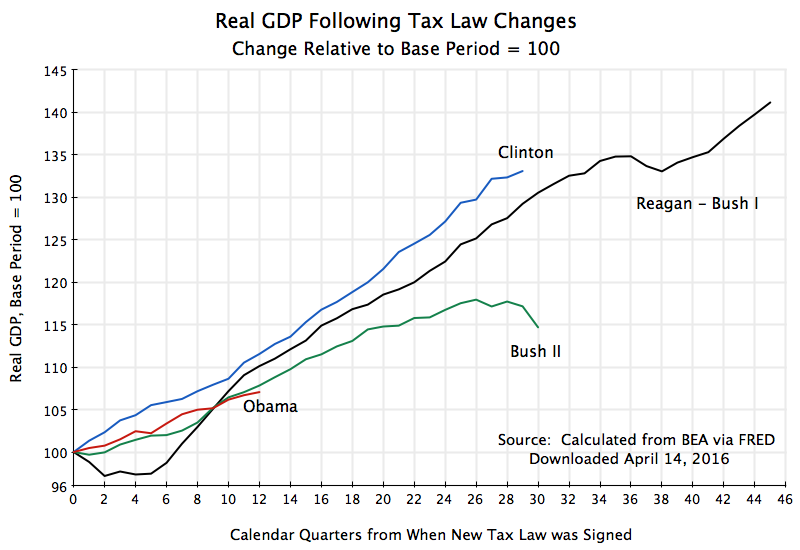
How about the possible impact on GDP growth?  A similar chart shows (based on BEA data on the GDP accounts):

Real GDP Following Tax Law Changes

Once again, growth was best following the Clinton tax increases.  Under Reagan, GDP growth first fell following the tax cuts being signed into law (as the economy moved down into a recession, which by NBER dating began almost exactly as the Reagan tax cut law was being signed), and then recovered.  But the path never catches up with that followed during the Clinton years.  Indeed after a partial catch-up over the initial three years (12 calendar quarters), the GDP path began to fall steadily behind the pace enjoyed under Clinton.  Higher taxes under Clinton were clearly not a hindrance to growth.

The Bush II and Obama paths are quite similar, even though growth during these Obama years has had to go up against the strong headwinds of fiscal drag from government spending cuts.  Federal government spending on goods and services (from the GDP accounts, with the figures in real, inflation-adjusted, terms) rose at a 4.4% per annum pace during the eight years of the Bush II administration, and rose at a 5.6% rate during Bush’s first term.  Federal government spending since the late 2012 tax increases were signed under Obama have fallen, in contrast, at a 2.8% per annum rate.

There is therefore also no evidence here that tax cuts are especially good for growth and tax increases especially bad for growth.  If anything, the data points the other way.

C.  The Impact on the Fiscal Accounts

The argument of those favoring tax cuts goes beyond the assertion that they will be good for growth in jobs and in GDP.  Some indeed go so far as to assert that the resulting stimulus to growth will be so strong that tax revenues will actually rise as a result, since while the tax rates will be lower, they will be applied against resulting higher incomes and hence “pay for themselves”.  This would be nice, if true.  Something for nothing. Unfortunately, it is a fairy tale.

What happened to federal income taxes following the changes in the tax rates?  Using CBO data on the historical fiscal accounts:

Real Federal Income Tax Revenues Following Tax Law Changes

Federal income tax revenues (in real terms) either fell or at best stagnated following the Reagan and then the Bush II tax cuts.  The revenues rose following the Clinton and Obama tax increases.  The impact is clear.

While one would think this should be obvious, the supply-siders who continue to dominate Republican thinking on these issues assert the opposite has been the case (and would be, going forward).  Indeed, in what must be one of the worst economic forecasts ever made in recent decades by economists (and there have been many bad forecasts), analysts at the Center for Data Analysis at the conservative Heritage Foundation concluded in 2001 that the Bush II tax cuts would lead government to “effectively pay off the publicly held federal debt by FY 2010”.  Publicly held federal debt would fall below 5% of GDP by FY2011 they said, and could not go any lower as some federal debt is needed for purposes such as monetary operations.  But actual publicly held federal debt reached 66% of GDP that year.  That is not a small difference.

Higher tax revenues help then make it possible to bring down the fiscal deficit.  While the deficit will also depend on public spending, a higher revenue base, all else being equal, will lead to a lower deficit.

So what happened to the fiscal deficit following these four episodes of major tax rate changes?  (Note to reader:  A reduction in the fiscal deficit is shown as a positive change in the figure.)

Change in Fiscal Deficit Relative to Base Year Following Tax Law Changes

The deficit as a share of GDP was sharply reduced under Clinton and even more so under Obama.  Indeed, under Clinton the fiscal accounts moved from a deficit of 4.5% of GDP in FY1992 to a surplus of 2.3% of GDP in FY2000, an improvement of close to 7% points of GDP.  And in the period since the tax increases under Obama, the deficit has been reduced by over 4% points of GDP, in just three years.  This has been a very rapid base, faster than that seen even during the Clinton years.  Indeed, the pace of fiscal deficit reduction has been too fast, a consequence of the federal government spending cuts discussed above.  This fiscal drag held back the pace of recovery from the downturn Obama inherited in 2009, but at least the economy has recovered.

In contrast, the fiscal deficit deteriorated sharply following the Reagan tax cuts, and got especially worse following the Bush II tax cuts.  The federal fiscal deficit was 2.5% of GDP in FY1981, when Reagan took office, went as high as 5.9% of GDP in FY1983, and was 4.5% of GDP in FY1992, the last year of Bush I (it was 2.5% of GDP in FY2015 under Obama).  Bush II inherited the Clinton surplus when he took office, but brought this down quickly (on a path initially similar to that seen under Reagan).  The deficit was then 3.1% of GDP in FY2008, the last full year when Bush II was in office, and hit 9.8% of GDP in FY2009 due largely to the collapsing economy (with Bush II in office for the first third of this fiscal year).

Republicans continue to complain of high fiscal deficits under the Democrats.  But the deficits were cut sharply under the Democrats, moving all the way to a substantial surplus under Clinton.  And the FY2015 deficit of 2.5% of GDP under Obama is not only far below the 9.8% deficit of FY2009, the year he took office, but is indeed lower than the deficit was in any year under Reagan and Bush I.  The tax increases signed into law by Clinton and Obama certainly helped this to be achieved.

D.  Conclusion

The still widespread belief among Republicans that tax cuts will spur growth in jobs and in GDP is simply not borne out be the facts.  Growth was better following the tax increases of recent decades than it was following the tax cuts.

I would not conclude from this, however, that tax increases are therefore necessarily good for growth.  The truth is that tax changes such as those examined here simply will not have much of an impact in one direction or the other on jobs and output, especially when a period of several years is considered.  Job and output growth largely depends on other factors.  Changes in marginal income tax rates simply will not matter much if at all. Economic performance was much better under the Clinton and Obama administrations not because they raised income taxes (even though they did), but because these administrations managed better a whole host of factors affecting the economy than was done under Reagan, Bush I, or Bush II.

Where the income tax rates do matter is in how much is collected in income taxes.  When tax rates are raised, more is collected, and when tax rates are cut, less is collected.  This, along with the management of other factors, then led to sharp reductions in the fiscal deficit under Clinton and Obama (and indeed to a significant surplus by the end of the Clinton administration), while fiscal deficits increased under Reagan, Bush I, and Bush II.

Higher tax collections when tax rates go up and lower collections when they go down should not be a surprising finding.  Indeed, it should be obvious.  Yet one still sees, for example in the tax plans issued by the Republican presidential candidates this year, reliance on the belief that a miraculous jump in growth will keep deficits from growing.

There is no evidence that such miracles happen.