Inequality and Poverty in the US: Worse Than Elsewhere Due to Small Government

Gini Before Taxes & Transfers, OECD, 2010

Gini After Taxes and Transfers, OECD, 2010

A.  Introduction

Many observers are aware that the US has the worst income inequality in the world among the more developed high income countries.  But conservatives have attributed this to inequality resulting from what they see as a dynamic market based economy, that rewards entrepreneurs generously for hard work and taking risks.  Government interventions that have sought to compensate for the resulting inequality are seen by these conservatives as ineffective and misguided, and indeed counterproductive.  Thus on the 50th anniversary last week of President Lyndon Johnson declaring a “War on Poverty”, conservatives such as Senator Marco Rubio have asserted that those efforts were a failure, and that we should scale back, and even defund and dismantle, government social programs which have sought to alleviate the conditions of the poor.  They assert “big government” is the problem, and small government the solution.

But the premises on which these criticisms are based are faulty.  Individual anti-poverty programs have in fact worked quite well and poverty rates have come down – see this reference for example.  But more fundamentally, one needs to start with the recognition that the US market system does not itself produce greater inequality or higher poverty rates than elsewhere.  For this, US rates are similar to those for others, as will be seen below.  Where the US differs, however, is in the inequality and poverty rates after one includes the impact of government via taxes and transfer programs, to arrive at what individuals are in fact able to buy and consume.  Such government interventions have reduced inequality and poverty rates in all countries.  But because the US efforts are so much more limited than they are elsewhere, US inequality and poverty rates are the worst in the world once one takes these into account.  And since a person’s living standard depends on what they are able to buy after taking into account taxes and transfer programs (such as Social Security or unemployment compensation), it is the latter which matters.

Thus the assertion from Senator Rubio and others that government efforts to reduce inequality and poverty have failed (since we still have inequality and poverty), and that they therefore should be cut back or eliminated altogether, is misguided. Government interventions through tax and transfer programs have reduced inequality and poverty, but they have done so less in the US than elsewhere because their scale in the US is more limited than elsewhere.  It is due to this limited scale that the US ends up being ranked as the worst in the world among other high income countries in terms of inequality and poverty.

This blog post will review these issues, drawing mostly on data available from the OECD Statistics web site.  We will first focus on the inequality measure called the Gini coefficient, both before and then after taxes and transfers.  The Gini is probably the most widely used measure of inequality (when there is any measure of inequality available, which is not always the case as one needs large and expensive household sample surveys).  It varies from zero to one, with a value of zero indicating perfect equality of incomes (all individuals, or households, in the country earn the same amount), and a value of one indicating complete inequality (all of the nation’s income accrues to one person).  The section of the blog post that then follows will then look at poverty head counts – both before and then after taxes and transfers.

B.  Income Inequality as Measured by the Gini Coefficient

The chart at the top of this blog post shows the Gini coefficient for the US and a set of comparable high income countries (mostly from Western Europe, along with Canada, Japan, Australia, and New Zealand).  Based just on incomes as earned in the market, inequality in the US is in the middle of the range found for the other countries – a bit worse than the average but not by much.  Inequality of market incomes was worse in Ireland, the UK, Portugal, Spain, France, and Italy.  There is no sign here that the US economic structure leads to a distribution of income that is worse than that seen elsewhere among the high income developed countries of the world.

The picture changes markedly once one takes into account the impact of taxes and government transfer programs.  This is shown on the second chart above.  Inequality then falls in all of the countries, as there is at least some degree of progressivity in the tax systems, and government transfer programs are also and more markedly progressive.  Even if the benefits of some transfer program are distributed in equal dollar amounts to all in the population, that level of transfer will be of greater relative importance to a poor person than to a rich person.

But inequality falls by less in the US than elsewhere once one takes into account taxes and transfers, so that the US moves from the middle of the set of comparator countries to the country with the worst distribution.  The differences in the Gini coefficients are shown explicitly in the following chart:
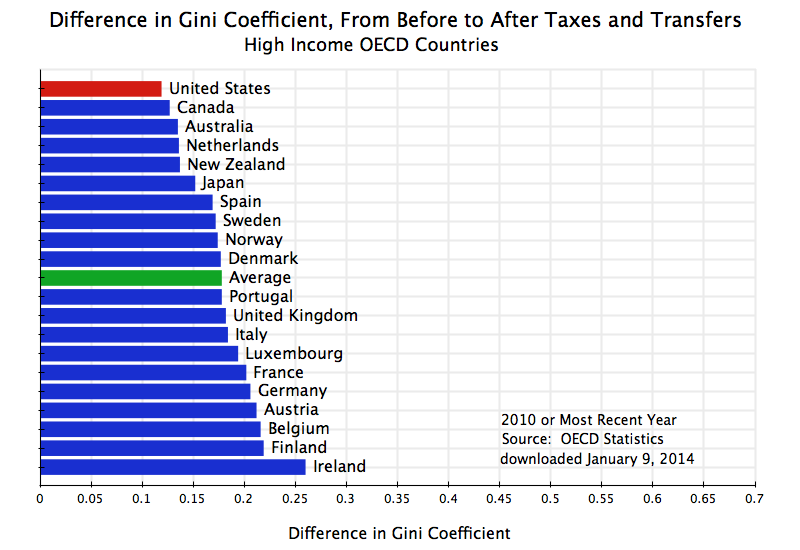
Gini Coefficient - Dif Before and After Taxes & Transfers, OECD, 2010

Inequality as measured by the Gini coefficient is reduced in each of the countries once one takes into account taxes and transfers.  The reductions are indeed quite significant.  But the reduction in the US is smaller than in any other country, and the result is that the US then ranks worst in terms of inequality once one takes into account taxes and transfers.

An interesting question is whether the reductions in inequality are primarily due to the tax system, or to transfer programs.  Tax systems and transfer programs are both in general progressive.  That is, tax rates are generally higher for those individuals with higher income, and transfer programs are generally designed to benefit the poor more than the rich.  But not all individual tax and transfer programs are progressive.  Flat consumption taxes, such as sales taxes in the US and value-added taxes in Europe, can be regressive, in that they take a higher share from the poor (who must consume almost all of their limited income) than the rich.  The scale of the programs also matter.  One might have an extremely progressive tax structure, for example, but if the size is small (so that little is collected in taxes) then it will have little impact on inequality.

One therefore needs to look at the data.  While the standard OECD files used for the above do not have this, an analysis posted as the Budget Incidence Fiscal Redistribution Database by the research center known as the Luxembourg Income Study (based in Luxembourg and with a US office at the City University of New York), does provide such a breakdown.  The analysis was prepared by Chen Wang and Koen Caminada of the University of Leiden in the Netherlands, and a description is available in this working paper.

Their analysis is drawn from data for 2004 (for most of the countries):

Change in Gini From Before To After Taxes and Transfers
2004 or nearest year
Gini Gini Total From From  Transfers/
Before After Change Taxes Transfers Income
US 0.482 0.372 0.109 0.043 0.066 9.9
Canada 0.433 0.318 0.114 0.038 0.076 10.9
Spain 0.441 0.315 0.126 0.001 0.124 20.7
Switzerland 0.395 0.268 0.128 -0.003 0.130 17.5
UK 0.490 0.345 0.145 0.021 0.124 14.3
Australia 0.461 0.312 0.149 0.047 0.101 11.1
Italy 0.503 0.338 0.165 0.000 0.165 25.4
Average 0.456 0.289 0.167 0.031 0.136 19.6
France 0.449 0.281 0.168 0.017 0.151 26.2
Norway 0.430 0.256 0.174 0.035 0.139 20.2
Ireland 0.490 0.312 0.178 0.046 0.132 17.3
Luxembourg 0.452 0.268 0.184 0.037 0.147 23.4
Austria 0.459 0.269 0.190 0.034 0.156 26.7
Denmark 0.419 0.228 0.191 0.042 0.149 18.9
Netherlands 0.459 0.263 0.196 0.040 0.156 21.3
Sweden 0.442 0.237 0.205 0.037 0.168 24.6
Germany 0.489 0.278 0.210 0.052 0.158 21.2
Finland 0.464 0.252 0.212 0.044 0.168 23.2
Europe only 0.456 0.279 0.177 0.029 0.148 21.5

The first two columns show the Gini coefficient, first before and then after taxes and transfers.  The third column then shows the change in the Gini, with the countries in the table ranked according to this change (from smallest to largest).  While the specific numbers differ from those in the OECD data shown above (the year is different, plus the data may be drawn from different underlying sources), the two are broadly consistent.  In both sets, the US ranks as the most unequal in terms of income after taxes and transfers, with the change in the Gini from before to after also the smallest.  Before taxes and transfers, the Gini for the US is within the range seen for the other countries, with Italy, the UK, Ireland, and Germany all worse.

The authors decompose the change in the Gini according to how much is due to the tax system and how much is due to government transfer programs.  For the US, for example, the total reduction in the Gini was 0.109 points, with 0.043 coming from the tax system and 0.066 coming from the impact of government transfers.

The reduction in the Gini in the US due to the impact of the tax system (of 0.043 points) is within the range seen for the other countries and is indeed even somewhat higher than the average impact across all countries (of 0.031 points).  The US relies mainly on direct income taxes for raising tax revenue, while European countries rely more on value-added taxes.  Income taxes with progressive rates will have a greater impact on reducing inequality than will value-added taxes.  But there are other taxes in all countries, including income taxes in Europe.  More importantly, Europe collects far more in tax revenues than the US does, and hence even if the US tax system has more progressive rates overall, the larger scale in Europe means there can be more of an impact on inequality there.  Based on OECD tax data, the US collected (at all levels of government) just 24% of GDP in tax revenue in 2012, while Western Europe on average collected over 60% more at 39% of GDP.

But more important than the impact of the tax system on inequality was the impact of government transfer programs.  Transfer programs in the US did reduce inequality as measured by the Gini by 0.066 points.  But this was the smallest of any of the countries.  It was less than half the average reduction across all the countries of 0.136 points, and an even smaller share relative to the average for just the European countries of 0.148 points.

The reduction was larger in Europe than in the US primarily because the transfer programs were larger in Europe than in the US.  The final column in the table shows the average level of transfers in each country relative to household incomes.  This was just 9.9% in the US, which was about half of the 19.6% for all the countries, and well less than half of the 21.5% average for just the European countries.

Transfer programs do bring down inequality, and does this in all countries including the US.  But government transfer programs are so much more limited in the US than elsewhere that the US ends up as the worst in the world in inequality once one accounts for them along with taxes.

C.  Poverty Rates

The discussion above was on inequality, using the Gini coefficient as the measure.  But inequality (and the Gini measure), cover the entire income range from rich to poor.  One might also reasonably want to know how the US compares when one focuses exclusively on the poor.  What share of the population is poor, where does the US rank by this measure compared to other countries, and again what is the impact of taxes and transfers?  We will find that the results are basically the same as that found above for the Gini.

A direct measure of the poverty rate is available from the same OECD data base utilized above for the Gini.  The concept used is the share of the population (the head count) with incomes below a poverty line defined as 50% of the median income in the country.  This is a relative measure that takes into account that the standard used for determining who is poor should depend on how rich the country is.

Based on this measure of poverty, the US poverty rate before taxes and transfers is again similar to that for other OECD countries.  It is indeed slightly better than the average for all the OECD countries included here (where there is consistent data also available now for this measure for the countries of Central Europe, so these countries have been added):
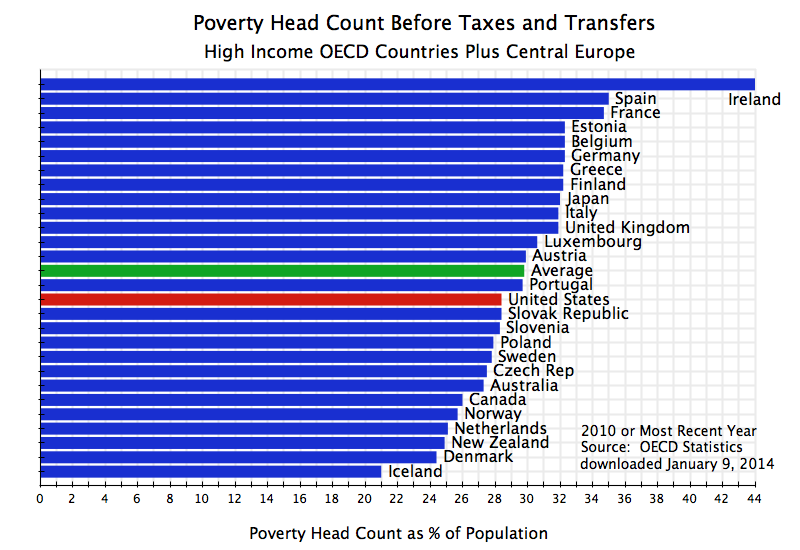
Poverty Head Count Before Taxes & Transfers, OECD, 2010

The US market economy therefore does not lead to higher poverty rates than that found in other OECD countries.  But this changes, as it did for the Gini, when one takes into account the system of taxes and transfers:
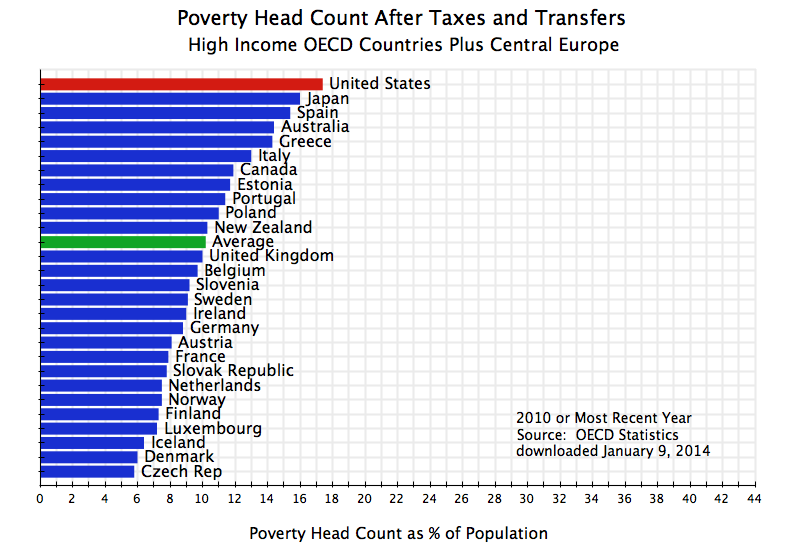
Poverty Head Count After Taxes & Transfers, OECD, 2010

The US then ranks again worst among all OECD countries in terms of the poverty rate, once one includes the impact of taxes and transfers.  The system of taxes and transfers has a positive impact in all of the countries, in that the poverty rates fall in each country once one accounts for taxes paid and transfers received.  Indeed, the impacts in many of the countries are quite large.  But the programs are more limited in the US than elsewhere, so that the net reduction in the US is the smallest:
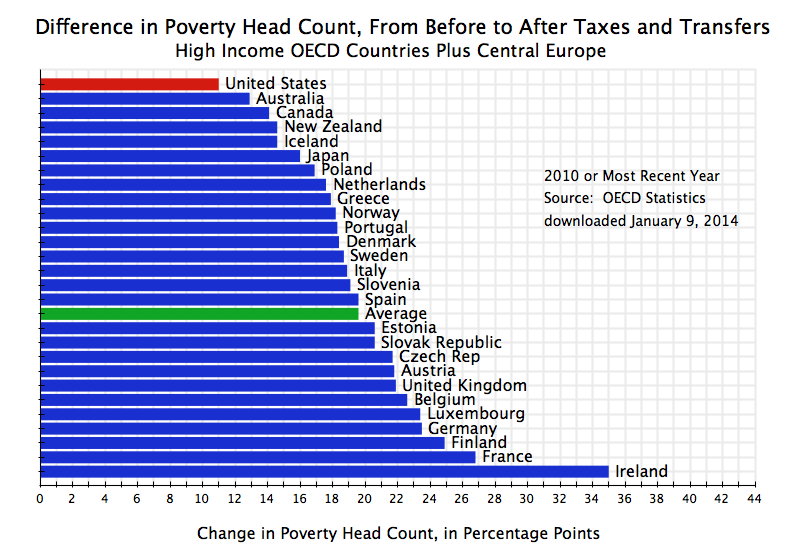
Dif in Poverty Head Count, Before to After Taxes & Transfers, OECD, 2010

Due to the limited scale of such government programs in the US, poverty rates end up higher in the US than in any other high income OECD country.

D.  Conclusion

Many presume that the US has high inequality and poverty rates because of the market economy system in the US.  While it may be recognized that inequality in the US is higher than elsewhere, and poverty rates also higher, the presumption is that these are unfortunate byproducts of a market system that rewards hard work and risk taking.

But this is not the case.  Inequality and poverty in the US is similar to that found elsewhere among the high income OECD countries, when one takes incomes as determined before accounting for taxes paid and the impact of government transfer programs.  The US is indeed quite close to the average seen elsewhere for these market determined incomes.  Where the US differs, however, is in inequality and poverty rates after one takes into account taxes paid and transfers received.  And since this determines what individuals are in fact able to buy and consume, these incomes after taxes and transfers determine actual living standards.

Once one takes into account taxes and transfers, the US moves from the middle of the range to the worst ranking country.  The tax systems and transfer programs reduce inequality and poverty rates in all countries, including the US.  But the US programs are so much more limited than those found elsewhere, particularly in Europe, that the rest of the OECD world reaches and surpasses the US by these measures.

Inequality and poverty rates in the US, as the worst in the world after accounting for taxes and transfers, are not therefore a consequence of failed government programs, which conservatives such as Senator Rubio want to cut by even more.  Rather, the ranking of the US as the worst in the world is a consequence of the opposite:  that these programs are too small and limited.
The High Concentration in US Health Care Expenditures, and Some Implications

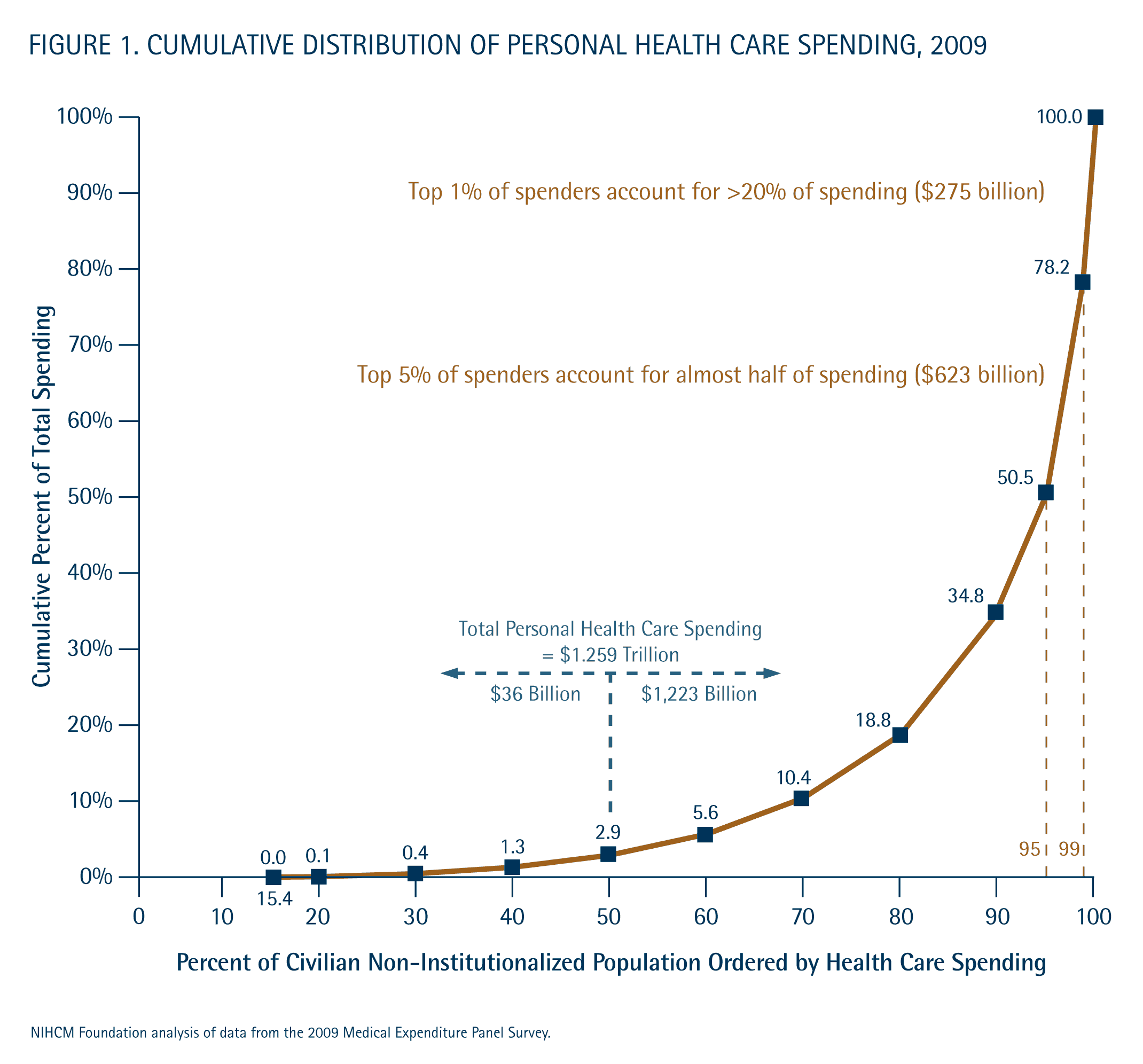
Concentration of Health Spending, 2009

A.  Concentration of US Health Care Costs

Previous blog posts in this series on health care have reviewed how the US spends far more than other countries yet achieves only mediocre results, how the prices charged for similar medical treatments can vary enormously even for hospitals that might be physically across the street from each other, and how this fragmentation and other factors in the US health care market have led to profits and compensation for at least some top individuals that can be enormous.

One other characteristic that needs to be understood before we go into the economics of the health insurance market and possible reforms, is the extremely high degree to which health costs are concentrated on a relatively small number of patients.  The graph above is copied from a July 2012 analysis of the National Institute for Health Care Management, and is based on data taken from the 2009 Medical Expenditure Panel Survey (MEPS) of the US Department of Health and Human Services.

As shown in that graph, just 5% of the US population accounted for close to 50% of all US health care spending (for treatment of patients) in 2009.  The top 1% of the population alone accounted for 22% of health care spending.  And the bottom 50% of the population accounted only for less than 3% of the spending.

It should not be surprising that health care spending is concentrated.  That is why we carry health insurance.  Insurance is to cover costs that may be high in some given year but are also, and hopefully, relatively infrequent and affect only a few of the population.  But the degree of concentration may be surprising to some, and the implications of such concentration on the design of an appropriate health financing reform have often been ignored.

Before we go into some of those implications, a few other facts are relevant.   First, the graph above on concentration of costs covers expenditures over the course of one calendar year.  There will be less concentration when one looks at the costs over several years, since for at least some individuals there will a treatment in one year which will hopefully cure the condition and lead to less need for treatment in future years.

But there is actually still a high degree of persistence in such spending from year to year.  Using data from the 2008 and 2009 Medical Expenditure Panel Surveys, Dr. Steven Cohen and William Yu reported in a 2012 note that 20% of those in the top 1% of spending in 2008 were again in the top 1% in 2009, even though by construct they were only 1% of the population.  They also found that 38% of those in the top 5% in 2008 were again in the top 5% in 2009.  And there were similar over-representations in the other groups.  That is, there is significant continuity in costs incurred from one year to the next.  The very sick tend to remain so and continue to require costly care.

Second, part of the reason for this continuity is that a very high proportion of costs are incurred for the treatment of chronic conditions.  Specifically, and also based on Medical Panel Expenditure Survey data (this time from the 2006 survey), an analysis by Dr. Gerard Anderson of Johns Hopkins found that 84% of total US health care spending is for treatment of individuals who have chronic conditions such as diabetes or heart disease.  These conditions carry over from one year to the next, and are rarely completely cured.

B.  Implications for Health Insurance Reform

This concentration of costs, with a high share coming from the need to treat chronic conditions, has important implications when considering any health care financing reform.  Specifically, it makes it clear that the reform needs to focus on the treatment of the high cost individuals, in particular those with chronic conditions.  That is where the spending is, and therefore that is where one will need to focus for there to be significant savings.  As noted above, the bottom 50% of the population accounts for only less than 3% of health care spending.  Even if such expenditures were cut in half, the savings would only be 1.5% of total health care spending.  In contrast, the costs in treating the top 1% is over 20% of US health care spending.  If these costs could be cut by just 7%, one would generate more savings than cutting the costs of the bottom 50% of the population by half.  And just a 15% cut in the costs of the top 1% would save more than the complete elimination of all medical spending for the bottom 50%.

Thus it is clear that one needs to focus on the expensive treatments and the care of those with chronic conditions.  That is where the money is being spent.  And as was documented in the earlier blog post on the variation in health care prices, the differences in prices for such health care procedures can be huge.  For a heart bypass operation, for example, the median price charged in the US in 2012 was $73,420.  But the cost was less than $46,547 in 25% of the cases.  At the other extreme, the costs were over $150,515 in 5% of the cases.  A system which would bring down the high end prices to just the current median, or better to the levels that are adequate in a quarter of the cases, would lead to huge savings.

But while this need to focus on the costs of the high-end procedures would seem clear, much of the conservative critique of the US health care insurance system is focused on trying to achieve savings among those at the opposite end of this spectrum.  That is, the conservative critique is that US households wastefully consume “too much” in health care services, because (they assert) the households do not face the full price of the care.  With insurance, the households pay only the coinsurance rate (after the deductible) of possibly 20%, and in many cases pay no coinsurance rate at all.

Thus conservatives recommend moving US households onto high deductible insurance plans, where the patients pay 100% of the costs up to the deductible amount, and then have insurance only for costs above this (i.e. catastrophic care plans).  The presumption is that patients then will not go to see doctors unless they really need to, as they will be paying the full cost until the deductible is used up, and will be careful to keep costs down when they do see a doctor.

The problem with this is that while this might lead to fewer doctor visits for those in the population whose health care costs are less than their deductible each year, it will do nothing for those whose medical costs are high.  They will have already used up their deductible anyway.  And as noted above, due to the concentration of health care costs on a relatively small share of the population, the savings on the rest will not matter much.  The bottom 50% of the population accounts for only less than 3% of health care costs.

But the results can be far worse.  Avoiding seeing a doctor early, when one suspects some medical issue but are not sure (as we are not doctors), can lead to far higher costs later if that condition develops into something serious.  A doctor’s visit is not costly (the average in 2011 according to the MEPS was $230), but a cancer that develops or a heart condition left untreated can lead to extremely costly treatment later.  While some of the high deductible health insurance plans will try to avoid this by covering things like routine annual check-ups outside of the deductible (and under Obamacare they are now required to do this for a specific list of such routine check-ups and tests), not all such checks are covered.  What an individual needs depends on that individual, and basic rules that apply to all will only cover a portion of these.

Conservatives have, however, used tax law to encourage a shift of consumers onto such high deductible health insurance plans.  The initial push was the creation of the Medical Savings Account in 1996, championed by the conservative Republican Congressman Bill Archer of Texas.  These are now called Archer MSAs.  These plans were primarily for the self-employed, and provided substantial tax advantages for an individual to use them.  In 2003, during the Bush administration, these were then substantially extended to the current program of Health Savings Accounts.

There are substantial tax advantages to such accounts.  Funds placed in them and used for medical expenses are not subject to income tax, and the investment income earned on the sums in the accounts are similarly not taxed (broadly similar to an IRA).  And these tax advantages will accrue primarily to those in the higher income tax brackets (the rich) and those who expect to spend less than the deductible each year (the relatively healthy and those who are younger).  The funds placed in these accounts also generate substantial fund management fees (generally 1 to 2% of assets annually) for the banks and other financial institutions who manage them.

Thus there are now important vested interests in maintaining such Health Savings Accounts, and Obamacare never fully addressed the issue given the political challenges.  Health Savings Accounts still exist, and while the standards set under Obamacare for an adequate health insurance plan limit total out-of-pocket expenses, plan deductibles can still be high (although not as high as existed before in some insurance plans).  Total out-of-pocket expenses (and hence the deductible) can now be no higher than $6,350 for an individual and $12,700 for a family, but this is still a lot.

But high deductible health insurance plans have failed in bringing down the high cost of medical care in the US, as they never addressed where the problem lies.

Vested Interests in Health Care: Spectacular Profits and Earnings for At Least Some Insurers and Providers

Cigna share price, Dec 1, 2003 to Dec 16, 2013.001

Ten-Year returns:  CIGNA = 361%;    S&P 500 Index = 70%

A.  Introduction

Earlier posts in this series on health care have documented how incredibly expensive the US health care system is (with costs almost $1 trillion more than would be the case if the US spent as a share of GDP what the second highest spending country does), and that the prices for the same procedure at different hospitals can vary by a factor of ten or even more.  Future posts will explore why this is the case.  But at this point it is worth reviewing how this US system of nominally competing private health insurance companies and health care providers nevertheless produces winners with truly astounding profits and personal compensation for those at the top.

The focus here will be on some of the numbers, documenting how at least some individuals and firms are doing very well in this non-transparent, non-competing, system.  The final section will add how this is taking place not because such insurers and health care providers are especially efficient at what they do, but rather because they are able to take advantage of a system of great inefficiency and waste.  And such winners now have a vested interest in keeping this badly functioning system in place.

B.  Spectacular Profits and Earnings of At Least Some Insurers and Providers

1)  To start, one can look at the stock market returns to investors in the major private health insurance companies.  The graph at the top of this post shows the ten year return (from December 2003 to December 2013) on an investment in the health insurer Cigna.  Such an investment would have received an overall ten year return of 361% (not counting dividends, which would have added to this).  That is, an investment of $10,000 in December 2003 would have grown to $46,100 by December 2013 (plus dividends).  Over this same period, the S&P 500 index (the generally used index of the overall stock market in the US, and shown as the orange line in the graph) would have grown by a pretty good 70%.  The Cigna return was more than five times as much.

2)  Other publicly traded health insurance companies have also done well.  Over this same ten year period, an investor would have received a return of 145% from an investment in Wellpoint, a return of 171% from an investment in UnitedHealth, a return of 318% in Aetna, and a return of 352% in Humana.  All of these are well in excess of the S&P 500 index return over this period.

3)  Wendell Potter, a former head of communications at two of the top health insurers (Humana and Cigna) who is now decidedly anti-insurance, presents in his 2010 book Deadly Spin figures on how much health insurance executives have been compensated.  Citing other sources that drew on corporate filings, he noted (page 139) that in 2007 the CEOs at the ten largest publicly traded health insurance companies received a combined total compensation of $118.6 million (an average of $11.9 million each).  From other corporate filings with the SEC, Potter noted (page 141) that between 2000 and 2008, the ten largest publicly-traded health insurers paid their CEOs a total of $690.7 million.  And in 2009, Wellpoint alone employed 39 executives who each collected total compensation exceeding $1 million.

4)  But annual compensation of even $10 million or more can substantially undercount what the CEOs of these health insurers ultimately receive.  According to a filing with the SEC, the Chairman and CEO of the health insurer Cigna retired at the end of 2009 with a retirement package worth $110.9 million.

5)  But the retirement package of the Cigna CEO was not the most generous among his peers.  The embattled CEO of UnitedHealth Care stepped down in late 2006 after being forced by the SEC to forfeit stock options worth $620 million.  The stock options in the company had been illegally backdated to make them especially profitable.  However the CEO was allowed to keep stock options worth $800 million, which was in addition to the $520 million he received in compensation from UnitedHealth while he ran the company from 1991 to 2006.  That is, this one individual received total compensation worth over $1.3 billion during his tenure as head of this private health insurer.

6)  Hospital providers have also done well.  Steven Brill, in his widely read article titled “Bitter Pill” published in Time Magazine in February 2013, calculated that in 2010 the prestigious MD Anderson Cancer Center in Houston, a non-profit that is formally part of the University of Texas system, had an operating profit of $531 million in fiscal year 2010.  This was equal to 26% of its revenue of $2.05 billion that year, which is a very generous margin for a service industry.

7)  Brill also noted the the total compensation of the president of the MD Anderson Cancer Center was $1.845 million that year (plus he earned more from other interests).  And he reported that six administrators at the Memorial Sloan-Kettering Cancer Center in New York earned over $1 million each at that one institution.

8) To coincide with the Steven Brill article, Time published figures on returns being earned by other major non-profit hospitals in the US.  The operating profits of the ten largest such hospitals (as measured by number of beds) varied from $118 million to $770 million (in the most recent year for which data is available).  The CEOs of these hospitals received between $2.1 million and $6.0 million in compensation from the hospitals (plus in general earned more from other interests as well):

Health - Profits & CEO Compensation at Non-Profit Hospitals, 2010.001

It should be added that not all hospitals are profitable.  The point, rather, is that at least some are highly profitable.

9) Using records that must be filed with the government each year, the California Nurses Association found that 100 executives at non-profit hospitals in California earned over $1 million each in 2010.  Four hospital groups accounted for 69 of these 100 high-earning executives, with the Sutter Health Network alone accounting for 28.  The top CEO compensation was $7.7 million in that year, and four CEOs earned $4 million or more.

C.  Yet Waste and Inefficiency is High

High profits and earnings could perhaps be justified if they were a consequence of highly efficient operators, providing an important service at low cost.  But that is not the case in the US:

1)  Overall Costs:  First, as has been noted before and discussed in the earlier blog post cited above, the US health care system is by far the most expensive in the world, with spending as a share of GDP which is 50% higher than in the second most costly country.  With almost $3 trillion being spent on health care in the US this year, that implies the US expenditures are about $1 trillion more than they would if it were spending (as a share of GDP) what the second highest country was spending.  And the US is spending $1.4 trillion more than it would if the US spent what the average OECD country does.

Yet as that blog post also noted, the results the US gets from such high spending are mediocre at best.  The infant mortality rate in the US is higher than in any other OECD country other than Mexico, Turkey, and Chile.  And life expectancy is only higher than in several OECD members with far lower income from Eastern Europe and Latin America.

If the US had an efficient health care system, it would not be spending so much for such poor results.

2)  Hospitals:  At least certain hospitals and their CEOs receive high incomes, as noted above, but there is no indication that this comes from being especially efficient.  Rather, the market in which they operate is highly fragmented, and as was documented in an earlier blog post, the variation in the prices they receive for similar medical procedures can vary by a factor of ten (or even more) between them.

As any economist will tell you, a normal market should not function that way.  In a normal market, one would not see much variation among prices (and what variation there is would be linked to some assessment of quality by the purchaser).  Economists call this the Law of One Price.  In such a market, profits will be earned by a provider who can provide the service at a lower cost (by being more efficient) and then selling it as this one price.  Furthermore, these more efficient producers, earning a higher profit than others who must also sell at this same price, will then expand to provide more of the product or service at this profitable price (profitable to them).  They will gain market share at the expense of the less efficient.  The price will drop, and over time the less efficient will be driven from the market, leaving the more efficient providers selling at what would then be a lower price than before.  In the end, only the most efficient providers will survive, and will earn a normal profit similar to that earned elsewhere and in other industries.

This process clearly does not happen in the market for health care provision.  Future blog posts will discuss why.  But briefly, the wide variation in prices makes it possible for even high cost medical providers to survive and even to thrive, and rewards those who are skillful at managing within this fragmented system.  It also rewards hospitals and other medical providers who enjoy market power vis-a-vis the insurer (by being one of only a few providers of this service within the region, for example by a hospital chain that might dominate the local market).  They will then be able to demand a high price, which the insurers (and ultimately the patient) will have little choice but to agree to.  Insurers, from their side, similarly seek to dominate any given local market.  Which side gains the upper hand depends on which is more successful in gaining market power against the other.

3)  Pharmaceuticals:  The pharmaceuticals industry also illustrates how an ability to exploit the rules in the system can lead to lead to big, indeed gargantuan, profits.  A good example was described in a recent Washington Post article, on the use of an expensive drug produced by Genentech for the treatment of age-related macular degeneration (AMD).  AMD is the most common cause of blindness among the elderly.  The Genentech drug, called Lucentis and developed through genetic engineering, is currently the most effective treatment for AMD.  Essentially the same drug, called Avastin for this purpose and also made by Genentech, is used for the treatment of certain cancers.  It can also be used to treat AMD, and many doctors notes it does this equally well as it is really the same drug.  But Lucentis costs $2,000 per dose, while Avastin, when used in the dosage required for AMD, only costs $50 to $60 per dose.

Why would any doctor then use Lucentis rather than Avastin for the treatment of AMD?  Because Genentech has only sought and obtained formal FDA approval for the use of Lucentis for AMD, while deliberately not applying to the FDA for the approval of Avastin for this purpose (it is, however, FDA approved for certain cancer treatments).  And in their compensation from Medicare for treating their elderly patients for AMD, the doctors will enjoy a much higher return from using Lucentis rather than Avastin since Medicare pays them a certain mark-up over cost.  This mark-up will be far higher in absolute terms for using Lucentis.  But by using Lucentis, the Washington Post calculates that Medicare has spent $5.7 billion more over the last five years than it would had Avastin been used.  Genentech has benefited enormously by its decision not to seek FDA approval of Avastin for treatment of AMD.

4)  Private Health Insurers:  Private health insurers, and their CEOs, have enjoyed often staggering returns, as noted above.  Such high returns could perhaps be seen as justified if these insurers provided their services efficiently and at low cost.  However, the costs incurred by private health insurers (and passed on to their clients) are high.

Figures on the net cost of private health insurers (i.e. administrative costs plus profits) are provided in the files on US health care costs issued each year by the Centers for Medicare and Medicaid Services (CMS).  The most recent data available go through 2011.  The “net costs” of private health insurers include all costs other than what the health insurers pay out to medical service providers on patient claims, and includes not only staff and office costs but also profits.  For brevity, this will sometimes be referred to simply as admin (or administrative) costs.

For 2011, the admin costs by private health insurers on private health insurance plans totaled $110.3 billion.  The benefits paid out under these plans came to $786.1 billion.  Thus the admin costs (including profits) amounted to 14.0% of the benefits paid.

The CMS data also provides such costs for Medicare.  The direct expenditures by government for administering this health insurance for the elderly totaled $8.2 billion in 2011, with benefits paid out of $521.6 billion, for a ratio of admin costs to benefits paid of 1.6%.  However, this would be a misleading figure as a substantial portion of Medicare is now administered by private health insurers under the Medicare Advantage program.  This program was expanded significantly in the 1990s and again with the passage of new legislation during the Bush administration, and in 2011 accounted for 25.3% of Medicare enrollees (see the table on page 168 of the May 2013 Medicare Trustees Annual Report).

The CMS data shows that private health insurers spent $24.5 billion in administering these Medicare Advantage programs.  One can then allocate Medicare payments to beneficiaries in proportion to the number of enrollees under either traditional government administered Medicare (74.7%) or under the privately administered Medicare Advantage (25.3%).  Assuming that the government’s $8.2 billion of admin costs was used solely for the programs it administered directly (even though a share would have been required to oversee the Medicare Advantage program), one can calculate the admin cost shares for the directly government administered side of Medicare, and for the Medicare Advantage program.

The result is that in 2011, the admin cost of the directly government managed portion of Medicare (for the 74.7%) came to 2.1% of benefits paid.  But for the privately administered side under Medicare Advantage (for the 25.3% enrolled there), the private admin costs alone came to 18.6% of benefits paid.  That is, private administration of Medicare programs was over nine times as expensive as direct government administration of such programs.

Future blog posts will discuss further why private administration of health care insurance is so expensive.  It is not simply profits, even though private health insurers have been substantially profitable.  It is also high costs from a business model that benefits from incurring costs to select a pool of insured clients who are relatively more healthy and hence are less likely to make insurance claims, and to deny claims when they can.

D.  Conclusion

Private health insurers and at least certain of the major health care providers have been hugely profitable in recent years, with the heads of these organizations often earning very large sums.  But such high profits and compensation have not been earned as a result of keeping down costs.  Costs in the US are especially high by international standards.  Rather, the high profits and compensation of those individuals at the top of their organizations have been made possible by a fragmented system, with little competitive pressure to bring down costs and prices.  The high returns go to those who are skillful at managing within such a system.

These high returns to at least some of the key players also creates powerful vested interests who benefit from a continuation of this high cost system.  Thus it should not be a surprise that powerful interests fear any major reform in the health care system, such as under Obamacare.  Even Obamacare, in the compromises it was forced to make in order to secure passage by Congress, was modest.  It focused on extending the availability of health insurance to those currently without insurance, with most of these to be enrolled in plans from the private health insurers.  There was no move to a single payer system such as from extending Medicare to the entire population, nor not even a public health insurance option which would be allowed to compete with the private health insurers.  There were only limited measures to try to contain health costs.  While it is still early, these limited measures appear to be having a positive effect on lowering costs, but they are not revolutionary.

More fundamental changes will be needed to bring down health care costs.  These will be explored in future blogs in this series on health care.

————————————

Update on January 9, 2014:  Following my posting of the blog above, Dr. Alex Horenstein of the Department of Economics at the University of Miami brought to my attention a paper he has prepared (with co-author Manuel Santos, also of the University of Miami) which addresses some of these same issues.  It comes to broadly similar conclusions on the high profitability of the health care and health insurance sectors, but is a much more rigorous piece than this blog post.  While portions of the Horenstein – Santos paper are fairly technical, and the piece is still a working paper that may be modified, there is a good deal of additional material on these issues in the paper and some readers may find it of interest.