Impact of the 1994 Assault Weapons Ban on Homicide Rates and Mass Shootings

US Murder Rates, 1980 to 2010Mme. Marie Curie (Nobel Laureate):  “Nothing in life is to be feared, it is only to be understood.  Now is the time to understand more, so that we may fear less.”

[Note:  An update to this post, with more recent data as well as a discussion of what should be done for a more effective ban, was posted on this blog on March 17, 2018.]

Introduction

The horrific shootings at Sandy Hook Elementary in Connecticut in December, in which 20 school children aged 6 and 7 died, led to an outcry for effective measures to stop this from happening again.  The gun control measure most commonly called for was reinstatement of the ban on assault weapons (the type of weapon used in the Sandy Hook shooting) that Congress had passed in September 1994.  The law had a 10 year sunset provision, and with the more conservative political climate in 2004 during the Bush Administration, efforts to renew the law were blocked.  Hence it expired in September 2004.  The mother of the Sandy Hook shooter was then legally eligible to purchase an assault weapon, and her son used the one she had at their home to kill the 20 school children, after he first shot his mother.

But did the 1994 Assault Weapons Ban law have an effect on homicides in the US, and separately on mass shootings?  This note will review what we might be able to say from simple trends over time.

US Homicide Rates Fell in the 1990s

The chart above shows US homicide rates between 1980 and 2010, with a breakdown (for 1980 to 2008) of the number of homicides as a result of the use of any gun, by handguns only, and by all other guns.  Other homicides could be through the use of knives or other objects.  The source is a report dated November 2011 on homicide trends in the US over 1980 to 2008, prepared in the Bureau of Justice Statistics of the US Department of Justice, and is the most recent such report available from this source.

The chart shows that homicides did indeed decline sharply over the 1994 to 2004 period that the law was in effect (more precisely, September 13, 1994, to September 12, 2004).  The overall homicide rate in the US was 9.5 deaths per 100,000 population in 1993, and this fell to a rate of 5.6 in 2005.  The homicide rate from use of guns fell from 6.6 in 1993 to 3.8 in 2005.

While these homicide rates are an improvement over what they had been, keep in mind that compared to other developed countries, the rates are still abysmal.  Based on UN assembled data for 2010 (or the most recent year available), the total homicide rates were just 1.2, 0.8, 1.1, and 0.4 for the UK, Germany, France, and Japan respectively, and the homicide rates by firearms were only 0.1, 0.2, 0.1, and 0.0 for the four countries (where the rate in Japan rounded to 0.0 per 100,000 population as there were only 11 homicides in Japan in 2008, the most recent year with data available in the UN report on this; in 2008, the US had 11,030 homicide deaths by firearms.  Japan has strict gun controls.).

But can one attribute this fall in the homicide rate to be a consequence of the Assault Gun Ban then in effect?  From just the relationship found in the chart, not really.  There was much else going on during this period which could and probably did also have an impact on homicide rates.  In addition, one can see in the chart that the decline in homicide rates began before the new law went into effect, and that the large fall then bottomed out around 2000, after which there was a small rise.  Furthermore, one does not see a jump back to previous rates once the ban was allowed to expire in September 2004.  Looking at this relationship over time, a stronger case could probably be made that the drop in the homicide rate was more due to the totality of measures implemented during the period of the Clinton presidency, from January 1993 to January 2001.  This fits well the observed period when the homicide rate dropped.  But here again, there was much else also going on which could affect the homicide rates, including at the level of state and local governments.

Mass Shootings, 1982 to 2012

It is also arguable that the metric used above (the overall homicide rate) is not the metric that should be used when assessing whether the Assault Gun Ban helped.  The Assault Gun Ban only affected one category of gun (semi-automatic weapons), and highly imperfectly at that (which will be discussed below).  Most murders are done with simple handguns.  Particularly with the Sandy Hook shooting of school children very much in mind, can one say whether the 1994 Assault Gun Ban may have reduced the number of, and severity of, mass shootings?

Following the Sandy Hook shooting, Mother Jones magazine recently updated a data set it had earlier prepared (after the Aurora theater shootings) on mass shootings in the US since 1982.  Using specific criteria to define what to include as a mass shooting (four or more people shot in a single incident; one shooter; the shootings occurred in a public place; and some other factors and with some specified exceptions), Mother Jones provides a well documented data set concluding that there were 62 mass shootings meeting its criteria over this period.  They provide brief descriptions of each event, what weapons were used, the number of fatalities and the number of those wounded, and other relevant data.

Based on this data set, the following graph shows the number of mass shooting incidents in each year from 1982 to 2012:

Mass Shootings, Number by Year, 1982-2012

The number of mass shootings meeting the specified definition averaged 1.5 each year between 1982 and 1994, and possibly might have been rising in the period leading up to 1994 (I say possibly as the number of events are small, and it is not clear this is statistically significant).  The annual average was about the same, at 1.6 per year, between 1995 and 2004, but with this average brought up by a high number in 1999 (the year of the Columbine High School shooting, but where there were five mass shootings in total), and to a lesser extent in 1998 (with three mass shootings).  The numbers were low in the other years.  After the Assault Gun Ban expired, the frequency went up, reaching 3.4 per year on average between 2005 and 2012, with an especially high number (seven) in 2012.

The data set also has the numbers over time on the number of fatalities and of all victims (including those wounded):

Mass Shootings, Fatalities and Total Victims, 1982-2012

Using the numbers underlying this figure, over 1982 to 1994 the number of fatalities in mass shootings averaged 8.5 per year and the number of total victims (including those injured) averaged 18.2.  Over the period 1995 to 2004, the number of fatalities fell somewhat to 6.4 per year while the total number of victims fell to 13.2.  The averages were higher than otherwise in this period due to the spikes in 1999 (the year of Columbine) and to a lesser extent 1998.  The numbers then went higher in the period 2005 to 2012, after the Assault Weapons Ban expired, to 9.2 fatalities per year and 16.7 total victims per year.  2012 was a particularly bad year.

But with the limited number of years and small number of incidents involved each year, it is difficult to say whether there were significant changes over time, and in particular whether the fatalities fell significantly during the period the Assault Weapons Ban was in effect.  Were it not for 1999, and to a lesser extent 1998, the number of annual fatalities and victims would have fallen sharply during the period of the Assault Weapons Ban, and then risen again after it was abandoned.  But 1999 and 1998 did occur, so it is hard to say whether the impact was significant.

The underlying numbers also indicate that over the period as a whole, 73% of the weapons used in the mass shootings (and there were typically multiple weapons used in each mass shooting) were either semi-automatic handguns or long-barreled assault weapons.  Both were in principle banned under the Assault Weapons Ban, but only the manufacture and sale of new such weapons were banned –  the existing stock remained.  Such weapons accounted for 67% of the weapons used in the mass shootings between 1982 and 1994, for 74% of the weapons during the period of Assault Weapons Ban was in effect, and for essentially the same share of 75% in the period 2005 to 2012 when the law had expired.  There was no significant change during the period of the Assault Weapons Ban.

Limitations of the Assault Weapons Ban Law

The evidence is therefore not clear whether the 1994 Assault Weapons Ban had a significant effect.  But part of this is certainly a consequence of the “ban” being extraordinarily weak.  While the law was controversial, and some attribute the loss of the Congress by the Democrats to a resurgent Republican Party that year (when Newt Gingrich became Speaker) to passage of the act, the act itself did little to “ban” assault weapons, despite the title.

First of all, the law only affected the manufacture and subsequent sale of newly produced assault weapons.  The existing stock of such weapons would remain, and could be sold or transferred between owners.  In anticipation of the law, manufacturers flooded the market with a huge supply of newly produced weapons.  Second, the law defined “assault weapons” in a highly specific way.  As an advocacy group later noted, gun manufacturers soon found they could circumvent the law with what were little more than cosmetic changes to the existing arms.  Finally, while the Assault Weapons Ban also limited the manufacture and sale of newly produced high capacity ammunition magazines (limited to ten rounds or less), the manufacturers also ramped up production of these clips and flooded the market in the period before the law went into effect.  The high capacity clips were still widely available in 2004.

With these limitations in the law, it is not surprising that it is difficult to determine with any confidence whether the law had an effect on homicides and mass shootings.  And it appears as I write this, that President Obama is likely to propose tomorrow, January 16, a new assault weapons ban as a center piece of his initiative to reduce gun violence.  I would certainly welcome this.  But for the law to be effective, it will be very important that it take into account and remedy the limitations that made the 1994 Assault Weapons Ban so weak.  And I do not expect that the current Congress will do this.

The Need for Serious Analysis and Research

It is also clear that the limitations that have been placed on serious research on the causes of gun violence has to end.  These were discussed in a previous posting on this blog.  As discussed there (and also see a recent summary here), the limitations on research have been imposed by a conservative Congress at the instigation of the NRA.

A good recent summary of the problem is provided in an open letter to Vice President Biden (as chair of the Commission on Gun Violence) signed by a senior group of 108 professors and analysts from prominent universities and institutions.  Despite the importance of gun violence to our health, the US Centers for Disease Control and Prevention (CDC) has been effectively blocked from sponsoring research on understanding the issue, and the CDC and the US Bureau of Alcohol, Tobacco, Firearms, and Explosives (ATF) have not been allowed even to assemble and disseminate relevant data.

As a consequence, high level review commissions have been forced to say, honestly, that we simply do not know what the impact of various possible gun measures might be.  Comprehensive reviews in 2003 by the CDC and in 2004 by the National Research Council of the National Academies of Sciences had to conclude that the research has not been done, nor even the data assembled to permit such research to be done, to determine what might be effective in curbing gun violence.  And as the CDC report notes in its up front summary:  “insufficient evidence to determine effectiveness should not be interpreted as evidence of ineffectiveness.”  They both called for further work, but I am not aware of a similar commission and review since 2003/2004, which itself is indicative.

It is extremely important to keep in mind that while we do not have adequate analysis which can allow us to say with any certainty what measures might be taken to reduce gun violence, that does not mean that measures to control the availability of firearms will not be effective.  We do, after all, see the lower homicide rates, and especially the far lower homicide rates by firearms, in countries that have controlled access to firearms, such as most of Europe and Japan.  Figures are cited above.  And it is not true that the overall level of crime is especially high in the US.  According to statistics issued by the OECD, the overall crime rate in the US, as well as the rate of criminal assaults and threats, are in the middle of the ranges for the 26 OECD members reviewed.  Where the US stands out is not in criminality, but in homicides resulting from criminality.

The easy availability of guns certainly has something to do with this.

Update:  An observant reader noted that in my original post I had mistakenly referred to Sandy Hook Elementary as Sandy Hill Elementary.  I have corrected that in the above.  My thanks to that reader.
 

The Virginia Governor’s Proposal to End the Gas Tax: A Stupendously Bad Idea

Virginia Gas Tax, 1961-2012, real and nominal terms

Introduction

On January 8, 2013, in a major policy address on how to address Virginia’s urgent transportation funding needs, Governor Bob McDonnell proposed to end Virginia’s state tax on gas and replace it with a higher rate for the state sales tax.  Along with higher vehicle registration fees, a new special charge on fuel efficient vehicles, and a shift in general state funds away from other uses (primarily education, health, and public safety), the governor’s proposal would provide for an additional $3.2 billion over five years for transportation investments.

Virginia certainly desperately needs to fund higher investment in roads and highways.  Virginia has chronically underfunded such investments for years, leading to over-crowded and poorly maintained roads, especially in Northern Virginia.  But the governor surprised many on how to provide the needed funds.

The Governor’s Proposal

Instead of increasing the tax on fuels for cars and trucks (the traditional primary source of funds for roads and highways) to make up at least partially for what has been lost to inflation over the years, he instead called for getting rid of the gasoline tax altogether.  Instead of drivers paying through a fuel tax for the building and maintenance of the roads they use, he would shift the burden onto the state sales tax.  Everyone has to pay this, drivers and non-drivers alike.  Indeed, if the governor’s proposals were to be adopted, the one product people commonly buy that would not be subject either to the sales tax or an excise tax would be gasoline!

This is stupendously bad policy.  A basic principle of economics is that for efficiency, those who benefit from some good or service should pay what it costs to the extent this is possible.  Fuel taxes, when they are set at a rate to cover what one needs to invest in road construction and for maintenance, approximates this fairly well.  Those who drive more and hence burn more fuel, pay more.  Those who drive heavy vehicles, which disproportionately account for road deterioration, also pay more as their heavier vehicles burn more fuel.  The relationship is not perfect, but is much better than dropping any link whatsoever, as the governor proposes.  The fuel tax also acts as an incentive to buy vehicles with greater fuel efficiency (a national objective) and to drive less (and hence reduce pollution and congestion).

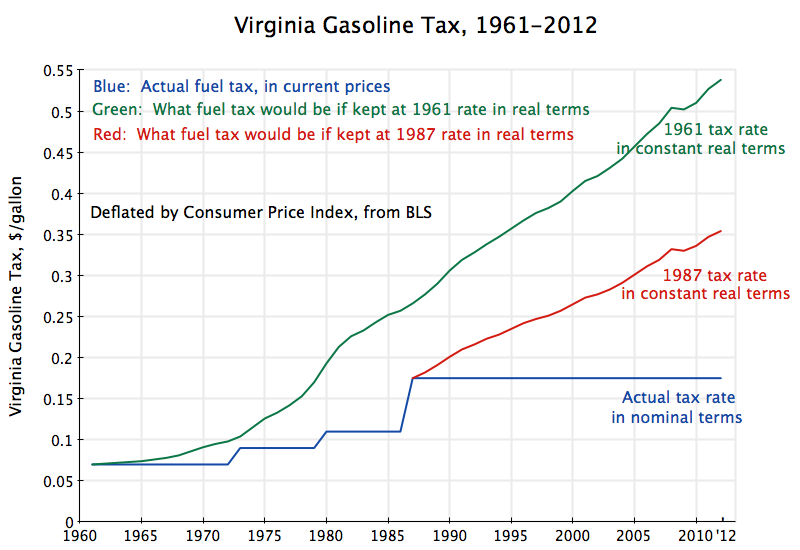
Virginia currently imposes a fuel tax of 17.5 cents per gallon for gasoline as well as diesel.  This rate has not changed since 1986 (taking effect in 1987).  The governor correctly points out that since it has not since been adjusted to reflect inflation, the 17.5 cents received today can buy only about 8 cents of what it could in 1986.  He also complains that since vehicles have become more fuel efficient, and since there are a small but growing number using alternative fuels such as ethanol, natural gas, and electricity, the state is receiving less through the fuel tax per mile driven than before.

These statements are true.  But there are obvious ways to address them instead of ending the gasoline tax altogether.  First, it is easy to index the fuel tax for inflation.  Every January 1 (or whatever anniversary date one wants to use) you adjust the rate to reflect inflation over the past year.  The adjustments each year would be small, but accumulate over time. With inflation currently running about 2% a year, a 17.5 cents per gallon fuel tax would rise to 17.85 cents, an increase of 0.35 cents – only about a third of a penny on gas that now costs $3 to $4 per gallon.

Second, one could charge similar taxes on vehicles powered by alternative fuels.  One could easily charge the same fuel tax rate for ethanol (just as one now charges the same 17.5 cents for both gasoline and diesel).  And one could work out the equivalent for natural gas and other fuels which are sold or will be sold at the equivalent of the pump for gasoline.

For electric power charging batteries it would be only slightly trickier.  Since one would normally charge the batteries at home from your household electricity supply, there is not the equivalent of a pump as the point where one could impose a tax to cover the costs of roads and highways.  But cars are inspected annually in Virginia.  At these annual inspections, one can check the mileage, see how many miles were driven in the past year, and then charge accordingly.  The amounts are not huge.  According to figures from the Federal Highway Administration, we on average drive 13,476 miles per year in the US, and the Energy Information Agency reports that the average fuel economy is 23.5 miles per gallon (as of 2010, the same as in 2009).  Dividing this out, the average driver burns 573 gallons per year, and with a tax at 17.5 cents per gallon, pays $100 in fuel taxes ($100.4 to be precise).  If the fuel tax were doubled to 35 cents, one would pay $200.  Such an amount (less if one has driven less, and more if one has driven more) could easily be charged at the time of the annual inspection.  And for plug-in hybrid vehicles, burning gas sometimes and using a battery charged at home other times, one could obtain a refund on your annual state income tax return for any fuel taxes paid at the pump (backed up by receipts).

None of this is impossible, and it need not be perfect.  And it is far better than charging drivers nothing at all for building and maintaining the roads they use.

Indexing the Fuel Tax for Inflation

The basic problem comes from not indexing the fuel taxes for inflation.  Virginia has imposed fuel taxes since 1923, and they have never, over this period, been as low as they are now in real terms.  In terms of today’s prices, they were at their highest in 1933 at what today would be 88 cents per gallon.  The nominal price then was 5 cents.  And it is absurd to argue that people today cannot afford 88 cents per gallon, when such a rate was possible in 1933 in the middle of the Great Depression.  People were far poorer then than they are now.

And no one is proposing a return to 88 cents per gallon for the state tax.  But it would not be unreasonable to return to the rate Virginia charged in 1961, or at least charged in 1987. The 1961 rate was 7 cents per gallon, and it generated sufficient revenues so that Virginia was widely seen at that time to have had one of the better road systems in the nation.  The 7 cents per gallon in 1961 would be a rate of about 54 cents today.  See the graph at the top of this post.  And again, if we could afford it in 1961 (and afford an even higher rate in real terms in 1933), it is absurd to say we cannot afford it today.

The graph also shows what the path would have been had Virginia, when it set the rate at 17.5 cents with effect from January 1, 1987, also then indexed the rate for inflation.  The rate would be a little over 35 cents per gallon today, or double the current rate.  This would also not be out of line with what other states charge.  North Carolina, on Virginia’s border, charges 37.8 cents per gallon, while New York charges 50.6 cents (the highest in the country).  The US average is 30.4 cents.  (To be precise and fair, to make these figures fully comparable one should also add a charge of 2.4 cents per gallon of fees for other purposes to what Virginia charges, in addition to the basic fuel tax.)

The governor’s detailed proposal provides estimates over the five years 2014 to 2018 of what the revenues would be under his proposals.  While losing the revenues generated by the fuel tax on gasoline, he would substitute by adding 0.8% points to the current 5.0% Virginia general sales tax, would keep the 17.5 cents tax on diesel fuel, and would take other measures (including shifts of funds out of education, health, and/or public safety; these areas account for 84% of Virginia’s non-transport budget so you would have to cut them; there is nothing else) to increase funds allocated to transportation.  Over the five years, funds for transport from the current fuel taxes on gasoline and diesel (if one were to keep them as now) would rise from $4.5 billion to a total of $7.7 billion, or an increase of $3.2 billion.

While the $7.7 billion total would be a good deal more than what is currently being funded for transport by the fuel taxes, many note that this would still be too low given the backlog of Virginia’s needs.  And in addition to being too low, it would shift the burden away from those who use the roads the most, onto the regressive sales tax which impacts the poor the most.

Alternatively, returning the fuel tax rate to what it was in 1987 in real terms, and even more so if it were returned to what it was in 1961 in real terms, would generate far more revenues.  Shifting to the 1987 rate and then indexing it for inflation, would generate revenues of $9.9 billion over the five years, an increase of $5.4 billion.  The governor is proposing an increase of only $3.2 billion.  Shifting to the 1961 rate and then indexing it for inflation, would generate revenues of $14.0 billion.  Such funding would permit a much more rapid rehabilitation of Virginia’s road infrastructure, and would be far fairer as those using the roads would pay for them in rough proportion to how much they use them.

Conclusion

In conclusion, there is no mystery as to why Virginia has been unable to invest in keeping up what was once a good road network:  It has allowed its source of funding for such investments to fall to the lowest it has been since first set in 1923.  But it would be straightforward to index the fuel tax to the rate of inflation, with a small annual adjustment which would not lead to this revenue source deteriorating over time.  Using fuel taxes to pay for roads is not only fair but is also efficient, as those who use the roads pay for them, and can decide whether and how much to drive based on facing the full cost of what they do.

In contrast, under Governor Bob McDonnell’s proposal:

  • The poor and the elderly and everyone else taking buses will pay more, while those driving Cadillacs will pay less;
  • The poor buying basic necessities will pay more, while the rich who like to drive out to a vacation or week-end home will pay less;
  • Those driving small and fuel efficient cars will pay more, while those driving gas guzzlers will pay less;
  • Those that decide to live close to where they work will pay more, while those who live in distant suburbs for a large house and lawn will pay less;
  • Those that car pool to work will pay more, while those driving alone each day will pay less;
  • Those that drive small and light cars which do not tear up the roads will pay more, while those that drive heavy vehicles which damage the roads disproportionately will pay less;
  • Virginians will pay more, while out-of-state drivers coming through the state and needing to buy gas will pay less;
  • Those driving alternative fuel vehicles will pay more, while those driving traditional gasoline fueled cars will pay less;
  • Those who purchase goods by catalog or over the internet and have them delivered by regular mail will pay more, while those who make frequent shopping trips by car will pay less;
  • And those that take care in not driving too much, adding to congestion and pollution, will pay more, while those who cannot be bothered will pay less.

Impact of the New Tax Provisions: The Poor and Middle Classes Account for Most of the New Revenues

Tax Policy Center - Net Impact of Jan 1, 2013, Tax Law

The discussion on the new tax law, passed by the Senate late on December 31 and by the House late on January 1, focussed on whether income tax rates should have been allowed to revert to what they were during the Clinton years for the well off (incomes over $250,000), the rich (incomes over $450,000), or the extremely rich (incomes over $1,000,000).  The final law, which Obama said he will sign, sets the break at $450,000.

But there is much more in the new law as well.  Many of its provisions will affect the poor and middle classes, so the federal taxes they will pay will also go up in 2013.  Especially important will be the end to the 2% point reduction in the payroll tax rate, which has been in effect since the start of 2011.  These impacts have been less discussed, but in the aggregate they will account for substantially more of the revenues that will be generated than the impact of the reversion to previous income tax rates on incomes over $450,000.

The non-partisan Tax Policy Center has estimated what the impacts will be by household income level of the new law.  The analysis uses their microsimulation model.  The model is based on data from a large sample of actual tax returns, to determine what the different income sources are by category of household.  Hence it can determine with some accuracy the impact of changes in the tax code.

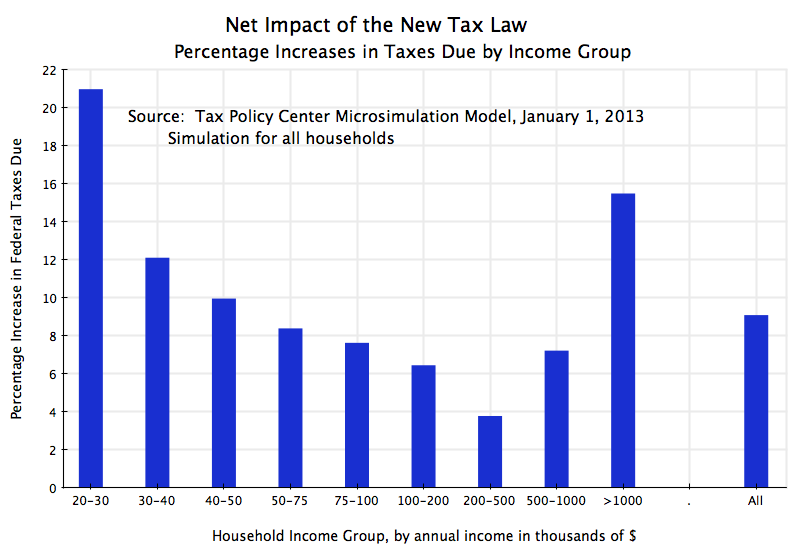
The graph above shows how much average taxes would rise in 2013 in percentage terms under the new law, for households classified by income category.  The Tax Policy Center also included two lower income groups (income of less than $10,000 per year, and income of $10,000 to $20,000 per year), but I have left these off of the graph.  Such very low levels of taxable income will be dominated by special groups, such as students with summer jobs, and may not be representative of actual households.  The official government poverty line for a family of four in 2012 was $23,050.  The taxes due are also quite small on average as one is averaging in many with a zero tax liability.  As a result, the percentage changes can be huge.  For those interested, the percentage increases that will result from the new tax law was 73% and 151% for the two groups, respectively.  But it is not clear that these figures are meaningful.

But the pattern seen among the other groups is significant, and interesting.  Those in the lowest income categories will see the largest percentage increases in their taxes due (by 21% for those earning between $20,000 and $30,000), with this then steadily declining to just a 3.8% increase for those earning between $200,000 and $500,000.  This then rises to an increase of 7.2% for those earning between $500,000 and $1,000,000, and to an increase of 15.5% for those earning over $1,000,000.

This is not terribly progressive.  Under a progressive scale, the percentage change would have been smallest for the poorest, and then rise steadily as one goes up the income scale to the richest.  But here one has the steepest increases for the poorest, with this declining steadily until one reaches an annual income of $500,000.  Only then does it start to rise.  And the percentage increase for those earning between $500,000 and $1,000,000 is less than the increase for those earning anything up to $100,000.  The percentage increase for those earning over $1,000,000 is less than the increase for those earning less than $30,000.

The reason for this is largely the impact of ending the 2% point reduction in the payroll tax. This had been introduced with effect from January 1, 2011, on the initiative of President Obama, as a mechanism to help especially the poor, as well as an economic incentive to businesses to hire more workers rather than use more machines (by reducing the relative cost of labor).  It would also have an especially strong stimulative effect, as the tax cut would be focused on relatively lower income workers who would likely spend most of the extra income, thus generating demand.  And while the 2% point reduction in the payroll tax was always viewed as temporary, some would question whether it is best to end it now, as opposed to next year or the year after.

The payroll tax is used to finance Social Security.  While the 2% point reduction was in effect, the US Treasury transferred an equal amount to the Social Security Trust Fund.  The amounts transferred were $103 billion in 2011 and an estimated $112 billion in 2012.  Projecting this forward, the amount needed would have been about $120 billion in 2013.  The figures underlying the graph above from the Tax Policy Center estimate that the aggregate increase in tax revenues in 2013 across all income groups (relative to what they would have been had 2012 law been extended into 2013) would have been about $200 billion ($199 billion to be more precise).  That is, the end of the 2% point reduction in the payroll tax accounts for 60% ($120 billion of the $200 billion) of the increase in revenues.  All the other changes, including the increase in the tax rates for those earning over $450,000, the phasing out of deductions and exemptions for households with incomes over $250,000, the increase in the capital gains tax rate to 20% from 15% for those earning over $450,000, and the other changes, only account for 40%.

Consistent with this, the Tax Policy Center figures indicate that 57% of the extra revenues generated will come from households of income $500,000 or less (they do not have a break point at $450,000).  Indeed, 33% comes from households of income of $100,000 or less.  Only 43% will come from households of income above $500,000.

The debate on this new tax law has centered on how much the rich should pay in taxes.  But the final law, as passed, is far from focussed only on taxes the rich.  The steepest increases will be borne by the poor, and the poor and middle classes will account for most of the revenues that will be raised.