The Impact of Austerity Policies on Unemployment: The Contrast Between the Eurozone and the US

Unemployment Rates - Eurozone and US, Jan 2006 to Oct 2014

A recent post on this blog looked at the disappointing growth in the Eurozone since early 2011, when Europe shifted to austerity policies from its previous focus on recovery from the 2008 economic and financial collapse.  There has indeed been no growth at all in the Eurozone in the three and a half years since that policy shift, with GDP at first falling by about 1 1/2% (leading to a double-dip recession) and then recovering by only that same amount thus far.  The recovery has been exceedingly slow, and prospects remain poor.

The consequences of the shift to austerity can be seen even more clearly in the unemployment figures.  See the chart above (the data comes from Eurostat).  Unemployment in Europe rose sharply starting in early 2008 and into early 2009.  But it then started to level off in late 2009 and early 2010 following the stimulus programs and aggressive central bank programs launched in late 2008.  Unemployment in the US followed a similar path during this period, and for similar reasons.

But the paths then diverged.  After peaking in early 2010 at about 10% and then starting to come down, the unemployment rate in the Eurozone switched directions and started to rise again in mid-2011.  It reached 12.0% in early 2013 and has since come down slowly and only modestly to a still high 11.5% currently.  In the US, in contrast, the unemployment rate reached a peak of 10.0% in October 2009, and has since fallen more or less steadily (with bumps along the way) to the current 5.8% (as of October 2014).  It has been a slow recovery, but at least it has been a recovery.

This divergence began in 2010, as Europe shifted from its previous expansionary stance to austerity.  Influential Europeans, in particular German officials and Jean-Claude Trichet (then the head of the European Central Bank) argued that not only was austerity needed, but that austerity would be expansionary rather than contractionary.  We now see that that was certainly not the case:  GDP fell and unemployment rose.

The most clear mark of that shift in policy can be found in the actions of the European Central Bank.  ECB interest rates had been kept at a low 0.25% for its Deposit Facility rate (one of its main policy rates) for two years until April 2011.  The ECB then raised the rate to 0.50% on April 13, and to 0.75% on July 13, 2011.  But European growth was already faltering (for a variety of reasons), and it was soon recognized by most that the hike in ECB interest rates had been a major mistake.  Trichet left office at the end on his term on November 1, replaced by Mario Draghi.  On November 9 the ECB Board approved a reversal.  The Deposit Facility rate was cut to 0.50% that day, to 0.25% a month later on December 11, and to 0.00% on July 11, 2012.

Fiscal policy had also been modestly expansionary up to 2010, as monetary policy had been up to that point, but then went into reverse.  Unfortunately, and unlike the quick recognition that raising central bank interest rates had been a mistake, fiscal expenditures have continued to be cut since mid-2010.

Germany in particular called for cuts in fiscal spending for the members of the Eurozone, and forced through a significantly stricter set of rules for fiscal deficits and public debt to GDP ratios for Eurozone members.  Discussions began in 2010, amendments to the existing “Stability and Growth Pact” were approved on March 11, 2011, and a formal new treaty among Eurozone members was signed on March 2, 2012.  The new treaty (commonly referred to as the Fiscal Compact) mandated a balanced budget in structural terms (defined as not exceeding 0.5% of GDP when the economy was close to full employment, with a separate requirement of the deficit never exceeding 3% of GDP no matter how depressed the economy might be).  Financial penalties would be imposed on countries not meeting the requirements.

The result was cuts to fiscal expenditures:

Govt Expenditures, Real Terms - Eurozone and US, 2006Q1 to 2014 Q2 or Q3

Government fiscal expenditures in the Eurozone had been growing in real terms in line with real GDP up to 2008, at around 2 to 3% a year.  With the onset of the crisis, fiscal expenditures at first grew to counter the fall GDP.  But instead of then allowing fiscal expenditures to continue to grow even at historical rates, much less the higher rates that would have been warranted to offset the fall in private demand during the crisis, fiscal expenditures peaked in mid-2010 and were then cut back.  By 2014 they were on the order of 14 to 15% below where they would have been had they been allowed to keep to their historical path.  This has suppressed demand and therefore output.

The path of US real government expenditures is also shown on the graph.  Note that government expenditures here include all levels of government (federal, state, and local), and include all government expenditures including transfers (such as for Social Security).  Government expenditures for the Eurozone are defined similarly.  The US data comes from the BEA, while the Eurozone data comes from Eurostat.

Government expenditures in the US also peaked in 2010, as they had in the Eurozone, and then fell.  This has been discussed in previous posts on this blog.  But while US government expenditures fell after 2010, they had grown by relatively more in the period leading up to 2010 than they had in the Eurozone, and then fell by relatively less.  They have now in 2014 started to pick up, mostly as a consequence of the budget deal reached last year between Congress and President Obama.  State and local government expenditures, which had been severely cut back before, have also now stabilized and started to grow as tax revenues have begun to recover from the downturn.  And in part as a result, recent GDP growth in the US has been good, with real GDP growing by 4.6% in the second quarter of 2014 and by 3.9% in the third quarter.

The fiscal path followed in the US could have been better.  An earlier post on this blog calculated that GDP would have returned to its full employment level by 2013 if government spending had been allowed to grow merely at its historical rate.  And the US could have returned to full employment by late 2011 or early 2012 if government spending had been allowed to grow at the more rapid rate that it had under Reagan.

But with the fiscal cuts, unemployment has come down only slowly in the US.  The recovery has been the slowest of any in the US for at least 40 years, and fiscal drag by itself can account for it.  But at least unemployment has come down in the US, in contrast to the path seen in Europe.
An Update on the Impact of the Austerity Programs in Europe and a Higher Tax on Consumption in Japan: Still No Growth


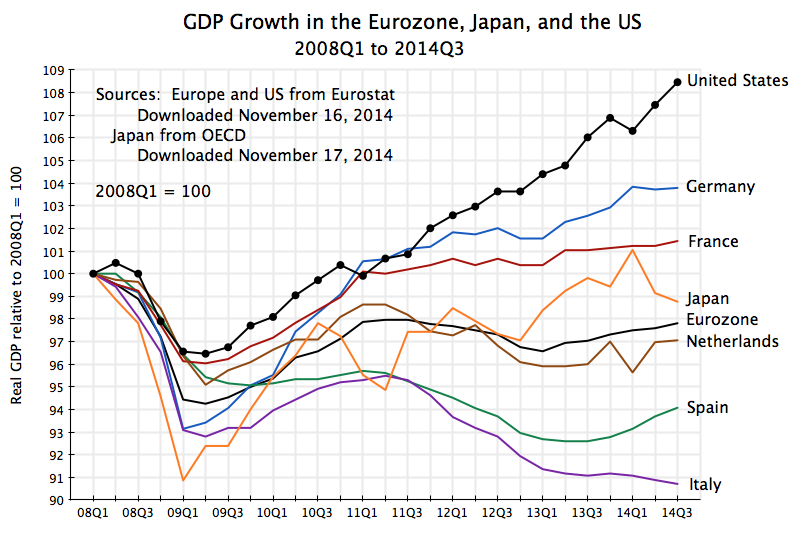
GDP Growth in Eurozone, Japan, and US, 2008Q1 to 2014Q3

A.  Introduction

With the release last Friday by Eurostat of the initial GDP growth estimates for most of Europe for the third quarter of 2014, and the release on Monday of the initial estimate for Japan, it is a good time to provide an update on how successful austerity strategies have been.

B.  Europe

As was discussed in earlier posts in this blog on Europe (here and here), Europe moved from expansionary fiscal policies in its initial response to the 2008 downturn, to austerity programs with fiscal cutbacks starting in 2010/11.  The initial expansionary policies did succeed in stopping the sharp downturn in output that followed the financial collapse of 2008/2009.  European economies began to grow again in mid-2009, and by late 2010 had recovered approximately two-thirds of the output that had been lost in the downturn.

But then a number of European leaders, and in particular the leaders of Germany (Chancellor Angela Merkel and others) plus the then-leader of the European Central Bank (Jean-Claude Trichet), called for fiscal cuts.  They expressed alarm over the fiscal deficits that had developed in the downturn, and argued that financial instability would result if they were not quickly addressed.  And they asserted that austerity policies would not be contractionary under those circumstances but rather expansionary.  Trichet, for example, said in a June 2010 interview with La Repubblica (the largest circulation newspaper in Italy):

Trichet:  … As regards the economy, the idea that austerity measures could trigger stagnation is incorrect.

La Republicca:  Incorrect?

Trichet:  Yes. In fact, in these circumstances, everything that helps to increase the confidence of households, firms and investors in the sustainability of public finances is good for the consolidation of growth and job creation.  I firmly believe that in the current circumstances confidence-inspiring policies will foster and not hamper economic recovery, because confidence is the key factor today.

So what has actually happened since the austerity programs were imposed in Europe?  The chart at the top of this post shows the path of real GDP for the larger Eurozone economies as well as for the Eurozone as a whole, plus Japan and the US for comparison.  The data for Europe (as well as the US) comes from Eurostat, with figures for 2014Q3 from the November 14 Eurostat press release, while the data for Japan came most conveniently from the OECD.  Real GDP is shown relative to where it was in the first quarter of 2008, which was the peak for most of Europe before the 2008/09 collapse.

In a word, the results in Europe have been terrible.  Real GDP in the Eurozone as a whole is basically the same as (in fact slightly less than) what it was in early 2011, three and a half years ago.  To be more precise, real GDP in the Eurozone fell by a bit more than 1% between early 2011 and early 2013, and since then rose by a bit over 1%, but it has basically been dead.  There has been no growth in the three and a half years since austerity programs took over.  And Eurozone output is still more than 2% below where it had been in early 2008, six and a half years ago.

Since early 2011, in contrast, the US economy grew by 8.6% in real terms.  Annualized, this comes to 2.4% a year.  While not great (fiscal drag has been a problem in the US as well), and not sufficient for a recovery from a downturn, the US result was at least far better than the zero growth in the Eurozone.

There was, not surprisingly, a good deal of variation across the European economies.  The chart shows the growth results for several of the larger economies in the Eurozone.  Germany has done best, but its growth flattened out as well since early 2011.  As was discussed in an earlier post, Germany (despite its rhetoric) in fact followed fairly expansionary fiscal policies in 2009, with further increases in 2010 and 2011 (when others, including the US, started to cut back).  And as the chart above shows, the recovery in Germany was fairly solid in 2009 and 2010, with this continuing into 2011.  But it then slowed.  Growth since early 2011 has averaged only 0.9% a year.

Other countries have done worse.  There has been very little growth in France since early 2011, and declines in the Netherlands, Spain, and Italy.  Spain was forced (as a condition of European aid) to implement a very tight austerity program following the collapse of its banking system in 2008/09 as a consequence of its own housing bubble, but has loosened this in the last year.  Only in France is real GDP higher now than where it was in early 2008, and only by 1.4% total over those six and a half years.  But France has also seen almost no growth (just 0.4% a year) since early 2011.

C.  Japan

The new figures for Japan were also bad, and many would say horrible.  After falling at a 7.3% annualized rate in the second quarter of this year, real GDP is estimated to have fallen by a further 1.6% rate in the third quarter.  The primary cause for these falls was the decision to go ahead with a planned increase in the consumption tax rate on April 1 (the start of the second quarter) from the previous 5% to a new 8% rate, an increase of 60%.

The Japanese consumption tax is often referred to in the US as a sales tax, but it is actually more like a value added tax (such as is common in Europe).  It is a tax on sales of goods and services to final consumers such as households, with offsets being provided for such taxes paid at earlier stages in production (which makes it more like a value-added tax).  As a tax on consumption, it is the worst possible tax Japan could have chosen to increase at this time, when the economy remains weak.  There is insufficient demand, and this is a straight tax on consumption demand.  It is also regressive, as poor and middle class households will pay a higher share of their incomes on such a tax, than will a richer household.  With its still weak economy, Japan should not now be increasing any such taxes, and increasing the tax on consumption is the worst one they could have chosen.

With recessions conventionally defined as declines in real GDP in two consecutive quarters, Japan is now suffering its fourth recessionary contraction (a “quadruple-dip” recession) since 2008.  This may be unprecedented.  Japan’s output is still a bit better, relative to early 2008, than it is for the Eurozone as a whole, but it has been much more volatile.

Prime Minister Shinzo Abe was elected in December 2012 and almost immediately announced a bold program to end deflation and get the economy growing again.  It was quickly dubbed “Abenomics”, and was built on three pillars (or “arrows” as Abe described it).  The first was a much more aggressive monetary policy by the Central Bank, with use of “quantitative easing” (such as the US had followed) where central bank funds are used to purchase long term bonds, and hence increase liquidity in the market.  The second arrow was further short-term fiscal stimulus.  And the third arrow was structural reforms.

In practice, however, the impacts have been mixed.  Expansionary monetary policy has been perhaps most seriously implemented, and it has succeeded in devaluing the exchange rate from what had been extremely appreciated levels.  This helped exporters, and the stock market also boomed for a period.  The Nikkei stock market average is now almost double where it was in early November 2012 (when it was already clear to most that Abe would win in a landslide, which he then did).  But the impact of such monetary policy on output can only be limited when interest rates are already close to zero, as they have been in Japan for some time.

The second “arrow” of fiscal stimulus centered on a package of measures announced and then approved by the Japanese Diet in January 2013.  But when looked at more closely, it was more limited than the headline figures suggest.  In gross terms, the headline expenditure figure amounted to a bit less than 2% of one year’s GDP, but the spending would be spread over more than one year.  It also included expenditures which were already planned.  It therefore needs to be looked at in the context of overall fiscal measures, including the then planned and ultimately implemented decision to raise the consumption tax rate on April 1, 2014.  The IMF, in its October 2013 World Economic Outlook, estimated that the net impact of all the fiscal measures (including not only the announced stimulus programs, but also the tax hike and all other fiscal measures) would be a neutral fiscal stance in 2013 (neither tightening nor loosening) and a tightening in the fiscal stance of 2.5% of GDP in 2014.  The fall in GDP this year should therefore not be a surprise.

Finally, very little has been done on Abe’s third “arrow” of structural reforms.

On balance, Abe’s program supported reasonably good growth of 2.4% for real GDP in 2013 (see the chart above).  There was then a spike up in the first quarter of 2014.  However, this was largely due to consumers pulling forward into the first quarter significant purchases (such as of cars) from the second quarter, due to the planned April 1 consumption tax hike.  Some fall in the second quarter was then not seen as a surprise, but the fall turned out to be a good deal sharper than anticipated.  And the further fall in the third quarter was a shock.

As a result of these developments, Abe has announced that he will dissolve the Diet, hold new elections in mid-December with the aim of renewing his mandate (he is expected to win easily, due to disorder in the opposition), and will postpone the planned next increase in the consumption tax (from its current 8% to a 10% rate) from the scheduled October 2015 date to April 2017.  Whether the economy will be strong enough to take this further increase in a tax on consumption by that date remains to be seen.  The government has no announced plans to reverse the increase of 5% to 8% last April.

Japan’s public debt is high, at 243% of GDP in gross terms as of the end of 2013.  Net debt is a good deal lower at 134% (debt figures from IMF WEO, October 2014), but still high.  The comparable net debt figure for the US was 80% at the end of 2013 (using the IMF definitions for comparability; note this covers all levels of government, not just federal).  Japan will eventually need to raise taxes.  But when it does, with an economy just then emerging from a recession due to inadequate demand, one should not raise a tax on consumption.  A hike in income tax rates, particularly on those of higher income, would be far less of a drag on the economy.

The Continued Fall in Government Spending Under Obama

Govt Spending on Goods & Services by Presidential Term, Quarterly

A.  Introduction

Government spending continues to fall under Obama.  As this blog has noted in earlier posts, the fiscal drag from this reduction in demand for the goods and services that unemployed workers could have been producing can fully explain why the recovery from the 2008 has been so slow.  As another blog post noted, if government spending had merely been allowed to grow under Obama at the same pace as it had historically, the economy would by now be back at full employment.  The public debt to GDP ratio would also be lower, as GDP would be higher.  And if government spending had been allowed to grow as it had under Reagan, we would likely have returned to full employment by 2011.

Fiscal drag is therefore important.  Yet it is still not yet commonly recognized that government spending has been falling in real absolute terms for the last several years (and even more so when measured as a share of GDP).  Earlier blog posts have reviewed this.  The trends have unfortunately continued and indeed strengthened over the last year.  Whether this will now change with government spending finally leveling off, and perhaps even start to recover, remains to be seen.  The budget compromise for fiscal years 2014 and 2015 reached by Senator Patty Murray and Congressman Paul Ryan in December, and passed by Congress in January, will reverse part of the impact of the budget sequester.  According to calculations by the Committee for a Responsible Federal Budget (fiscal hawks in favor of budget cuts), the agreement for FY2014 will lead to a small (1.8%) rise in nominal terms in budget authority compared to the FY2013 post-sequester levels.  This would still be flat to negative in real terms, based on inflation of about 2%.  And the FY2014 sum would still represent a 3.7% fall compared to what the FY2013 pre-sequester levels would have been.

Possibly more important would be government spending at the state and local level.  This was cut back as a result of the 2008 collapse and slow recovery, due to lower revenues and the requirement in many states and localities of a balanced budget.  While expenditures were still falling in 2013, revenues have started to grow (due to the positive, though still slow, recovery of GDP) and state and local budgets as a result can now start to recover as well.  But it also remains to be seen if that will happen.

This blog post will update the government spending figures during the Obama term through the fifth year of his administration.  And it will present the figures from a different perspective than before, by tracing the paths during the course of each presidential term (going back to Carter’s) relative to what the spending was at the start of their respective presidencies.

[Note that all the government spending figures used in this post will be in real, inflation-adjusted, terms.]

B.  Government Spending on Consumption and Investment

The graph at the top of this post shows the tracks of real government spending on consumption and investment during each presidential term going back to Carter, as a ratio to what it was at the start of their terms.  The base period is always taken as the last quarter before their inauguration (i.e. in the fourth quarter of the calendar year preceding their January 20 inauguration).  The data is computed from the figures in the standard National Income and Product Accounts (NIPA accounts, also commonly referred to as the GDP accounts) of the Bureau of Economic Analysis (BEA) of the US Department of Commerce, and are seasonally adjusted.  Note that all levels of government are included here – federal, state, and local.  We will examine below spending at the federal level only, as well as spending including transfer payments.

This government spending has fallen by 5 1/2% in real terms by the end of the fifth year (the 20th quarter) of Obama’s term in office.  It rose by 2 1/2% during Obama’s first year, which one might note is similar to the increases seen by that point under Carter, Reagan, and Bush I, and with a significantly greater increase by that point under Bush II.  Spending during Obama’s term has since been falling steadily, leading to the fiscal drag referred to above, to a point where it is now 8% lower in real terms than it was in his first year, or a net 5 1/2% fall from when he took office.

There has been no such fall in government spending under any other presidential term since Carter.  The closest was spending during the Clinton period, but there was still a 3% rise by the end of his fifth year in office.  The increases by the end of the fourth year under Carter and Bush I (single term presidencies) were 8% and 6 1/2% respectively.  And the increases by the end of the fifth year in office were 13% during the term of Bush II, and by a full 21% in real terms under Reagan.  Government spending also continued to grow under Bush II and Reagan, reaching increases of 21% and 33% respectively by the end of their eight years in office.

Yet Reagan and Bush II are seen as small government conservatives, while Obama is deemed by conservatives to be a big spending liberal.  The facts simply do not support this.

C.  Government Spending Including Transfers

Government spending for the direct purchase of goods and services (used for consumption or investment), reviewed above, is a direct component of GDP demand.  When there are substantial unemployed resources (as now), such government spending will have a significant positive impact in spurring economic expansion.  As was discussed in an Econ 101 post on this blog, under such circumstances the fiscal multiplier will be positive and high.  Hence the fiscal drag from the cut-back in government spending during Obama’s term in office has kept the recovery below what it would have been.

But there is also government spending on transfers to households (such as for Social Security, food stamps, or unemployment insurance).  Such transfers are ultimately spent by households for their consumption of goods and services (or will in part be saved, including through the pay-down of debt such as mortgage debt).  It will enter into GDP demand by way of the spending of households for consumption, and the impact on GDP will depend on the behavior of households in deciding what share of those transfers they will spend or save.

Such spending rose more sharply during Obama’s first year in office, as he faced an economy in free fall as he was taking his inaugural oath:

Govt Spending, Total incl Transfers, by Presidential Term, Quarterly

The economy was losing 800,000 jobs per month at that time, pushing the unemployment roles up rapidly and plunging the incomes of many in the population to levels where they qualified for food stamps.  Government spending including transfers therefore rose by almost 9% by the third quarter of 2009, and reached a peak of 9.8% in the third quarter of 2010.  Since then, however, total government spending including transfers has been modestly falling, and is now 7 1/2% above where it was when Obama took office.

[Note all figures are in real terms.  The personal consumption expenditures deflator in the NIPA accounts was used to adjust transfer payments for inflation.]

Only during the Clinton period did one see a modestly smaller increase, of about 6 1/2%.  But there was a 16 1/2% increase in such spending at the same point in the term of Bush II, and an increase of over 22% under Reagan.  It was also higher by the end of their fourth years in office for both Carter and Bush I.

The differences are not small.

D.  Federal Government Spending on Consumption and Investment

What matters to the economy when demand is inadequate and unemployment is high is spending at all levels of government.  Yet while we commonly blame the president in office for the performance of the economy, they at best can only influence the federal budget (and influence it only partially, as Congress decides on the budget).  Hence it may be of interest also to examine the paths of only federal government spending.

Such federal spending on direct consumption and investment at first rose during the Obama term, reaching a peak 8% increase in the third quarter of his second year in office.  It then fell sharply, to a point where it is now 5 1/2% below where it was when Obama took office:

Federal Govt Spending on Goods & Services by Presidential Term, Quarterly

The initial increase in federal spending was in part due to the stimulus package that served to restart the economy (GDP was falling from 2008 through the first half of 2009; it then began to recover).  Note that while federal spending rose by 8% by the third quarter of 2010, overall government spending (including state and local) rose only by 2 1/2% at that point.  State and local government was cutting back, as they were forced to do by the balanced budget requirements of many of them, so federal spending and the stimulus it could provide was partially being offset by their cut-backs.

But after this initial increase in the first two years of the Obama presidency, federal spending has been cut substantially, to the point where it is now 5 1/2% below in real absolute terms where it was when Obama took office.  Federal spending also fell during the Clinton term, by 11% at the same point in his term.  In contrast, federal spending rose sharply under Bush II (by 27% at the same point) and especially under Reagan (by over 31%).

E.  Federal Government Spending Including Transfers

Finally, federal government spending including transfers:

Fed Govt Spending, Total incl Transfers, Quarterly

[Technical Note:  Federal government transfers in the NIPA accounts include transfers to individuals as well as transfers to the states or localities for all purposes, including road construction, for example.  Such intra-government transfers are netted out in the accounts when government as a whole – federal, state, and local – is examined, so that remaining government transfers are then solely transfers to individuals, such as for Social Security.]

Such spending is now lower under Obama than under any of the presidencies examined, including Clinton.  Federal spending including transfers rose to a peak in 2010 of 10% above where it was when Obama took office, but has since declined to just 1% above that level.  It was 4% higher at that point in Clinton’s term, 23% higher at the point in the term of Bush II, and 25 1/2% higher at that point in the term of Reagan.

F.  Conclusion

Republicans in Congress and conservatives generally continue to criticize Obama as being responsible for runaway government spending.  But after an initial modest increase in the first two years of his term, as he sought to stop the economic free fall he inherited on taking office (and succeeded), government spending has come down under any measure one takes.  The resulting fiscal drag has held back the economy, leading to an only slow recovery.  And the fiscal drag during Obama’s term in office is in sharp contrast to the large increases in government spending observed during the terms of George W. Bush and especially Ronald Reagan. Yet they have been viewed as small government conservatives.