| Ryan Budget Plan |
Actual |
Projected |
Change from 2011 |
| % of GDP |
2011 |
2023 |
2030 |
2023-2011 |
2030-2011 |
| Total Spending excluding Interest |
22.50 |
17.25 |
17.50 |
-5.25 |
-5.00 |
| A. Medicare |
3.25 |
3.50 |
4.25 |
0.25 |
1.00 |
| B. Medicaid & CHIP |
2.00 |
1.25 |
1.25 |
-0.75 |
-0.75 |
| C. Social Security |
4.75 |
5.50 |
6.00 |
0.75 |
1.25 |
| D. All Other |
12.50 |
6.75 |
5.75 |
-5.75 |
-6.75 |
| 1) Defense including VA |
5.75 |
4.50 |
4.50 |
-1.25 |
-1.25 |
| 2) Rest of Govt (calculated) |
6.75 |
2.25 |
1.25 |
-4.50 |
-5.50 |
| Sources: For Defense spending line: CBO March 2012 “Updated Budget Projections”. Assumes constant Defense (including VA) spending in real terms to 2023, with no sequestration. The Ryan Plan calls for more, but it is not clear how much more, so this is a minimum. Assumes constant share of GDP after that. |
| For all other lines: CBO March 2012 evaluation of Ryan Budget proposal. The CBO numbers are presented to the nearest quarter of a percentage point of GDP, and is shown here in decimals simply for clarity. Note: Totals may not add due to round-off in the CBO figures. |
With Mitt Romney’s choice of Congressman Paul Ryan as his vice-presidential running mate, the policy positions that Ryan has taken over the years have become of more interest. As Chairman of the House Budget Committee, Ryan is particularly well known for the plans he put forward each spring for the federal budget. Even ostensibly neutral news reporters have praised these plans as serious proposals to remedy America’s fiscal ills, noting that while one might not agree with certain of the specifics, the plans at least set forth a serious and internally consistent set of proposals to bring down the deficits.
Superficially, the plans might convey such an appearance. But as soon as one starts to dig into the numbers, one finds major issues. The Ryan Plan does not really reduce the deficit compared to a scenario where the Bush Tax Cuts are allowed to expire, but rather slashes spending in order to bring down the deficit to what it would be without the Bush tax cuts. Ryan then goes further by proposing even higher tax cuts on top of this. Defense spending would be increased; there are specific proposals to cap spending on Medicare and on Medicaid; and Social Security (in the 2012 proposal) is left as is. Everything else government spends funds on, from assistance to the poor, to NASA, to border security, and to the Judiciary, would be drastically slashed. Ryan does not present detail on which programs would be cut the most, but only some vague commentary, but these programs as a whole would be slashed by at least two-thirds by 2023 (as a share of GDP), by over 80% by 2030, and by essentially 100% by 2040. After that, there would have to be negative spending on such programs for Ryan’s budget to add up. This is simply not serious.
The rest of this blog post will document and discuss these points, and others. A note on sources: The Ryan Budget Plan is as presented in his budget document of March 2012. The CBO at that time presented its own analysis of the budgetary implications of the Ryan Budget Plan, as is standard and as was requested by Ryan. For other CBO estimates, I have taken figures from the CBO projections of March 2012, to coincide in time with when the Ryan Plan (and the CBO analysis of it) came out. The CBO has updated its standard projections since then, but the changes have not been significant, in particular for the numbers a decade out or more. For consistency and to see where the differences are, it is therefore best to use the March CBO numbers when making comparisons to those that would result from the Ryan proposals.
The main points are:
1) The budget deficit under the Ryan Plan is not significantly lower than it would be compared to simply allowing the Bush Tax Cuts to expire.
Ryan presents his Budget Plan as perhaps unfortunately tough on many, but nonetheless critically necessary in order to keep the government debt from exploding. He starts his presentation with scary figures, showing an ever rising government debt to absurd levels if the “current path” is followed. He asserts his plan is necessary to bring this under control.
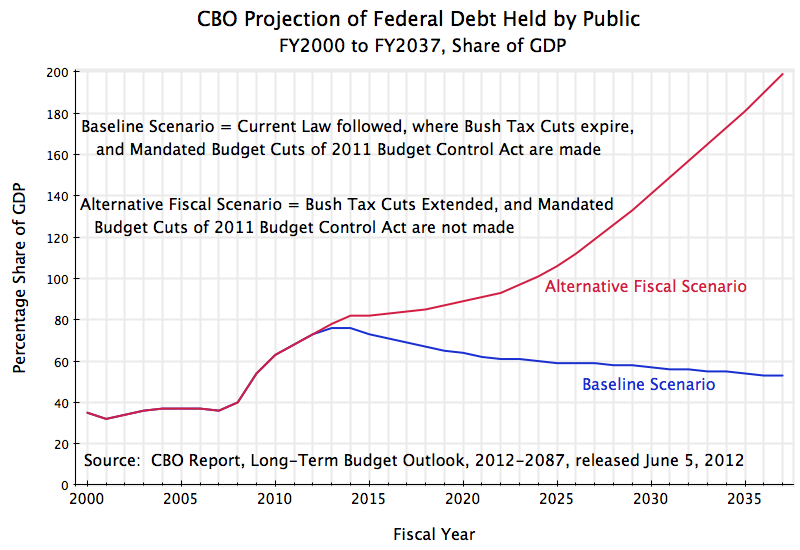
But what Ryan does not show is the path that would be followed if the Bush tax cuts are allowed to expire. The Bush tax cuts were never permanent, but rather have always been scheduled to end. The CBO presents such a path in their “Baseline” and “Extended Baseline” scenarios. The federal deficit under the Ryan Plan would be 1 1/4 % of GDP in 2023, while under the CBO Extended Baseline Scenario it would be 1 3/4% of GDP. Both of these numbers are modest, and the difference is well within the forecasting error one would expect for a figure eleven years in the future. It should be noted that the CBO Extended Baseline scenario also includes some federal spending cuts relative to what they would be under current policy, but these cuts are not nearly as drastic as the cuts under the Ryan Plan, plus they are relatively small (accounting for only one-fifth to one-quarter of the impact of allowing the Bush tax cuts to expire).
The Bush tax cuts are currently scheduled to expire on December 31, 2012, and I would certainly not advocate allowing them to expire abruptly on that date. Unemployment is still high due to a lack of demand for what the economy could produce, and in a pure Keynesian fashion higher taxes on consumers for a given level of government expenditure will be depressive. Rather, the tax cuts should be phased out over a period of a few years (and start with phasing out the beneficial rates for the very rich, as Obama has proposed). The long term benefits of deficit reduction would still come through, but taxes on those whose consumption would be impacted would not increase while unemployment is high.
It is therefore simply not true that the Ryan Budget Plan is necessary to bring down the federal deficit to sustainable levels. The CBO shows that under current law, which provides that the Bush tax cuts would be allowed to expire, the deficit would come down similarly over the next decade. This point was made in an earlier posting on this blog on the CBO projections that were issued in June (see here), and in an analysis focused more specifically on just the Bush tax cuts from last February (in this post).
2) The deficit does not fall significantly despite a drastic slashing of much of government spending, since Ryan would not only make the Bush tax cuts permanent, but would cut taxes even further by a similar amount.
Extending the Bush tax cuts would cut tax revenues by 2 3/4% of GDP in 2023, by 4% of GDP in 2030, and by more later according to the CBO projections. (This can be worked out from the difference in revenues between the CBO Baseline Scenario and its Alternative Fiscal Scenario, where both are presented in the CBO analysis of the Ryan Plan.) The very long term scenarios should not be taken too seriously as so much will certainly change by then, but they give an indication of the trends implied by the scenarios. Ryan would then add further tax cuts on top of the Bush tax cuts, reducing the top marginal tax rate to 25% and reducing the progressivity in the tax system by consolidating all taxes into just two brackets of 10% and 25%. He would also cut the top tax rate on corporate profits to 25% from the current 35%.
The additional tax cuts proposed by Ryan would cut federal tax revenue by a further 3% of GDP by 2023 if nothing additional is done (based on an analysis of the Ryan Plan by the non-partisan Tax Policy Center, and comparing their results to the CBO Baseline Scenario). This is similar in magnitude to the losses in tax revenues resulting from the Bush tax cuts.
3) Ryan does, however, propose to offset the additional 3% of GDP of revenue losses resulting from his additional tax cuts, by reducing or eliminating certain (but unspecified) tax deductions or tax preference items. But it is impossible to do this without leading to higher taxes on the poor and middle classes, to offset the tax cuts going to the very rich.
Ryan asserts he would fully pay for his additional tax cuts, making this part of the plan revenue neutral, by eliminating or reducing certain tax deductions and tax preference items. But he refuses to say which deductions and other preferences would be reduced or eliminated. He does say that the highly preferential tax rate on capital gains and dividends of just 15% would not be raised (and in his 2010 budget plan he would have brought this rate all the way down to zero). This preferential tax rate on income received from wealth of course benefits the wealthy the most.
Especially with the wealthy able to continue to enjoy the benefits of this preferential tax rate on capital gains and dividends, it is impossible to make such a tax plan revenue neutral without raising taxes on the majority of Americans. The non-partisan Tax Policy Center did an analysis of the implications in the broadly similar Romney tax plan. While there are differences in the detail between Romney and Ryan, both would cut marginal tax rates sharply, especially for the rich, and both assert they would then reduce or eliminate certain deductions and other tax preferences (but not the capital gains tax preference) to raise sufficient revenue to make it overall revenue neutral. And both keep secret which deductions or other tax preferences they would reduce or eliminate. The Tax Policy Center therefore took the most extreme case possible, by assuming that all the remaining deductions and tax preferences of the highest income group would be cut first (and cut in full for them), followed by that for the next highest income group, and so on down the scale until enough had been raised by cuts in deductions and tax preferences so as to offset the revenue losses from lower tax rates.
The Tax Policy Center found that even in this most extreme case for the Romney tax plan, taxes due from the richest 5% of the population would still fall (and some very substantially: i.e. fall by $87,000 for those making over $1 million in income), while taxes would have to rise for remaining 95% of the population. And this is the most extreme possible case. In any real program, it is possible that only the very richest 2 or 3 or 4% of the population would see a net decrease in taxes (as they would still enjoy at least some deductions and tax preferences) while the remainder of the population would see a net increase in their taxes.
The Ryan tax plan, while not yet analyzed by the Tax Policy Center, would have a similar effect. That is, the very richest in the population would gain, while the over-whelming majority of the population would lose.
It is therefore not surprising why Ryan would want to keep secret which deductions and tax preference items he would cut. But if he insists his tax plan would be revenue neutral, it is mathematically impossible to cut taxes for some without raising them for others. And when the tax cuts benefit the rich by a disproportionate amount, as they do under these plans to cut the top marginal tax rates, a disproportionate number of the poor and the middle class will need to see their taxes rise to make up for such tax losses.
4) While slashing much of government spending in order to keep the deficit under control while slashing taxes, Ryan insists on increasing defense spending.
Ryan would not slash all government spending. Indeed, he would increase spending on defense beyond what Obama would have. While he provides some figures in his plan, it is difficult to relate them to the CBO numbers, as the base used for each differs. He does say (on page 21 in his plan) that his budget “ensures that the defense budget grows in real terms in each year” over the ten-year period covered by the budget resolution (2013-22). But it is not clear how big of a real increase he would have. The line on defense spending in the table at the top of this blog therefore takes the CBO figures for what defense spending (including for the Veterans Administration) would need to be to be constant in real terms until 2023. Ryan would spend more than this on defense, but it is not clear how much more. After 2023, defense spending is assumed then to remain steady as a share of GDP.
The line in the table on defense spending should therefore be viewed as a minimum, where Ryan would spend more. This is important, since the line in the table on “Rest of Government” would be squeezed even more if defense spending is higher.
5) While asserting loudly that Social Security is on an unsustainable course, the Ryan budget plan does not propose any changes in Social Security.
Rather, all Ryan proposes in his budget is that the President submit a plan to address this. The Social Security expenditure figures in the budget are the same as in the President’s budget, and are what the Social Security Board of Trustees project will be required.
Earlier in his career, Ryan had proposed diverting what is paid in Social Security taxes to individual private accounts. As had been noted in an earlier entry on this blog, such a plan would, if fully implemented, divert tax revenues equal to 5% of GDP to privately managed accounts, thus increasing the fiscal deficit by 5% of GDP unless other taxes are raised. These privately managed accounts would also be enormously more costly to individuals than the current program is, as private fund managers charge fees an order of magnitude greater than the administrative costs of the Social Security Administration. And they would expose individuals to market risks, which as we have seen in recent years many individual investors (in managing their IRAs, 401k’s and similar pension plans) are not in a good position to handle.
6) While Ryan proposes to end Medicare as a program that ensures medical coverage for all seniors, his proposals would be phased in (applying only to those age 55 and below) and would not have a major impact on government spending for several decades.
Paul Ryan is perhaps best known for his proposal to end Medicare as a program that ensures medical coverage for all seniors, and replace it with a voucher scheme where seniors would instead be given a limited coupon, which could be used to pay part of the cost of private medical insurance. There are many problems with such a scheme, which merits a separate blog post by itself. But from the point of view of the budget, the primary point is that Ryan would limit the size of the individual vouchers to some fixed amount, rather than have Medicare insurance cover the cost of medical care, whatever that cost turns out to be. That is, he shifts onto seniors the burden of any costs above whatever amount he believes the federal budget should cover (given whatever tax cuts are implemented). Rising medical costs certainly are a problem, but Ryan does not address this. Rather, he would simply shift the burden of rising costs onto seniors, and for those not then rich enough to afford coverage like they have now, he would say too bad.
This Ryan plan was strongly criticized by many when it came out. In a more recent variant, Ryan says he would retain traditional Medicare as an option. However, such a plan would not be sustainable. Budgeted medical costs would still be capped, and with traditional Medicare obligated to accept any senior who applies for this option, those most in need for medical care would choose Medicare coverage, while private insurers would seek to enroll (whether overtly, or more subtly through the design of their coverage) the more healthy and hence less costly patients. Traditional Medicare would then soon be bankrupted as it took on the burden of the seniors with the highest medical expenses.
Ryan’s proposals have not been popular. This has been especially clear for those over age 65 who are now receiving Medicare coverage, and for those approaching 65 who will soon depend on Medicare. They naturally have been the ones to follow the issue most closely. For solely political reasons, Ryan therefore proposed that his changes to Medicare would only apply to those currently under the age of 55. If Ryan’s proposals were in fact of benefit, there is no reason why they could not be implemented immediately.
Because Ryan’s proposal to end Medicare as an insurance scheme would only apply to those currently below age 55, there will be no impact on the budget for ten years. It would then impact the budget only slowly as the new seniors phase into the different plan (the existing Medicare recipients would continue to participate in the traditional insurance program). There would then be no budgetary impact, relative to the CBO Baseline, for the next ten years. And this is indeed what he assumes, with Medicare spending then still rising as a share of GDP relative to 2011 as an increasing share of the population (the baby boomers) turn 65 and enroll in Medicare (and as shown in the table at the top of this blog).
But Ryan then made what must have been an overlooked error. As was discussed in an earlier posting on this blog, Ryan assumes in his budget the same $716 billion in savings (over ten years) in Medicare expenses resulting from the implementation of Obamacare, as the Obama budget does. This savings to what Medicare would otherwise have to pay hospitals and other health care facilities arises because of the reduction in the number of uninsured under Obamacare, with consequent cost savings to these hospitals and other facilities. Hospitals currently can recover only a part of their costs from treating the uninsured, and hence must shift these costs onto those covered by Medicare or by private insurance. With Obamacare and fewer uninsured, such cost shifting will be reduced. The estimated savings is $716 billion.
But Ryan (and Romney) would end Obamacare. Ryan’s budget assumes Obamacare would be immediately reversed. But the hospitals and other health care facilities would not then realize the $716 billion in savings from fewer uninsured to treat. However, Ryan assumes that Medicare would still see a savings of $716 billion in what it would pay out. This is a blatant inconsistency. Ryan is treated as a good numbers person, but a good numbers person would not make such a simple mistake. And if not a mistake, it is fraud. He (along with Romney) also continues to call the $716 billion in Medicare cost savings as a “raid” on the Medicare Trust Fund (see again the earlier blog posting referenced above), when it is the opposite.
7) In contrast to Medicare, the Ryan budget would immediately slash spending on Medicaid and CHIP.
While much of the discussion has been on Ryan’s proposal to end Medicare in its current form, the big cuts in medical care in Ryan’s proposed budget would be to Medicaid (medical insurance for the poor, including a portion of costs for the elderly poor) and in CHIP (the Children’s Health Insurance Program). The CBO Baseline forecasts that spending on these two programs, to maintain current standards, would need to rise from 2% of GDP in 2011, to 3% of GDP in 2023 and 3 1/4% of GDP in 2030. The increase would be due to a changing demographic structure among the poor, as they get older on average (as the overall population does) and hence require more in medical care.
Ryan, in contrast, would slash federal spending on Medicaid and CHIP to 1 1/4% of GDP in 2023 and still 1 1/4% of GDP in 2030. This would be a cut of close to 60% in 2023 and over 60% by 2030. Ryan justifies such cuts by saying he would transfer the capped funds as “block grants” to the states. Block grants give the states flexibility in how they could then spend these funds. Ryan argues that the states could then become more efficient in delivering these health care services. But it is nonsense to believe that the program funds could be cut by 60% and still achieve anything close to current coverage. The poor would clearly suffer.
8) All other federal spending would be slashed under the Ryan budget, to levels that are simply not credible.
As shown in the table at the top of this blog, Ryan would cut total federal spending (excluding interest) from 22 1/2% of GDP in 2011 to 17 1/4% of GDP in 2023 and about the same in 2030. While not included in the table above, the CBO assessment of the Ryan plan projected that such spending under his proposals would then fall further to just 16 3/4% of GDP in 2040 and to 15 1/2% of GDP in 2050.
To arrive at these totals, and given the spending on Medicare, Medicaid and CHIP, and on Social Security, the total spending on defense and on everything else in the government budget would fall under Ryan’s proposals from 12 1/2% of GDP in 2011 to just 6 3/4% in 2023 and 5 3/4% in 2030. Although not shown above, it would fall even further to 4 3/4% of GDP in 2040 and to 3 3/4% in 2050.
The CBO noted that spending on this category had never fallen below 8% of GDP in any year since before World War II. The figures Ryan proposes are simply not credible. But it gets even worse. As noted above, Ryan says specifically that he would not cut Defense spending, but rather have it increase in real terms over at least the next ten years. He was not clear by how big an increase in real terms it would be, but it would be an increase. The table above assumes that spending on defense (including for veterans) would be constant in real terms until 2023, and then constant as a share of GDP thereafter. This is conservative, and Ryan would in fact spend more on defense, although it is not clear how much more.
Even with this conservative assumption on what Ryan intends for defense spending, the spending on the rest of government (other than on defense, major medical programs, and Social Security) would fall from 6 3/4% of GDP in 2011 to just 2 1/4% of GDP in 2023. This is a cut of two-thirds on everything else the government does. And on these assumptions, such spending would fall further to essentially zero in 2040 and to a negative amount in 2050. It is impossible to “spend” negative amounts.
Conclusion
Ryan’s budget proposals simply do not add up to a credible program. There are internal inconsistencies; he projects cuts in what government spends other than on defense, Social Security, and major medical programs, that are simply not credible and ultimately mathematically impossible; and he leaves out key specifics such as what tax deductions and tax preferences would be cut to make up for lost revenue, and what specific government programs would be cut to lead to the totals he proposes.
Furthermore, the bottom line deficits following from his proposals would not be that different from the deficits in the CBO Baseline over the next decade (and is only cut by more in the long term by his assumption that the residual government programs can be cut to levels that are simply not credible, and ultimately to levels implying negative spending).
This is not a serious program.


 An Economic Sense
You must be logged in to post a comment.