Although Improving, Still Many More Unemployed Than Job Openings

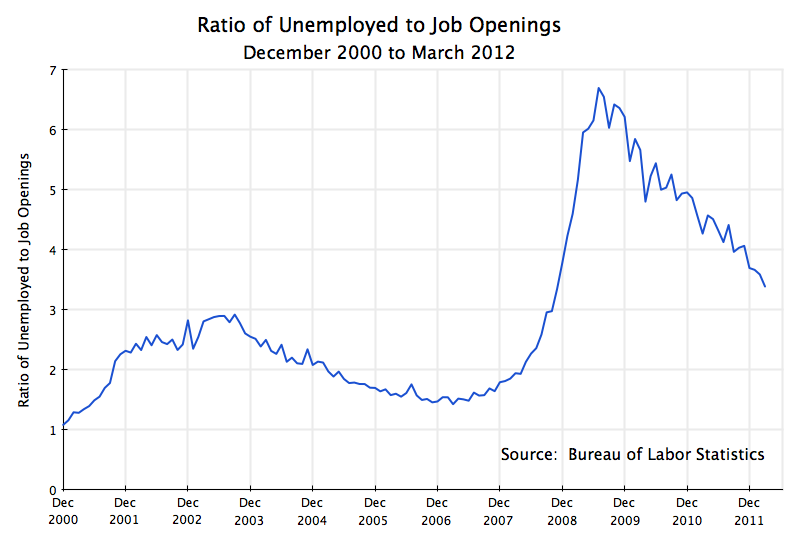
Number of unemployed as a ratio to job openings, US data, December 2000 to march 2012

There are many conservatives who argue that the unemployed need not be unemployed if they were only willing, perhaps with a cut in wages, to take one of the many jobs they assert are available.  Help wanted signs are seen, and thus these conservatives believe the unemployed could get a job if they wished.  They believe the unemployed are unemployed by their own choice, either out of laziness or due to an unwillingness to accept a lower wage.  In terms economists would use, they believe that the markets for labor would always clear if only the workers were willing to accept a lower wage.

The problem with this view is that it is not consistent with the fact that in economic downturns there are many more unemployed than job openings.  Even if every single one of the job openings were immediately filled, there would be many unemployed workers seeking jobs still left.  And since it in fact takes some time to fill any job, and since there is also constant turnover in jobs, one will see the help wanted signs posted for a while.

Data for the US on this is now gathered by the Bureau of Labor Statistics of the US Department of Labor, in a monthly survey of private establishments (which includes non-profits) and government entities.  The survey is a relatively recent one, having started only with data from December 2000, and gathers data on labor turnover (hirings, quits, firings, and other turnover) in addition to job openings (and is called JOLTS, for Job Openings and Labor Turnover Survey).  The labor turnover side of these numbers was discussed in a post on this blog in January, which used the numbers to look at the dynamics of the job market.  The post today will consider the job openings side of this survey.

The graph above, based on the JOLTS data from the Bureau of Labor Statistics coupled with the BLS unemployment figures (from its separate monthly survey of households), shows the ratio of the reported number of job openings to the number of unemployed.  For the most recent month available, the ratio of the number of unemployed to the number of open jobs was 3.4.  That is, there were 3.4 unemployed workers in the US for each open job that employers were seeking to fill.

This ratio of 3.4 is significantly better than the approximately 6.5 ratio of unemployed to open jobs when unemployment was at its peak following the recent economic collapse.  It is interesting to see in the graph the close to straight line downward trend since it hit that peak.  But there are still many more unemployed than available jobs, and the labor market is healing only slowly.  It still has a long ways to go.

Note that when the economy is close to full employment (as in December 2000, at the end of the Clinton presidency, or in late 2006 / early 2007, at the peak of the housing bubble), the ratio is around 1.0 to 1.5.  Note that there is no reason why the ratio necessarily has to be greater than one, as one could in principle have a situation of few unemployed and many open jobs seeking workers.  But in practice, it appears that in the US the ratio will always be greater than one, even when the economy is at full employment.  There will always be some unemployed and some unfilled jobs, and at full employment these are in rough balance.

But the current ratio of 3.4 unemployed for every job opening, while better than the 6.5 ratio seen when unemployment was at is peek, is still well above the 1.0 to 1.5 ratio one sees when the economy is close to full employment.  The unemployed cannot be blamed for being unemployed because they are lazy, or unwilling to accept a lower wage.  They are unemployed because there are too few jobs out there.  And there are too few jobs because there is not sufficient demand for the goods these workers could produce.

As was discussed in postings on this blog on March 3 and on March 12, this insufficiency of demand in the aggregate for what American workers can produce is largely explained by fiscal drag, compounded (although of lesser importance in the aggregate) by the collapse of housing investment following the bursting of the bubble.  Government (mostly at the state and local level) has cut back in this downturn.  This is in contrast to the expansions of government spending and hence government demand seen in other downturns, and very notably in contrast to the strong expansion in government spending during the Reagan period (despite the myth).  As the March 3 post estimated, if government spending (including state and local) during the Obama presidency had been allowed to expand by as much as it had during the Reagan presidency, the economy would now be at full employment.

Private Job Growth Under Obama: Recovery, in Contrast to the Fall Under Bush

Cumulative Private sector employment growth by months from inaugurations, Obama, Bush II, Clinton, Bush I

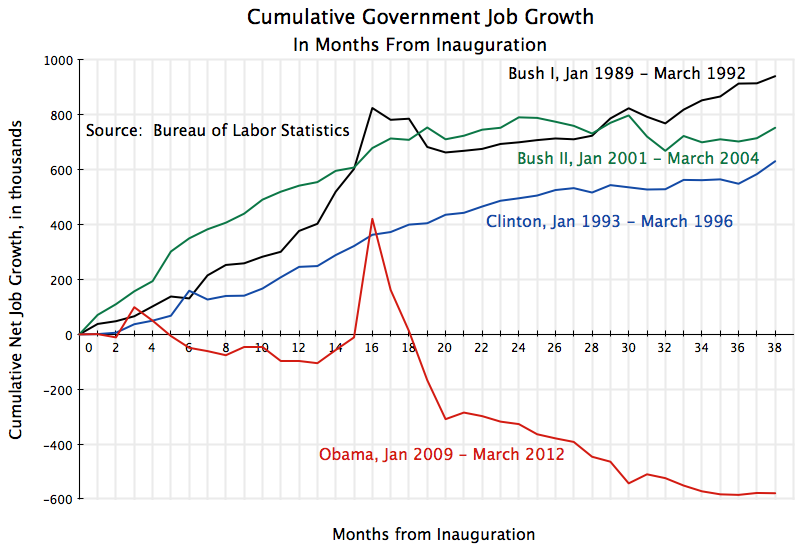
Cumulative Government sector employment growth by months from inaugurations, Obama, Bush II, Clinton, Bush I

[Update on February 2, 2013:  A more recent analysis of these issues, with these charts now covering the full first term of Obama, is available here.]

A.  Introduction

Mitt Romney and Republican Party leaders have repeatedly and emphatically asserted that Obama and the policies of his administration have been terrible for private sector job growth, and that voters should therefore bring back the Republicans and their policies.  Indeed, Romney has said his campaign is all about jobs.  At the same time, they’ve asserted that government and its bureaucrats have exploded during the Obama years, with this holding back private sector job growth.

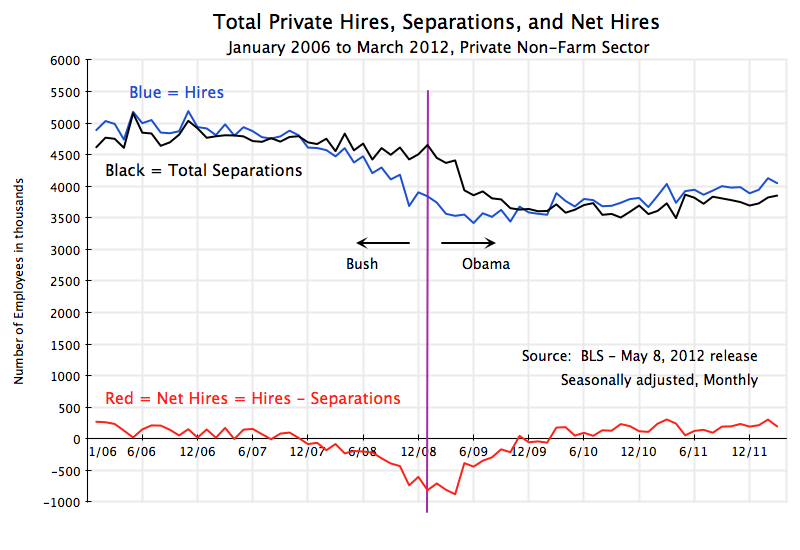
But as the figures above show, private sector jobs have recovered under Obama, reversing the freefall that was underway as he was taking the oath of office, while government employment has contracted sharply.  In contrast, private jobs were stable when George W. Bush took office, but then started to fall and fall sharply, while government jobs rose.  By 38 months into his first term, there were 2.4 million fewer private sector jobs in the US economy than on the day Bush was inaugurated.  Yet Romney repeatedly lambasts Obama for his jobs record, while he argues for bringing back the policies of Bush.

They figures show the cumulative change in private and in government jobs between January of the year the Presidents were inaugurated, to the March that was 38 months (a little over three years) later.  The March date 38 months later was chosen as that is the most recent date for which data is available for Obama.  The data all come from the Bureau of Labor Statistics.  The graph on government jobs is similar in presentation to that used by Paul Krugman in a posting on his blog yesterday.  The government jobs issue was also reviewed in a posting on this blog site over four months ago, which noted the collapse in government jobs during the Obama years (while they grew under Bush), and discussed how this has hurt overall job growth in the economy.

B.  Private Sector Jobs

Private sector jobs were falling rapidly in the period leading up to Obama’s inauguration in January 2009, as has been discussed before in this blog (see in particular the figure at this posting).  While the pace of decline was turned around almost immediately (within three months of Obama taking office), the number of private sector jobs continued to decline in Obama’s first year.  But jobs in the private sector then began to grow, and by March 2012 (the most recent figure available) they are almost back to where they were when he took office.  While this represents a growth of over 4 million private jobs over the past two years, the hole was a deep one.  The economy was hemorrhaging 800,000 jobs per month at the end of the Bush administration.  One would have of course wanted a more rapid recovery from this deep hole, but Republican opposition in Congress has blocked the measures that would have been needed to get this done (such as further stimulus).

But while one would have wanted a more rapid recovery from the 2008 economic collapse, contrast the record of Obama with that of George W. Bush in the first term of his administration.  Private jobs were growing in the final months of the Clinton administration, and were flat in the first two months of the Bush administration.   But they then began to fall (with the fall well underway before the September 11 attacks, so one cannot blame them).  The steady decline in private sector jobs continued for two and a half years, and at the trough there were 3.4 million fewer private jobs than when Bush took office.  They then began a slow recovery, but by 38 months into his term there were still 2.4 million fewer private jobs than when Bush took the oath of office.   Yet Romney and his economic advisors (most of whom held high positions in the Bush administration) advocate bringing back the policies of Bush.

The graph also shows private job growth for similar periods in the Clinton administration and in the administration of the elder George Bush.  Under the Democratic administration of Clinton, there was steady and strong private sector job growth throughout the period being followed here (and indeed throughout his two terms).  Under the Republican administration of the elder George Bush, there was some, but weak, private job growth in his first year and a half in office, but then private jobs fell, so that by 38 months into his term they were close to where they had been when he started.  Put another way, after one year in office up to the point 38 months into their respective terms, private jobs rose by over 4 million under Obama, but fell by 1.4 million under the elder Bush.

C.  Government Jobs

The story commonly told about growth in government jobs under the different Democratic and Republican administrations is also a false one.  Total government jobs have fallen during the Obama term, but grew sharply during the terms of both Bush administrations.  They also grew during the Clinton period, although by less than in either of the two Bush terms.  (Note that the sharp spike, and then after a few months a reversion to the previous trend, at a little over a year into both the Obama and first Bush administrations, is due to temporary hiring for the decennial census.)  Keep in mind that government employment in the US is mostly state and local government employment, with federal employment only a small share (13% currently).  But under Obama, non-defense federal employment has fallen as well (discussed in this blog posting).

Positive government job growth during the Obama period, similar to that seen during the two Bush administrations, would have helped spur the recovery.  But federal support which would have saved the jobs of teachers, police, and others has been blocked by Republican opposition, while cuts at the state and local level have been driven not only by deficit concerns but also by ideology.  Indeed, prominent Republican governors such as Scott Walker in Wisconsin, Chris Christie in New Jersey, John Kasich of Ohio, Rick Perry of Texas, Rick Scott of Florida, and others, have celebrated their slashing of state and local government employment, often while cutting taxes at the same time.  The job cuts have been unprecedented.

D.  Conclusion

The Republican stories on jobs are myths, and not consistent with the facts.  Private sector jobs have recovered under Obama, and have grown by over 4 million jobs once the downturn Obama inherited was stopped.  One would have hoped for a faster recovery, but further efforts to spur the recovery have been blocked by Republican opposition in Congress.  And the story should be compared to that in the first term of George W. Bush, where there were 2.4 million fewer private sector jobs than when he took office, at the comparable point in his term.

The story told about government job growth under the different administrations is also false.  Government jobs have been slashed sharply (mostly at the state and local level) during the Obama period, which has hurt the economic recovery.  In contrast, government jobs grew significantly under both Bush administrations, and grew but by somewhat less during the comparable Clinton period.  Positive government job growth during the Obama period, had it happened, would have helped spur the economic recovery.

Weekly Initial Claims for Unemployment Insurance: A Good Report, But Not Yet Where It Needs to Be

Initial claims for unemployment insurance continue to improve, although claims are still somewhat above where they would normally be when the economy is at full employment.  While there is a good deal of noise in the week to week figures, the trend has clearly been an improving one.  But there are concerns that weak US growth, and problems stemming from Europe and elsewhere, could undermine the improvement seen so far.

The data come from this morning’s regular weekly release by the US Department of Labor, and it is helpful to see the figures in the longer term context.  The graph above updates one from my posting of November 20, 2011.  Initial claims for unemployment insurance came to 348,000 in the week ending February 11, far better than the roughly 650,000 per week who were being laid off and filing claims for unemployment insurance when Obama took office.

The initial unemployment claims are still somewhat above, although now fairly close to, the level of around 310,000 to 320,000 per week that one would see when the economy is at close to full employment.  As was discussed in a January 19 posting on this blog on the dynamics of the labor market, there is constant churning in the jobs market, with workers being laid off even when the economy is at full employment.  And as was shown in the second graph in that January 19 posting, layoffs are now close to where they were before the 2008 economic collapse.

But new hires remain (at around 4 million per month) well below where they would be when the economy is operating at full employment (around 5 million per month).  Hence unemployment remains high (8.3%).  Firms have a surfeit of cash in their accounts from very high profits (see posting here), but there is little demand for extra production.  Unfortunately, it is now politically impossible (due to concerted Republican opposition in Congress) for the government to follow the expansionary policy one would need to provide that demand.

So the economy continues to grow, but slowly.  Hence the employment situation has continued to improve, but only slowly.  And there are concerns that the on-going recovery in 2012 remains fragile.  As was noted in a January 27 post, US growth in the fourth quarter of 2011 was largely due to a large increase in inventories.  This is unlikely to continue, and even if inventory growth increases again as much as it did in the fourth quarter (with all else growing as it did in the fourth quarter, although these will of course change), GDP growth would come to only 0.8% at an annual rate.

There are also major concerns arising from Europe.  Europe has been following deliberate austerity policies, and consequently is likely now in recession.  It was announced yesterday that GDP fell in the EU as a whole at a 1.2% annualized rate in the fourth quarter (0.3% at a quarterly rate).  The normal criterion for a recession is for two quarters of such negative growth.  The Greek crisis is also not resolved, and could get much worse.  And there are other global concerns as well, such as the risk that tensions with Iran could escalate and lead to an attempt to close of the Straits of Hormuz, and cause oil prices to skyrocket.

So while the labor market has improved, there are concerns on whether this can be sustained.