
Government Expenditures Leading Up To Presidential Re-Elections: Falling Under Obama, While Rising for Others

US Government expenditures before Presidential re-elections, Reagan, Clinton, Bush, Obama

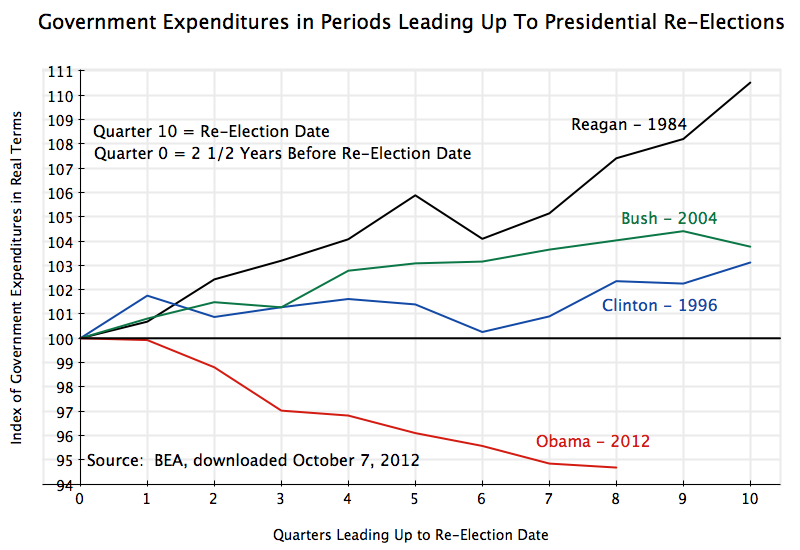
Despite the continued rhetoric that government expenditures have exploded under Obama, the truth is the opposite.  Government expenditures have been contracting in the period leading up to the election.  This contraction has led to slower economic growth and has hurt Obama’s re-election chances.

Previous posts on this blog (here, here, and here) have looked at the paths of government expenditures and government employment from either presidential inauguration dates or around business cycle peaks.  This post will look at the paths leading up to re-election dates.

The figure above shows the path government expenditures have followed in the 2 1/2 years leading up to the presidential re-election dates, for Obama as well as Reagan, Clinton, and the second Bush.  The data is taken from the GDP accounts, and shows real government expenditures on consumption and investment, a component of GDP.  They come from the Bureau of Economic Analysis of the US Department of Commerce.  Note that this is all of government, including state and local.  We do not yet have data yet for the third quarter of 2012 (the initial estimate will be released later in October) nor obviously for the fourth quarter.  But the pattern is clear.

Government expenditures (including state and local) have been falling steadily and sharply under Obama in the period leading up to the re-election date, and as of the second quarter of 2012 were over 5% below where they were in the second quarter of 2010.  At the comparable point under Clinton they were over 2% higher, under Bush Jr. they were 4% higher, and under the conservative idol Reagan they were 7 1/2% higher.  Stated another way, government spending under Obama as of the second quarter of 2012 would have had to been 13.4% higher to have matched where it was under Reagan.

Government expenditures continued to rise rapidly under Reagan.  By the date of the 1984 election, the expenditures were 10 1/2% higher in real terms than 2 1/2 years before.  While Reagan is praised as a small government conservative, his re-election was helped immensely by this rapid growth of government.  This growth in government spending led to growth in demand for the production that could be provided from the then unemployed workers, and sparked the recovery from the 1981/82 downturn.  Unemployment reached a peak of 10.8% in late 1982 under Reagan, substantially higher than the peak of 10.0% under Obama.  But with government then expanding under Reagan, rather than contracting as under Obama, the unemployment rate fell rapidly under Reagan to 7.3% in September 1984, vs. 7.8% under Obama in September 2012.

The impact of the growth in government under Reagan instead of the contraction under Obama can be estimated using the GDP accounts issued by the BEA.  The growth of GDP can be broken down into the contributions to that growth from the individual components making up GDP, one of which is government spending.  During the ten quarters from mid-1982 to the last quarter of 1984, GDP growth averaged 5.2% at an annualized rate under Reagan.  This was indeed a good rate of growth from the sharp downturn experienced in 1981/82 at the start of the Reagan term.  Of this 5.2% rate of growth, the growth in government spending accounted for 0.85% points.  In contrast, the rate of growth under Obama from mid-2010 to the second quarter of 2012 (the most recent period with data) was 2.0% (annualized), well below the 5.2% rate of growth under Reagan.  But Obama’s growth was dragged down by a contracting government, by 0.55% points.  The figures are summarized in the following table:

Impact of Govt growth at level of other president
Govt contribution to GDP growth (annualized) GDP growth (annualized) Direct Impact Multiplier of Two
Reagan – 1982Q3 to 1984Q4 0.85% 5.2% 3.8% 2.4%
Obama – 2010Q3 to 2012Q2 -0.55% 2.0% 3.4% 4.8%
difference 1.40%

With government growth adding 0.85% points of GDP growth under Reagan, but subtracting 0.55% points under Obama, the net difference is 1.40% points of growth.  If government spending under Reagan had fallen as it had under Obama (that is, had the contribution been 1.4% points less), the rate of growth of GDP under Reagan leading up to the election would have been only 3.8% annualized due to the direct impact alone, and only 2.4% with a multiplier of two on such expenditures.  Looked at from the base of what growth was during the Obama period, growth (from the direct impact alone) would have been at a 3.4% rate had government been allowed to expand during the Obama term at the rate it had under Reagan, and growth would have been at a 4.8% rate with a multiplier of two.

Put another way, if government spending had declined during the Reagan period at the rate it had during Obama’s term, the estimated resulting growth rate of 2.4% a year (assuming a multiplier of two) would have been similar to the 2.0% rate seen under Obama.  Symmetrically, if government spending during the Obama period had been allowed to grow as it had under Reagan, the estimated resulting growth rate of 4.8% would have been similar to the 5.2% seen under Reagan.  These resulting growth rates are similar for each.  The different paths followed for government spending can by itself account for the differences in the growth rates observed between the Reagan and Obama periods, when government spending rose under Reagan but fell under Obama.

A final issue to address is whether the fall in government spending under Obama since mid-2010 is a reflection of a sharp jump early in his administration (due perhaps to the stimulus package or whatever), from which a decline would be easy.  This is not the case.  Government spending in the second quarter of 2010 was 3.9% higher (total, not annualized) than it was in the fourth quarter of 2008, the last quarter of Bush.  The total growth under the similar period under Reagan was 2.8%.  The difference is just 1.1%.  But as noted above, government spending was 13.4% higher by the second quarter of 1984 than it was at the same point in the Obama term.  The 1.1% is minor compared to this 13.4%.

The stories being told on the efficacy of the Obama and Reagan policies might therefore be quite different if one recognizes that despite the rhetoric, government expanded under Reagan while it contracted under Obama.  Had government spending grown during the Obama term at the pace it had during the Reagan term, the economy would have grown similarly fast.  Obama could then be running similar “Morning in America” ads as Reagan did, rather than explaining that while America has been heading in the right direction, there is much more to do.
Romney’s and Ryan’s Confusion on Basic Accounting: Medicare Cost Savings is Not a Raid on Medicare

From a Romney / Ryan TV ad currently being broadcast:   “Obama has cut $716 billion dollars from Medicare,” says the narrator. “The money you paid for your guaranteed health care…is going to a massive new government program that’s not for you.”

Mitt Romney in a stump speech in Ohio on August 14:   “Did you know that he’s taken $716 billion out of the Medicare trust fund?  He’s raided that trust fund.  And you know what he did with it?  He’s used it to pay for Obamacare”

Paul Ryan in an interview on Fox News Channel:  “We’re the ones who are not raiding Medicare to pay for Obamacare”

(all three sources quoted in this ABC News story)

Over the last several days there have been incredible allegations from Mitt Romney, his proposed running mate Paul Ryan, and their campaign, that Obama is raiding the Medicare Trust Fund for $716 billion in order to pay for Obamacare.  The statement has been made with such certainty and certitude, and repeated so often, that one assumes there must be some element of truth behind it.   Not surprisingly, many news services are reporting it as fact, and a good deal of digging is required to find out what Romney and Ryan are in fact referring to.  And since it is so basic, one wants to double-check and triple-check to make sure something has not been missed.

But the basic conclusion is inescapable:  Either Romney does not understand basic accounting (and given his business career, one would assume he would), or he is trying to deliberately mislead the public.  And Ryan appears to be completely confused on the difference between cost savings and cost increases.

First of all, everyone agrees that the $716 billion number comes from the Congressional Budget Office, from a July 24, 2012 report produced at the request of Speaker of the House John Boehner.  The report analyses the impact on the budget over the ten year period 2013 to 2023, if the Affordable Care Act of 2010 (“Obamacare”) were repealed, as his draft bill H.R. 6079 would do.  Since the analysis is looking at the impact on public spending and revenues from the repeal of Obamacare, one needs to be careful on the mathematical sign of the changes projected.  Most analyses look at the impacts on spending and revenues that will follow as a consequence of Obamacare being approved.    This is looking at the reverse.  And while it is important to keep this straight, I don’t think this is the source of Romney’s and Ryan’s error.

The $716 billion figure is an estimate by the CBO of the higher costs that Medicare would incur if Obamacare were reversed.  The primary reason Medicare will enjoy savings as a result of Obamacare is that hospitals and other health facilities will not bear the uncompensated costs they now incur when they treat the uninsured.  Everyone recognizes, even Romney and Ryan, that the number of uninsured will go down under Obamacare.  Like everyone else, the uninsured often require medical care, and currently hospitals and other facilities will not turn anyone away for at least initial treatment, either in accordance with their own ethical standards, or in some States in accordance with the law.  But the costs need to be covered somehow, and hospitals and other facilities currently shift these costs to those who are insured, either by Medicare or by private insurance.  As the current uninsured become insured under the Obamacare system, hospitals will no longer have to shift these costs onto Medicare and other insured patients, and Medicare (as well as private insurance) will save.  The $716 billion figure is the CBO’s estimate of the savings Medicare will receive as a consequence of reducing the number of uninsured.  There will still be uninsured patients, but there will be fewer.

The CBO in fact presents a break-down of these estimates across some major categories.  Mathematically, I will present them here as the savings that would follow if Obamacare is implemented rather than reversed.

CBO estimates of ten year savings, 2013-2022.   In $ billions.
A.  Lower Medicare payments to facilities, currently needed to compensate for care to the uninsured: $415b
   1)  Hospitals                                    $260b
   2)  Skilled Nursing Facilities              $39b
   3)  Hospice Services                         $17b
   4)  Home Health Services                 $66b
   5)  All Other                                        $33b
B.  Lower Medicare payments needed to hospitals serving a disproportionate share of low-income patients  $56b
C.  Lower Medicare subsidies to the Medicare Advantage option $156b
D.  All other  $89b
TOTAL $716b

Medicare and the Medicare Trust Fund (and private insurance as well) will therefore save enormous amounts when the cost shifting that currently occurs because of the large number of uninsured, will be reduced as the uninsured become able to obtain their own medical insurance under the Obamacare system.  There will still of course be costs for the currently uninsured to obtain new health insurance coverage.  Part will be borne by the currently uninsured when they are able to purchase coverage currently beyond their reach (as prices for individual coverage can be extremely high in the current US system, due to adverse selection problems; such prices will come down under Obamacare due to the universal mandate).  But part will be borne by the government, whether through direct subsidies to those of lower income to pay part of the costs of their health insurance, or the direct costs of an expanded Medicaid.  These costs are reflected in the CBO estimates of the overall costs of implementing Obamacare.  For consistency, the CBO then estimated also what Medicare would save (an estimated $716 billion) when there is less cost-shifting by hospitals and other facilities to cover care for the current uninsured.

What Romney either never understood or is mis-representing, is that the savings Medicare will receive as a result of increased coverage of the uninsured under Obamacare, is not a “raid” on the Medicare Trust Fund.  Indeed, it is the exact opposite.  Medicare will enjoy an estimated $716 billion in savings as a result of Obamacare, and hence the funds in the Medicare Trust Fund will go further than they would without such savings.  And the CBO, in estimating the expected ten-year overall cost of the Obamacare reforms, correctly reflected such savings in lower Medicare costs.

What is completely disingenuous is the Paul Ryan comment that he is not “raiding” the Medicare Trust Fund under his plan (which Romney says he supports), while Obama is.  In recent days, it has been pointed out that buried in the Paul Ryan budget proposal (approved by the Republican House), are cuts to Medicare of the same $716 billion.  Ryan has reluctantly acknowledged that they are there.  But when asked today while campaigning in Ohio why his budget plan includes the same $716 billion cut, Ryan responded:

“First of all, those are in the baseline, he put those cuts in,” Ryan said, referring to Obama.  “Second of all, we voted to repeal Obamacare repeatedly, including those cuts. I voted that way before the budget, I voted that way after the budget.  So when you repeal all of Obamacare what you end up doing is that repeals that as well.”

“In our budget we’ve restored a lot of that,” Ryan continued. “It gets a little wonky but it was already in the baseline.  We would never have done it in the first place.  We voted to repeal the whole bill.  I just don’t think the president’s going to be able to get out of the fact that he took $716 billion from Medicare to pay for Obamacare.”

The confusion here is breathtaking.  The $716 billion reduction in costs that Medicare will incur are in the Obama budget precisely because Obamacare would be implemented, and hence the number of uninsured reduced.  The hospitals and others will not then need to shift the costs of treating the uninsured onto Medicare and others of us who are fortunate to have medical insurance.  But Ryan would repeal Obamacare, and hence these savings to Medicare would not materialize.  Medicare would need to spend more if Ryan gets his wish, and if in his budget he would then cap what Medicare could spend to $716 billion less than then needed, Medicare would no longer be able to pay in full for the medical costs of its seniors.  If Medicare spending is not capped (and there is no current legal basis for it to be so capped), the extra $716 billion in Medicare costs would go straight to an increase in the deficit over what the Ryan budget projects.

Paul Ryan delights in being treated as a “policy wonk” who supposedly knows his numbers.  If he does, then he is seriously misrepresenting the truth.  And the best that can be said about Mitt Romney is that this might be an issue which he does not really understand, and hence has accepted as correct the position that Ryan (and other Republican advisors) have repeatedly stated.  The alternative is that he too understands that this is a complete misrepresentation of what the CBO has estimated.

Employment in Manufacturing: Parties Do Matter

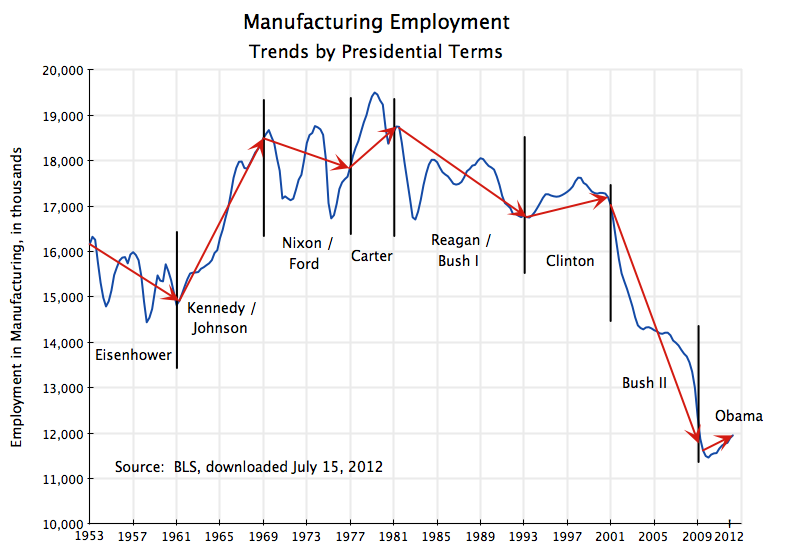
US manufacturing employment, 1953Q1 to 2012Q2, trends by Presidential terms

Manufacturing employment in the US plummeted during the term of George W. Bush, and has started to recover under Obama.  There were 27% fewer manufacturing jobs in the US when Bush left office than when he took the oath of office in January 2001, an overall loss of 4.6 million jobs in the sector.  The fall was often rapid, but what is striking is that they fell in each and every year of his administration.  And this collapse in manufacturing took place during a period when the economy grew overall.

Economists debate whether manufacturing jobs are inherently better for the economy than jobs outside manufacturing at the same wage (where the arguments center on the linkages to the rest of the economy, and on whether manufacturing experience leads to more rapid growth in technology and hence productivity or not).  But regardless of the position taken on this debate, economists agree that the sharp fall of manufacturing jobs during the Bush period was unhealthy.  Economic imbalances built up during the eight years Bush was president:  The housing bubble developed, there was an excess of consumption (and hence a fall in savings) spurred by the Bush tax cuts and by financial deregulation (easy loans), and there were the large fiscal deficits under Bush due to these tax cuts as well as spending on two major wars that were not paid for except by borrowing.  This led to record high trade deficits, appreciation of the dollar, and a manufacturing sector that could not then compete with imports.

Manufacturing jobs have begun to recover under Obama.  Such jobs were plummeting and at an accelerating pace when he took office, falling by 297,000 in January 2009 alone.  This started to turn around almost immediately after he took office (along with total employment), due to the stimulus package and other measures.  The loss of manufacturing jobs immediately started to slow, and by early 2010 started to grow for the first time since Clinton.  It is still early, but the change in trend is clear.

It is also interesting to go back further.  The figure above shows the number of jobs in manufacturing in the US going back to Eisenhower (the data is from the Bureau of Labor Statistics).  I have broken up the figure by presidential terms.  Excluding Obama (as his term is not yet complete), there have been seven presidential periods (combining terms with presidents of the same political party):  four Republican and three Democratic.  Manufacturing jobs fell in each of the Republican periods, while they rose in each of the Democratic periods.

And the pattern indeed goes back further.  Manufacturing jobs rose under Roosevelt and under Truman (even if one treats Truman as a separate period, and despite Truman taking office when war time manufacturing employment was still high).  They fell under Hoover.  One has to go back all the way to Calvin Coolidge, President from 1925 to 1929, for a Republican during whose term manufacturing jobs rose.

Much has of course varied over so many decades, plus there have been wars and other such factors affecting the numbers.  But there has also been a certain degree of consistency of policies within each party, with changes that are generally gradual (reflecting evolution over time) rather than abrupt.  Senior officials in each new administration will have generally served in some capacity in a prior administration of the same party.

It is nevertheless striking that there has been this 100% consistency in performance between the two parties when it comes to jobs in manufacturing:  The number of jobs have always improved under the Democrats, and have always (since Coolidge) deteriorated under the Republicans.  If you are interested in seeing such jobs grow, vote Democratic, not Republican.