We Have a Revenue Problem: Government Debt to GDP Would Fall Without the Bush Tax Cuts

Debt to GDP Ratio, FY1790 to 2038, no Bush Tax Cuts

A.  Debt to GDP Would Fall Without the Bush Tax Cuts

If the Bush tax cuts had not been extended at the start of this year for almost all households, the public debt to GDP ratio would be falling rapidly.  Even though health care costs are rising and Social Security payments will need to increase as baby boomers retire, the US would be generating more than sufficient tax revenues to cover such costs, if we simply had reverted to the tax rates that held prior to the Bush tax cuts.

The figures on this can be calculated from numbers provided by the Congressional Budget Office with its annual Long-Term Budget Outlook, which was published earlier this week.  Most of the attention paid to the report focussed on the base case projection by the CBO of the public debt to GDP ratio if nothing changes in current policy.   The ratio had risen sharply as a consequence of the economic collapse of 2008, in the last year of the Bush administration, and subsequent weak recovery.  But with the economy recovering and with other measures taken, the ratio is now projected to stabilize and indeed fall modestly for several years.  However, the ratio would then start to grow again in fiscal year 2019, and especially after 2023.  As the graph above shows, the CBO projects that, under current policy, the debt to GDP ratio would rise to 100% of GDP by fiscal 2038, reaching levels last seen at the end of World War II.

This has been interpreted by Republicans as a runaway spending problem, and have asserted this calls for further sharp cuts.  But the data issued by the CBO with its report allows one also to work out what the consequences were of allowing most of the Bush tax cuts (primarily – there were also some other tax measures) to be extended from January 1, 2013.  The Bush tax cuts had been scheduled to expire on that date.  They were instead extended and made permanent for all but the extremely rich (those households earning more than $450,000 a year, the richest 0.7% of the population).

Specifically, the CBO provided in the projections it had made last year (in 2012) what public revenues would have been if the tax cuts had expired, as scheduled, at the start of 2013.  The new report provides those figures for comparison, updated to reflect the new methodology for GDP that the BEA adopted in July.  One can combine those revenue projections with CBO’s current projections of non-interest expenditures, along with a calculation of what interest would then be on the resulting (lower) debt, to estimate what the fiscal deficit and debt to GDP figures would then be.

The resulting path of federal government debt to GDP is shown as the green line in the graph above.  The debt to GDP ratio plummets.  Instead of reaching 100% of GDP in fiscal 2038, it instead would fall to just 37% of GDP in that year.  And a simple extrapolation of that line forward would bring the debt all the way to zero in a further 24 years.

The extension of the Bush tax cuts for most households can therefore, on its own, more than fully account for the projected rise in the public debt to GDP ratio.  With tax rates as they had been under Clinton, there would be no debt issue.

B.  A Longer Term Perspective

The CBO report also provides data on the federal government debt to GDP ratio going back to the founding of the republic in 1790.  I have put the projected paths on a graph with the history to put them in that context.  The fall in the debt ratio that would follow if the Bush tax cuts had not been extended is similar to the falls seen in that ratio in the periods following the Revolutionary War, the Civil War, World War I, World War II, and during the Clinton years following the run-up during the Reagan and first Bush presidencies.

Public debt reached a peak of 106% of GDP in fiscal year 1946, at the end of World War II.  The ratio then fell steadily in the 1950s and 1060s, and was just 25% in 1981, at the end of the Carter presidency.  It fell during this period not because there were large budget surpluses, but rather because of generally strong economic growth.  This also shows that strong growth is possible even if the debt ratio is as high as 106%, undermining the argument made by the economists Carmen Reinhart and Ken Rogoff in a 2010 paper, that debt in excess of 90% of GDP will lead to a sharp reduction in growth.  Republican politicians had quickly jumped on the Reinhart and Rogoff conclusion, arguing that this work supported their views.  But aside from numerous counterexamples, such as the US after World War II, researchers later discovered that there had been a coding error in the spreadsheet Reinhart and Rogoff used to assemble their data.  More fundamentally, researchers showed that to the extent there is a relationship between high debt and slow growth, it is that downturns and slow growth lead to a rise in the debt to GDP ratio (as we saw in the US after the 2008 collapse), rather than that a high debt ratio leads to slow growth.

The debt ratio then rose sharply during the Reagan and first Bush presidencies, rising from 25% of GDP in fiscal 1981 to 48% in fiscal 1993.  This was the first such rise in the debt ratio in American history, aside from the times when the country went into war or at the start of the Great Depression.  During the Great Depression the ratio rose during the Hoover years from 15% in fiscal 1929 to 39% in fiscal 1933, and then to 43% in fiscal 1934.  But it is interesting that during the Roosevelt presidency, and in stark contrast to the common view that the New Deal was characterized by big increases in government spending, the ratio then stayed in the range of 40% to 44% until 1942, following the entry of the US into World War II.

The debt ratio then fell during the Clinton presidency, from 48% in fiscal 1993 to 31% in fiscal 2001.  But with the Bush tax cuts and then the 2008 collapse, the ratio rose to 52% in  fiscal 2009, and to 73% this year.   As noted above, the ratio would now start to fall again if the Bush tax cuts had not been extended, reaching a projected 37% in fiscal 2038.  But with most of the Bush tax cuts made permanent, the ratio (with the same government spending levels) is instead projected to rise to 100% in that year.

C.  Conclusion

The first step in addressing some problem is to understand the cause.  The cause of the current fiscal problems, which if not addressed would lead to a public debt rising to 100% of GDP by fiscal 2038, is the Bush tax cuts.

An earlier post on this blog looked at what the debt to GDP ratio would have been had the Bush tax cuts never been enacted (in 2001 and 2003) and the Afghan and Iraq wars had not been launched.  It found that even assuming the 2008 economic downturn would still have occurred, the public debt to GDP ratio would have risen only to about 35% by fiscal 2014, and would then start to fall.  That post also showed that even assuming the cost of the wars and with the Bush tax cuts in place from 2001 to 2013, phasing out the tax cuts starting in fiscal 2014 would have led the public debt to GDP ratio to fall until at least fiscal 2022 (the last year in the CBO figures then available).

The current post has made use of the CBO’s new long term projections, and finds that if the Bush tax cuts had not been extended at the beginning of 2013, the debt to GDP ratio would be on a sharp downward path to at least fiscal 2038.  The current conventional wisdom appears to be that rising health care costs and the increase in the number of retirees as the baby boom generation reaches 65 means that a rise in the debt to GDP ratio is inevitable, unless there are sharp cut-backs in Medicare and Social Security.

But that is not the case.  The debt ratio would be falling rapidly if it were not for the Bush tax cuts.

The Recovery From the 2008 Collapse That Could Have Been: The Impact of the Fiscal Cuts

GDP Recovery Path with Govt Growth at Historic Average, 2004Q4 to 2013Q2

A.  Introduction

Previous posts on this blog (including this older one from 2012) have discussed how the sluggish recovery from the 2008 economic collapse could have been avoided if one had allowed government spending to grow as it had during Reagan’s term.  This post will look in more detail at what the resulting path for GDP would have been if government spending had followed the path as it had under Reagan, or even had simply been allowed to grow at its normal historical rate.

The 2008 collapse was of course not caused by fiscal actions, but rather by the bursting of the housing bubble, and its consequent impact both in bankrupting a large share of an overly-leveraged financial system and in causing household consumption to fall as many homeowners struggled to repay mortgages that were now greater than the value of their homes.  Faced with the high unemployment resulting from this, an expansion of government spending would have supported the demand for output and hence for workers to produce that output.  And initially, fiscal spending did indeed grow.  This growth (along with aggressive action by the Fed) did succeed in turning around the steep slide of the economy that Obama faced as he took office.  But since 2009 government spending has been cut back, and as a result the recovery of GDP has been by far the slowest in any cyclical downturn of the last four decades.

This blog post will look at alternative scenarios of what the recovery path of GDP could have been, had government spending not been reduced.  Two primary alternatives will be examined.  In the first, government spending is allowed to grow from the point President Obama took office at a rate equal to its average rate of growth over the period 1981 to 2008.  In the second, government spending is allowed to grow from the onset of the recession (i.e. from the fourth quarter of 2007) at the same rate as it had during the Reagan years, following the downturn that began in the third quarter of 1981.

B.  Government Spending Growth at the Historic Average Rate

In the first scenario, real government spending on goods and services (as measured in the GDP accounts, and inclusive of state and local government as well as federal) is allowed to grow at a rate of 2.24% per year.  This is the average rate of growth for government spending over the 28 years from 1980 to 2008.  This was a modest growth rate, and spanned the presidencies of three Republicans (Reagan and the two Bushes) for 20 of the 28 years, and one Democrat (Clinton) for 8 of the 28 years.  The 2.24% growth rate was substantially below the growth rate of GDP of 3.04% over this same period (note this is for total GDP, not per capita).  As a result, real GDP grew by over 50% more over this period than government spending did.  But this modest pace of government spending growth was substantially more than the absolute fall in government spending during Obama’s term in office.

Note that this path for government spending is not some special rate faster than the historical average, as would normally be called for in a downturn when fiscal stimulus is needed because aggregate demand in the economy is less than what is needed for full employment.  Rather, it is just the historical average rate.  This should be seen as a neutral path, with government spending neither purposely stimulative, nor purposely contractionary.

This path for government spending is shown as the orange line in the following, where the path is superimposed on the graph presented in the earlier blog post of such paths of government spending in each of the downturns the US has faced since the 1970s:

Recessions - Govt Cons + Inv Expenditures Around Peak, 12Q before to 22Q after, with growth at avg historical rate

Maintaining government spending growth at the historical 2.24% rate would have led to government spending well below that seen during the Reagan years (in the recoveries from the July 1981 and January 1980 downturns), roughly where it was in the recoveries from the November 1973 and March 2001 downturns, and well above where it was in the recoveries from the July 1990 downturn (during the Clinton years) and of course the December 2007 downturn (under Obama).  Government spending in the current downturn (the brown curve in the graph) has fallen substantially during the period Obama has been in office.

The graph at the top of this post then shows what the GDP path would have been if government spending would have been allowed to grow at the historic average rate.  The impact will depend on the multiplier.  As was discussed in the earlier post on fiscal multipliers, the multiplier for the US in this period of high unemployment and short-term interest rates of close to zero will be relatively high.  But for the purposes here, we will run scenarios of multipliers of 1.5, of 2.0, and of 2.5.  This will span the range most economists would find reasonable for this period.

The results indicate that had one simply had government spending grow at its historic average rate, the economy would likely now be at or close to potential GDP, which is what GDP would be at full employment.  But because of the fall in government spending since 2009 rather than this increase, current actual GDP is over 6% below potential GDP, and unemployment is high.  (Potential GDP comes from the CBO estimates used in its May 2013 budget projections, but adjusted to reflect the methodological change made by the BEA in July 2013.  Due to these adjustments, including for the GDP deflators used, the potential GDP path is not as “smooth” as one would normally see.  But it will be close.)

Republicans have argued that we cannot, however, afford higher government spending, even if it would lead the economy back to full employment, as it would lead to an even higher public debt to GDP ratio.  But as was discussed in a recent post on this blog on the arithmetic of the debt to GDP ratio, it is not necessarily the case that higher government spending will lead to a higher ratio.  The Republican argument fails to recognize both that GDP will higher (due to the multiplier, and indeed a relatively high multiplier in the current conditions of high unemployment and close to zero short-term interest rates), and that a higher GDP will generate higher tax revenues due to that growth, which will off-set at least in part the impact on the deficit of the higher spending.

The resulting paths for the debt to GDP ratios by fiscal year, using a 30% marginal tax rate for the higher income, would be:

Public Debt to GDP with Govt Growth at Historic Average, FY2009 to FY2013

The impact of the higher government spending is to reduce the debt to GDP ratios over this period.  The higher government spending leads to a higher GDP, and this higher GDP along with the extra tax revenues generated at the higher output means the debt rises by proportionately less.  The ratios fall the most, as one would expect, the higher the multiplier.  If one is truly concerned about the burden of the debt, one should be supportive of fiscal spending in this environment to bring the economy quickly back to full employment.  The debt burden will then be less.

The debt to GDP ratios still rise over these years.  This serves to point out that the assertion made by the Republicans that the public debt to GDP ratio has risen so much during Obama’s term due to explosive spending under Obama is simply nonsense.  The debt to GDP ratios rose not due to higher government spending, but primarily due to the economic collapse and slow recovery, which has decimated tax revenues.  With higher government spending, the debt to GDP ratios would have been lower.

C.  Government Spending Growth at the Rate During the Reagan Years

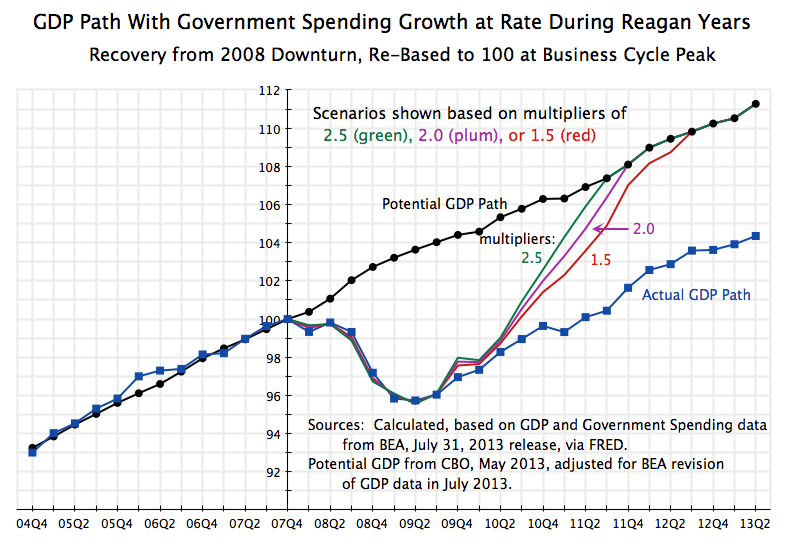
The second set of scenarios examine what the path of GDP would have been had government spending been allowed to grow, following the onset of the downturn in December 2007, at the same pace as it had during the Reagan years following the onset of the July 1981 downturn.  The path followed is shown as the green line in the graph above on government spending around the business cycle peaks.

The resulting recovery in GDP during the current downturn would have been significantly faster:

GDP Recovery Path with Govt Growth at Reagan Rate, 2004Q2 to 2013Q2

If government spending had been allowed to grow under Obama as it had under Reagan, the economy likely would have reached full employment in 2011 (multipliers of 2.5 or 2.0), or at least by the summer of 2012 (multiplier of just 1.5).  That is, the economy would have been at full employment well before the election.

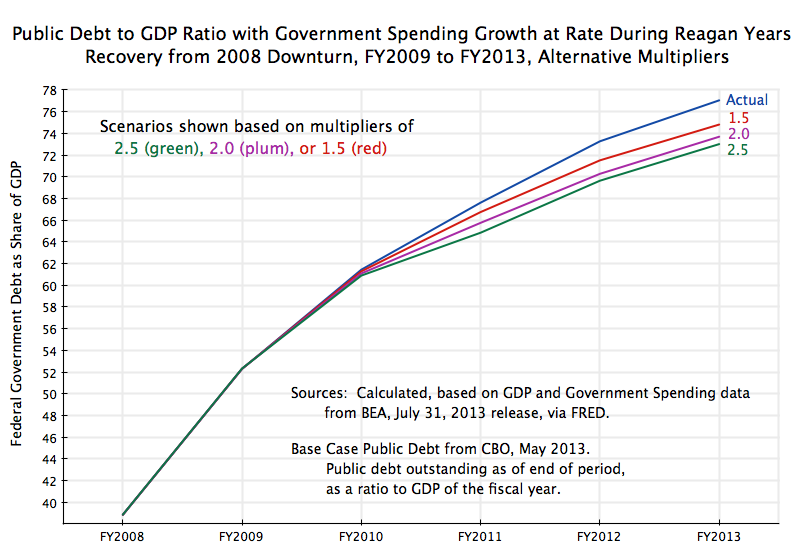
The deb to GDP ratios would also have been less than what they actually were:

Public Debt to GDP with Govt Growth at Reagan Rate, FY2008 to FY2013

Note that for these calculations I assumed that once the economy reached full employment   GDP (potential GDP), that government spending was then scaled back to what was then necessary to maintain full employment, and not over-shoot it.  Hence the curves for the 2.5 and 2.0 multipliers move parallel to each other (and are close to each other) once this ceiling has been reached.

D.  Conclusion

Fiscal spending was not the cause of the 2008 collapse.  Rather, the cause was the bursting of the housing bubble, and the resulting bankruptcy of a large share of the financial system, as well as the resulting reduction in household spending when many homeowners found that their homes were now worth less than their mortgages.

But following an initial increase in government spending, in particular as part of the fiscal stimulus package passed soon after Obama took office, government spending has been cut back.  The scenarios reviewed above indicate that had government spending merely been allowed to grow at its normal historical rate from when Obama took office (i.e. even without the special stimulus package), the US would by now be at or at least close to full employment.  And if government spending had grown as it had during the Reagan years, the economy would likely have reached full employment in 2011.

There is no need to introduce some special factor to explain why GDP is still so far below what it would be at full employment.  There is no need to assume that something such as “business uncertainty” due to Obama, or new and burdensome regulations, have for some reason led to this slow recovery in GDP.  Rather, the sluggish recovery of GDP and hence of employment can be explained fully by the policies that have kept government spending well below the historical norms.

An Increase in Government Spending Can Reduce the Debt to GDP Ratio: Econ 101

Most people realize that it is not the absolute value of the government debt that matters, but rather the ratio of that debt to GDP.  A larger economy can support a larger debt.  But most people will also think instinctively that an increase in government spending will necessarily lead to an increase in the government debt to GDP ratio.  It is not surprising that they should think so.  But it is wrong.

Whether the government debt to GDP ratio will rise or will fall when government spending increases will depend on economic conditions and other structural factors.  In conditions of high unemployment and where the Central Bank has driven the interest rates it can control essentially to zero, such as exist now in the US and Europe, an increase in government spending will increase the demand for goods and services, and hence will increase the demand for labor to produce those goods and services.

Employment and output will then rise. How much they will rise will depend on the multiplier, but as was discussed in a previous Econ 101 post on this site, in conditions of high unemployment and close to zero Central Bank controlled interest rates such as currently exist, the multiplier will be relatively high.  The higher incomes that then follow from the higher employment and output will also then lead to higher tax revenues, as a share of the higher incomes will be paid in taxes.

Hence the addition to the deficit and thus the public debt will be less than simply the increase in government spending, due to the higher tax revenues.  With GDP higher due to the greater demand and with the debt also possibly higher but not by as much, the debt to GDP ratio could fall.  And indeed, under conditions such as currently exist in the US and Europe, the debt ratio will almost certainly fall.

To see this, one can start with a simple numerical example.  Suppose one starts with a GDP equal to 100 units (it could be $100 billion), a public debt of 50 (or 50% of GDP, roughly where it was in the US in 2009), a multiplier equal to 2.0 (a reasonable estimate for the US in recent years), and a marginal tax rate on additional income of 30% (also a reasonable estimate for what it is for US federal government level revenues; it would be higher if one included state and local government revenues).

In these conditions, suppose government spending rises by 1 unit.  With a multiplier of two, GDP will then rise by 2 units.  Tax revenues will then rise by 0.6 units, when the marginal tax rate is 30% on the additional 2 units of GDP.  The government deficit, and hence the public debt, will rise by 0.4 units, equal to the extra 1 unit of government spending less the 0.6 units of additional tax revenue.  The resulting public debt will be 50.4, while GDP will then be 102, and the ratio of 50.4/102 is equal to 0.494.  Hence the debt ratio fell from 50% to 49.4% when government spending rose by 1.  Higher government spending led to a reduction in the debt to GDP ratio.  While the total debt rose, GDP rose by proportionately more, leading to a fall in the debt to GDP ratio.

Further numerical examples will help give a feel to what is going on:

Impact on Debt/GDP Ratio from a One Unit Increase in Government Spending
        Scenario: (a) (b) (c) (d) (e)
GDP: Y 100 100 100 100 100
Public Debt: D 50 70 30 50 50
multiplier: m 2.0 2.0 2.0 0.5 3.5
marginal tax rate: t 0.3 0.3 0.3 0.3 0.3
pre-change D/Y 0.500 0.700 0.300 0.500 0.500
Change in G 1 1 1 1 1
Change in Y 2 2 2 0.5 3.5
Change in D 0.4 0.4 0.4 0.85 -0.05
Resulting D/Y 0.494 0.690 0.298 0.506 0.483

Scenario (a) is the case just discussed.  With an initial public debt ratio of 50%, a multiplier of 2, and a marginal tax rate of 30%, a unit increase in government spending will lead the debt to GDP ratio to fall to 49.4%.  This is robust to different initial debt to GDP ratios:  The debt to GDP ratio will fall with higher government spending with an initial debt ratio of 70% (scenario (b), with the debt ratio where it was in FY2012) or at 30% (scenario (c), almost what the debt ratio had fallen to at the end of the Clinton administration, before the Bush tax cuts).

Under conditions where the economy is close to full employment, so that the multiplier will be relatively small, the debt ratio could rise with the higher government spending.  GDP will not rise by much, if at all, if the economy is already producing at or close to full employment levels.  The denominator in the ratio hence will not rise by much, if at all, while the numerator (the level of debt) will rise by the level of extra government spending, with only limited or no extra tax revenues to offset this since GDP has not increased by much.   Scenario (d) provides an example, with a multiplier of 0.5.  The debt ratio will rise from 50% to 50.6% in this example, when government spending rises by 1.

At the other extreme, a very high multiplier may lead to such a large increase in GDP that the extra tax revenues thus generated are greater than the increase in government spending, leading to an actual decrease in the deficit and hence the debt.  Scenario (e) presents an example, with a multiplier of 3.5.  Debt actually falls from 50 units to 49.95 units, despite the increase in government spending by 1 unit, and the debt to GDP ratio falls from 50% to 48.3%.

One will also get this result if the extra tax revenues generated for a given increase in GDP is sufficiently high.  The above examples assume a marginal tax rate of 30%.  More generally, if the marginal tax rate times the multiplier is greater than one (e.g. 30% times 3.5 = 1.05 in the example above), then the absolute value of the debt will fall with the higher government spending.

It may well be unlikely, however, that the multiplier will be as high as 3.5, even with the current high unemployment in the US and Europe.  Thus it is unlikely that the absolute value of the debt will fall with higher government spending, even in conditions of high unemployment.  But as was discussed above, with a reasonable estimate of the multiplier at around 2, one will see the debt to GDP ratio fall, under conditions such as now exist in the US and Europe.

For those with some mathematical expertise, it is straightforward to derive the specific conditions which will determine whether the debt to GDP ratio will rise or fall with an increase in government spending.  This requires some elementary differential calculus, and I will not go through the derivation here.  But the final result is that the debt to GDP ratio will fall if:

(t + D/Y) – (1/m) > 0

and the debt ratio will fall if the sum on the left is less than zero.  That is, the debt to GDP ratio will fall if the marginal tax rate (t), plus the initial debt to GDP ratio (D/Y), minus the inverse of the multiplier (m), is greater than zero (and will rise if the sum is less than zero). Thus if t=30%, D/Y=50%, and m=2 (so 1/m=0.5), with a sum then of 0.3 + 0.5 – 0.5 = 0.3, which is greater than zero, the debt to GDP ratio will fall.

The material above is straightforward.  There is nothing deep or complex.  It also just examines the immediate impact on the public debt to GDP ratio from an increase in government spending.  For a more elaborate look at the long-term impact, see the paper of Brad DeLong and Larry Summers published in 2012.  They show there that higher government spending will not only spur GDP in the short run under conditions such as exist now, but also that such spending will likely pay for itself in the long run through its long term positive impact on growth.

But this post simply focuses on the short term, and shows that counter to what many people might at first believe, higher government spending can lead to a fall in the public debt to GDP ratio.  All this result requires is the recognition that under conditions such as exist now, when unemployment is high and Central Bank controlled interest rates are close to zero, there will be a significant multiplier effect from an increase in government spending.  The resulting increase in GDP along with the extra tax revenues thus generated could very well then lead to a fall in the debt to GDP ratio.  Indeed, with the conditions and parameters such as now exist in the US and Europe, one should expect this result.