
Larry Hogan’s Purple Line Fiasco: A Case Study in Poor Judgment, Poor Management, and Poor Decision-Making

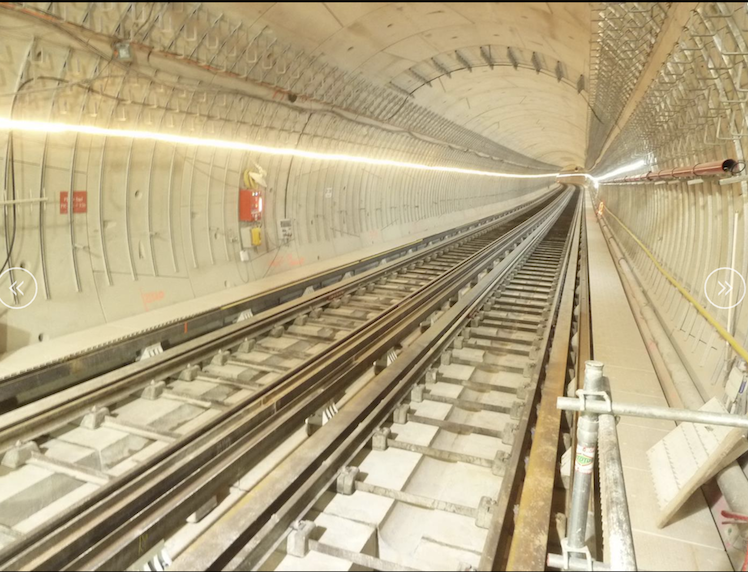
Paris Metro Line 14 Tunnel:
 

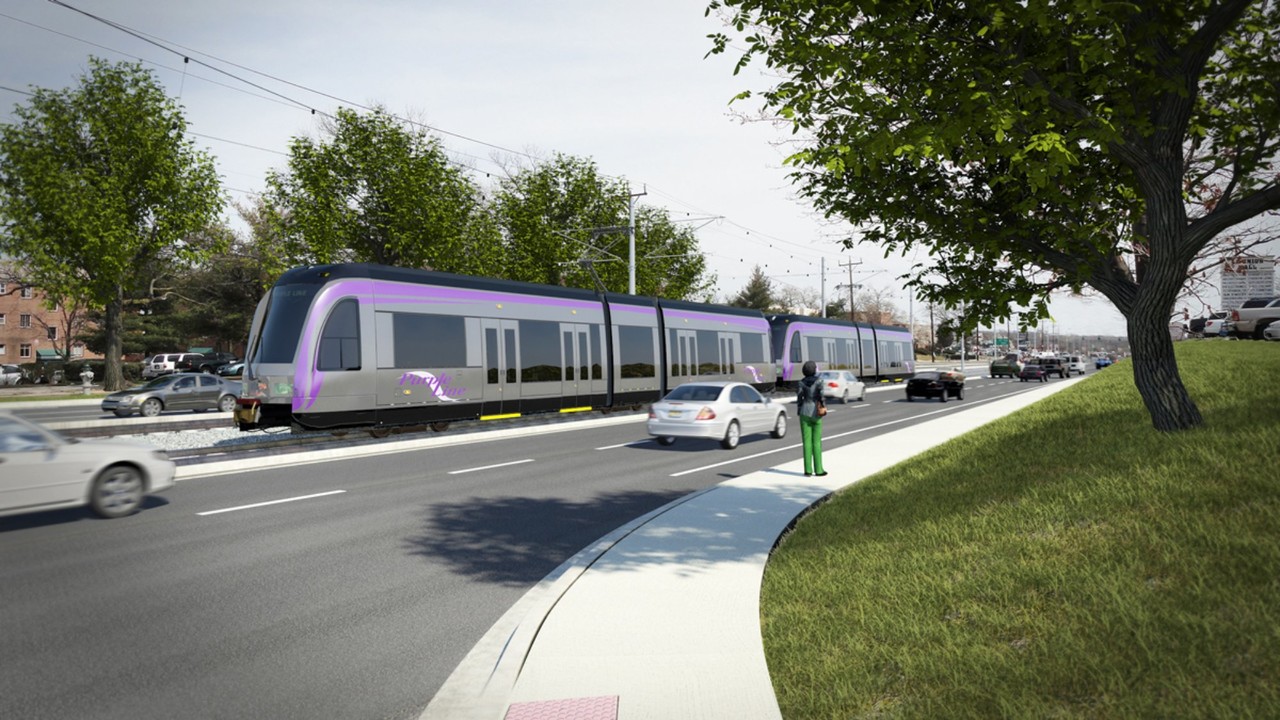
Maryland Purple Line Light Rail – Route adjacent to roadway:
A.  Introduction

Few dispute that the management of the Purple Line project has been a fiasco.  Construction costs that are now well more than double what they were in the original contract and a forecast ten years (at least) for construction rather than the originally planned five, are just two of the more obvious problems with what has been a poorly planned and managed project.  As the governor of Maryland at the time, Larry Hogan signed the contracts that launched the project (and then the contracts that re-launched the project when the initial contractor walked away), and must bear responsibility for the consequences.

The Purple Line is a 16.2 mile light rail line that will arc north and east outside of Washington, DC, through the Maryland suburbs from Bethesda on the west to New Carrollton on the east.  It was supposed to be built at a fixed price in what was called an “innovative” PPP (Public-Private-Partnership) contract, where the risk of any cost overruns was to be the responsibility of the private concessionaire.  That has not been the case.

The cost – even the original cost – is also high for what the State of Maryland is getting.  The Purple Line is a relatively simple and straightforward light rail line of two parallel tracks built mostly at ground level, along existing roadways or over what had previously been public parks.  Yet, as we will see below, its cost per mile is comparable to that of a heavy rail line recently completed in Paris.  That rail line – a major extension of Line 14 of the Paris Metro – is entirely in tunnels and has a capacity to handle more than 14 times the number of passengers the Purple Line is being built to carry.  The photos at the top of this post show a portion of Paris’s new Line 14 in comparison to the simple tracks along the side of the road of the Purple Line.

The high cost of the Purple Line is, however, only one aspect of a terribly mismanaged program.  Despite years, indeed decades, to prepare, there have been repeated delays by the Maryland Transit Authority (MTA, part of the Maryland Department of Transportation – MDOT) in fulfilling its design and other responsibilities.  This increased what were already high costs.  The MTA has been responsible for the supervision of the contract, the basic design work, as well as the acquisition of the required land parcels along the right-of-way and arranging for the movement of utility lines along that right-of-way.  It has repeatedly failed to complete this on a timely basis, leading to delays in the work the construction contractor could do and consequent higher costs.

This led the original contractor responsible for the work to walk away, where a poorly designed PPP contract made that easy for them to do as they had little equity invested in the project.  The total now being paid by the State of Maryland for the construction phase of the project is $4.5 billion – an increase of $2.5 billion over the originally contracted cost of $2.0 billion.  And that is assuming there will be no further increases in the cost, which has happened multiple times already.  The time required to build what should have been a relatively straightforward project is also now expected to be ten years – if it is completed under the current schedule in late 2027 – rather than the originally scheduled five.

Then Governor Hogan sought to blame a citizen lawsuit opposed to the project for these delays and higher costs.  But that is nonsense.  The lawsuit argued that the project had not been adequately prepared, and the judge agreed, putting a hold on the start of construction for the project while calling for the State of Maryland to undertake further work on the justification for the project.  The judicial order was issued in August 2016, construction had been scheduled to start in October 2016, and then started instead in August 2017 after the appeals court decided that deference should be given to the State of Maryland on this matter.  The construction contractor, in their formal letter stating they would withdraw from the project, said this delayed the start of construction by 266 calendar days:  less than nine months.  That cannot account for an extra five years (i.e. ten years rather than five) to build the project from when construction began in 2017.

Indeed, if anything the extra nine months provided to the MTA to prepare the project should have reduced – rather than lengthened – the time required to build the project.  The MTA continued to work on the design of the project, as well as on the land acquisition and utility work needed, during the nine months when construction was on hold.  Yet despite that extra nine months to prepare, the MTA was still not able to keep up with the schedule.  The letter of May 2020 formally notifying the MTA that the original construction firm intended to withdraw stated:

“MTA was late in providing nearly every ROW [right-of-way] parcel out of the original 600+ parcels it was required to acquire … by more than two years in some cases”.

Construction obviously cannot begin on some portion of the line until they have the land to do it on, yet the MTA was consistently late in providing this despite the extra 9 months they had due to the judicial order.

And those MTA delays have continued.  Under the revised contract for the new construction firm, compensation is paid for any further delays resulting from the MTA not fulfilling its responsibilities.  Payments from the State of Maryland have been made twice under that provision – in July 2023 and in March 2024 – totaling $563 million thus far.  That is equal to 29% of what was supposed to be the original cost of building the entire rail line.

The problems have not been just with the construction.  There were major problems also with the assessments that were done to determine whether the project was the best use of scarce funds to serve the transit needs of these communities.  Issues in two key areas illustrate this.   One was with the forecasts made of what the ridership on the Purple Line might be (where expected ridership is fundamental to any decision on how best to serve transit needs, what the capacity of that service should be, and whether the expected ridership can justify the costs).  The second was the assessment of the economic impacts to be expected from the project.

But a close examination of the work done on those two key issues often shows absurd results that are simply impossible – mathematically impossible in some cases.  I have looked at this in prior posts on this blog (see here and here), and will only summarize below some of the key findings from those analyses.  The official assessments of whether the Purple Line was warranted were simply not serious.  A moderately competent but neutral professional could have pointed out the errors.  But none was evidently consulted.

As the governor at the time, Larry Hogan was responsible for the decision to proceed with the project.  While there is no expectation that he should have undertaken any kind of technical review himself of whether the project could be justified, he should have insisted that such assessments be made and that they be honest.  And he should have listened to neutral professionals on the adequacy of the assessments.

Rather, it appears Maryland state staff were expected to approach the issue not to determine whether the Purple Line was justified, but instead to find a way to justify a decision that had already been made and then to get it built.

Staff were especially praised by then Governor Hogan in 2022 when the contract was re-negotiated with a new construction firm (at a far higher cost than the original contract – see below).  As recorded in the transcript of the meeting of the Maryland Board of Public Works in January 2022 at which the new contract with the concessionaire was approved, Governor Hogan said:

“So I’m very proud of the team that in spite of incredible — it’s a huge project and it has incredible obstacles. But they have kept pushing, you know, moving the ball forward no matter how many times there was a setback from outside. It’s not the fault of anyone in any of these positions. They kept moving.”

Indeed, the more costly the project became, and thus the less justifiable it was as a use of scarce public funds, the more the staff were praised for their skill in nonetheless being able to keep pushing it forward.

To be fair, Governor Hogan was not the first Maryland governor to favor building the Purple Line.  Governor O’Malley, his predecessor and a Democrat, favored it as well.  But Governor Hogan made the final decision to proceed when the high cost was clear.  He signed the PPP contract and he is ultimately responsible.

Hogan is now running to represent Maryland in the US Senate as a Republican.  Should he win, he could very well represent the key vote to give Republicans control over what is expected to be a closely divided Senate.  While Hogan has stated he will not personally vote for Donald Trump to be president, that is not the vote of Hogan that will matter.  Rather, a Republican-controlled US Senate – possibly as a consequence of Hogan’s vote for a Republican as the Leader – could allow Trump, should he become president, to carry through his radical program with his openly stated aim of revenge.  Senate approval of Trump’s judicial and other appointees could also then be easily granted.  And if Harris should win the presidency, a Republican-controlled Senate could block much of what she would seek to achieve.

The experience with the Purple Line provides a good basis for assessing Hogan’s judgment.  It merits a review.  We will examine below first what the Purple Line is costing to build, starting with the original 2016 contract and through to now.  The line is not yet finished so the costs may rise even further, but we will examine the contracted costs as they stand now.

The section following will then compare those costs to the cost per mile of building a major extension to the Paris Metro Line 14 heavy rail subway line.  That extension was recently opened (in June 2024, just prior to the Paris Olympics this past summer), so we have good figures on what the cost was.  It was built entirely as a tunnel – which would be expected to be far more expensive than laying rails at ground level – and has a capacity to carry more than 14 times the number of passengers the Purple Line has been designed for.  But its cost per mile is only about a third more.  The cost per unit of capacity is more than ten times higher for the Purple Line than for the new Paris Metro line.

Sections will then briefly review the problems in the analyses of forecast Purple Line ridership and of its economic impacts.  These have been covered in previous posts on this blog, so only the highlights will be summarized here.  Finally, issues with the design of the PPP contract and the incentives it created will be briefly reviewed, along with Maryland governance issues.

B.  The Purple Line’s Construction Cost

1)  Cost

The cost of the Purple Line PPP contract first to build and then to operate this light rail line is summarized in the following table, with figures both for the original contract (signed in 2016) and for the contract as it stands now (most recently amended in March 2024):

Purple Line Cost
   in $ millions

Original Contract

New Contract

$ Increase

% Increase

A. Construction Costs $1,971.9 $4,467.8 $2,495.9 126.6%
Design-Build Contract $1,971.9 $3,435.8 $1,463.9
Settlement    $250.0    $250.0
MTA supervised work    $218.7    $218.7
Compensation for MTA Delays: July 2023 *    $148.3    $148.3
Compensation for MTA Delays: March 2024 *    $415.0    $415.0
B.  Operational Period $2,306.0 $2,613.7    $307.7 13.3%
Operations & Maintenance $1,744.3 $1,977.2     $232.9
Insurance    $272.6     $340.6      $68.0
Capital Renewal    $289.1    $295.9         $6.8
C.  Financing Costs (as of Feb 2022) $1,312.0 $2,765.8 $1,453.8 110.8%
Overall Total Cost (as of March 2024) $5,589.9 $9,847.3 $4,257.4 76.2%

*  Includes an unspecified amount for financing costs.

Sources:  MDOT Briefing prepared for Maryland Legislature, February 2022, and Board of Public Works Agenda, March 13, 2024

These figures do not include all the costs of the Purple Line, but rather just the costs covered under the PPP contract with the private concessionaire.  Thus the figures here exclude associated projects, such as the cost to connect the Purple Line station in Bethesda to the nearby Metro station (at a cost currently estimated to be $130.4 million), and the cost to restore what had been a tunnel for walkers and bikers at what will now be the Purple Line Bethesda station (at a cost currently estimated to be $82.5 million, although there is a good chance this promised restoration will be canceled).

More significantly although difficult to estimate, there have also been the direct costs incurred by MTA for both its staff and the consulting firms it contracted as the Purple Line project was designed, assessed, and now supervised.  The then Maryland Secretary of Transportation Pete Rahn had indicated in a court filing in 2017 that those costs over the years were already at that time at least $200 million.  They would be significantly higher now.  There have also been the costs covered directly by both the state and county governments and by other entities for some share of the road and utility work necessitated by the placement of the Purple Line.

And while less easy to estimate in dollar value, they should also have recognized that there has been the cost of taking over what had previously been parkland for use now as a rail line.  No compensation was paid for that parkland.  Had this been a World Bank funded project, the entities responsible for the project would have been required to acquire a similar acreage of land of a similar nature and relatively close by as an offset to the parkland lost to the project.  It does not appear there was ever any consideration given to acquiring such an offset, possibly because it would have been expensive.  But this loss of parkland for the rail line should still be recognized as a cost.

The overall costs of the Purple Line are therefore substantially higher than just the costs reflected in the PPP contract with the concessionaire.  But we will focus only on the costs of that contract.

The original PPP contract was approved and signed in the Spring of 2016.  The table above shows the costs of what would be covered under that contract broken down for both the construction period and then the subsequent 30 years of operation.  But it was just one unified contract for all of those costs.  While there would be certain payments made during the period of construction as various milestones were reached, the bulk of the payments would be made by the State of Maryland on a monthly basis once the line was operational.  These are called “availability payments” as the State of Maryland is obliged to make those payments as long as the Purple Line is available to be operated.  And those payments will be the same regardless of ridership; they must be made in the set amounts even if no riders show up.

The original construction firms responsible for the actual building of the Purple Line (primarily Fluor Enterprises – a large Texas construction firm – with two smaller partners) decided in 2020 that, due primarily to the frequent delays and other issues that arose after construction began in 2017, they would abandon the project unless compensated for the resulting costs.  As noted above, they explained that MTA was late (and as much as two years late – with this at a point where construction had been underway for only two and a half years) in delivering almost all of the more than 600 land parcels they needed to build the line.

They filed a claim for $800 million in additional payments from Maryland for the extra costs they had incurred, but Maryland refused and decided instead to seek a new construction firm to complete the project.  A negotiated settlement was eventually reached where the State of Maryland agreed to pay $250 million to the original construction firms for their additional costs, with the firms then leaving the project.

In early 2022 Maryland reached an agreement with the concessionaire on a new construction firm (with Dragagdos, of Spain, as the lead contractor), at a new cost of $3.4 billion for the rail line.  See the table above.  To this one needs to add $250 million for the settlement payment to Fluor and its partners, plus $219 million for construction work by the numerous sub-contractors that had been working on the project in 2020 when Fluor left, and which the MTA then supervised directly in order for the work to continue.

The State of Maryland has since agreed to provide the Purple Line concessionaire two additional payments – of $148 million approved in July 2023 and of $415 million approved in March 2024 – as compensation for the extra costs the concessionaire incurred as a consequence of continued delays in the MTA fulfilling its responsibilities under the project.  Such MTA delays was the issue that frustrated Fluor.  It appears that Dragados was careful in the new, 2022, contract to ensure there was a clear formula for what it would be compensated for the costs arising from such delays.

Taken together, the overall cost of construction is now at $4.5 billion instead of the $2.0 billion in the original contract – an increase of $2.5 billion or 127%.  MTA staff were praised by Governor Hogan for their negotiation of this new contract, and there is no doubt they worked hard at it.  But one should question the wisdom of the decision to start over with a new contract when the original contractor (Fluor) had indicated it would continue if it were fairly compensated for the costs it incurred as a consequence of the MTA delays – primarily delays in receiving the cleared land parcels it needed before it could begin its work.  It asked for an additional $800 million (which could probably have been negotiated down by some amount), but even at the full $800 million, the total cost would have been $2.8 billion to complete the line.  Under the new contract, the cost will be $3.9 billion for this same work (i.e. the $4.5 billion cost less the later payments of $148 million and $415 million).

It is hard to see how the new contract at $3.9 billion represented a better deal for Maryland taxpayers when the original contractor would have continued if paid $2.8 billion.  It is $1.1 billion more.  Yet Governor Hogan praised MTA staff for their skill at arriving at what he praised as a well-negotiated new contract.

Section B of the table above shows the costs associated with the operating stage of the concession (the 30 years following the completion of construction).  They increased by a total of $308 million in the new contract.  This part of the original contract would not have changed had Maryland agreed to compensate the original construction contractors the extra $800 million requested (or some lower negotiated amount).  The actual cost of the new contract is therefore not just the $1.1 billion for the construction, but rather $1.4 billion when one takes into account the higher cost of what will be paid for the operation of the line.

Section C then provides a figure for what the total financing costs will sum to over the life of the concession.  These financing costs are the sum of the interest and other fees associated with the funds borrowed by the concessionaire for the project, as well as a return on its equity investment.  It is of interest to the State of Maryland as it will be paying these financing costs via the availability payments, in addition to the repayment of the principal on the loans (where that principal is already reflected in what is shown for the construction costs and should not be double-counted).

[Side note:  The additional payments of $148 million agreed in July 2023 and $415 million in March 2024 are primarily for additional construction costs, and have been included in that section of the cost table above.  But some unspecified share of each appears to include additional financing costs to cover the interest on what will be borrowed and then repaid only over the 30-year concession period via consequent higher availability payments.  However, a breakdown of those payments to show the financing portion was not provided by MTA staff at the Board of Public Works meetings (see here and here) that approved the additional spending commitments, and thus could not be shown here.]

The financing costs (as of the February 2022 contract) more than doubled between the old and the new contracts:  from $1.3 billion to $2.8 billion, or an increase of $1.5 billion.  This was not due to higher interest rates when the new contract was signed in early 2022 compared to what they were when the original contract was signed in 2016 (or finalized in 2017).  Interest rates were in fact similar in those two periods.  They had declined in 2019 and especially 2020 during the Covid crisis, and in early 2022 were roughly where they were in 2016 / 2017.

Rather, one needs to examine the funding structure.

2)  Funding 

The original funding structure and that as of the February 2022 new contract were:

Purple Line Funding
in $ millions

Original Contract

Shares

New Contract

Shares

A.  Federal Government $1,775.0 79.7% $2,706.0 67.7%
  Grant – New Starts Program    $900.0 40.4% $1,006.0 25.2%
  Loan – TIFIA    $875.0 39.3% $1,700.0 42.5%
B.  Tax-exempt Private Activity Bond    $313.0 14.1% $1,013.0 25.3%
C.  Private Equity    $138.0   6.2%    $280.0   7.0%
Total (incl. for working capital) $2,226.0 100.0% $3,999.0 100.0%
Sub-Total:  Borrowed funds only $1,326.0 59.6% $2,993.0 74.8%

Sources:  MDOT Presentation of April 2019, and MDOT Briefing of February 2022

Even though the Purple Line PPP was proclaimed to be a “privately-funded” project, the federal government in fact covered 80% of the original costs.  Half of this was as a straight grant, and half as a low interest loan under the federal TIFIA (Transportation Infrastructure Finance and Innovation Act) program, which lends funds for such projects at an interest rate set equal to the funding costs of the federal government.  That is, funds under the TIFIA program basically pay the low US Treasury rate.

Under the revised contract signed in early 2022, there will only be a relatively minor increase in federal grant support: an additional $106 million that Maryland would have been able to use for a range of transportation projects but chose to give to the Purple Line.  Rather, the major increase in funding will be borrowed funds under the TIFIA program, with an increase to $1.7 billion from the prior $875 million.

More is also being borrowed through tax-exempt Private Activity Bonds, which enable the borrower for such projects to issue bonds that are exempt from Maryland state income taxes.  While Private Activity Bonds are granted exemption from Maryland income taxes because the investments are deemed to be in the public interest, the Maryland tax exemption is certainly appropriate here.  These are in essence State of Maryland borrowing obligations as Maryland will be repaying these bonds through the monthly availability payments to the concessionaire.  As of February 2022, MDOT stated that “new” Private Activity Bonds of $700 million would be issued.  While it is not fully clear from the MDOT presentation, it appears these new bonds are being counted in terms of the net increase in such bonds relative to those originally issued (as the originally issued bonds would be retired and replaced under the new contract). The equity stake was also increased to $280 million from the prior $138 million.

With the far higher construction costs ($3.9 billion as of February 2022) and the federal grant funding only modestly increased, there had to be far greater borrowing to cover the cost of the project.  That was the cause of the 111% increase in the financing costs, not (as some have asserted) higher interest rates in early 2022.  Indeed, the total funds borrowed for the project (including via equity) rose from $1,326 million in the original funding structure to $2,993 million in the new one – an increase of 126%.  This is even a bit more than the 111% increase in financing costs.

3)  Lack of Justification to Continue When the Higher Costs Became Clear

A critical question that should have been addressed when the far higher costs of the new concession contract became clear was whether there was a justification to continue with the project.  A project is an investment, and whether any investment is worthwhile depends on the relationship of its cost to its benefits.  At a low enough cost or high enough benefits, it may be a good use of funds.  But if the costs turn out to be substantially higher, or the benefits substantially lower, that may no longer be the case.  The issue therefore needs to be re-examined when there has been a substantial increase in costs.  But it does not appear it was ever seriously considered for the Purple Line.

Two questions should have been addressed by MTA staff and then considered by Governor Hogan in deciding whether to proceed.  One was whether at the new cost (which turned out to be $3.9 billion once the new bids became known, although with the possibility – and later the reality – that there could be further cost increases later), the rail line could be justified.  The second was whether given what had already been spent by that time on the project ($1.1 billion), was the further spending justified?  Treating the $1.1 billion as a sunk cost already lost, was it worth spending a further $2.8 billion on the project to cover the $3.9 billion cost of construction (minimum – assuming no further increases)?  One should also have taken into account that operating the line for the 30 years of the concession period would now also cost the state $300 million more, but I will set that aside for the purposes here.

It is clear that the answer to both of these questions is no.  The project was at best highly marginal when it was approved.  As was discussed in an earlier post on this blog, at the time the light rail line alternative was chosen as the “preferred alternative” by the State of Maryland (in 2008), a measure of its cost relative to its benefits placed it just barely in a “medium” cost category where it might be considered for federal support.  But with a cost only a tiny 0.7% higher (or benefits from expected ridership of just 0.7% less), it would have been in the “medium-low” category and unlikely to receive federal financial support.  And at costs 27% higher (or benefits 27% lower) it would have been in the “low” category and federal financial support would have been impossible.

Adjusting for inflation, the construction cost expected in 2008 ($1.2 billion) would have come to $1.6 billion as of late 2021 when decisions were being made on whether to proceed with the new contract.  The $3.9 billion construction cost being considered at that time was 144% higher than this, and the $2.8 cost excluding the $1.1 expense already incurred was 75% higher.  Even leaving the expected benefits the same (where we will see below that they will likely be far less than forecast), any of these costs are far above the 27% higher cost that would have placed the project in a category where it never would have been considered for approval.

The criteria for federal approval used in 2008 were later revised during the Obama administration to ones where qualitative judgment factors entered in addition to the cost factors.  A multi-level, weighted, point scoring system was then used to arrive at an overall rating.  But even at the original costs – costs that were known in early 2022 to be far too low – the project only obtained a minimally adequate rating in 2016 because of a system where the weighted averages of the point scores were rounded up at each level.  Without such rounding – i.e. with each of the specific weighted scores kept rather than rounded up – the Purple Line would not have obtained a minimally adequate rating for federal approval.

But there is no evidence that there was any consideration in early 2022 of whether the project could be justified at the then known costs (and minimum costs, as they could – and did – go even higher).  Rather, it appears MTA staff were directed to find a way to have it built regardless of the costs, as long as those costs would not appear in the current Maryland state budget.  Those costs would instead be paid for by future Maryland budgets when Governor Hogan would already have left office.  And that is what they did, with the increased costs loaded into higher availability payments that would begin when the rail line was completed.

C.  A Comparison to the Cost of the Extension of Line 14 of the Paris Metro 

A major extension of Paris Metro Line 14 has recently been completed, and good figures are available on what that cost.  It extends Line 14 south by 14 kilometers (8.7 miles) to Orly Airport, and was opened in June 2024, in time for the Paris Olympics.  There was also a more minor extension of the line north, but by only 1.1 kilometers (0.7 miles) to a new station.  The cost and other figures here will, however, only be for the extension south to Orly.

The cost figures can be found in a report published in April 2024 by the “Cour des Comptes” of France – the supreme audit institution in France, under the control of the courts and hence independent of the executive and legislative branches.  It audits major government programs.  The extension of Line 14 is the first part of a major (indeed huge) program expanding the Paris Metro system, which will add 200 kilometers of lines (almost all underground) and where in addition to the extension of Line 14 there will be four new lines (15, 16, 17, and 18) circling Paris.  The new lines are scheduled to open in phases between late 2025 and 2030, although it would not be a surprise if there are delays.  Figures on the costs so far (and what is expected to be the costs for the new lines when they are completed) can be found in Annex 11 of the Cour des Comptes report, while Annex 10 provides figures on the costs of the new trains that will run in these lines (including Line 14).

Comparing the new Paris Line 14 South extension with the Purple Line:

Paris Line 14 South Purple Line Ratio
Length 14 km = 8.7 miles 16.2 miles
Type of line Heavy rail Light rail
Tunnel 100% one of 1,020 feet
Depth 100 feet below ground Mostly at grade
Stations 7, o/w 6 new, all underground 21, mostly at surface
Stations per mile 0.8 1.3
Length of train 394 ft 142 ft
Driver required? Fully automated Driver required
Average speed incl. stops 37.3 mph on new section 15.5 mph
Cost per mile $365.9 million $275.8 million 1.34 times
Daily passenger capacity 1 million 70,000 14.3 times
Cost per unit of capacity   $365.9


$3,940.0 10.8 times (inverse)

The length of both lines is substantial:  8.7 miles for the Line 14 extension and 16.2 miles for the Purple Line.  Line 14 passes through the center of Paris, and now has a full length of 16.8 miles.  This extension south is thus more than doubling the length of the line.  It is a heavy rail line while the Purple Line is only light rail, and is designed to carry far more passengers.  In contrast to the Purple Line, which is mostly being built at ground level (with just a few bridges and elevated sections, and one tunnel of just 1,020 feet), 100% of Line 14 is built as a tunnel deep underground – on average about 30 meters (about 100 feet) underground.  Tunneling is far more expensive than a rail line that is simply built mostly at ground level alongside existing roads or over what had previously been public parks.

Six new stations have been built on the Line 14 extension, and it was connected at a seventh to the existing Line 14.  This comes to 0.8 stations per mile on average.  Such stations are major projects in themselves, as they have to be built to bring the passengers down to 100 feet underground (the height of a 10-story building) to where the rail line is.  The Purple Line will have 21 stations – or 1.3 per mile on average – but these should be far less expensive.  Most will be not much more than simple platforms with something to cover them.

To carry the passengers, each Line 14 train will consist of eight rail cars and will be 120 meters (394 feet) long.  The Purple Line trains are just 142 feet long.  The Line 14 trains are also fully automated, with no need to employ a driver on each train.  The Purple Line trains, in contrast, will require drivers.  This is necessary for safety as the Purple Line trains will be at ground level and will cross many roads at intersections.  While this will reduce the upfront capital costs (as there is then no need to spend the money needed to make the trains fully automated), the need for drivers on the Purple Line will increase operating expenses.

Paris’s Line 14 trains will also be far faster.  For the newly completed southern extension, they will average 37.3 miles per hour while the Purple Line will average just 15.5 miles per hour.

The Line 14 South Extension has cost Euro 2.71 billion according to the Cour des Comptes report.  Using an exchange rate of 1.085 Dollars per Euro (the current exchange rate as I write this), this comes to $2.94 billion. This includes the cost of the six new stations (and the connection to a seventh).  To this, one should add the cost of the train cars for comparability as that cost is included in the Purple Line construction cost contract.  They have purchased new trains for the entire Line 14 route (the old train cars on the line will be used elsewhere in the Paris Metro system), at a total cost of Euro 431 million.  Prorating this based on distance for the South Extension vs. the entire Line 14 route (51.9%), and with the 1.085 Dollars per Euro exchange rate, the cost for the train cars for the South Extension is $243 million.  Adding this to the $2.94 billion construction cost and dividing the total cost by the 8.7 mile length leads to an overall cost per mile of $365.9 million.

The Purple Line total construction cost, as noted above, will now be $4,467.8 million (assuming no further cost increases).  Over 16.2 miles, this comes to $275.8 million per mile.

The cost per mile of Line 14 is thus 34% higher than for the Purple Line, but Line 14 is a heavy rail line, built entirely as a tunnel rather than mostly at grade, with stations that will bring passengers to 100 feet below ground level, operating at a far higher speed.  One would expect that such a heavy rail line would cost many times the cost of a light rail line built mostly at grade.  But it is just 34% more.

And Line 14 will have a far greater passenger capacity.  The new line has been built to be able to carry 1 million passengers per day.  While the 1 million passengers would be for the entire Line 14 – including the existing section – the extensions will have the same capacity as the same trains at the same frequency will pass through them.  One might also note that the length of the full Line 14 – at 27 kilometers or 16.8 miles – is also similar to the length of the Purple Line.

The Purple Line, in contrast, is being built to be able to handle daily ridership that has been forecast to total 69,300 in 2040.  It is being built to handle a peak load that is forecast to be on the segment between Silver Spring and Bethesda.  I have rounded this up to 70,000 for the purposes here.  While “capacity” on such a system is not always easy to define (what degree of crowding should one assume, for example), the reader is welcome to substitute a higher figure for the calculations should they wish.  The story is fundamentally the same for any reasonable capacity figure that might be assumed.

The capacity to carry 1 million passengers per day on the Line 14 extension is more than 14 times the capacity to carry 70,000 passengers per day on the Purple Line.  But the cost is not 14 times higher; it is only 34% higher.  Or in terms of the cost per unit of capacity, the Purple Line is 10.8 times as expensive as the Paris Line 14 South Extension.  That is huge.

Prior to his decision to proceed with the Purple Line, Governor Hogan asked his Secretary of Transportation to find ways to reduce its cost.  There were some cuts, but primarily by removing some “nice-to-haves” by cutting what would be spent on artwork, on the visible surfaces at the stations, and on the promise that the area between the rails would be planted with grasses and other natural vegetation instead of covered with something harsher such as gravel.  These were all removed, or reduced in scale.  But this had only a modest effect on the costs, and the costs remained high, as discussed above.

What Governor Hogan should have asked was why were the basic costs simply so high.  Even at the original cost of the PPP contract (and thus excluding all the other costs associated with the project), $1,971.9 million for 16.2 miles works out to over $23,000 for each linear foot.  It is hard to understand why it should cost so much to lay down two parallel rail lines, mostly at ground level, with some concrete and other materials (and some pro-rated share of the costs of the trains and other equipment).  At the current cost of $4,467.8 million, the cost is $52,200 per linear foot.  That is over a half million dollars for every ten feet of the line!

Governor Hogan could also have asked why such lines cost so much less in a country such as France.  Wages of construction workers are not less in France than in the US; unions are certainly more powerful in France than in the US; and safety, environmental, and other regulations are certainly stricter in France than in the US.  Yet in terms of the cost per unit of capacity, the Purple Line is costing more than ten times what the Paris Metro Line 14 South Extension has cost.

But such questions were evidently never asked.

D.  Mismanagement Prior to Construction

The mismanagement of the Purple Line has not been limited only to the implementation of the construction phase of the project.  Prior to that, there were also major issues in the process that was followed to assess the project, determine what alternative would best serve the very real transit needs of the neighborhoods in the most cost-effective way, the approach taken in structuring the concession contract (including whether it should indeed be structured as a concession), and the role of the Maryland state legislature in approving or not the financial commitments the State of Maryland has made.

These issues have been reviewed in some detail in prior posts on this blog.  See the posts here, here, here, and here.  I will only summarize in this post some of the key issues and the more blatant mistakes.  These mistakes illustrate that the process followed simply was not serious; it was not professional.  Rather, it appears the aim of the process was not to assess how best to provide public transit services to meet the needs of these neighborhoods, but rather to provide a justification for a decision that had already been made and then to work out a way to get that particular approach done, regardless of the cost.

1)  The Ridership Forecasts

To start, a central issue is what ridership should be expected if the rail line is built.  A figure for expected ridership (for a specific project design) is needed to determine whether the project is being sized appropriately in terms of capacity, what the economic benefits might be should it be built, and whether those benefits justify the costs.

Ridership forecasts are inherently difficult to do, even with the best of intentions.  At this point – with the project not yet completed – we cannot say for sure what the ridership will be.  But with a rail line, it is too late once the line is built to change the design or choose a different option to provide transit services.  The money has already been spent, and a rail line does not have the flexibility to adapt should ridership turn out to be different than was forecast.  This is in contrast to expanded bus service, for example, where one can easily add to or reduce capacity depending on what the ridership turns out to be.  Also, in the specific case of the Purple Line, the concession contract has been structured so not only will the money for the construction have been spent, but the State of Maryland will also be committed to pay the concessionaire to operate the system for 30 years and in the same amount regardless of how many people choose to ride.

The ridership forecasts for the Purple Line are therefore especially important to taxpayers in the State of Maryland.  They do not matter to the concessionaire, as they will be paid the same regardless of how many riders show up.  Indeed, they would prefer fewer riders rather than more, as their costs will then be lower (less wear and tear on equipment due to use, for example, and less to clean up each day).

This was an important flaw in how the concession contract was designed, and will be discussed below.  But first on the ridership forecasts themselves.

The earlier post on this blog on ridership pointed out that there are numerous – and often obvious – errors in the ridership forecasts.  Some involved forecast figures that were simply mathematically impossible.  Among the more important (as well as obvious) mistakes:

a)  Mathematically Impossible Ridership Forecasts:  More than half of the figures for the forecast ridership between groups of Purple Line stations are mathematically impossible.  Briefly (see the earlier blog post for more detail) ridership forecasts are produced in a multi-level process by first dividing up the metro area (in this case the Washington, DC, metro area) into basically a large “checkerboard” (although with uneven borders and areas, not squares), with each defined area a “traffic analysis zone”.  A forecast for some future year (2040 in the case of the Purple Line forecasts) is produced via a model for the number of daily trips that will be taken from each zone to each other zone by all modes of transportation.  The number of trips is modeled based on the population of each zone, the number of jobs in each zone that workers will travel to, distances between the zones, and other factors such as income levels.

They then model what share of those trips will be taken by private vehicles (cars mainly) and what share by public transit, based on factors such as relative costs and travel times by each mode.  At the level below, they then model the share of the trips by public transit that will be taken between each zone by bus, by the Washington Metrorail system, by commuter rail, or by – in the scenario where the Purple Line is built – by the Purple Line.  Again, the shares are modeled based on factors such as the relative costs and travel times of each.

For the Purple Line, the objective is to forecast how many people will choose to travel each day between the Purple Line stations.  While there will be 21 Purple Line stations, they combined the stations into 7 adjacent groups based on the traffic analysis zones, with anywhere from one station in the zone (in the case of Bethesda) to several.  There would therefore be 7 x 7 = 49 different combinations of trips that are being modeled – from one traffic zone along the Purple Line route to another, in both directions.

In such a multi-level process, the number of trips that would be taken on the Purple Line alone cannot be more than the number of trips that will be taken by all forms of public transit, i.e. by bus, or the Metrorail, or commuter rail, or the Purple Line.  Yet, if one compares the forecast number of daily trips provided in the Travel Forecasts chapter of the Final Environmental Impact Statement (FEIS, Volume III, available here and with the relevant table reproduced in my blog post), one finds this not always to be the case.  For the figures on the number of trips from each zone to each other zone (in what is called the “Production/Attraction format” – see my post for more on that if interested), the forecast ridership on the Purple Line is higher than the forecast ridership on all forms of public transit in 29 of the 49 possible cases.

This is mathematically impossible and indeed simply nonsense.  The consultants responsible for this analysis (Parsons Brinckerhoff) made some kind of mistake.  Indeed, with 29 of the 49 possible cases, it is conceivable that the figures are simply random.  One would expect half to be higher and half lower if these are random figures, and 29 of 49 is not far from that.

b)  The Forecast Capacity Requirement:  There is another impossibility as well, although here the cause of the error is clear.  The number of daily riders that the Travel Forecasts chapter estimates will be exiting the Bethesda station each day is 19,800.  But they state that only 10,210 will be going from Bethesda to elsewhere on the Purple Line each day.  (See Figure 10 in the Travel Forecasts chapter, reproduced in my blog post.)  This is obviously silly; Bethesda will not be gaining a population of close to 10,000 each day.

The cause of this error is clear, however.  The analysts responsible for this work used ridership figures from the “Production/Attraction” format tables.  But that format does not present the total ridership that will be entering or leaving a station each day.  Rather, it is one step in the modeling process, and is an estimate of how many of the daily trips will start in a given zone (based mainly on how many people live there – this is the “Production”) and how many daily trips will have this as the destination (where the jobs are – this is the “Attraction”).  Bethesda is a relatively significant jobs center on the line, and hence “Attracts” a higher number of riders than it “Produces”.

The final step is to convert the figures to an “Origin/ Destination” format to show the number of daily trips that will originate at a given station and will end at a given destination.  The figures in origin/destination format will be close to the average for the figures in the production/attraction framework.  Thus the daily number of entries and exits at Bethesda would be roughly 15,000:  the average of the 19,800 and 10,210 figures.  And the Travel Forecasts chapter presents the origin/destination figures in its Tables 24 and 25, although in one they provide a figure of 15.010 and 14,990 in the other, with similar small differences for all of the stations as well in the overall daily ridership forecasts (69,330 in Table 24 and 69,300 in Table 25).  The cause of these small differences was never explained and suggests sloppiness.

But due to this error, the report indicates in its Figure 10 and in the associated text that the number of Purple Line riders going into Bethesda each day will be 19,800, and that the peak ridership (and hence the capacity that will be necessary) will be in the segment from the Woodside/16th Street station to Lyttonsville (a portion of the line between Silver Spring and Bethesda), where there would be 21,400 travelers each day in the westbound direction.  This is wrong, and a misinterpretation of the forecasts due to confusion between figures in a production/attraction format and ones in origin/destination.

c)  Time Savings:  The forecast time that would be saved by travelers choosing to take the Purple Line is central both to the forecast of how many would take the Purple Line (instead of some other mode of public transit) as well as for the estimate of the social benefits from the construction of the Purple Line (which is based on how much time would be saved by travelers).

But there were also major problems here.  Table 23 of the Travel Forecasts chapter of the FEIS provides the estimates they used for the average number of minutes that would be saved by travelers per trip (from each traffic zone to each other) if they have the Purple Line as a choice.  But some of the figures are obviously absurd.  They indicate an average time savings for travelers from the Bethesda traffic zone (Bethesda station) to the New Carrollton zone at the other end of the line of 691 minutes.  That is 11.5 hours!  That is 1.4 miles per hour for the 16.2 mile route of the Purple Line; one could walk faster!  Similarly, the time savings from Bethesda to the traffic zone just before New Carrollton (Riverdale Park) is 582 minutes, or 9.7 hours.  This is also absurd.  My guess is that they misentered the data, with a decimal point in the wrong place.

But there are more general and much more significant problems.  One is that in the data they entered on alternative travel options in the absence of the Purple Line, they failed to include use of the existing Washington Metrorail system as such an option.  And some of the trips would require less time on the Metro than they would if one rode on the Purple Line.  For example, the Travel Forecasts report itself indicated that traveling from Bethesda to New Carrollton via Metro currently takes only 55 minutes (Table 6 in the report).  On the Purple Line, the same trip would require 62.6 minutes (Table 11).  There would not be any time savings, but rather a time cost.  And obviously not 691 minutes of time savings.

More generally, the time savings per trip across the 7×7 zones being forecast (Table 21) appear to be far too high on average.  The summary at the bottom of the table indicates an average savings of 30 minutes per trip for trips in the metropolitan region as a whole.  Yet in the three detailed examples they provided for how such calculations are made, they calculated an average time savings of a much more plausible 7.3 minutes per trip.  The sample is small, but a savings of 10 minutes per trip is probably a better estimate than 30 minutes. This is especially the case if one allows (as one should) the option of taking the existing Metrorail system between several of the stations – often for a faster trip than the Purple Line will provide.

An average time savings of 10 minutes per trip rather than 30 reduces the benefits of the Purple Line by a far from insignificant two-thirds even assuming the number of trips would remain the same as forecast.  But it would also significantly reduce the number of Purple Line trips in the forecast, as that forecast number depends primarily on the assumed time savings.  If linear, it would imply that the number of trips should also be reduced by two-thirds, and the overall benefits (the number of trips times the time savings per trip) would fall by eight-ninths.  That is far from a minor adjustment in the forecast benefits.

A reduction in the forecast ridership on the Purple Line by two-thirds would also be more in line with the ridership seen on other light rail lines in the US.  As I noted in my earlier blog post:

study from 2015 found that the forecast ridership on the Purple Line would be three times as high as the ridership actually observed in 2012 on 31 light rail lines built in the US over the last three decades.  Furthermore, the forecast Purple Line ridership would be 58% higher than ridership actually observed on the highest line among those 31.  And with the Purple Line route passing through suburban areas of generally medium to low density, in contrast to routes to and from major downtown areas for most of those 31, many have concluded the Purple Line forecasts are simply not credible.

d)  Uncertainty and the Lack of Resilience in a Rail System:  Finally, one should always keep in mind that there will be uncertainties with any such forecasts.  The Purple Line ridership forecasts are not plausible, but a more fundamental issue is that future ridership can never be known with certainty.  The experience with ridership on Washington’s Metrorail system over the past decade and a half illustrates well the uncertainties, and also has a direct bearing on the Purple Line forecasts.

The Purple Line will intersect with four Metrorail lines, and a major share of the forecast Purple Line ridership is of riders who would use the Purple Line for part of their journeys to connect to a regular Metro line or to return home from a trip on the Metro.  The ridership forecasts for the Purple Line were first developed around 2008 and then refined later, and assumed that ridership on Metrorail as a whole would grow steadily over time.  But it turned out that Metrorail ridership peaked in 2008 and then fell steadily.  This was indeed a major issue raised by Judge Richard Leon in his August 2016 ruling, where he indicated the State of Maryland should review whether, in light of the steady decline in Metrorail ridership in the years leading up to 2016, the Purple Line would still be justified.  By 2016, Metrorail ridership was already 14% below where it had been in 2008, and by even more, of course, relative to where it would have been had it kept to the pre-2008 trend (a rising trend the ridership forecasts assumed would continue).  The response by Maryland was that they expected Metrorail ridership would soon recover fully to its pre-2008 trend path, and then continue at that trend growth rate in the future.

Metrorail ridership did not.  It continued to fall and then collapsed in 2020 due to the Covid crisis.  Average daily ridership on the Metrorail system in 2020 was 72% below what it was in 2019, and in 2021 was 78% below 2019.  There has since been some recovery, but in 2024 (up to October 11 – the most recent data as I write this) it is still 38% below what it was in 2019.  Given the shift to working from home for many office workers, there is the question of whether Metrorail ridership will ever recover to where it was in 2008, much less to the trend growth path that was assumed for the Purple Line ridership forecasts.

Defenders of the Purple Line might say that it was impossible to predict the Covid crisis and the shift to working from home.  That is true, and is precisely the point!  The future is uncertain, and major surprises are always possible.  It is for this reason that one should favor resilient and flexible systems that can respond as the future unfolds.  A light rail line such as the Purple Line is not flexible.  Once the rail lines have been laid, they cannot be moved.  And with the train sets purchased and other equipment installed, the capacity is basically fixed.  This is in direct contrast to bus systems, where routes can be changed based on how development proceeds and capacity on any given route can easily be adjusted by running more or fewer buses.

Bus options existed for serving the neighborhoods through which the Purple Line is being run.  Bus routes could have been adjusted, capacity on those routes could have been adjusted, and express routes could have been added (such as between Silver Spring and Bethesda – if there is indeed a demand).  And while less flexible, they could also have built – at a far lower cost than the Purple Line – bus-only lanes in key locations (such as into and through Bethesda), or they could have extended planned Bus Rapid Transit routes to include segments the Purple Line will be covering (such as between Silver Spring and Bethesda).

2)  The Economic Impact

A key question for a project such as the Purple Line is what economic impact can be expected, and will that impact justify the costs.  Studies are commissioned for this, and the key one for the Purple Line was prepared by the consulting firm TEMS (for Transportation Economics and Management Systems, Inc.).  Its March 2015 report was an update of one it had prepared in 2010, and will be the focus here.

The release of the TEMS report on April 20, 2015, was highly orchestrated, with a press conference, an article in the Washington Post, an editorial that same day in the Washington Post extolling the reported benefits, as well as letters to Governor Hogan from local political figures citing the report.  Presumably, the TEMS report was circulated before this date for review by selected entities (including the Washington Post) but embargoed until the press conference on that day.

It does not appear, however, that any of these entities undertook a serious review of the report prior to citing it as proof that the Purple Line would have highly beneficial economic impacts on the communities and the state and region more generally.  It is a report that could be highly technical in areas, and it would not have been reasonable to assume that members of the Editorial Board at the Washington Post would have fully understood what was being done.  However, before jumping to the conclusion that the report’s conclusions were soundly based, the Editorial Board (as well as others) could have requested a review by a neutral professional or scholar to advise on whether the report was sound.  But they did not.  There are major problems with the report, and indeed obvious problems that any professional would have quickly seen.

a)  The “Statistical” Analysis:  To start with a simple but obvious issue, and one that any professional in the field would have seen immediately just by glancing at the report, the TEMS study provided what it said were the results of a statistical regression analysis of travel demand between different zones of the Washington metro area.  The report said it used a database constructed of travel patterns in the region between each of the defined traffic zones, the cost of travel between the zones, and socioeconomic variables such as population, employment, and average household incomes.  The results are presented in Exhibit 4.2 on page 25.

They state that the statistical results they found were very good.  If properly done, such results would not only have been good, but far too good.  Indeed impossibly good.  For example, and most blatantly, they claimed to have obtained a statistical measure of goodness of fit (called a t-statistic) in one of the regressions of 250 for one of the parameters estimated and over 200 for each of two others.  The higher the t-statistic, the better (the tighter) the statistical fit.  For most such regressions, analysts are happy with a t-statistic of 2.0.  At 2.0, there is a 95% likelihood that a statistically meaningful correlation is being found, and only one chance in 20 that it is not.  At a t-statistic of 3, it is one chance in 370, at a t-statistic of 4 it is one in almost 16,000, at a t-statistic of 5 it is one in 1.7 million, at a t-statistic of 6 it is one in half a billion and at a t-statistic of 7 it is one in almost 400 billion.  As you can see, it diminishes rapidly.  It is impossible to imagine what it would be at a t-statistic of 250.  Something is clearly wrong here.  No statistical analysis of real-world data produces such results.

This would have been obvious to any professional with just a glance at the report.  But there were other issues as well.

b)  Correlation is Not Causation:  The TEMS report states that it estimates that annual household incomes in the region will increase by $2.2 billion each year as a return on the $1.9 billion investment in the building of the Purple Line (where $1.9 billion was the estimated cost at the time the study was done).  This would be a rate of return of 116% ($2.2 billion per year for a one-time investment of $1.9 billion).  Any professional would immediately see that this is certainly wrong.  Transportation investments – especially passenger rail investments – do not generate anything close to such returns.

How did they arrive at this figure?  Going through the report’s presentation, one sees that the estimate of the impact on household incomes is based on another statistical regression analysis.  That one looked at the relationship between existing household incomes in a particular geographic zone and a figure for average transportation costs for those living in that zone (along with other variables for that zone).

The problem was that they confused correlation with causation.  As any introductory statistical course in college will teach, a regression equation provides estimates of correlations, and one should not assume these necessarily imply causation.  There may be neighborhoods (Georgetown in Washington, DC, would be an example) where travel costs to work might be relatively low on average (Georgetown is close to jobs in downtown DC) and incomes are relatively high.  But it is a mistake then to jump to the conclusion that the reason rich people in Georgetown became rich was that their commuting costs were relatively low.

The TEMS study made this simple mistake.  Correlation is not causation.

c)  Errors in the Analysis of Construction Impacts:  In addition to their (mistaken) estimates of the economic benefits to households and others in the region once the Purple Line is running, the TEMS report also provided what it claimed to be estimates of benefits accruing from what will be spent for the construction of the line.  There were also fundamental problems here.

First, and most basic, the TEMS analysis is based on the presumption that the more that is spent on the construction, the greater the benefit.  That is, if the construction costs doubled to $4 billion, say, from the initial estimate of $2 billion, then the “benefits” would be twice as much.  And if the costs blew up to $20 billion, say, the benefits would be ten times as much.

This is, of course, not just perverse but also silly.  Cost overruns are not benefits.  While they are claiming that jobs would be “created” for those working on the construction (and hence twice as many jobs if twice as much is spent), the mistake they make is assuming the alternative is that such funds for public transit would not be spent at all.  But that is not the alternative.  There are huge needs for public transit – and for transportation projects more generally – and the alternative that should have been examined is not to do nothing, but rather to make use of the funds for one or more of the high-priority needs.  That is, instead of covering cost overruns on a poorly managed project, those funds could have been used to meet the very real transit needs of these communities.  The number of jobs “created” (if that is the objective) would have been similar.

It gets worse.  The TEMS study used what is called an “input-output” analysis to estimate what it said would be the impacts on the various sectors of the economy in the region from the expenditures for items that would be needed for the construction.  They excluded (properly) the $0.2 billion in expenditures on the rail cars for the Purple Line (as they have been built elsewhere), leaving $1.7 billion for the “construction” cost from their $1.9 billion overall cost estimate.  But they then assumed – completely improperly – that all of the $1.7 billion would be spent locally.  This is obviously not true.  While a portion would be spent for  local construction labor, a far greater portion would be for the materials and equipment needed for the rail line.  But the steel rails being laid down, for example, would not be an expenditure on a locally produced item.  There are no steel mills in the DC metro area.  And that would be the case for most of the items purchased for the project.  Yet the TEMS input-output analysis assumed all of the construction expenditure would be for locally produced products.

And then it gets even worse.  The TEMS study calculated such direct and feedback effects separately for Montgomery County and for Prince George’s County (the two Maryland counties of the 16.2 mile Purple Line route), and then also for Washington, DC (where the Purple Line will not run at all).  But one look at the detailed estimates of the purported economic impacts (Tables 7.10, 7.11, and 7.12, in the TEMS report for Montgomery, PG County, and DC, respectively).  They show that they assigned the full $1.7 billion of construction costs as if it were spent entirely in Montgomery County, spent entirely again in Prince George’s County, and spent entirely again in Washington, DC.

That is, they triple-counted those construction expenditures!  Even if one accepts the problematic methodology of TEMS, the implementation is replete with errors.

This was not a competent analysis.  Before extolling the purported “findings” of a report of the tremendous impact building the Purple Line would have on the region, the Washington Post editorial board, as well as others, should have first asked a neutral professional or academic to review it and indicate whether it was sound.

3)  The Structuring of the PPP Contract, Maryland Debt, and the Role of the State Legislature

There are also major issues with the process followed.  Only three will be addressed here:  the structuring of the PPP contract, the impact on State of Maryland debt, and the role of the state legislature in voting approval for (or, in this case, not voting) on what will be a major public expenditure commitment lasting over 35 years.

a)  How the PPP Contract Was Structured:  The Purple Line project is the first project of the State of Maryland that has gone forward under legislation passed in 2013 for PPP contracts.  It has important lessons on what not to do.

A PPP (Public-Private Partnership) contract divides responsibilities between state and private parties on investments where there is a direct public interest.  It can be a broad concept, covering a variety of contract structures, but the aim normally is to encourage the party best able to manage a particular type of risk to take responsibility for that risk and have an incentive to manage it well.

The Purple Line PPP does not do that.  Indeed, it is not much different from Maryland using a standard fixed-price procurement contract for the work to be done.  The private consortium that won the contract committed to building the Purple Line in accordance with the basic design provided by the state, and then to operate the line for 30 years following its opening in compliance with agreed service standards (such as for the hours and frequency of the train operations).  They were supposed to do this for a fixed cost that, as noted in Section B above, was to total $5.6 billion in payments over the planned 35 years (5 years for construction and then 30 years for operation).  The cost of the PPP contract will now be at least $9,8 billion over the full period.

This could have been structured as a standard fixed-price procurement contract.  Indeed, a standard procurement contract could have been written with greater flexibility by not combining the building of the rail line with its later operation.  Different types of firms have expertise in each.  There could have been a fixed-price contract to build it, and then separate fixed-price contracts for operating it for a given period as a concession.  And the operating concessions need not be for a very long, 30-year, period, but perhaps 5 years at a time after which it could be adjusted to reflect what ridership actually turned out to be and then re-bid.

It is certainly true that public procurement contracts that are supposed to be for a “fixed price” often end up with major cost increases.  But this would not differ from how the Purple Line contract turned out.  Its cost (over the full concession period) is now $4.3 billion higher than the original “fixed price” of $5.6 billion.

Private firms do not appear to be very good at managing the risk that costs may turn out to be substantially higher than initially agreed in such major public sector infrastructure projects.  It was a mistake to assume – as the structure of the Purple Line PPP assumed – that costs would not rise.  In the case of the Purple Line, the public sector (MTA) has been responsible for delivering on time the parcels of land required to build the rail line, as well as for ensuring utility lines and pipes are moved as required and for the basic design of the rail system.  But MTA has been repeatedly late in fulfilling those obligations (even with the lawsuit, that provided the MTA an extra 9 months to get a headstart on this work).  The most recent payment of compensation for the higher construction costs arising from the continued MTA delays was approved just last March – six and a half years after construction began.

In contrast, private firms can be good at assessing “market risk” – in this case assessing what ridership demand might be.  The Purple Line PPP contract was not, however, structured so that the private concessionaire would care whether ridership turns out to be anywhere close to the forecasts that were made.  The concessionaire will be paid the same regardless.  Whatever is collected in fares will be passed directly to the State of Maryland.

A better structure of the PPP contract would have been for the concessionaire to receive the fares.  This would have been much like how many private toll road PPP contracts are structured.  A significant difference is that while tolls on toll roads can usually suffice to cover the costs of building and then operating the road, fares on rail lines rarely cover their costs – and they certainly will not in the case of the Purple Line.  However, this could be addressed by basing the bidding criterion on the level of state subsidy the concessionaire would receive each month, say, during the concession period.  There would be a competitive bidding process, and the pre-qualified private consortium submitting the lowest bid for the subsidy required would win the contract.

Note that in the existing structure that was used for the PPP for the Purple Line, the State of Maryland is paying the concessionaire a similar “subsidy” for building and then operating the concession, with the subsidy then paid out monthly through the availability payments.  But the critical difference would be that the fares would instead go to the concessionaire rather than the state.  Instead of bidding an amount for which they would build and then operate the project (as in the current PPP contract), those competing for this contract would instead submit a bid that was reduced from that amount based on what they expected to receive in fares.

The structure would still be one where the private concessionaire would build the project and then operate it for a period such as 30 years.  The receipts – fares plus the fixed subsidies – over those 30 years would cover what it cost to build the rail line plus the operating and maintenance costs.  While this might appear to be close to the PPP structure used for the Purple Line, there is an important difference.  In this new structure, the concessionaire would have an incentive to build and operate a rail line that is attractive to riders, with a service that will maximize the number of riders and hence the fares.  The concessionaire would be receiving the fares.  Under the current structure, the concessionaire will be paid the same regardless of riders, would prefer fewer to more riders, and will need to be supervised closely to ensure they are not cutting corners to save money.  In the current PPP structure, they do not care whether fewer riders would choose the system (and indeed would prefer fewer).

In this new PPP structure, the potential bidders will pay close attention to the ridership forecasts, as they will lose directly should those forecasts turn out to be overly optimistic.  One can therefore be sure that they would be more carefully done than those – discussed above (with their numerous errors) – used by the State of Maryland to establish what they considered to be a justification for building the line.

However, there would be a major drawback to such a PPP structure, as neither the private concessionaires nor the politicians and others pushing for the project would have been happy.  Such a PPP structure would have made clear upfront that building the Purple Line was simply not warranted.  There would have been more carefully worked out estimates of the ridership (providing a more realistic estimate of what ridership to expect) as well as greater clarity on the state subsidies that would then have been required for the Purple Line to be built.  The political figures seeking a justification for building the rail line would not have wanted this.  Nor would the vested interests that are benefiting privately from it while others are paying.

The private consortia bidding on the line would also not favor such an approach.  They of course favor a structure where, as in the present one, they do not bear the risk of ridership not materializing.  They certainly prefer the State of Maryland to take on this risk.

There was an additional flaw in the structuring of the PPP contract.  Section B above noted that in the original financial structure agreed to in 2016, the equity investment of the Purple Line concessionaire was only $138 million – equal to just 6.2% of the overall cost to build the line.  This was small, and gave the concessionaire the credible threat to walk away should problems develop leading to higher costs.  Furthermore, the primary construction contractor – Fluor – held only a 15% share in the consortium responsible for the project, and hence would have put up only 15% of $138 million in equity, or $20.7 million.

Fluor walked away from the contract in 2020 when the persistent delays and other issues that raised their costs led them to demand $800 million in compensation in order to continue.  They eventually settled for $250 million, but both of these figures are far in excess of the $20.7 million they had invested in the project in equity.  The State of Maryland had claimed that the PPP contract would ensure that the private consortium responsible for the project would be responsible for any cost overruns, with Maryland protected.  This proved not to be the case, and the very low share of equity in the project gave the private consortium strong negotiating leverage when costs turned out to be higher.

b)  The Impact on Maryland’s Public Debt Commitments

The availability payments that Maryland will be obliged to pay on the Purple Line are essentially the same as debt commitments.  Maryland will be obliged to pay them in the amounts set in the contract, with the sole condition that the rail line is available for operations.  The availability payments due will not be reduced should ridership turn out to be less than forecast – even far less than forecast.  Nor will they be reduced should there be, for example, an economic downturn so that public funds are especially tight.  They will have to be maintained at the level agreed in the PPP contract.

The payments are thus basically like payments on a state bond obligation.  But unlike bonds, the payment obligations under the Purple Line PPP are to be for 35 years (5 years for the anticipated construction period, and then 30 years for operations).  In contrast, the maximum term of a State of Maryland public bond is set by law to be no more than 15 years – a maximum term that was presumably set for prudential borrowing reasons.

But Maryland is not counting these availability payment obligations as part of the state’s debt obligations.  If they had, then the Purple Line payment obligations would be included in debt limits set by the state’s Capital Debt Affordability Committee – a committee of senior state officials chaired by the State Treasurer.  The limits are for tax-supported state debt not to exceed 4% of personal (i.e. household) income in the state, nor for debt service obligations to exceed 8% of state revenues.

The state has been close to these limits, where according to the most recent report of the Capital Debt Affordability Committee (issued in December 2023 for FY2025 borrowing), Maryland state debt was 3.1% of state personal income in FY2023 and debt service on such debt was 6.5% of state revenues.  Scaling these up as if the Purple Line debt (construction cost less federal grant) and estimated availability payments were owed and due, Maryland debt would have been 3.9% of personal income in the state (just below the 4% limit), and debt service would have been 7.4% (versus the 8% limit).  Maryland was closer to the limits in FY2019 (as well as FY2020).  Had the Purple Line obligations been due and recognized then, the borrowing limits would have been breached, with state debt at 4.3% of personal income in FY2019 (and 4.4% in FY2020) and debt service payments at 8.7% of state revenues in FY2019 (and 8.5% in FY2020).

These past fiscal year figures are just taken for illustration.  The additional amounts that will be due on the Purple Line would be booked in a future year, and the base amounts for Maryland debt and debt service obligations in those future years are not now known.  But the recent figures indicate that including the Purple Line debts could lead to a breach of the prudential borrowing limits the state has set.  And even if not breached, the Purple Line obligations would reduce the headroom the state has for meeting its other needs.

The State of Maryland under then Governor Hogan decided, however, to exclude the Purple Line debt obligations and the 30-year commitment on the availability payments from Maryland state debt accounts.  As was discussed in more detail in an earlier post on this blog, Maryland officials structured the payment obligations for the Purple Line as if they would be made through a newly created trust account.  When the Purple Line is operational with the availability payments due, that trust account will receive whatever fare revenues are collected on the Purple Line plus then transfers of sufficient revenues from MARC (the state’s public commuter rail system) to suffice to cover the payments due.

Excluding the Purple Line debt and availability payments due would not be inappropriate if fare revenues from the Purple Line could be expected to cover what will be due.  It would not then need to be covered by general state tax revenue.  But the Purple Line fares will not come anywhere close to what is needed to cover the costs.  The average annual availability payments required will be approximately $280 million.  This is based on the $250 million figure provided in February 2022 by the MTA in a briefing to a legislative committee, accounting for the portion that will cover operations and maintenance ($87 million per year on average), and scaling up the debt repayment portion to reflect the additional compensation agreed in July 2023 ($148.3 million) and in March 2024 ($415.0 million).

The fares collected will be far less.  The Travel Forecasts chapter of the FEIS estimates that the net increase in fares on all public transit services when the Purple Line is in operation will only be $9.6 million in 2040.  This figure is especially low as it takes into account that much of the forecast ridership on the Purple Line will be riders who have shifted from other forms of public transit – primarily buses.  Based just on the fares to be collected on the Purple Line itself, with a forecast ridership in 2040 of 69,300 per weekday (certainly highly optimistic, as discussed above) and a fare per trip of $2 (a figure MTA has provided), and using the standard rule of thumb that ridership on weekends is about half the rate of that per weekday, then the gross fares collected on the Purple Line would be $21.6 million per year.

Fare collection of even $21.6 million per year is far below the $280 million needed for the availability payments, and the net fare collection of $9.6 million is even less.  And both figures are certainly overestimates due to the optimistic ridership forecasts.  The difference in what is needed to cover the availability payments would then be covered by a notional transfer of MARC fare revenues.  The argument made is that what is needed to cover the Purple Line payments will thus not come from the Maryland state budget and its regular tax revenues.

But this is not true.  MARC, like most commuter rail systems, does not run a surplus, but rather needs regular budgetary transfers as a subsidy to its operations.  Hence, whatever is transferred from the MARC accounts to cover the Purple Line availability payments will need to be matched dollar-for-dollar by an increase in budgetary transfers to MARC to cover its costs.

This is then just a shell game.  The payment obligations for the Purple Line availability payments are the same – and are being covered by the general state budget – whether the budget transfers are made directly to a Purple Line account or are made indirectly first to a MARC account and then from MARC to a Purple Line account.

The main rating agencies – S&P, Moody’s, and Fitch – recognize that availability payment commitments as have been made for the Purple Line are a state financial commitment, and cannot be ignored when they arrive at their decisions on state bond ratings.  They differ in the details of precisely how they account for what they call “debt-like obligations”, and when those obligations should be taken into account (e.g. as milestone payments are made during construction, or only when the project is operational) but they are unanimous in saying the obligations cannot be excluded in the debt and debt service ratios they examine.

Maryland has a AAA rating, which allows it to borrow on exceptionally good terms.  The Purple Line obligations could have an impact on this.

c)  The Role (or Non-Role) of the State Legislature in Setting the State Budget

The state legislature in Maryland, as in most states, approves major project commitments as well as the regular annual budget of the state.  As was discussed in more detail in an earlier post on this blog, the procedures to be followed in a PPP process were set out in legislation passed in 2013.  The Purple Line PPP was the first project to be managed under this new process, and the legislature gave its approval (also in 2013) for the state to begin the competitive bidding process to select a concessionaire for the project.

This approval by the legislature in 2013 to start the process could only be based, of course, on estimates of what the contract costs might be.  As I noted in the earlier blog post, the state issued a Request for Qualifications in November 2013 to identify interested bidders and a Request for Proposals in July 2014, and then received proposals from four bidders in November and December 2015.  Following a review and final negotiations, the state then announced the winning bidder on March 1, 2016.

The state legislature was then given 30 days to review the proposed contract (of close to 900 pages!), and was allowed within that 30-day window to vote non-approval, should it choose.  If no vote was held, then the contract was deemed approved, and it was.  That original contract, as noted in Section B above, provided for $1,971.9 million for construction and $5,589.9 million in total cost over the anticipated 35-year period:  for construction, operations, as well as the financing costs (interest basically).

The cost is now far higher, at $4,467.8 million for the construction and $9,847.3 million overall (including the July 2023 and March 2024 additions of $153.8 million and $415.0 million respectively).  Yet even though the total cost is $4,247.5 million higher – 76% more than was approved originally – the state legislature has never taken a vote on whether it approved of the additional payment obligations.  It has played no role – at least no formal role – in approving major increased expenditure commitments that future governors (and legislators) will be obliged to abide by.

All that was required by Maryland’s process was approval by the state’s Board of Public Works.  The Board is made up of three members – with one being the governor, one the State Treasurer, and one the State Comptroller – and only two votes are required for the expenditure commitments to pass.  With the governor having one vote, he only needs one other vote when such PPP contracts are being amended to bind the state to a financial commitment that appears to be unlimited.  It could be $4.3 billion and 76% higher than the original approval – as was the case here – or something ten times higher.  It does not appear that there is any limit where legislative approval would be required.  And the term of the obligation – 35 years here – could apparently also be extended to any number of years.

One would think that the state legislature should have a say in any such financial commitments.  Governor Hogan created major new financial obligations that will bind future governors and state legislators for 35 years, with no vote by the legislature on whether this was warranted.

E.  Conclusion

The Purple Line has been a fiasco.  It has been terribly mismanaged, where the cost of building it is now well more than twice what the original fixed price was supposed to be.  And its cost as of today (it could still go even higher) compared to what it cost to build a heavy rail line in Paris – all of it by underground tunnel – is more than ten times as much in terms of the capacity per mile provided.

The problems have not just been with the implementation of the PPP contract.  There were also obvious, and telling, issues with the studies done to forecast what ridership to expect and what the economic impacts would be if the project is built.  The PPP contract could also have been structured so that the potential concessionaires bidding on the contract would take seriously the ridership forecasts.  However, this would then have made it clear that the published ridership forecasts should not have been believed.

In addition, booking the payments that will need to be made during the 35 years of the Purple Line concession contract through a special trust account to be filled by the transfer of fare revenues from MARC, and then for the state legislature to cover those transfers through the annual state budget for MARC, is just a shell game.  The state budget will be covering the payments for the Purple Line.  There should be transparency on this being a state commitment that will bind future Maryland governors and legislatures with a major budgetary expenditure for 35 years.

All this points to a process that simply was not serious.  Expensive studies such as for the ridership forecasts and on the economic impact were not part of a process to determine whether a light rail line was the best use of scarce resources to serve the very real transit needs of these communities.  Rather, one can only see the process as work aimed at trying to find a way to justify a decision that had already been made.

As costs rose and the difficulties with the project became more and more clear, MTA staff did not then consider whether continuing with the project remained warranted (if it ever was).  Rather, they were praised by Governor Hogan for finding a way to push the project forward despite the far higher cost.

As the governor who made the decision in 2016 to have the Purple Line built, and then to sign the re-negotiated contract in 2022 at a far higher cost, Larry Hogan is in the end responsible for this.  It is certainly true that there were other Maryland officials and state legislators – including prior governors – who also pushed for the line to be built.  But Hogan is ultimately responsible for the key decision to proceed, and he should be held accountable.

It is Time to Admit the Purple Line Was a Mistake

The Path the Purple Line Will Take – Before and The View At Rock Creek Now

A.  Introduction

The proposed Purple Line, a 16-mile light-rail line passing in an arc across parts of suburban Maryland around Washington, DC, has become a fiasco.  The State of Maryland, under Republican Governor Larry Hogan, is preparing to sign a new contract with the private concessionaire that will pay that concessionaire $3.7 billion more than had been agreed to under the existing contract.  The total cost of that contract alone (there are significant other costs on top) will now be $9.3 billion (66% more than the $5.6 billion set in the earlier contract), and the opening will be delayed by at least a further 4 1/2 years (thus doubling the originally contracted construction period – now to a total of 9 years).  And the governor is doing this with no legislative approval being sought.

The Purple Line has long been controversial – due to its high cost, the disruption it is causing to a number of suburban neighborhoods, the destruction of parkland it has been routed through, and its use of scarce resources for public transit to benefit a privileged few rather than the broader community.  There are alternatives that would not only be far more cost-efficient but also less environmentally destructive.  The project illustrates well why the US has such poor public transit and poor public infrastructure more generally, as scarce resources are channeled into politically-driven white elephant projects such as this.

In response to the announcement of the terms of the revised contract with the concessionaire, I submitted to the Washington Post a short column for its “Local Opinions” section.  They have, however, declined to publish it.  This is not terribly surprising, as the Washington Post Editorial Board has long been a strong proponent of the Purple Line, with numerous editorials pushing strongly for it to go forward.  And while the Post claims that it supports an active debate on such issues, the guest opinion columns it has published, as well as letters-to-the-editor, have been very heavily weighted in number to those with a similar view as that of its Editorial Board.

I am therefore posting that column here.  It has been slightly edited to reflect developments since it was first drafted, but has been kept in style to that of an opinion column.

Opinion columns must also be short, with the Post setting a tight word limit.  That means important related issues can not be addressed due to the limited space.  But with room here, I can address several of them below.  Finally, I will discuss the calculations behind two of the statements made in the column, as a “fact check” backing up the assertions made.  These should themselves be of interest to those interested in the Purple Line project (and in public transit more broadly), as they illustrate factors that should be taken into account when assessing a project such as this.

B.  The Column Submitted to the Washington Post

This is the column submitted to the Post, with some minor changes to reflect developments since it was first drafted:

               It is Time to Admit the Purple Line was a Mistake

Governor Hogan has re-negotiated the contract with the private concessionaire that will build and operate the 16-mile long Purple Line through suburban Maryland.  The Board of Public Works has approved it, and despite an extra $3.7 billion that will be spent the Maryland legislature will have no vote.  The private concessionaire will now be paid $9.3 billion, a 66% increase over the $5.6 billion cost in the original contract.  And this is just for the contract with the concessionaire.  The total cost, including contracts with others (such as for design and engineering work) as well as direct costs at the Maryland Department of Transportation (MDOT), is likely well over $10 billion.

The amount to be paid to the concessionaire for the construction alone will rise to $3.4 billion from the earlier $2.0 billion, an increase of 70%.  And even though the construction is purportedly halfway complete (with $1.1 billion already spent), the remaining amount ($2.3 billion) is larger than the original total was supposed to be.  And the amount being paid to the private contractors for the construction will in fact be even higher, at $3.9 billion, once one includes the $219 million MDOT has paid directly to the subcontractors in the period since the primary construction contractor withdrew, and the $250 million paid to that primary contractor in settlement for the additional construction expenses it incurred.  That $3.9 billion is close to double the $2.0 billion provided for in the original contract.  In addition, the project under the new contract will require an extra 4 1/2 years (at least) before it is operational, doubling the time set in the original contract to 9 years.  Even though the project is purportedly halfway built, the remaining time required will equal the time that was supposed to have been required under the original plan for the entire project.

The critics were right.  They said it would cost more and take longer than what Maryland asserted (and with supposedly no risk to the state due to the “innovative” contract).  It also shows that it is silly to blame the opponents of the project.  The lawsuit delayed the start of construction by less than 9 months.  That cannot account for a delay of 4 1/2 years.  Furthermore, the state had the opportunity during those 9 months to better prepare the project, acquire the land required, and finalize the engineering and design work.  Construction should then have been able to proceed more smoothly.  It did not.  It also shows that Judge Leon was right when he ruled that the project had not met the legal requirements for being adequately prepared.

Even the state’s own assessment recognized that such a rail line was marginal at best at the costs originally forecast.  With the now far higher costs, no unbiased observer can deny that the project is a bad use of funds.  The only possible question is whether, with what has already been spent, the state should push on.  But so far only $1.1 billion has been spent on the construction, plus the state agreed to pay the former construction company the extra $250 million when it quit the project.  Thus close to $8 billion (plus what the state is spending outside of the contract with the concessionaire) would be saved by stopping now.

There are far better uses for those funds.  A top priority should be to support public transit in Montgomery and Prince George’s countries.  Even at the originally contracted cost for the Purple Line there would have been sufficient funds not only to double capacity on the county-run bus systems (doubling the routes or doubling the frequency on the routes or some combination), but also to end charging any fares on those buses.  Those bus systems also cover the entire counties, not simply a narrow 16-mile long corridor serving some of the richest zip codes in the nation.  In particular, better service could be provided to the southern half of Prince George’s, the location of some of the poorer communities in the DC area and where an end to bus fares would be of particular benefit.

Covid-19 has also now shown the foolishness of spending such sums on new fixed rail lines.  DC area Metro ridership is still only 20% of what it was in 2019.   Rail lines are inflexible and cannot be moved, and in its contract the state will pay the concessionaire the same even if no riders show up.  Who knows what will happen to ridership in the 35 years of this contract?  In contrast, bus routes and frequency of service have the flexibility to be adjusted based on whatever develops.

It is time to cut our losses.  Acknowledge it was a mistake, don’t sign the revised contract, and use the funds saved to provide decent public transit services to all of our residents.

C.  Additional issues

a)  The Cost of Not Keeping the Original Construction Contractor

Media coverage of the proposed new contract has focussed on the overall $9.3 billion cost (understandably), as well as the cost of the construction portion alone.  The figure used for that construction cost has been $3.4 billion, a 70% increase over the originally contracted $2.0 billion cost.

But as noted in the column I drafted above, that $3.4 billion excludes what MDOT has paid directly to the subcontractors who have continued to work on the project since September 2020 (under the direct supervision of MDOT) after the original primary contractor (Fluor, a global corporation with projects on six continents) exited.  According to a report by MDOT in January 2022, $219 million was paid directly by MDOT for this work, and this will be in addition to the $3.4 billion to be paid to the concessionaire.  One should also add in the $250 million Maryland has agreed to pay the original primary contractor in the settlement for its claims that it incurred an additional $800 million in construction expenses on the project – expenses that were the fault of the state from an inadequately prepared project.  That $250 million was for construction costs incurred, and should be included as part of the overall construction costs that MDOT is paying the concessionaire.  The total to be paid for the construction (if there are no further cost increases, which based on the experience so far cannot be guaranteed) is thus in fact $3.9 billion.  This is close to double the original contracted cost of $2.0 billion.

This also raises another issue, which remarkably does not appear to have been discussed (from all that I have read).  The original contractor in 2020 had requested an additional $800 million in compensation for extra costs incurred in the project that it argued were the fault of the state.  One can debate whether this was warranted and whether it was the fault of the state or the contractor, but the amount claimed was $800 million.  Thus, had the state agreed, the total cost would then have been $2.8 billion, up from the originally contracted $2.0 billion.  The state rejected this, however, and then congratulated itself for bargaining the $800 million down to “only” $250 million.

But now we see that the overall amount to be paid the private firms building the rail line will be $3.9 billion.  Fluor was evidently right (even conservative) in its claim that building the project will cost more.  But the $3.9 billion it will now cost is $1.1 billion more than the $2.8 billion they would have paid had the state agreed to cover the $800 million (which probably could have been bargained down some as well).  This hardly looks like smart negotiating by Governor Hogan and his state officials.

Put another way, state officials refused to pay an extra $800 million for the project, insisting that that cost was too high.  They then negotiated a contract where instead of paying $800 million more they will pay $1.9 billion more – for the same work.  And then they sought praise for negotiating a new agreement where they will pay “only” an extra $1.9 billion.

Furthermore, the re-negotiated contract will not only pay $1.9 billion more for the construction, but also higher amounts for the subsequent 30 years when the concessionaire will operate and maintain the line.  Maryland had agreed to pay a total of $2.3 billion for this over the 30 years in the original 2016 contract, but in the re-negotiated contract will now pay $2.6 billion, an increase of $300 million.  Governor Hogan had earlier asserted that under its “innovative” PPP contract, the state would not have to cover any cost increases for the rail line operations over those 30 years – but now it does.  In addition, due to the now far higher construction costs and the proportionately much higher share of those costs that will be funded by borrowing (as the up-front grants to be provided will be largely the same – $1.36 billion will now be provided, vs. $1.25 billion before), the total financing costs over the life of the contract will now be $2.8 billion versus $1.3 billion before, an increase of $1.5 billion.  Thus the total contract will now cost $9.3 billion versus $5.6 billion before, an increase of $3.7 billion (which equals the $1.9 billion on construction + $0.3 billion on operations + $1.5 billion on financing).

It is difficult to see how there is any way this can be interpreted as smart negotiating.

b)  Don’t Blame the Lawsuit for the Problems

The politicians responsible for the Purple Line, starting with Governor Hogan, blame the lawsuit brought by opponents of the Purple Line for all the problems that followed.  This is simply wrong, and indeed silly.  The ruling by Judge Richard Leon delayed the start of construction by less than 9 months.  This cannot account for a delay that will now be at least 4 1/2 years (assuming no further delays).  Nor can it account for a project cost that is now $3.7 billion higher.

Judge Leon ruled in August 2016 that the State of Maryland had not fulfilled the legal conditions required for a properly prepared project.  The primary issue was whether a project such as this, with the unavoidable harm to the environment that a new rail line will have, is necessary to provide the transit services needed in the corridor.  Could there be other options that would provide the services desired with less harm to the environment?  If so, the law requires that they be considered.  The answer depends critically on the level of ridership that should be expected, and the State of Maryland argued that only a rail line would be able to handle the high ridership load they forecast.  Many of the Purple Line riders would be transferring from and to the DC Metrorail lines it would intersect, and the State of Maryland claimed that the DC Metrorail system (just Metro, for short) would see a steady rise in ridership over the years and thus serve as a primary draw for Purple Line riders.

Judge Leon observed that in fact Metro ridership had been declining in the years leading up this case (2016), and ruled that Maryland should look at this issue and determine whether, based on what was then known, a less environmentally destructive alternative to the Purple Line might in fact be possible.  If Maryland had complied with this ruling, they could have undertaken such a study and completed it within just a few months.  There would have been little surprise if such a study, under their own control, would have concluded that the Purple Line was still warranted.  The judge would have accepted this, and they could then have proceeded, with little to no delay.  Construction had only been scheduled to begin in October 2016.

Instead, the State filed numerous motions to reverse the ruling and to be allowed to proceed with no examination of their ridership assumptions.  They argued in those motions that there would be a steady rise in Metro ridership over time, and that by the year the Purple Line would open (then expected to be in 2022) Metro ridership would have been growing at a steady pace for years, which would then continue thereafter.  When Judge Leon declined to reverse his ruling, the State appealed and then won at the Appeals Court level.  The judges in the Appeals Court decided that the judicial branch should defer to the executive branch on this issue.  Construction then began in August 2017.  The Purple Line contractors said that they were delayed by 266 days ( = 8.7 months) as a result of Judge Leon’s ruling.

We now know that Judge Leon was in fact right in raising this concern with the prospects for Metro ridership.  Ridership on the system had in fact been falling for a number of years leading up to 2016, and it has continued to fall since then.  Metro ridership peaked in 2008, fell more or less steadily through 2016, and then continued to fall.  Ridership in 2016 was 14% below where it had reached in 2008 (despite the Silver Line opening with four new stations in 2015), and then was even less than 2016 levels in 2019.  And all this was pre-Covid.  Metrorail ridership then completely collapsed with the onset of Covid, with ridership in 2020 at 72% below where it was in 2019 and in 2021 at 79% below where it was in 2019.

Judge Leon was right.  Even setting aside the collapse in ridership with the onset of Covid, Metro ridership declined significantly and more or less steadily for more than a decade.  It was not safe to assume (as the state insisted in its court filings would be safe to assume) that Metro ridership would resume its pre-2008 upward climb.  And now we have seen not only the collapse in Metro ridership following from Covid, but also the near certainty that it will never fully recover due to the work-from-home arrangements that became common during the Covid crisis and are now expected to continue at some level.

In addition and importantly, while the Purple Line contractor noted that the judicial ruling delayed the start of construction by 266 days, this does not mean project completion should have been delayed by as much.  As Maryland state officials themselves noted, while the ruling meant construction could not start, the state could (and did) continue with necessary preparatory work, including final design work, acquisition of land parcels that would be needed along the right of way, and the securing of the necessary clearances and permits that are required for any construction project.  The state was responsible for each of these.  With the extra 9 months they should have been able to make good progress on each, and with this then ensure that the project could proceed smoothly and indeed at a faster pace once they began.

This turned out not to be the case.  Despite the extra 9 months to prepare, the Purple Line contractors cited each of these as major problems causing delays and higher costs.  Final designs were not ready on time or there had to be redesigns (as for a crash wall that has to be built for the portion of the Purple Line that will run parallel to CSX train tracks); state permits were delayed and/or required significant new expenditures (such as for the handling of water run-off); and the state was late in acquiring “nearly every” right of way land parcel required (there were more than 600) – and “by more than two years in some cases”.

An extra 9 months for preparation should have led to fewer such issues.  That they still were there, despite the extra 9 months, makes one wonder what the conditions would have been had they started construction 9 months earlier.  The extra time to prepare the project – where these were later revealed still to be major problems – likely saved the project money compared to what would have been the case had they started construction earlier.  It simply makes no sense now to blame that extra 9 months for the difficulties when they in fact had an extra 9 months to work on them.

c)  Diversion of MARC Revenues to Get Around Maryland’s Public Debt Limits

Under the Purple Line contract, the State of Maryland will be obliged to pay the concessionaire certain set amounts over 35 years, starting with a payment of $100 million when operations start (in a planned 4 1/2 years from now), but especially then for the following 30 years when the concessionaire will operate the line.  The state will be obliged to make those payments for those 30 years on the sole condition that the rail line is available to be operated (i.e. is in working order).  Hence those payments are called “availability payments”.  The payments will be the same regardless of ridership levels.  Indeed, they will have to be made (and in the same amount) even if no riders show up.  A major share of the availability payments will be made up of what will be required to cover the principal and interest on the loans that the concessionaire will be taking out to finance the construction of the project, with the repayment then by the state through the availability payments.  The concessionaire is in essence borrowing on behalf of the state, and the loans will then be repaid by the state via the concessionaire.

These long-term budget obligations are similar to the obligations incurred when the state borrows funds via a bond being issued.  Indeed, this can hardly be disputed for the borrowing being done by the concessionaire to finance the construction, with the state then repaying this through the availability payments.  it is also, at 35 years, a longer-term financial obligation than any bond Maryland has ever issued.  Governor Hogan will be tying the hands of future governors for a very long time, as failure to repay on the terms he negotiated would be an event of default.

Due to concerns of excessive government borrowing undermining finances, many states have set limits on the amount they can borrow.  In Maryland, the state has set two “capital debt affordability ratios”, which limit outstanding, tax-supported, state debt to less than 4% of Maryland personal income and the debt service that will be due on this debt to less than 8% of state tax and other revenues.

If the 35-year long Purple Line obligations were treated as state debt, then there could be a problem of Maryland running close to, and possibly exceeding, these debt affordability ratios.  This is discussed in further detail in an annex at the end of this blog post, with illustrative calculations.  Exceeding those limits would be a significant issue for the state, and might conceivably put it in violation of conditions written into the contracts for its outstanding state bonds.  To avoid this, or even if the Purple Line obligations would bring it closer to but not over those limits, Maryland would need to limit its public sector borrowing, postponing other projects and programs due to the limited borrowing space that the Purple Line has used up.

The issue is not new.  It already arose in the contract signed in 2016.  But it will be even more important now due to the higher cost of the concession  – $9.3 billion to be paid to the concessionaire vs. $5.6 billion before.

Lawyers can debate whether the payment obligations (or a portion of them, e.g. the portion directly tied to the debt incurred by the concessionaire on behalf of the state) should or should not be included in the state’s capital debt affordability ratios.  But to forestall such a debate, MDOT has chosen to create a special trust account from which all payments for the Purple Line would be made.  That trust would be funded by Purple Line fare revenues (whatever they are) and grant funds received for the project (primarily from federal sources).  But MDOT acknowledges that such funding would not suffice for the financial obligations being incurred for the Purple Line, at least for some time.  And if direct support to cover this was then provided from the Maryland state budget, where revenues come primarily from taxes, the Purple Line obligations would be seen as tax-supported debt and hence subject to the borrowing limits set by the capital debt affordability ratios.

So instead of openly providing funding directly from the state budget, they will channel fare revenues collected on MARC (the state-owned commuter rail system) in the amounts necessary to cover the payment obligations on the Purple Line.  But MARC does not run a surplus.  Like other commuter rail lines it runs a deficit.  Each dollar in MARC fares channeled to cover Purple Line payment obligations thus will increase that MARC deficit by a dollar.  But then, for reasons that make little sense to an economist but which a lawyer might appreciate, those higher MARC deficits can be covered by increased funding from the state budget without this impacting the state’s capital affordability limits.  The identical payments if sent directly to cover the Purple Line obligations, however, would be counted against those ratios.

But this is just a shell game.  The funding to cover the Purple Line payment obligations are ultimately coming from the state budget, and routing it via MARC transfers simply serves to allow the state to bypass the capital debt affordability limits.  It also reduces transparency on how the Purple Line costs are being covered.

Nor are the agencies that assign ratings to Maryland state bonds being fooled by this.  S&P, for example, noted specifically that it will take into account the payment obligations on the Purple Line when they compute for themselves what the capital debt affordability ratios in fact are.

d)  Role (or Lack of It) of the State Legislature

Under the new contract Governor Hogan and his administration have negotiated, a total of $9.3 billion will be paid to the concessionaire, or $3.7 billion more than the $5.6 billion that was to be paid under the original contract.  The state legislature will apparently have no say in this.  While it will bind future administrations to make specified payments over a 35 year period, with payments that must be made regardless of ridership or any factor the state has control over (the rail line needs merely to be “available”), the only recognized check on this is apparently a vote in the Board of Public Works.  But there are only three members on this Board, only two votes are required for approval, and the governor has one of those two votes.  The legislature has no role.

I find this astonishing.  The state legislature is supposed to set the budget, but no vote will be taken on whether the further $3.7 billion should be spent.  Indeed, it appears the legislature would have no role regardless of how much the current governor is binding his successors to pay (Governor Hogan will be long out of office when the payments are due), nor for how long.  Suppose it was twice as much, or ten times as much, or whatever.  And while this commitment will be for 35 years to 2056 (five years past what was in the original contract), it appears the same would apply if the revised contract were extended to 50 years, or 100 years, or whatever.  Under the current rules, it appears that the legislature has accepted that the governor can commit future administrations to pay whatever he decides and for as long as he decides, with just the approval of the Board of Public Works.

This is apparently a consequence of the state law passed in 2013 establishing the process to be followed for state projects that would be pursued via a Public-Private Partnership (PPP) approach.  The Purple Line is the first state project being pursued on the basis of that 2013 legislation, with the legislature approving also in 2013 the start of the process on the Purple Line.  This legislative approval was provided on the basis of cost estimates provided to it at the time.  MDOT then issued a Request for Qualifications in November 2013 to identify interested bidders, a Request for Proposals in July 2014, and received proposals from four bidders in November and December 2015.  Following review and final negotiations, MDOT announced the winning bidder on March 1, 2016.  Only then did they know what the cost (under that winning bid) would be, and the state legislature was given 30 days to review the draft contract (of close to 900 pages) during which time they could vote not to approve.  But no vote taken would be deemed approval.  Then, with just the approval of the Board of Public Works as well (received in early April 2016), MDOT could sign the contracts on behalf of Maryland.

However, there will be no such review by the legislature of any amendments to that contract.  Amendments apparently require nothing more than the approval of the Board of Public Works, and with that sole approval, the governor is apparently empowered to commit future administrations to pay whatever amount he deems appropriate, for as many years as he deems appropriate.  The increase in the future payment obligations in this case will be $3.7 billion, but apparently it could be any amount whatsoever, with just the approval of the Board of Public Works.

Based on this experience, one would think that the legislature would at a minimum hold public hearings to examine what went wrong with the Purple Line, and what needs to be done to ensure the legislature retains control of the state budget.  The current legislation apparently gives the governor close to a blank check (requiring only the approval of the Board of Public Works) to obligate future administrations to pay whatever amount he sees fit, for as many years as he sees fit.

Central also to any legislative review of a proposed expenditure is whether that expenditure is warranted as a good use of scarce public resources.  One can debate whether the Purple Line was warranted at the initial cost estimates.  As will be discussed below, at those initially forecast costs even the state’s own analysis indicated it was at best marginal (and inferior to alternatives).  But even if warranted at the then forecast costs, it does not mean the project makes sense at any cost.  Based on what we now know will be a far higher cost, no unbiased person can claim that the Purple Line is still (if it ever was ) a good use of public resources.

Yet remarkably, it does not appear that any assessment was done by any office in Maryland government of whether this project is justified at the now much higher costs.  The issue simply did not enter into the discussion – at least in any discussion that has been made public.  Rather, at the Board of Public Works meeting on the project, Governor Hogan praised MDOT staff for continuing to push the project forward despite the problems.  Indeed, the higher the increase in cost for the project, the more difficult it would be to proceed, and hence the more the staff should be commended (in that view) for nevertheless succeeding in pushing the project through.  This is perverse.

Legislative review is supposed to look at such issues and to set overall budget priorities.  Yet under the PPP law passed in 2013, the legislature apparently has no role to review and consider whether an amended expenditure on such a project is a good use of the budget resources available.

D.  Fact Checks

a)  The Lack of Economic Justification for the Purple Line

The column includes the statement:

Even the state’s own assessment recognized that such a rail line was marginal at best at the costs then envisaged.  With the now far higher costs, no unbiased observer can deny that the project is far from justified.

This statement is based on the results of the state’s analysis reported in the Alternatives Analysis / Draft Environmental Impact Statement, released in September 2008.  The Alternatives Analysis looked at seven options to provide improved public transit services in the Purple Line corridor – an upgrading of existing bus services (labeled TSM for Transportation System Management), three bus rapid transit options (low medium, and high), and three light rail options (low, medium, and high).  All would provide improved public transit services in the corridor.  The question is which one would be best.

The summary results from the analysis are provided in Chapter 6, and the primary measure of whether the investment would be worthwhile is the “FTA cost-effectiveness measure” – see tables 6-2 and 6-3.  The Federal Transit Administration (FTA) cost-effectiveness measure is calculated as the ratio of the extra costs of the given option (extra relative to what the costs would be under the TSM option, and with both annualized capital costs and annual operational and maintenance costs), to the extra annual hours of user benefits of that option relative to the TSM option.  That is, it is a ratio of two differences – the difference in costs (relative to TSM) as a ratio to the difference in benefits (again relative to TSM).  Thus it is a ratio of costs to benefits, and a higher number is worse.  Hours of user benefits are an estimate of the number of hours saved by riders if the given transit option is available, where they mark up those hours saved by a notional factor to account for what they say would be a more pleasant ride on a light rail line (which biases the results in favor of a rail line but, as we will see, not by enough even with this).

The FTA issues guidelines classifying projects by their cost-effectiveness ratios.  For FY2008 (the relevant year for the September 2008 Alternatives Analysis), the breakpoints for those costs were (see Table II-2 in Appendix B of the FTA’s FY2008 Annual Report on Funding Recommendations):

High (meaning best) $11.49 and under
Medium-High $11.50 – $14.99
Medium $15.00 – $22.99
Medium-Low $23.00 – $28.99
Low (meaning worst) $29.00 and over

The Alternatives Analysis estimated that the Medium Light Rail Line option would have a cost-effectiveness ratio of $22.82.  This would place it in the Medium category for the FTA cost-effectiveness measures, but just barely.  This was important, as the FTA will very rarely consider for federal grant funding a project in its Medium-Low category, and never in the Low category.

The other two light rail options examined had worse cost-effectiveness ratios ($26.51 and $23.71 for the Low and High options respectively) that would have placed them in FTA’s Medium-Low cost-effectiveness category, and thus highly unlikely to be accepted by the FTA for funding.  Not surprisingly, the Governor of Maryland (O’Malley at the time) selected the Medium Light Rail option as the state’s preferred option, as the other two light rail options would likely have been immediately rejected, while the Medium Light Rail choice would have been within the acceptable limits – although just barely so.  And while in principle they chose the Medium Light Rail option, they then added features (and costs) to it that brought it closer to what had been the High Light Rail Option, while not re-doing the cost-effectiveness analysis.

Maryland should also have considered any of the three Bus Rapid Transit options, as their cost-effectiveness measures were uniformly better than any of the light rail options (with cost-effectiveness ratios of $18.24, $14.01, and $19.34 for the Low, Medium, and High options respectively).  They were better even without the scaling-up of user benefits (by a notional factor for what was claimed would be a more pleasant ride) that biased the results in favor of the light rail options.  And most cost-effective of all would have been a simple upgrading of regular bus services, introducing express lines and other such services where there is a demand.

These were all calculated at the costs as estimated in 2008.  We now know that the costs for the light rail line option chosen will be far higher than what was estimated in 2008.  That cost then was estimated to be $1.2 billion to build the line, and an annual $25.0 million then for operations and maintenance.  Adjusting these figures for general inflation from the prices of 2007 (the prices used for these estimates) to those of December 2021 would raise them by 34%, or to $1.6 billion for the capital cost and $33.5 million for the annual operational and maintenance costs.  But under the new contract, the capital cost will be $3.9 billion, or 2.4 times higher than estimated in 2008 (in end-2021 prices).  Also, the annual operational and maintenance costs (including insurance) in the new contract will be $2.6 billion over 30 years.  This payment will be adjusted for inflation, and the $2.6 billion reflects what it would be at an assumed inflation rate of 2% a year.  One can calculate that at such a 2% inflation rate, the annual payment over the 30 years in the prices of end-2021 would be $58.0 million, or 73% higher than the $33.5 million had been forecast earlier (also at end-2021 prices).

Putting the capital cost in annualized terms in the same way as was done in the Alternatives Analysis report, and adding in the annual operational and maintenance costs, the overall costs under the new contract (with all in end-2021 prices) is 2.3 times higher than what was forecast in 2008, when the Medium Light Rail option was chosen.  To be conservative, I will round this down to just double.  To calculate what the FTA cost-effectiveness measures would have been (had the forecast costs been closer to what the new contract calls for), one also needs ridership forecasts.  While we know that those forecasts are also highly problematic (as discussed in this earlier blog post, they have mathematical impossibilities), for the purposes here I will leave them as they were forecast in the Alternatives Analysis.

Based on this, one can calculate that the FTA cost-effectiveness measure would have jumped to $50.55 had the capital and operating costs been estimated closer to what they now are under the new contract.  This would have put the Purple Line far into the Low category for cost-effectiveness (far above the $29.00 limit), and the FTA would never have approved it for funding.  And at more plausible ridership estimates, the ratio would have been higher still.

b)  For the Cost of the Purple Line, One Could Double Bus Services in Suburban Maryland, and Stop Charging Fares

Resources available for public transit are scarce, and by spending them on the Purple Line they will not be available for other transit uses.  The Purple Line will serve a relatively narrow population – those living along a 16-mile corridor passing through some of the richest zip codes in the country, providing high-end services to a relatively few riders.  The question that should have been examined (but never was) was whether the resources being spent on the Purple Line could have been used in a way that would better serve the broader community.

A specific alternative that should have been considered would have been to use the funds that are being spent on the Purple Line instead to support public transit more broadly in Montgomery and Prince George’s Counties.  What could have been done?  The alternatives can then be compared, and a determination made of which would lead to a greater benefit for the community.  Only with such a comparison can one say whether a proposed project is worthwhile.

Specifically, what could be done if such resources were used instead to support the local, county-run bus services in Montgomery and Prince George’s Counties (Ride-On and The Bus respectively)?  They already carry twice as many riders as what the Purple Line would have carried in the base period examined (according to its optimistic forecasts), had it been in operation then.  As we will see below, with the funds that the State of Maryland will make in the availability payments on the Purple Line (and net of forecast Purple Line fare revenues), one could instead end the collection of all fares on those bus systems and at the same time double the size of those systems (doubling the routes or doubling the frequency on the current routes, or, and most likely, some combination of the two).  With unchanged average bus occupancy, they could thus serve four times the number of riders that the Purple Line is forecast (optimistically, but unrealistically) to carry.

The services would also be provided to the entire counties, not just to those living along the Purple Line’s 16-mile corridor.  Especially important would be service to the southern half of Prince George’s County, where much of its poorer population lives.  The Purple Line will not be anywhere close to this.  Ending the collection of fares would also be of particular value to these riders.

For the comparison to the cost of running the county-run bus systems, I used data on their operating costs, capital costs, and fare revenues from the National Transit Database, which is managed by the Federal Transit Administration of the US Department of Transportation.  The data was downloaded on February 1, 2022.  The data is available through 2020, but I used 2019 figures so as not to be affected by the special circumstances of the Covid-19 pandemic.

The bus system costs in 2019, along with what the Purple Line costs will be, are:

(in millions of $)

County-Run Bus Systems (for 2019):
Operating costs $157.6
10-year average K costs $17.1
  Total costs $174.7
Fares collected $22.0
  Total to double capacity and no fares $196.7
Purple Line:
Annual availability payments $240.0
Less fares collected (forecast) $45.3
  Net Costs $194.7

The two bottom-line figures basically match, at around $195 million.  The net payments that will be made on the Purple Line over its 30-year life would be $194.7 million, based on the announced availability payment averaging $240.0 million per year less forecast average annual fares to be collected.  That average fare forecast is undoubtedly optimistic (as the ridership forecasts are optimistic), and is based on what was provided in 2016 when the original contract was discussed with the legislature.  I have not seen an updated forecast, but MDOT staff stated (at the Board of Public Works meeting on January 26 to discuss and vote on the new contract) that fares would not be changed from what was planned before.

The cost of doubling the size of the county-run bus systems would have been $157.6 million for the operating cost (based on the actual cost in 2019) plus $17.1 million for the capital cost (based on the 10-year annual average between 2010 and 2019, as these expenditures fluctuate a good deal year to year), or a total of $174.7 million.  It is assumed that government will continue to spend what it is spending now to support these bus systems, so the extra funding needed for doubling the systems would be those costs again (for that second half), plus what is received in fare revenues in the system now (the $22.0 million) as fares would no longer be collected.  Thus the net cost would be $196.7 million, very close to the amount that could be covered by what will be provided on a net basis to the Purple Line (and assuming, optimistically, fares averaging $45.3 million a year).

In addition to this, a total of $1.36 billion will be provided in grants to the Purple Line.  At the lower cost of the earlier, 2016, contract, a portion of those grant funds ($1.25 billion before) would have been needed to cover a share of the costs of doubling the capacity of the bus systems and ending the collection of fares.  One could in principle have invested those grant funds and at a reasonable interest rate have generated sufficient funds to close the remaining gap.  But with the now far higher costs of the renegotiated contract, there would be no need for a share of those grant funds for this, and they could instead be used to provide funding for other high-priority transit needs in the region.

E.  Conclusion

The Purple Line has long been a problematic project, and with the now far higher costs in the renegotiated contract with the concessionaire, can only be described as a fiasco.  After rejecting a demand from the contractor to pay $800 million more to complete the construction of the rail line, they will instead now pay $1.9 billion more to a total of $3.9 billion for the construction alone, or close to double the originally negotiated cost of $2.0 billion.  They will also now pay more for the subsequent operation of the line.  It is all a terribly wasteful use of the scarce funds available for public transit, and comes with great environmental harm on top.  Funds that will be spent by the state under this concession contract could have been far better used, and far more equitably used, by supporting the public transit systems that serve the entire counties.

Despite the much higher costs, there does not appear to have been any serious assessment of whether the Purple Line can be justified at these higher costs.  At least there has not been any public discussion of this.  Rather, MDOT staff appear to have been directed to do whatever it takes, and at whatever the cost it turns out to be, to push through the project.  But that is in fundamental contradiction to basic public policy.  A project might be warranted at some low cost, but that does not then mean it is still warranted if it turns out the cost will be far higher.  That needs to be examined, but there is no evidence that there was any such examination here.

We should also now recognize as obvious that forecasts of ridership on fixed rail lines are uncertain.  Ridership on the DC Metro rail lines not only fell, more or less steadily, over the decade leading up to 2019, but then collapsed in 2020 and 2021 due to the Covid crisis.  Ridership in 2021 was almost 80% below what it was in 2019.  And it is highly unlikely that Metrorail ridership will ever recover to its earlier levels, as many of the former commuters on the system will now be working from home for at least part of the workweek.

Despite this, Governor Hogan has adamantly refused to look at alternatives to building a new fixed rail line, with this to be paid for via a 35-year long concession with private investors that will tie his successors to making regular availability payments regardless of whatever ridership turns out to be, and regardless of any other developments that might lead to more urgent priorities for the state’s budget resources.  The issue is not only that the ridership forecasts on the Purple Line are highly problematic, with mathematical impossibilities and other issues.  It is also, and more importantly, that any such ridership forecasts are uncertain.  Just look at what happened with Covid.  It was totally unanticipated but led ridership to collapse almost literally overnight.  And the effects are still with us, almost two years later.

The fundamental failure is the failure to acknowledge that any such forecasts are uncertain, and highly so.  There might be future Covids, and also other future events that we have no ability to foresee or predict.  For precisely this reason, it is important to design systems that are flexible.  A rail line is not.  Once it is built (at great cost), it cannot be moved.  Bus routes, in contrast can be shifted when this might be warranted, as can the frequency of services on the routes.

None of this seems to have mattered in the decisions now being taken.  As a consequence, and despite billions of dollars being spent, we do not have the transit systems that provide the services our residents need.


=========================================================

Annex:  Details on the Diversion of MARC Revenues to Get Around Maryland’s Public Debt Limits

The State of Maryland follows a policy to limit its public borrowing so that state debt does not become excessive.  Specifically, it has set two “capital debt affordability ratios”:

1) Keep the stock of tax-supported state debt below 4% of personal income in the state;

and 2)  Keep debt service on tax-supported state debt below 8% of state revenues.

I am not sure whether these are limits have been set by statute, but as policy they will in any case be reflected in the state bond ratings.  It is also possible that representations, and perhaps even covenants, have been made in the Maryland state bond contracts stating the intention of the state to keep to them.  If so, then violation of those limits could have consequences for those bonds, possibly putting the state technically in default.

The commitments Governor Hogan will be making in signing the concession contracts for the Purple Line are in essence the same as commitments made when the state issues a bond and agrees to pay amortization and interest on that bond as those payments come due.  For the Purple Line, the private concessionaire will similarly be borrowing funds, but the State of Maryland will then have the obligation under the contract to repay that borrowing through the availability payments to be paid to the concessionaire for 30 years.  In addition to repaying (with interest) the borrowings made by the concessionaire, the availability payments will also cover the operational, maintenance, and similar costs over the 30-year life of the contract during which the concessionaire will operate the line.

Under the original contract, signed in 2016, these payments were expected to average $154 million per year for 30 years.  Under the new contract, they are expected to average $240 million a year.  One can debate whether all of the availability payment (which includes payment for the operations and maintenance) or simply some share of these payments should be considered similar to debt, but the payment obligation is fundamentally the same.  Governor Hogan is committing future governors (up until 2056) to make these payments, with the sole condition that the concessionaire has ensured the rail line is available to be used (hence the label “availability payments”).  In particular, they will be obliged to make these payments regardless of what ridership turns out to be, or indeed whether any riders show up at all.  That risk is being taken on fully by the state and is not a concern of the concessionaire (who, indeed, will find things easier and hence preferable the fewer the number of riders who show up).

These availability payments have all the characteristics of a debt obligation.  But if it were treated as state debt, it would have to be included in the capital debt affordability limits, and this could affect the amount that the state could borrow for other purposes.  One can debate precisely what obligations to include and the timing of when they should be included, but purely for the sake of illustration, let’s use the 2016 contract amounts and assume that the obligation to be repaid would have had a capital value of $2.0 billion (equal to the then planned construction cost, minus grants received for it, but plus the present discounted value of non-debt operating and other costs that have been obligated).  Assume also this would have applied in 2017.  Based on figures in the November 2021 report of Maryland’s Capital Debt Affordability Committee (see Table 1 on page 26), the ratio of tax-supported state debt to Maryland personal income was 3.5% in 2017, or below the 4% limit.  However, if the full $2.0 billion from the Purple Line would have been added in 2017, following the contract signing in 2016, that ratio would have grown to 4.1%.

Similarly, the Capital Debt Affordability Committee report indicates (Table 2A on page 28) that debt service on tax-supported public debt in 2017 was 7.5% of state revenues.  If one were to add the full annual $154 million payment that would be due (under the original contract) for the Purple Line already in 2017 (too early, as it would not be due until construction is over, but this is just for illustration), the debt service ratio to state revenues would have risen from 7.5% without the Purple Line commitments to 8.2% with it – above the 8.0% limit.  Of the $154 million, about two-thirds would have been used to repay the funds borrowed to pay for the construction (plus for the equity, which was a small share of the total).  If one argued that only these payments on the debt incurred (and the similar equity cost) should be included, and not also the 30-year commitment to cover the operational and similar other costs, then the ratio would have risen to 7.98% if it applied in 2017 – basically at the 8.0% limit.

Again, these figures are simply for illustration, and the actual additions in 2017 would have been less and/or applied only in later years.  But as a rough indication, they indicate that the Purple Line debt and payments due would be materially significant and hence problematic.

it was thus important that MDOT structure these payment obligations in such a way that it could argue that they are not for “tax-supported public debt”.  This would be the case, for example, if the fare revenues from ridership on the Purple Line would suffice to cover the debt service and other payment obligations incurred.  But even MDOT had to concede the Purple Line revenues would not suffice for that in at least the early years, although it did assert (unconvincingly) that ultimately they would.

MDOT therefore established a separately managed trust for the Purple Line, which would be used to make the payments due and into which it would direct not simply Purple Line fare revenues and grants to be received for the project (primarily from federal sources), but also sufficient revenues from the MARC commuter rail line (operated by MDOT) to make the payments.  It argued also that only the debt service component of the availability payment would have to be included (about two-thirds of the total payment obligation in the 2016 contract), with the operations, maintenance, and other such costs not relevant to the capital debt affordability ratios (despite being a long-term, 30-year, commitment).  The State Treasurer, Nancy Kopp in 2016, ruled that this structure was acceptable and that Purple Line debt should thus not count against the state’s capital debt affordability limits.

But while deemed not applicable for the capital debt affordability limits, the immediate question that arises is what then happens to MARC?  Commuter rail lines in the US do not run a surplus, and require subsidies from a government budget to remain in operation.  MARC is no exception.  If a portion of MARC revenues are diverted to cover payments on Purple Line debt, then MARC’s deficit will rise by that amount and Maryland’s subsidies to MARC will have to rise by that same amount.  And those subsidies will come from state tax revenues.  Hence state tax revenues are in reality covering the Purple Line debt payments, and routing it via MARC does not change that reality.  At a minimum, transparency is being lost.

Furthermore, and as noted before, the state bond rating agencies have made it known that they are fully aware of what is going on, and will include these Purple Line obligations into their calculations.  S&P explained in May 2016 that upon the signing of the Purple Line contract, they will include the net present value of the payments to be made by the state during the construction period in their calculations of the state’s tax-supported debt ratios, and that once operations begin will include in the ratios the full availability payments net of fare revenues collected on the Purple Line only.

Maryland’s payment commitments under the revised Purple Line contract are now expected to average $240 million a year, far above the $154 million expected before.  MDOT has once again made its case with the new State Treasurer (Dereck Davis, who took office on December 17, 2021, replacing the long-time former Treasurer Kopp) that these long-term payment obligations should not count against the state’s Capital Debt Affordability Ratios.  While I have not seen a formal ruling on this from the State Treasurer’s office, presumably he agreed with the MDOT view as otherwise it would not have been presented to the Board of Public Works on January 26.

The Ridership Forecasts for the Baltimore-Washington SCMAGLEV Are Far Too High

The United States desperately needs better public transit.  While the lockdowns made necessary by the spread of the virus that causes Covid-19 led to sharp declines in transit use in 2020, with (so far) only a partial recovery, there will remain a need for transit to provide decent basic service in our metropolitan regions.  Lower-income workers are especially dependent on public transit, and many of them are, as we now see, the “essential workers” that society needs to function.  The Washington-Baltimore region is no exception.

Yet rather than focus on the basic nuts and bolts of ensuring quality services on our subways, buses, and trains, the State of Maryland is once again enamored with using the scarce resources available for public transit to build rail lines through our public parkland in order to serve a small elite.  The Purple Line light rail line was such a case.  Its dual rail lines will serve a narrow 16-mile corridor, passing through some of the richest zip codes in the nation, but destroying precious urban parkland.  As was discussed in an earlier post on this blog, with what will be spent on the Purple Line one could instead stop charging fares on the county-run bus services in the entirety of the two counties the Purple Line will pass through (Montgomery and Prince George’s), and at the same time double those bus services (i.e. double the lines, or double the service frequency, or some combination).

The administration of Governor Hogan of Maryland nonetheless pushed the Purple Line through, although construction has now been halted for close to a year due to cost overruns leading the primary construction contractor to withdraw.  Hogan’s administration is now promoting the building of a superconducting, magnetically-levitating, train (SCMAGLEV) between downtown Baltimore and downtown Washington, DC, with a stop at BWI Airport.  Over $35 million has already been spent, with a massive Draft Environmental Impact Statement (DEIS) produced.  As required by federal law, the DEIS has been made available for public comment, with comments due by May 24.

It is inevitable that such a project will lead to major, and permanent, environmental damage.  The SCMAGLEV would travel partially in tunnels underground, but also on elevated pylons parallel to the Baltimore-Washington Parkway (administered by the National Park Service).  The photos at the top of this post show what it would look like at one section of the parkway.  The question that needs to be addressed is whether any benefits will outweigh the costs (both environmental and other costs), and ridership is central to this.  If ridership is likely to be well less than that forecast, the whole case for the project collapses.  It will not cover its operating and maintenance costs, much less pay back even a portion of what will be spent to build it (up to $17 billion according to the DEIS, but likely to be far more based on experience with similar projects).  Nor would the purported economic benefits then follow.

I have copied below comments I submitted on the DEIS forecasts.  Readers may find them of interest as this project illustrates once again that despite millions of dollars being spent, the consulting firms producing such analyses can get some very basic things wrong.  The issue I focus on for the proposed SCMAGLEV is the ridership forecasts.  The SCMAGLEV project sponsors forecast that the SCMAGLEV will carry 24.9 million riders (one-way trips) in 2045.  The SCMAGLEV will require just 15 minutes to travel between downtown Baltimore and downtown Washington (with a stop at BWI), and is expected to charge a fare of $120 (roundtrip) on average and up to $160 at peak hours.  As one can already see from the fares, at best it would serve a narrow elite.

But there is already a high-speed train providing premier-level service between Baltimore and Washington – the Acela service of Amtrak.  It takes somewhat longer – 30 minutes currently – but its fare is also somewhat lower at $104 for a roundtrip, plus it operates from more convenient stations in Baltimore and Washington.  Importantly, it operates now, and we thus have a sound basis for forecasts of what its ridership might be in the future.

One can thus compare the forecast ridership on the proposed SCMAGLEV to the forecast for Acela ridership (also in the DEIS) in a scenario of no SCMAGLEV.  One would expect the forecasts to be broadly comparable.  One could allow that perhaps it might be somewhat higher on the SCMAGLEV, but probably less than twice as high and certainly less than three times as high.  But one can calculate from figures in the DEIS that the forecast SCMAGLEV ridership in 2045 would be 133 times higher than what they forecast Acela ridership would be in that year (in a scenario of no SCMAGLEV).  For those going just between downtown Baltimore and downtown Washington (i.e. excluding BWI travelers), the forecast SCMAGLEV ridership would be 154 times higher than what it would be on the comparable Acela.  This is absurd.

And it gets worse.  For reasons that are not clear, the base year figures for Acela ridership in the Baltimore-Washington market are more than eight times higher in the DEIS than figures that Amtrak itself has produced.  It is possible that the SCMAGLEV analysts included Acela riders who have boarded north of Baltimore (such as in Philadelphia or New York) and then traveled through to DC (or from DC would pass through Baltimore to ultimate destinations further north).  But such travelers should not be included, as the relevant travelers who might take the SCMAGLEV would only be those whose trips begin in either Baltimore or in Washington and end in the other metropolitan area.  The project sponsors have made no secret that they hope eventually to build a SCMAGLEV line the full distance between Washington and New York, but that would at a minimum be in the distant future.  It is not a source of riders included in their forecasts for a Baltimore to Washington SCMAGLEV.

The Amtrak forecasts of what it expects its Acela ridership would be, by market (including between Baltimore and Washington) and under various investment scenarios, come from its recent NEC FUTURE (for Northeast Corridor Future) study, for which it produced a Final Environmental Impact Statement.  Using Amtrak’s forecasts of what its Acela ridership would be in a scenario where major investments allowed the Acela to take just 20 minutes to go between Baltimore and Washington, the SCMAGLEV ridership forecasts were 727 times as high (in 2040).  That is complete nonsense.

My comment submitted on the DEIS, copied below, goes further into these results and discusses as well how the SCMAGLEV sponsors could have gotten their forecasts so absurdly wrong.  But the lesson here is that the consultants producing such forecasts are paid by project sponsors who wish to see the project built.  Thus they have little interest in even asking the question of why they have come up with an estimate that 24.9 million would take a SCMAGLEV in 2045 (requiring 15 minutes on the train itself to go between Baltimore and DC) while ridership on the Acela in that year (in a scenario where the Acela would require 5 minutes more, i.e. 20 minutes, and there is no SCMAGLEV) would be about just 34,000.

One saw similar issues with the Purple Line.  An examination of the ridership forecasts made for it found that in about half of the transit analysis zone pairs, the predicted ridership on all forms of public transit (buses, trains, and the Purple Line as well) was less than what they forecast it would be on the Purple Line only.  This is mathematically impossible.  And the fact that half were higher and half were lower suggests that the results they obtained were basically just random.  They also forecast that close to 20,000 would travel by the Purple Line into Bethesda each day but only about 10,000 would leave (which would lead to Bethesda’s population exploding, if true).  The source of this error was clear (they mixed up two formats for the trips – what is called the production/attraction format with origin/destination), but it mattered.  They concluded that the Purple Line had to be a rail line rather than a bus service in order to handle their predicted 20,000 riders each day on the segment to Bethesda.

It may not be surprising that private promoters of such projects would overlook such issues.  They may stand to gain (i.e. from the construction contracts, or from an increase in land values next to station sites), even though society as a whole loses.  Someone else (government) is paying.  But public officials in agencies such as the Maryland Department of Transportation should be looking at what is the best way to ensure quality and affordable transit services for the general public.  Problems develop once the officials see their role as promoters of some specific project.  They then seek to come up with a rationale to justify the project, and see their role as surmounting all the hurdles encountered along the way.  They are not asking whether this is the best use of scarce public resources to address our very real transit needs.

A high-speed magnetically-levitating train (with superconducting magnets, no less), may look attractive.  But officials should not assume such a shiny new toy will address our transit issues.

—————————————————————————————————

May 22, 2021

Comment Submitted on the DEIS for SCMAGLEV

The Ridership Forecasts Are Far Too High

A.  Introduction

I am opposed to the construction of the proposed SCMAGLEV project between Baltimore and Washington, DC.  A key issue for any such system is whether ridership will be high enough to compensate for the environmental damage that is inevitable with such a project.  But the ridership forecasts presented in the DEIS are hugely flawed.  They are far too high and simply do not meet basic conditions of plausibility.  At more plausible ridership levels, the case for such a project collapses.  It will not cover its operating costs, much less pay back any of the investment (of up to $17 billion according to the DEIS, but based on experience likely to be far higher).  Nor will the purported positive economic benefits then follow.  But the damage to the environment will be permanent.

Specifically, there is rail service now between Baltimore and Washington, at three levels of service (the high-speed Acela service of Amtrak, the regular Amtrak Regional service, and MARC).  Ridership on the Acela service, as it is now and with what is expected with upgrades in future years, provides a benchmark that can be used.  While it could be argued that ridership on the proposed SCMAGLEV would be higher than ridership on the Acela trains, the question is how much higher.  I will discuss below in more detail the factors to take into account in making such a comparison, but briefly, the Acela service takes 30 minutes today to go between Baltimore and Washington, while the SCMAGLEV would take 15 minutes.  But given that it also takes time to get to the station and on the train, and then to the ultimate destination at the other end, the time savings would be well less than 50%.  The fare would also be higher on the SCMAGLEV (at an average, according to the DEIS, of $120 for a round-trip ticket but up to $160 at peak hours, versus an average of $104 on the Acela).  In addition, the stations the SCMAGLEV would use for travel between downtown Baltimore and downtown Washington are less conveniently located (with poorer connections to local transit) than the Acela uses.

Thus while it could be argued that the SCMAGLEV would attract more riders than the Acela, even this is not clear.  But being generous, one could allow that it might attract somewhat more riders.  The question is how many.  And this is where it becomes completely implausible.  Based on the ridership forecasts in the DEIS, for both the SCMAGLEV and for the Acela (in a scenario where the SCMAGLEV is not built), the SCMAGLEV in 2045 would carry 133 times what ridership would be on the Acela.  Excluding the BWI ridership on both, it would be 154 times higher.  There is no way to describe this other than that it is just nonsense.  And with other, likely more accurate, forecasts of what Acela ridership would be in the future (discussed below) the ratios become higher still.

Similarly, if the SCMAGLEV will be as attractive to MARC riders as the project sponsors forecast it will be, then most of those MARC riders would now be on the modestly less attractive Acela.  But they aren’t.  The Acela is 30 minutes faster than MARC (the SCMAGLEV would be 45 minutes faster), yet 28 times as many riders choose MARC over Acela between Baltimore and Washington.  I suspect the fare difference ($16 per day on MARC, vs. $104 on the Acela) plays an important role.  The model used could have been tested by calculating a forecast with their model of what Acela ridership would be under current conditions, with this then compared this to what the actual figures are.  Evidently this was not done.  Had they, their predicted Acela ridership would likely have been a high multiple of the actual and it would have been clear that their modeling framework has problems.

Why are the forecasts off by orders of magnitude?  Unfortunately, given what has been made available in the DEIS and with the accompanying papers on ridership, one cannot say for sure.  But from what has been made available, there are indications of where the modeling approach taken had issues.  I will discuss these below.

In the rest of this comment I will first discuss the use of Acela service and its ridership (both the actual now and as projected) as a basis for comparison to the ridership forecasts made for the SCMAGLEV.  They would be basically similar services, where a modest time saving on the SCMAGLEV (15 minutes now, but only 5 minutes in the future if further investments are made in the Acela service that would cut its Baltimore to DC time to just 20 minutes) is offset by a higher fare and less convenient station locations.  I will then discuss some reasons that might explain why the SCMAGLEV ridership forecasts are so hugely out-of-line with what plausible numbers might be.

B.  A Comparison of SCMAGLEV Ridership Forecasts to Those for Acela  

The DEIS provides ridership forecasts for the SCMAGLEV for both 2030 (several years after the DEIS says it would be opened, so ridership would then be stable after an initial ramping up) and for a horizon year of 2045.  I will focus here on the 2045 forecasts, and specifically on the alternative where the destination station in Baltimore is Camden Yards.  The DEIS also has forecasts for ridership in an alternative where the SCMAGLEV line would end in the less convenient Cherry Hill neighborhood of Baltimore, which is significantly further from downtown and with poorer connections to local transit options.  The Camden Yards station is more comparable to Penn Station – Baltimore, which the Acela (and Amtrak Regional trains and one of the MARC lines) use.  Penn Station – Baltimore has better local transit connections and would be more convenient for many potential riders, but this will of course depend on the particular circumstances of the rider – where he or she will be starting from and where their particular destination will be.  It will, in particular, be more convenient for riders coming from North and Northeast of Baltimore than Camden Yards would be.  And those from South and Southwest of Baltimore would be more likely to drive directly to the DC region than try to reach Camden Yards, or they would alight at BWI.

The DEIS also provides forecasts of what ridership would be on the existing train services between Baltimore and Washington:  the Acela services (operated by Amtrak), the regular Amtrak Regional trains, and the MARC commuter service operated by the State of Maryland.  Note also that the 2045 forecasts for the train services are for both a scenario where the SCMAGLEV is not built and then what they forecast the reduced ridership would be with a SCMAGLEV option.  For the purposes here, what is of interest is the scenario with no SCMAGLEV.

The SCMAGLEV would provide a premium service, requiring 15 minutes to go between downtown Baltimore and downtown Washington, DC.  Acela also provides a premium service and currently takes 30 minutes, while the regular Amtrak Regional trains take 40 to 45 minutes and MARC service takes 60 minutes.  But the fares differ substantially.  Using the DEIS figures (with all prices and fares expressed in base year 2018 dollars), the SCMAGLEV would charge an average fare of $120 for a round-trip (Baltimore-Washington), and up to $160 for a roundtrip at peak times.  The Acela also has a high fare for its also premium service, although not as high as SCMAGLEV, charging an average of $104 for a roundtrip (using the DEIS figures).  But Amtrak Regional trains charge only $34 for a similar roundtrip, and MARC only $16.

Acela service thus provides a reasonable basis for comparison to what SCMAGLEV would provide, with the great advantage that we know now what Acela ridership has actually been.  This provides a firm base for a forecast of what Acela ridership would be in a future year in a scenario where the SCMAGLEV is not built.  And while the ridership on the two would not be exactly the same, one should expect them to be in the same ballpark.

But they are far from that:

  DEIS Forecasts of SCMAGLEV vs. Acela Ridership, Annual Trips in 2045

Route

SCMAGLEV Trips

Acela Trips

Ratio

Baltimore – DC only

19,277,578

125,226

154 times as much

All, including BWI

24,938,652

187,887

133 times as much

Sources:  DEIS, Main Report Table 4.2-3; and Table D-4-48 of Appendix D.4 of the DEIS

Using estimates just from the DEIS, the project sponsor is forecasting that annual (one-way) trips on the SCMAGLEV in 2045 would be 133 times what they would be in that year on the Acela (in a scenario where the SCMAGLEV is not built).  And it would be 154 times as much for the Baltimore – Washington riders only.  This is nonsense.  One could have a reasonable debate if the SCMAGLEV figures were twice as high, and maybe even if they were three times as high.  But it is absurd that they would be 133 or 154 times as high.

And it gets worse.  The figures above are all taken from the DEIS.  But the base year Acela ridership figures in the DEIS (Appendix D.4, Table D.4-45) differ substantially from figures Amtrak itself has produced in its recent NEC FUTURE study.  This review of future investment options in Northeast Corridor (Washington to Boston) Amtrak service was concluded in July 2017.  As part of this it provided forecasts of what future Acela ridership would be under various alternatives, including one (its Alternative 3) where Acela trains would be substantially upgraded and require just 20 minutes for the trip between downtown Baltimore and downtown Washington, DC.  This would be quite similar to what SCMAGLEV service would be.

But for reasons that are not clear, the base year figures for Acela ridership between Baltimore and Washington differ substantially between what the SCMAGLEV DEIS has and what NEC FUTURE has.  The figure in the NEC FUTURE study (for a base year of 2013) puts the number of riders (one-way) between Baltimore and Washington (and not counting those who boarded north of Baltimore, at Philadelphia or New York for example, and then rode through to Washington, and similarly for those going from Washington to Baltimore) at just 17,595.  The DEIS for the SCMAGLEV put the similar Acela ridership (for a base year of 2017) at 147,831 (calculated from Table D.4-45, of Appendix D.4).  While the base years differ (2013 vs. 2017), the disparity cannot be explained by that.  It is far too large.  My guess would be that the DEIS counted all Acela travelers taking up seats between Baltimore and Washington, including those who alighted north of Baltimore (or whose destination from Washington was north of Baltimore), and not just those travelers traveling solely between Washington and Baltimore.  But the SCMAGLEV will be serving only the Baltimore-Washington market, with no interconnections with the train routes coming from north of Baltimore.

What was the source of the Acela ridership figure in the DEIS of 147,831 in 2017?  That is not clear.  Table D.4-45 of Appendix D.4 says that its source is Table 3-10 of the “SCMAGLEV Final Ridership Report”, dated November 8, 2018.  But that report, which is available along with the other DEIS reports (with a direct link at https://bwmaglev.info/index.php/component/jdownloads/?task=download.send&id=71&catid=6&m=0&Itemid=101), does not have a Table 3-10.  Significant portions of that report were redacted, but in its Table of Contents no reference is shown to a Table 3-10 (even though other redacted tables, such as Tables 5-2 and 6-3, are still referenced in the Table of Contents, but labeled as redacted).

One can only speculate on why there is no Table 3-10 in the Final Ridership Report.  Perhaps it was deleted when someone discovered that the figures reported there, which were then later used as part of the database for the ridership forecast models, were grossly out of line with the Amtrak figures.  The Amtrak figure for Acela ridership for Baltimore-Washington passengers of 17,595 (in 2013) is less than one-eighth of the figure on Acela ridership shown in the DEIS or 147,831 (in 2017).

It can be difficult for an outsider to know how many of those riding on the Acela between Washington and Baltimore are passengers going just between those two cities (as well as BWI).  Most of the passengers riding on that segment will be going on to (or coming from) cities further north.  One would need access to ticket sales data.  But it is reasonable to assume that Amtrak itself would know this, and therefore that the figures in the NEC FUTURE study would likely be accurate.  Furthermore, in the forecast horizon years, where Amtrak is trying to show what Acela (and other rail) ridership would grow to with alternative investment programs, it is reasonable to assume that Amtrak would provide relatively optimistic (i.e. higher) estimates, as higher estimates are more likely to convince Congress to provide the funding that would be required for such investments.

The Amtrak figures would in any case provide a suitable comparison to what SCMAGLEV’s future ridership might be.  The Amtrak forecasts are for 2040, so for the SCMAGLEV forecasts I interpolated to produce an estimate for 2040 assuming a constant rate of growth between the forecast SCMAGLEV ridership in 2030 and that for 2045.  Both the NEC FUTURE and SCMAGLEV figures include the stop at BWI.

    Forecasts of SCMAGLEV (DEIS) vs. Acela (NEC FUTURE) Ridership between Baltimore and Washington, Annual Trips in 2040 

Alternative

SCMAGLEV Trips

Acela Trips

Ratio

No Action

22,761,428

26,177

870 times as much

Alternative 1

22,761,428

26,779

850 times as much

Alternative 2

22,761,428

29,170

780 times as much

Alternative 3

22,761,428

31,291

727 times as much

Sources:  SCMAGLEV trips interpolated from figures on forecast ridership in 2030 and 2045 (Camden Yards) in Table 4.2-3 of DEIS.  Acela trips from NEC FUTURE Final EIS, Volume 2, Appendix B.08.

The Acela ridership figures are those estimated under various investment scenarios in the rail service in the Northeast Corridor.  NEC FUTURE examined a “No Action” scenario with just minimal investments, and then various alternative investment levels to produce increasingly capable services.  Alternative 3 (of which there were four sub-variants, but all addressing alternative investments between New York and Boston and thus not affecting directly the Washington-Baltimore route) would upgrade Acela service to the extent that it would go between Baltimore and Washington in just 20 minutes.  This would be very close to the 15 minutes for the SCMAGLEV.  Yet even with such a comparable service, the SCMAGLEV DEIS is forecasting that its service would carry 727 times as many riders as what Amtrak has forecast for its Acela service (in a scenario where there is no SCMAGLEV).  This is complete nonsense.

To be clear, I would stress again that the forecast future Acela ridership figures are a scenario under various possible investment programs by Amtrak.  The investment program in Alternative 3 would upgrade Acela service to a degree where the Baltimore – Washington trip (with a stop at BWI) would take just 20 minutes.  The NEC FUTURE study forecasts that in such a scenario the Baltimore-Washington ridership on Acela would total a bit over 31,000 trips in the year 2040.  In contrast, the DEIS for the SCMAGLEV forecasts that there would in that year be close to 23 million trips taken on the similar SCMAGLEV service, requiring 15 minutes to make such a trip.  Such a disparity makes no sense.

C.  How Could the Forecasts be so Wrong?

A well-known consulting firm, Louis Berger, prepared the ridership forecasts, and their “Final Ridership Report” dated November 8, 2018, referenced above, provides an overview on the approach they took.  Unfortunately, while I appreciate that the project sponsor provided a link to this report along with the rest of the DEIS (I had asked for this, having seen references to it in the DEIS), the report that was posted had significant sections redacted.  Due to those redactions, and possibly also limitations in what the full report itself might have included (such as summaries of the underlying data), it is impossible to say for sure why the forecasts of SCMAGLEV ridership were close to three orders of magnitude greater than what ridership has been and is expected to be on comparable Acela service.

Thus I can only speculate.  But there are several indications of what may have led the SCMAGLEV estimates to be so out of line with ridership on a service that is at least broadly comparable.  Specifically:

1)  As noted above, there were apparent problems in assembling existing data on rail ridership for the Baltimore-Washington market, in particular for the Acela.  The ridership numbers for the Acela in the DEIS were more than eight times higher in their base year (2017) than what Amtrak had in an only slightly earlier base year (2013).  The ridership numbers on Amtrak Regional trains (for Baltimore-Washington riders) were closer but still substantially different:  409,671 in Table D.4-45 of the DEIS (for 2017), vs. 172,151 in NEC FUTURE (for 2013).

Table D.4-45 states that its source for this data on rail ridership is a Table 3-10 in the Final Ridership Report of November 8, 2018.  But as noted previously, such a table is not there – it was either never there or it was redacted.  Thus it is impossible to determine why their figures differ so much from those of Amtrak.  But the differences for the Acela figures (more than a factor of eight) are huge, i.e. close to an order of magnitude by itself.  While it is impossible to say for sure, my guess (as noted above) is that the Acela ridership numbers in the DEIS included travelers whose trip began, or would end, in destinations north of Baltimore, who then traveled through Baltimore on their way to, or from, Washington, DC.  But such travelers are not part of the market the SCMAGLEV would serve.

2)  In modeling the choice those traveling between Baltimore and Washington would have between SCMAGLEV and alternatives, the analysts collapsed all the train options (Acela, Amtrak Regional, and MARC) into one.  See page 61 of the Ridership Report.  They create a weighted average for a single “train” alternative, and they note that since (in their figures) MARC ridership makes up almost 90% of the rail market, the weighted averages for travel time and the fare will be essentially that of MARC.

Thus they never looked at Acela as an alternative, with a service level not far from that of SCMAGLEV.  Nor do they even consider the question of why so many MARC riders (67.5% of MARC riders in 2045 if the Camden Yards option is chosen – see page D-56 of Appendix D-4 of the DEIS) are forecast to divert to the SCMAGLEV, but are not doing so now (nor in the future) to Acela.  According to Table D-45 of Appendix D.4 of the DEIS, in their data for their 2017 base year, there are 28 times as many MARC riders as on Acela between downtown Baltimore and downtown Washington, and 20 times as many with those going to and from the BWI stop included.  Evidently, they do not find the Acela option attractive.  Why should they then find the SCMAGLEV train attractive?

3)  The answer as to why MARC riders have not chosen to ride on the Acela almost certainly has something to do with the difference in the fares.  A round-trip on MARC costs $16 a day.  A round trip on Acela costs, according to the DEIS, an average of $104 a day.  That is not a small difference.  For someone commuting 5 days a week and 50 weeks a year (or 250 days a year), the annual cost on MARC would be $4,000 but $26,000 a year on the Acela.  And it would be an even higher $30,000 a year on the SCMAGLEV (based on an average fare of $120 for a round trip), and $40,000 a year ($160 a day) at peak hours (which would cover the times commuters would normally use).  Even for those moderately well off, $40,000 a year for commuting would be a significant expense, and not an attractive alternative to MARC with its cost of just one-tenth of this.

If such costs were properly taken into account in the forecasting model, why did it nonetheless predict that most MARC riders would switch to the SCMAGLEV?  This is not fully clear as the model details were not presented in the redacted report, but note that the modelers assigned high dollar amounts for the time value of money ($31.00 to $46.50 for commuters and other non-business travel, and $50.60 to $75.80 for business travel – see page 53 of the Ridership Report).  However, even at such high values, the numbers do not appear to be consistent.  Taking a SCMAGLEV (15 minute trip) rather than MARC (60 minutes) would save 45 minutes each way or 1 1/2 hours a day.  Only at the very high end value of time for business travelers (of $75.80 per hour, or $113.70 for 1 1/2 hours) would this value of time offset the fare difference of $104 (using the average SCMAGLEV fare of $120 minus the MARC fare of $16).  And even that would not suffice for travelers at peak hours (with its SCMAGLEV fare of $160).

But there is also a more basic problem.  It is wrong to assume that travelers on MARC treat their 60 minutes on the train as all wasted time.  They can read, do some work, check their emails, get some sleep, or plan their day.  The presumption that they would pay amounts similar to what some might on average earn in an hour based on their annual salaries is simply incorrect.  And as noted above, if it were correct, then one would see many more riders on the Acela than one does (and similarly riders on the Amtrak Regional trains, that require about 40 minutes for the Washington to Baltimore trip, with an average fare of $34 for a round trip).

There is a similar issue for those who drive.  Those who drive do not place a value on the time spent in their cars equal to what they would earn in an hourly equivalent of their regular salary.  They may well want to avoid traffic jams, which are stressful and frustrating for other reasons, but numerous studies have found that a simple value-of-time calculation based on annual salaries does not explain why so many commuters choose to drive.

4)  Data for the forecasting model also came in part from two personal surveys.  One was an in-person survey of travelers encountered on MARC, at either the MARC BWI Station or onboard Penn Line trains, or at BWI airport.  The other was an online internet survey, where they unfortunately redacted out how they chose possible respondents.

But such surveys are unreliable, with answers that depend critically on how the questions are phrased.  The Final Ridership report does not include the questionnaire itself (most such reports would), so one cannot know what bias there might have been in how the questions were worded.  As an example (and admittedly an exaggerated example, to make the point) were the MARC riders simply asked whether they would prefer a much faster, 15 minute, trip?  Or were they asked whether they would pay an extra $104 per day ($144 at peak hours) to ride a service that would save them 45 minutes each way on the train?

But even such willingness to pay questions are notoriously unreliable.  An appropriate follow-up question to a MARC rider saying they would be willing to pay up to an extra $144 a day to ride a SCMAGLEV, would be why are they evidently not now riding the Acela (at an extra $88 a day) for a ride just 15 minutes longer than what it would be on the SCMAGLEV.

One therefore has to be careful in interpreting and using the results from such a survey in forecasting how travelers would behave.  If current choices (e.g. using the MARC rather than the Acela) do not reflect the responses provided, one should be concerned.

5)  Finally, the particular mathematical form used to model the choices the future travelers would make can make a big difference to the findings.  The Final Ridership Report briefly explains (page 53) that it used a multinomial logit model as the basis for its modeling.  Logit functions assign a continuous probability (starting from 0 and rising to 100%) of some event occurring.  In this model, the event is that a traveler going from one travel zone to another will choose to travel via the SCMAGLEV, or not.  The likelihood of choosing to travel via the SCMAGLEV will be depicted as an S-shaped function, starting at zero and then smoothly rising (following the S-shape) until it reaches 100%, depending on, among other factors, what the travel time savings might be.

The results that such a model will predict will depend critically, of course, on the particular parameters chosen.  But the heavily redacted Final Ridership Report does not show what those parameters were nor how they were chosen or possibly estimated, nor even the complete set of variables used in that function.  The report says little (in what remains after the redactions) beyond that they used that functional form.

A feature of such logit models is that while the choices are discrete (one either will ride the SCMAGLEV or will not), it allows for “fuzziness” around the turning points, that recognize that between individuals, even if they confront a similar combination of variables (a combination of cost, travel time, and other measured attributes), some will simply prefer to drive while some will prefer to take the train.  That is how people are.  But then, while a higher share might prefer to take a train (or the SCMAGLEV) when travel times fall (by close to 45 minutes with the SCMAGLEV when compared to their single “train” option that is 90% MARC, and by variable amounts for those who drive depending on the travel zone pairs), how much higher that share will be will depend on the parameters they selected for their logit.

With certain parameters, the responses can be sensitive to even small reductions in travel times, and the predicted resulting shifts then large.  But are those parameters reasonable?  As noted previously, a test would have been whether the model, with the parameters chosen, would have predicted accurately the number of riders actually observed on the Acela trains in the base year.  But it does not appear such a test was done.  At least no such results were reported to test whether the model was validated or not.

Thus there are a number of possible reasons why the forecast ridership on the SCMAGLEV differs so much from what one currently observes for ridership on the Acela, and from what one might reasonably expect Acela ridership to be in the future.  It is not possible to say whether these are indeed the reasons why the SCMAGLEV forecasts are so incredibly out of line with what one observes for the Acela.  There may be, and indeed likely are, other reasons as well.  But due to issues such as those outlined here, one can understand the possible factors behind SCMAGLEV ridership forecasts that deviate so markedly from plausibility.

D.  Conclusion

The ridership forecasts for the SCMAGLEV are vastly over-estimated.  Predicted ridership on the SCMAGLEV is a minimum of two, and up to three, orders of magnitude higher than what has been observed on, and can reasonably be forecast for, the Acela.  One should not be getting predicted ridership that is more than 100 times what one observes on a comparable, existing (and thus knowable), service.

With ridership on the proposed system far less than what the project sponsors have forecast, the case for building the SCMAGLEV collapses.  Operational and maintenance costs would not be covered, much less any possibility of paying back a portion of the billions of dollars spent to build it, nor will the purported economic benefits follow.

However, the harm to the environment will have been done.  Even if the system is then shut down (due to the forecast ridership never materializing), it will not be possible to reverse much of that environmental damage.

The US very much needs to improve its public transit.  It is far too difficult, with resulting harm both to the economy and to the population, to move around in the Baltimore-Washington region.  But fixing this will require a focus on the basic nuts and bolts of operating, maintaining, and investing in the transit systems we have, including the trains and buses.  This might not look as attractive as a magnetically levitating train, but will be of benefit.  And it will be of benefit to the general public – in particular to those who rely on public transit – and not just to a narrow elite that can afford $120 fares.  Money for public transit is scarce.  It should not be wasted on shiny new toys.