Fiscally Prudent Germany: Government Expenditures Have Grown, Despite the Rhetoric

Europe GDP Growth, 2007Q4 to 2012Q3 - 1

Germany & US - Govt Cons & Investment, 2007 to 2011

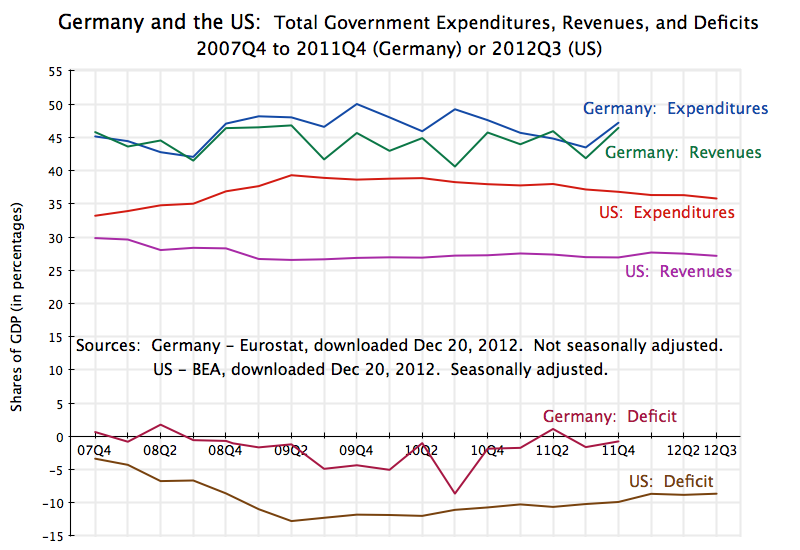
Germany & US - Govt Expenditures, Revenues, Deficit - 2007Q4 to 2012Q3

As was noted in the preceding post on this blog, austerity programs implemented in most of the major European economies in 2010/2011 have led to a double-dip recession in Europe, as the incipient recovery of 2009/2010 was killed.  Germany would appear to be an exception to this, as the German economy (like that of the US) continued to grow in 2011 and 2012.  The top graph above (repeated here from the preceding blog post) shows the growth since the end of 2007 for Germany, the US, and for the Eurozone area as a whole, as well as for France, the Netherlands, and the UK.

Germany, led by Angela Merkel of the conservative Christian Democrats since 2005, has been especially adamant in insisting on the austerity programs.  She pushed for such programs in much of the continent, and in particular as a condition of financial loan support from Germany in the cases of Spain, Italy, Greece, and others.  She was also the principal proponent of the “fiscal compact” under which EU member governments would be required to maintain balanced budgets.

Given all this, one would have expected that Germany itself would have followed a strict austerity program.  However, it in fact allowed government expenditures to rise relatively sharply (see the second graph above), and by a good deal more than in the US.  What is different in Germany is that it also kept up its government revenues, rather than seek to stimulate the economy through tax cuts.  This is seen in the third graph.  The result is that while German fiscal deficits grew, to almost 5% of GDP in 2010, they remained well below the deficits seen in the US and elsewhere.  The deficit was then reduced in 2011 as revenues rose and expenditure growth was moderated, but with a resulting slow-down in German growth in 2011 and 2012 (see the top graph).

In contrast to Germany, the US had government consumption and investment expenditures level off in 2010 and then fall in 2011 (second graph).  Total government expenditures (including transfer payments, such as for Social Security and Medicare) were reduced after peaking in the second quarter of 2009 (third graph).  But the US also cut back sharply on taxes (as discussed in this blog post).  The result was an increase in the overall government deficit to over 12% of GDP (for all levels of government).  This has now come down to about 8 1/2% of GDP, but remains high.

Germany is often cited as an example by conservatives in the US and elsewhere of prudent fiscal policy in response to the crisis.  The German fiscal deficit is indeed relatively modest.  But the German deficit is modest not because government expenditures are low, but because Germany has kept government revenues high.  Indeed, German government expenditures are a good deal higher than they are in the US as a share of GDP (21% higher in 2011).  But German government revenues are also far higher than they are in the US (64% higher in 2011, as a share of GDP).  The prudence comes not from low government expenditures, but from ensuring government revenues are kept high to pay for such expenditures.

Senator Mitch McConnell, the Republican Leader in the Senate, has said repeatedly in recent years:  “We’re not in this mess because Washington taxes too little; we’re in this mess because Washington spends too much.”  The example of conservative and fiscally prudent Germany points to the opposite:  We are in trouble not because Washington spends too much, but because it taxes too little.

————————————————

Notes on Data

The data for Germany comes from the European statistical agency Eurostat.  It is an excellent source of consistent data for all members of the European Union.  However, national accounts and fiscal data for Europe are gathered differently in the US, which sometimes makes it difficult to arrive at directly comparable data.  In particular:

  • Quarterly data on government total expenditures and revenues are not available on a seasonally adjusted basis.  Furthermore, the most recent quarterly data reported is only for the period through the fourth quarter of 2011.
  • While seasonally adjusted quarterly data (in real, inflation-adjusted, terms) are available in the national income (GDP) accounts for government consumption, the national income accounts in Europe do not show government investment separately.  Rather, government investment is combined with private investment in the European accounts.  In the US, the national income accounts record government consumption and government investment together.
  • Real government investment is available separately on an annual basis for the European economies, which is why the second graph above shows these numbers on an annual rather than quarterly basis.
  • Total government expenditure (for not just consumption and investment, but also including transfer payments such as for old-age pensions, medical care, unemployment insurance, etc.) is available on a quarterly basis, but only in nominal terms (i.e. not inflation adjusted) and not on a seasonally adjusted basis.  The German data in the third graph was therefore shown as a share of GDP, and the lack of seasonal adjustment accounts for the quarterly fluctuation seen.  When figures are quoted in the text (such as for 2011 government expenditures and revenues) the four quarter average was used.
  • The US data comes from the Bureau of Economic Analysis (BEA) of the US Department of Commerce.

Finally, note that “government” as defined here includes all levels of government:  federal, state, and local.

Romney’s Proposal to Cut to Zero the Taxes on Income from Wealth for those Making Up to $200,000

Having just watched the second presidential debate between President Obama and former Governor Romney, I want to make a quick point on Romney’s tax proposals that have not been much commented upon.

It is well known that Romney has proposed a tax plan where he would cut all individual income tax rates by 20%.  It is accepted by all, including Romney, that this by itself would cut tax revenues by about $5 trillion over ten years, but that Romney then says he would also cut certain (but unspecified) tax deductions and other preferences in the tax code so as to raise back that $5 trillion and thus make the overall plan revenue neutral.

While this has been much discussed (and the impossibility of doing this without increasing taxes on the middle classes has been noted by neutral observers, including the Tax Policy Center, a group that Romney himself had praised during the Republican primaries), certain other aspects of his tax proposals have been less discussed.  One, which Romney highlighted in the debate tonight, would be that he would cut to zero the income earned from dividends, interest, and long term capital gains, for all households earning up to $200,000 a year.

Note what this implies.  Suppose you are someone who has $4 million in wealth.  Perhaps you inherited this from someone, or struck it rich in the stock market, or won the lottery.  And suppose you are earning a modest 5% on this $4 million from dividends plus interest plus long term capital gains.  You would then be receiving $200,000 a year from this wealth.  While perhaps not really rich, the income is good enough for you, so you do not work.  Under Romney’s proposal, you would pay zero in federal taxes.

In contrast, suppose you work for a living, earning $100,000 a year (or half of what the better off individual described above earns simply from his wealth).  You would pay Social Security and Medicare taxes at a rate of 15.3% on this (total, including the half that is nominally is “paid by” the employer, which all analysts, including Republican ones, agree comes out of worker wages).  You would also be in the middle of the 25% tax bracket currently for federal income taxes, which would fall to 20% under Romney’s proposal to cut all rates by 20%.

Even ignoring the additional taxes you would pay under Romney’s proposal to reduce or eliminate certain (but unspecified) tax deductions and tax preferences, the individual earning $100,000 a year would pay taxes at a marginal rate of 35.3% ( = 15.3% + 20%).  But the wealthy individual, with $4 million in wealth making $200,000 a year would pay absolutely zero.

How can this be considered fair?

Why Does America’s Infrastructure Cost So Much to Build?

The US chronically underinvests in infrastructure, to the point where even a country as poor as China enjoys a better train system, better airports, better highways and bridges, and more extensive urban subways.

Part of the reason is that taxes in the US are low, so public infrastructure spending gets squeezed.  Comparing the US to the 34 OECD countries and using OECD data (the OECD is a “club” of the main rich countries of the world, along with a few upper middle income countries such as Chile, Mexico, and Turkey), US overall taxes were only 24.1% of GDP in 2009, the most recent year with data published for all OECD members.  This was only seven-tenths of the average for all OECD members of 33.8%.  Taxes in Denmark were the highest, at 48.1%, or double the US level, and living standards in Denmark are excellent with the Danish economy doing well.  It is hard to see how one can assert, as the Republicans repeatedly do, that even slightly higher taxes than the US has now will bring economic ruin.  The only OECD members collecting less in taxes than the US are Chile and Mexico.  That is part of the reason why infrastructure in the US, which was at one time excellent, is now closer to what one finds in Chile and Mexico than what one finds in Europe.

But in addition to spending less, I was struck by two articles in the local section of today’s Washington Post which illustrate the problem of costs.  First, an article on the American Legion Bridge, which carries the northern portion of the Capital Beltway (Interstate 495) over the Potomac River, noted that the bridge opened in December 1962, and cost $2.8 million to build.  This was not a small project.  It opened with six lanes of Interstate Highway, and 48,000 vehicles a day used it in 1965.  Yet it cost only $2.8 million.  This would be equivalent to $21.3 million in today’s prices, using the general CPI index for inflation.

A second article noted that the Klingle Valley Park (a portion of Rock Creek Park, which follows a stream valley leading into Rock Creek) might reopen in a few years.  An old road ran through this park, but the road was closed following a storm twenty-one years ago when portions caved in.  The article was on a recent court decision that dismissed a case by a group wishing to build a new road through that park.  This may now clear the way to proceed with re-opening the park with a hiking – biking trail, which the DC Council approved in 2008, which would follow the route of the old road.  Personally, I strongly support this.

The park is only three-quarters of a mile long.  One would think that building a paved trail (where most portions of the concrete base of the old road still exist) should not cost much. But along with work on new storm sewers to follow this short right-of-way and with some general environmental work, the cost is now estimated at $8 million to $11 million.

Why is it that one could build a major bridge carrying six lanes of Interstate Highway over the Potomac River in 1962 for $21.3 million in today’s dollars, but a hiking-biking trail three-quarters of a mile long, together with some storm sewer and environmental work, will cost fully half as much?  I do not know the answer, but one sees such high prices in all of the major recent infrastructure projects.  Consideration has to be given to how we can build these projects less expensively, or America will remain short of the infrastructure a modern economy requires.