Trump’s Attack on Social Security

Trump famously promised in his 2016 campaign for the presidency that he would never cut Social Security.  He just did.  How much is not yet clear.  It could be minor or it could be major, depending on how he follows up (or is allowed to follow up) on the executive order he signed on Saturday, August 8 while spending a weekend at his luxury golf course in New Jersey.  The executive order (one of four signed at that time) would defer collection of the 6.2% payroll tax paid by employees earning up to $104,000 a year for the pay periods between September 1 and December 31 (usefully straddling election day, as many immediately noted).

What would then happen on December 31?  That is not clear.  On signing the executive order, Trump said that “If I’m victorious on November 3rd, I plan to forgive these taxes and make permanent cuts to the payroll tax.  I’m going to make them all permanent.”  He later added:  “In other words, I’ll extend beyond the end of the year and terminate the tax.”

The impact on Social Security and the trust fund that supports it will depend on how far this goes.  If Trump is re-elected and he then, as promised, defers beyond December 31 collection of the payroll tax that workers pay for their Social Security, the constitutional question arises of what authority he has to do this.  While temporary deferrals of collections are allowed during a time of crisis, what happens when the president says he will bar the IRS from collecting them ever?  The president swore in his oath of office that he would uphold the law, the law clearly calls for these taxes to be collected, and a permanent deferral would clearly violate that.  But would repeated “temporary” deferrals become a violation of the statutory obligations of a president?  And he has clearly already said that he wants to make the suspension permanent and to “terminate the tax”.

There is much, therefore, which is not yet clear.  But one can examine what the impact would be under several scenarios.  They are all adverse, undermining the system of retirement benefits that has served the country well since Franklin Roosevelt signed the program into law.

Some of the implications:

a)  Deferring the collection of the Social Security payroll taxes will lead to a huge balloon payment coming due on December 31:

The executive order that Trump signed directs that firms need not (and he wants that they should not) withhold from employee paychecks the 6.2% that goes to fund the employee share of the Social Security tax.  But under current law the taxes are still due, and would need to be paid in full by December 31.

Suppose firms did decide not to withhold the 6.2% tax, and instead allow take-home pay to rise by that amount over this four-month period straddling election day.  Unless deferred further, the total of what would have been withheld will now come due on December 31, in one large balloon payment.  For those on a two-week paycheck cycle, that balloon payment would have grown to 54% of their end of the year paycheck.  It is doubtful that many employees would be very happy to see that cut in end-year pay.  Plus how would firms collect on the taxes due on workers who had been with the firm but had left for any reason before December 31?  By tax law, the firms are still obliged to pay to the IRS the payroll taxes that were due when the workers were employed with them.

Hence most expect that firms will continue to withhold for the payroll taxes due, as they always have.  The firms would likely hold off on forwarding these payments to the IRS until December 31 and instead place the funds in an escrow account to earn a bit of interest, but they would still withhold the taxes due in each paycheck just as they always have (and as their payroll systems are set up to do).  This also then defeats the whole purpose of Trump’s re-election gambit.  Workers would not see a pre-election bump up in their take-home pay.

b)  But even in this limited impact scenario, there will still be a loss to the Social Security Trust Fund:

Thus there is good reason to believe that Trump’s executive order will likely be basically just ignored.  There would, however, still be a loss to the Social Security Trust Fund, although that loss would be relatively small.

Payroll taxes paid for Social Security go directly into the Social Security Trust Fund, where they immediately begin to earn interest (at the long-term US Treasury rate).  Based on what was paid in payroll taxes in FY2019 ($1,243 billion according to the Congressional Budget Office), and adjusting for the fewer jobs now due to the sharp downturn this year, the 6.2% component of payroll taxes due would generate approximately $40 billion in revenue each month.  Assuming the $160 billion total (over four months) were then all paid in one big balloon payment on December 31 rather than monthly, the Social Security Trust Fund would lose what it would have earned in interest on the amounts deferred.  At current (low) interest rates, the total loss to Social Security would come to approximately $250 million.  Not huge, but still a loss.

c)  If collection of the 6.2% payroll tax is deferred further, beyond December 31, the losses to the Social Security Trust Fund would then grow further, and exponentially, and become disastrous if terminated:

Trump promised that “if re-elected” he would defer collection by the IRS of the taxes due further, beyond December 31.  How much further was not said, but Trump did say he would want the tax to be “terminated” altogether.  This would of course be disastrous for Social Security.  Even if the employer share of the payroll tax for Social Security (an additional 6.2%) continued to be paid in (where what would happen to it is not clear), the loss to Social Security of the employee share would lead the Trust Fund to run out in less than six years.  At that point, under current law the amounts paid to Social Security beneficiaries (retirees and dependents) would be sharply scaled back, by 50% or more (assuming the employer share of 6.2% continued to be paid).

d)  Even if the Social Security Trust Fund were kept alive by Congress acting to replenish it from other sources of tax revenues, under current law individual benefits would be reduced on those who saw their payroll tax contributions diminished:

There is also an issue at the level of individual benefits, which I have not seen mentioned but which would be significant.  The extent of this impact would depend on the particular scenario assumed, but suppose that the payroll taxes that would have come due and collected from September 1 to December 31 were permanently suspended.  For each individual, this would affect how much they had paid in to the Social Security system, where benefits are calculated by a formula based on an individual’s top 35 years of earnings (with earnings from prior years adjusted to current prices as of the year of retirement eligibility based on an average wage inflation index).

The impact on the benefits any individual will receive will then depend on the individual’s wage profile over their lifetime.  Workers may typically have 20 or 25 or maybe even 30 years of solid earnings, but then also a number of years within the 35 where they may have been not working, e.g. to raise a baby, or were unemployed, or employed only part-time, or employed in a low wage job (perhaps when a student, or when just starting out), and so on.

There would thus be a good deal of variation.  In an extreme case, the loss of four months of contributions to the Social Security Trust Fund from their employment history might have almost no impact.  This would be the case where a worker’s income in their 36th year of employment history was very similar to what it was in their 35th, and the loss in 2020 of four months of employment history would lead to 2020 dropping out of their employment top 35 altogether.  But this situation is likely to be rare.

More likely is that 2020 would remain in the top 35 years for the individual, but now with four months less of payroll contributions being recorded.  One can then calculate how much their Social Security retirement benefits would be reduced as a result.

The formulae used can be found at the Social Security website (see here, here, and here).  Using the parameters for 2020, and assuming a person had earned each year the median wages for the year (see table 4.B.3 of the 2019 Annual Statistical Supplement of Social Security), one can calculate what the benefits would be with a full year of earnings recorded for 2020 and what they would be with four months excluded, and hence the difference.

In this scenario of median earnings throughout 35 years, annual benefits to the retiree would be reduced by $105 (from $17,411 without the four months of non-payment, to $17,306 with the four months of the payroll tax not being paid).  Not huge, but not trivial either when benefits are tied to a full 35 years of earnings.  That $105 annual reduction in benefits would have been in return for the one-time reduction of $669 in payroll taxes being paid (6.2% for four months where median annual earnings of $32,378 in 2019 were assumed to apply also in 2020 despite the economic downturn).  That is, the $669 not paid in now would lead to a $105 reduction in benefits (15.8%) each and every year of retirement (assuming retirement at the Social Security normal retirement age).

The loss in retirement benefits would be greater in dollar amount if the period of non-payment of the payroll tax were extended.  Assuming, for example, a scenario where it was extended for a full year (and one then had just 34 years of contributions being paid in, with the rest at zero), with wages at the median level throughout those now 34 years, the reduction in retirement benefits would be $316 each year (three times as much as for the four-month reduction).  Payroll taxes paid would have been reduced by $2,007 in this scenario, and the $316 annual reduction is again (given how the arithmetic works) 15.8% of the $2,007 one-time reduction in payroll taxes paid.

All this assumes Social Security would continue to pay out retiree benefits in accordance with current law and assumes the Trust Fund remained adequate.  The suspension of these payroll taxes would make this difficult, as noted above, unless there was then some general bailout enacted by Congress.  But any such bailout would raise further issues.

e)  If Congress were to appropriate funds to ensure the Social Security Trust Fund remained adequately funded, the resulting gains would be far greater for those who are well off than for those who are poor:

Suppose Congress allowed these payroll taxes to be “terminated”, as Trump has called for, but then appropriated funds to ensure benefits continued to be paid as per the current formulae.  Who would gain?

For at least this part of the transaction (the origin of the funds is not clear), it would be the rich.  The savings in the payroll taxes that would be paid in order to keep one’s benefits would be five times as high for someone earning $100,000 a year as for someone earning $20,000.  The tax is a fixed 6.2% for all earnings up to the ceiling (of $137,700 in 2020, after which the tax is zero).  The difference in terms of the benefits paid would be less, since the formulae for benefits have a degree of progressivity built-in, but one can calculate with the formulae that the change in benefits from such a Congressional bailout would still be 2.3 times higher for those earning $100,000 than for those earning $20,000.

One might question whether this is the best use of such funds.  Normally one would want that the benefits accrue more to the poor than to those who are relatively well off.  The opposite would be the case here.

f)  Importantly, none of this helps those who are unemployed:

Unemployment has shot up this year due to the mismanagement of the Covid-19 crisis, with the unemployment rate rising to a level not seen in the US since the Great Depression.  Unemployment insurance, expanded in this crisis, has proven to be a critical lifeline not only to the unemployed but also to the economy as a whole, which would have collapsed by even more without the expanded programs.

Yet cutting payroll taxes for those who have a job and are on a payroll will not help with this.  If you are on a payroll you are still earning a wage, and that wage is, except in rare conditions, the same as what you had been earning before.  You have not suffered, as the newly unemployed have, due to this crisis.  Why, then, should you then be granted, in the middle of this crisis where government deficits have rocketed to unprecedented levels, a tax cut?

It makes no sense.  Some other motive must be in play.

g)  This does make sense, however, if your intention is to undermine Social Security:

Trump pushed for a cut in the payroll taxes supporting Social Security when discussions began in July in the Senate on the new Covid-19 relief bill (the House had already passed such a bill in May).  But even the Republicans in the Senate said this made no sense (as did business groups who are normally heavily in favor of tax cuts, such as the US Chamber of Commerce), and they kept it out of the bill they were drafting.

The primary advisor pushing this appears to have been Stephen Moore, an informal (unpaid) White House advisor close to Trump.  He co-authored an opinion column in The Wall Street Journal just a week before Trump’s announcement advocating the precise policy of deferring collection of the Social Security payroll tax.  Joining Moore were Arthur Laffer (author of the repeatedly disproven Laffer Curve, whom Trump had awarded the Presidential Medal of Freedom in 2019), and Larry Kudlow (Trump’s primary economic advisor and a strong advocate of tax cuts).

Moore has long been advocating for an end to Social Security, arguing that individual retirement accounts (such as 401(k)s for all) would be preferable.  As discussed above, the indefinite deferral of collection of the payroll taxes that support Social Security would, indeed, lead to a collapse of the system.  Thus this policy makes sense if you want to end Social Security.  It does not otherwise.

Yet Social Security is popular, and critically important.  Fully one-third of Americans aged 65 or older depend on Social Security for 90% or more of their income in retirement.  And 20% depend on Social Security for 100% of their income in retirement.  Cuts have serious implications, and Social Security is a highly popular program.

Thus advocates for ending Social Security cannot expect that their proposals would go far, particularly just before an election.  But suspending the payroll taxes that support the program, with a promise to terminate those taxes if re-elected, might appear to be more attractive to those who do not see the implications.

The issue then becomes whether enough see what those implications are, and vote accordingly in the election.
The Spread of Covid-19: Trump States vs. Clinton States – An Update

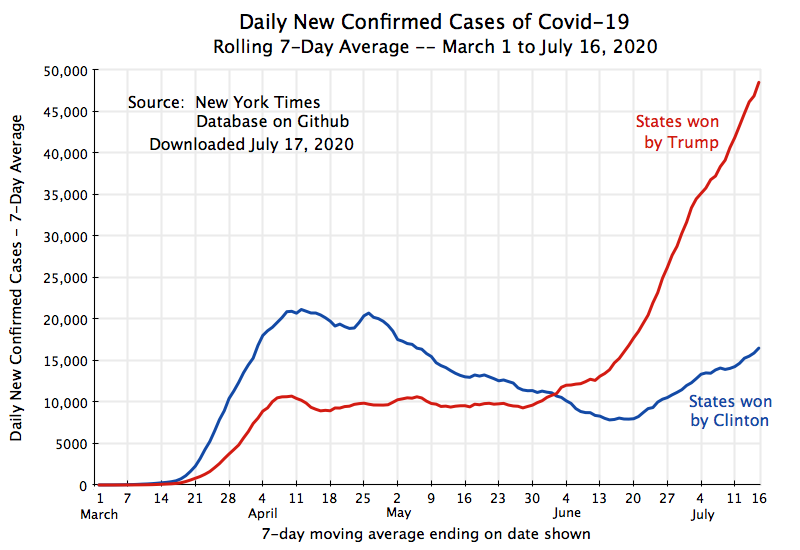
An earlier post on this blog compared the spread of Covid-19 in the states that Trump had won in 2016 to that in the states won by Clinton, with data through June 24.  This post will update those figures to July 16.  The trends have become even clearer.

As seen in the chart above, new cases in the states won by Trump have continued to shoot upwards, at an alarming pace.  They had reached 22,000 new cases per day as of June 24 (based on a seven-day rolling average ending on that date), but have now (as of July 16, just three weeks later) more than doubled to 48,500.  The decisions to rapidly reopen by the governors of such Trump-won states as Florida, Georgia, Texas, and Arizona, as well as others, have clearly been a disaster.  The virus is now spreading rapidly in those states, and some of these governors are now putting back in place (albeit only partially) the social distancing measures that had earlier worked.

Daily new cases are also now clearly increasing in the states won by Clinton.  This trend was still too recent to be clear in the data through June 24.  But the pace of spread in the Clinton states is far below that of the Trump states, and the number of new daily cases in the Clinton states (16,500 as of July 16) is only one-third the number in the Trump states.

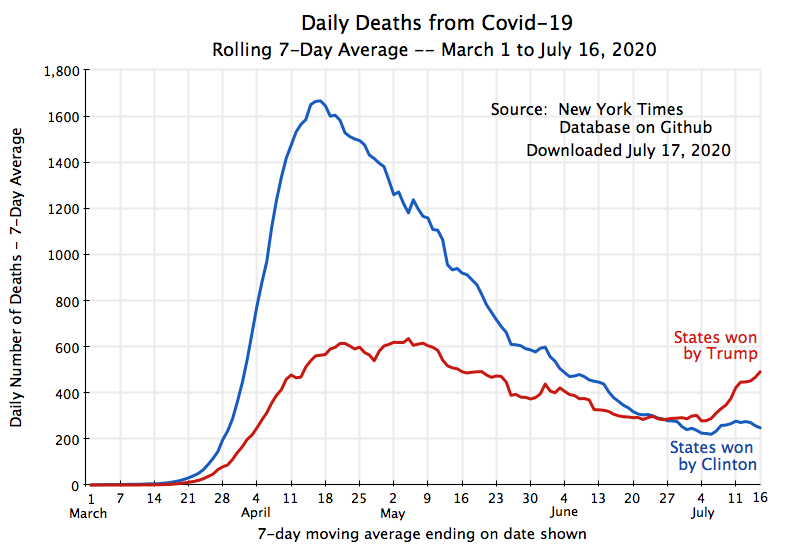
The trends in the figures for the number of deaths from Covid-19 have also now become clear:

In the previous data through June 24, the daily number of deaths (again based on seven-day rolling averages) had come down from their mid-April peaks to a relatively flat level as of mid-June.  This had marked a sharp decline of over 80% in the daily number of deaths in the Clinton states (where peaks early in the crisis in New York had overwhelmed the hospital system, at a time when still little was known on how best to treat the extremely sick), and by a lesser but still significant decline (about 50%) in the Trump states.

Since mid-June, the daily number of deaths in the Clinton states has been relatively flat (hovering between about 200 and 300).  But there has now been a significant increase in deaths in the Trump states, rising from a trough of about 280 per day to now almost 500, an increase of about 75%.  And the path points to a continued rise, as one would expect given the even sharper rise in daily new cases (as there is a lag – deaths occur several weeks after when a case is first confirmed).

These trends should be worrisome in the extreme.  They are not the consequence of increased testing in the US, as Trump has repeatedly asserted.  While testing was slow to start in the US (the administration had bungled the roll-out in February and into much of March), there has not been a significant change in test availability since mid or late April, and certainly since May.  The increases in cases started in June.  More people are now being tested because more people are getting sick, and seek a test as they come down with the symptoms.  And the increase in the number of people dying from the disease is certainly not a consequence of testing, but rather of more people becoming sick.

More could be done, but sadly this presidential administration isn’t.  And it would not be all that difficult.  As I had noted in my June 25 post, a relatively easy measure would be for everyone to wear masks.  Since that post, Robert Redfield (the head of the CDC) noted in an interview on July 14 that “if we could get everyone to wear a mask right now, I really do think that over the next four-six-eight weeks we could bring this epidemic under control” (see this YouTube video of the interview, starting at about the 4-minute mark).  He noted that this is not difficult – the problem is just that not enough people do it.

For many of those refusing to wear a mask – some adamantly so – the issue is seen as political.  The problem started with Trump, where at the April 3 press conference announcing CDC guidelines calling on people to wear face masks, Trump simultaneously emphasized that he would not himself abide by those guidelines.  With any other president, this would be unbelievable.  Since then, supporters of Trump have increasingly seen the issue as one of making a political statement rather than as the public health matter that it is.  A recent academic study found that political partisanship is the most important factor in explaining whether or not people will wear masks and exercise other social distancing recommendations, and that this partisan difference has grown over time.

This has even become violent.  In early May, for example, a security guard at a Famlly Dollar store told a customer she would need to wear a face mask to enter, as per the state orders of the time.  She returned with members of her family about 20 minutes later who shot the guard, who died.  More recently, a 43-year old man entering a convenience store without a mask was asked by another customer to put on a mask.  He responded by stabbing the 77-year old customer.  The man then fled, was later spotted by police, and started to attack the policewoman who then shot him.  He died.  And there have been, sadly, a number of such incidents.

Those refusing to wear face masks when in public insist that such a requirement infringes on their “freedom”.  Thus, as a matter of principle, they refuse to do it.  If it was indeed the case that the only one suffering harm from not wearing a mask was that individual only, I would not be so concerned.  But that is not the case – others exposed may then become infected, and possibly even die.  It is similar to speed limits on highways.  If the only one who might be harmed by speeding is the speeder only, I would not be so concerned.  But speeders may harm, and possibly kill, others as well.  Hence we have speed limits and those limits are enforced.

Refusing to wear a face mask under a belief that it is an infringement on freedom, and responding with threats or even violence when asked to do so, is madness.  With true leadership in Washington we would have a president who would act on this.  Not only would that president model responsible behavior by wearing a face mask himself when in public or when meeting with others, he would also call on all his supporters to do so as well.  They might listen to him.  But his refusal to do so speaks volumes itself.

The Failure of the US to Limit the Spread of Covid-19: A Comparison to What Other Countries Have Been Able to Achieve

A.  Introduction

The virus that causes Covid-19 has struck countries around the world, and it is the same virus everywhere.  But countries have responded differently.  Many countries have responded effectively, and some highly effectively.  The US is not among them.  The experience in other countries shows what would have been possible, had the US responded as they did.  Unfortunately, the US, with Trump leading as president, did not.

B.  The US Compared to Italy, Spain, Germany, and the UK

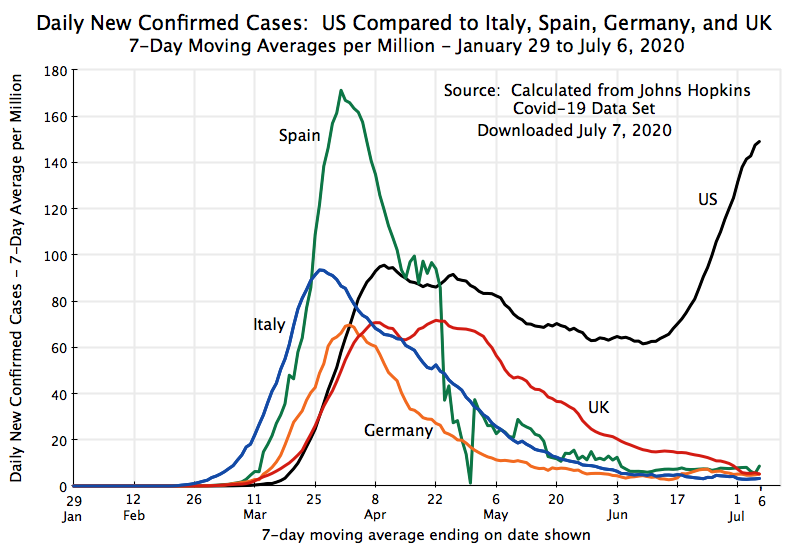
The chart above shows the daily number of new confirmed cases (on a 7-day moving average basis) since the start of the pandemic through to July 6, for the US plus several of the larger countries of Western Europe:  Italy, Spain, Germany, and the UK.  These countries were chosen in part as they were all hit with the virus that causes Covid-19 earlier than most (including earlier than in the US).  They thus faced a crisis when much was still not known about the virus, including how quickly it could spread and under what conditions, and uncertainty on what should be done to bring it under control.  The underlying data on Covid-19 case totals, from which the figures for the chart were derived, comes from the widely-used data set maintained by Johns Hopkins University.  Population numbers from the UN were used to put the number of cases on comparable terms:  of daily new cases per million residents.

Italy was the first major country in Europe to have been hit by the virus, for reasons still not fully known.  Cases rose quickly, reaching a peak at the end of March.  Spain came next, roughly a week later than Italy at first, but then rose especially quickly to a peak in early April of almost double the peak in Italy.  Germany also had a high number of cases early, but was then more successful through aggressive testing and quarantining to keep the peak from rising as high.  Finally, the UK saw a similar peak to that of Germany, but with that peak then lasting for close to a month.

Each of these European countries was then able to bring their daily new case numbers down sharply, to less than 10 new cases a day per million residents by early July (and indeed by early June for all other than the UK).  Each country had its own policies, and I will not go into the nuances of the country-specific differences here, but they succeeded through a combination of social distancing (including lockdowns), wide use of masks, extensive testing, contact tracing, and then isolation or quarantining of those infected or exposed to someone infected.  And with their success in bringing down the number of Covid-19 cases, these countries are now opening up for business, schools, and travel, and are doing so safely.

The US followed a different path.  Cases rose similarly at first as in these European countries, although with a lag (or about two weeks compared to Italy).  One should be cautious with these early numbers as testing, particularly in the US, was not as complete as was being done later, but the early trends appear to be broadly similar.

But what is important is what happened next.  In contrast to the European countries, who were all able to bring down their case numbers by 90% or more, new daily cases in the US fell much more modestly.  Despite official policies (in much, although not all, of the country) to lock down the economy to limit person-to-person spread of the virus, plus guidelines encouraging (and in some cases mandating, but with lax to no enforcement) the wearing of masks and social distancing, the daily case numbers in the US were reduced only from about 95 per million in early/mid April to a trough in early June that never fell below 60.

US cases then started to shoot up.  This followed the easing of social distancing and other measures to limit the spread of the virus during the month of May.  While there were important differences by state and indeed often by locality, most states started to lift the measures cautiously in early May and much more comprehensively by the end of May (and sometimes completely so by that point).  And as was examined in an earlier post on this blog, the increases in daily cases have been particularly sharp in the states won by Trump in 2016 – states often with governments and a population that have been particularly aggressive in lifting (or increasingly ignoring) those measures.

As a further example of the impact of this politicization of what should be seen as basic public health measures, the number of Covid-19 cases in Tulsa, Oklahoma, have now spiked two weeks after Trump held a large campaign rally in an indoor arena there.  Local health officials have said it is “more than likely” that the two are linked.  Few at the Trump rally wore masks, they were grouped closely together for the cameras, and loud cheering was of course encouraged.  The two week lag from the rally to the spike in Covid-19 cases is about what health experts say one should expect, between when there is exposure to the virus at an event such as this to when confirmed case numbers will rise as results are obtained for people seeking tests following an onset of symptoms.

C.  The US Compared to Europe, Canada, and Sweden

The chart at the top of this post highlights only a few countries.  But the same results hold for Western Europe as a whole as well as for Canada:

Cases in Western Europe as a whole rose early, reached a peak, and then fell.  Since early June cases have remained below 10 per day per million.  As of July 6, they were at 8.3, or less than 6% of the US rate of 149 per day.  The path for the countries of Eastern Europe (the countries from Estonia on the north to Bulgaria on the south, who are now mostly members of the EU) is interesting as they were able to contain the virus throughout, with a peak of less than 14 in early to mid-April.  But a modest increase in recent weeks (to almost 15 currently) warrants watching.

Canada is also interesting as the economy and the population are broadly similar to that of the US, but with very different politics.  Cases rose in Canada to a peak of about 50 in mid-April.  But they were then brought down, to levels now very similar to that of Western Europe.  Again, this is in sharp contrast to the US.

Sweden is an exception to others in Europe.  It is also the one country of the rich Western democracies that explicitly followed a different policy path.  Instead of mandating a lockdown of the economy, the wearing of masks, social distancing, and other such measures, it only issued general guidance.  And even this guidance was eased later.  Daily cases per million then reached about 60 in late April, fell only modestly to about 50 in late May, before increasing significantly to as much as 120 at points in June (although with erratic numbers that probably reflect reporting practices).  Sweden is now taken as a good example of what not to do.  Furthermore, while “protecting the economy” was presented as a rationale for Sweden’s decision to issue only general guidelines, with no requirement for businesses such as restaurants to close, early evidence indicates that the Swedish economy has suffered similarly to those of its neighbors.  There was no economic gain, but a profound human loss in sickness as well as lives.  As I write this (July 9), the accumulated number of deaths per million of population has come to 545 in Sweden, or roughly ten times the totals of 46 in neighboring Norway and 59 in Finland.

D.  The US Compared to East Asia, Australia, and New Zealand

Europe (with the exception of Sweden), as well as Canada, have therefore been far more successful than the US in limiting the spread of the virus that causes Covid-19.  But the countries that have been by far the most successful in containing the virus have been those of East Asia, as well as Australia and New Zealand:

Drawn on the same scale as the other charts, one can barely distinguish their case levels, other than during a few, and still always low, periods (in early March in South Korea and in late March and early April for most of the others).  And the daily case rates in Taiwan were never over 1 per million of population, so one cannot distinguish its curve from the horizontal axis of the chart.  Yet Taiwan has probably closer contact with China, from business relationships as well as personal travel, than any other country in the world other than Hong Kong.

All of these countries reacted quickly as soon as it became clear that an infectious disease had spread in China.  While travel limits were imposed, these limits were complemented by extensive testing and contact tracing, quarantining of all travelers (whether citizens or not), and wide use of masks and other social distancing measures.  None of this was secret.  Nor did it require special expertise.  Others could have responded similarly, but did not.

E.  Countries with a Similar Result as the US

Which, then, are the country cases that are broadly comparable to that of the US?  The closest are Brazil and South Africa, with similarities also in the cases of Russia and Mexico:

These are not countries that the US would normally compare itself to.  One should certainly be cautious and note that the quality of the case number data may not be all that good in some of these countries (and indeed, it is not all that good in the US itself).  But the patterns are probably broadly accurate.

Brazil is the one major country in the world with more confirmed cases (per million of population) than the US.  Its right-wing president, Jair Bolsonaro, has responded to the virus in many ways similar to Trump.  He has consistently downplayed the virus (like Trump), has refused to wear a mask (like Trump), has encouraged rallies to oppose rules on social distancing that some Brazilian states and localities had issued (also like Trump), and has insisted that the disease is not serious but rather “It’s just a little flu or the sniffles”.  And like Trump, he accuses the media of stoking hysteria.

The result is that the number of cases in Brazil per million of population is now the highest of any large country in the world, and indeed second only to the US in absolute total number.  And on July 7, Bolsonaro himself tested positive for the virus.  Again like Trump (who took the drug when he was possibly exposed to the virus), Bolsonaro is now taking doses of hydroxychloroquine as a treatment, even though there is clear evidence that this drug does not help with Covid-19 and may in fact do harm.

Other countries with rising numbers of new cases include South Africa and Mexico.  The daily cases for South Africa now match the US number, with a path since mid-June broadly similar to the US path.  Russia saw an increase in April to mid-May, after which there has been some decrease.  But the daily numbers in Russia remain high.

F.  Conclusion

There is not much here for the US to be proud of.  While countries in Western Europe, as well as Canada, saw sharp increases in cases in much of March and early April, they were then all (with the notable exception of Sweden) able to bring the rates for new cases down to modest levels.  With that success, they are now reopening their economies, are permitting travel (other than, notably, to and from the US), and will be reopening schools.  They are all still cautious, and maintain aggressive efforts at testing, contact tracing, and then quarantining when warranted, but their success in bringing down the daily case numbers means they can, albeit carefully, resume a degree of normalcy.  It is possible that things will take a turn for the worse in the weeks and months ahead.  Until there is an effective vaccine that is broadly available, there will remain conditions in which the virus could pop up and cause major disruptions again.  But the situation in these countries has remained stable there for more than a month now.

Countries in East Asia, as well as Australia and New Zealand, have done far better.  They kept rates low from the start and have thus been able to reopen safely and more quickly.  Indeed, schools in Taiwan never even closed (other than for a two-week extension of the traditional Chinese New Year holiday in February).  But Taiwan then opened schools safely, with students required to wear masks, temperature checks carried out daily of all students, and with plastic shields installed to separate desks from each other.  [Not everyone liked this.  I know from direct personal information that at least a few elementary school age children thought it horribly unfair that they have had to go to school while children around the world were able to stay home.]

So who resembles the US in effectiveness in limiting the spread of the virus that causes Covid-19?:  Among the larger countries of the world, only Brazil and South Africa, and to some extent Mexico and Russia.  In the past, they were not the countries the US would see as comparables.  But they are now.