Although Improving, Still Many More Unemployed Than Job Openings

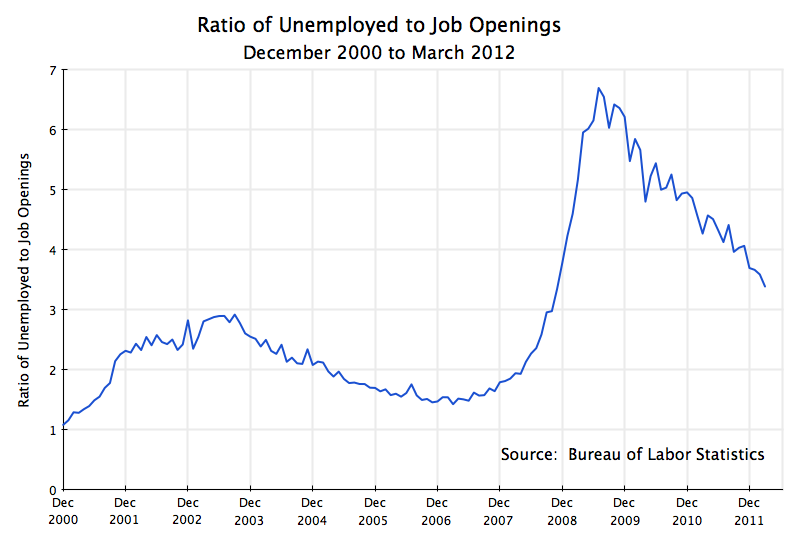
Number of unemployed as a ratio to job openings, US data, December 2000 to march 2012

There are many conservatives who argue that the unemployed need not be unemployed if they were only willing, perhaps with a cut in wages, to take one of the many jobs they assert are available.  Help wanted signs are seen, and thus these conservatives believe the unemployed could get a job if they wished.  They believe the unemployed are unemployed by their own choice, either out of laziness or due to an unwillingness to accept a lower wage.  In terms economists would use, they believe that the markets for labor would always clear if only the workers were willing to accept a lower wage.

The problem with this view is that it is not consistent with the fact that in economic downturns there are many more unemployed than job openings.  Even if every single one of the job openings were immediately filled, there would be many unemployed workers seeking jobs still left.  And since it in fact takes some time to fill any job, and since there is also constant turnover in jobs, one will see the help wanted signs posted for a while.

Data for the US on this is now gathered by the Bureau of Labor Statistics of the US Department of Labor, in a monthly survey of private establishments (which includes non-profits) and government entities.  The survey is a relatively recent one, having started only with data from December 2000, and gathers data on labor turnover (hirings, quits, firings, and other turnover) in addition to job openings (and is called JOLTS, for Job Openings and Labor Turnover Survey).  The labor turnover side of these numbers was discussed in a post on this blog in January, which used the numbers to look at the dynamics of the job market.  The post today will consider the job openings side of this survey.

The graph above, based on the JOLTS data from the Bureau of Labor Statistics coupled with the BLS unemployment figures (from its separate monthly survey of households), shows the ratio of the reported number of job openings to the number of unemployed.  For the most recent month available, the ratio of the number of unemployed to the number of open jobs was 3.4.  That is, there were 3.4 unemployed workers in the US for each open job that employers were seeking to fill.

This ratio of 3.4 is significantly better than the approximately 6.5 ratio of unemployed to open jobs when unemployment was at its peak following the recent economic collapse.  It is interesting to see in the graph the close to straight line downward trend since it hit that peak.  But there are still many more unemployed than available jobs, and the labor market is healing only slowly.  It still has a long ways to go.

Note that when the economy is close to full employment (as in December 2000, at the end of the Clinton presidency, or in late 2006 / early 2007, at the peak of the housing bubble), the ratio is around 1.0 to 1.5.  Note that there is no reason why the ratio necessarily has to be greater than one, as one could in principle have a situation of few unemployed and many open jobs seeking workers.  But in practice, it appears that in the US the ratio will always be greater than one, even when the economy is at full employment.  There will always be some unemployed and some unfilled jobs, and at full employment these are in rough balance.

But the current ratio of 3.4 unemployed for every job opening, while better than the 6.5 ratio seen when unemployment was at is peek, is still well above the 1.0 to 1.5 ratio one sees when the economy is close to full employment.  The unemployed cannot be blamed for being unemployed because they are lazy, or unwilling to accept a lower wage.  They are unemployed because there are too few jobs out there.  And there are too few jobs because there is not sufficient demand for the goods these workers could produce.

As was discussed in postings on this blog on March 3 and on March 12, this insufficiency of demand in the aggregate for what American workers can produce is largely explained by fiscal drag, compounded (although of lesser importance in the aggregate) by the collapse of housing investment following the bursting of the bubble.  Government (mostly at the state and local level) has cut back in this downturn.  This is in contrast to the expansions of government spending and hence government demand seen in other downturns, and very notably in contrast to the strong expansion in government spending during the Reagan period (despite the myth).  As the March 3 post estimated, if government spending (including state and local) during the Obama presidency had been allowed to expand by as much as it had during the Reagan presidency, the economy would now be at full employment.
Weekly Initial Claims for Unemployment Insurance: A Good Report, But Not Yet Where It Needs to Be

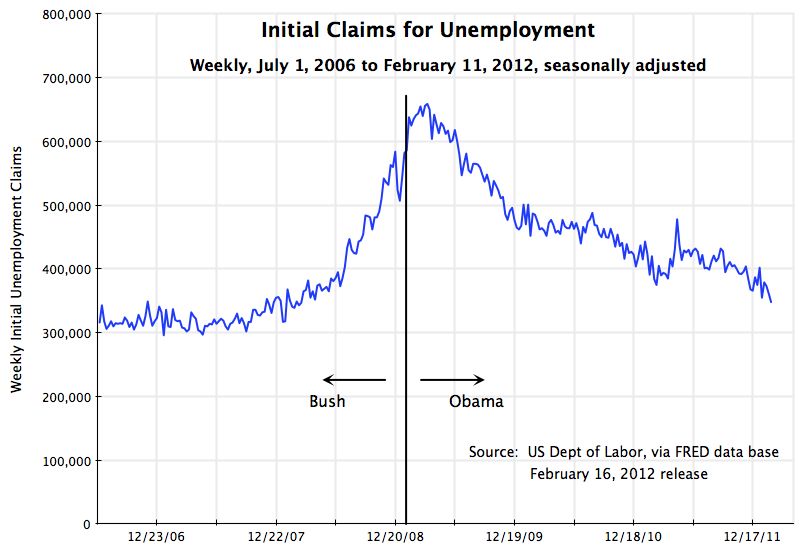
Initial claims for unemployment insurance continue to improve, although claims are still somewhat above where they would normally be when the economy is at full employment.  While there is a good deal of noise in the week to week figures, the trend has clearly been an improving one.  But there are concerns that weak US growth, and problems stemming from Europe and elsewhere, could undermine the improvement seen so far.

The data come from this morning’s regular weekly release by the US Department of Labor, and it is helpful to see the figures in the longer term context.  The graph above updates one from my posting of November 20, 2011.  Initial claims for unemployment insurance came to 348,000 in the week ending February 11, far better than the roughly 650,000 per week who were being laid off and filing claims for unemployment insurance when Obama took office.

The initial unemployment claims are still somewhat above, although now fairly close to, the level of around 310,000 to 320,000 per week that one would see when the economy is at close to full employment.  As was discussed in a January 19 posting on this blog on the dynamics of the labor market, there is constant churning in the jobs market, with workers being laid off even when the economy is at full employment.  And as was shown in the second graph in that January 19 posting, layoffs are now close to where they were before the 2008 economic collapse.

But new hires remain (at around 4 million per month) well below where they would be when the economy is operating at full employment (around 5 million per month).  Hence unemployment remains high (8.3%).  Firms have a surfeit of cash in their accounts from very high profits (see posting here), but there is little demand for extra production.  Unfortunately, it is now politically impossible (due to concerted Republican opposition in Congress) for the government to follow the expansionary policy one would need to provide that demand.

So the economy continues to grow, but slowly.  Hence the employment situation has continued to improve, but only slowly.  And there are concerns that the on-going recovery in 2012 remains fragile.  As was noted in a January 27 post, US growth in the fourth quarter of 2011 was largely due to a large increase in inventories.  This is unlikely to continue, and even if inventory growth increases again as much as it did in the fourth quarter (with all else growing as it did in the fourth quarter, although these will of course change), GDP growth would come to only 0.8% at an annual rate.

There are also major concerns arising from Europe.  Europe has been following deliberate austerity policies, and consequently is likely now in recession.  It was announced yesterday that GDP fell in the EU as a whole at a 1.2% annualized rate in the fourth quarter (0.3% at a quarterly rate).  The normal criterion for a recession is for two quarters of such negative growth.  The Greek crisis is also not resolved, and could get much worse.  And there are other global concerns as well, such as the risk that tensions with Iran could escalate and lead to an attempt to close of the Straits of Hormuz, and cause oil prices to skyrocket.

So while the labor market has improved, there are concerns on whether this can be sustained.

Employment Growth in January: Better, but Sustainability is a Concern

The employment report for January, released this morning by the Bureau of Labor Statistics, is a positive report.  But while employment growth is now improving, it is still not rapid enough, and its sustainability is a concern.

As I had noted in a posting on December 5 in this blog, monthly employment growth in the US needs to be in a range of roughly 200 to 250,000 per month for unemployment to fall on a sustainable basis.  One is now starting to see that, with overall employment growth of 203,000 in December and 243,000 in January.  With such growth, the unemployment rate fell from 8.9% in October to 8.7% in November to 8.5% in December and to 8.3% in January.  This is certainly welcome.  But unemployment at 8.3% is still far too high.  In a more robust recovery, one would be seeing monthly employment growth figures of over 300,000.

And the overall employment figures are still being held back by falling employment in government (mostly state and local government, which accounts for 87% of government employment in the US, but there have also been falls in federal employment).  In January, total government employment fell by 14,000, thus partly offsetting the rise in private employment of 257,000, to produce the overall gain of 243,000.

For the past year (January 2011 to January 2012), government employment fell by 276,000.  This has been a significant factor in holding down overall employment growth.  And government employment fell by 230,000 in the year before that (January 2010 to January 2011), and fell by 97,000 in the year before that (January 2009, when Obama was inaugurated, to January 2010), for a total fall in government employment of 603,000 over the three years.  In the three years before Obama took office, government employment rose by 248,000 in 2006, rose by 281,000 in 2007, and rose by 200,000 in 2008, for a total increase of 729,000.

Yet Obama has been repeatedly accused of creating an explosion of government.  (For a more detailed review of what has happened to Federal Government employment alone, see this blog.)  Had total government employment risen by 600,000 rather than fallen by 600,000 since Obama took office, one would have had an extra 1.2 million jobs directly.  Even ignoring any multiplier impact, this by itself would have led to an unemployment rate now of 7.5% rather than 8.3%.  And assuming, conservatively, a multiplier of just two (so that one additional government job leads to one additional private job, to supply the goods to cover the increased personal spending of the now employed government workers), the unemployment rate would now be a more respectable 6.7%.

While the January employment report was positive, one should keep in mind that there are threats on the horizon.  Two to consider:

1)  As noted in a January 27 blog, GDP growth in the fourth quarter of 2011 was only 2.8%, and 70% of this came from the change in the change in private inventories.  Without this inventory change, GDP would have grown by just 0.8%.  For the first quarter of 2012, it is unlikely that private inventories will again go up by so much.  And note that because it is the change in the change in private inventories that is the contribution to GDP growth (see this blog), then should private inventories once again increase by as much as they did in the fourth quarter of 2011, the growth in GDP in the current quarter would only be 0.8% (everything else being equal as in the fourth quarter of 2011, which of course it won’t be).  That is, inventories would have to continue to rise by as much as they did in the fourth quarter of 2011 simply to keep GDP growth at 0.8%.  They are likely to rise by far less, and quite possibly might fall if the high level of inventory accumulation in late 2011 was more than suppliers wanted.  This could then significantly hold back production and GDP growth, and hence employment growth, over the next several months.

2)  Europe continues to be problematic, with the focus on policies (fiscal austerity) which will make the situation worse rather than better.  Europe will certainly be in recession in 2012, and probably already is, and this will hurt the US recovery.

And there are of course other risks, such as, for example, an escalation in tensions with Iran leading to disruption of shipping through the Strait of Hormuz, that could cause oil prices to skyrocket.  There are many such scenarios that one can imagine, so a US recovery is anything but certain.  So while the January employment report was a positive one, there are still reasons to be concerned.