
| (change, in thousands of jobs) | Jan 2001 to Jan 2005 | Jan 2005 to Jan 2009 | Jan 2001 to Jan 2009 | Jan 2009 to Nov 2011 |
| Total Employment | -16 | +1,110 | +1,094 | -1,855 |
| Private Sector | -916 | +263 | -653 | -1,262 |
| Government Sector | +900 | +847 | +1,747 | -593 |
Obama has repeatedly and emphatically been charged by Republican politicians as fostering a huge expansion in government job growth, with this a major cause for the weak recovery in private job growth. The facts do not support this. The government sector has in fact been contracting sharply during the Obama period, in distinct contrast to the expansion during the Bush presidency, and it is this contraction which indeed can explain a significant share of the drop in overall jobs in the economy.
The table above, drawn from Bureau of Labor Statistics (US Department of Labor) figures on employment levels by the major sectors, shows the change in the number of those employed, for the periods between January 2001 and January 2005 (the first Bush term), between January 2005 and January 2009 (the second Bush term), between January 2001 and January 2009 (the two Bush terms together), and between January 2009 and November 2011 (the most recent figures, for the Obama term so far).
In the first Bush presidential term, overall job growth was basically zero. But it is striking that it only comes to zero because a decline of 916,000 private jobs is almost fully offset by a nearly identical rise in government jobs of 900,000. Note that while the time periods we are examining are the presidential terms, government job growth is largely affected by changes at the state and local level, as these account for about 87% of government jobs.
During the second Bush term, private sector job growth became positive, by a modest 263,000 for the period (with growth early on offset by the downturn in his final year), while government job growth continued at a roughly similar positive rate as during his first term. With both positive, total job growth was then about 1.1 million.
For the Bush presidency as a whole, it is then interesting to note the overall job growth of about 1.1 million (all in his second term), only came about due to a growth in government jobs of about 1.75 million: Private jobs in fact fell by about 650,000.
During the Obama presidency so far, government job growth went into reverse, with a decline of almost 600,000 jobs. It is interesting that the pace of the decline for the first 34 months of Obama’s 48 month term (that is, through November 2011), matches almost exactly the pace of the increase during either of the Bush terms.
Suppose government job growth had increased during the Obama period at the pace it had during the Bush terms. There would then have been a growth in government employment of over 600,000, rather than a decline of almost that amount, for a swing of 1.2 million jobs. Assuming the same decline as now of over 1.2 million private jobs, overall jobs would have still fallen, but by only about 600,000 rather than over 1.8 million.
Of course, with such a different policy on government job growth, one would not expect private job growth to be the same. Conservatives might argue that the government job growth would “crowd out” the private sector, leading to even an even larger fall in private jobs. But there is no evidence to support this, in an environment where unemployment is high and interest rates on government borrowing are close to zero as the economy suffers from a liquidity trap.
Indeed, the basic insight of John Maynard Keynes is that in such a situation, government job growth (and its accompanying spending) will not only not displace private job growth, but will add to it at a multiple of what is spent directly, as the newly employed by the government will add to demand for privately produced goods and services as they spend their wages. A reasonable estimate of this government employment multiplier would be at least two, and many would argue higher. At a multiplier of two (that is, each additional government job leads to one additional private job, for two total), the swing in government employment of 1.2 million (that is, a rise of 600,000 rather than a decline of about 600,000), would have led to 1.2 million additional private jobs, and total employment growth would then have been a positive of 600,000 rather than a negative of over 1.8 million. This is a swing of 2.4 million jobs. With current unemployment in the US of 13.3 million, and a civilian labor force of 153.9 million, the unemployment rate would then be 7.1% rather than the current 8.6%. It was 7.8% when Obama took office.
One can quibble with the specific figures, and what multiplier to assume. But the basic point is that the contraction in government employment in recent years (primarily at the state and local levels) is a major reason why the overall job picture is still so bad. If government employment had continued to expand at the pace it had during either of the Bush terms, rather than contract at a similar pace, then under quite plausible estimates, unemployment would be less now than when Obama took office.
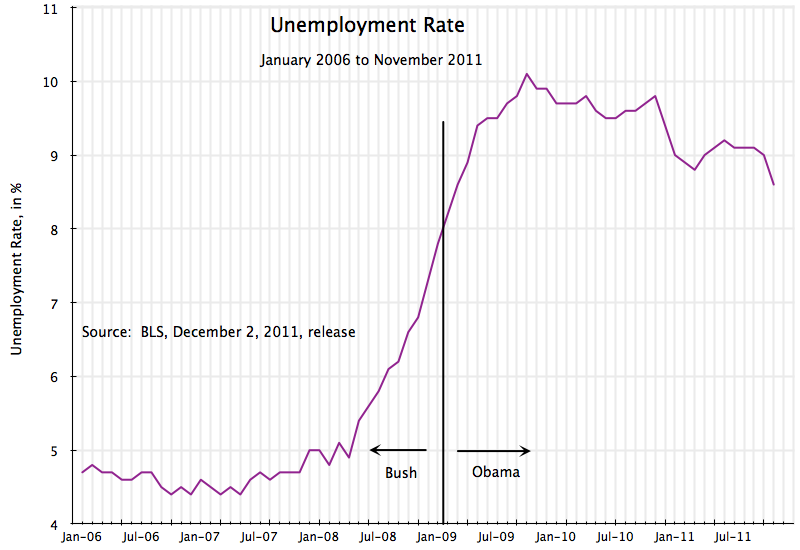
 While Republican politicians have charged that Obama and his policies have been responsible for the high levels of unemployment in the US, the increase was well underway in the Bush Presidency. The weekly figure for initial claims for unemployment began its rise in late 2007, reached its peak two months after Obama’s inauguration, and has fallen since. The levels are still unacceptably high, and are not yet at levels consistent with what they would need to be full employment (new claims will never be zero, as there is always labor turnover), but this is a consequence of the insufficient scale of the stimulus program and other such policies rather than the nature of the policies themselves.
 An Economic Sense
You must be logged in to post a comment.