
The Example of Europe: Austerity Programs Are Indeed Contractionary


Europe GDP Growth, 2007Q4 to 2012Q3 - 1A.  Introduction

As the US comes closer to the so-called “fiscal cliff” (actually, more of a “fiscal slope”, as many have noted, as the impact will build over time rather than hit abruptly), it is worth reviewing the experience of Europe with the type of austerity programs that many are now pushing for the US.  The fiscal cliff we are now facing in the US is a manufactured crisis, created at the insistence of Republicans in August 2011 when they finally approved a higher statutory federal government debt limit.  It is a set of measures that will automatically enter into force on January 1, 2013, unless an agreement had been reached before then on actions to drastically cut back the federal deficit.

Unfortunately the debate underway in Washington is not on whether it is wise now (with the still weak economy) to enter into an austerity program of some sort.  Rather, it is solely on how severe that austerity program should be.  Any agreement will lead to a reduction in government spending and to increases in taxes, relative to what they would have been without the measures being negotiated.

The Republican argument is that adoption of such an austerity program is necessary for the US to be able to continue to grow.  Similar arguments were made in Europe.  Much of the continent has now adopted austerity programs, either willingly (such as in the UK) or due to pressure from other EU members and in particular pressure from the German government (such as in the cases of Greece, Spain, and Italy).  Our aim here is not to review in each case the reasons why the different countries may have chosen to adopt these austerity programs, which as noted was sometimes by policy choice and sometimes as a result of outside pressure.  Rather, the aim is to see what the impacts on growth have been since the programs were adopted (for whatever reason).

It is worth recalling what was said when these programs were first being pushed by prominent European authorities.  While critics forecast that such austerity programs would kill the incipient recoveries from the 2008/09 collapse (that started in the US and then spread globally), the European authorities in favor of these austerity programs argued that there was no need to worry.  They argued that such austerity programs would in fact be expansionary rather than contractionary.

The most prominent example is perhaps in the arguments made by the then President of the European Central Bank, Jean-Claude Trichet.  For example, in a June 2010 interview with La Repubblica (the largest circulation newspaper in Italy), Trichet said:

Trichet:  … As regards the economy, the idea that austerity measures could trigger stagnation is incorrect.

La Republicca:  Incorrect?

Trichet:  Yes. In fact, in these circumstances, everything that helps to increase the confidence of households, firms and investors in the sustainability of public finances is good for the consolidation of growth and job creation.  I firmly believe that in the current circumstances confidence-inspiring policies will foster and not hamper economic recovery, because confidence is the key factor today.

Trichet did not mis-speak.  He made a similar statement a month later in an interview with the newspaper Libération of France:

Libération:  Do the austerity plans announced amid monumental disarray by the Member States pose the risk of killing off the first green shoots of growth?

Trichet:  It is an error to think that fiscal austerity is a threat to growth and job creation. … Economies embarking on austerity policies that lend credibility to their fiscal policy strengthen confidence, growth and job creation.

But that has not been the case.

B.  The Larger European Economies, and Europe as a Whole

The figure above shows the paths of real GDP for the US, for several of the larger European economies, and for the Eurozone area as a whole, relative to the fourth quarter of 2007 (the peak before the start of the downturn in the US, and just before the start of the downturn in Europe, which for most was in the first quarter of 2008).  Some points to note:

  • The early path of the downturns were similar between the US and Europe, with a collapse in 2008 and into the first half of 2009, and then a start of a recovery with the stimulus packages adopted in the US as well as in much of Europe in 2009.
  • But then growth faltered in several of the European economies:  in mid-2010 in the UK, in early 2011 in the Netherlands, and more broadly in the 17 countries making up the Eurozone (who use the euro as their currency) in mid-2011.
  • The turnaround in the UK is particularly interesting for the US, as the UK (like the US) has its own currency and central bank, and can follow its own fiscal policy.  The abrupt end to the UK recovery in mid-2010 followed directly from new measures enacted by the then newly elected Conservative-led government (elected in May 2010, with initial emergency measures implemented from June, and a broader program implemented from October).  This was discussed in a previous blog post on this site.  Many of the Conservative government measures are similar to those being pushed by the Republicans in the US, with a sharp-cut back in government expenditures and in particular cuts in expenditures that provide support to the poor, accompanied by cuts in corporate taxes and more recently cuts in the top tax rates on the rich.
  • But while the Conservative Party argument for the UK austerity program was that this would lead to growth and to a reduction in government debt ratios, it is widely acknowledged now that the downturn that resulted from the austerity measures instead means that the program failed in terms of its originally stated objectives.  The austerity measures did not lead to an acceleration of growth, but rather to stagnation.  (And note that while there was an uptick in GDP by one percentage point in the third quarter of 2012, this has been attributed to the stimulus in spending resulting from the staging of the 2012 Olympics in London.  Indeed, the Bank of England in November, in its official forecast for the economy, noted GDP could fall back again in the fourth quarter of 2012 and downgraded its expected growth in 2013 to only 1%.)
  • Germany appears to be an exception, with a path followed for GDP above that of the US, although with a narrowing since mid-2011.  But while Germany has argued most strenuously and forcefully on the need for other European countries to follow austerity policies, its own internal government spending policies have been expansionary.  This is surprising given its rhetoric, and will be reviewed in a separate post on this blog which will be prepared after this one.  And it is also important to note that even with this performance, German GDP was only 2% higher in the third quarter of 2012 than it was in the first quarter of 2008, for a compound growth rate of only 0.4% per annum over four and a half years.
  • Each country has its own story, and it is not possible to review them all here.  But it is clear that for the Eurozone area as a whole, as well as for the UK but with the exception of Germany (which kept to expansionary government spending), the austerity programs launched in 2010 and 2011 have led to stagnation at best and falling output for most.

C.  Southern Europe and Ireland

There are two other groups of European economies where the response to austerity programs is of interest.  The first is the group of mostly Southern European economies were strict austerity policies were imposed as conditions of support programs from the IMF and the rest of Europe.  Funds were lent in these programs to those governments to enable them to continue to repay their creditors (who were in large part banks from Northern Europe).  This is the group affectionately known as the PIIGS, for Portugal, Italy, Ireland, Greece, and Spain.

The austerity measures led to collapses in output.  (A seasonally adjusted series is not available for Greece, but its path is clear.):
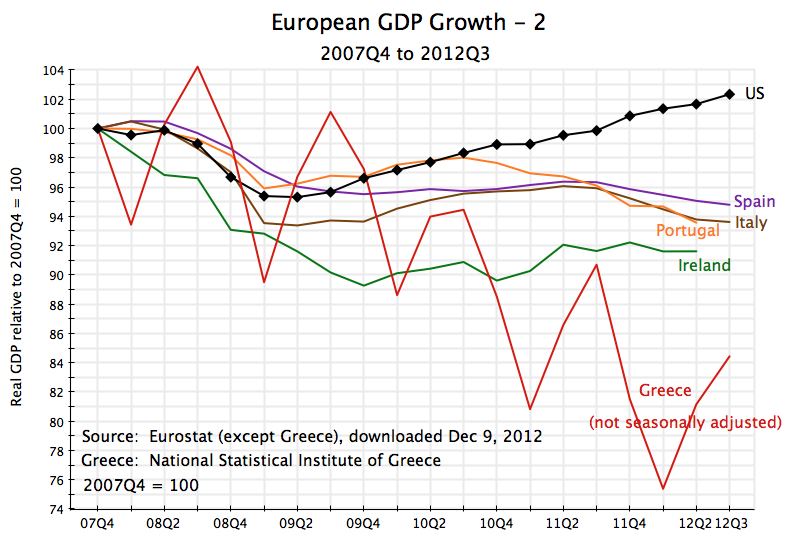
Europe GDP Growth, 2007Q4 to 2012Q3 - 2

D.  The Baltics

The other group of interest is the three small Baltic countries:  Estonia, Latvia, and Lithuania.  They were each severely impacted by the 2008/09 financial collapse, and each responded with stern austerity programs.  With strong growth over the last three years in each of them, these countries are sometimes held as examples of how austerity programs can lead to growth.  But this ignores the depth of the downturns that resulted from their austerity measures.  From the fourth quarter of 2007 to their troughs in 2009, GDP fell by 15% in Lithuania, by almost 20% in Estonia, and by an astounding 25% in Latvia.  There has been growth since then, but their current output remains far below where it was in 2007:
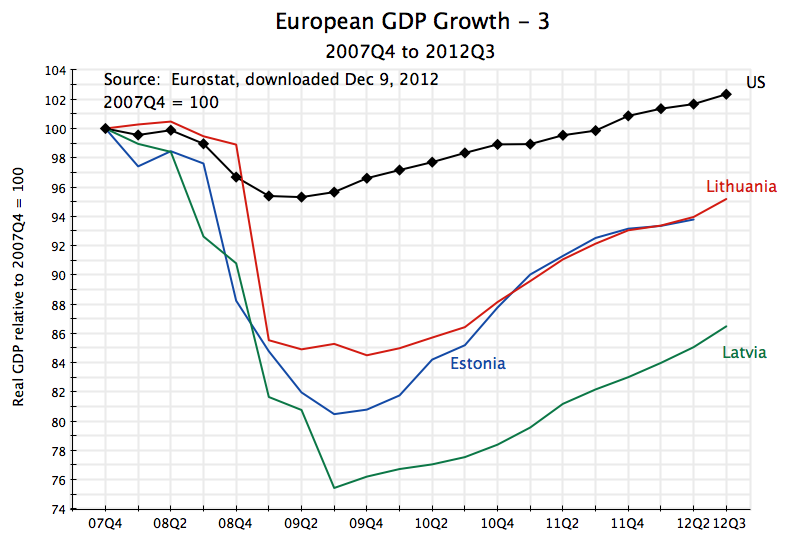
Europe GDP Growth, 2007Q4 to 2012Q3 - 3

Some have argued that the countries had no choice.  Estonia is a member of the Eurozone, and could not as a result depreciate an independent currency without leaving the Eurozone.  As in the other Eurozone members, monetary policy for Estonia is determined centrally by the European Central Bank, and fiscal policy is constrained by the extent to which the country will be able to borrow in the financial markets to finance any deficits.  But as noted above, the aim here is not to ascertain whether or not the countries had any policy choice on whether to follow some austerity program (or how severe that austerity program should have been), but rather what the impacts on growth have been of the austerity programs followed.  And the impacts have been negative.

Lithuania and Latvia had more scope in terms of policies they could have followed, since their currencies, while tied (by government decision) to some rate vis-a-vis the euro, are still independent currencies.  The governments could have chosen to devalue these currencies, which would have spurred their exports.  However, they decided not to, and instead decided to follow programs of severe fiscal austerity.  Output collapsed.

E.  Unemployment

The fall in output resulting from the austerity measures is bad enough by itself.  The loss in output is a loss in real resources, which could have been used for productive purposes.  But the tragedy is in fact much worse, as the pain from falling output is not spread evenly over the population, but rather is concentrated among a few.  In particular, those who lose their jobs and become unemployed see a drop not only in their current living standards, but for many also a permanent loss in their real standard of living, and for all a psychological burden as well.

It is therefore tragic to see how unemployment rates have risen, to almost 12% for the Eurozone as a whole, and to 26% in Spain and Greece following their particularly severe austerity programs:
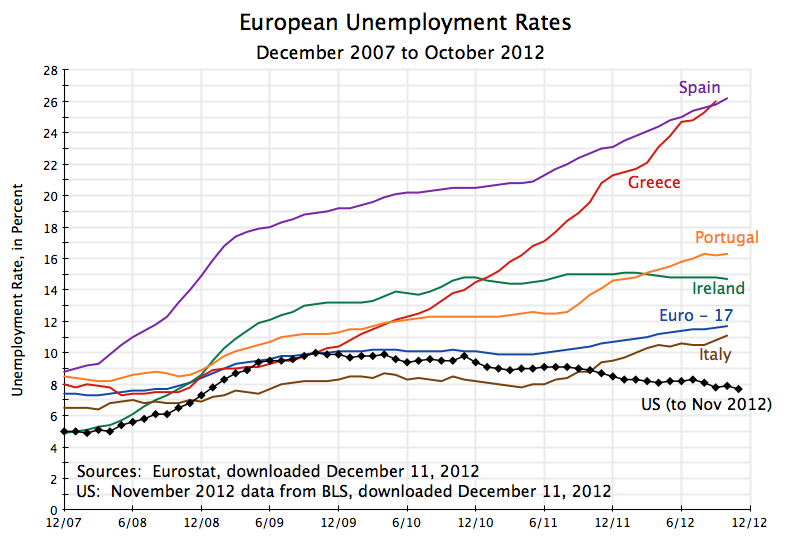
European Unemployment Rates, Dec 2007 to Oct 2012F.  Conclusion

The austerity programs implemented in Europe killed the recoveries which were underway in 2009/2010, and led to double-dip recessions.  Unemployment had started to decline in the Eurozone area as a whole, but then rose following the new austerity programs, reaching a rate of almost 12% recently.  The US economy has so far fared better, with positive growth and a decline in the unemployment rate from a peak of 10.0% to a rate of 7.7% in November 2012.

But there is now the strong danger that if the negotiations under the threat of the fiscal cliff leads to new austerity measures, with expenditure cuts and tax increases starting in 2013 in order to reduce rapidly the federal fiscal deficit, that the consequences in the US will be similar to that which has been seen in Europe.

Employment Growth: Positive, but Still Sluggish

US employment, monthly change, private and government, December 2005 to September 2012

The Bureau of Labor Statistics released this morning its regular monthly report on employment and unemployment.  There will be one more such report on Friday, November 2, but this will be just a few days prior to the November 6 election.  The current report will likely be more heavily scrutinized, and commented upon, in the period leading up to the election.

The report indicates that while employment growth in the US remains positive, it remains sluggish.  The estimate is that total employment rose by 114,000, of which 104,000 were private jobs, and 10,000 were government jobs.  While positive, this is less than the estimated 200,000 to 250,000 new jobs required each month which this blog has indicated  in an earlier post needs to be sustained for unemployment to fall on a consistent basis.

This estimate of 114,000 new jobs is less than the revised estimates of net new jobs created in July and August.  All the estimates are preliminary for the most recent two months, as the BLS revises the estimates as new numbers come in through the regular reporting system.  The July and August net new jobs estimates were revised upwards to 181,000 in July (from an estimate of 141,000 last month) and to 142,000 in August (from an estimate of 96,000 last month), for a net addition of 86,000 jobs over these two months over what was estimated before.

Almost all of the revisions were in the figures on government jobs, to growth of 18,000 in July (versus a decline of 21,000 estimated before) and growth of 45,000 in August (versus a decline of 7,000 estimated before).  But government jobs remain depressed:  Despite the recent growth, as of September 2012 there were 575,000 fewer government jobs than when Obama took office in January 2009 (mostly at the state and local level, as they account for 87% of government jobs in the US).  As this blog has noted before, if government jobs had been allowed to grow in the downturn following the 2008 collapse as they had in previous downturns (including in particular when Reagan was in office) or as they had when Bush, Jr., was in office, we would now be at, or close to, full employment.

Despite the disappointing growth in total jobs in September (of just 114,000), it is interesting and encouraging that the estimated unemployment rate fell sharply, to 7.8% from the previous 8.1%.  How could this be?  It is important to remember that the estimated employment figure comes from a survey of about 140,000 business establishments (including government agencies and non-profit entities), while the unemployment estimate comes from a separate survey of 60,000 households.  There are significant differences between the two surveys, both statistical and conceptual.  Statistically, they are both estimates taken from samples.  Conceptually, they measure different things:  The household survey asks the household if they (and other household members) are employed, including as self-employed, as unpaid family labor, as private household workers, or in farm work.  The business survey excludes farm workers, and the others (the self-employed, etc.) will be excluded as well as they are not employed in business establishments.  But if a person has two jobs, the business survey will count them as holding two different jobs, while the household survey will merely record them once, as employed.

Bearing this in mind, it is still interesting that the household survey estimated that the number of employed jumped by 873,000 in September (the biggest such jump since 2003), while the business survey only estimated an additional 114,000 were employed.  Analysts generally discount the employment estimate from the household survey, as it is subject to greater statistical fluctuation (due not only to the smaller sample size, but more importantly since the business establishments surveyed will have many workers generally, while households will generally have only one or two workers).  The household estimates bounce around a good deal more.

But still, a jump of 873,000 employed in one month is a lot.  In part, this was a bounce back from estimated negative growth in the number employed in the household survey in July and August (of -195,000 in July and -119,000 in August).  It also suggests that the creeping up of the unemployment rate in recent months (from 8.1% in April, rising to 8.3% in July) may have been an aberration.  The 7.8% rate of September indicates a return to the previous trend.  And the 7.8% figure may have some political significance as that was the unemployment rate in January 2009 when Obama took office, although rising rapidly at that time until the stimulus program and other measures were able to turn it around.

There are also indications that the recent employment estimates from the business establishment survey may have been low.  First, there was a BLS announcement on September 27 that the preliminary estimate in its regular annual re-benchmarking analysis was that employment in March 2012 was 386,000 higher than previously estimated.  This will be further analyzed still, and the employment figures shown above do not yet reflect this new estimate for the benchmark.  Re-estimated figures for 2011 and 2012 will be provided, as they always are, when the January 2013 employment report is issued on the first Friday of February.  With the new benchmark estimate, they will show that employment levels, as well as employment growth, has been considerably higher in the latter part of 2011 and into 2012 than is being currently estimated.

Second, one can compare the estimates on the growth in the number of employed from the household survey to the number of employed from the business survey.  As noted above, the two surveys measure slightly different concepts.  But over time one would expect that they will move together, with the ratio of one to the other close to constant, although with month to month volatility.

A reasonable time span to look at would be the averages over a year, such as between September 2011 and September 2012.  Over this time period, the household survey indicated employment grew by an average of 238,900 per month, while the business survey indicated employment growth of just 150,500 per month.  Once the new, higher, benchmark is incorporated into the business survey employment figures, the employment growth estimate from the business survey will move towards the higher figure suggested by the household survey.

One can also calculate what employment growth as measured in the business survey would have been in September 2012, if the ratio of employment as estimated in the household survey to employment as estimated in the business survey (keeping in mind they are measuring somewhat different things), was the same in September 2012 as it had been in September 2011.  If it were, one can calculate that employment growth as estimated by the business survey would have been an average of 223,400 per month over that period.

There are therefore indications that employment growth over the past year has been stronger than the current estimates from the business survey indicate.  It looks like employment growth over the last year might have averaged between 200,000 and 250,000 per month.  As noted above, growth in such a range is consistent with a falling (although slowly falling) rate of unemployment.  And the unemployment rate did indeed fall slowly over this period, from 9.0% in September 2011 to 7.8% in September 2012, or an average of 0.1% point per month.

There is therefore some evidence that employment growth in 2011 and so far in 2012 has been somewhat higher than currently estimated.  It has been high enough to lead to a fall in the unemployment rate to the current 7.8%.  But this progress is still disappointingly slow, as drag from cuts in fiscal expenditures (including for government employment) has held back the economy.

Restoring Government Employment as a Way to Restore Full Employment

cumulative growth in private jobs by month from inauguration, Bush I, Clinton, Bush II, Obama, through June 2012

cumulative growth in government jobs by month from inauguration, Bush I, Clinton, Bush II, Obama, through June 2012


[Update on February 2, 2013:  A more recent analysis of these issues, with these charts now covering the full first term of Obama, is available here.] 

I.  Introduction

The purpose of this blog post is two-fold:  First, to update the graphs that were first presented in an April 26 posting on this web site to reflect the more recent data (an additional three months) now available.  And second, to discuss and present some numbers on what would be implied if government employment, which has fallen sharply under Obama, were allowed to recover to the increase seen during the George W. Bush presidency.  A posting on July 6 on this site noted that this by itself would bring the unemployment rate down to 7.3% from the direct effect of employing these teachers, policemen, and other government workers who have been laid off (or new ones not hired), and an unemployment rate of 6.4% with a conservative estimate of a multiplier of two.  This post will discuss this in more detail, including an estimate of what the cost would be.

II.  Private Job Growth

The figures above show what cumulative job growth has been, for private jobs and then for government jobs, from the month of inauguration to June 2012 for Obama (the most recent data now available), and to the equivalent points in the presidencies of the first Bush, Clinton, and the second Bush.

Under Obama, private jobs are now back to where they were (and in fact slightly above) when he was inaugurated.  The economy was in free fall at that inauguration, with the economy losing 800,000 private jobs per month.  The stimulus package Obama was able to get passed a month after taking office, as well as aggressive actions by the Federal Reserve Board and other measures, started to bend this curve almost right away, leading to positive job growth starting a year after Obama took office.  Since then, 4.4 million new private jobs have been created under Obama.

In contrast, private jobs fell during the similar period under the presidency of George W. Bush.  Private jobs were steady in the first few months after he took office, but then started to fall, and continued to fall for the first two and a half years of his presidency.  They then started to recover, but at the similar point in his presidency (June 2004) there were still 1.8 million fewer private jobs than when he took the oath of office.  Yet Romney and other Republican Party leaders are calling for a return to the tax cut and financial deregulation (or non-regulation) policies of Bush.  The pace of private job growth did pick up starting in 2004 under Bush, and this continued into 2005 and 2006 as the housing bubble built up.  But then this bubble burst, private employment started to fall in 2007, and private employment was crashing in 2008.

The graph also shows the strong and steady private job growth during the Clinton period. And under the first Bush, private employment grew for the first year of his presidency (although at a slower pace than under Clinton), but then leveled off and began to fall.  At this point in the presidency of the first Bush, private jobs were barely above where they were when he was inaugurated.

III.  Government Job Growth

The second graph above shows what happened to growth in government jobs during these presidencies.  Government job growth (primarily at the state and local level, which accounts for 87% of all government jobs) was significant during the administrations of both of the Bush presidencies.  It was also significant during the Clinton period, although at a slower pace than under either Bush I or Bush II.

In stark contrast, government employment has fallen sharply during the Obama term (except for the temporary spike at the time of the hiring for the decennial census, after which it returned to the previous downward trend).  From Obama’s inauguration to June 2012, total government employees fell by 633,000.  During the similar period under Bush II, government employment rose by 766,000.  Yet Romney and other Republicans assert loudly and in the face of such evidence that the government sector has grown enormously during the Obama term, while Bush II was a small government conservative.  There was a similar growth of government workers (by 776,000) during the similar period of Bush II’s second term, from his inauguration to June 2008.

Had government grown during the Obama term as much as it had during the similar period in Bush II’s terms (either first or second), there would now be 1.4 million more public sector workers employed (633,000 + 766,000).  This is not a small number.  The implications of this loss on the labor market and on unemployment will be discussed in the next section.

IV.  The Gains from Bringing Back Government Jobs

These cut-backs in government employment during Obama’s term as president have acted as a significant drag on the labor market and on the economy as a whole.  Keep in mind that these are mostly state and local government workers, where the largest numbers of such employees are in public education (teachers) and public safety (police, firemen, and similar).  State and local governments have cut back on the number of such workers either out of necessity (as their tax revenues collapsed in the downturn, and there are often tight limits on what they can borrow), or in some cases out of choice (as conservative and mostly Republican governors and other officials have used the downturn to cut back on such government employment, ofter while simultaneously cutting corporate and other taxes).  But schools and other public services have suffered.

The 1.4 million workers not employed in government equals 0.9% of the labor force.  The direct effect of employing such teachers and others rather than leaving them unemployed would bring down the rate of unemployment from the current 8.2% to a rate of 7.3%.  But there will be further employment impacts when such workers move from unemployed to employed.  They will now have income to spend in their communities and in the economy, and additional workers will be employed to provide these goods and services.  They will not necessarily spend all of their additional income (some will be used to pay down debt, or saved by other means), but a significant portion will be.  Furthermore, the newly employed workers (newly employed to provide such goods and services to the additional teachers and other government workers) will themselves spend a high portion of their income on goods and services provided by other workers, continuing the process.

This is the concept of what economists call the multiplier.  Views and estimates vary on the size of the multiplier, in part as the multiplier itself varies depending on the types of workers employed (those with high incomes will likely save more and hence spend less, for example), on how close the economy is to full employment, and on other factors.  But note that the multiplier for expenditures for the direct hiring of low and middle income government workers (such as teachers, policemen, health care workers, and so on), will be substantially higher than the multiplier one would expect from providing tax cuts, for example.  Tax cuts primarily go to those with higher incomes (as they account for a higher share of taxes), and those with higher income will save a large share of such tax cuts.  As another example, increasing government expenditures in such areas as weapons procurement will also have a lower multiplier, as the funds there will be used to hire relatively skilled and hence relatively high income aerospace and technology workers, or will accrue as profits to defense firms like Boeing or Lockheed, with a significant share saved.  Similarly, the multiplier resulting from government spending for construction projects or others done via procurement from private firms, should be expected to be less than that from directly hiring teachers and similar low and middle income government workers.

There is therefore no unique “multiplier” which applies in all circumstances.  But for hiring low and middle income government workers such as teachers and so on, a reasonable estimate is that in current circumstances the multiplier would at least be two.  Many would argue it could be three or even higher, although there are also some conservatives who would argue it is less than one or even zero.  But with a multiplier of just two, hiring 1.4 million workers directly (to bring government employment back to the path it was on before) would lead to an overall increase of national employment of 2.8 million (1.4 million government workers, and 1.4 million others). This would bring unemployment down to a rate 6.4% from the current 8.2%.  With a multiplier of 2 1/2, so that an additional 3.5 million Americans would be employed, the unemployment rate would fall to just below 6%.  There is always some unemployment (due to labor market turnover) even when the economy is at “full employment”, with this generally taken to be unemployment somewhere in the range of 5 to 6%.  Therefore, such a program of hiring 1.4 million government workers to bring government employment back to the path it was on before, would likely suffice by itself to bring the economy back to, or close to, full employment.

Stated another way, the reason the job market performance has been so poor during the term of the Obama presidency, with national unemployment still exceedingly high at 8.2%, is that we allowed government (primarily at the state and local level) to lay off so many government workers in this downturn (or not hire new ones to replace those departing), rather than stay on the previous path.

Note that bringing back 1.4 million government workers to return to the previous path would lead to an increase of just 6.4% in the number of government workers from where they are now (at 21.9 million workers).  This is not such a huge increase, and as noted, simply brings the number back to the path it was on before.  Another way to look at the number is as a share of the US population.  The US population is growing, and a growing population needs more government services.  If the share of government workers in the US population were the same in June 2012 as it was in January 2009, we would have 1.3 million more government workers employed now.  This 1.3 million figure is close to the 1.4 million needed to return to the previous growth path.

The cost of hiring 1.4 million more teachers, policemen, firemen, and other public workers is also quite manageable.  The average cost of employing government workers at the state and local level is $85,612, based on data drawn from the most recent report of the Bureau of Labor Statistics on Employer Cost of Employee Compensation.  Of this cost, about two-thirds is in wages paid directly to the employees, and one-third covers the cost of various benefits (primarily the costs of paid holidays and leave, health insurance, and retirement).  But note that the average cost of existing government workers will be higher than the cost of new hires, as new hires will come in at lower wages and benefits to start.  Hence using this figure is a conservative estimate of the cost, and in reality the cost of hiring 1.4 million new government workers will be less.  But even using the $85,612 figure, hiring 1.4 million new public workers would cost $120 billion per year.  This is equal to 0.8% of current GDP.  And as a double check on this figure, recall that the 1.4 million new workers would be equal to 0.9% of the labor force.  The figures are similar, as one would expect.

A cost of $120 billion is not small, but should be put in context.  Romney has proposed a tax plan which in the year 2015 alone would reduce Federal Government revenues by $900 billion relative to what they would be if current law is followed, or $480 billion less revenues if one allows the Bush tax cuts to be extended in full.  If one can afford $900 billion a year in tax cuts, most of which will go to the rich, or even $480 billion, then one can easily afford $120 billion to employ the teachers, policemen, and other government workers who have been laid off or not hired.

And as has been noted previously in this blog, Obama has signed into law a total of $1.5 trillion in tax cuts so far in his presidency, of which $1.4 trillion were cuts that applied Fiscal Years 2009 to 2012.  That is an average of $350 billion in tax cuts per year over these four years.  Spending $120 billion per year to bring the economy back to full employment is far less than this.  One might immediately wonder how this could be, but it is important to keep two points in mind.  First, tax cuts do act to stimulate the economy, but as discussed above, are not terribly efficient as a form of stimulus as the bulk of tax cuts go to the relatively well off, who will simply save a high share of what they receive in tax cuts.  Second, the tax cuts, while inefficient (and taken in combination with other measures, such as some stimulus spending and aggressive actions by the US Federal Reserve) have brought the economy to where it is now.  The economy was in free fall when Obama took the oath of office, and these measures reversed the collapse and have brought the rate of unemployment down from a peak of 10% to the current 8.2%.  But the recovery has not gone farther because, in sharp contrast to the path taken in other US recoveries (see the blog posting here), government has been laying off rather than hiring workers.

V.  Conclusion

Government employment has been cut back sharply during this downturn, in sharp contrast to the paths followed by other recent Presidents (see the graph above) or in contrast to the paths followed in any other downturn in the US of the last four decades (see the blog post cited above or here).  As a result, there are now 1.4 million fewer government workers than there would have been, had government employment been allowed to grow as it had under Bush.  This has added significantly to unemployment.

Had such teachers, policemen, and others been kept employed, the economy would likely now be at, or close to, full employment.  By itself, the cuts can account for the weak recovery that Obama is now being blamed for.