GDP Growth in the Fourth Quarter of 2012: Cuts in Government Spending Drove GDP Down

Growth of GDP and Contri of Govt, 2007Q1 to 2012Q4

BEA release of 1/30/13; Seasonally adjusted annualized rates       Percent Growth Contribution to GDP      Growth (% points)
2012Q2 2012Q3 2012Q4 2012Q2 2012Q3 2012Q4
Total GDP 1.3 3.1 -0.1 1.3 3.1 -0.1
A.  Personal Consumption Expenditure 1.5 1.6 2.2 1.06 1.12 1.52
B.  Gross Private Fixed Investment 4.5 0.9 9.7 0.56 0.12 1.19
 1.  Non-Residential Fixed Investment 3.6 -1.8 8.4 0.36 -0.19 0.83
 2.  Residential Fixed Investment 8.5 13.5 15.3 0.19 0.31 0.36
C.  Change in Private Inventories nm* nm* nm* -0.46 0.73 -1.27
D.  Net Exports nm* nm* nm* 0.23 0.38 -0.25
E.  Government -0.7 3.9 -6.6 -0.14 0.75 -1.33
Memo:  Final Sales 1.7 2.4 1.1 1.71 2.37 1.13
    nm* = not meaningful
$ Value of Change in Private Inventories (2005 prices) $41.4b $60.3b $20.0b

The Bureau of Economic Analysis of the US Department of Commerce released on January 30 its initial estimate (what it formally calls its “advance” estimate) of US GDP growth in the fourth quarter of 2012.  The result was terrible:  GDP is estimated to have declined by a slight amount (0.1% at an annual rate).  While it is possible that this estimate will be revised upwards as the second and third revisions are released next month and the month after (there has historically been an upward revision on average of 0.3% points from the advance estimate to the third, and there was a particularly large upward revision in the 2012Q3 figures between the advance and third estimates), fourth quarter growth will still likely be disappointingly low.

The primary cause of the stagnation of GDP in the fourth quarter was a sharp cut in government spending.  As shown in the table above, total government spending on goods and services (federal, state, and local) fell at an annualized 6.6% rate in the quarter.  This had the direct impact of subtracting 1.33% points from what GDP growth would otherwise have been.  But there will also be an indirect impact, as workers who would have been employed producing goods and services for government would in turn buy goods and services themselves with the salaries they would have received.  With a multiplier of just two, the impact of the cut in government spending in the fourth quarter was a subtraction of 2.66% points (2 x 1.33% points) from what growth would have been.

Most of the decline in government spending was due to a large fall in spending at the federal level, although state and local spending fell some as well.  Federal government spending fell at an annualized rate of 15%, all due to a fall in defense spending at an annualized rate of 22%.  These declines more than offset increases of an estimated 9.5% and 13% in total federal and in defense spending respectively in the third quarter, which had contributed to the relatively good GDP growth of 3.1% in that quarter.  The swings were likely due to end of the fiscal year spending (the federal fiscal year ends September 30) which was particularly sharp last year and therefore not picked up in the normal seasonal adjustment calculations.  The fall in the fourth quarter of 2012 (the first quarter of the fiscal year) reflected the continued budget uncertainty, as Congress threatens to slash the current budget drastically, either by design or through the automatic sequester cut-backs dictated as part of the agreement to get out of the debt ceiling debacle in 2011, that might be instituted soon (see below).

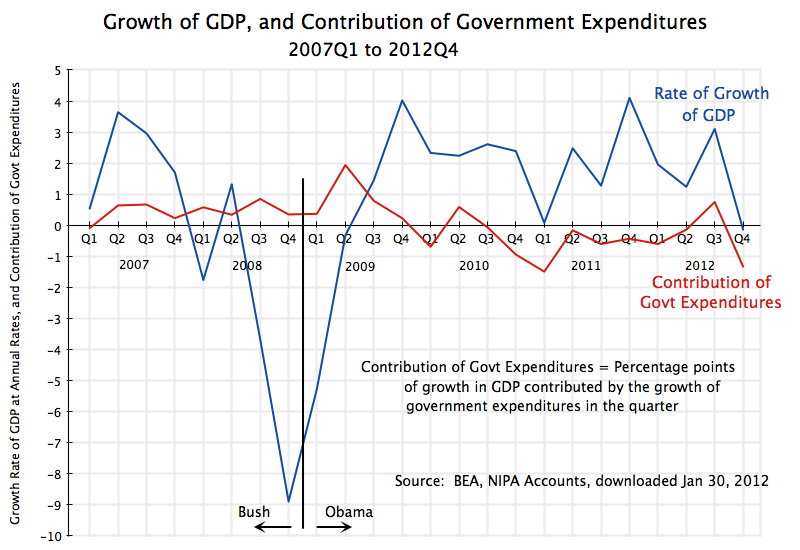
The fall in government spending in the fourth quarter was particularly sharp, but government spending has been falling in each quarter but two since the beginning of 2010.  The resulting fiscal drag has held back growth.  The figures are shown in the graph at the top of this blog.  The graph shows the rate of growth of GDP each quarter (in blue, at annualized rates) since the beginning of 2007, plus the direct contribution to this growth each quarter from government expenditures (in red).

Government spending rose each quarter in 2007 and 2008, the last two years of the Bush Administration, and this continued into 2009 after Obama was inaugurated.  The growth in government expenditures was particularly sharp in the second quarter of 2009 as the stimulus measures started, and this succeeded in turning around GDP.  GDP was falling at an annualized rate of 8.9% in the fourth quarter of 2008, and this carried over into the first quarter of 2009 with an annualized fall of 5.3%.  But then GDP stabilized and began to grow in the third quarter of 2009, and it has grown each quarter since until the fourth quarter of 2012.

But GDP growth since 2010 has been disappointingly modest, at rates of just 2 to 3% a year on average (with some quarterly fluctuation), as it has been dragged down by the falling government expenditures over this period.  As has been noted in earlier postings on this blog (for example here and here), the resulting fiscal drag can explain fully why this recovery has been modest in comparison to the recoveries seen in previous downturns in the US economy over the past four decades.

The other major factor explaining the stagnation of GDP in the fourth quarter was the negative contribution from inventory accumulation.  The change in private inventories led to 1.27% points being subtracted from what GDP growth otherwise would have been.  But as was explained in an Econ 101 posting on this blog, it is the change in the change in private inventory accumulation which acts to contribute to (or subtract from) GDP growth in any given period.

One sees news reports that still get this wrong, with statements such as that inventories fell by $40 billion in the fourth quarter.  This is not correct.  As noted in the table above, inventories actually grew by $20 billion in the fourth quarter.  But they grew by more (by $60 billion) in the third quarter.  That is, the change (the growth) in inventories was $60 billion in the third quarter, while the change (the growth) in inventories was again positive at $20 billion in the fourth quarter.  But while they continued to grow, they did not grow as fast as before, and the change in the change in inventories was a negative $40 billion.  This subtracted 1.27% points from GDP growth.

As was noted a year ago on this blog when the figures for GDP growth in the fourth quarter of 2011 were released, an increase in private inventory accumulation in that quarter largely explained the relatively good growth rate of that quarter.  But I argued this would then likely be reversed, with inventories not growing as fast and perhaps even declining, which would act as a drag on growth in 2012.  The 2012 figures now out show that this in fact happened, with a negative contribution of private inventory accumulation to GDP growth in the first, second, and fourth quarters.

Other than the drag from cuts in government spending and the deceleration of inventory accumulation, the other components of GDP growth in the fourth quarter of 2012 were generally quite good.  Residential fixed investment grew at an annualized rate of 15.3%, continuing the strong growth seen already in the second and third quarters.  But residential fixed investment was only 2.6% of GDP in the fourth quarter, so the rapid growth on this small base only made a contribution of 0.36% points to GDP growth in the quarter.  In contrast, government spending in the fourth quarter was 19.3% of GDP (down from 19.6% of GDP in the third quarter).  [Figures on GDP shares directly from BEA on-line GDP tables.]

Non-residential fixed investment (basically private business investment in capital and structures) also grew at a good rate in the fourth quarter, at 8.4% annualized, reversing a small decline seen in the third quarter.  And personal consumption expenditure rose at a 2.2% rate.  Since personal consumption accounts for 71% of GDP spending, this 2.2% increase contributed 1.52% points to what GDP growth would have been.

The fourth quarter GDP report therefore would have been solid, had it not been for the sharp cuts in government spending in the quarter.  Accumulation of private inventories then responds, as businesses do not want to see inventories mounting up on the shelves when they cannot be sold and scale back production (or in the fourth quarter, still increase their inventories, but not by as much as before).

The danger to the economy now is that government spending will be scaled back even further, as a Republican controlled Congress insists on slashing public expenditures.  If nothing is agreed to, then the sequesters that Congress required in August 2011 as a condition for the debt ceiling increase (so that the US would not then be forced to default) will mandate a sharp scaling back in federal government expenditures.  While the deadline for this was pushed back to March 1 from January 1 as part of the fiscal cliff agreement at the end of 2012, there is still a deadline.  The nonpartisan Center on Budget and Policy Priorities has estimated in a recent report that should the sequester enter into effect on March 1, defense spending would be cut by $42.7 billion, or 7.3%, while non-defense spending would be cut by also $42.7 billion, or 5.1% for programs included other than Medicare (Medicare would be cut by 2.0%).

Such cuts, especially if they suddenly enter into effect on March 1, would be devastating to  the economy.  Note that while federal spending already fell by 15% at an annualized rate in the fourth quarter, this fall at a quarterly rate is just 3.6%.  The sudden cuts under the sequester would be far larger.

Almost all of the participants in this budget process, both Democrat and Republican, agree that the sequester is something to be avoided.  The sequester requirement was in fact set up precisely as something both sides would want to avoid, so that agreement would be reached on some other budget plan.  But Republicans are insisting on similarly large cuts in any budget.  They simply wish that the cuts would fall more on domestic programs affecting the poor and middle classes, and less on the military.  But economically the problem for GDP growth would remain if similarly sized cuts are forced through, and would indeed be worse (in terms of the impact on GDP, even ignoring the distributional consequences) if they are re-focused on programs for the poor and middle classes.

Finally, it is worth noting that the price index figures also released by the BEA on January 30 as part of the GDP accounts still show no indication that inflation is any issue.  While conservatives have been asserting since Obama took office four years ago that high deficits resulting from his policies would lead to high inflation, that has not occurred.  The price deflator for GDP, the most broad-based index measuring inflation, grew by only 1.8% in 2012.  The price deflator for the personal consumption expenditures component of GDP (the price deflator that Alan Greenspan reportedly favored for tracking inflation) grew by a similar 1.7% in 2012.  These are both just below the target of 2% for inflation that the Federal Reserve Board favors.  (Inflation of zero is not desired by the Fed or others as it is then easy for the economy to slip into deflation, which makes management of the economy even more difficult.)

And inflation in the fourth quarter of 2012 was even less, at just 0.6% for the GDP deflator and 1.2% for the personal consumption expenditures deflator.  The prediction of both conservative economists and politicians that high deficits under Obama would lead to high inflation unless government expenditures were slashed drastically, could not have been more wrong.

GDP Growth in the Second Quarter of 2012: Even Slower

BEA release of 7/27/12. Seasonally adjusted annualized rates       Percent Growth Contribution to GDP      Growth
2011Q4 2012Q1 2012Q2 2011Q4 2012Q1 2012Q2
Total GDP 4.1 2.0 1.5 4.1 2.0 1.5
A.  Personal Consumption Expenditure 2.0 2.4 1.5 1.45 1.72 1.05
B.  Gross Private Fixed Investment 10.0 9.8 6.1 1.19 1.18 0.76
 1.  Non-Residential Fixed Investment 9.5 7.5 5.3 0.93 0.74 0.54
 2.  Residential Fixed Investment 12.1 20.5 9.7 0.26 0.43 0.22
C.  Change in Private Inventories nm* nm* nm* 2.53 -0.39 0.32
D.  Net Exports nm* nm* nm* -0.64 0.06 -0.31
E.  Government -2.2 -3.0 -1.4 -0.43 -0.60 -0.28
Memo:  Final Sales 1.5 2.4 1.2 1.52 2.38 1.23
    nm* = not meaningful
$ Value of Change in Private Inventories (2005 prices) $70.5b $56.9b $66.3b

The initial estimates for US GDP growth in the second quarter of 2012 were released by the BEA of the US Department of Commerce on July 27, and indicated that a slowly growing economy was growing even more slowly than before.  GDP growth of 4.1% in the last quarter of 2011 (based on revised figures issued on July 27 as well), had slowed to just 2.0% growth in the first quarter of 2012, and then to an estimated 1.5% growth in the second quarter.  The figures are subject to revision, but it is unlikely that the basic story will change significantly.

This slowdown in growth in 2012 had in fact been predicted on this blog in a posting on January 27, when the initial estimates for growth in the last quarter of 2011 were issued.  While growth at the end of 2011 was relatively robust, it was noted there that much of this had occurred due to an increase in private inventory accumulation.  As has been explained in an Econ 101 posting on this blog, it is the change in the change in private inventories which contributes to GDP growth, and that change in the change in private inventories had been large in the fourth quarter of 2011.  Using the figures from the current BEA estimates, the change in private inventories was essentially zero in the third quarter of 2011 (a fall of just $4.3 billion at 2005 prices), but then rose by $70.5 billion in the fourth quarter.  This increase by a net $74.8 billion added 2.53% points to GDP in the fourth quarter, accounting for over 60% of the now estimated 4.1% growth in that period.  Without this (that is, if inventory accumulation had been at the same pace as before), GDP growth would not have been 4.1% but only 1.5% in that period (the growth of final sales).  Since over time the pace of inventory accumulation is relatively steady on average, even though there can be significant swings in any given quarter, it was predicted that GDP growth could well slow in 2012.

That is what happened.  GDP growth slowed to a pace of just 2.0% in the first quarter of 2012 and to an initial estimate of just 1.5% in the second quarter.  There are many other changes going on of course, but the swings in the change in change in inventory accumulation can have a significant impact in any given quarter.  In the first quarter of 2012, the pace of inventory accumulation slowed to $56.9 billion.  This was still positive (inventories grew), but was a slower pace than the $70.5 billion accumulation in the fourth quarter of 2011.  That is, inventories were still growing at a fairly high rate in the first quarter of 2012, but by not as rapid a rate as they had in the last quarter of 2011, so this subtracted from GDP growth.  It subtracted 0.39% points from what GDP growth otherwise would have been (see the figure on Contribution to GDP Growth in the table above).  The initial estimate for the second quarter of 2012 is that private inventories grew by $66.3 billion, which was an increase from the $56.9 billion pace of the first quarter, and so contributed 0.32% points to GDP growth.  But will this continue?

Inventories are held only because of an expectation that the goods will be sold, and businesses do not wish to hold too much in inventories.  Inventory accumulation must be financed, and goods can deteriorate in value if not soon sold (this is especially the case for anything where technology changes rapidly, such as the latest electronic gadgets).  Rapid accumulation of inventories is indeed normally a sign that goods are not being sold as rapidly as the producers of these goods had expected, so a rapid rise in inventories is often a disturbing sign.  Production is still going on, and hence GDP is being generated, but a rapid accumulation of inventories will often then lead producers to cut back on production, and GDP growth will slow or even become negative.

This could happen now.  Private inventories have grown by a total of almost $200 billion in the last three quarters together (at constant prices of 2005), and have not grown by so much over a three quarter period since 2006.  Should producers decide to limit production so that total inventories stay where they are now in the next quarter (and succeed in doing this, as there is unpredictability in what sales will be), inventory accumulation will drop back to zero.  This is not unusual:  As noted above, inventory accumulation was essentially zero (in fact slightly negative) in the third quarter of 2011.  But if this happens, GDP growth would fall by 2.0% points (given the current pace of inventory accumulation) below what it would otherwise be, and could easily push GDP growth into negative territory.

Because of these swings in inventory accumulation from quarter to quarter, it is wise to look at what is happening to final sales.  This will often provide a better picture of what is happening in the basic underpinnings to short run growth.  As seen in the table above, final sales have grown at rates of 1.5%, 2.4%, and 1.2% in the most recent three quarters, respectively.  On average, GDP growth will tend to match these rates over time.  They show that the economy has been fundamentally weak over this period.

And the concerns are not just with what may happen to inventories.  Aside from inventory accumulation, the other elements making up GDP growth all show a weakening in the second quarter of 2012 compared to what their growth had been in the first quarter.  Private consumption expenditure only rose by 1.5% (at annualized rates) in the second quarter, compared to growth at a rate of 2.4% in the first quarter.  Private fixed investment only grew at a 6.1% rate, vs. a 9.8% rate in the first quarter.  Of this, non-residential fixed investment grew at a 5.3% rate vs 7.5% before, and residential fixed investment (a bright spot in the first quarter) slowed to a 9.7% rate of growth vs. 20.5% before.  Net exports (the net between exports and imports) subtracted from growth, and once again, government expenditure contracted and acted as a drag on growth.  As has been discussed before in this blog, if government expenditure had been allowed to grow during the Obama term by as much as it had during the same period under Reagan, the economy would likely now be at full employment.

There is therefore little to be encouraged by in these initial estimates for growth in the second quarter of 2012.  With Europe already in a double-dip recession, as they have foolishly pushed fiscal austerity policies despite their high unemployment, there is a good chance that US growth will slow to below 1%, and quite possibly even to something negative, in the second half of 2012.  Regardless of who should be blamed for this, it is likely that Obama will be the one blamed.

The Shift from Equitable to Inequitable Growth After 1980: Helping the Rich Has Not Helped the Not-So-Rich

I.  Introduction

Central in the debate in this year’s presidential election is whether government provision of new benefits and additional tax breaks to the rich will in the end also help the not-so-rich.  Mitt Romney, himself a good representative of those who have become extremely rich through finance, as well as other Republicans, argue that the rich must be helped and given further tax breaks as they are the “job creators” who in the end help us all.  The alternative view is that at best the help to the rich will be kept by the rich, and whatever goes to the rich (whether through additional government provided benefits to the rich, or through how the economy itself benefits the rich) will come dollar for dollar from what would otherwise go to the not-so-rich, thus worsening their position.

This blog posting will examine evidence behind this issue, through a look at long-term growth in the US (going back to 1870), and how this growth has been distributed between the rich and the not-so-rich (for the period we have data, from 1917).  It will find that long-run growth (growth in economic capacity) has been remarkably constant since 1870, which calls into question whether government policies have had much of an effect one way or the other on growth over the long term.

But it will also find that how this growth is distributed among income groups has changed markedly over time.  Growth was equitable from World War II (following the reforms of the New Deal era) until 1980, with all income groups (rich and not-so-rich) benefiting similarly.  But this changed markedly after about 1980, following the measures deemed the “Reagan Revolution”.  Since 1980, the rich have become much richer indeed, while the bottom 90% of households have seen their real incomes stagnate or even decline.

II.  The Growth in GDP per Capita in the US

We start with a look at the growth of per capita GDP in the United States, going back to 1870:

Levels of US GDP per capita, 1870 to 2011, in constant dollars, long-run growth

The numbers are principally from data put together by the late Angus Maddison, who in his career at the OECD and elsewhere assembled a remarkable set of data on growth over the long term of not only the US, but also of much of the rest of the world.  The Maddison numbers were extended to cover 2007 to 2011 based on figures in the regular GDP accounts of the US issued by the BEA in the US Department of Commerce.

The figure shows the growth of US per capita GDP from about $3,500 in 1870 (in terms of 2005 prices) to $43,000 today.  By way of comparison, China’s GDP per capita is currently about $4,800 (in 2005 prices), which is about where the US was in the late 1880s.

While there have been some fluctuations (notably in the downturn in the 1930s during the Great Depression, and then the spike in the early 1940s during World War II), it is difficult to see in a figure such as this whether growth in recent decades has been faster or slower or the same as in earlier periods.  But this can be easily seen if the numbers are converted into their logarithmic equivalent.  In logarithms, a constant rate of growth will be a straight line; an increasing rate of growth will be seen as a line bending upwards; while a decreasing rate of growth will be seen as a line bending downwards.  If you are not familiar with logarithms, you can either take my word for this or consult your high school math textbook.

Converting the GDP per capita numbers into their logarithmic equivalent (these are in 1990 prices, which Maddison had used, but the base year for this does not matter), one finds:

Natural logarithms of US GDP per capita, 1870 to 2011, straight line growth

The red line drawn through this is a straight line, indicating a steady rate of growth of per capita GDP over this 141 year period (at a rate of 1.9% per year, or 1.869% per year to be more precise).  This is remarkable.  REMARKABLE!   There are significant year to year variations, and sometimes decade long variations (such as in the 1930s during the Great Depression, and the spike during World War II).  But eventually, even after the shocks of the Great Depression and of World War II, the economy has always returned to the same path it had been on before, not to a different one.

The path can perhaps best be interpreted as the growth in productive capacity when all resources, and in particular all labor resources, are being fully employed.  This capacity limit for the economy grows over time based on growth in technology and in the skills applied in using that technology as well as in using labor and other resources.  And for some reason we do not understand, the rate of growth on that path has been the same for over 140 years.

It is remarkable that that rate of growth in productive capacity was the same in the closing decades of the 20th century as it was in the closing decades of the 19th century, and in the connecting periods in between.  That is, the rate of growth in the age of steam and rail in the latter 1800s, or growth in the age of microchips and information in recent decades, and everything in between, has always been the same.

This finding should be rather disconcerting to economists.  Hardly a week goes by that a book is not published which says that the key to faster growth is to do … (with each saying something different).  Yet the steady pace of long-term growth at 1.9% per capita a year suggests that for a developed country like the US, operating close to what technology allows in terms of overall production, growth in capacity will be little affected by less regulation or by more regulation, by more investment in education or by less investment in education, by more spending on research and development or by less spending on research and development, and so on.  All of these have varied greatly over time.  But the long-run rate of growth has not.

To be fair, merely showing such constancy in long-run growth does not prove anything.  It is possible that policies have varied over time in such a way that changes which would have raised the long-run rate of growth were offset by policies that reduced the long-run rate of growth by the same amount.  This is possible, but it would be an amazing coincidence if there were always such exact offsets.

What is fair to say is that the reasons behind this long-term constancy in the rate of growth are not well understood, and that economists, politicians, and others should be modest when they advocate one policy or another.

III.  The Distribution of the Income Produced by That Growth

While there has been constancy in the growth of average per capita income, this does not mean that different income groups have necessarily shared equally in that growth.  But while such distributional data are not assembled in the regular national income (GDP) accounts, Thomas Piketty and Emmanuel Saez (as part of a larger international effort) have assembled such data based on US income tax returns.  The concept of income is not exactly the same.  GDP measures the value of all production in any specific year (which ultimately accrues to someone), while tax returns report on taxable household incomes in any year, including realized capital gains but not items such as unrealized capital gains.  But over long periods of time they will move similarly.  By using US income tax return data, Piketty and Saez are able to arrive at estimates going back to 1917 (and 1913 for some of the data, the year the modern US Income Tax system began).  And by using tax return data, Piketty and Saez are able to arrive at accurate figures on the incomes of the very rich (including the top 1%, top 0.1% and top 0.01%), which survey based methods cannot cover well as the numbers in such groups will be relatively small in any broad-based sample.

Using the Piketty-Saez data, one can arrive at the following:

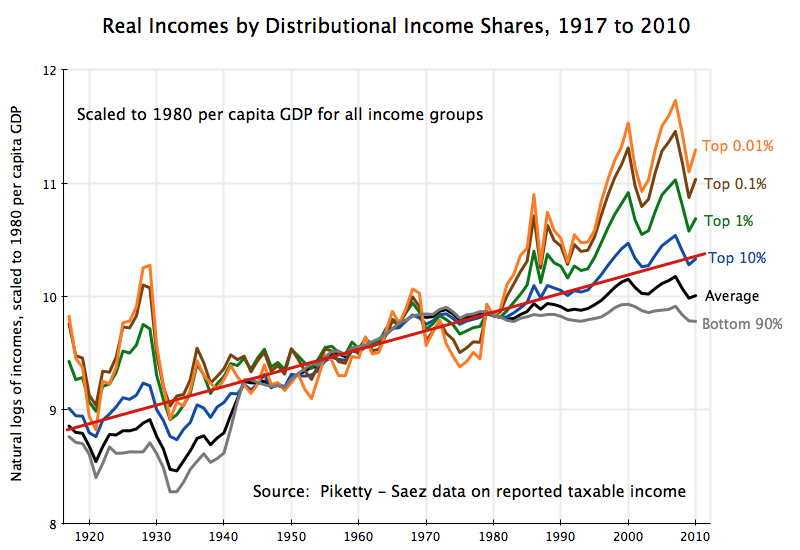
real incomes by distributional shares, 1917 to 2010

This is an unconventional presentation, as the aim is to focus on how real per capita (actually per tax unit, which is normally a household) distributional shares have varied against each other over time.  In this presentation, the incomes (in logarithms) are presented relative to what they were in 1980.  The 1980 figures could have all been set equal to 100.  But to facilitate comparison with the figure above on average GDP per capita (in logarithms), the scale is set to average per capita GDP in 1980.  To state this point again:  All incomes were not equal in 1980.  The top 0.01% earned far more than the bottom 90%.  But to show the changes relative to 1980 as the base year, all incomes were scaled to the same number in 1980 (which could have been anything, such as 100, but which in this case was set to the log of per capita GDP in 1980).

Several things are clear in this figure.  First, the very rich (top 1% and higher) did very well in the 1920s, even though the bottom 90% saw their incomes stagnate.  The “Roaring 20s” were not a boom for everyone.  But everyone then saw their incomes collapse with the on-set of the Great Depression in the 1930s, with only a slow and partial recovery during the decade until the largest fiscal stimulus program in history (spending in World War II) was implemented in the early 1940s.

Then, from the middle of World War II to 1980, the incomes of all of the groups rose by similar proportions (with each of the groups enjoying an increase in real incomes of about 80% per household), with only limited differences between the groups.  This was a period of not only growth, but equitable growth.

Things then changed in the early 1980s.  While overall growth continued (although perhaps at a somewhat slower rate, depending on the precise dates chosen), all of the benefits of this growth was accruing to the rich (the top 1%) and especially the very rich (the top 0.1%, and the top 0.01% even more so).  The bottom 90% saw their incomes stagnate, or even decline depending on the year chosen for comparison.

Note that there is no mathematical reason leading to the top 0.01% seeing their incomes necessarily grow by more than the top 0.1%, who in turn saw their incomes grow by more than the top 1%, and so on.  The figure shows the proportional changes in the real incomes in these different groups defined relative to what they were in 1980, and one can see in the diagram periods in the past where the top 0.01% fared worse than the top 0.1%, for example.  It is only since 1980 that one sees this non-overlapping stratification, with the incomes of the absolute richest increasing by more than the incomes of the very rich, with these increasing by more than the incomes of the moderately rich, and so on down the scale.  The changes in the economy since 1980, whether due to Reagan or for other reasons, not only benefited the rich, but benefited the absolute richest the most of all.

But what is true mathematically is that if the average per capita income is growing at some rate as it has historically, as it appears to have since 1870, then a higher share going to the rich and especially the very rich must be matched by a lower share going to the not-so-rich.  This is then not a story where helping the rich will help us all, but rather a story that what goes to the rich must be coming from the not-so-rich.  And that, unfortunately, seems to be consistent with the data depicted above, where the rich have done very well since 1980, while the bottom 90% have seen their real incomes stagnate and indeed decline to below 1980 levels following the 2008 collapse.

IV.  The Changes in the Real Incomes of the Different Groups Since 1980

The proportional changes in the incomes of the different groups in absolute values (not logarithms) since 1980 has been as follows:

US real income growth by distributional shares, 1980 to 2010

The rich have done very well since the 1980s and the start of the “Reagan Revolution”.  Even following the 2008 economic and financial collapse in the last year of the Bush Administration, the top 0.01% in 2010 earned 333% more in real terms than what they earned in 1980.  The average income of those in the top 0.01% bracket in 2010 was $23.8 million.  And they were doing much better in 2007 before the 2008 economic collapse, when their income was 570% above what it had been in 1980 in real terms, and they earned an average of $36.9 million (in prices of 2010) each.

In contrast to the rich, the bottom 90% have seen their incomes stagnate since 1980.  In 2010, their income was 5% below what it was in 1980.  They were doing modestly better during the Clinton years, and their real incomes peaked at 11% above their 1980 level in 2000.  But their incomes then fell, to only 3% higher in 2003 than in 1980, recovered a bit to 9% higher in 2007, but then fell again in the 2008 collapse.

Note also that it really is the super-rich who have benefited in this post-Reagan economic system.  Even the top 10% saw their incomes grow by only 65% over the thirty years from 1980 to 2010.  Thirty years of growth at the long-term rate for US per capita GDP of 1.9% would have led to a 76% increase in their real incomes.  And the top 10% includes the top 1% (and richer), whose huge income increases will raise the average for the top 10%.  Excluding the top 1%, the real incomes of the remaining 9% (i.e., those with incomes between the 90th and 99th percentiles) rose by only 35% over this thirty year period.

V.  Summary and Conclusion

In summary:

a)  The long-run rate of growth in the US has been remarkably stable since 1870, at 1.9% a year.  It has maintained this rate from the age of steam and rail, to the current age of microchips and information.  Economists have no good explanation of this, which suggests a good deal of skepticism is warranted when economists, politicians, or others suggest they know the secret to how to raise the rate of long-term growth.

b)  In contrast to this stable rate of long-term growth, the pattern of how this growth has been distributed across the population has varied a good deal, at least back to 1917 (the earliest year for which we have complete data).  Distribution worsened in the 1920s and became less unequal only with the start of the massive stimulus program of World War II.  Then from the middle of that war to 1980, the economy grew with both the rich and the not-so-rich sharing similarly in growth.

c)  This then changed after 1980, with massive growth in real incomes for the very rich, while the bottom 90% saw their incomes stagnate or get worse.

The Republican policies launched by Reagan of low taxes on the rich plus financial and other deregulation were justified on the basis of the assertion that they would lead the economy to grow faster, and that all income groups would benefit from this.  There is no evidence in the data that this has occurred.  Growth has not accelerated.  If anything, growth has decelerated, although this could still reflect a downswing from which the economy could eventually recover as it did following the 1930s.  The rich have nonetheless gotten very rich since 1980, while the bottom 90% have suffered.  The data suggest that the Reagan policies have not acted to accelerate growth for all, but rather have acted to transfer the gains that there were to the rich from those in not so advantageous a position.

Given how Mitt Romney himself has benefited from this Reagan program, it should not be surprising that not only does he support it, but that he wants to extend it even further.  But it is not clear why those not in his super-rich class should agree.

_______________________________________________________________________

Update – April 19, 2013

A reader of this blog has asked me a very good question through the Contact Me form.  As others may have a similar question, I thought it best to try to provide an answer here, for all to see.

The question raised was that in the final graph shown on the blog (titled “Changes in Real Per Unit  Incomes by Distributional Shares”), average real income per unit is reported to have risen by only 19% between 1980 and 2010.  Yet if real GDP per capita had grown at the long term trend of 1.9% per year over this period, real GDP per capita would have increased by 76%.  Why the big difference?

The difference is indeed very large.  One would not normally expect such a divergence.  But there are several reasons for this.  I had noted one in the original posting, but there are others as well.

In the original post I noted that the Piketty-Saez data, based on incomes reported on tax returns, will differ from incomes as reported in the GDP accounts as they are measuring different concepts of income.  The GDP accounts measure the value of all production in any given year.  While that income will eventually accrue to someone, it will differ from incomes reported by households on their annual tax returns.  A major part of income in the GDP accounts, for example, will first be earned by corporate entities.  While corporations do pay a portion of this in dividends to their owners, a portion is retained and not immediately paid out.  The portions can vary over time.  And household taxable income includes not only what is currently earned in wages or received in dividends, but also capital gains that are realized through the purchase and sale of assets.  Such capital gains are not part of the GDP accounts, as they do not reflect the value of current production.

But there are other reasons as well for the difference.  Specifically:

  1. First, while growth at the trend rate of 1.9% per year would have led to a rise in real GDP per capita of 76% over 30 years, the actual GDP per capita growth over 1980 to 2010 was 65%.  Due to the 2008 downturn, from which there has been only a partial recovery, GDP in 2010 was about 6% below the capacity level of GDP in that year. One can see in the graph above of GDP per capita in logarithms how the actual per capita GDP fell below the trend from 2008.  And while all economists expect the economy to recover eventually, it is not known how long this will take (it will depend on policy).
  2. The change in real GDP is determined using the GDP deflator for the price index. The GDP deflator is based on the prices of all goods that make up GDP, which includes not only the goods that households consume, but also investment goods as well as the prices of imports and exports.  Piketty-Saez, in contrast, are focused on household real incomes, and therefore have used the Consumer Price Index (CPI) as their price deflator.  The two price indices differed markedly over the 1980 to 2010 time period:  the GDP deflator rose by 32% while the CPI used by Piketty-Saez rose by 52%.  Had GDP per capita been deflated by the CPI rather than the GDP deflator, measured real per capita GDP would have risen by 43% instead of 65%.
  3. Real GDP per capita is based on the whole US population, while the Piketty-Saez data is based on reporting tax units.  Tax units are generally households.  Over the 1980 to 2010 period, the number of households rose at a faster pace than population, as the average household size fell (fewer children as well as more households reflecting a single adult).  Over 1980 to 2010, population rose by 36% while the number of tax units (households) rose by 57%.  Adjusting for this, real per unit GDP (based on the CPI, as per above) would have risen by 25% based on the number of tax units rather than 43% based on population.
  4. The final difference between this 25% increase and the 19% increase in real per unit average incomes reported in the Piketty-Saez data can be accounted for by the differences in definition between taxable household income and GDP.