Why Have Productivity and Profits Gone Up During Obama’s Term?

In the post immediately preceding this one (see directly below, or here), I noted that a glance at the economic data makes clear that productivity and profitability have both increased under Obama.  Hence, the argument made by Mitt Romney and the other Republican candidates that onerous regulations imposed by Obama are the cause of disappointing job and output growth, is simply not correct.  If new regulations were such a problem, one would have expected productivity and especially profitability to have suffered, and yet both have improved.  Indeed, profitability has sky-rocketed.

For convenience, here is the basic graph again:

But this naturally then also raises the question of why productivity and especially profitability have gone up by so much under Obama.  Indeed, some might wonder whether Obama’s administration has deliberately favored profits at the expense of wages.

While a full analysis cannot be done here, I find no reason to jump to such a conclusion.  The path of profits is what one would expect over the last few years, with the sharp collapse in output at the end of the Bush Administration and then only a slow recovery with unemployment staying high.  There is the separate issue of the longer term trends, where profits have been growing as a share of National Income since about 1980 (for the last decade, see here, and for the underlying data and the longer term see the BEA data at here).  But the fluctuations over the last few years can be well understood in terms of the short term dynamics of the economic collapse and subsequent slow recovery.

Specifically, profits fell sharply in the economic downturn at the end of the Bush Administration, and started to to fall (per unit of production) as far back as 2006.  It is worth noting that housing prices peaked in the first half of 2006, and the economy began to slow after that.  A collapse in profits when the economy collapsed is as one would expect.

In response to the economic downturn, the Federal Reserve Board cut interest rates, ultimately to historically low levels of essentially zero for rates on risk-free assets.  Coupled with other aggressive Fed measures, as well as the TARP program to stabilize the banks (launched by Bush) and then the Obama stimulus program, the collapse was halted and the economy then started to grow in the middle of 2009.  Profitability then recovered.

The business response to the downturn was to lay off workers, as they always do in a downturn, and then later they invested in new machinery and equipment.  The investment was spurred in part by the low interest rates following from the Fed policies, and indeed the recovery in non-residential private fixed investment was surprisingly strong (see here).  Both these actions increased labor productivity, as shown in the diagram above.

But aggregate demand growth remained sluggish, despite the growth in private investment.   The downturn was due primarily to the bursting of the housing price bubble that the Bush Administration regulators had allowed to build up (or at least made no attempt to limit).  As housing prices collapsed, home owners became poorer and many ended up with mortgages that were larger than the now lower values of their homes.  Stock prices also fell, hurting retirement and savings accounts.  Coupled also with worries generated by high unemployment, households hunkered down to consume less and try to save more.  Private consumption stagnated.  And after the Obama stimulus plan was passed (helping to stop the free-fall in output and to turn around the economy), political pressures from the Republican Party and especially the Tea Party wing made it impossible for government to maintain a high enough demand to fill in the still large gap in aggregate national demand.

As a consequence, the recovery in growth was limited and unemployment has stayed high.    This has kept wages largely flat.  But labor productivity rose due to the large early lay-offs and later the growth in business investment.  With wages flat but labor productivity higher, unit labor costs fell.

In addition, there are non-labor costs (not shown in the diagram) which also fell.  The main component of such costs that fell was interest payments, which the Fed reduced to the maximum extent it could to try to spur the economy.

With both unit labor costs and non-labor costs down, profits rose and rose sharply.

Regulations Under Obama Cannot Be Blamed: Productivity and Profits Have Gone Up


The Republican Presidential candidates, and especially Mitt Romney, have repeatedly asserted that burdensome regulations imposed by the Obama Administration are to blame for the disappointing performance of the economy during the recovery, and especially the disappointing job performance.  The evidence points to the opposite:  productivity has in fact performed quite well and profitability has sky-rocketed.  If regulations were a problem, one would have expected productivity to have declined and profitability to have suffered, and they haven’t.

The disappointing performance of the economy in recent years can rather be attributed to slow growth in aggregate demand.  Households have had to scale back consumption after the housing bubble burst, while conservative fiscal policies forced by a Republican Congress have not allowed government expenditures to fill in the resulting gap.

The chart above shows how labor productivity, unit labor costs, and unit profits have performed in recent years (for non-financial corporations), each indexed so that the 2005 average equals 100.  Labor productivity (in green in the chart) is the amount of output produced per unit of labor.  It was basically flat prior to Obama taking office, rising by just 2.2% total in those four years, but then jumped by 8.6% total in the subsequent 2 1/2 years.  If regulations imposed by Obama were a major hindrance, productivity would not have gone up like this.

But while labor productivity improved, labor compensation (not shown in the chart to reduce clutter) was basically flat.  Indeed, hourly wages in real terms have declined slightly since Obama took office (by 0.8% total).  This is consistent with a slack labor market, with high unemployment depressing wages.  With higher productivity and wages not increasing, the result was falling unit labor costs (labor costs per unit of output), as shown in blue in the chart.

What did shoot up after Obama took office was unit profits (profits per unit of output, in red in the chart).  This is much more volatile, but it is interesting to note that it peaked in the third quarter of 2006 and then fell sharply well before Obama took office.  If someone is to be “blamed” for this, it would have to be Bush.  Unit profits then reached its low point in the second quarter of 2009, as the recession came to an end, and then skyrocketed by over 75% up to the third quarter of 2011 (the most recent data available).  This is of course all consistent with what has been observed at the level of the aggregate National Income accounts, which was reviewed in an earlier post (see here) on this blog.

Mitt Romney and the other Republican candidates assert that burdensome regulations under Obama have stifled the ability of business to make a profit, and with that, businesses have been unwilling to employ more workers.  But productivity has improved and profitability has soared.  The evidence simply does not support their assertions.

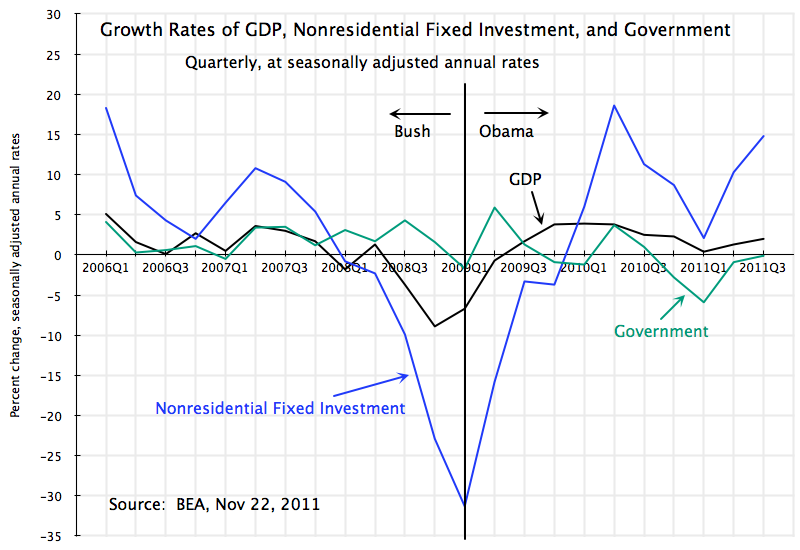
GDP Growth in the Recovery Remains Slow, But Policies Are Not Holding Back Business Investment

GDP growth in the economic recovery from the 2008 collapse remains weak.  The recently released GDP figures for the second quarter of 2011 (second revision, from the Bureau of Economic Analysis of the Department of Commerce), revises downward the growth estimate to 2.0% from the previous estimate of 2.5% (all figures are quarter on quarter growth, seasonally adjusted at annual rates).  While still positive, and better than earlier in the year, such growth is insufficient to bring down the still high unemployment to a significant degree.

Four points:

  1. The overall GDP growth rate would have been 1.55% points higher (i.e. a more decent 3 1/2%) if the change in private inventories had remained the same as it had been in the second quarter of 2011.  Over time, the contribution to GDP growth from inventory accumulation is on average close to zero, so one would expect that over the next couple of quarters this will switch back to positive from negative to balance out desired inventories.  Note that the contribution to the growth in GDP in any period is the change in the change in private inventories.  Private inventories did not fall in the third quarter of 2011:  they merely failed to grow as fast as they had in the second quarter.  I will try to prepare a methodology note discussing this arithmetic at some point in the future, and post it in the Econ 101 section of this blog.  (Update:  It is now posted here.)
  2. Obama has been strongly criticized by Republicans that his policies have been anti-business, and hence have led business not to invest, with this then resulting in the disappointing growth of GDP.  But the figures do not support this.  Business investment has in fact been quite good, as seen in the figure above, with growth of 15% in the most recent quarter, and generally quite strong growth since the beginning of 2010.  This is especially surprising as capacity utilization (as estimated by the US Fed) is still only 78% of potential capacity (and while never at 100%, this figure will be at around 85% when the economy is close to full capacity utilization).  Business is investing even with the current excess in capacity.
  3. An economic headwind that has been hurting growth, starting in late 2010 and then into 2011, has been the fall in government demand.  This has principally been from cutbacks in state and local governments.  If government demand had simply not been cut, GDP growth would have been about half a percentage point higher than what it was from simply the direct impact of the government cut-backs, and even higher if multiplier effects are included.
  4. And, perhaps stating the obvious, while Obama is now being blamed for the downturn, the critics need to be reminded that the sharp collapse in output came in 2008.  This was then turned around in 2009, after Obama took office, with growth since.  The growth has not been fast enough, and the economy remains well below its potential capacity, but reverting to the previous policies is the last thing one should do.