Contribution to GDP Growth of the Change in Inventories: Econ 101 Again

A.  Introduction

The contribution of changes in inventories to changes in reported GDP is easily misunderstood.  One saw this in reports on the recent release (on July 28) by the Bureau of Economic Analysis (BEA) of its first estimate of GDP for the second quarter of 2022.  It estimated that GDP fell – at an annualized rate of -0.9% in the quarter – and that along with the first quarter decline in GDP (at an estimated rate of -1.6%), the US has now seen two straight quarters of falling GDP.  While there will be revisions in the coming months of the second quarter figures, as additional data become available, a fall in GDP for two straight quarters has often been used as a rule of thumb for an economy being in recession.

News reports on the figures noted also that were it not for the estimated change in inventories, GDP would have gone up rather than down.  The estimate was that GDP fell by -0.9% (at an annual rate) in the second quarter, and that the change in private inventories alone accounted for a 2.0% point reduction in GDP.  That is, if the inventory contribution had been neutral, GDP would have grown by about 1% rather than fallen by almost 1%.

But it would be wrong to attribute this to “decreases in inventories”, as some reports did.  Inventories grew strongly in the fourth quarter of 2021, with this continuing at a similarly strong pace in the first quarter of 2022 and still (although at a slower pace) in the second quarter of 2022.  How, then, could this have contributed to a reduction in GDP in 2022?

It is easy to become confused on this.  While really just a consequence of some basic arithmetic, it does require a good understanding of what GDP is and how changes in inventories are reflected in GDP.  I discussed this in a January 2012 post on this blog, but that was more than a decade ago and a revisit to the issue may be warranted.  This post will examine the problem from a different perspective from that used before.  It will start with a review of what GDP measures, and then use some simple numerical examples to show how changes in inventories affect GDP.  It will then use a series of charts, based on actual numbers from the GDP accounts in recent years, to show how changes in inventories have mattered.

A note of the data:  All the figures used come from the BEA National Income and Product Accounts (NIPA), as updated through the July 28 release.  These are often also called by many (including myself) the GDP accounts, but NIPA is the more proper term.  Also, the figures for inventories in the NIPA accounts are for private inventories only.  Inventories held by government entities are small and are not broken out separately in the accounts.  Instead, changes in such inventories are aggregated into the figures for government consumption.  While I will often refer to “inventories” in this post, the measures of those inventories are technically for private inventories only.

B.  Inventories and GDP, with Some Simple Numerical Illustrations

GDP – Gross Domestic Product – is a measure of production (product).  Yet as anyone who has ever taken an Econ 101 class knows, GDP is typically described as (and measured by) how those goods and services are used:  for Consumption plus Investment plus Government Spending plus Net Foreign Trade (Exports less Imports).  In symbols:

GDP = C + I + G + (X-M)

Where “C” is private consumption; “I” is private investment; “G” is government spending on goods or services for direct consumption or investment; and “X-M” is exports minus imports, or net foreign trade.

(Imports, M, can be thought of either as an addition to the supply of available goods or netted out from exports, X, to yield net exports.  To keep the language simple, I will treat it as being netted out from exports.)

Private investment includes investment both in new fixed assets (such as buildings or machinery and equipment) and in accumulation of inventory.  This accumulation of inventory, or net change in inventory, is key to why this equation adds up.  As noted above, GDP is product – how much is produced.  Whatever is produced can then be sold for consumption, fixed asset investment, government spending on consumption or investment, or net exports.  If whatever is produced exceeds what is sold in the period for these various purposes, then the difference will accrue as inventories.  If the amount produced falls short of what is sold, there will have to have been a drawdown of inventories for the demands to have been met.  Otherwise it would not have been possible – the goods had to come from somewhere.

The balancing item is therefore the change in inventories.  It is what allows us to go from an estimate of what is sold to an estimate (if one knows how much inventories changed by) of what was produced, i.e. to Gross Domestic Product.

How then do changes in inventories affect measured GDP?  This is best seen through a series of simple numerical examples, tracing changes in the stock of inventories over time.

Period

Stock

Change

Change in the Change

0

2000

1

2200

200

2

2400

200

0

Start with a stock of inventories in the economy as a whole in period 0 of say 2000 (in whatever units – perhaps billions of dollars).  This stock then grows to 2200 in period 1 and 2400 in period 2.  The change in inventories in period 1 will then be 200, and that change in inventories will be one of the components making up GDP (along with private consumption, private fixed investment, and so on).  It is an investment – an investment in inventories – and thus one of the uses of whatever product was produced in the period.  It will equal the total of what was produced (GDP) less what was sold for the sum of all final demands (private consumption, private fixed Investment, government, and net foreign trade).

With the stock of inventories growing to 2400 in period 2, the change in inventories in that period will once again be 200.  Hence the contribution to GDP will once again be 200.  This is the same as what its contribution to GDP was in the previous period, and hence the higher inventories would not have been a contributor to some higher level of GDP – its contribution to GDP is the same as before.  The change in the change in the stock of inventories is zero.

But this does not mean that inventories fell in period 2.  They grew by 200.  But that was simply the same as its accumulation in the prior period, so it did not add to GDP growth.

To make a contribution to GDP growth in period 2, the addition to inventories would have had to have grown.  For example:

Period

Stock

Change

Change in the Change

0

2000

1

2200

200

2

2500

300

100

In this example, the stock of inventories grew to 2500 in period 2.  The change in inventories was then 300, which is higher than the change in inventories of 200 in period 2 – it is 100 more.  This would be reflected in a GDP in period 2 which would be 100 higher than it would have been otherwise.

If, on the other hand, the pace of inventory accumulation slows, then inventory accumulation will subtract from GDP:

Period

Stock

Change

Change in the Change

0

2000

1

2200

200

2

2300

100

-100

In this example, inventories are still growing in period 2 – to a level of 2300.  This is 100 higher than what it was in period 2.  But the change in inventories is then only 100 – which is less than the change of 200 in period 1.  Inventories are still growing but they will add less to GDP than they had in period 2.  Hence they will subtract from whatever growth in GDP there might have been otherwise.

This is what happened in the recently released estimates for GDP growth in the second quarter of 2022.  Inventories were still growing, but they were growing at a slower pace than in the prior quarter.  In terms of annual rates (and with seasonally adjusted figures), inventories grew by $81.6 billion in the second quarter (in terms of constant 2012 dollar prices; see line 40 of Table 3 of the BEA release).  But this was less than the $188.5 billion growth in inventories in the first quarter of 2022.  In percentage point terms, that difference (a reduction of $106.8 billion) subtracted 2.0% from what GDP growth would have otherwise been in the second quarter (see line 40 of Table 2 of the BEA release).  With the changes in the other components of GDP, the end result was that estimated GDP fell by 0.9% in the quarter.  Thus one can attribute the fall in GDP in the quarter to what happened to inventories, but not because inventories fell.  It was because they did not grow as fast as they had in the previous quarter.

C.  Changes in Inventories in the Data

Based on this, it is of interest to see how inventories have in fact changed quarter to quarter in recent years.  These changes, and especially the changes in the changes, are volatile.  They can make a big difference in the quarter-to-quarter changes in GDP.  Over time, however, they will even out, as there is some desired level of inventories in relation to their sales and producers will target their purchases to levels to try to reach that desired level.

Start with the chart at the top of this post.  It shows the stock of private inventories by quarter going back to 1998.  The figures are in constant 2012 dollars so that inflation is not a factor (and more precisely using what are called “chained” dollars where the weights used to compute the overall indices are based on prior period shares of each of the goods – so the weights shift over time as these shares shift).

Stocks generally move up over time as the economy grows, although there have been reductions in periods when the economy was in recession or otherwise disrupted.  Thus one sees a fall in 2001, due to the recession in the first year of the Bush II administration, an especially sharp fall in 2008 with the onset of the economic and financial collapse in the last year of the Bush II administration with this then carrying over into 2009, and then a fall again in 2020 due to the Covid lockdowns.  The trough in the most recent downturn was reached in the third quarter of 2021, following which the stock of inventories grew rapidly.  They are still, however, slightly below the level reached in mid-2019 even though GDP is higher now than what it was then.

One starts with the stocks, but as was discussed above, the contribution to GDP comes from the accumulation of inventories – the change in the stocks.  These changes, based on the figures underlying the chart at the top of this post, have been:
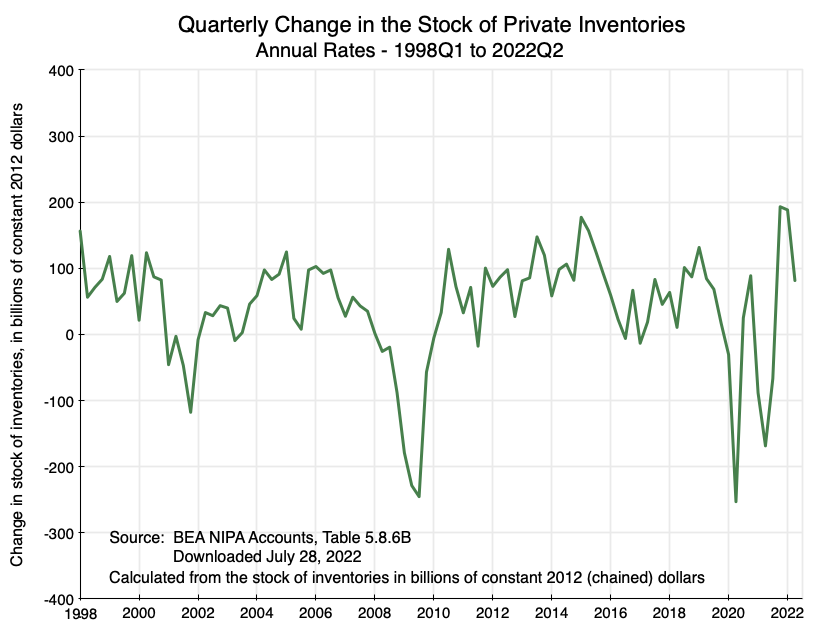
There is considerable quarter-to-quarter volatility.  Note that the figures here are expressed in terms of annual rates.  That is, they are each four times what the actual change was (in dollar terms) in the given quarter.  One sees that the change in the fourth quarter of 2021 was quite high – higher than in any other quarter of this 24-year period – and was still almost as high in the first quarter of 2022.  The increase was then less in the second quarter of 2022, but was still a substantial increase (of $81.6 billion at an annual rate) in the quarter.

The changes in inventories are a component of GDP, but the contribution to the growth in GDP comes from the changes in the change in inventories.  These are easily computed as well by simple subtraction, and were:
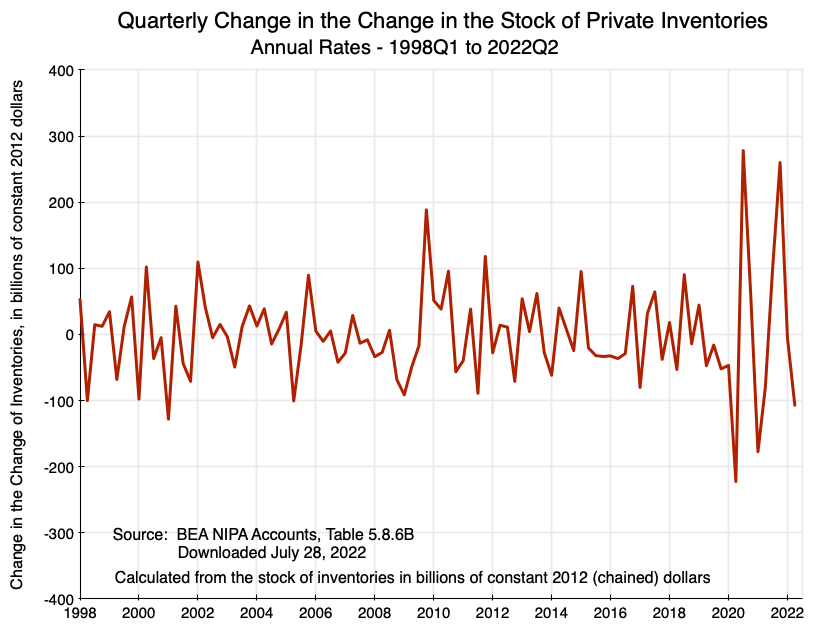
These are now very highly volatile, and one sees especially sharp fluctuations in the last couple of years.  With all the disruptions of the lockdowns, the subsequent supply chain disruptions, and the very strong recovery of the economy in 2021 (with GDP growing faster than in any year in almost four decades, and private consumption growing faster than in any year since 1946!), it has been difficult to manage production to meet expected demands and allow for some desired target level of inventories.

This had a substantial impact on the quarter-to-quarter changes in GDP, both positive and negative.  Focussing on the recent quarters, the changes in inventories were a $193.2 billion increase in the fourth quarter of 2021, and as noted before, a further $188.5 billion increase in the first quarter of 2022 and a further although smaller increase of $81.6 billion in the second quarter of 2022.  These were the changes in inventories.  But the changes in the changes, which is what will add to or subtract from GDP growth, were a very high $260.0 billion in the fourth quarter of 2021, and then a fall of $4.7 billion in the first quarter of 2022.  This reduction in the first quarter of 2022 came despite inventories increasing in that quarter by close to a record high level.  But they followed a quarter where inventories rose by a bit more, so the change in the change was small and indeed a bit negative.

In the second quarter of 2022 inventories again rose – by $81.6 billion.  But following the close to record high growth in the first quarter of 2022, its contribution to the growth in GDP in the quarter was substantially negative.  The $81.6 billion increase in inventories in the second quarter was $106.9 billion less than the increase of $188.5 billion in the first quarter.  And it is this $106.9 billion which is a contribution to (or in this case a subtraction from) what GDP growth would have been in the quarter.

Finally, one can show this also in the possibly more helpful units of the percentage point contribution to the growth in GDP:

Although in different units, the chart here mirrors closely the preceding one, as one would expect if one has been doing the calculations correctly.  The only difference, in principle, is that with GDP growth over time, the dollar values of the quarter-to-quarter changes will look larger when expressed as a share of GDP in the earlier years of the period.

There are, however, some minor differences deriving from the nature of the data used.  The chart here was drawn directly from the figures presented in the BEA NIPA accounts for the percentage point contributions to GDP growth from changes in inventories.  One can also calculate it by taking the quarterly changes in the change in constant dollar terms (from the preceding chart, in red), dividing it by the previous quarter’s GDP (as one is looking at growth over the preceding quarter), and then annualizing it by taking one plus the ratio to the fourth power.  I did that, and the curve lies very close to on top of the curve shown here (in orange).

But not quite, due in part to rounding errors that compound when one is taking the changes and then the changes in the changes.  In addition, inventories by their nature are highly heterogeneous, with some going up and some down in any given period even though there is some bottom line total on whether the aggregate rose or fell.  This makes working with price indices tricky.  The BEA figures are based on far more disaggregated calculations than the ones they present in the NIPA accounts, and their underlying data also have more significant digits than what they show in the tables they report.

D.  Inventories to Sales, and Near Term Prospects

What will happen to inventories now?  Given how important changes in inventories are to the quarter-to-quarter figures on GDP growth, economists have long tried to develop some system to predict how they will change (as have Wall Street analysts, where success in this could make some of them very rich).  But they have all failed (at least to my knowledge).

One statistic that many focus on, quite logically, is the ratio of inventory to sales:
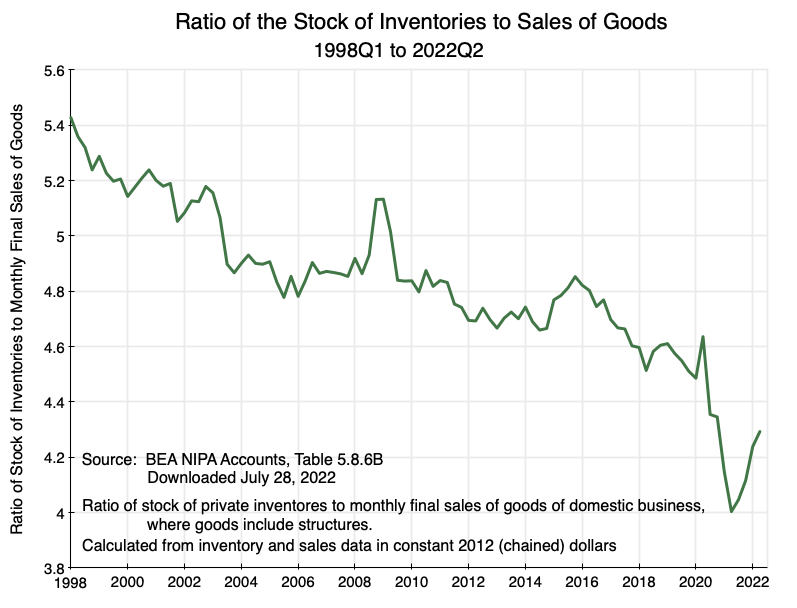
The figures here were computed from data reported in the BEA NIPA Accounts, Table 5.8.6B, where inventories include all private inventories while sales are of goods (including newly built structures) sold by domestic businesses.  Inventories are by nature of goods only, and hence one should leave out services (as an increasing share of services in GDP would, on its own, lead to a fall in the ratio).  Sales of newly built structures are included as one has inventories of building materials.  The figures on the sale of goods by domestic businesses are provided by the BEA.  Note that “sales” here are expressed on a monthly basis.  Hence the ratio is of inventories in terms of months of sales.

As one sees in the chart, the ratio of inventory to sales has been coming down over time.  This is consistent with all the literature advising on tighter inventory management.  There was then an unusually sharp decline in 2020 – a consequence of the Covid lockdowns – that bottomed out in the second quarter of 2021 (as a share of sales) and has since grown strongly.  But the ratio is still below where it was prior to the pre-Covid trend, although how much below depends on how one would draw the trend line pre-Covid.

Where will it go from here?  While important to what will happen to the quarter-to-quarter figures for GDP growth, as discussed above, I doubt that anyone has a good forecast of what that will be.  While there might well be room for the inventory to sales ratio to rise from where it is now, keep in mind that the ratio can rise not only by adding to inventories but also by sales going down.  And while GDP growth was exceptionally strong in 2021, it has been weak so far this year (indeed negative) and that weakness might well worsen.  Personally, while I do not see that the economy is in recession now (employment growth has been strong, with 2.7 million net new jobs in the first half of 2022, and the unemployment rate has been just 3.6% for several months now), the likelihood of a recession in 2023 is, I would say, quite high.

There also have been recent announcements by major retailers that the inventories they are currently holding are well in excess of what they want, and that they will take exceptional measures to try to bring them down.  Target announced a plan to do so in June (with a warning it will squeeze their near-term profits), Walmart announced in July they had similar issues (and that it would slash prices to move that inventory), and other retailers have announced similar problems.  If this is indeed a general issue, then those efforts to bring down inventories in themselves will act as a strong drag on the economy, making a recession even more likely.  And as was discussed above, the stock of inventories does not need to fall in absolute terms to cut GDP growth – a change that is less than what the change had been in the prior period will subtract from GDP growth, even though the inventories may still be growing in absolute terms.

Firms such as Target and Walmart employ many highly trained professionals to manage their inventories.  Yet even they find it difficult to get their inventories to come out where they want them to be.  If they and others now begin a concerted effort to bring down their inventory levels in the coming months, the impact on GDP in the rest of this year could be severe.

The Great Resignation Has Been Greatly Exaggerated

I would like to acknowledge and thank Mr. Steve Hipple, Economist at the Bureau of Labor Statistics, for his generous assistance in assembling the data used in this post from the public-use micro data files of the Current Population Survey.  This post would not have been possible without his help.

A.  Introduction

There has been much discussion in recent months about workers resigning from their jobs at record high levels.  This has often been attributed to workers reassessing their lives and deciding their jobs are simply not worth it.  A new name has even been coined for this:  the “Great Resignation”.

But while resignations have indeed been high, two quite distinct matters have often been confounded.  One is workers resigning from a position in order to move to a new, more attractive and usually higher-paying, position with a different employer.  The other is workers resigning from a position with no intention to take a new job, but rather to leave the labor force and do something else.  The former reflects a reshuffling in the economy, with workers moving to positions where they will likely be better paid and more productive.  This should raise the overall productivity of the economy.  The latter (those leaving the labor force) would reduce the overall capacity of the economy, if significant.  But as we will see below, while quits from jobs in order to move to a new job is, indeed, at record high levels, the number quitting in order to drop out of the labor force is at this point quite modest, and likely also to prove temporary.  While the Covid pandemic led to a major shock in the labor market, previous trends in labor market participation rates are reasserting themselves.

This post will look at the data on each of these two issues – both important but also both quite different.  It will start with the figures on turnover in the labor market, and present these figures in the context of the net number of new jobs being created.  Quits are high, but hiring is also at record highs.  Workers are quitting their jobs largely to switch to more attractive jobs.

While far more modest, some workers have, however, left the labor market.  The second part of this post will look at the reasons given by those not in the labor force for why they are not, and how this has changed from before the pandemic hit.  This is based on original data assembled from the public use micro data files of the Current Population Survey (CPS).  While publicly accessible by scholars and researchers, these figures are not presented in the regular monthly reports of the Bureau of Labor Statistics on the CPS.  This data will hopefully serve to better inform the discussion on what has been termed by some as the “Great Resignation”.

We will see that the changes in the number of US adults deciding whether or not to participate in the labor force are now modest compared to pre-pandemic trends, and are mostly accounted for by older workers deciding to retire earlier than what would have been expected, on average, under previous patterns.  But to the extent some worker decides to retire now, a year or two earlier than when they had earlier planned, there will then be one less worker retiring a year or two from now.  That is, there will not be a long-term impact, and one should expect to see a return to previous trends.  And so far, that is precisely what we have been seeing.

B.  Quits, Job Openings, and Net New Jobs

The number of workers quitting their jobs each month has indeed risen – and to the highest levels of at least two decades (the data do not go back further).  But the number of workers being hired each month to fill open positions has also increased – to even higher levels.  And despite the record pace of hiring, the number of open jobs employers are seeking to fill has grown to especially high levels.

The figures are shown in this chart:

The data come from the Job Openings and Labor Turnover Surveys (JOLTS) of the Bureau of Labor Statistics (BLS), a monthly survey of employers (although with reports that lag one month compared to the more closely watched monthly BLS report titled “The Employment Situation”, with its figures on such estimates as the unemployment rate and on the net number of new jobs in the economy).  The JOLTS surveys are relatively recent, with data going back only to December 2000, in contrast to the CPS, which goes back to 1948.  The chart here is shown in terms of the absolute number of workers or jobs in each group.

[Side Note: One might sometimes see a chart similar to this but shown in terms of rates:  Hires and Quits shown as a percentage share of the number employed, and Job Openings as a percentage share of the number employed plus the number of job openings.  However, for the relatively short period here (21 years) the patterns in the two presentations look very much the same,]

The number of “Hires” are the number of workers added to the payroll in the given month, according to this survey of employers.  Employers are also asked how many workers left the payroll (“Total Separations”) and whether they were workers who left voluntarily (“Quits”), were laid off or discharged involuntarily (“Layoffs & Discharges”), or left for some other reason (“Other Separations”).  The BLS includes in the Other Separations category those who left to go into retirement, or due to a new disability, or due to deaths.  Hence quits are only one reason for workers leaving their jobs, although its share has been growing:  Layoffs & Discharges have been falling, while the number in the “Other Separations” category has been flat and relatively low. (These latter two categories were not included in the chart to reduce the clutter.)

Hires and the various categories of separations are all flows, measured by the BLS over the course of a full month (and then seasonally adjusted, which among other effects will compensate for the different number of days in different months).  The “Job Openings” estimate, in contrast, is a stock, reporting the number of open job positions the employer is actively seeking to fill as of the last business day of each month.  Its scale on the chart therefore should not be taken as directly comparable to the number of Hires or Quits on the chart, which are flows over the course of a one-month period.  While they happen to be similar in number, one could have reported the number of Hires or Quits over, say, a two-month period (in which case they would have been about twice as much).  One needs to remember that stocks and flows are different.

As the chart shows, open jobs that employers are seeking to fill (“Job Openings”) have grown sharply over the last year.  While the monthly rate of hires has also grown – to record levels – the hiring could not keep up.  And with more workers being hired and actively recruited to fill the open job positions, it should not be at all surprising that the number of workers quitting their old jobs to take a new job – a job that is more attractive to them that probably also pays more –  has also been increasing.  Thus there are resignations, but not to leave the labor force.  Rather, workers are resigning to switch to a new, more attractive, job.

Such “churn” in the labor market is a good thing.  Not only are workers moving to what is for them a more attractive (and likely higher-paying) job, but the productivity of the economy as a whole will also go up as a result.  Employers are able to pay more to attract the workers to these jobs because the workers hired into those jobs will likely be producing more than they had in their old jobs.

How do we know that the quits were largely in order to move to a new job?  It is clear from the magnitudes.  The number of quits in the JOLTS data from March 2020 through February 2022 totaled over 85 million over the two-year period.  And this does not even include those quitting in order to retire (they are included in the “other” category in JOLTS).  Yet as will be discussed in the next section below, the labor force in February 2022 totaled only about 2.7 million less as of February 2022 than what would have been the case had the pre-pandemic shares of participation in the labor force continued.  And close to three-quarters of that 2.7 million reduction was due to workers entering into retirement at somewhat greater rates than was the pattern before.  This is nowhere close to the 85 million quits over the period.

One can also compare the monthly averages for the labor turnover figures with the net figures for new jobs:

The chart shows the average monthly figures for 2021, all from the BLS (either from JOLTS or the CPS).  January figures are excluded as the BLS changes each January the population controls it receives from the Census Bureau for its CPS figures, without revising earlier estimates.  This can lead to an abrupt one-month change in January, making it not comparable to the changes found in other months.

The first three columns show the average monthly growth in 2021 in the adult population (117,000), in the labor force (192,000), and in the number of net new jobs (547,000).  Over the long term, the labor force cannot grow faster than the adult population, but it did in 2021 as the labor force participation rate rose in 2021 following the turmoil of 2020.  And the net number of new jobs could grow faster in 2021 than the increase in the labor force as the number of unemployed fell rapidly in this first year of the Biden administration.  But the economy is now at full employment, and unemployment will not be able to fall much further.  Thus over the longer-term one cannot expect the net number of new jobs to grow faster than the increase in the labor force, and one cannot expect the labor force to grow faster than the adult population (and indeed normally by substantially less, as not all adults choose to be part of the labor force).

In contrast to the figures seen in the first three columns, the average monthly number of workers hired is far higher.  So is the number of separations, and it is the relatively small difference between the number of workers hired into positions and those separated from them for whatever reason that equals the number of net new jobs in the economy.  The separations in 2021 mostly came from quits (70% of the total), with smaller numbers from layoffs or discharges and from the “other” category (where, as noted before, the BLS includes those choosing to quit due to retirement).

All this is consistent with a very strong labor market.  Workers are indeed resigning, but this is largely due to the opportunity to move to a more attractive, better paying, open job.  As we will discuss in the next section, relatively few are resigning to leave the labor force altogether.

C.  The Extent to Which the Labor Force Fell, and the Factors Behind It

As of February 2022, there were 592,000 fewer US residents in the labor force (in the seasonally adjusted figures) than there were in February 2020, just before the lockdowns due to Covid began.  This is not much:  Just 0.4% of the labor force.  But it is not a fair comparison.  The adult population grew over those two years, and thus one would expect that in normal circumstances, the labor force would also have grown.  The question is by how much.  For this one needs to construct some counter-factual scenario of what the labor force would have been (in normal circumstances) and compare that to what it in fact was (given the consequences of Covid) to see how much of a change there was.  Is there evidence here for a “Great Resignation”, of people leaving the labor force in high numbers?

A simple and reasonable counterfactual would be to assume the labor force (in a breakdown by individual groups based on gender and age) would have grown in the absence of the crisis at the same rate as their population.  Population growth is determined by long-term demographics.  That is, in this scenario it is assumed that the rates at which those in the individual demographic groups chose to be part of the labor force (the labor force participation rate) would have remained the same as what they were in February 2020.  Similarly, the rates of those choosing not to be part of the labor force would be the same as in February 2020 (it will simply be one minus the labor force participation rates), and similarly for the reasons given for not participating in the labor force (e.g. retirement, home or family care, full-time students, disability, and so on).  One can then compare changes in the labor force and in the numbers not in the labor force (by the reasons given for this), under a scenario where the participation rates in February 2022 were the same as they were in February 2020, to what they actually were in February 2022.

The households surveyed in the monthly CPS are asked, when they respond that they are not employed and have not been actively seeking a job, the major reason for why they are not in the labor force.  However, the BLS monthly report on the findings of that month’s CPS survey does not report these reasons.  The monthly report is already pretty long.  However, one can obtain these results from the CPS public-use micro data files on the CPS.  The results reported here come from those files (and were assembled by Mr. Steve Hipple of the BLS for this post).

The basic results for the whole population, and for men and all women separately, are summarized in this chart:

Had the participation rates remained the same as in February 2020, there would have been an extra almost 2.7 million workers in the labor force in February 2022.  The labor force would have been 1.6% higher than what it was.  While significant, I would not see this as qualifying as a “Great Resignation”.

[Technical note:  The calculations for those in the labor force and those not in the labor force (by reason) were worked out first for the most basic groups examined:  men and women, each in three different age groups of ages 16 to 24, 25 to 54, and 55 and above, for a total of six groups.  The aggregations for all men or all women, for both men and women in each age group, and for everyone together, were then calculated by summing over the relevant groups.]

Almost three-quarters of the 2.7 million reduction (2.0 million, or 73% of the total) reflected a higher share of adults choosing to retire.  This is consistent with the story that with the disruption in the last two years, coupled also with significant income supplements being provided to most households through the various Covid relief measures passed by Congress during the administrations of both Trump and Biden, a significant number of workers decided to retire earlier than they had previously planned.  It might be a year or two earlier, or possibly longer.  The implications of this are important, as it implies that the changes in the labor force will be temporary rather than permanent.  One more person retiring now, earlier than they had previously planned, means there will be one less person retiring at whatever that future date was to have been.

The second most important reason for leaving the labor force was to take care of home or family, with this accounting for 582,000 workers – 22% of the total reduction in the labor force in the scenario being examined.  This is also understandable in the context of the Covid crisis.  Many workers had to leave the labor force during the midst of the crisis to take care of school-age children when the schools were closed, but almost all schools are now once again open (albeit with some occasional disruption due to Covid outbreaks).  There might also have been a need to take care of family members who became sick during the crisis with Covid itself, and that might still have been a factor in February 2022 (as the Omicron wave subsided).  To the extent this has been Covid driven, these effects should also prove to be temporary as the Covid crisis recedes.

There are, in addition, a list of other possible reasons given in the CPS survey for not participating in the labor force (such as full-time studies as a student, disability, illness, and a catch-all “other” category).  In the aggregate the difference these made in the scenario being examined was small:  only 138,000 – or only 5% of the total reduction in the labor force in this scenario.

In terms of the gender breakdown, more women than men left the labor force in the given scenario (1.7 million women vs. 1.0 million men) even though the share of the labor force made up of women (47% in 2022) is less than the share made up of men (53%).  The shares of this due to more entering retirement or for taking care of home or family are broadly similar between men and women, which is perhaps surprising.  Indeed, the share reporting that they are not in the labor force due to home or family care was somewhat higher for men (25.2% of their total) than for women (19.4%), but it is not clear whether such differences should be considered significant.  The underlying data comes from surveys, there will be statistical noise, and these figures are all based on changes between what the February 2022 levels were and what they would have been in a scenario where we assume the February 2020 participation patterns had remained.

The figures broken down by age group were:

The largest single cause leading to lower participation in the labor force (in the scenario where prior patterns would have remained) was an increase in the share of retirees among those aged 55 and above.  This accounted for 1.5 million workers, which was 3.9% of adults in this age group.  Surprisingly (at least to me) was that there was essentially no difference in this age group of those who were not in the labor force due to home or family care.

Among prime-age workers (ages 25 to 54) there were roughly similar shares among those no longer in the labor force who gave as their reason retirement or for home or family care.  The total number no longer in the labor force (relative to the scenario being examined) was also relatively small for this 25 to 54 age group, at just 0.9% of the population in the age group.  The share no longer in the labor force in the group aged 55 and above was substantially higher, at 3.1% of the population of that age group.  This is as one would expect when the primary factor behind those leaving the labor force was early retirement.

The share of the youngest age group (ages 16 to 24) no longer in the labor force fell by 2.6%, but primarily here for reasons lumped into the “all other” category.  The largest single factor here was full-time studies, but this accounted for just 144,000 of the 414,000 (about 35%) in this “all other” category.  One should also note that while there is a small number in the “retired” category (19,000), this is probably just a reflection of the fact this is a survey.  Respondents do not always fully understand the nature of the questions or may have been in some unusual circumstance that does not fit in well with any of the listed possible responses.

Graphically, how much of a difference has it made?  Not much.  In terms of the labor force participation rates, one has for men and for women, as well as overall:

And by age group, as well as overall:

The “X” on each category shows where the labor force participation rates would be had the February 2020 rates (for the underlying groups of men or women by each age group) continued to hold.  There was certainly a large shock to the system at the start of the pandemic, with the lockdowns that suddenly became necessary in March 2020.  There was then a partial bounceback, followed by a leveling off but with a continued but slow recovery to the earlier patterns of participation rates.  While still not fully back to what they were, the difference is now relatively modest.

This return to previous patterns in the participation rates is likely also to continue.  With the single most important factor (almost three-quarters of the total) being people retiring earlier than what they had planned (or to be more precise, earlier than in the observed pattern in prior years, before the pandemic), the labor force numbers should be expected to return to their previous path in a few years.  As noted before, if some worker retires a year or two earlier than they had earlier planned, then there will be one less retirement in a year or two (as that worker is already retired).  This is consistent with the observed slow return to previous labor force participation rates.

D.  Conclusion

The number of workers quitting their jobs has been high.  But the quits are not a reflection of workers dropping out of the labor force.  Rather, quits have been high as workers quit one job to move to another job – more attractive and likely better paying.  Hires have also been exceptionally high.  And despite the high rate of hiring, employers could not keep up and the number of open jobs they have been seeking to fill has grown.  While some workers have left the labor force during the disruptions of the Covid pandemic, about three-quarters of this (as of February 2022) stemmed from a somewhat higher share of workers choosing to retire.  But unless there has been a permanent change in retirement patterns (and there is no indication that there has been), decisions during the pandemic to retire earlier than previously planned will be self-correcting.

The high level of quits reflects, rather, an extremely strong labor market.  Indeed, the number of net new jobs created in 2021, the first year of the Biden administration, came to 6.7 million – the highest in any one year in US history.  (To be fair one should also note that the fall in the number of jobs in the US in 2020, the last year of the Trump administration, was also the highest in US history.  Thus the Biden record was made possible by the low starting point.)  With this strong labor market, workers have more of an opportunity to move to jobs that can make better use of their talents.  And they have taken advantage of this opportunity, which will be a boost both to the workers and to productivity in the economy as a whole.

The November Jobs Report Was Actually Quite Solid: One Should Not Expect More Going Forward

A.  Introduction

The Bureau of Labor Statistics (BLS) released its regular monthly “Employment Situation” report, for November 2021, on Friday, December 3.  The report is always eagerly awaited.  It provides estimates for the net number of new jobs created in the most recent month, as well as figures on the unemployment rate, certain wage measures, and much else.

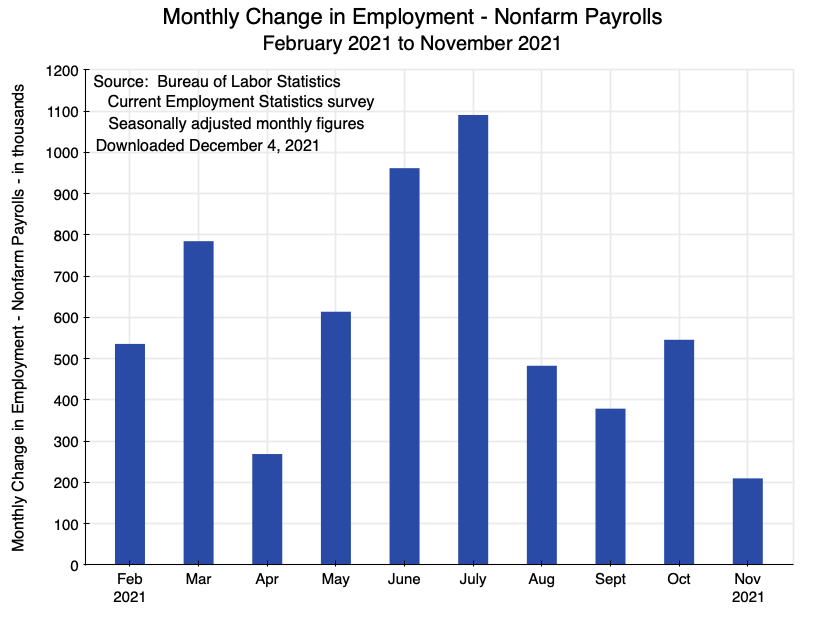
The initial reaction to the report by the media was negative.  Net job growth, estimated at 210,000 in the month, was viewed as disappointing.  This was down from 546,000 net new jobs in October, and was well below Wall Street expectations (based on a survey of Wall Street firms by Dow Jones) that the figure for November would come to 573,000.  While it was noted that the unemployment rate also fell – to just 4.2% – the negative reaction contributed to a significant decline in the stock market that day, with the S&P 500 index, for example, down by over 2% at one point.

But the November jobs report was actually pretty solid.  In this post, we will look at what was reported and some factors to take into account when examining such figures.

B.  Monthly Job Gains in 2021

The chart at the top of this post shows the current BLS estimates of monthly net job growth this year, starting in February to cover the period of Biden’s presidency  The estimates are based on a survey of establishments by the BLS, that asks (along with much else) the number of employees on their payroll as of the middle week of each month.  Hence the January numbers would have been for before Biden’s January 20 inauguration.  The news reports following the release by the BLS of the November jobs report were often accompanied by charts such as this one, with the November figure showing a substantial reduction in the number of net new jobs compared to what was seen in earlier months.  The question of interest is whether this was significant.

A number of factors should be taken into account.  One is simply that there is substantial month to month variation, as seen in the chart.  This may be in part due to fluctuations in the economy, but may also be due to idiosyncratic factors (such as how the weather was in the week of the survey) and to statistical noise.  The figures are based on surveys, and surveys are never perfect.  Examined in context, the change in the November figure from the prior month is similar to the changes seen in other months this year.  Indeed, it was less than in several.

There will, however, always be limitations with any single estimate, and in part for this reason the BLS provides in its published document a few different estimates for employment growth. The measure shown in the chart at the top is rightly considered the best one.  It is based on a monthly survey (called the Current Employment Statistics, or CES, survey) of business and other establishments (including government entities as well as non-profits such as universities and hospitals) – whoever employs workers.  The sample size is huge:  144,000 different businesses and government entities, at almost 700,000 different worksites.   The BLS indicates this “sample” covers approximately one-third of all such jobs in the US.

The numbers are specifically for nonfarm payroll jobs, and hence exclude those employed on farms (which is now small in the US – about 1.4% of workers based on figures from other surveys) and more importantly the self-employed (about 6% of the labor force).  Given the large sample size, and also recognizing that those in the sample include not only small firms but also large entities employing thousands of workers, statistical noise is limited.  However, even with such a large sample size, the BLS states that the 90% confidence interval on the month to month changes in employment is +/- 110,000.  At the more commonly accepted 95% confidence interval it would be wider.

Finally, the figures for the prior two months in each report are preliminary and subject to change as more complete data comes in.  The November report, for example, indicated the estimate of net new jobs in October had been revised up by 15,000, and for September by 67,000.  And the October report last month indicated that its earlier estimate for September had been revised up by 118,000.  That is, the initial estimate for September had been 194,000 net new jobs, but this was revised up a month later to 312,000 net new jobs, and then revised again in the estimates published this month to 379,000.  Such revisions are routine, and one should expect that the initial estimate for November of 210,000 net new jobs will likely be revised in the coming months as more complete data becomes available.  While the revisions can in principle be positive or negative, in an expanding job market (as now) they are likely to be positive.  

The figures in the chart are also seasonally adjusted.  This is done via standard algorithms that estimate the normal annual pattern of employment changes in any given month based on historical data.  Employment growth is normally higher in certain months of the year (such as June, following the end of the school year) and normally lower in other months (such as January).  Analysts will therefore usually focus on the seasonally adjusted figures to see whether certain trends are developing outside of the normal seasonal fluctuations.

This is indeed appropriate.  However, it is also worth recognizing that due to Covid, with the resulting lockdowns, opening-ups, quite prudent changes in consumer behavior due to the health risks from Covid-19 even with all the protective measures taken that can be taken, and the truly historic fiscal relief measures provided through the government budget to support households in the light of all these disruptions, seasonal patterns this year (and last) are likely to be not at all similar to what they have been historically.  It is therefore of interest also to look at the underlying employment estimates, before the seasonal adjustment algorithms are run, to see what those numbers might be saying.

The next section will look at this, along with other measures of the change in employment.

C.  Alternative Measures, and Long-Term Limits on What Employment Growth Could Be

As noted, the BLS makes available in its monthly Employment Situation report several measures of how employment is estimated to have changed in the month, in addition to the one discussed above.  These additional measures should not be seen as better measures (at least in normal circumstances) than the seasonally adjusted measure based on the findings from the huge CES survey of establishments.  Rather, it is best to see them as supplementary measures, or alternative measures, that together help us understand what may be going on in terms of employment. There is always uncertainty in any individual measure, as they are all estimates.  It is better to look at several, to see what the overall story might be.

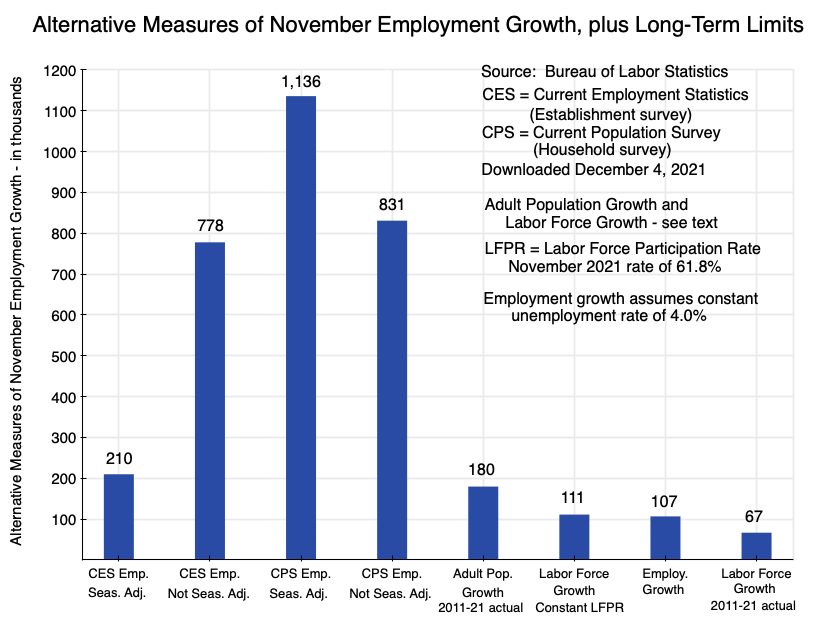
The estimated change in employment in November (or, more precisely, the change in nonfarm payroll), based on figures from the CES survey of establishments, was 210,000 after seasonal adjustment.  But three alternative estimates for employment growth in November were far higher, as depicted in this chart:

In the CES estimate before the normal seasonal adjustment, the growth in net new jobs in November was 778,000.  This difference between the seasonally adjusted and non-seasonally adjusted figures is substantially greater than what one has normally seen for November.  Seasonal adjustment is complicated, but a simple average of the difference between the seasonally adjusted figures for November and the non-seasonally adjusted figures over the 20 years from 2000 to 2019, is 205,000.  But in November 2021 it was 568,000, suggesting something unusual.  If the November 2021 increase in the number of jobs was adjusted by 205,000 rather than the 568,000 estimated by the algorithms, then the “seasonally adjusted” change in the number of jobs would have been 573,000 (= 778,000 – 205,000).  This is exactly what the pre-release expectation was on Wall Street (as noted at the start of this post).  That it was exactly the same as the Wall Street forecast is just a coincidence, but the fact it was close at all might be significant.  It may be suggesting that the standard seasonal adjustment calculations, built from patterns historically seen for the month, might not have captured well the circumstances in this highly unusual year.

Quite separately, the BLS also has an employment measure from the monthly survey of households conducted by the US Census Bureau (with BLS input on what is asked), called the Current Population Survey (CPS).  This survey of a sample of 60,000 households is used by the BLS to determine how many are in the labor force (i.e. are working or are looking for work), whether they are employed (including self-employed and on farms), and thus the number unemployed (those in the labor force but not employed).  The BLS uses this to determine the unemployment rate, but to get to that they have to first estimate, based on this survey, how many are employed.

The November estimates based on the CPS of net new employment were 1,136,000 for the seasonally adjusted figure and 831,000 for the figure before seasonal adjustment.  Why the seasonal adjustment led to a reduction in the job growth estimate from the CPS while it led to an increase in the job growth estimate from the CES is not clear (seasonal adjustment is complicated), but in any case, both figures are relatively close to the 778,000 estimate from the CES estimate before seasonal adjustment.  And all three are all well above the 210,000 seasonally adjusted estimate from the CES that we normally focus on.  Together they suggest that the 210,000 estimate, while usually the most reliable one, might in this case be on the low side.

I have also included in the chart four figures for what I have termed the “long-term limits” on what monthly job growth might be for an economy at full employment.  I included them on the same chart so that one can easily recognize the relative scale.

For an economy at full employment (with unemployment at frictional levels), employment growth cannot exceed the growth of the adult population.  And indeed it will be less, as not all adults (defined by the BLS as all those in the population at age 18 and above) will be in the labor force – some will be retired, some will be students in college, some will have voluntarily left the labor force to raise children or provide care for others, and for other reasons.  Examining what these limits are for the US will provide a sense of what monthly employment growth might be, on average, in the coming years.

First, on population:  Population growth is relatively steady and predictable.  For the ten-year period from November 2011 to November 2021, it averaged 180,000 per month in the US.  It will be similar to this in the coming years, and it sets a (very) crude upper limit on what job growth could be in a steady state.  But one can see even from this figure that it will not be possible to sustain forever monthly net new job growth of even 200,000.  There will not be that many new adults available each month.

But 100% of the adult population are not in the labor force.  As noted, some will be retired, some students, and so on.  The labor force participation rate (LFPR) is the ratio of those who choose to be in the labor force (employed or looking for employment) to the adult population.  In the November CPS figures, that LFPR was 61.8%.  If one assumes that it will remain at that rate, then the monthly growth in the labor force will not be 180,000 (the growth in the adult population) but 61.8% of this, or 111,000.  And if one assumes that unemployment will be something steady, at say 4% at full employment, then potential employment growth would be even less, at 107,000.

The implication is that if the labor force participation rate remains where it is now, one should not be surprised to see monthly figures on job growth of no more than roughly 100,000.  This follows by simple arithmetic.  It could be higher for some period (but not forever) if the labor force participation rate rises from the current 61.8%.  This is possible, and perhaps even likely in the very near term, but probably not for long.  The LFPR in fact rose in the November BLS report to 61.8% from 61.6% in the prior month.  It normally changes only slowly over time.  The disruption that followed from Covid-19 led to relatively wide swings at first, with the LFPR falling from 63.4% in January 2020 to 60.2% in April 2020 with the lockdowns.  But by June 2020 it was back to 61.4% and since has fluctuated in a relatively narrow range before rising the 61.8% of November 2021.

What no one knows is what will happen to the LFPR now.  It might rise a bit more, but the long term trend has been downward.  It peaked in the year 2000, with a steady increase up until then following from a rising participation rate of women in the labor force.  But since 2000 the participation rate for women has moved down, paralleling (but about 20% below) the slow downward trend seen for men since the mid-1950s.  (The factors behind this are discussed in some detail in this earlier blog post.)  It is due to this downward trend over the period of 2011 to 2021 that actual labor force growth over this period was just 67,000 per month (as depicted in the chart above) even though adult population growth was 180,000 per month over this same period.

The current 61.8% LFPR is in fact close to what a simple extrapolation of the trend since 2000 suggests it would be in November 2021.  While the LFPR has behaved unusually since 2016 (when it flattened out for several years and indeed then rose a bit until the start of 2020, before collapsing and then partially recovering in the spring of 2020 due to the Covid-19 crisis), it is now back roughly to what one would find by a simple extrapolation of the trend since the year 2000.

There may well be surprises in what now happens to labor force participation.  After the disruptions of the Covid-19 crisis, it may never revert to where it was just before the crisis.  Those who retired early may mostly choose to stay retired.  And many of those in low-paying jobs, particularly in cases of one spouse in a couple with young children, may have discovered during the Covid-19 crisis that one spouse dropping out of the labor force is not all that costly, and in a two-earner household they may be able to manage financially.

There is therefore a substantial degree of uncertainty on what will now happen to the LFPR.  If it goes up, with a substantial number of adults re-entering the labor force, there will be a transition period when the labor force (and hence the number employed) could rise by significantly more than the 107,000 per month that one would see at a constant LFPR.  Monthly changes in employment during this transition period could be substantial.  For example (and again, this is simple arithmetic), if the LFPR were to increase from the current 61.8% by one percentage point to 62.8% (which would put it back to where it was in much of 2016 through 2018), then the number in the labor force would increase by 2.5 million over what would follow from regular population growth.  Possible employment growth would be about the same 2.5 million if unemployment stays where it is now.  Thus there could be a transition period of five months during which employment could potentially grow by 600,000 per month (a fifth of the extra 2.5 million in the labor force under this scenario, on top of about 100,000 per month from natural population growth).  Or the transition period could be shorter or longer depending on the number of new jobs each month.

But the point is that even if the LFPR should rise, the impact would be a transitory one, after which one should expect employment growth each month of no more than 100,000 or so.  And as noted before, the trend over the last 20 years has been that the LFPR has been moving downward, not upward.

D.  Conclusion

The November jobs report was interpreted by many as disappointing, as the estimated number of net new jobs (based on the estimate normally used – and rightly so) was 210,000.  This was seen as low, and the stock market fell.  However, the report was in fact a pretty strong one, and analysts may have recognized this once they started to look at it more closely.  While one never knows with any certainty why the stock market moves as it does (and there will always be other factors as well), the S&P 500, after falling by over 2% at one point on December 3, started to recover partially by the end of the day.  And it then rose strongly on the next two trading days.

There are reasons to believe the estimate of 210,000 net new jobs in November may have been low.  Seasonal adjustment factors mattered more than normally, and other measures of job growth were significantly higher.  But even at 210,000, analysts need to recognize that as the economy returns to more normal conditions, monthly job growth will likely be a good deal less than that.  While monthly job growth during Biden’s presidency from February to November has so far averaged over a half-million per month (588,000 per month to be more precise), this was only possible because the unemployment rate could come down.  But unemployment is now low – it reached 4.2% in November – and cannot go much lower.  If the labor force participation rate stays where it is now, possible employment growth will only be around 107,000 per month.  If the LFPR rises, then this could go up for some transition period, but that transition period is limited in time and when it is over employment growth will then have to revert to something close to 100,000.

What is more likely is that the LFPR will now return to the longer-term trend seen since it reached its peak in the year 2000, and will fall slowly over time.  Monthly employment growth would then be less, at something less than 100,000 per month (where how much less depends on the pace at which the LFPR falls).

Expectations have to be reset.  Other than during a transition period should the labor force participation rate rise above where it is now, monthly net new jobs growth of 100,000 per month or so is likely to be the limit of what one will see.  But that would be a good performance in an economy that remains at full employment.  Only if unemployment shoots up due to some future downturn could one then see – during a recovery from that downturn – something more.