Fiscal Drag Continues to Pull Down the Economy

Private employment, government employment, December 2010 to May 2012

A pair of disappointing reports, from this morning (June 1) and yesterday (May 31), indicate that the economy continues to grow only slowly, with consequent slow growth in employment and indeed a small rise in the rate of unemployment to 8.2% from 8.1% last month.  Posts on this blog in January, on GDP growth and on employment, had flagged that growth, which at that time appeared to be improving, could well fall back in 2012.  Unfortunately, that appears to be happening.  Cut-backs in government spending account for a major part of that disappointing growth.

The Bureau of Labor Statistics, in its June 1 release this morning on employment, found that total US employment grew in May by a net 69,000 jobs, with an increase of 82,000 private jobs and a fall of 13,000 government jobs.  Based on the growth rate of the labor force over the ten year period of 2002 to 2012 (there is a good deal of fluctuation in monthly figures), the labor force is growing at about 83,000 workers per month on average.  Employment growth in May of just 69,000 jobs does not keep up with this, much less make a dent in the still high unemployment.

The figures released this morning were also disappointing in the revised numbers they showed for April.  Last month, the initial estimates were that April total employment had risen by 115,000 jobs, with private jobs growing by 130,000.  These were already not good, but the revised estimates issued this morning based on more complete data indicate total jobs in April grew by only 77,000 jobs, with private jobs growing by just 87,000 jobs.  With the May numbers of 69,000 and 82,000 for total and private jobs, respectively, we now have two months of disappointing job growth.  Unless the May numbers are significantly revised when more complete data becomes available, we cannot say that this is only a one month fluke.

As one can note from these numbers, private job growth has been consistently above total job growth.  That is because government continues to cut back on the number of workers it employs, despite assertions by Mitt Romney and other Republicans that government has been growing.  The graph above shows the monthly changes in employment of both private and government employees over the last year and a half, where one sees that government employment has been falling in all but two of these months.  Note that the government figures in the graph are for total government, including at the state and local level.  But the underlying figures show that the fall has been in employment both at the federal and at the state and local levels.

This steady fall in government employment depresses overall job growth, and adds up over time.  Between January 2009, when Obama was inaugurated, and May 2012, total government jobs fell by 607,000.  In contrast, over January 2005 and May 2008, the comparable period in Bush’s second term, total government employment rose by 743,000.  If government employment had been allowed to grow as much during the Obama period as it had during the Bush period, the difference would have been an additional 1.35 million jobs.   This difference alone would have brought the unemployment rate down from the current 8.2%, to just 7.3%.  But one would expect with the still depressed economy, with unemployment high, that increased government employment would have spurred some private job growth.  Assuming conservatively a multiplier of two (i.e. there would be one additional private job for each additional government job, to produce what the now employed government workers will spend on), the unemployment rate would have dropped to just 6.5%.

That is, had government employment been allowed to grow during the Obama period by as much as it had during the comparable Bush period, unemployment would have dropped to 6.5%.  With full employment generally considered to be in the range of 5 to 6% currently, this would have brought employment most of the way to full employment.

The other disappointing report was on estimated GDP growth in the first quarter of 2012, released by the Bureau of Economic Analysis on May 31.  This was the regular first revision of the initial estimate of GDP growth that had been released a month ago.  The initial estimate of GDP growth in the first quarter of 2012 was discussed in a posting on this blog in April.  The initial estimate was that GDP had grown at a 2.2% annualized rate in the first quarter.  This estimate has now been revised downward to 1.9%.

The revision is not large, but is not in a good direction.  And it is interesting to note that two-thirds of that downward change (0.2% points of the 0.3% points reduction) was due to a downward revised figure on government spending.  Government spending was already falling, and the initial estimate, discussed in the blog post cited above, was that it took 0.6% points away from what GDP growth would have been.  The revised estimate increases that reduction to 0.8% points of GDP.  Government spending on goods and services (for all government, including state and local) is estimated to have declined at an annualized rate of 3.9% in the first quarter, similar to the 4.2% rate fall in the fourth quarter of 2011.

The reduction in government demand for goods and services leads to a reduction in GDP in present circumstances since unemployment is high, there is substantial excess capacity, and hence goods and services produced for sale to government will not come from goods and services that could be sold elsewhere.  There is plenty of capacity to produce whatever people demand, and the problem is there is no demand for additional goods and services to be sold elsewhere.

This fall in government spending, especially in the last half year (i.e. the fourth quarter of 2011 and the first quarter of 2012), can explain a large part of the recent slow growth.  As noted above, the revised GDP estimates indicate that the fall in government spending in the first quarter of 2012 subtracted 0.8% points from what GDP growth would have been.  There was a similar 0.8% point reduction in the fourth quarter of 2011.

But far from simply not falling, government spending will grow in a normally growing economy.  Hence the basis of comparison should not be to zero government spending growth, but rather something positive.  One comparison to use would be the growth seen during the Bush administration.  Over 2001 to 2008, government spending growth on average accounted for 0.42% points of GDP growth at an annualized rate.  Keep in mind that this spending growth is for all government, not simply federal spending (which was high), but also state and local government spending.  Also, government spending in the GDP accounts is for direct goods and services only, and excludes spending via transfers (such as Social Security).

Finally, government spending growth in periods such as now, when unemployment is high and there is excess capacity, will have a multiplier impact, for the reasons discussed above.  A reasonable and conservative multiplier to use would be a multiplier of two.

The table below summarizes the impact of these assumptions for what growth would have been in 2011Q4 and 2012Q1:

      Annualized growth rate of GDP 2011Q4 2012Q1
GDP Growth Observed 3.0 1.9
GDP Growth if Government had not contracted 3.8 2.6
GDP Growth if Government had grown at the Bush rate 4.2 3.1
GDP Growth if Government had grown at the Bush rate, with a multiplier of two 5.5 4.3

GDP growth as actually happened was at a 3.0% rate in the fourth quarter of 2011 and 1.9% in the first quarter of 2012.  Had reductions in government spending not taken away 0.8% points from these growth rates in each of these two periods, growth would have been 3.8% and 2.6% respectively.  But this implicitly places government spending growth at zero.  Had government been allowed to grow as it had between 2001 and 2008 during the Bush terms, growth would have been 4.2% and 3.1% even with no multiplier.  With a multiplier of two, the rates would have been 5.5% and 4.3% respectively.

Such growth rates of about 5% on average is what the economy needs if it is to recover.  At 2% or so, growth is insufficient to create sufficient demand for labor to bring down unemployment on a sustainable basis, as we have just seen in the report this morning.  And a 2% growth rate is so modest that it is vulnerable to shocks, such as from Europe (where Germany and the EU still have not addressed what needs to be done to resolve the Euro crisis), or from a spike in oil prices (should the Iran situation blow up, literally), or even from swings in inventories (as discussed before in this blog).

With government contracting as it has, despite the high unemployment and excess capacity, fiscal drag is acting as a severe constraint on economic growth.  There is a not a small danger that growth could slip back to negative rates, and that is not good for an incumbent President in an election year.
Job Market Dynamics: A Continued, But Slow, Recovery

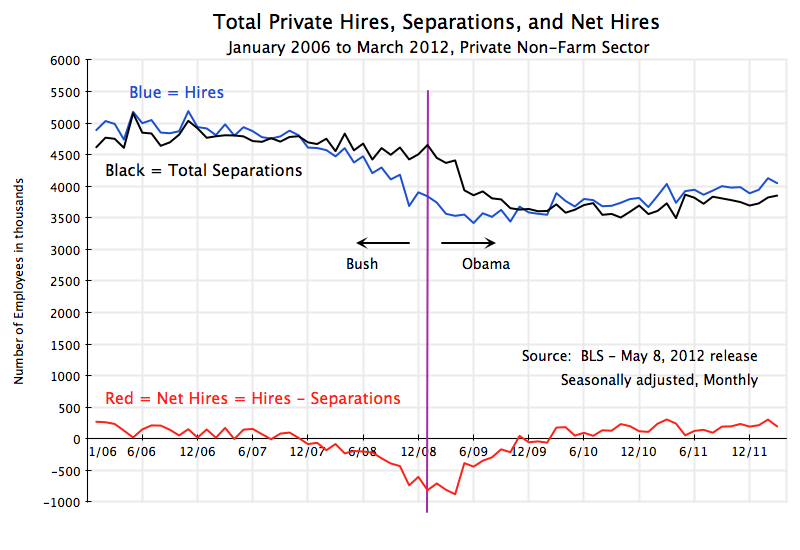
Jobs, employment, new hiring, job separations, net job creation, January 2006 to March 2012


employment, jobs, total separations, layoffs and discharges, quits, January 2006 to March 2012This post is an update of one from January of this year, with more recent data and to reflect revisions that have been made in the earlier figures.  The numbers are from the Bureau of Labor Statistics, and this spring it issued new figures for the last several years, reflecting methodological improvements in the system it uses to go from its survey results to its national estimates.  What is shown above and will be discussed below are jobs in the private non-farm sector.  Government jobs have been falling, as has been noted in this blog, but follow a different dynamic than private jobs.  Hopefully government jobs will now stabilize and preferably grow, rather than continue to act to depress the economy.

The story on the private job dynamics is the same as before, and the more recent numbers (through March in the figures above, vs. through November 2011 in the January posting) confirm the trend that was noted before.  That is, the job market is recovering, but at too slow a pace given the still high level of unemployment.  At such a slow pace, it could easily go into reverse should the economy slow.  As has been noted before in this blog, US GDP growth has been slow due to the continued fiscal drag as government expenditures have been cut back.  There is also the threat of a European collapse, with negative impacts on the US, as Europe has failed to address the Eurozone problems with any policy other than increased austerity.  Growth in Europe is already at zero.

There is now the additional threat made recently by Speaker of the House John Boehner, to hold hostage the Congressional approval required for the debt ceiling later this year unless Republican demands of further government expenditure cuts are met.  Without this Congressional approval, the United States would be forced to default.  Economic chaos would result.

Among the points to note from the figures above:

1)  There were major net job losses in 2008 and 2009 (the curve in red in the top figure), but not because more people were leaving their jobs, due to layoffs or other reasons.  Rather, it was because the pace of new hiring slowed.  At the peak of the housing bubble in 2006, new hiring was being done at a pace of roughly 5 million jobs per month.  This started to fall, but slowly, in late 2006 / early 2007.  It began to fall at a rapid rate in 2008 (the last year of the Bush administration), and then stabilized and began to recover within a few months of Obama taking office, as the stimulus package and other measures began to have their positive effect.  From a trough of about 3 1/2 million new hires per month in mid-2009, new hires has slowly grown to a pace of a bit over 4 million per month currently.  That is, there has been some recovery, but the pace is still well below the 5 million new hires per month seen when the economy is at full employment.

2)  Total job separations, whether from layoffs or quitting or anything else, actually fell in the downturn.  People often believe that unemployment shot up in the downturn because of massive layoffs, but that is not really the case.  Unemployment went up not because of more people being fired or otherwise leaving their jobs, but rather because the pace of job separations did not fall as rapidly as did the pace of new hiring.  In normal times, more people separate from their jobs because they quit (usually to take a new job elsewhere) or voluntarily leave for some other reason (e.g. retirement), than leave because of being laid off.  The pace of layoffs and discharges did indeed go up in 2008, the last year of Bush, from roughly 1.7 million per month before the downturn, to a peak of 2.5 million in the last month of Bush.  But this was less than the fall in the number of people who voluntarily quit, so total separations actually fell.  And layoffs then soon started to fall in number under Obama, and is currently below 1.6 million per month, i.e. less than the pace seen when the economy was near full employment.

3)  Since late 2009, the pace of new hiring has risen under Obama, as noted above, from roughly 3 1/2 million per month to a bit over 4 million per month currently.  Quits also started to rise with the improving job market, from about 1.5 million per month to 2 million per month most recently.  This is a good sign, and an indication that people are voluntarily leaving their jobs as the pace of new hiring has improved.  And layoffs and discharges has slowly fallen over this period as well.  The result is that the pace of total separations have been below that of new hires since early 2010, with net new jobs thus being created.

But the pace of net new job creation has been slow, at only about 200,000 net new jobs per month over the last half year (other than 300,000 in February).  With unemployment still at 8.1%, it would take years to reach full employment at such a pace of net job growth.  That is, at a pace of net job growth of 200,000 per month and assuming growth in the labor force of about 0.65% per year (the rate seen in the past decade, as it depends on population growth and demographics), it would take over two more years for the unemployment rate to fall below 6%, and almost three and a half years to fall below 5%.  At 300,000 net new jobs per month, unemployment would fall below 6% in a more reasonable 15 months, and would hit 5% in about two years.

A pace of net new job growth of 300,000 per month is not at all impossible, but will require a sufficient growth in aggregate demand in the economy so that the goods and services these workers would produce could be sold.  As has been noted before in this blog, fiscal drag largely explains the slow growth in aggregate demand in the US:  Had government demand been allowed to grow during the Obama years at the pace it had during the Reagan period when the economy was recovering from the 1981 downturn, we would now be at close to full employment.

Although Improving, Still Many More Unemployed Than Job Openings

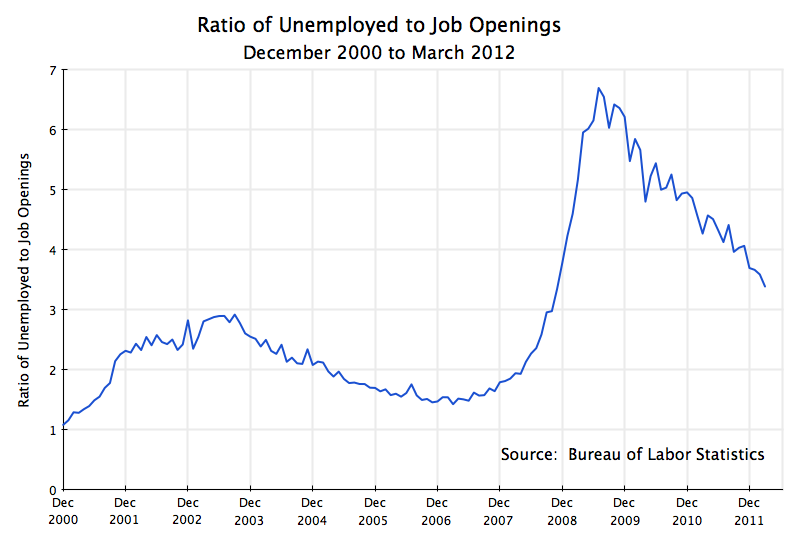
Number of unemployed as a ratio to job openings, US data, December 2000 to march 2012

There are many conservatives who argue that the unemployed need not be unemployed if they were only willing, perhaps with a cut in wages, to take one of the many jobs they assert are available.  Help wanted signs are seen, and thus these conservatives believe the unemployed could get a job if they wished.  They believe the unemployed are unemployed by their own choice, either out of laziness or due to an unwillingness to accept a lower wage.  In terms economists would use, they believe that the markets for labor would always clear if only the workers were willing to accept a lower wage.

The problem with this view is that it is not consistent with the fact that in economic downturns there are many more unemployed than job openings.  Even if every single one of the job openings were immediately filled, there would be many unemployed workers seeking jobs still left.  And since it in fact takes some time to fill any job, and since there is also constant turnover in jobs, one will see the help wanted signs posted for a while.

Data for the US on this is now gathered by the Bureau of Labor Statistics of the US Department of Labor, in a monthly survey of private establishments (which includes non-profits) and government entities.  The survey is a relatively recent one, having started only with data from December 2000, and gathers data on labor turnover (hirings, quits, firings, and other turnover) in addition to job openings (and is called JOLTS, for Job Openings and Labor Turnover Survey).  The labor turnover side of these numbers was discussed in a post on this blog in January, which used the numbers to look at the dynamics of the job market.  The post today will consider the job openings side of this survey.

The graph above, based on the JOLTS data from the Bureau of Labor Statistics coupled with the BLS unemployment figures (from its separate monthly survey of households), shows the ratio of the reported number of job openings to the number of unemployed.  For the most recent month available, the ratio of the number of unemployed to the number of open jobs was 3.4.  That is, there were 3.4 unemployed workers in the US for each open job that employers were seeking to fill.

This ratio of 3.4 is significantly better than the approximately 6.5 ratio of unemployed to open jobs when unemployment was at its peak following the recent economic collapse.  It is interesting to see in the graph the close to straight line downward trend since it hit that peak.  But there are still many more unemployed than available jobs, and the labor market is healing only slowly.  It still has a long ways to go.

Note that when the economy is close to full employment (as in December 2000, at the end of the Clinton presidency, or in late 2006 / early 2007, at the peak of the housing bubble), the ratio is around 1.0 to 1.5.  Note that there is no reason why the ratio necessarily has to be greater than one, as one could in principle have a situation of few unemployed and many open jobs seeking workers.  But in practice, it appears that in the US the ratio will always be greater than one, even when the economy is at full employment.  There will always be some unemployed and some unfilled jobs, and at full employment these are in rough balance.

But the current ratio of 3.4 unemployed for every job opening, while better than the 6.5 ratio seen when unemployment was at is peek, is still well above the 1.0 to 1.5 ratio one sees when the economy is close to full employment.  The unemployed cannot be blamed for being unemployed because they are lazy, or unwilling to accept a lower wage.  They are unemployed because there are too few jobs out there.  And there are too few jobs because there is not sufficient demand for the goods these workers could produce.

As was discussed in postings on this blog on March 3 and on March 12, this insufficiency of demand in the aggregate for what American workers can produce is largely explained by fiscal drag, compounded (although of lesser importance in the aggregate) by the collapse of housing investment following the bursting of the bubble.  Government (mostly at the state and local level) has cut back in this downturn.  This is in contrast to the expansions of government spending and hence government demand seen in other downturns, and very notably in contrast to the strong expansion in government spending during the Reagan period (despite the myth).  As the March 3 post estimated, if government spending (including state and local) during the Obama presidency had been allowed to expand by as much as it had during the Reagan presidency, the economy would now be at full employment.