The UK Parliamentary Election Results: A Big Victory for the Conservative Party, While Voters Shifted to the Left

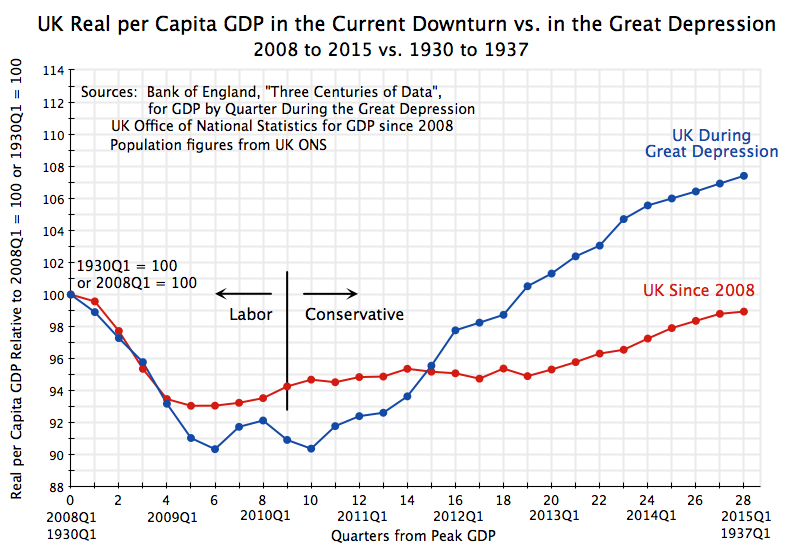
UK Per Capita GDP 2008Q1 to 2015Q1 vs Great Depression

A.  Introduction

The recent Parliamentary election in the United Kingdom was without doubt a big victory for the Conservative Party and a loss for Labour.  The normally staid The Economist (which I try to read on a regular basis) sub-titled its Bagehot column this past week as “British voters have showed a crushing disdain for the Labour Party”, and in its first sentence termed the election a “calamitous defeat” for Labour.  Stronger language is available in other British publications, for those who are interested.

But while undoubtedly a defeat for Labour and a victory for the Conservatives (who gained a majority of the seats in Parliament, and hence will no longer need to rule in a coalition), one should not jump to what would seem to be the natural conclusion that voters shifted to the Right while abandoning the Left.  That did not happen.  Given the rules of the British electoral system, where Parliamentary seats are won by whomever gained most votes (not necessarily a majority) in each of the 650 constituencies (a “first past the post” system), plus the rise of significant third parties on both the Left and the Right, swings in voter support between Left and Right were quite different from swings in the number of seats won by the major parties.

This blog post will look at these election results, in comparison to the results from the most recent UK general election in May 2010.  That election brought a Conservative – Liberal Democrats coalition to power, replacing the previous Labour Government.  Some have argued (most strongly by the Conservative Party leaders themselves) that the recent election results mark a vindication of the economic program it launched soon after taking office, and a recognition of its success.  The first section below will examine very briefly whether that program can be termed a success, and the rest of the post will then look at the election results themselves.

B.  Growth Has Been Poor

Perhaps the best single measure of whether a government’s program succeeded or not is whether it led to good and sustained growth or not.  While there is of course much more to be concerned with, real incomes and living standards cannot increase overall unless there is growth.

The chart at the top of this post shows what happened in the recent downturn to real per capita GDP in the UK, measured relative to the peak level it had achieved before the downturn (in the first quarter of 2008).  It also shows the path followed by the economy during the Great Depression in the UK, from the peak reached in the first quarter of 1930. The recent data come from the UK Office of National Statistics, while the data on real GDP in the 1930s come from the data set (drawn from academic studies) released by the Bank of England and called “Three Centuries of Data” (a hot link is not possible, but just do a Google search to find it).

The rapid and steep decline in GDP at the start of the Great Depression, and then a delayed and initially slow recovery, had marked the worst previous period for the economy over at least the last century.  But the current recovery has been worse.

The downturn during the 2008 collapse initially traced very closely the path of the downturn during the first year of the Great Depression.  But the Labour Government in power until mid-2010 was able to turn this around after about a year with stabilization and stimulative measures, with the economy then starting to grow.  A Conservative led coalition (with the Liberal Democrats) then took power after the May 2010 general elections, and soon announced a sharp austerity program.  After one more quarter of growth (the new austerity measures began to be implemented in the fall of 2010), the economic recovery was brought to a halt.  Real per capita output was largely unchanged over the next two and a half years.

Policy then shifted, with an easing of the austerity measures.  Growth resumed in early 2013, to a modest rate averaging 1.9% a year (per capita) over the two years leading up to the recent election.  While better than no growth at all, as during the first two and a half years of the Conservative-led Government, such a modest growth rate for an economy coming out of the worst downturn since the Great Depression is poor.

Indeed, as the chart at the top of this post shows, the recovery was a good deal faster during the Great Depression.  At the same point in the downturn (after 28 quarters, or 7 years), real GDP per capita in the Great Depression was 7 1/2 % higher than it had been at its previous peak at the start of 1930.  In the current downturn, it is still 1% lower than it was at the start of 2008.

This is a terrible record.  While there is strong evidence in the political science literature that voters only pay attention to growth in just the year or so before a general election (rather than looking farther back to the full record of the administration), one cannot find evidence here that the austerity program of the Conservatives has been a great success. At most it says that voters can perhaps be fooled by timing the economic cycle to cut growth when first taking office to make it easy to have a “recovery” as the next election approaches.  But it is not clear that UK voters have in fact been fooled in this way, once one looks at whether voters indeed shifted to the Right or to the Left.

C.  Overall Election Results by Party

First the election results by party.  The figures are all taken from the BBC, and the comparisons are made relative to the results in the 2010 general election.  In terms of the number of seats gained or lost:

UK Parliament 2015 Election Results, Change in Number of Seats by Party

Labour lost 26 seats, and the Conservatives won 24, bringing the Conservative total to 331, or a majority in the 650 seat House of Commons in Parliament.  This was a major victory for the Conservatives and a loss for Labour.

The Liberal Democrats also lost, but by much more.  They had won 57 seats in the previous election but only 8 now, for a loss of 49.  They had joined as the junior partner in the Conservative-led coalition of the previous Parliament, and provided the key votes that allowed approval of the conservative agenda of austerity (as well as tax cuts, mostly benefiting the rich).  Voters who had supported the Liberal Democrats before clearly did not like what their party representatives had done, and the party was decimated.

But the biggest winner by far in terms of number of seats was the Scottish National Party (SNP), which gained 50 seats.  This was more than double what the Conservatives gained. The SNP advocates policies well to the left of Labour in terms of support for social programs (in addition to its support for a Scottish nation).  This hints at the need to start to break down the results to see what really happened.

The first step is to look at the swing by party in the share of votes cast.  Because of the UK “first past the post” system, plus the existence of significant smaller parties, swings in votes cast can differ significantly from swings in seats won.  The changes in the shares of the vote gained were:

UK Parliament 2015 Election Results, Change in Share of Vote by Party

Here the Labour Party actually gained, increasing their share of the UK vote by 1.5% points.  They gained in terms of their share of the vote, but still lost 26 seats.  The Conservatives also increased their share of the vote. but only by 0.8% points, about half of what Labour gained, even though this led to their gaining 24 seats in the new parliament. One cannot conclude from this that there was a big swing in sentiment away from Labour and towards the Conservatives.  Labour increased its share of the vote, and by more than the Conservatives did.  But with the UK first past the post system, what matters in terms of seats won is how these votes are spread across constituencies and what gains and losses are being made by third parties.

Among the remaining parties, the Liberal Democrats saw their share of the vote collapse by over 15% points, to a total in 2015 of less than 8% of the voters.  They were decimated, and their losses in seats are consistent with this.

The SNP, as noted above, won big in terms of seats gained, but at a national level their share of the vote rose by just 3% points.  But the SNP contested only seats in the 59 districts in Scotland (and took 56 of them), and there their share of the vote rose by 30% points.  The 50 seats the SNP gained came mostly from Labour (which lost 40 seats in the Scottish districts) and the Liberal Democrats (which lost 10 seats).  The Conservatives had one seat before in Scotland and one seat after, for no net loss, but they basically had nothing to lose there to start with.

The Green Party, with a focus on environmental and social issues, is also on the left. While they gained no new seats in parliament, they increased their share of the UK vote by close to 3% points.

On the right is UKIP (UK Independence Party), a radically right-wing populist party advocating exit from the EU and conservative social programs.  They increased their share of the vote (relative to the 2010 elections) by 9.5% points and gained one seat relative to their 2010 results (when they won zero seats; in by-elections since 2010, UKIP won two seats, so their one seat now is a reduction relative to what they had immediately before the 2015 elections were called).

The BNP (British National Party) is an even more extreme right wing, anti-immigrant and anti-EU, party.  It had close to 2% of the vote in 2010, but dropped to essentially zero now, with most of its supporters likely shifting to UKIP.  It held no seats before or after.

Finally, the other category is comprised of a fairly large number of mostly small parties. The more important among them are regional parties in Wales and Northern Ireland, whose primary focus is on regional issues.  They had no net gain or loss of seats, but they hold a not insignificant 21 seats in the Parliament.

 D.  Left, Center, or Right

Given this distribution across parties, how would the vote and seat count add up if one grouped the parties by ideology?  The Left is made up of Labour, the SNP, and the Greens; the Center is the Liberal Democrats; the Right is the Conservatives, TKIP, and BNP; and Other is everyone else.

The results in terms of share of the vote is:

UK Parliament 2015 Election Results, Change in Share of Vote by Left, Center, Right

The Left gained 7.4% points of the vote, while the Right gained 8.4%.  And the Center (the Liberal Democrats) lost over 15% points.  This is hardly a resounding trouncing of the Left, or a renunciation of their views.

There is then more of a consistent result in the number of seats won or lost:
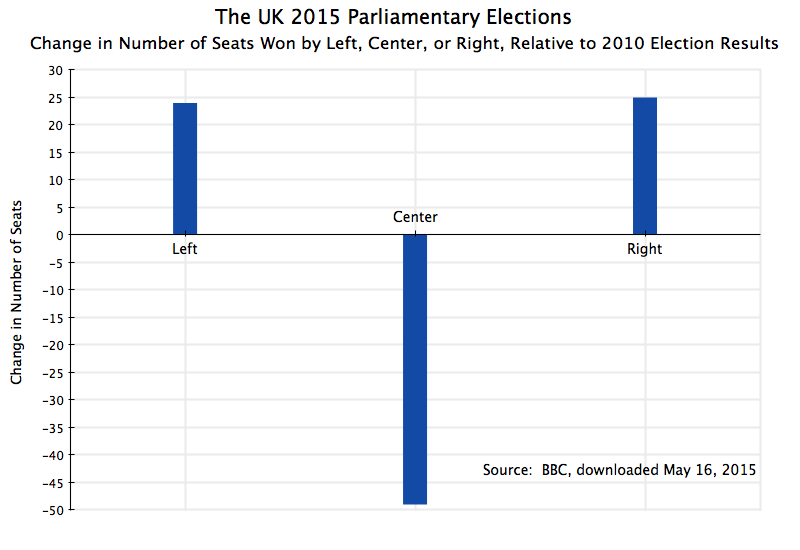
UK Parliament 2015 Election Results, Change in Number of Seats by Left, Center, Right

The Left won 24 seats, the Right won 25, and the Center lost 49.  It is hard to argue the Left lost in this election.  It is more correct to say that the Center lost, with almost even shares then going to the Left and to the Right.

E.  Just Left or Right

Finally, it is arguable that the Liberal Democrats can no longer be considered a centrist party.  They have been coalition with the Conservatives in the most recent Parliament, and provided the critical votes they needed to implement their austerity program of cuts in government programs (while at the same time granting tax cuts mostly benefiting the rich). While I would not want to argue the point too strongly, for completeness it is of interest to look at how the results add up if one combines the Liberal Democrats with the right-leaning parties.

In terms of voting shares, there is now a clear shift from the Right to the Left:
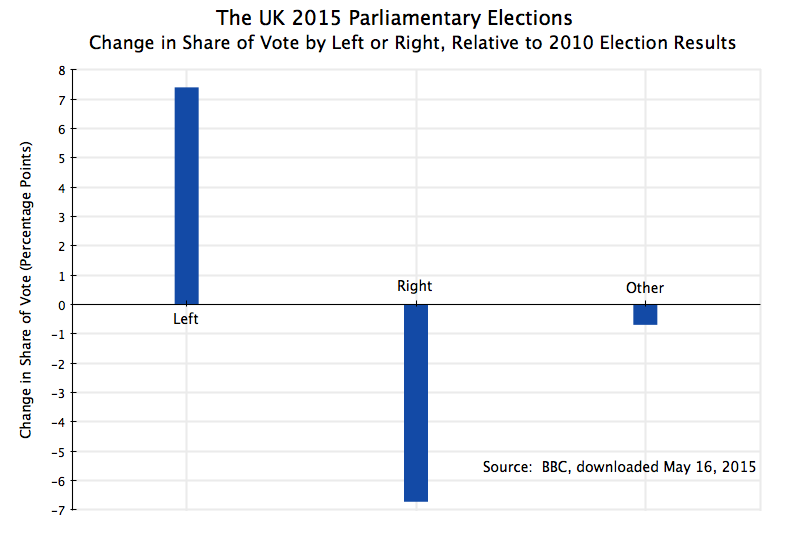
UK Parliament 2015 Election Results, Change in Share of Vote by Left, Right

The Left gained 7.4% points of the vote, while the Right lost 6.7% points (while the Other category lost 0.7%).  This would then be a pretty sharp swing to the Left.

And in terms of seats won:
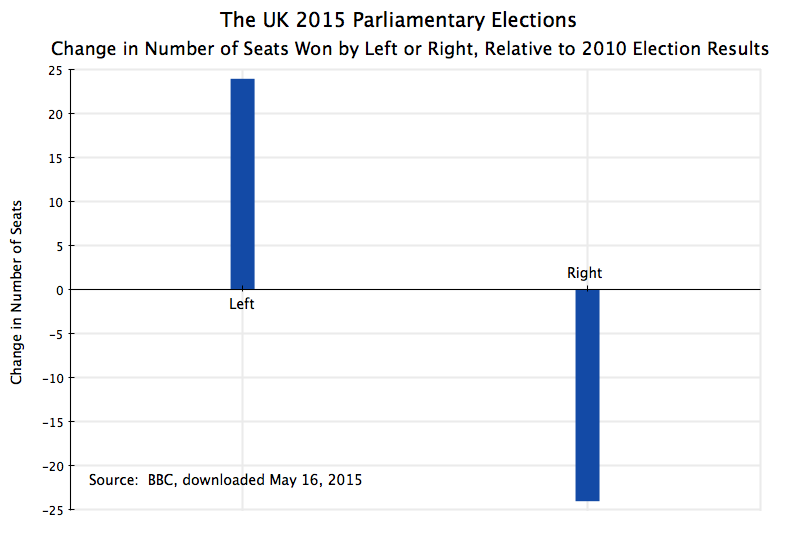
UK Parliament 2015 Election Results, Change in Number of Seats by Left, Right

The Left gained 24 and the Right lost 24.  Under a different voting system than that used in the UK, this would have been a major victory for the Left.

F.  Conclusion

There can be no dispute that the Conservative Party won big in this election, while Labour lost.  The Conservatives gained an absolute majority in the new Parliament, and no longer need to rule in coalition.

But this win was a result of the particular electoral rules used in the UK.  The rules are what they are, and those who win by those rules are those who form the new government, but one should not then jump to the conclusion that this win by the Conservatives reflects an endorsement by the voters of their economic program.  There was, rather, a big move to the Left among the electorate as a whole, to parties that strongly criticized the austerity policies of the Conservative-led government.

More fundamentally, the UK recovery from the 2008 downturn has been far too slow, with growth that is not only well below where the economy was at the same seven-year mark during the Great Depression (8% lower in real per capita terms), but also even still below where the economy was in 2008.  No one can dispute that this is a terrible record.

The Strong Recovery in Employment Under Obama

Unemployment Rates - Obama vs Reagan

A.  The December Jobs Report

The Bureau of Labor Statistics released on Friday its regular monthly report on employment.  Job growth was once again strong.  Total jobs (nonfarm payroll employment, to be precise) rose by a solid 252,000 in December, and the unemployment rate came down to 5.6%.  Total jobs rose by an even higher (and upwardly revised) 353,000 in November and by an also upwardly revised 243,000 in October (the two most recent monthly figures are always preliminary and subject to revision).  These are all good numbers.  The 353,000 figure for job gains in November was the highest monthly figure in over nine years.

The overall job gain in 2014 came to 2.95 million.  This was the highest annual total since 1999.  Private sector jobs rose by 2.86 million in 2014.  This was the highest annual gain in private jobs since 1997.  Government jobs (federal, state, and local) also grew, although only by 91,000 and equal to just 3% of the overall growth in jobs of 2.95 million.  But at least it was positive and stopped being the drag on growth it had been before through repeated cuts.  Government jobs had been cut each and every year since 2009, reducing American jobs by 702,000 between 2009 and 2013.

B.  Obama’s Performance on Unemployment, Compared to Reagan’s

While the pace of improvement has accelerated in the past year, the Obama record on jobs has in fact been a good deal better for some time than he has been given credit for.  Critics said that Obama’s policies, both as a consequence of the passage of the Obamacare health reforms and from his use of government regulatory powers, would (they asserted) constrain job growth and keep unemployment high.  These critics look to the Reagan presidency as a model, with the belief that there was a rapid fall in unemployment following his tax cuts, attacks on unions, and aggressive deregulatory actions.  This adulation continues.  A recent example was a column by Stephen Moore (Chief Economist of the Heritage Foundation) published in the Washington Post just two weeks ago (and which a number of commentators, including Paul Krugman, noted was full of errors).

But how do the Obama and Reagan records in fact compare?  The graph at the top of this post shows the path the rate of unemployment has taken during Obama’s presidency, and for the same period during Reagan’s presidency.  Both curves start from their respective inaugurations.

Unemployment under Reagan was high when he took office (at 7.5%), although on a downward trend.  But it then rose quickly (peaking at 10.8%) followed by a fall at a similar pace, before leveling off at a still high 7 to 7 1/2%.  It then fell only slowly for the next two and a half years, by a total of just 0.6% points.  The recovery in terms of the unemployment rate lacked strong staying power.

The pattern was different under Obama.  While unemployment was also high when he took office (7.8%), it was rising rapidly as the economy was losing 800,000 jobs a month.  It rose to a peak of 10.0% nine months later, before starting a fall that has continued to today.  The pace of the reduction was relatively steady over the years, but accelerated in 2014.  Over the last two and a half years, the unemployment rate has been reduced by 2.6% points, far better than the 0.6% reduction for the comparable period under Reagan.

As a result, the unemployment rate is now 5.6% under Obama, versus 6.6% at the same point in Reagan’s tenure.  By this measure, performance has been better under Obama than it was under Reagan.  The 5.6% rate under Obama can also be compared to Mitt Romney’s statement in 2012, during his presidential campaign, that adoption of his policies would bring the unemployment rate down to 6% by January 2017.  Romney viewed this as an ambitious goal, but achievable if one would follow the policies he advocated.  It was achieved under Obama already by September 2014.  One did not hear, however, any words of congratulations from Romney or others in the Republican Party to mark that success.

Of possibly more interest in the debate about the response to the respective policy regimes of Obama vs. Reagan, was the flattening out of unemployment under Reagan at the still high level of 7.5% or close to it in mid-1984.  If his “supply-side” policies were going to be effective in bringing down unemployment, this was the period when they should have been working.  The tax cuts had been passed, and the regulatory and other policies of the Reagan administration were being implemented and enforced.  But unemployment was trending down only slowly.  In contrast, unemployment was falling rapidly for the same period in the Obama presidency, with the pace of reduction indeed accelerating in 2014.  There is absolutely no evidence that Obamacare, actions to protect the consumer or the environment, the application of government regulations under Obama, or even “policy uncertainty” (a new criticism of Obama that was given prominence during the 2012 campaign), have acted to slow job growth.

C.  A Few More Points

1)  Why did unemployment rise rapidly from mid-1981 to late-1982 (to 10.8%), and then fall at almost the same rapid rate from that peak to mid-1984?  This had less to do with the policies of Reagan than of those of Paul Volcker, then Chairman of the Federal Reserve Board (and a Jimmy Carter appointee).  Volcker and the Fed raised interest rates sharply to bring down inflation, with the federal funds rate (the interest rate at which banks lend funds on deposit at the Fed to each other; it is the main policy target of the Fed) reaching over 19% at its peak.  Inflation came down, the Fed then reduced interest rates, and the economic downturn that the Fed policy had induced was then reversed.  Unemployment thus rose fast, and then fell fast.

2)  Has the fall in the unemployment rate under Obama been more a reflection of people dropping out of the labor force than a recovery in jobs?  No.  A previous post on this blog looked at this issue, and found that labor force participation rates have been following their long term trends.  There is no evidence that labor force participation rates have made a sudden shift in recent years.

3)  Why has the pace of improvement in the unemployment rate accelerated in 2014?  As earlier posts on this blog have noted,  Obama is the only president in recent history where government spending has been cut in a downturn.  The resulting fiscal drag pulled back the economy from the growth it would have achieved had government spending, and its resulting demand for goods and services and hence jobs to produce those goods and services, not been cut.

But this finally turned around in 2014.  Congress finally agreed to a budget deal with Obama, and state and local governments saw spending stabilize and then start to rise as the recovery got underway and boosted tax revenues.  The result is shown in this chart, copied from an earlier post whose focus was on austerity policies in Europe:

Govt Expenditures, Real Terms - Eurozone and US, 2006Q1 to 2014 Q2 or Q3

Total US government expenditures (federal, state, and local; in real terms; and for all purposes, including both direct purchases of goods and services and for transfers to households such as for Social Security and Medicare), turned around in the first quarter of 2014 and began to rise.  Government spending had previously been falling from mid-2010.  With that turnaround in government spending, GDP rose by 4.6% (at an annualized rate) in the second quarter of 2014 and by 5.0% in the third quarter.  Much more was going on, of course, and one cannot attribute all moves in GDP growth to what has happened to government spending.  But the turnaround in government spending meant that this component of GDP stopped acting as the drag on growth that it had been before.

Jobs then grew in 2014 at the most rapid rate since 1999, and unemployment fell.  The unemployment rate of 5.6% is the lowest since 2008, the year the economy entered into the economic collapse that marked the end of the Bush administration.

D.  How Much Further Does Unemployment Need to Fall to Reach Full Employment?

The 5.6% rate is not yet full employment.  While it might appear to some to be a contradiction in terms, there will always be some unemployment in an economy, even at “full employment”.  There will be frictions as workers enter and leave jobs, mismatches in skills and in geographic location, and so on.  But the 5.6% rate is still well above this.

Historically, the US economy was often able to achieve far lower rates of unemployment and not see excessive upward pressure on wages and prices.  The unemployment rate was at 4.4% in 2006/07, at 3.9% in 2000, and at 4.0% or below continuously from late 1965 through to early 1970 (and reached 3.5% or below for a full year from mid-1968 to mid-1969).  It even dipped to a post-war low of 2.5% in 1953, although few would say that the conditions then would apply to now.

Based on such historical measures, the unemployment rate could still be reduced substantially from where it is now before the labor market would be so tight as to cause problems.  Economists debate what that rate might be at any given time, but personally I would say that a reasonable target would be no higher than 4 1/2%, and perhaps as low as 4%.

But rather than try to predict what the full employment rate of unemployment might be, one can follow a more operational approach of continuing to push down the rate of unemployment until one sees whether upward wage and price pressures have developed and become excessive.  That is how the Fed operates and determines what policy stance to take on interest rates.  And there is absolutely no sign whatsoever that there is such upward wage or price pressure currently, with the unemployment rate of 5.6%.

As a number of the news reports on the December BLS employment report noted, while unemployment has come down, estimated hourly earnings in December also fell by 5 cents from the previous month (to $24.57 for all private non-farm jobs, from $24.62 the previous month).  Such a one-month change is not really significant, and could be due to statistical fluctuations (as the data comes from a survey of business establishments).  But what is significant is that average hourly earnings in recent years have only kept pace with low inflation of less than 2% a year.  In real terms, wages today are almost exactly the same as they were in late 2008.  This has been the case even though labor productivity is about 10% higher now than in late 2008 (this figure is an estimate, as the GDP figures for the fourth quarter of 2014 have not yet been reported).  In a properly functioning labor market, real wage growth will be similar to labor productivity growth.  But high unemployment since the 2008 downturn has weakened labor’s bargaining position, leaving real wages flat.

Government policy, including actions by the Fed, should be to keep the expansion going at as fast a pace as possible until unemployment has fallen so low that one sees upward pressures on wages and hence prices.  As I noted above, I would not expect to see that until the unemployment rate falls below 4 1/2%, and quite possibly below 4%.

How Much Was Bank Regulation Weakened in the New Budget Bill? And What Can Be Done Now?

A.  Introduction

In a rare, late-night and weekend, session, the US Senate on Saturday night passed a $1.1 trillion government funding bill to keep the government running through to the end of fiscal year 2015 (i.e. until September 30, 2015).  The House had passed the bill on Thursday, and it has now gone to Obama for his expected signature.  Had it not been passed, the government would once have been forced to shut down due to lack of budget authority.  It was a “must-pass” bill, and as such, was a convenient vehicle for a number of provisions which stood little chance to pass on their own, but which could only be blocked by opponents now at the cost of forcing a government shutdown.  The specific provisions included were worked out in a series of deals and compromises between the leadership of the Republican-controlled House and the now Democrat-controlled (but soon to be Republican-controlled) Senate.

One such provision was an amendment to the Dodd-Frank Wall Street reform bill, originally passed in July 2010, which enacted a series of measures to strengthen the regulatory framework for our financial sector.  The failure of this framework had led to the 2008 economic and financial collapse in the last year of the Bush administration.  The amendment in the new budget bill addressed just one, and some would say relatively minor, provision in Dodd-Frank.  But its inclusion drew heavy criticism from liberal Democrats, led by Senator Elizabeth Warren of Massachusetts.  Senator Warren argued that the amendments to Section 716 of Dodd-Frank would “would let derivatives traders on Wall Street gamble with taxpayer money and get bailed out by the government when their risky bets threaten to blow up our financial system.”  The amendments were reportedly first drafted by lobbyists for Citibank, and would benefit primarily a very small group of large Wall Street banks.

The amendments do reflect a backwards step from the tighter controls on risk that Dodd-Frank had provided for.  In my view, it would have been better to have kept the original provisions on the issue in Dodd-Frank.  But with a positive response now by the regulators to the reality of this new provision, the impact could be negated.  This blog post will discuss what was passed, what could be done now by bank regulators to address the change, and the politics of it all.

B.  The Amendment to Dodd-Frank, and the Economics of Derivatives

The amendment to Dodd-Frank addresses one specific provision in a very large and comprehensive bill.  An important link in the 2008 financial collapse was the risk major banks had carried on their books from certain financial derivative instruments.  “Derivatives” are financial instruments that derive their price or value from the price or value of some other product.  For example, oil derivatives derive their value from the price of oil (perhaps the price of oil at some future date), foreign exchange derivatives are linked to foreign exchange rates, credit default swaps are linked to whether there is a default on some bond or mortgage or other financial instrument, and so on.

Derivatives can be quite complicated and their pricing can be volatile.  And they can lead to greater, or to reduced, financial risk to those who hold them, depending on their particular situation.  For example, airlines must buy fuel to fly their planes, and hence they will face oil price risk.  They can hedge this risk (i.e. face reduced risk) by buying an oil derivative that locks in some fixed price for oil for some point in the future.  An oil producer similarly faces an oil price risk, but a bad risk for it is the opposite of what the airline faces:  The oil producer gains when the price of oil goes up and loses when it goes down.  Hence both the airline and the oil producer can reduce the adverse risk each faces by entering into a contract that locks in some future price of oil, and derivative instruments are one way to do this.  Banks will often stand in the middle of such trades, as the buyer and the seller of such derivative instruments to the airlines and the oil producers (in this example), and of course to many others.

Derivatives played an important role in the 2008 collapse.  As the housing bubble burst and home prices came down, it became clear that the assumptions used for the pricing of credit default swaps on home mortgages (derivatives which would pay to the holder some amount if the underlying mortgages went into default) had been badly wrong.  Credit default swaps had been priced on the assumption that some mortgages here and there around the US might go into default, but in a basically random and uncorrelated manner.  That had been the case historically in the US, for at least most of the time in the last few decades (it had not always been true).  But this ignored that a bubble could develop and then pop, with many mortgages then going into default together.  And that is what happened.

Dodd-Frank in no way prohibits such derivative instruments.  They can serve a useful and indeed important purpose.  Nor did Dodd-Frank say that bank holding companies could no longer operate in such markets.  But what Section 716 of Dodd-Frank did say was that banks that took FDIC-insured deposits and which had access to certain credit windows at the Federal Reserve Board, would not be allowed, in those specific corporate entities, also to trade in a specifically defined set of derivatives.  That list included, most notably, credit default swaps that were not traded through an open market exchange, as well as equity derivatives (such as on IBM and other publicly traded companies) and commodity derivatives (such as for oil, or copper, or wheat).  The bank holding companies could still set up separate corporate entities to trade in such derivatives.  Thus while Citigroup, for example, could set up a corporate entity owned by it to trade in such derivatives, Citibank (also owned by Citigroup), with its FDIC-insured deposits and with its access to the Fed, would not be allowed to trade in such derivatives.  That will now change.

It is also worth highlighting that under Dodd-Frank, banks with FDIC-insured deposits could still directly trade in such derivatives as interest rate swaps, foreign exchange derivatives, and credit default swaps that were cleared through an organized public exchange.  That had always been so, and will remain so.  The banks could also always hedge their own financial positions.  But they will now be allowed to trade directly (and not simply via an associated company under the same holding company) also in the narrow list of derivative instruments described above.

It is arguable that this is not a big change.  All it does is allow bank holding companies to keep their trading in such derivative instruments in the banks (with FDIC-insured deposits) that they own, rather than in separately capitalized entities that they also own.  The then Chairman of the Federal Reserve Ben Bernanke noted in testimony in front of a House panel in 2013 that “It’s not evident why that makes the company as a whole safer.”

So why do banks (or at least certain banks) want this?  Banks with FDIC-insured deposits and who also have access to certain credit windows at the Fed, are seen in the market as enjoying a degree of support from the government, that other financial entities do not enjoy.  The very largest of these banks may be viewed as “too-big-to-fail”, since the collapse of one or more of them in a financial crisis would in turn lead to a financial cataclysm for the country.  Thus depositors and other lenders are willing to place their money with such institutions at a lower rate of interest than they would demand in other financial institutions.

Thus Senator Warren and others charge that the amendments to Dodd-Frank “would let derivatives traders on Wall Street gamble with taxpayer money and get bailed out by the government when their risky bets threaten to blow up our financial system”, as quoted above.  To be more precise (and less eloquent), any bank with FDIC-insured deposits will make investments with those deposits, those investments will have varying degrees of risk, and if there is a threat that they will fail, the government may decide that it is better for the country to extend a financial lifeline to such banks (as they did in 2008) rather than let them fail.  The amendments to Dodd-Frank will allow these banks to invest in a broader set of derivative contracts directly (rather than only at the holding company level) than they could have before.  Thus they could end up investing directly in a riskier set of assets than they could have before without this amendment, and all else being equal, there could then be a higher risk that they will fail.

Finally, it should be noted that the amendments to Dodd-Frank will benefit largely only four very large banks.  The most recent quarterly report from the Office of the Comptroller of the Currency indicates that just four big banks (Citibank, JP Morgan Chase, Goldman Sachs, and Bank of America) account for 93% of derivative contract exposure among banks (as of June 30, 2014).  While this figure includes all types of derivatives, and not just those on the list that is at issue here, it is clear that trading in such instruments is highly concentrated.

C.  What Can Be Done Now? 

Over the objections of Senator Warren and others, the amendments to Section 716 of Dodd-Frank have been passed as part of the budget bill.  Banks, and in practice a limited number of very large banks, will now be able to take on a riskier set of assets on their balance sheets.  But Dodd-Frank, and indeed previous bank regulation, has established a bank regulatory and supervision regime that requires that banks hold capital sufficient, under reasonable estimates of the risks they face, to keep them out of insolvency and an inability then to repay their depositors.  The bank regulatory and supervision framework was clearly inadequate before, as the 2008 collapse showed.  Dodd-Frank has strengthened it considerably.  The specific rules are now being worked out, and like all such rules will evolve over time as experience dictates.

The amendments to Section 716 of Dodd-Frank will now change the set of risks the banks will possibly face.  I would suggest that now would be a good time for current Fed Chair Janet Yellen, or one of the other senior bank regulators heading up the process or even President Obama himself, to make a statement that they will of course follow the dictate of the law (as spelled out in Dodd-Frank, as it still stands) to take into account these possible new risks as they work out the capital adequacy ratios for the banks that will be required.

Specifically, the statement should make clear that the capital ratios required of banks that trade in these newly allowed instruments will now have to be set at some higher level than would previously have been required, due to the higher risks of such assets now in their portfolio.  It could and should be made clear that the law requires this:  The regulators are required to determine what the capital ratios must be on the basis of the risks being held by the banks in their portfolios.  How much higher the capital ratios will need to be will depend on the riskiness of these new assets compared to what the banks previously invested in, and how significant such new assets will be in their portfolios.  It is quite possible that faced with such higher capital requirements, the banks that had pushed for this new latitude will decide that it would be wiser not to enter into those new markets after all.  They may well come to regret that they pushed so strongly for these amendments to Dodd-Frank.

This is perhaps not the best solution.  The prohibition on direct trading in the proscribed list of certain financial derivative instruments is cleaner and clearer.  Most importantly, while current bank regulators may use their authority to ensure banks hold sufficient capital to reflect the greater risk in their portfolio, there is the danger that regulators appointed by some future president may not exercise that authority as wisely or as carefully.  This was indeed the fundamental underlying problem leading up to the 2008 collapse.  The Bush administration was famously anti-regulation, and Bush appointed officials who were often opposed to the regulations they were in office to enforce.  In at least some cases, the officials appointed who were not even competent to carry out their enforcement obligations.  For example, Bush famously appointed former Congressman Christopher Cox as head of the SEC.  The SEC at the time had the obligation to regulate investment banks such as Lehman Brothers, Goldman Sachs, and Morgan Stanley.  As Lehman Brothers collapsed, with worries that Goldman Sachs, Morgan Stanley, and others would soon be next, Christopher Cox was at a loss on what to do, and was largely by-passed.  Dodd-Frank changed regulatory responsibility (the Fed and other financial regulators are now clearly responsible, where Goldman Sachs and Morgan Stanley had already been “encouraged” to become formal banks and as such subject to Fed oversight), but there is the risk that some future president will choose, like Bush, to put in place figures who either do not believe in, or are not capable of, serious financial supervision and oversight.

In addition, financial crises are always a surprise.  They occur for some unexpected reason.  If they were expected, actions could be taken to address the causes, and they would not happen and hence not be observed.  But surprises happen.  Hence Dodd-Frank, and indeed all financial regulation, includes an overlapping and mutually reinforcing set of measures to try to ensure crises will not occur and that banks will not become insolvent should they occur.  One does not know beforehand which of the regulatory measures might be the critical one for some future and unforeseen set of circumstances leading to a crisis.  it is therefore wise to include what others might call redundancies.  The amendment to Dodd-Frank will remove one of the possibly redundant measures to ensure bank safety.  The remaining measures (e.g. the capital adequacy requirements) may well suffice to address the safety issue, but in cases like this, redundancy is better.

D.  The Politics of It All

While the economics may suggest that the change resulting from the amendment to Dodd-Frank need not be catastrophic if regulators respond wisely, and hence that the amendment is not such a big deal, the politics might be different.

The biggest concern is that many see this as possibly the opening round of a series of amendments to Dodd-Frank and other laws identified with the Obama administration, that a Republican Congress and now Senate will push through on “must-pass” legislation such as budget bills.  Particularly if this had slipped through quietly, with little public attention until after the bill had been passed, the bankers and their Republican representatives could have seen this as a model of how to pass changes to legislation that would not otherwise have gone through.  While the model is certainly not a new one, its affirmation in this instance would have strengthened their case.

The loud objections by Senator Warren and others has served to bring daylight to the changes in financial regulation being proposed.  This will hopefully make it more difficult to push through further, possibly much more damaging, changes to Dodd-Frank at the behest of the banks.

Ensuring attention was paid to the issue also served to make clear who in the House and the Senate are in fact in favor of bank bailouts.  Weakening Dodd-Frank will increase the likelihood (even if only marginally so) that bank bailouts will be necessary in some future crisis to protect FDIC insured deposits and to protect the economy from a full financial collapse.  Republicans, including in particular Tea Party supported Republicans, have asserted they are against bank bailouts.  But their actions here, with the Dodd-Frank amendments inserted into the budget bill at the insistence of the House Republican leadership, belies that.

The actual economic substance of the Dodd-Frank amendments might therefore be limited, especially if there is now the regulatory response that should be required in the environment of certain banks holding more risky assets.  But the politics may be quite different, and could explain why there was such a vociferous response by Senator Warren and others to this ultimately successful effort to weaken a provision in Dodd-Frank.