The Impact of the Fiscal Austerity Program in the UK: A Comparison to the US and to the Great Depression

UK and US real GDP, comparison of growth since 2008 downturn by quarter

Both the US and the UK released last week (on July 25 by the UK Office for National Statistics, and on July 27 by the US Bureau of Economic Analysis) their initial estimates for GDP growth in the second quarter of 2012.  Both were disappointing:  The estimated US growth was a positive 1.5% at an annual rate, down from growth of 2.0% in the first quarter and a now estimated 4.1% in the last quarter of 2011.  But the UK figure was abysmal, showing growth at a negative 2.8% at an annual rate.   (The headline figure commonly quoted in the UK was a negative 0.7%, but the tradition in the UK is to express this on a quarter on quarter basis.  It comes to four times this, or a negative 2.8%, when annualized.  In the US, the figures are traditionally expressed on an annualized basis.)

The US growth figures were discussed in a post on this blog yesterday.  The focus in this post will be on the UK numbers, and in particular the path followed by the UK in the downturn that was sparked by the US financial collapse in 2008, in the last year of the Bush administration.  Comparison to the path followed in the US economy is especially interesting as both countries have followed similar aggressive monetary policies (with independent Central Banks pushing short term interest rates essentially to zero, plus the use of quantitative easing to provide ample liquidity to the economy), both have independent floating currencies (unlike the economies tied together with a common currency in the Eurozone), and both moved aggressively at the onset of the crisis to keep large banks from failing through official loans which were later repaid.

But there is one important difference, and this sets up a natural experiment which is rarely possible in economics.  Following elections in May 2010, a Conservative Party led government in the UK (in coalition with the Liberal Democrats as a minority partner) moved to an aggressive austerity focused fiscal policy, with major cut-backs in government spending.  With other policy factors being similar, one can see what the impact of such a fiscal austerity program will be, not only in comparison to what was happening immediately before in the UK, but also in comparison to a US economy which was otherwise following similar policies.

In the UK parliamentary system, the fiscal austerity program was passed via an Emergency Budget in late June 2010.  Such a dramatic change in policy is possible in a parliamentary system as the ruling government will always enjoy a majority in Parliament (perhaps in coalition with other parties), so Parliament will not hold up the program of the government as it can in the US congressional system.  Indeed, in the US now a minority of 40% of Senators will veto any measure they wish due to abuse of Senate rules (rules which are not reflected in any way in the US Constitution, which does not call for a super-majority of 60% to pass such measures).  These Senate rules have been in place for a century and a half, but until recently were used only in rare exceptional circumstances.  This use of these Senate rules have blocked Obama from implementing many, although not all, of the programs he has sought.

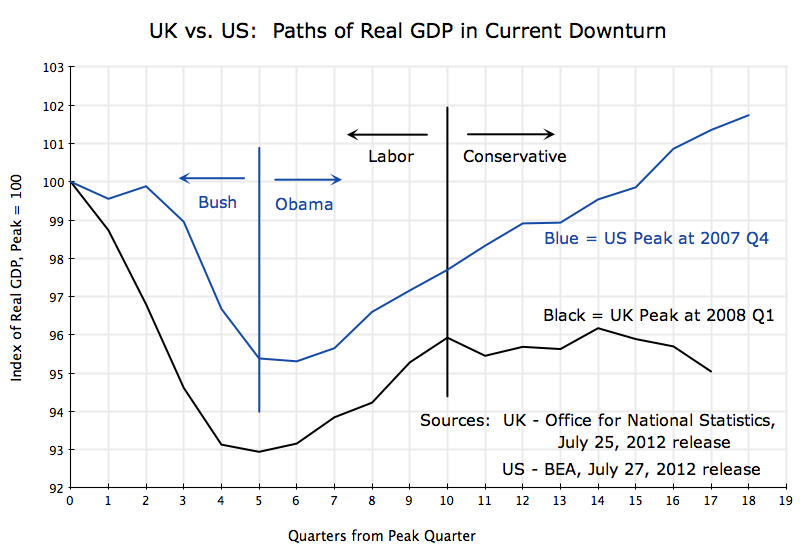
The graph above shows the path of GDP growth in the UK and in the US by calendar quarters from the pre-recession peaks in GDP (set equal to 100).  This peak was in the fourth quarter of 2007 for the US, and in the first quarter of 2008 for the UK.  The downturn started in the US.  The UK economy then dropped further and faster, as the financial sector was at the center of the collapse and the financial sector (with London as the most important international center) is a larger share of the UK economy than it is in the larger and more diversified US economy.

The US economy began to recover soon after Obama was elected and was able to pass and start to implement the fiscal stimulus package (along with aggressive measures by the US Fed and other actions).  The UK economy also began to turn around at about the same time.  The Labor Party Government under Gordon Brown was following similar measures as were being implemented under Obama in the US.  Both economies then began to grow, at roughly similar rates.

But then the UK held the May 2010 elections, which the Labor Party lost.  The Conservatives (in coalition with the Liberal Democrats) took control of the Parliament and of the government.  David Cameron became Prime Minister.  He immediately announced that an aggressive austerity budget would be drawn up and implemented, and it was, starting in the summer of 2010.  This was the tenth quarter from the pre-recession peak for the UK of the first quarter of 2008.

The impact has been clear and stark, as shown in the diagram above.  The economy reached a peak in its recovery in the tenth quarter, but then the recovery stopped.  The UK economy has now fallen for three straight quarters, going into a double-dip recession.  The US economy, in contrast, has continued to grow.

The UK fiscal austerity package has clearly been a failure.  The economy stopped growing when that program began.  The Conservative Party argument in favor of their austerity package was that it would induce “confidence” among investors, and that their increased investment would off-set the cut-backs in government.  This has not happened, despite ample liquidity in the markets and interest rates that are at historical lows.  The alternative view, which I share, is that investors will invest to expand capacity only if they see a market for what they would then be able to produce, and only if they do not have an existing excess of capacity to produce it without further investment.  Fiscal austerity will reduce that market, not expand it.  To argue that contractionary fiscal policies will be expansionary is just wrong and is inconsistent with the facts.  Contractionary policies are contractionary.

The austerity program has also failed in its announced aim of rapidly bringing down the fiscal deficit at a faster pace than was forecast before.  With the economy flattening out and then declining, tax revenues have fallen below what was anticipated.  After close to a year and a half of experience under their fiscal austerity program, the Conservative Government had to admit last November that their plan to bring down the budget deficit to zero would require two more years than they had originally said.  Since then the economy has deteriorated even further, with GDP falling for three calendar quarters now rather than merely remaining flat.  The date by which their avowed aim of budget balance will be achieved will have receded even further.  The austerity program has failed even by its own objective of seeking to bring down the deficit rapidly.

These results are important for the US.  Mitt Romney and the Republican Party in the US have argued for a fiscal austerity program similar in nature to what the Conservative Party is implementing in the UK.  But the UK results have been abysmal.  Even business leaders gathered in London for meetings surrounding the Olympics now underway, have called for David Cameron and his Conservative Party to reconsider his fiscal program, according to a report in today’s Financial Times.  The Cameron Government has argued that the 2.8% decline in GDP in the second quarter was in part a consequence of special factors (the celebration of the Queen’s Diamond Jubilee and unusually wet weather; but celebrations normally spark growth, and one would have thought that the UK knows how to cope with wet weather).  It also may well be the case that the Olympic Games now underway in London will lead to growth in the third quarter due to high tourist and other expenditures linked to the games.  But even discounting such special factors, one cannot hide the abrupt flattening out and then decline in the economy since the fiscal austerity program was initiated.  The contrast to the US path is stark.

Finally, it is of interest to compare the 2008 downturn and aborted recovery in the UK to the path the UK economy followed in the 1930s, during the world-wide Great Depression.  As seen in the graph below, the UK path is now well below where it was at the same point during the recovery from the 1930 downturn.  Economic performance in the UK is worse now than it was during the Great Depression.  The record of the austerity program in the UK, a program that the Repubicans want to duplicate in the US, has been truly terrible.

UK real GDP, comparison of growth since 2008 and during Great Depression, by quarter

Restoring Government Employment as a Way to Restore Full Employment

cumulative growth in private jobs by month from inauguration, Bush I, Clinton, Bush II, Obama, through June 2012

cumulative growth in government jobs by month from inauguration, Bush I, Clinton, Bush II, Obama, through June 2012


[Update on February 2, 2013:  A more recent analysis of these issues, with these charts now covering the full first term of Obama, is available here.] 

I.  Introduction

The purpose of this blog post is two-fold:  First, to update the graphs that were first presented in an April 26 posting on this web site to reflect the more recent data (an additional three months) now available.  And second, to discuss and present some numbers on what would be implied if government employment, which has fallen sharply under Obama, were allowed to recover to the increase seen during the George W. Bush presidency.  A posting on July 6 on this site noted that this by itself would bring the unemployment rate down to 7.3% from the direct effect of employing these teachers, policemen, and other government workers who have been laid off (or new ones not hired), and an unemployment rate of 6.4% with a conservative estimate of a multiplier of two.  This post will discuss this in more detail, including an estimate of what the cost would be.

II.  Private Job Growth

The figures above show what cumulative job growth has been, for private jobs and then for government jobs, from the month of inauguration to June 2012 for Obama (the most recent data now available), and to the equivalent points in the presidencies of the first Bush, Clinton, and the second Bush.

Under Obama, private jobs are now back to where they were (and in fact slightly above) when he was inaugurated.  The economy was in free fall at that inauguration, with the economy losing 800,000 private jobs per month.  The stimulus package Obama was able to get passed a month after taking office, as well as aggressive actions by the Federal Reserve Board and other measures, started to bend this curve almost right away, leading to positive job growth starting a year after Obama took office.  Since then, 4.4 million new private jobs have been created under Obama.

In contrast, private jobs fell during the similar period under the presidency of George W. Bush.  Private jobs were steady in the first few months after he took office, but then started to fall, and continued to fall for the first two and a half years of his presidency.  They then started to recover, but at the similar point in his presidency (June 2004) there were still 1.8 million fewer private jobs than when he took the oath of office.  Yet Romney and other Republican Party leaders are calling for a return to the tax cut and financial deregulation (or non-regulation) policies of Bush.  The pace of private job growth did pick up starting in 2004 under Bush, and this continued into 2005 and 2006 as the housing bubble built up.  But then this bubble burst, private employment started to fall in 2007, and private employment was crashing in 2008.

The graph also shows the strong and steady private job growth during the Clinton period. And under the first Bush, private employment grew for the first year of his presidency (although at a slower pace than under Clinton), but then leveled off and began to fall.  At this point in the presidency of the first Bush, private jobs were barely above where they were when he was inaugurated.

III.  Government Job Growth

The second graph above shows what happened to growth in government jobs during these presidencies.  Government job growth (primarily at the state and local level, which accounts for 87% of all government jobs) was significant during the administrations of both of the Bush presidencies.  It was also significant during the Clinton period, although at a slower pace than under either Bush I or Bush II.

In stark contrast, government employment has fallen sharply during the Obama term (except for the temporary spike at the time of the hiring for the decennial census, after which it returned to the previous downward trend).  From Obama’s inauguration to June 2012, total government employees fell by 633,000.  During the similar period under Bush II, government employment rose by 766,000.  Yet Romney and other Republicans assert loudly and in the face of such evidence that the government sector has grown enormously during the Obama term, while Bush II was a small government conservative.  There was a similar growth of government workers (by 776,000) during the similar period of Bush II’s second term, from his inauguration to June 2008.

Had government grown during the Obama term as much as it had during the similar period in Bush II’s terms (either first or second), there would now be 1.4 million more public sector workers employed (633,000 + 766,000).  This is not a small number.  The implications of this loss on the labor market and on unemployment will be discussed in the next section.

IV.  The Gains from Bringing Back Government Jobs

These cut-backs in government employment during Obama’s term as president have acted as a significant drag on the labor market and on the economy as a whole.  Keep in mind that these are mostly state and local government workers, where the largest numbers of such employees are in public education (teachers) and public safety (police, firemen, and similar).  State and local governments have cut back on the number of such workers either out of necessity (as their tax revenues collapsed in the downturn, and there are often tight limits on what they can borrow), or in some cases out of choice (as conservative and mostly Republican governors and other officials have used the downturn to cut back on such government employment, ofter while simultaneously cutting corporate and other taxes).  But schools and other public services have suffered.

The 1.4 million workers not employed in government equals 0.9% of the labor force.  The direct effect of employing such teachers and others rather than leaving them unemployed would bring down the rate of unemployment from the current 8.2% to a rate of 7.3%.  But there will be further employment impacts when such workers move from unemployed to employed.  They will now have income to spend in their communities and in the economy, and additional workers will be employed to provide these goods and services.  They will not necessarily spend all of their additional income (some will be used to pay down debt, or saved by other means), but a significant portion will be.  Furthermore, the newly employed workers (newly employed to provide such goods and services to the additional teachers and other government workers) will themselves spend a high portion of their income on goods and services provided by other workers, continuing the process.

This is the concept of what economists call the multiplier.  Views and estimates vary on the size of the multiplier, in part as the multiplier itself varies depending on the types of workers employed (those with high incomes will likely save more and hence spend less, for example), on how close the economy is to full employment, and on other factors.  But note that the multiplier for expenditures for the direct hiring of low and middle income government workers (such as teachers, policemen, health care workers, and so on), will be substantially higher than the multiplier one would expect from providing tax cuts, for example.  Tax cuts primarily go to those with higher incomes (as they account for a higher share of taxes), and those with higher income will save a large share of such tax cuts.  As another example, increasing government expenditures in such areas as weapons procurement will also have a lower multiplier, as the funds there will be used to hire relatively skilled and hence relatively high income aerospace and technology workers, or will accrue as profits to defense firms like Boeing or Lockheed, with a significant share saved.  Similarly, the multiplier resulting from government spending for construction projects or others done via procurement from private firms, should be expected to be less than that from directly hiring teachers and similar low and middle income government workers.

There is therefore no unique “multiplier” which applies in all circumstances.  But for hiring low and middle income government workers such as teachers and so on, a reasonable estimate is that in current circumstances the multiplier would at least be two.  Many would argue it could be three or even higher, although there are also some conservatives who would argue it is less than one or even zero.  But with a multiplier of just two, hiring 1.4 million workers directly (to bring government employment back to the path it was on before) would lead to an overall increase of national employment of 2.8 million (1.4 million government workers, and 1.4 million others). This would bring unemployment down to a rate 6.4% from the current 8.2%.  With a multiplier of 2 1/2, so that an additional 3.5 million Americans would be employed, the unemployment rate would fall to just below 6%.  There is always some unemployment (due to labor market turnover) even when the economy is at “full employment”, with this generally taken to be unemployment somewhere in the range of 5 to 6%.  Therefore, such a program of hiring 1.4 million government workers to bring government employment back to the path it was on before, would likely suffice by itself to bring the economy back to, or close to, full employment.

Stated another way, the reason the job market performance has been so poor during the term of the Obama presidency, with national unemployment still exceedingly high at 8.2%, is that we allowed government (primarily at the state and local level) to lay off so many government workers in this downturn (or not hire new ones to replace those departing), rather than stay on the previous path.

Note that bringing back 1.4 million government workers to return to the previous path would lead to an increase of just 6.4% in the number of government workers from where they are now (at 21.9 million workers).  This is not such a huge increase, and as noted, simply brings the number back to the path it was on before.  Another way to look at the number is as a share of the US population.  The US population is growing, and a growing population needs more government services.  If the share of government workers in the US population were the same in June 2012 as it was in January 2009, we would have 1.3 million more government workers employed now.  This 1.3 million figure is close to the 1.4 million needed to return to the previous growth path.

The cost of hiring 1.4 million more teachers, policemen, firemen, and other public workers is also quite manageable.  The average cost of employing government workers at the state and local level is $85,612, based on data drawn from the most recent report of the Bureau of Labor Statistics on Employer Cost of Employee Compensation.  Of this cost, about two-thirds is in wages paid directly to the employees, and one-third covers the cost of various benefits (primarily the costs of paid holidays and leave, health insurance, and retirement).  But note that the average cost of existing government workers will be higher than the cost of new hires, as new hires will come in at lower wages and benefits to start.  Hence using this figure is a conservative estimate of the cost, and in reality the cost of hiring 1.4 million new government workers will be less.  But even using the $85,612 figure, hiring 1.4 million new public workers would cost $120 billion per year.  This is equal to 0.8% of current GDP.  And as a double check on this figure, recall that the 1.4 million new workers would be equal to 0.9% of the labor force.  The figures are similar, as one would expect.

A cost of $120 billion is not small, but should be put in context.  Romney has proposed a tax plan which in the year 2015 alone would reduce Federal Government revenues by $900 billion relative to what they would be if current law is followed, or $480 billion less revenues if one allows the Bush tax cuts to be extended in full.  If one can afford $900 billion a year in tax cuts, most of which will go to the rich, or even $480 billion, then one can easily afford $120 billion to employ the teachers, policemen, and other government workers who have been laid off or not hired.

And as has been noted previously in this blog, Obama has signed into law a total of $1.5 trillion in tax cuts so far in his presidency, of which $1.4 trillion were cuts that applied Fiscal Years 2009 to 2012.  That is an average of $350 billion in tax cuts per year over these four years.  Spending $120 billion per year to bring the economy back to full employment is far less than this.  One might immediately wonder how this could be, but it is important to keep two points in mind.  First, tax cuts do act to stimulate the economy, but as discussed above, are not terribly efficient as a form of stimulus as the bulk of tax cuts go to the relatively well off, who will simply save a high share of what they receive in tax cuts.  Second, the tax cuts, while inefficient (and taken in combination with other measures, such as some stimulus spending and aggressive actions by the US Federal Reserve) have brought the economy to where it is now.  The economy was in free fall when Obama took the oath of office, and these measures reversed the collapse and have brought the rate of unemployment down from a peak of 10% to the current 8.2%.  But the recovery has not gone farther because, in sharp contrast to the path taken in other US recoveries (see the blog posting here), government has been laying off rather than hiring workers.

V.  Conclusion

Government employment has been cut back sharply during this downturn, in sharp contrast to the paths followed by other recent Presidents (see the graph above) or in contrast to the paths followed in any other downturn in the US of the last four decades (see the blog post cited above or here).  As a result, there are now 1.4 million fewer government workers than there would have been, had government employment been allowed to grow as it had under Bush.  This has added significantly to unemployment.

Had such teachers, policemen, and others been kept employed, the economy would likely now be at, or close to, full employment.  By itself, the cuts can account for the weak recovery that Obama is now being blamed for.

Government Jobs Have Been Cut in This Recession: This Has Hurt, Not Helped, the Recovery

I.  Introduction

A Republican theme in this Presidential campaign, asserted repeatedly by Mitt Romney and other Republican leaders, is that a sharp expansion of government under Barack Obama is the cause of the weak job growth in the recovery from the 2008 collapse.  Romney laid out this theme most clearly in his policy address on economic issues last March (see here for a transcript).  I noted in this blog entry that the address was confused and full of factual errors, but it does represent what Romney said he believes.  More recently, in remarks in Iowa earlier this month, Romney said of Obama that, “he wants another stimulus, he wants to hire more government workers.  He says we need more fireman, more policeman, more teachers.  Did he not get the message of Wisconsin?  The American people did.  It’s time for us to cut back on government and help the American people.”

As I have noted in a number of entries in this blog, government has in fact been contracting rather than expanding during this economic recovery, and that indeed the resulting fiscal drag can account for the weakness of the recovery.  See, for example, the posts on fiscal drag during the recession (here and here); the reduction in total government employment (including state and local) during the period Obama has been in office (here and here), with federal government employment flat and non-defense federal employment falling (here); and on federal government spending that has in fact been close to flat during the Obama term, in contrast to the sharp increases under recent Republicans (here).

Given the importance and centrality of this issue in the weak recovery, it is important to get the facts right.  While the previous blogs have looked at the relationship of government spending in recent US economic downturns to the pace of recovery of GDP, they have not explicitly examined the assertion Romney and his Republican colleagues have now raised that higher government employment accounts for the slow recovery in jobs.

This can be done quickly, through a series of graphs.  The analysis here complements and extends the earlier blog post on fiscal drag as the principal cause of the weak recovery from the 2008 collapse, and the blog post on the path of employment during these downturns.

II.  The Data

First, total employment (both public and private) has fallen more in the current downturn than in any other in the US over the last four decades, and the recovery once it bottomed out has been relatively weak:

Recessions, index of total employment before and after peaks, US, 1970s until 2012

Total employment was falling at a rapid rate when Obama took office (and at that point, had fallen by more than had been the case in any other US downturn of the last four decades).  Actions taken by Obama at the start of his administration (as well as aggressive actions by the Fed) started right away to bend this curve, and within a year it had bottomed out.  Since then there has been positive and remarkably steady employment growth, but at too slow a pace given the depth to which employment had fallen to make up for the initial decline.  The path has been the weakest seen in any of the recoveries from the downturns the US has faced over the last four decades.

(Note:  The figure above, and the ones below on employment, go out for 18 quarters.  This carries the data to the second quarter for 2012 for the downturn that began in December 2007.  The employment figures are the averages for the periods, and the June 2012 figure, not yet published by the BLS, was estimated based on the April and May figures.)

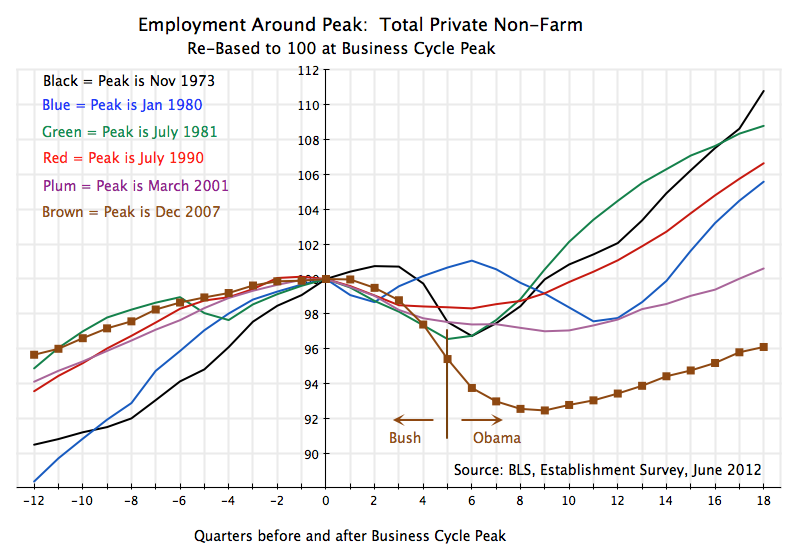
The graph for total private employment is similar, although with a somewhat stronger fall initially, until it bottoms out following the measures early in Obama’s term, and then a somewhat stronger recovery.  Private employment is now above where it was when Obama took office, but it still has not made up for the sharp fall in the last year of the Bush administration:

Recessions, index of total private employment before and after peaks, US, 1970s until 2012

In contrast, total government employment (including state and local, as well as federal) has followed a different pattern.  In contrast to private employment, it did not fall initially (during the last year of the Bush administration).  But once Obama took office, it has fallen steadily except for the temporary blip seen in the 10th quarter after the onset of the downturn, due to the temporary hiring for the decennial census in the Spring of 2010:

Recessions, index of total government employment before and after peaks, US, 1970s until 2012

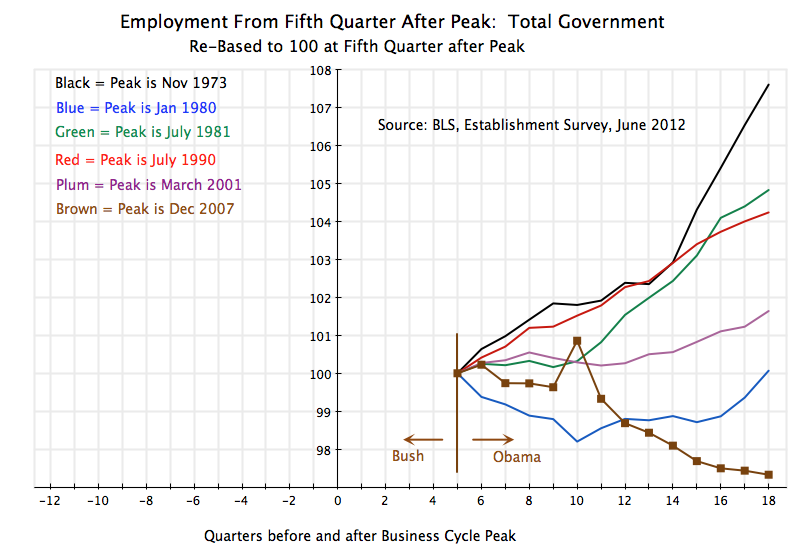
The fall in government employment was particularly sharp once Obama took office, as can be seen more clearly in a graph which re-bases the data to equal 100 in the fifth quarter following the business cycle peak:

Recessions, index of total government employment starting fifth quarter after peaks, US, 1970s until 2012

In no other downturn has the US had such a cut-back in government employment.  Yet Romney and his Republican colleagues are arguing for even greater cut-backs, including for firemen, policemen, and teachers, as Romney stated in the quotation copied above.

Looking closely at the two graphs above on government employment, one might note that while the reductions in government employment were greater under Obama and in the most recent downturn than in any other, the second smallest was in the recovery following the January 1980 downturn.  This period was initially under Carter (for four quarters) and then under Reagan.  Since I have noted before in this blog that had government grown under Obama at the pace seen under Reagan, the economy would now be at close to full employment, is there a contradiction here?

The answer is no.  First, one should note that the “recovery” from the January 1980 downturn merges into that from the July 1981 downturn (but leading by six quarters), as the economy went into a new recession a half year after Reagan took office.  Reagan did cut back on government employment initially, before allowing it to grow.  Hence the paths followed by the green (July 1981) lines in the graphs above are more directly related to Reagan’s policies than those indicated by the blue (January 1980) lines.

Second and more fundamentally, the importance of the government sector to the economy and its recovery is more related to overall government expenditures than to simply the number of government employees.  Romney and his Republican colleagues are simply missing this point when they focus their criticisms on the number of government workers.  Reagan expanded government spending, but the focus was on things like defense expenditures rather than the number of school teachers.  Defense expenditures are done under contract to private companies (much of it to a few giant companies such as Boeing and Lockheed).  Building modern jet fighters and naval ships can be very labor intensive, but these are employees of private contractors, and are not directly classified as government workers.

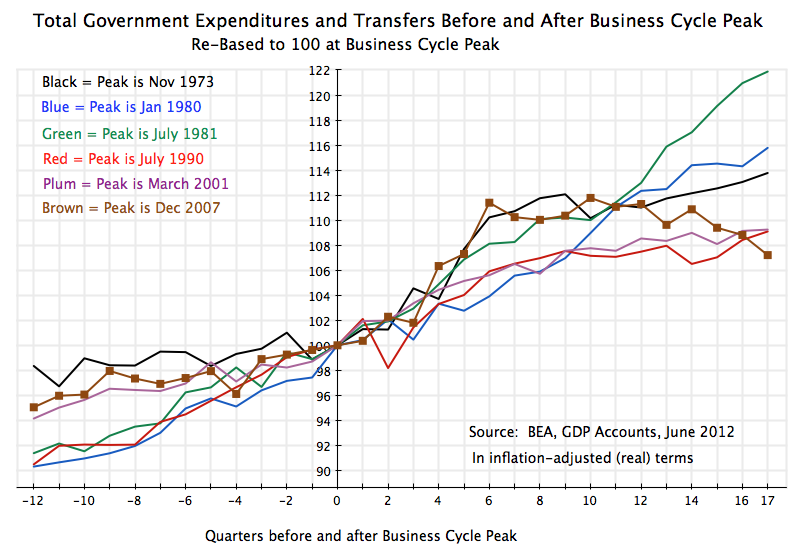
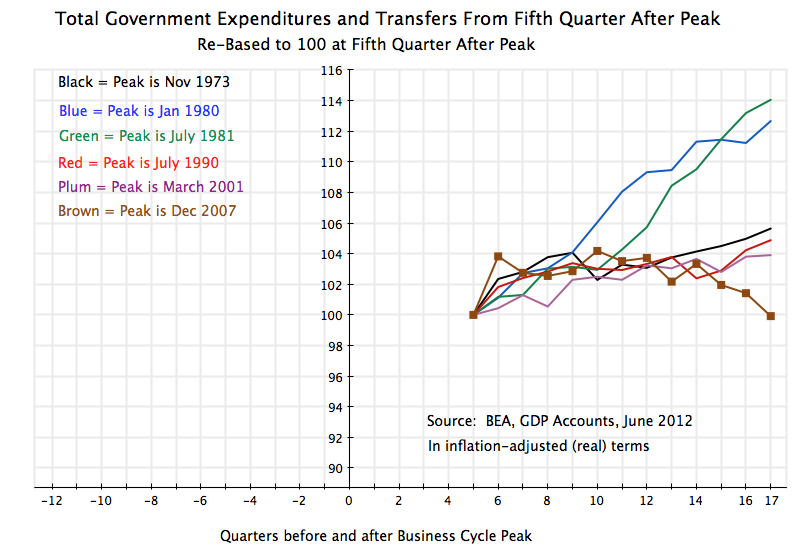
The paths can be seen in the following graphs, similar to ones presented in the earlier blog, but now with 17 quarters shown rather than 16 (as there is now one quarter of additional GDP data available):

US recessions 1970-2012, total government expenditures before and after business cycle peaks

US recessions 1970-2012, total government expenditures from fifth quarter after business cycle peaks

Growth in government spending during the Reagan periods (the blue and green paths) is the highest of all, especially when one starts five quarters from the cyclical peaks (when Obama took office).

III.  Conclusion

In summary, if there was any basis for the belief of Romney and his Republican colleagues that cut-backs in government employment and spending would lead to strong growth, then the economy would be booming right now.  Government employment and spending in the current downturn, especially once Obama took office in January 2009, have been below the paths followed in each of the other downturns the US has faced over the last four decades.

The recovery has been weak because there has been weak demand for the goods and services that business could produce.  There is no point in hiring a worker to make something if you cannot then sell it.  Government demand has been weak, as seen in the graphs above, due to strong Republican opposition.  Investment demand has been weak, despite record low interest rates and high cash balances on corporate balance sheets, since there is surplus production capacity.  There is little point in investing to build even more capacity when what you have is not being fully utilized.  Consumer demand has been weak, both because of weak incomes (the high unemployment and depressed wages for those who are employed) and because of the collapse of the housing bubble, which wrecked household wealth.  And global demand has been weak, due to crises in Europe (with its own mis-guided policies focussed on austerity) and elsewhere.

The cause of this weak recovery is not that government has grown rapidly, but rather that is hasn’t.