Employment in the Recession: The Problem is Slow GDP Growth, Not Productivity

I.  Introduction

The recovery in employment has been exceedingly weak in the on-going, but slow, recovery from the 2008 collapse.  The recovery of GDP has been weak as aggregate demand has simply not been there to absorb increased production.  Household consumption has been weak following the collapse of the housing bubble, and monetary policy has been pushed to the limit with Fed interest rates now almost zero but the economy still in a liquidity trap.

The one instrument that could have been used to create demand for output and hence employment would have been increased fiscal expenditures.  But as noted in a March 3 posting on this blog, total government spending (including that from state and local governments) has been flat or falling since Obama was inaugurated.  Indeed, that blog found that if fiscal expenditure had been allowed to grow as fast as it had in the Reagan years following the downturn that began in July 1981, GDP at the end of 2011 would have been close to full employment output.

The oft repeated Republican alternative view, however, is that the slow recovery in GDP and jobs has been due to overbearing new regulations, and not due to fiscal drag or some other demand side issue.  Indeed, Republicans have argued strongly that government expenditures should be cut even further.  They have asserted that the recovery in jobs has been weak due to expensive and excessive new regulations instituted by the Obama administration, which have deterred businesses from creating jobs.  While more than a bit confused, as we will see below, the argument is that these new regulations have hurt productivity, so businessmen could not profitably employ new workers and hence did not hire new workers.

A convenient summary of this view appeared today in the Washington Post, in the “Right Turn” column of the conservative columnist/blogger Jennifer Rubin (link here to the on-line version).  She wrote:  “Get Obama out of the way — and with him Obamacare, the Dodd-Frank legislation, a chunk of discretionary spending and the planned tax hikes — and instead put in place his agenda — tax cuts, entitlement reform, reduced regulation, and domestic energy development — and the economy will take off.”  The argument falls apart if these measures, and the rest of what has been done during Obama’s period in office, did not result in a collapse in productivity.

This blog will look at whether there is any factual support for this Republican alternative view on the cause of the slow recovery in employment.  Did productivity go down after Obama took office?  What path has productivity taken over the course of this downturn, and how does this compare to the paths taken in previous downturns?  And in reviewing this, we will examine the confusion in this argument on the links between productivity and job growth.

II.  GDP and Employment Growth in the Downturns

To start, it is helpful to see what the paths of GDP and employment have been in this downturn, and in comparison to previous downturns.  The path of real GDP was shown in the March 3 blog cited above, and is repeated here for convenience:

As was noted before, the path of GDP recovery has been especially slow following the 2008 financial collapse.  GDP fell sharply in the first five quarters of the downturn, in the last year of the Bush presidency and into the quarter that Obama was inaugurated (the first quarter of 2009).  GDP stabilized soon after Obama took office and then started to grow, but has since grown only slowly.  The recovery has been the weakest of any among the six recessions in the US of the last four decades.  The earlier blog noted that this can be explained by weak demand for output, due to government spending that has been flat or falling since Obama took office, and exacerbated by the collapse of the housing market.

With the weak growth of GDP, it should not be surprising that employment growth in this weak recovery has been exceptionally weak as well:

Employment fell sharply in the year before Obama took office, more than in any of the other downturns of the last forty years.  And then, despite the stabilization of GDP, employment continued to fall through 2009 before stabilizing.  But the recovery in employment since then has been poor.  This employment path has been by far the weakest of any of the six downturns of the last forty years.

III.  Labor Productivity in the Downturns

Can this weak recovery in employment in the current downturn be explained by poor productivity growth (a result of excessive regulation), as the Republican argument asserts? Has the path of labor productivity also been an outlier in the current downturn?

Actually, the path of labor productivity has been well within the paths seen in the other downturns:

Labor productivity did in fact fall at first, during the last year of the Bush presidency, although this was not uncommon among the downturns.  The fall while Bush was still president was relatively high, but similar to the downturns seen after November 1973 (Nixon/Ford) and July 1981 (Reagan).

But it is interesting to note that labor productivity began to rise quite rapidly immediately after Obama took office.  I would not argue that this was entirely due to Obama, especially in the first few months of his term.  I am merely pointing out that there is no basis for the assertion that Obama instigated regulations hurt productivity and hence job growth (under the Republican argument) after he took office.

This becomes even more clear if one re-bases the series so that labor productivity in the fifth quarter after the start of a downturn is set equal to 100:

Starting from when Obama took office (in the fifth quarter after the start of the downturn), labor productivity growth has been high, and indeed grew at about the same rate as that seen following the 1981 downturn (during the Reagan presidency).  Productivity growth during these two recoveries were not only similar but also the most rapid by a significant margin among the six downturns tracked.  The main difference between the two is that productivity growth has slowed in the current cycle over roughly the last year (i.e. starting in quarter 13), while it continued to grow at that point in the recovery from the downturn that began in July 1981.  But the difference is not large, and one should not draw strong conclusions from it.

It is a firmly held position in Republican dogma that the “reforms” instituted by Reagan of deregulation, cuts in taxes, undermining of labor unions, and other such measures, led to a miracle of productivity growth from which the economy still benefits.  I noted in an earlier posting (see here) that productivity and output growth in the US was in fact slower in the 30 years following Reagan than in the 30 years before.  Over a long term perspective, Reagan was not such a miracle.  And from the diagram above, we see that over the short term, starting from the same point in the business cycle (five quarters after the peak), the record in terms of productivity growth for the vilified Obama is basically the same as for the sanctified Reagan.

It is not a coincidence that the employment picture finally started to improve in 2011, precisely when productivity growth, which had been strong, started to level off.  And this points to the basic confusion in the Republican argument, which some of you may have already seen.  By basic arithmetic, the number of employees one needs to produce a given amount of output depends on productivity, but depends on it negatively.  That is, if productivity has increased, one needs fewer workers to produce a given amount of output.  If one can only sell so much of output due to slack demand, and if productivity growth is strong, then employment growth will be weak.  This has been the story of the recovery during the Obama term, and it is only in the last year, when the pace of productivity improvement slowed, that one has seen a more steady increase in the number of employed.

Productivity growth is due to many factors, and for the economy as a whole it will not change quickly due to any policy action.  It will vary over the course of the business cycle, as seen in the diagrams above, where it will normally (although not necessarily always) fall at the onset of the downturn (as firms will usually be slow to lay off workers as demand for output slows), and then rise significantly once the recovery begins (as firms will usually also be slow to hire additional workers as demand for output increases, but instead use existing workers more).

The current downturn and recovery was not that much different, although the swings were more extreme this time as the downturn was more extreme.  But what was different in the current cycle is that in the recovery (as discussed in the March 3 blog posting), demand from government spending did not increase as it had in previous recoveries, but rather was flat and then fell.  Furthermore, demand from housing construction was extremely depressed, due to the size of the housing bubble and subsequent collapse.  Recovery in GDP, and hence in employment, has therefore been slow.

IV.  Conclusion

There is no factual support for the Republican assertion that overbearing new regulations from the Obama administration has led to weak job growth, due to the negative impact of such regulations on productivity.  Indeed, the argument is quite confused, since for any given level of output, higher (not lower) productivity means fewer workers are needed to produce that output, which hurts immediate job growth.

The path of labor productivity in the current downturn and recovery has in fact been within the bounds seen in other downturns and recoveries in the US over the past four decades.  If anything, productivity fell somewhat more sharply than in most of the others during the last year of the Bush presidency, and more rapidly than most of the others after Obama took office.  And it is this relatively rapid growth of labor productivity during the Obama term, coupled with weak GDP growth (due to fiscal drag and the collapse in housing) which explains the weak recovery in employment.

It should be emphasized that productivity growth is good over the longer term, as it leads to a higher level of output and hence overall income at the full employment level of GDP.  But when the economy is operating at less than full employment GDP, higher productivity will translate into fewer jobs than otherwise.  The way to resolve this is to bring the demand for output back up to the level of output that could be produced if all resources (in particular labor) were fully utilized.  It is a terrible waste, as well as a human tragedy, to allow such unemployment when the needs are so great.
Recovering from the Recession: Fiscal Drag Can Explain the Slow Recovery

I.  Introduction

Economic recovery from the 2008 financial collapse and economic downturn has been slow, with unemployment still high in 2012.  Republican political officials, whether the presidential candidates or the Republican leaders in Congress, have charged that this has been due to an unprecedented explosion in government spending during the Obama administration, and that the way to a fast recovery would be to slash drastically that government spending.  Senator Mitch McConnell, the Republican Leader in the Senate, for example, has repeatedly harped on what he has called the “failed stimulus package” of Obama, and has successfully blocked any effort to extend any fiscal stimulus to address the continued weak state of the recovery.

They point to the recovery during the Reagan years from the downturn that began in July 1981.  This was the sharpest downturn the US had suffered until then since the Great Depression, and the Republicans point to the subsequent recovery as an example of how (they assert) cutting back on government spending will lead to a strong recovery.  Unemployment reached a peak of 10.8% in the Reagan downturn in late 1982, surpassing even the peak of 10.0% reached in the current downturn.  But the unemployment rate then fell to 7.2% by election day in November 1984, and Reagan was re-elected in a landslide.

Recovery from the 2008 downturn has indeed been slow.  But it is simply false to say that fiscal spending has exploded during the Obama years, while it was contained during the Reagan years.  In fact, it was the exact opposite.  Understanding begins with getting the facts right.  And once one does, one sees that fiscal drag can fully explain the slow recovery from the 2008 downturn, while the recovery during the Reagan years was helped by the largest expansion of fiscal spending in any downturn of at least the last four decades.

II.  The Path of Real GDP

Start with the path of real GDP at each of the downturns since the 1970s (with the data here and below from the Bureau of Economic Analysis of the US Department of Commerce):

The graph shows the path of real GDP in the three years (12 quarters) before each business cycle peak since the 1970s (as dated by the NBER, the recognized entity that does this for the US), to four years (16 quarters) after the peak.  Recessions start from the business cycle peaks, with negative growth then for varying periods (of between 6 months and 18 months in the recessions tracked here) before the economy starts to grow again.  Six recessions have been called by the NBER in the US over the last four decades.  The NBER stresses that it concludes whether or not the economy went into recession based on a wide range of indicators, and not simply real GDP decline, but generally, negative GDP growth of two quarters or more is commonly associated with a recession.

As the graph shows, the downturn that followed the business cycle peak of December 2007 was the largest of any of those tracked here, with most of the decline occurring in 2008, before Obama took office, and in the first quarter of 2009, when Obama was inaugurated.  The economy stabilized quickly under Obama, and then recovered but only slowly.  By 16 quarters after the quarter of the business cycle peak (i.e. by the fourth quarter of 2011, the most recent period for which we have data), real GDP was barely above where it had been at the peak.  This was the worst performance for GDP of any downturn of those tracked here, and indeed the worst since the Great Depression (other than the fall in output after 1945, which is a special case).

The recession that began in July 1981 (shown in green in the figure) at first followed a strongly negative path, but after five quarters began to recover.  The economy then recovered faster than in any other US downturn of the last four decades, and by 16 quarters out, real GDP was over 14% above where it had been at the pre-recession peak. Republican officials argue that government cut-backs under Reagan account for this strong recovery.

III.  The Path of Government Spending

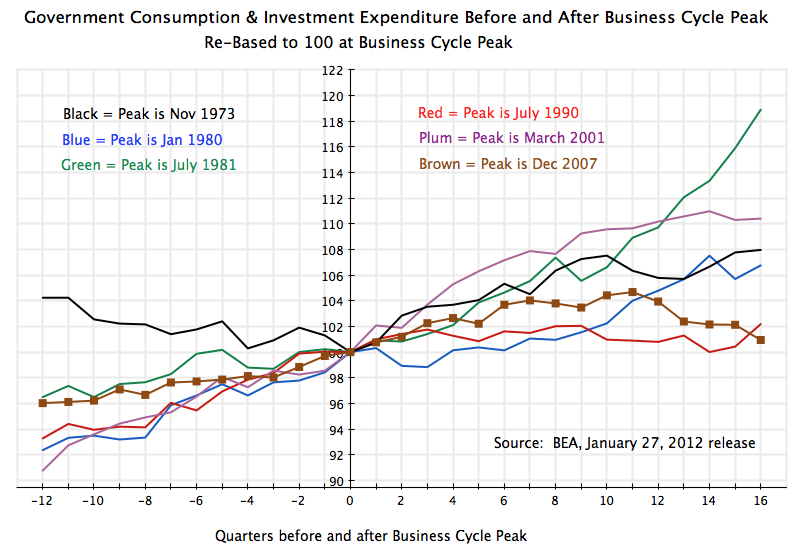
But what was in fact the path of government spending?  There are a couple of different measures of government expenditures one can use, but they tell similar stories.  First, one can look at direct government expenditures, for either consumption or investment.  This is the concept of government spending which enters directly as one component of demand in the GDP accounts:

In the downturn following the December 2007 peak, government expenditures rose in the first six quarters following the business cycle peak in the middle of the range seen in the other downturns.  But then it flattened out, and then it fell.  By the 16th quarter following the peak, real government spending was barely (less than 1%) above where it had been at the business cycle peak, four years before, and was the lowest for any of the six downturns of the last four decades (although close to that following the 1990 downturn, which was then into the Clinton years).  In contrast, government spending in the 1980s, during the Reagan years, continued to grow rapidly, so that by 16 quarters out it was almost 19% above where it had been four years earlier.  This growth in government spending during the Reagan period was by far the most rapid growth in such spending seen in any of the downturns.  Government spending growth following the March 2001 business cycle peak (i.e. during the Bush II years) was second highest after Reagan, but only a bit over 10% higher rather than 19% higher.

If one believes in the Republican assertions that fiscal spending will restrain growth and that fiscal cuts in periods of high unemployment will spur growth, then one would have seen slow growth during the Reagan period and rapid growth during the Obama period.  In fact, one saw the opposite.  Fiscal austerity is bad for growth, while fiscal expansion when the economy is in recession will spur growth.

It should be noted that government spending considered here is total government spending, at the state and local level as well as federal.  State and local spending is on the order of 60% of the total in recent years.  The cut-backs in recent years in total government spending has been driven by cut-backs in spending at the state and local levels, many of whom have followed conservative fiscal policy either by statute (balanced budget requirements when revenues are falling) or by choice.  In the four years following the December 2007 cyclical peak, state and local spending indeed fell by 6%.  This was offset to a degree by growth of 13% in spending at the federal level (of which 8.8% occurred in the last year of the Bush administration, while 4.1% total occurred over the three years of the Obama administration).  A similar breakdown during the Reagan years following the July 1981 downturn shows that state and local government spending rose by a total of 13.6% in the four years, while federal spending under Reagan rose by a total of 25.4% in those four years, for overall growth in government spending of 19%.  This large increase in federal spending does not support the common assertion that Reagan followed a policy of small government.  Federal spending grew almost twice as fast under Reagan as it did in the Bush II / Obama period following the 2008 downturn.

We therefore find that government spending on consumption and investment grew sharply during the Reagan years following the July 1981 downturn, more than in any other downturn in the US over the last four decades, and that the economy then recovered well.  In contrast, overall government spending (including state and local) was flat in the most recent downturn (rising at first in the last year of the Bush administration, but then flattening out and then falling), and the recovery has been weak.

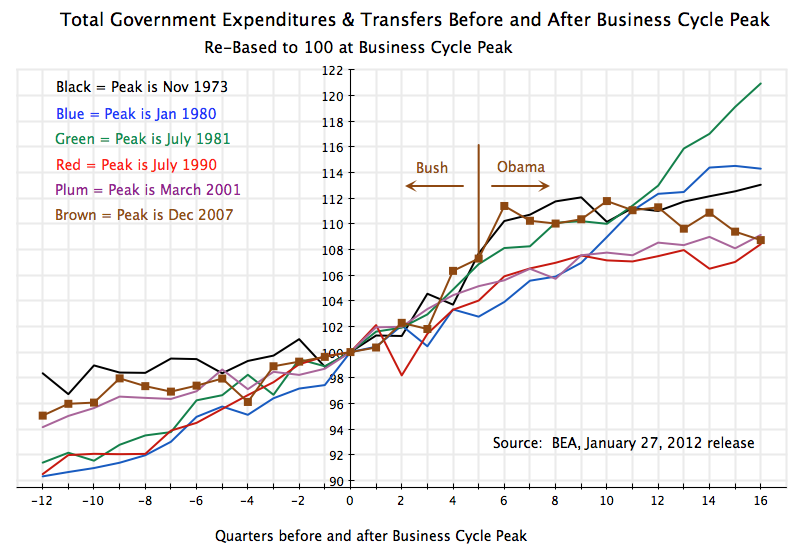
It could be argued, however, that the government accounts that appear as a component of GDP (as direct consumption or investment of goods or services) do not capture the full influence of government spending on the economy, as it leaves out transfers.  Transfers include amounts distributed under Social Security, Medicare, unemployment insurance, and similar programs, which are indeed a significant component of government expenditures.  The purchases of good or services (or the amounts saved) are then undertaken by households, where it will appear in the GDP accounts.  But including transfers in the total for government spending will not change the story:

One again sees government spending increasing over the initial periods in each of the six downturns tracked, including that following the December 2007 peak.  This continues into the first complete quarter during the Obama administration, after which it flattens out and then falls.  By quarter 16, government spending including transfers in the Obama period is tied for the smallest growth seen in any of the six downturns (all at about 9% higher), along with that following the 1990 and 2001 downturns.  Once again, sharply higher growth is seen following the 1981 downturn, with total government spending including transfers was 21% higher after four years in this Reagan period.

By either measure of government spending, therefore, with or without transfers, government spending rose rapidly during the Reagan period while it flattened out and then fell during the Obama term.  This has produced a strong fiscal drag which has harmed the recovery.  In contrast, strong growth in government spending during the Reagan period was associated with strong GDP growth.

IV.  The Path of Residential Investment

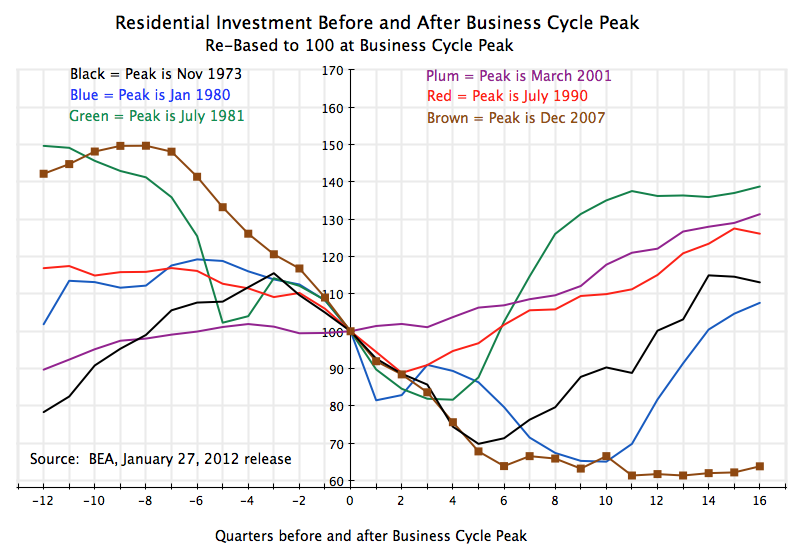
There will, of course, be many other things operating on the economy at any given time, so it would be too simplistic to assign all blame or credit for GDP recovery on government spending alone.  Government spending is powerful, and does have a major impact on growth, but there are other things going on at the same time.  In the most recent downturn, the most significant other factor affecting aggregate demand for output has been residential investment.

Residential investment had risen sharply during the Bush II presidency, as has been discussed previously in this blog (see here).  The housing bubble then burst after reaching a peak in prices in early 2006 (see here), housing construction fell to levels not seen in decades, and such construction remains stagnant.

The collapse in residential investment seen in the most recent downturn in unprecedented.  While residential investment has typically fallen at the start of the downturn (and indeed was often already falling before the start of the overall economic downturn), the falls had never been so sharp and extended as now.  Four years since the business cycle peak in December 2007 (and six years since the peak in residential investment), residential investment remains weak, with no sign yet of recovery.  There are two reasons:  1)  The housing bubble reaching a peak in 2005/06 was unprecedented in size in the past half century, with residential investment reaching 6.3% of GDP in the fourth quarter of 2005, and then collapsing to just 2.2% of GDP in 2010/11; and 2) The downturn that started after the overall GDP peak in December 2007 was fundamentally caused by this bursting of the housing bubble, which led to mortgage delinquencies, financial stress in the financial institutions who held such mortgages, and then to collapse of the financial system.

V.  The Impact on GDP Recovery of the Fiscal Drag and of Housing

Finally, it is of interest to see what the impacts on GDP recovery might have been, had there not been the fiscal drag seen in recent years, or if residential investment had followed a different path.  There are many counterfactuals one could envision, but of particular interest would be the path of government spending seen during the Reagan years, as this is often held up by Republicans as the example to follow.  The following table shows what the impact would have been, along with a counterfactual scenario which keeps residential investment flat at the level it had been in 2007Q4.

Counterfactual Scenarios    All figures as a share of GDP.  Note that the shortfall from Full Employment GDP was 5.8% of 2011Q4 GDP (CBO estimate) Direct Impact Multiplier of 1.5
Government Consumption & Investment increases                                   as in 1981Q3-1985Q3 3.4% 5.1%
Total Government Spending (incl. Transfers) increases                             as in 1981Q3-1985Q3 4.0% 6.0%
Residential Investment flat at 2007Q4 level 1.4% 2.1%

The results indicate that the fiscal drag in recent years can by itself account for the shortfall of current GDP from its full employment level.  The estimate of full employment GDP comes from the January 31, 2012, economic baseline forecast of the Congressional Budget Office (see here), and is 5.8% above where current GDP was as of the end of 2011.  That is, if GDP were 5.8% higher, we would be at full employment (or “potential”) GDP, as estimated by the CBO.

In the first line of the table, government consumption and investment expenditure is increased by how much it was in 1981Q3 to 1985Q3 during the Reagan years, rather than the much slower growth (indeed essentially no growth) of 2007Q4 to 2011Q4.  The direct impact would have been to increase GDP by 3.4%.  Assuming a very modest multiplier of 1.5 (many would argue that the multiplier when the economy is in recession as now, with Federal Reserve Board interest rates close to zero, would be 2 or more), the impact would be 5.1% of GDP.  This is close to what would be needed to make up for the 5.8% gap.

In the scenario where total government spending (including transfers) is increased as it was during the Reagan years rather than the slow growth that has been chosen in recent years, GDP would have been 4.0% higher by the direct impact alone, and by 6.0% with a multiplier of 1.5.  This would have fully closed the gap.

One can also look at scenarios for residential investment.  Given how high the housing bubble had gone in 2005/6, it would be unrealistic to believe that housing would bounce back up quickly, and certainly not to the bubble levels.  But in a scenario where housing had simply recovered in real terms to the level seen in the fourth quarter of 2007 (when it was 4.0% of GDP), the direct impact on GDP would have 1.4%, or 2.1% assuming a multiplier of 1.5.  While still quite significant, these impacts are less than that resulting from the slow growth of government spending in recent years.

VI.  Conclusion

In summary:

1)  The recovery of GDP in the recent economic downturn has been slow, with unemployment still high.  Not only is a vast amount of potential output being lost, but long periods of unemployment is particularly cruel to the lives of those who must suffer this.

2)  Prominent Republican leaders have repeatedly asserted that the slow recovery has been due to an explosion of government spending under Obama.  This is simply not true.  Growth in government spending since the onset of the recession in December 2007 has been slower than in any other downturn of the last four decades in the US, and has been far less than the growth seen following the 1981 downturn during the Reagan years.

3)  Growth in government spending following the 1981 downturn during the Reagan period was in fact the highest by a substantial margin of any of the six downturns.

4)  If government spending had been allowed to grow in the recent downturn as it had during these Reagan years, the economy by the end of 2011 would likely have been at or close to full employment.

5)  Residential investment has also collapsed following the housing bubble that reached its peak in 2005/6, and has contributed substantially to the current downturn.  Its impact, while significant, is however quantitatively less than the impact of slow government spending, since residential investment is normally (and even at its peak) well less than government spending as a share of GDP.

Resolving the US Fiscal Deficit: Understanding the Causes, and What to Do Now

The US came close to defaulting on its public debt in August 2011, when Congressional Republicans refused to raise the debt ceiling unless their demands were met.  And the public discussion and what was presented in the press accepted the view that to bring the US budget dynamics back to a sustainable path would require drastic cut-backs in federal expenditures.  Of necessity, it was said, this would have to include drastic cut-backs in important social support programs, which would devastate the lives of many who were struggling to get by.  Not surprisingly given these presumptions, the deficit and debt issues are still not resolved.

Actually, the issue is not that difficult, at least for the next decade.  While there will, indeed, be long term problems that need to be addressed in the US budget dynamics, these will not arise until the 2020s and 2030s.  They will stem at that time from rising medical costs coupled with an aging population, and will need to be addressed by health system reform (which the Obama reforms start to address, but do not go far enough).  But as will be shown below, the issue through at least 2022 would be fully addressed provided one allows the Bush tax cuts to be phased out (and under current law, they are due to expire), leading us back to tax rates under which the economy performed quite well during the Clinton years.

One first needs to understand what led to the current budgetary problems, problems which (due to Congressional brinkmanship) almost led to the US Government defaulting on its debt last summer.  One can then work out alternative scenarios for the fiscal accounts, to examine “what if” questions to see the impacts of certain policy decisions.  These are worked out below, using numbers made available by the Congressional Budget Office, in its recent, January 31, 2012, report titled “The Budget and Economic Outlook:  Fiscal Years 2012 to 2022”.  The calculations were somewhat complex to work out (it is especially important to include the feedback from higher or lower fiscal deficits on the future interest payments then due on the resulting debt; many analysts ignore this).  But I was then surprised by how quickly the fiscal accounts would stabilize provided only that the Bush tax cuts were phased out.  Not more is needed.

We can start with the fiscal accounts based on the historic actuals between fiscal years 1972 and 2011, and then (for 2012 to 2022) as projected by the CBO under its current policy scenario.  The current policy scenario (which the CBO calls its “Alternative Fiscal Scenario”) assumes that the Bush tax cuts will be renewed and that the “automatic” spending reductions mandated under last year’s Budget Control Act will not in fact happen (and also that compensation of doctors under Medicare is kept as now rather than being cut:  but this is minor).  The resulting fiscal accounts look like this:

One sees here the deterioration in the accounts during the Reagan presidency, as revenues were cut (the Reagan tax cuts) and outlays were increased (defense expenditures) leading the public debt to GDP ratio to almost double during the Reagan and Bush I years, from 26% in 1981 to almost 50% in 1993.  Outlays were then reduced and revenues increased during the Clinton years, reducing the deficit and in fact leading to a surplus by 1998.  The public debt to GDP ratio fell sharply.  Bush II then cut taxes sharply soon after taking office in 2001 and increased outlays, leading back to deficits, and the public debt to GDP ratio started to rise again.

Revenues then fell sharply in 2008 and especially in 2009 as a result of the 2008 economic collapse as well as tax cuts aimed at stimulating the economy.  Outlays rose in the downturn to cover increased expenditures on unemployment compensation and similar support programs, as well as a consequence of the Obama stimulus measures enacted in response to the sharpest downturn the US had faced since the Great Depression.  Under the CBO projections going forward, outlays are expected to remain well above revenues, leading only to a gradual fall in the deficit.  The public debt to GDP ratio then explodes, reaching 94% of GDP in 2022 and still rising.

This scenario is pretty grim and is clearly not sustainable.  Hence the agreement by all that something needs to be done.  But first it is important to see why the fiscal situation deteriorated so much since 2001, when Bush II took office.  There were two main reasons:  the Bush tax cuts, and the decision to fight major and lengthy wars in Iraq and Afghanistan without taking any step whatsoever to pay for them other than through borrowing.

Of these two, the Bush tax cuts are the more important.  The CBO estimates that the Bush tax cuts will lead to reductions in collected tax revenues of about 2.5% of GDP each year going forward (up to 2020 when the losses are projected to rise a bit to 2.6%, and then to 2.7% of GDP in 2021 and 2022).  Over a twenty year period, and considering also the resulting higher public debt and hence the interest due on this higher debt, this is huge.

The unfinanced wars in Iraq and Afghanistan have also been costly.  Based on CBO estimates, the wars have cost on average 1.0% of GDP each year between 2003 and 2011, and will decline only modestly in 2012 and 2013.

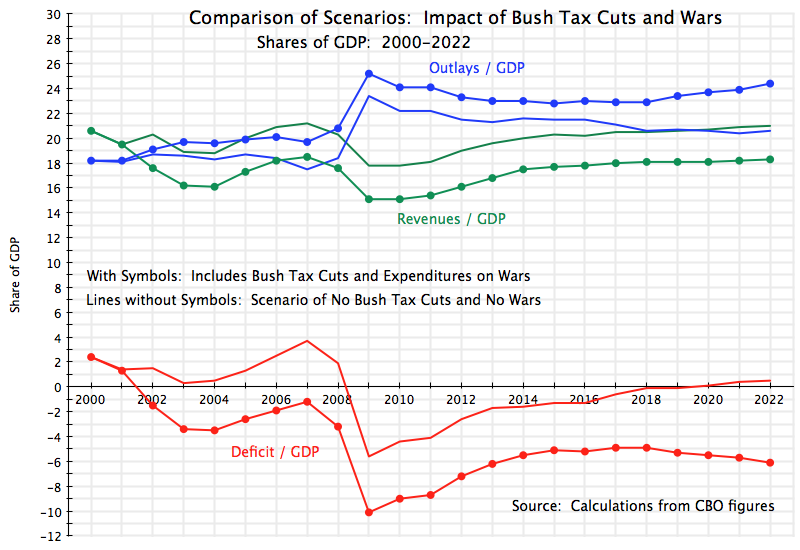
Using the CBO data, one can then calculate what the fiscal picture would have been, and what it would then be expected to be, had the Bush tax cuts never been passed, and had the Iraq and Afghan wars not been started (or, in terms of the impact on the deficit and the debt, had they been paid for by current taxes rather than borrowing).  Under this scenario the budget is in surplus and debt falls rapidly until the shock of the 2008 crisis.  And the deficit and the debt then stabilize quickly after that shock:


Note the scale here is different from that in the figure above.  With just these two changes, and leaving all else as before (including the economic collapse of 2008, even though some have argued it would not have then been so severe), the fiscal deficit diminishes and becomes a surplus by 2020, and the public debt to GDP ratio levels off and then starts to fall by 2014/15.  (Note for those not familiar with such dynamics:  The debt to GDP ratio can fall even while the public accounts are in a modest deficit because of GDP growth, which increases the denominator in the debt to GDP ratio.)  The public debt to GDP ratio peaks at 35% of GDP, well below what it reached during the Reagan / Bush I period.

Putting the two scenarios together on one figure allows for easier comparison:

All is the same until 2001, so this focusses only on 2001 to the projected 2022.  Revenues are always substantially lower as a result of the Bush tax cuts.  Outlays are always higher, for two reasons:  the costs of the Iraq and Afghan wars, and then, growing over time, due to outlays for interest on a growing public debt as a result of the deficits.  Deficits are always substantially higher with the Bush tax cuts and wars, and worsen over time due to growing interest expenditures.

And the impact on the public debt to GDP ratios is particularly stark:

The cause of the fiscal mess we are in is therefore clear:  without the Bush tax cuts and the unfinanced Iraq and Afghan wars, the fiscal accounts would not have worsened so much in the 2008 economic collapse, and would soon be back on a sustainable path.  This is taking all else as equal, including all other revenues and expenditures, as well as overall economic growth.  While it is certainly fair to note that all else would likely not then have been equal, there is no evidence to support the Republican argument that higher taxes (without the Bush tax cuts) would have stifled economic growth.  Without the Bush tax cuts, one would have had tax rates as they were during the Clinton years, when the economy grew well.  Why would taxes have suddenly become such a problem?  And growth during the Bush years was in fact quite poor (and terrible if one measures it by growth over his two full terms, with the 2008 collapse at the end of his second term).  The lower taxes under the Bush tax cuts did not lead to better growth than what the US economy achieved during the Clinton years.  It was far worse.

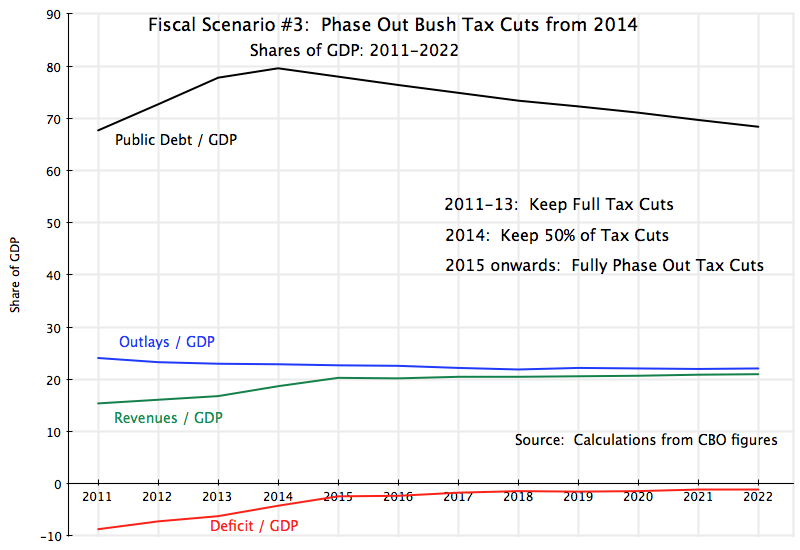
It is also fair to note that while the above may help us understand better the causes of the current fiscal mess, it does not by itself tell us how to solve the mess.  We cannot change the past.  But it does point out that re-establishing prior tax rates would be a clear place to start.  And it turns out that by themselves they would be more than enough:

This scenario assumes that the Bush tax cuts will be phased out starting in 2014 (and not earlier, as the economy has not yet fully recovered from the 2008 economic collapse), with 50% phased out in 2014 and 100% phased out from 2015 and onwards.  This, by itself, puts the economy on a stable and sustainable fiscal path.  The public debt to GDP ratio peaks in 2014 and then starts to fall, and the fiscal deficit falls steadily if slowly, to just 1% of GDP by 2021.  Revenues stabilize at about 21% of GDP and outlays at 22% of GDP.

In summary, the Bush tax cuts enacted in 2001 and 2003 (and extended in 2010 for two further years, through 2012), plus the costs of the unfinanced Iraq and Afghan wars, have undermined the US fiscal accounts, to the extent they are now unstable and lead to explosive growth in debt.  Had these decisions not been taken, the fiscal accounts would be quite stable, even with the extraordinary measures that were necessary (and the decline in fiscal revenues received) due to the economic collapse of 2008 and the then slow recovery.  But even with the debts incurred due to the Bush tax cuts and his unfinanced wars, the fiscal accounts can be put on a sustainable path simply by phasing out the tax cuts starting in 2014.