
Already Low Public Investment Has Fallen Sharply Under Obama

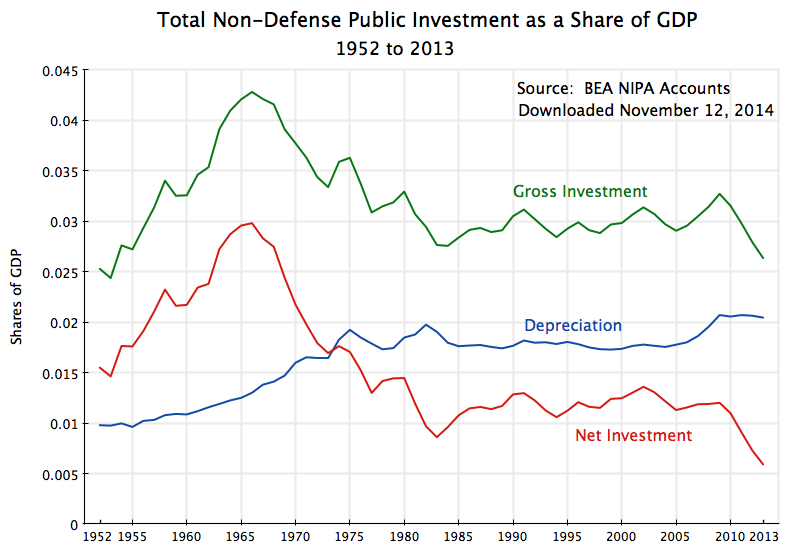
Public Investment Share of GDP, 1952-2013


A.  Public Investment as a Share of GDP

Public investment has fallen sharply under Obama, from already low levels.  This may come as a surprise to many, given the repeated assertions of conservatives that government has grown radically during his presidential term.  Obama has indeed repeatedly called for the need to revive public investment, particularly at a time when unemployment has been high, and government borrowing rates have been essentially zero in real terms.  But Republican control in Congress has blocked this.

Net public investment after depreciation (and excluding public investment by the military) has as a result fallen in half during Obama’s tenure in office, from an already low 1.2% of GDP in 2009, to just 0.6% of GDP in 2013.  And contrary to a common belief, net public investment in 2009 was not exceptionally high.  To be precise, it came to 1.20% of GDP in 2009, and an almost identical 1.19% of GDP in 2007 and again in 2008.  The 2009 stimulus program, with its focus on tax cuts, did not really do that much for public investment.  It rose, but only by barely more than depreciation rose that year on old investments.

The fall since 2009 would have been even greater had one included investment by the military, which has also been scaled back.  But the focus in this post will be on investment in our economy.

The figures are shown in the chart above.  The data are calculated from the numbers in the National Income and Product Accounts (NIPA accounts, often also referred to as the GDP accounts) from the Bureau of Economic Analysis.  The public investment figures shown here cover all forms of public investment by government other than by the military, and at all levels (federal, state, and local).  Using figures for 2013, 60% of the gross public investment was for public infrastructure, 27% was for research and development (as well as investment in software), and 13% was for equipment (such as computers).

Many observers focus solely on the gross investment figures, as these can be most easily measured.  The GDP shares for gross public investment are shown as the green line in the chart above.   But what matters for economic growth is the net addition to productive capacity from this investment, after one subtracts depreciation.  Investments wear out over time.  The BEA NIPA accounts include estimates of what this depreciation will be (worked out at the detailed individual product levels), and those estimates are shown as the blue line in the chart.  The difference between gross investment and depreciation is net investment, shown in red on the chart.

The net investment of 0.6% of GDP in 2013 is the lowest level of net (non-military) public investment as a share of GDP in 66 years, or two-thirds of a century.  In data going back to 1929 (the earliest year with official GDP estimates), it was only lower during World War II and the immediate post-war years (1942 to 1947), when non-military spending of all kinds was drastically scaled back.

Net public investment rose sharply as a share of GDP in the 1950s and up to the mid-1960s.  Its share of GDP doubled, from 1.5% in 1952 and again in 1953, to 3.0% at its peak in 1966.  This was the period when we invested in the then new Interstate Highway system, in new and expanded water and sewerage systems, and in government research and development (such as the Apollo moon mission).  The economy then grew strongly, with supportive infrastructure.  But public investment then started to be cut back sharply, reaching a trough in 1983 of just 0.9% of GDP, after which it fluctuated around a low level of generally 1.1 to 1.4% of GDP.  It then was cut back sharply again, by half, during the period Obama has been president.  Aside from 1942 to 1947, it is now at a historic low.

B.  Public Investment in Real Per Capita Dollar Terms

Another way to look at such figures is in real per capita terms.  Using prices of 2013, net non-defense public investment came to $291 per person in 1952.  It was only slightly more, at $313 per person, in 2013, an increase of just 8% in 61 years:

Real per Capita Dollar Terms Change Change
     2013 prices 1952 1968 2013 1952-2013 1968-2013
Non-Defense Net Public Investment $291 $783 $313 8% -60%
Per Capita Real GDP $16,675 $24,240 $52,985 218% 119%

Over this same period, real per capita GDP more than tripled, from $16,675 in 1952 to $52,985 in 2013.  It is ridiculous to say the US cannot now afford to invest more in infrastructure and other public assets.  We could afford to invest a similar amount to what we are investing now, when incomes were only one-third as high as now.

Per capita net pubic investment reached a peak in dollar terms in 1968, at $783 (in terms of 2013 prices).  (The peak as a share of GDP was in 1966, but GDP was growing strongly in those years, so the peak in dollar terms could come two years later.)  From that peak, per capita net public investment fell to the $313 of 2013, a fall of 60%.  But over that same period, real per capita GDP more than doubled.  We could certainly have afforded to have kept up, and indeed expanded, our investment in public infrastructure.  But the political choice was made not to.  The result has been our deteriorating public assets.

C.  Conclusion

The poor and inadequate condition of American infrastructure and other public assets should not be a surprise when one looks at how little we spend on such capital.  Net spending of just $313 per person in 2013 is tiny.  Doubling or tripling this would not be a big burden.

One can live on old capital, such as the roads and bridges we built in the 1950s and 60s, for a period of time, but eventually they do wear out.  Net public investment of just 0.6% of GDP will not suffice to support an economy that should be growing at 3 to 4% a year.  But what we have instead is an embarrassment at best (as anyone who has traveled abroad to Europe or East Asia knows), and one which will increasingly act as a drag on the economy.
Some Thoughts on the Midterm Elections in the US

The Democrats clearly did terribly in the midterm elections on November 4.  Here are some thoughts on some (not all) of the factors behind this:

1)  Turnout is the “name of the game” in US elections, and the Democrats did badly at getting their normal supporters to go to the polls and vote.  Only an estimated 36% of those eligible to vote in the US actually voted this time, 11% below the 41% rate estimated for the 2010 midterms.  One traditionally thinks of elections as if voters go to the polls regardless, with the issue then being whether their choice will be candidate A or candidate B.  Under such circumstances, a successful campaign strategy is to focus on how best to convince those voters to vote for you rather than your opponent.  An appeal to the voters who are politically in the middle would then be, under such conditions, a good strategy.

But most Americans do not vote.  The winner is then the candidate most successful at convincing those who would vote for him or her, to actually take the trouble to vote.  The need is to get those who would vote for you to overcome the hurdles they must go through to cast their ballot.  They are more likely do this the more committed they are to the candidate and what he or she represents.

2)  Obama, and Democrats generally, did a poor job at making such an appeal.  Possibly the clearest example of this was Obama’s decision (under pressure from several Democratic candidates for the Senate, most of whom then lost) to postpone any announcement of executive actions he would take on immigration reform – actions which would not require new legislation.  Obama publicly promised to make such an announcement this past summer, but then decided to postpone any such announcement until after the election.  This then led to strong criticism by many Hispanics, including heckling at some of his speeches, and a reduction in support from Hispanics.  This was manifested in part by a reduced share of the Hispanic vote going to Democrats, but even more in a reduction in Hispanics going to the polls at all.  The result will now be a Senate more averse to immigration reform than before.  But the reaction by Hispanics is understandable.

The strategy did not pick up many, if any, moderate votes.  But it did lead to a key constituency to be less interested in overcoming the hurdles that exist in the US (and increasingly exist:  see below) to go out and vote.

One can point to issues that have disappointed other key constituencies as well. Significant groups of Obama supporters were disappointed by his (so far) non-decision on the Keystone pipeline (he has not approved it, but nor has he decided against it); his extension of the Bush tax cuts for all but the extremely rich (which has weakened the fiscal accounts, with this then strengthening those opposed to the government spending that would have accelerated the recovery and reduced unemployment); his failure to prosecute aggressively those on Wall Street who through fraud sold mortgage-backed securities that misrepresented the financial capacity of many of those receiving such mortgages, which led directly to the 2008 financial crisis; the support provided to those Wall Street banks and other financial institutions then to rescue them from this crisis, while home-owners who were sold such mortgages received only limited, and in the end ineffectual, help; and more.

I would not argue that these positions did not reflect Obama’s genuine beliefs.  While conservative pundits have labeled him a far-left socialist, or worse, Obama has in fact governed from the middle.  But such positions then had the effect of leading many with more liberal views not to see a reason to go to the polls.

Obamacare provides a further example.  It has successfully reduced the number of uninsured in America by over ten million so far, and has been the most important health care reform in the US since Medicare was passed in 1965.  But it has been criticized by those on the left as an overly complex program.  As they note, it was a plan first conceived by the conservative Heritage Foundation in 1989.  Republicans in Congress in 1993 then championed this plan, with its individual mandate, as their counter-proposal to the health reform plan of the White House task force led by Hillary Clinton.  Many Obama supporters would have preferred the simpler approach of a health care plan built on extending Medicare to the full population (a single-payer system).  The problems with the launch of the Obamacare exchanges in October 2013 affirmed for many that such a simpler plan would have been better.

The Obamacare system that works through private insurance companies may have been necessary politically, to get any health care reform passed through congress.  It was politically in the middle, derived from a plan first pushed by Republicans.  But it disappointed many liberals as overly complex and more costly than an extension of Medicare to all would have been, while picking up few votes from voters in the middle.

3)  Voter suppression works, and can be decisive in close elections.  A wave of more restrictive voting measures were enacted following the 2010 elections, in those states where Republicans took (or kept) control of both the governorship and both houses of their legislatures.  Courts have ruled against some of the new voting restrictions, while others were merely postponed.  Such new measures, which vary by state, were in place in 21 states for the first time in a midterm election in 2014.

The measures all act to increase the hurdles to voting.  They can have a particularly discriminatory impact on the poor and many minorities.  Voter ID requirements may not matter much to someone with a car and driver’s license, but if you are poor and do not own a car, and hence have had no need for a driver’s license, the burden can be significant.  And the intent of such laws was made especially clear in Texas, where a license to carry a handgun is counted as a valid ID for voting, while a state-issued photo ID at the University of Texas for an in-state student is not.

It is difficult to impossible to estimate the impact that raising the hurdles to voting has had on voter participation.  A recent study by the GAO estimated that in two states examined (Kansas and Tennessee), the result may have been a reduction in voter participation of about 2 to 3%.  If all this impact is focussed on one side of potential voters (e.g. poor who would vote for Democrats) in an otherwise evenly divided state, the impact would be to reduce the votes on one side by 4 to 6%.  This is huge, and could be decisive in many contests.

Two prominent states that introduced significant new voting hurdles since 2010 were North Carolina and Florida.  Republican Thom Tillis, who as speaker of the state House of Representatives pushed through the new voting measures, beat Senate incumbent Kay Hagan by a narrow 49.0% to 47.3%.  He may well owe his win to the new hurdles.  And Republican Governor Rick Scott of Florida signed into law new voting restrictions as well as implemented executive actions that made voting more difficult.  He won over his challenger (former governor Charlie Crist) by a margin of just 48.2% to 47.1%.

While it is impossible to say with certainty that the new hurdles were the deciding factors in these races, they figures are so close that they very well could have been.

4)  Obamacare has succeeded in its primary objective of making it possible for more Americans to obtain health insurance.   But the politics of whether such progress will translate into net votes in favor of politicians who supported it are not straightforward.

In the US, before Obamacare, roughly 85% of the population (using round numbers, but sufficient for the illustrative purposes here) had health insurance, whether through government programs such as Medicare and Medicaid, or through private insurance normally obtained via your employer.  About 15% of the population had no such health insurance cover, and the primary aim of Obamacare was to make it possible for this 15% to obtain health insurance coverage.

While making it possible for this 15% to obtain health insurance is an indisputable gain to the 15%, they of course only make up 15% of the total.  The other 85% already have health insurance, and health insurance coverage is of course important to all of us.  But with the complexities of the Obamacare reforms, the 85% who already with health insurance cover can understandably be worried whether Obamacare might have an adverse impact on them.  It won’t, and there will indeed be gains for most of them (health insurance policies must now meet certain minimum standards, including the provision of coverage for routine annual check-ups without a deductible, coverage for adult children up to the age of 26, an end to denial of coverage for pre-existing conditions, and other measures).  Only a relative few of the very rich will now pay more in taxes to cover in part the cost of subsidies that will make it possible for those of lower income to afford coverage.

But with the complexities of the Obamacare reforms, plus the anti-Obamacare campaigns by certain political groups (such as a number supported by the Koch brothers), as well as by Fox television and a number of radio talk programs (such as Rush Limbaugh), it is not surprising that people within the 85% may worry.  Access to health care is important to all of us, and if Obamacare would, in some unclear fashion but based on what critics are asserting, lead to loss of coverage within the 85%, one can understand the concerns.  And with the 85% far outnumbering the 15%, it would not take a very high share of the 85% to oppose Obamacare, under the mistaken belief they will be harmed in some unknown way, to offset the positive reactions among the 15% now able to obtain affordable health care.

There can be a similar political arithmetic in other areas as well.  Falling unemployment will matter a good deal to those now able to get jobs, but they constitute a relatively small share of the labor force.  After all, an unemployment rate below 6% (as it is now) means that more than 94% have jobs.  And if those with jobs are told that the measures being taken to spur growth will have an adverse effect on them (such as the assertions, completed unsupported by any facts on what has happened to inflation thus far, that the Fed’s monetary policy will lead to hyperinflation), the political gains from bringing down the unemployment rate may be more than offset by the worries of the 94%.


There were many reasons for the poor showing of the Democrats in the November 4 midterms.  The factors discussed above are only a few, and perhaps not even the most important ones.  But they did contribute.

The Government Debt to GDP Ratio is Falling

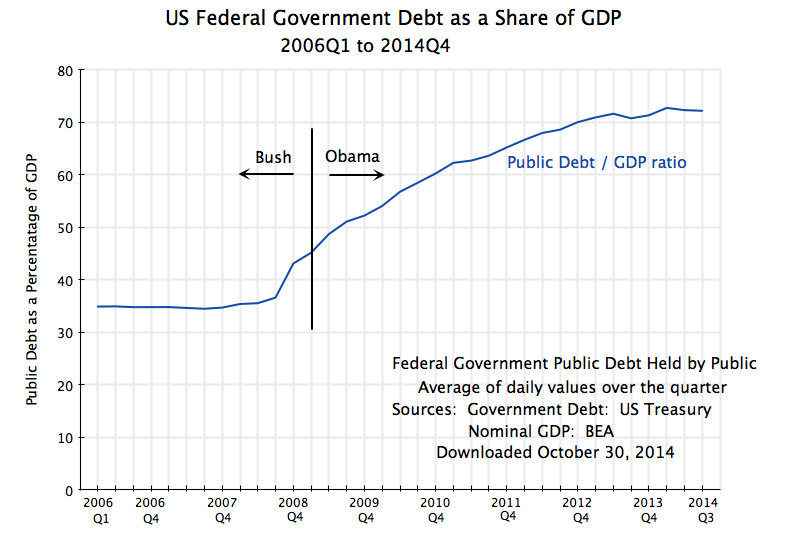
Fed Govt Debt as Share of GDP, 2006Q1 to 2014Q3

The US federal government debt to GDP ratio is falling.  A few years ago, conservative critics (such as Congressman Paul Ryan) argued that if drastic action were not taken immediately to slash government expenditures, consequent rapidly rising federal government debt would stifle growth and spiral ever upwards.  Liberals (such as Paul Krugman) argued that the federal deficit and debt were far less of a concern than these critics asserted:  With the recovery of the economy, both would soon start to fall.  And the detailed projections from the Congressional Budget Office backed this up, with projected falls in the debt to GDP ratio for at least a few years.  There would be a rise later if nothing further is done, in particular on medical costs, but the question at issue here is whether the debt to GDP ratio could fall in the near term without drastic cuts in government expenditures.  Conservatives asserted it would not be possible.

But these were projections and assertions.  The chart above shows the actual data.  With the release this morning by the Bureau of Economic Analysis of its first estimate of 2014 third quarter GDP (growth at a fairly solid 3.5% real rate), one can now see that there has been a downward turn in the debt to GDP ratio.  The ratio peaked at 72.8% of GDP in the first quarter of 2014, and dropped to 72.2% as of the third quarter.

The federal government debt figure used here is the debt held by the public.  There are also various trust funds (most notably the Social Security Trust Fund) that formally hold government debt in trust, but this reflects internal accounting within government.  The figures come from the US Treasury, with quarterly averages taken based on an average of the amounts outstanding each day of the quarter.  This average is then taken as a share of nominal GDP for the quarter (nominal GDP since debt is also a nominal concept).  And since nominal GDP reflects the flow of production over the course of the quarter, taking the daily average debt outstanding over the course of the quarter will better reflect the debt burden than simply taking debt as of the end of the quarter and dividing this by GDP (although this is commonly done by many).

There was an earlier downward dip in the public debt to GDP ratio in the third quarter of 2013, but this was due to special circumstances surrounding the delay by Congress to approve a rise in the statutory government debt ceiling.  Various accounting tricks were used to delay recognition of items that would add to the formally defined government debt in order to keep under the ceiling, which artificially suppressed the debt to GDP ratio in that quarter.  This carried over into the fourth quarter, with the Republicans forcing a shutdown of the federal government from October 1 by not approving a new budget.  The dispute was not resolved until October 16, when deals were reached to raise the debt ceiling and to approve a budget.  The debt ratio then returned to its previous path.

The fall in the debt ratio in 2014 is more significant.  Accounting tricks are not now being used due to debt ceiling disputes, and the fall reflects the continued fall in the fiscal deficit coupled with reasonably sound growth.  The deficit is estimated to have totaled $483 billion in fiscal 2014 (which just ended on September 30), or 2.8% of GDP.  This is sharply down from the $1.4 trillion (or 9.8% of GDP) of fiscal 2009, in the first year of the downturn.  The fiscal deficit has fallen primarily due to the recovery, but also due to cuts in federal government expenditures under Obama since 2010.  While not nearly as drastic as Congressman Ryan and other conservatives had insisted would be necessary, government spending has still fallen under Obama, in contrast to the increases allowed in previous downturns.

Note that the government expenditure cuts that were done do not represent what would have been the desirable path in deficit reduction:  As discussed in an earlier post on this blog, it would have been far better to follow a fiscal path similar to that followed by Reagan and others in earlier downturns, with government spending allowed to grow so that the economy could have more quickly returned to full employment.  Once full employment was reached, one would then consider fiscal cuts, if warranted, to address any debt concerns.

The path followed has thus been far from optimal.  But it has shown that the alarms raised by the conservative critics, that the debt to GDP ratio could not fall without drastic government cutbacks (far more severe than that seen under Obama), were simply wrong.