An Increase in Government Spending Can Reduce the Debt to GDP Ratio: Econ 101

Most people realize that it is not the absolute value of the government debt that matters, but rather the ratio of that debt to GDP.  A larger economy can support a larger debt.  But most people will also think instinctively that an increase in government spending will necessarily lead to an increase in the government debt to GDP ratio.  It is not surprising that they should think so.  But it is wrong.

Whether the government debt to GDP ratio will rise or will fall when government spending increases will depend on economic conditions and other structural factors.  In conditions of high unemployment and where the Central Bank has driven the interest rates it can control essentially to zero, such as exist now in the US and Europe, an increase in government spending will increase the demand for goods and services, and hence will increase the demand for labor to produce those goods and services.

Employment and output will then rise. How much they will rise will depend on the multiplier, but as was discussed in a previous Econ 101 post on this site, in conditions of high unemployment and close to zero Central Bank controlled interest rates such as currently exist, the multiplier will be relatively high.  The higher incomes that then follow from the higher employment and output will also then lead to higher tax revenues, as a share of the higher incomes will be paid in taxes.

Hence the addition to the deficit and thus the public debt will be less than simply the increase in government spending, due to the higher tax revenues.  With GDP higher due to the greater demand and with the debt also possibly higher but not by as much, the debt to GDP ratio could fall.  And indeed, under conditions such as currently exist in the US and Europe, the debt ratio will almost certainly fall.

To see this, one can start with a simple numerical example.  Suppose one starts with a GDP equal to 100 units (it could be $100 billion), a public debt of 50 (or 50% of GDP, roughly where it was in the US in 2009), a multiplier equal to 2.0 (a reasonable estimate for the US in recent years), and a marginal tax rate on additional income of 30% (also a reasonable estimate for what it is for US federal government level revenues; it would be higher if one included state and local government revenues).

In these conditions, suppose government spending rises by 1 unit.  With a multiplier of two, GDP will then rise by 2 units.  Tax revenues will then rise by 0.6 units, when the marginal tax rate is 30% on the additional 2 units of GDP.  The government deficit, and hence the public debt, will rise by 0.4 units, equal to the extra 1 unit of government spending less the 0.6 units of additional tax revenue.  The resulting public debt will be 50.4, while GDP will then be 102, and the ratio of 50.4/102 is equal to 0.494.  Hence the debt ratio fell from 50% to 49.4% when government spending rose by 1.  Higher government spending led to a reduction in the debt to GDP ratio.  While the total debt rose, GDP rose by proportionately more, leading to a fall in the debt to GDP ratio.

Further numerical examples will help give a feel to what is going on:

Impact on Debt/GDP Ratio from a One Unit Increase in Government Spending
        Scenario: (a) (b) (c) (d) (e)
GDP: Y 100 100 100 100 100
Public Debt: D 50 70 30 50 50
multiplier: m 2.0 2.0 2.0 0.5 3.5
marginal tax rate: t 0.3 0.3 0.3 0.3 0.3
pre-change D/Y 0.500 0.700 0.300 0.500 0.500
Change in G 1 1 1 1 1
Change in Y 2 2 2 0.5 3.5
Change in D 0.4 0.4 0.4 0.85 -0.05
Resulting D/Y 0.494 0.690 0.298 0.506 0.483

Scenario (a) is the case just discussed.  With an initial public debt ratio of 50%, a multiplier of 2, and a marginal tax rate of 30%, a unit increase in government spending will lead the debt to GDP ratio to fall to 49.4%.  This is robust to different initial debt to GDP ratios:  The debt to GDP ratio will fall with higher government spending with an initial debt ratio of 70% (scenario (b), with the debt ratio where it was in FY2012) or at 30% (scenario (c), almost what the debt ratio had fallen to at the end of the Clinton administration, before the Bush tax cuts).

Under conditions where the economy is close to full employment, so that the multiplier will be relatively small, the debt ratio could rise with the higher government spending.  GDP will not rise by much, if at all, if the economy is already producing at or close to full employment levels.  The denominator in the ratio hence will not rise by much, if at all, while the numerator (the level of debt) will rise by the level of extra government spending, with only limited or no extra tax revenues to offset this since GDP has not increased by much.   Scenario (d) provides an example, with a multiplier of 0.5.  The debt ratio will rise from 50% to 50.6% in this example, when government spending rises by 1.

At the other extreme, a very high multiplier may lead to such a large increase in GDP that the extra tax revenues thus generated are greater than the increase in government spending, leading to an actual decrease in the deficit and hence the debt.  Scenario (e) presents an example, with a multiplier of 3.5.  Debt actually falls from 50 units to 49.95 units, despite the increase in government spending by 1 unit, and the debt to GDP ratio falls from 50% to 48.3%.

One will also get this result if the extra tax revenues generated for a given increase in GDP is sufficiently high.  The above examples assume a marginal tax rate of 30%.  More generally, if the marginal tax rate times the multiplier is greater than one (e.g. 30% times 3.5 = 1.05 in the example above), then the absolute value of the debt will fall with the higher government spending.

It may well be unlikely, however, that the multiplier will be as high as 3.5, even with the current high unemployment in the US and Europe.  Thus it is unlikely that the absolute value of the debt will fall with higher government spending, even in conditions of high unemployment.  But as was discussed above, with a reasonable estimate of the multiplier at around 2, one will see the debt to GDP ratio fall, under conditions such as now exist in the US and Europe.

For those with some mathematical expertise, it is straightforward to derive the specific conditions which will determine whether the debt to GDP ratio will rise or fall with an increase in government spending.  This requires some elementary differential calculus, and I will not go through the derivation here.  But the final result is that the debt to GDP ratio will fall if:

(t + D/Y) – (1/m) > 0

and the debt ratio will fall if the sum on the left is less than zero.  That is, the debt to GDP ratio will fall if the marginal tax rate (t), plus the initial debt to GDP ratio (D/Y), minus the inverse of the multiplier (m), is greater than zero (and will rise if the sum is less than zero). Thus if t=30%, D/Y=50%, and m=2 (so 1/m=0.5), with a sum then of 0.3 + 0.5 – 0.5 = 0.3, which is greater than zero, the debt to GDP ratio will fall.

The material above is straightforward.  There is nothing deep or complex.  It also just examines the immediate impact on the public debt to GDP ratio from an increase in government spending.  For a more elaborate look at the long-term impact, see the paper of Brad DeLong and Larry Summers published in 2012.  They show there that higher government spending will not only spur GDP in the short run under conditions such as exist now, but also that such spending will likely pay for itself in the long run through its long term positive impact on growth.

But this post simply focuses on the short term, and shows that counter to what many people might at first believe, higher government spending can lead to a fall in the public debt to GDP ratio.  All this result requires is the recognition that under conditions such as exist now, when unemployment is high and Central Bank controlled interest rates are close to zero, there will be a significant multiplier effect from an increase in government spending.  The resulting increase in GDP along with the extra tax revenues thus generated could very well then lead to a fall in the debt to GDP ratio.  Indeed, with the conditions and parameters such as now exist in the US and Europe, one should expect this result.

The Sluggish Recovery: Fiscal Drag Continues to Hold Back the Economy

Recessions - GDP Around Peak, 12Q before to 22Q after

I.  Introduction

The recovery from the 2008 economic collapse remains sluggish, with GDP growing in the first half of 2013 at an annualized rate of only 1.4% (according to recently released BEA estimates).  And based on fourth quarter to fourth quarter figures, GDP grew by only 2.0% in 2011 followed by just 2.0% again in 2012.  As a result, the unemployment rate has come down only slowly, from a peak of 10.0% in 2009 to a still high 7.4% as of July.

Conservatives have asserted that the recovery has been slow due to huge and unprecedented increases in government spending during Obama’s term, and that the answer should therefore be to cut that spending.  But as has been noted in earlier posts on this blog, direct government spending during Obama’s term has instead been falling.  This reduction in demand for what the economy can produce has slowed the recovery from what it would have been.

This blog will update numbers first presented in a March 2012 post on this blog, which compared the paths of GDP, government spending, and other items in the periods before and after the start of each of the recessions the US has faced since the 1970s.  That earlier blog post looked at the paths of GDP and the other items from 12 quarters before the business cycle peak (as dated by the NBER, the entity that organizes a panel of experts to date economic downturns) to 16 quarters after those peaks (when the downturns by definition begin).  The figures were rebased to equal 100.0 at the business cycle peaks.  We now have an additional year and a half of GDP account data, so it is now possible to extend the paths to 22 quarters from the start of the recent downturn in December 2007.  This has therefore been done for all.

The conclusions from the earlier post unfortunately remain, but are even more clear with the additional year and a half of observations.  GDP growth remains sluggish, government spending has fallen by even more, and residential investment remains depressed (although it has finally begun to recover).

II.  The Path of Real GDP

The graph at the top of this post shows the path followed by real GDP in the periods from 12 quarters before to 22 quarters after the onset dates of each of the recessions the US has faced since the 1970s.  The sluggish recovery from the current downturn is clear.

The economy fell sharply in the final year of the Bush administration, and then stabilized quickly after Obama took office.  GDP then began to grow from the third quarter of 2009 and has continued to grow since.  But the pace of recovery has been slow.  By 22 quarters from the previous business cycle peak, real GDP in the current downturn is only 4% above where it had been at that peak.  At the same point in the other downturns since the 1970s, real GDP was between 15% and 20% above where it had been at the previous peak.  This has been a terrible recovery.

 III.  The Path of Government Spending

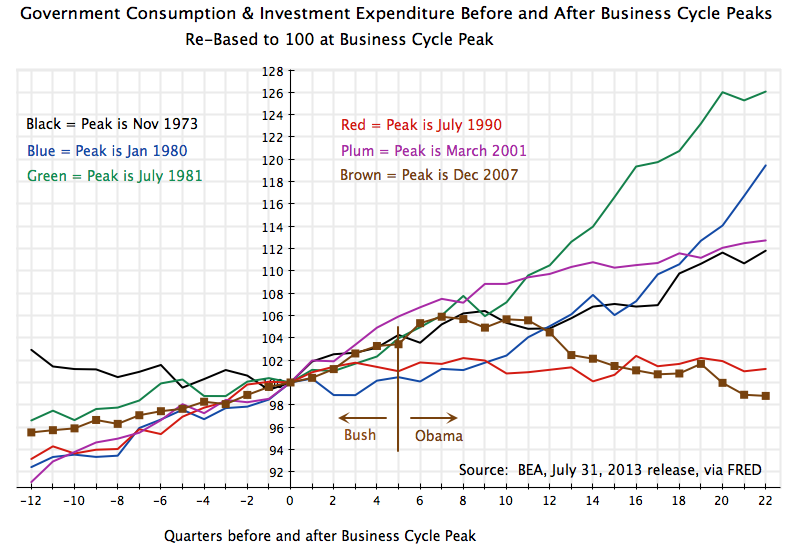
How has this recovery differed from the others?  To start to understand this, look at the path government spending has taken:

Recessions - Govt Cons + Inv Expenditures Around Peak, 12Q before to 22Q after

Direct government spending has fallen in this recovery, in sharp contrast to the increases seen in the other recoveries.  Real government spending was 26% higher by 22 quarters after the onset of the July 1981 recession (the green line) during the Reagan presidency, and 13% higher at the same point in the recovery from the March 2001 recession (the plum colored line) during the Bush II presidency.  While both Reagan and Bush claimed to represent small government conservatism, government spending instead rose sharply during their terms.

In contrast, in the current downturn direct government spending is now 1.2% below what it had been at the start of the recession in December 2007.  Furthermore, it is worth noting that while it rose in the final year of the Bush presidency and then in the first half year after Obama took office (a major reason why the recovery then began), it has since fallen sharply.  Government spending is now almost 7% below where it had been in mid-2009, a half year after Obama took office.  Such a decline (indeed no decline) has ever happened before, going back at least four decades, as the economy has struggled to recover from a recession.  The closest was during the Clinton years, when government spending was essentially flat (a 1% increase at the same point in the recovery).

Note that the measure of government spending shown here is that for total government spending on consumption and investment (i.e. all government spending on goods and services).  This is the direct component of GDP.  Government spending can also be measured by including transfer payments to households (such as for Social Security or unemployment insurance), but as was noted in the earlier blog post from March 2012, the results are similar.  Note also that the government spending figures include spending at the state and local levels, in addition to federal spending.  While we speak of government spending as taking place during some presidential term in office, the decisions are made not simply by the president but also by many others (including state and local officials, and the Congress) in the US system.  But the president at the time is typically assigned the blame (or the credit) for the outcome.

IV.  The Path of Residential Investment

The current downturn and recovery also differs from the others by the scale of the housing collapse, and consequent fall in residential investment:

Recessions - Residential Investment Around Peaks, 12Q before to 22Q after

The build up of the housing bubble from 2002 to 2006 was unprecedented in the US, and the collapse then more severe.  As the graph above shows, there has been a start in the recovery of residential investment from the lows it had reached in 2009 / 2010, but it is still far below the levels seen in previous downturns.

Housing had been overbuilt during the bubble in the Bush years, leaving an oversupply of housing once the bubble burst.  And while supply was in excess, demand for housing was reduced due to the severe recession.  As was discussed in an earlier blog post on the housing crisis, the result was a doubling up of households as well as delays in household formation as young adults continued to live with their parents.  Residential investment therefore collapsed, and has recovered only very slowly.

V.  The Path of Household Debt

The housing bubble also led to over-indebtedness of households.  Nothing of this sort at all close to this scale had ever happened before in the US.  With the lack of regulation and oversight of the financial sector during the Bush administration, banks and other financial entities launched and aggressively marketed and sold financial instruments that led to a bidding up of home prices.  But these new financial instruments were only viable if housing prices continued to rise forever.  When the housing bubble burst, widespread defaults followed.  And those households who did not default struggled to pay down the debts they had taken on, for assets now worth less than the size of the debts tied to them.

The result was a sustained fall in household debt (three-quarters of which is mortgage debt) in the period of the downturn:

Recessions - HH Debt Around Peak, 12Q before to 22Q after

This pay-down of debt had never happened before, and is in stark contrast to the rise in household debt seen in all the other downturns of the last four decades.

VI.  The Path of Personal Consumption Expenditure

Households struggling to pay down their debt have to cut back on their consumption expenditures.  This brings us to the last element of the current recovery I would like to highlight:  the especially slow recovery in household consumption.  That path of consumption during the current downturn stands out again in contrast to the paths followed in the other downturns and recoveries of the last four decades in the US:

Recessions - Personal Consumption Around Peaks, 12Q before to 22Q after

The difference is stark.  Households could spend more in the prior recoveries in part because they could continue to borrow (see the graph on household debt above).  In this recovery, households have instead had to pay down the debts they had accumulated in the housing bubble years, and could increase their household consumption only modestly.

VII.  Conclusion

The recovery in the current downturn has been disappointing.  GDP has grown since soon after Obama took office, but has grown only slowly, and has been on a path well below that seen in other recoveries.

There are a number of reasons for this.  Household consumption has kept to a low path as households have struggled to repay the over-indebtedness they had accumulated during the housing bubble years.  Residential investment collapsed as well following the bubble, is only now starting to recover, and remains far below the levels seen at similar points in other recoveries.
And government spending has been allowed to fall during Obama’s term.  This had never happened before in the previous downturns.  Indeed, while real government spending rose by 26% at the same point in the economic recovery during the Reagan presidency, it has been reduced by over 1% in this recovery (and reduced by 7% from what it had been a half year after Obama took office).
The reduction in government spending reduced the demand for what the economy could have produced.  In this it was similar to the reduced demand resulting from lower residential investment or lower household consumption expenditure.  All these reductions in demand reduced GDP, reduced the demand for workers, and hence increased unemployment.  But while residential investment and household consumption can only be influenced indirectly and highly imperfectly by government policy, government has direct control over how much it spends.  That is, government can decide whether to build a road or a school building, and doing so will employ workers and will lead to an increase in GDP.  Hence government spending is a direct instrument that can be used to raise growth and employment, should the government so choose.
Sadly, and in stark contrast to the sharp increase in government spending during the Reagan period that spurred the recovery to the 1981 downturn, US politics during the Obama presidency have instead led to a cut-back in government spending, with a resulting drag on growth.  The disappointing consequences are clear.

The Fiscal Multiplier: Econ 101

A.  Introduction

The “fiscal multiplier” (often referred to as just the “multiplier”) is simply the ratio of how much aggregate GDP will increase for a unit increase of fiscal spending.  Hence if fiscal spending increases by say $100 and aggregate GDP increases by $200 in response, the multiplier is equal to 2.  The concept is also often applied similarly to tax cuts of some dollar amount.

Under conditions where there is significant unemployment in an economy, an increase in government spending can be expected to have a multiple impact on GDP.  There will be a direct contribution to GDP from the increased production to provide for the demand from government, but also an indirect contribution as those being paid for the initial goods (whether newly employed workers or suppliers of inputs to the production of the good) will in turn spend at least some portion of their higher incomes on other goods or services in turn.  And this process will continue in further rounds.

While the concept is simple, the multiplier in practice is difficult to measure.  It is not a constant, but rather a definitional concept whose value will vary depending on the specific economic circumstances of the time and place.  It has also been controversial, as some economists both historically and even currently do not believe it is possible for an economy to be functioning at less than full employment.  For such economists, higher production from an increase in demand is not possible since the economy is already at full employment, and the multiplier must then always and everywhere be uniquely equal to zero.

But most economists recognize that it is possible for the economy to be at less than full employment.  This is especially clear today in most of the developed world, including in the US, Europe, and Japan, with unemployment high in each of these countries or regions.

The real debate, then, is about the size of the multiplier in a particular situation – whether it is low or high.  If low, then fiscal stimulus will not have much of an effect on increasing GDP, while fiscal austerity will not lead to a big reduction in GDP.  If high in contrast, fiscal stimulus will be quite effective in raising GDP, while fiscal austerity will lead to big reductions in GDP and consequent large increases in unemployment.

Recent work at the IMF, a conservative institution, on the size of the multiplier has brought this debate into the general news.  In particular, in June the IMF published a self-evaluation of the IMF supported (as well as EU and ECB supported) economic program in Greece.  It noted there (on page 21) that the fiscal multipliers assumed in that program turned out, based on actual experience, to have been too low.  This self-criticism was picked up in the general press, and many have questioned how the IMF (and the others) could have gotten this so wrong.

But judging the size of the multiplier in a particular place and in particular circumstances is not easy.  This Econ 101 blog post will discuss why the multiplier will vary in different countries and in different country circumstances.  And while it might be understandable how the multiplier might be misjudged ex ante in some concrete case, what is outrageous is not that initial misjudgment.  What is outrageous is that the policies that had been taken based on that earlier misjudgment were not then revised or reversed to reflect what had been learned.

B.  Why the Multiplier Will Vary

As noted above, the multiplier is not a constant, equal to the some particular value in all countries and under all circumstances.  Rather, it is a concept, expressing a relationship (between changes in GDP and changes in government spending) which will in general vary across different economies and across different circumstances in any particular economy.  Hence even if one had a good estimate of what it might be in one particular country under particular circumstances, one should not assume it would have that some value in another country or even in the same country under different circumstances.

Specifically, one should expect:

1)  The multiplier will vary across countries, depending on the size and structure of those countries:  In a large country such as the US, an increase in spending (both direct and indirect) will be met primarily by supplies originating in the US.  The multiplier will then be relatively large.  In contrast, higher spending in a small and open economy, such as Monaco to take an extreme example, will be met primarily by supplies originating elsewhere.  The multiplier will then be relatively small.   Most economies are in between these two in size, and one would expect the multiplier then also to be in between these two in size.

Note that this will depend not only on the size of the economy, but also its economic structure (the type of goods produced within that economy, as opposed to imported) and the nature of its trade regime.  Some economies are more open than others.

2)  The multiplier will vary depending on the current state of the economy – how far or close the economy is to full employment:  If unemployment is significant, an increase in demand can be met with an increased supply of goods, and an increase in employment of workers to produce those goods.  The multiplier will be relatively high.  In contrast, if the economy is at a time of close to full employment, an increase in demand for certain goods can only be met by reduced production of something else (with a shift in jobs from the latter to the former), so overall output might not rise by much.  In such circumstances the multiplier will be relatively low.

Hence if one had a good estimate of the multiplier in some particular economy at a point in time when the economy was close to full employment, one would greatly underestimate what the multiplier would be in that same economy at a different time when unemployment was high.

3)  The multiplier will vary depending on the form of the fiscal stimulus:  Fiscal stimulus programs can take the form of spending on newly produced goods (such as infrastructure), or on transfer programs to households (such as higher or extended unemployment benefits), or on tax cuts or tax rebates.  But while each might have a similar direct dollar impact on the fiscal deficit, the impact on GDP could vary widely.

Direct government expenditures on newly produced goods, such as new roads or school buildings, will likely have the largest impact on GDP.  The newly produced goods will, with certainty, be produced, and such product is a direct component of GDP (GDP stands for Gross Domestic Product).  And those newly employed to produce such goods (e.g. construction workers) will also then spend most or even all of their new earnings on goods they need.  The multiplier will be high.

The multiplier will also likely be relatively high on transfer programs that go to the unemployed and others who are relatively disadvantaged, as they will spend what they receive on goods that they and their family very much need. The multiplier will be less on transfer programs that benefit those who are better off (such as certain farm subsidies, for example, when they mostly benefit large and relatively well-off corporate farms), as such individuals or firms will likely save a higher share of such receipts.

And the multiplier might be quite small for tax cuts or tax rebates that go to upper income households, as they will likely save much of what they receive.

Hence the size of the multiplier will depend on the nature of the fiscal stimulus program.  Programs focussed on the direct production of goods, especially labor-intensive goods (such as the building and maintenance of much of infrastructure), or on transfers to the relatively less well off, can be expected to have a relatively high multiplier effect.  Programs focussed on transfers or subsidies going to the relatively well off, or tax cuts that accrue primarily to the relatively well off, can be expected to have a relatively low multiplier effect.

4)  The multiplier will vary depending on whether the stimulus (or austerity) programs are temporary or expected to be sustained:   Temporary tax cuts or tax rebates are a common component of stimulus programs, in part because they can be implemented quickly and easily.  However, households receiving a temporary tax cut or a one-time rebate will normally simply save a high share of what is distributed to them (or use the funds to pay down outstanding debt they might have).  The multiplier will then be relatively low or even negligible, as there would be little increased demand for goods to be produced.

5)  The multiplier will vary depending on the direction of change:  Many make the simplistic assumption that if the multiplier has some value for an increase in spending or for a tax cut, one will see the same value for the multiplier for a decrease in spending or a tax increase.  But there is no reason to assume this will be the case.  People will in general respond differently if facing an increase in income (such as from a tax cut) or a decrease (such as from an equal tax increase).  With a tax cut, the households might simply save most of what they receive, resulting in a low multiplier.  But with a tax increase (which one might see as part of an austerity program, for example), the households might be forced to scale back their consumption to pay the higher taxes, resulting in a relatively high multiplier when going in this downward direction.

Similarly, the multiplier impact when a worker is newly hired as a result of a stimulus program will likely be different than the multiplier impact when a worker is laid off as a result of an austerity program.  The multiplier impact is likely to be substantially greater (in the negative direction) when workers are laid off as such workers will likely be forced to scale back their consumption substantially.

6)  The multiplier will vary depending on the policy response of others:   While the government might launch a stimulus program, other economic actors might respond with policy changes of their own.  For example, a Central Bank might raise interest rates when the government launches a stimulus program, due perhaps to a concern on inflation (possibly a mis-guided concern, but nonetheless what they are acting on).  Raising interest rates would lead to a cut in investment, and hence the impact of the stimulus program on GDP might be constrained.  The multiplier would then be low.

Importantly, the ability of the Central Bank to respond by lowering interest rates to a cut-back in government spending, to offset what would otherwise be the contractionary effects of such a cut-back, is important to recognize and take into account.  In times like the present in the US, Europe, and Japan, when the interest rates set by the Central Bank are essentially at zero and cannot go lower, a cut-back in government spending cannot be offset by a cut in interest rates (interest rates are already as low as they can go), and the multiplier will be relatively high.  The fiscal contraction will lead to a large reduction in GDP.  In contrast, if the fiscal contraction is delayed until the economy is closer to full employment, with interest rates then positive and significant, the impact on GDP of a cut-back in government spending can be offset at that point by the Central Bank lowering interest rates, and output will not then fall.  The multiplier will at that point be close to zero.

This has extremely important implications for the design of fiscal adjustment programs.  There may well be a need eventually to reduce public debt to GDP ratios, by cutting back on government spending or increasing taxes.  But if this is done when there is significant unemployment and the Central Bank controlled interest rates are at or close to the zero lower bound, then the fiscal austerity programs will reduce demand and lead to a large fall in GDP (and consequent further rise in unemployment).  One should instead maintain fiscal demand until the economy has recovered sufficiently that one is close to full employment and interest rates are no longer at or close to zero.  At that point, a cut-back in government spending (or an increase in taxes) can be offset by the Central Bank through its management of interest rates, and GDP need not then fall.

Unfortunately, the US, Europe, and until recently Japan, have been doing the opposite since 2010.

The financial markets are another economic actor which can have an impact.  For example, in economies where the foreign exchange rate floats, the foreign exchange markets might respond to a stimulus program with a devaluation of the foreign exchange rate.  This devaluation would make exports more competitive (thus spurring production of exports), and imports more expensive (thus encouraging production of domestic substitutes for what had been imported), which would be expansionary.  The multiplier in such circumstances would then be relatively high.

7)  The multiplier will vary depending on the time frame:  So far we have not made any note of the time dimension, and have implicitly treated all the responses as taking place simultaneously.  But the time dimension does matter, as it takes time to implement programs, and then time for the multiple round responses to work themselves out.  Hence one should be clear on whether one is referring to the multiplier as the response in, say, the current quarter of a year, or over the next year, or over the next several years, or what.  The multiplier will be relatively low if measured as the impact on GDP in the current quarter, fairly large over the next year, and then begin to diminish thereafter.  And one then needs to be clear if one is referring to the multiplier in terms of the impact on GDP only within a certain period, or the cumulative impacts over a multi-year range.

C.  Conclusion

The multiplier is important, and a good deal of work has been done over the years to try to measure what it might have been in a particular time and place.  But factors such as those listed above have not always been taken into account when economists (including at the IMF) and analysts have sought to apply those results.

It has unfortunately been the case, for example, that estimates of the multiplier found when the economy was close to full employment, were then assumed to be similar when the economies at some later time were in a downturn and far from full employment.  Or cross-country differences have been ignored when the multiplier found for some small economy, say, was assumed to apply equally to a large economy.  Or the multiplier that might apply in an expansion resulting from a stimulus program was then assumed to apply similarly in a contraction resulting from an austerity program.  Or no attention was paid to how the multiplier will differ in a stimulus program depending on whether one is looking at new infrastructure work, or transfer programs, or tax cuts.  Or the multiplier for tax cut programs was treated as the same whether the tax cuts were going to the relatively poor or the relatively rich.

This has not always been the case.  Some economists and analysts have been careful.  But there has also been a lack of attention to these issues.  This does not mean one should ignore the multiplier, but rather that one needs to work with care.