Employment is Deteriorating

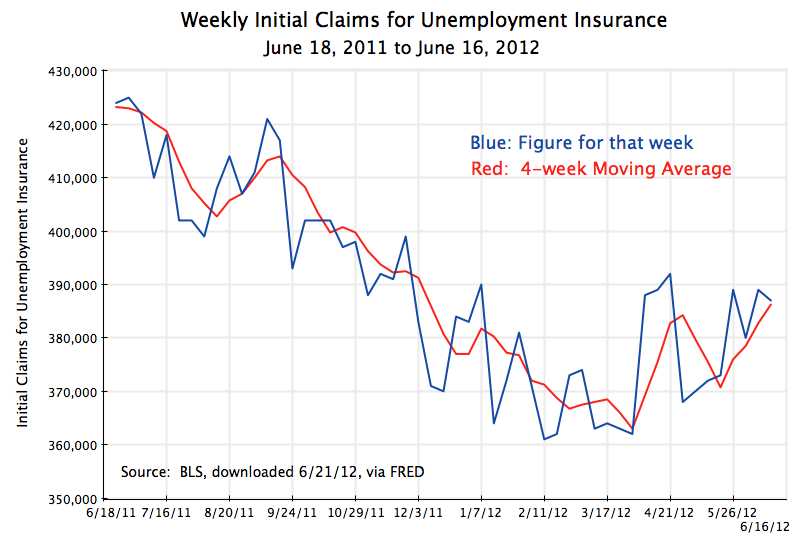
US weekly initial claims for unemployment insurance, June 18, 2011, to June 16, 2012

The Bureau of Labor Statistics released this morning its regular weekly report on the number of American workers who had filed initial claims for unemployment insurance.  Although there is a good deal of noise in this weekly data (so some analysts focus on the four-week moving average rather than on the weekly figures themselves), the report provides a useful early indication of developments in the labor market.

It is now clear that the labor market situation is deteriorating.  The graph above shows the figures (for both the weekly initial claims and for the four-week moving average) for the last year.  The trend was improving (weekly initial claims were falling) until mid to late March of this year.  But it is now clear that there was a turn at that point, with the employment situation since then worsening.  Using the four-week moving average, initial claims for unemployment insurance rose from 363,000 in late March, to 386,250 in the most recent figure.

Keep in mind that with normal churn in the labor market, there will always be initial claims for unemployment insurance.  Even with the economy at full employment, weekly initial claims will be at about 310,000 to 320,000 given the size of and extent of turnover in the US labor force (see the figure below for the numbers in 2006 and early 2007, before the downturn).  And the rise in the weekly rate of initial claims for unemployment insurance could still be consistent with positive net job growth each month.  The labor force is growing over time, although with significant month to month fluctuation in the number of people entering and leaving the labor force.

Nevertheless, the turnaround and sustained increase in the weekly figure on initial claims for unemployment insurance is likely to be a signal that the unemployment rate may now start to rise for a period.  This can be seen by looking at the initial claims figure in a longer term context, and correlating that with the overall unemployment rate.

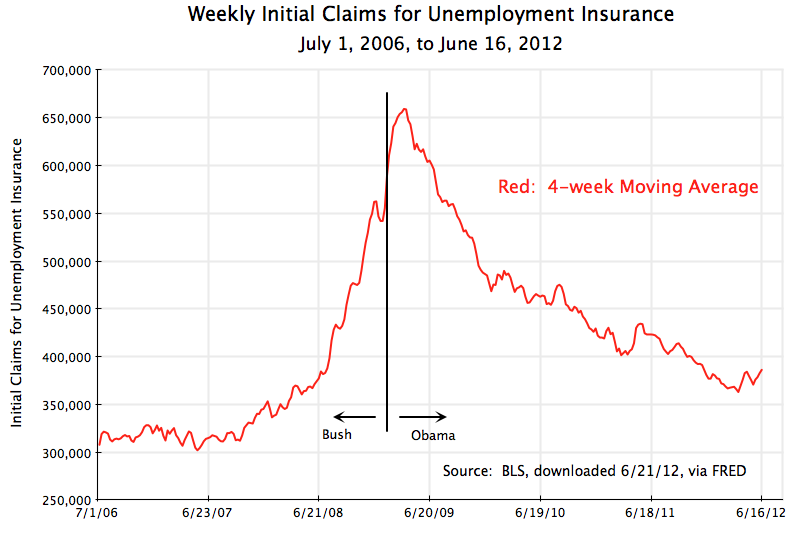
US weekly initial claims for unemployment insurance, July 1, 2006, to June 16, 2012

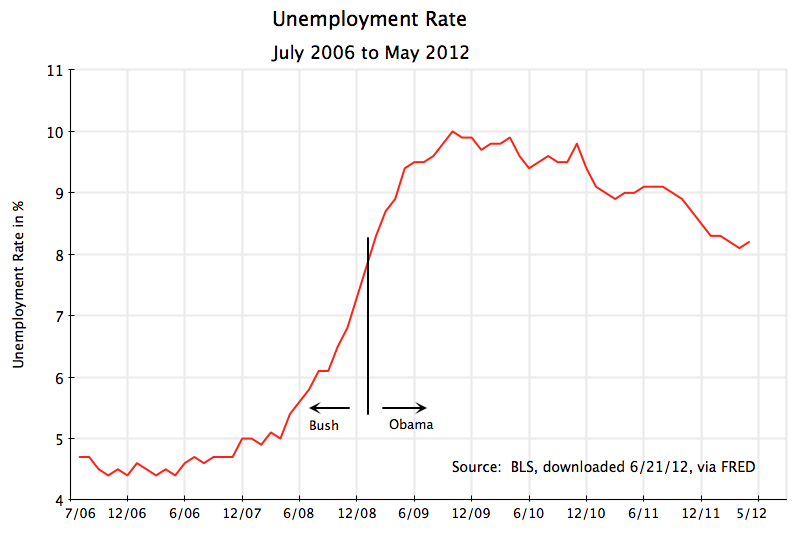
US unemployment rate, July 2006 to May 2012

The first figure shows the weekly initial claims figure (four-week moving average) for the period from July 1, 2006, to now.  The second shows the unemployment rate.  The sharp rise in the initial claims figure in the last year of the Bush Administration is clear, with a peak reached just after Obama took office.  With new measures such as the Stimulus Bill (passed in February 2009) and other actions (such as continued aggressive measures by the US Federal Reserve Board), the economy started to turn around, and new claims for unemployment insurance began to diminish.  But while the weekly pace was reduced, it was still high, and the overall rate of unemployment continued to rise for a period before starting to fall.

The recovery has been weak, however.  As noted previously in this blog (such as here, and here), fiscal drag from falling government expenditures (mainly at the state and local level, but also weakness at the federal level) can by itself account for this slow and weak recovery.  And as seen in the figure above, in this weak recovery there have been two periods (between May and August 2010, and between March and June 2011) when initial claims reversed its downward path and began to rise for a period.  In each of these times, the unemployment rate also then started to rise for about half a year (from June to November 2010, and from March to June/July/August 2011).

The blip upwards of the unemployment rate last month to 8.2% from the earlier 8.1%, might therefore not be a fluke, but rather a signal of further weakness to come.  Such a rise in the unemployment rate in the half year before an election should be particularly worrisome to any incumbent seeking re-election.  And all this is unfortunately also consistent with the prediction made in this blog in January (see posting here), that despite what looked like an acceleration of growth in the second half of 2011, growth in 2012 could be weak.  It appears that is what is happening.

The Long-Term Rise in Federal Debt is Due to the Bush Tax Cuts

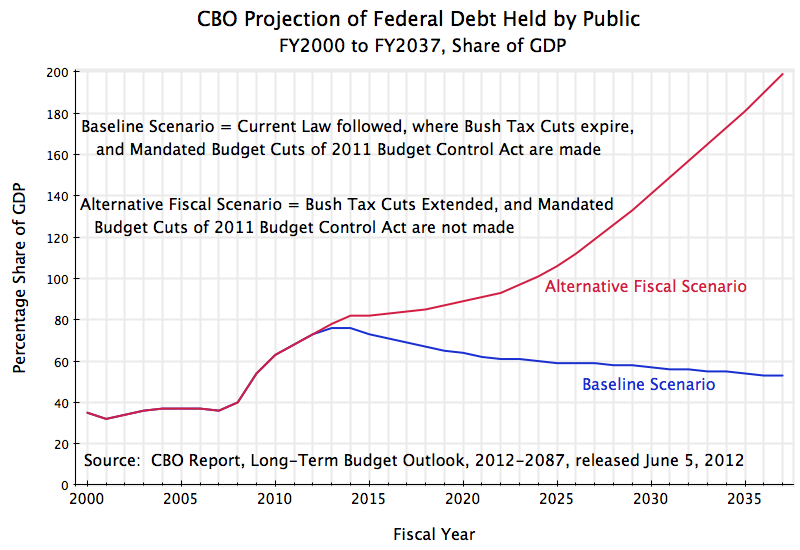
US Federal Government Debt to GDP ratio, CBO long-term projection, 2000 to 2037The Congressional Budget Office released yesterday its regular annual report on the long-term budget outlook for the federal government.  Surprisingly, it did not receive much attention in the press (at least not yet).  But the implications of the projections it has made are important:  They basically indicate that were it not for the Bush Tax Cuts passed in 2001 and 2003, we would not be facing a long-term fiscal problem.  That is, if tax rates were allowed to return to those we had during the Clinton years, along with some near term control on spending, federal government debt as a share of GDP would stabilize and then fall.  And since the economy prospered during the Clinton years, there is no support for the argument that such tax rates would stifle long run growth.

The results are consistent with projections made in a posting on this blog on February 11, 2012.  In that blog, results are shown from calculations (based on underlying CBO numbers) which demonstrated that phasing out the Bush Tax Cuts would lead the federal government debt to GDP ratio to start to fall.  The new CBO numbers, with calculations by their staff rather than myself, back this up.

The figure above shows the CBO projections of federal debt (held by the public) as a share of GDP, for the period FY2000 to FY2037, under two scenarios.  Under CBO’s Baseline Scenario, current law is followed in all respects.  This includes that the Bush Tax Cuts would be allowed to expire (as currently provided by law) at the end of 2012, and that the budget cuts mandated by the 2011 Budget Control Act for the period 2013 to 2022 (if Congress failed to make similar cuts before then) would be implemented.  Medical payments to doctors made by Medicare would also be cut (as per a law passed by the then Republican Congress in 1997, but then over-ridden annually since then), while over the longer term, the growth in medical costs would be moderated through the implementation of measures passed in the “ObamaCare” reforms.

Under the Alternative Fiscal Scenario, the Bush Tax Cuts would all be extended permanently, the 2013 to 2022 mandated budget cuts would not be made, after 2022 budget expenditures would be raised further to historical levels (as a share of GDP), medical payments to doctors would not be cut but rather kept at current levels, and the ObamaCare medical cost reforms would not be implemented, so medical costs would rise compared to the costs in the Baseline Scenario.

The CBO also mechanically extrapolated the underlying numbers under the two scenarios all the way to 2087, but wisely focussed on the period to 2037 (the next twenty-five years).  The longer term numbers are subject to much uncertainty.  The diagram above presents the CBO numbers to 2037.

What is striking is that the figure above shows that under the Baseline Scenario, where current law is followed and in particular the Bush Tax Cuts are allowed to expire, the federal government debt to GDP ratio peaks in 2013 and then immediately starts to fall.  Indeed, the long-term numbers extended mechanically to 2085 indicate that the federal government debt would fall to zero in 2069.  In contrast, the debt to GDP ratio grows explosively upwards under the Alternative Fiscal Scenario.

It was noted above that a number of changes are made in the Alternative Fiscal Scenario compared to the Baseline Scenario, affecting both tax revenues and spending.  However, one can calculate from the underlying data released by the CBO along with its report (in spreadsheet form at the CBO site), that 76% of the higher deficits in the Alternative Scenario over the key period 2013 to 2022 would be due to the lower revenues following from the Bush Tax Cuts.  Higher government spending other than on medical expenditures accounted for 18% of the higher deficits, while higher spending on medical costs (principally for doctors over this period) accounted for only 6% of the higher deficits.

That is, lower revenues due to the Bush Tax Cuts account for three-quarters of the difference in the deficits between what one would have under the Baseline Scenario and what one would have under the Alternative Fiscal Scenario.  Given the extent of the decline in the debt to GDP ratio that one sees under the Baseline Scenario, it is likely that allowing the Bush Tax Cuts to expire would alone suffice to lead that ratio to start to fall in these new CBO scenarios.  My February 11 posting on this blog did find this.  But it should be noted that the new CBO scenarios included other factors as well in its projections, which accounted for one-quarter of the reduction in deficits.  The report does not show a scenario focused exclusively on the impact of the Tax Cuts.

It should be emphasized that no one, and certainly not myself, is arguing that the Baseline Scenario should be followed in all respects.  Doctor payments under Medicare should certainly not be allowed to be cut sharply as they would if the annual “Medicare doc fix” were not extended.  Nor, I would strongly stress, should all the crude and across-the-board spending cuts mandated by the 2011 Budget Control Act  be allowed to go through.

The basic point, rather, is that drastic cuts in entitlement programs such as Social Security and Medicare are not absolutely necessary for the US to achieve budget balance, despite what Mitt Romney, Congressman Paul Ryan, and other Republicans have asserted.  What the CBO scenarios show is that the Bush Tax Cuts have led to the US fiscal debt problem, and that simply allowing these Tax Cuts to expire would likely suffice to fix that problem.  The US debt spirals out of control due to the Bush Tax Cuts.

To fix a problem, it is important to know the source.  The CBO scenarios make clear that the primary source of the exploding federal government debt is the Bush Tax Cuts.  And while I would not advocate an immediate re-instatement of tax rates to their previous levels, since the economy remains weak, phasing out the Bush Tax Cuts over the next few years would suffice to resolve the fiscal problems we face.

Fiscal Drag Continues to Pull Down the Economy

Private employment, government employment, December 2010 to May 2012

A pair of disappointing reports, from this morning (June 1) and yesterday (May 31), indicate that the economy continues to grow only slowly, with consequent slow growth in employment and indeed a small rise in the rate of unemployment to 8.2% from 8.1% last month.  Posts on this blog in January, on GDP growth and on employment, had flagged that growth, which at that time appeared to be improving, could well fall back in 2012.  Unfortunately, that appears to be happening.  Cut-backs in government spending account for a major part of that disappointing growth.

The Bureau of Labor Statistics, in its June 1 release this morning on employment, found that total US employment grew in May by a net 69,000 jobs, with an increase of 82,000 private jobs and a fall of 13,000 government jobs.  Based on the growth rate of the labor force over the ten year period of 2002 to 2012 (there is a good deal of fluctuation in monthly figures), the labor force is growing at about 83,000 workers per month on average.  Employment growth in May of just 69,000 jobs does not keep up with this, much less make a dent in the still high unemployment.

The figures released this morning were also disappointing in the revised numbers they showed for April.  Last month, the initial estimates were that April total employment had risen by 115,000 jobs, with private jobs growing by 130,000.  These were already not good, but the revised estimates issued this morning based on more complete data indicate total jobs in April grew by only 77,000 jobs, with private jobs growing by just 87,000 jobs.  With the May numbers of 69,000 and 82,000 for total and private jobs, respectively, we now have two months of disappointing job growth.  Unless the May numbers are significantly revised when more complete data becomes available, we cannot say that this is only a one month fluke.

As one can note from these numbers, private job growth has been consistently above total job growth.  That is because government continues to cut back on the number of workers it employs, despite assertions by Mitt Romney and other Republicans that government has been growing.  The graph above shows the monthly changes in employment of both private and government employees over the last year and a half, where one sees that government employment has been falling in all but two of these months.  Note that the government figures in the graph are for total government, including at the state and local level.  But the underlying figures show that the fall has been in employment both at the federal and at the state and local levels.

This steady fall in government employment depresses overall job growth, and adds up over time.  Between January 2009, when Obama was inaugurated, and May 2012, total government jobs fell by 607,000.  In contrast, over January 2005 and May 2008, the comparable period in Bush’s second term, total government employment rose by 743,000.  If government employment had been allowed to grow as much during the Obama period as it had during the Bush period, the difference would have been an additional 1.35 million jobs.   This difference alone would have brought the unemployment rate down from the current 8.2%, to just 7.3%.  But one would expect with the still depressed economy, with unemployment high, that increased government employment would have spurred some private job growth.  Assuming conservatively a multiplier of two (i.e. there would be one additional private job for each additional government job, to produce what the now employed government workers will spend on), the unemployment rate would have dropped to just 6.5%.

That is, had government employment been allowed to grow during the Obama period by as much as it had during the comparable Bush period, unemployment would have dropped to 6.5%.  With full employment generally considered to be in the range of 5 to 6% currently, this would have brought employment most of the way to full employment.

The other disappointing report was on estimated GDP growth in the first quarter of 2012, released by the Bureau of Economic Analysis on May 31.  This was the regular first revision of the initial estimate of GDP growth that had been released a month ago.  The initial estimate of GDP growth in the first quarter of 2012 was discussed in a posting on this blog in April.  The initial estimate was that GDP had grown at a 2.2% annualized rate in the first quarter.  This estimate has now been revised downward to 1.9%.

The revision is not large, but is not in a good direction.  And it is interesting to note that two-thirds of that downward change (0.2% points of the 0.3% points reduction) was due to a downward revised figure on government spending.  Government spending was already falling, and the initial estimate, discussed in the blog post cited above, was that it took 0.6% points away from what GDP growth would have been.  The revised estimate increases that reduction to 0.8% points of GDP.  Government spending on goods and services (for all government, including state and local) is estimated to have declined at an annualized rate of 3.9% in the first quarter, similar to the 4.2% rate fall in the fourth quarter of 2011.

The reduction in government demand for goods and services leads to a reduction in GDP in present circumstances since unemployment is high, there is substantial excess capacity, and hence goods and services produced for sale to government will not come from goods and services that could be sold elsewhere.  There is plenty of capacity to produce whatever people demand, and the problem is there is no demand for additional goods and services to be sold elsewhere.

This fall in government spending, especially in the last half year (i.e. the fourth quarter of 2011 and the first quarter of 2012), can explain a large part of the recent slow growth.  As noted above, the revised GDP estimates indicate that the fall in government spending in the first quarter of 2012 subtracted 0.8% points from what GDP growth would have been.  There was a similar 0.8% point reduction in the fourth quarter of 2011.

But far from simply not falling, government spending will grow in a normally growing economy.  Hence the basis of comparison should not be to zero government spending growth, but rather something positive.  One comparison to use would be the growth seen during the Bush administration.  Over 2001 to 2008, government spending growth on average accounted for 0.42% points of GDP growth at an annualized rate.  Keep in mind that this spending growth is for all government, not simply federal spending (which was high), but also state and local government spending.  Also, government spending in the GDP accounts is for direct goods and services only, and excludes spending via transfers (such as Social Security).

Finally, government spending growth in periods such as now, when unemployment is high and there is excess capacity, will have a multiplier impact, for the reasons discussed above.  A reasonable and conservative multiplier to use would be a multiplier of two.

The table below summarizes the impact of these assumptions for what growth would have been in 2011Q4 and 2012Q1:

      Annualized growth rate of GDP 2011Q4 2012Q1
GDP Growth Observed 3.0 1.9
GDP Growth if Government had not contracted 3.8 2.6
GDP Growth if Government had grown at the Bush rate 4.2 3.1
GDP Growth if Government had grown at the Bush rate, with a multiplier of two 5.5 4.3

GDP growth as actually happened was at a 3.0% rate in the fourth quarter of 2011 and 1.9% in the first quarter of 2012.  Had reductions in government spending not taken away 0.8% points from these growth rates in each of these two periods, growth would have been 3.8% and 2.6% respectively.  But this implicitly places government spending growth at zero.  Had government been allowed to grow as it had between 2001 and 2008 during the Bush terms, growth would have been 4.2% and 3.1% even with no multiplier.  With a multiplier of two, the rates would have been 5.5% and 4.3% respectively.

Such growth rates of about 5% on average is what the economy needs if it is to recover.  At 2% or so, growth is insufficient to create sufficient demand for labor to bring down unemployment on a sustainable basis, as we have just seen in the report this morning.  And a 2% growth rate is so modest that it is vulnerable to shocks, such as from Europe (where Germany and the EU still have not addressed what needs to be done to resolve the Euro crisis), or from a spike in oil prices (should the Iran situation blow up, literally), or even from swings in inventories (as discussed before in this blog).

With government contracting as it has, despite the high unemployment and excess capacity, fiscal drag is acting as a severe constraint on economic growth.  There is a not a small danger that growth could slip back to negative rates, and that is not good for an incumbent President in an election year.