Tax Cuts Do Not Spur Growth – There Are Income as well as Substitution Effects, and Much More Besides: Econ 101

gdp-growth-and-top-marg-tax-rate-1930-to-2015

A.   Introduction, and a Brief Aside on the Macro Issues

While there is much we do not yet know on what economic policies Donald Trump will pursue (he said many things in his campaign, but they were often contradictory), one thing we can be sure of is that there will be a major tax cut.  Republicans in Congress (led by Paul Ryan) and in the Senator want the same.  And they along with Trump insist that the cuts in tax rates will spur a sharp jump in GDP growth, with the result that net tax revenues in the end will not fall by all that much.

But do tax cuts spur growth?  The chart above suggests not.  Marginal tax rates of those in the top income brackets have come down sharply since the 1950s and early 1960s, when they exceeded 90%.  They reached as low as 28% during the later Reagan years and 35% during the administration of George W. Bush.  But GDP growth did not jump to some higher rate as a result.

This Econ 101 post will discuss the economics on why this is actually what one should expect.  It will focus on the microeconomics behind this, as the case for income tax cuts is normally presented by the so-called “supply siders” as a micro story of incentives.  The macro case for tax cuts is different.  Briefly, in times of high unemployment when the economy is suffering from insufficient demand in the aggregate to purchase all that could be produced if more labor were employed, a cut in income taxes might spur demand by households, as they would then have higher post-tax incomes to spend on consumption items.  This increase in demand could then spur production and hence GDP.

Critically, this macro story depends on allowing the fiscal deficit to rise by there not being simultaneously a cut in government expenditures along with the tax cuts.  If there is such a cut in government expenditures, demand may be reduced by as much as or even more than demand would be increased by households.  But the economic plans of both Trump and Congressman (and Speaker) Paul Ryan do also call for large cuts in government expenditures.  While both Trump and Ryan have called for government expenditures to increase on certain items, such as for defense, they still want a net overall reduction.

The net impact on demand will then depend on how large the government expenditure cuts would be relative to the tax cuts, and on the design of the income tax cuts.  As was discussed in an earlier post on this blog on the size of the fiscal multiplier, If most of the income tax cuts go to those who are relatively well off, who will then save most or perhaps all of their tax windfall, there will be little or no macro stimulus from the tax cuts.  Any government expenditure cuts on top of this would then lead not to a spur in growth, but rather to output growing more slowly or contracting.  And the tax plan offered by Donald Trump in his campaign would indeed direct the bulk of the tax cuts to the extremely well off.  A careful analysis by the non-partisan Tax Policy Center found that 71% of the tax cuts (in dollar value) from the overall plan (which includes cuts in corporate and other taxes as well) would go to the richest 5% of households (those earning $299,500 or more), 51% would go to the top 1% (those earning $774,300 or more), and fully 25% would go to the richest 0.1% (those earning $4.8 million or more).

[A side note:  To give some perspective on how large these tax cuts for the rich would be, the 25% going to the richest 0.1% under Trump’s plan would total $1.5 trillion over the next ten years, under the Tax Policy Center estimates.  By comparison, the total that the Congressional Budget Office projects would be spent on the food stamp program (now officially called SNAP) for the poor over this period would come to a bit below $700 billion (see the August 2016 CBO 10-year budget projections).  That is, the tax breaks to be given under Trump’s tax plan to the top 0.1% (who have earnings of $4.8 million or more in a year) would be more than twice as large as would be spent on the entire food stamp program over the period.  Yet the Republican position is that we have to cut the food stamp program because we do not have sufficient government revenues to support it.]

The macro consequences of tax cuts that mostly go to the already well off, accompanied by government expenditure cuts to try to offset the deficit impact, are likely therefore to lead not to a spur in growth but to the opposite.

The microeconomic story is separate, and the rest of this blog post will focus on the arguments there.  Those who argue that cuts in income taxes will act as a spur to growth base their argument on what they see as the incentive effects.  Income taxes are a tax on working, they argue, and if you tax income less, people will work longer hours.  More will be produced, the economy will grow faster, and people will have higher incomes.

This micro argument is mistaken in numerous ways, however.  This Econ 101 post will discuss why.  There is the textbook economics, where it appears these “supply siders” forgot some of the basic economics they were taught in their introductory micro courses. But we should also recognize that the decision on how many hours to work each week goes beyond simply the economics.  There are important common social practices (which can vary by the nature of the job, i.e. what is a normal work day, and what do you do to get promoted) and institutional structures (the 40 hour work week) which play an important and I suspect dominant role. This blog post will review some of them.

But first, what do we know from the data, and what does standard textbook economics say?

B.  Start with the Data

It is always good first to look at what the data is telling us.  There have been many sharp cuts in income tax rates over the last several decades, and also some increases.  Did the economy grow faster after the tax cuts, and slower following the tax increases?

The chart at the top of this post indicates not.  The chart shows what GDP growth was year by year since 1930 along with the top marginal income tax rate of each year.  The top marginal income tax rate is the rate of tax that would be paid on an additional dollar of income by those in the highest income tax bracket.  The top marginal income tax rate is taken by those favoring tax cuts as the most important tax rate to focus on.  It is paid by the richest, and these individuals are seen as the “job creators” and hence play an especially important role under this point of view.  But changes in the top rates also mark the times when there were normally more general tax cuts for the rest of the population as well, as cuts (or increases) in the top marginal rates were generally accompanied by cuts (or increases) in the other rates also.  It can thus be taken as a good indicator of when tax rates changed and in what direction.  Note also that the chart combines on one scale the annual GDP percentage growth rates and the marginal tax rate as a percentage of an extra dollar of income, which are two different percentage concepts.  But the point is to compare the two.

As the chart shows, the top marginal income tax rate exceeded 90% in the 1950s and early 1960s.  The top rate then came down sharply, to generally 70% until the Reagan tax cuts of the early 1980s, when they fell to 50% and ultimately to just 28%.  They then rose under Clinton to almost 40%, fell under the Bush II tax cuts to 35%, and then returned under Obama to the rate of almost 40%.

Were GDP growth rates faster in the periods when the marginal tax rates were lower, and slower when the tax rates were higher?  One cannot see any indication of it in the chart. Indeed, even though the highest marginal tax rates are now far below what they were in the 1950s and early 1960s, GDP growth over the last decade and a half has been less than it what was when tax rates were not just a little bit, but much much higher.  If cuts in the marginal tax rates are supposed to spur growth, one would have expected to see a significant increase in growth between when the top rate exceeded 90% and where it is now at about 40%.

Indeed, while I would not argue that higher tax rates necessarily lead to faster growth, the data do in fact show higher tax rates being positively correlated with faster growth.  That is, the economy grew faster in years when the tax rates were higher, not lower.  A simple statistical regression of the GDP growth rate on the top marginal income tax rate of the year found that if the top marginal tax rate were 10% points higher, GDP growth was 0.57% points higher.  Furthermore, the t-statistic (of 2.48) indicates that the correlation was statistically significant.

Again, I would not argue that higher tax rates lead to faster GDP growth.  Rather, much more was going on with the economy over this period which likely explains the correlation. But the data do indicate that very high top marginal income tax rates, even over 90%, were not a hindrance to growth.  And there is clearly no support in the evidence that lower tax rates lead to faster growth.

The chart above focuses on the long-term impacts, and does not find any indication that tax cuts have led to faster growth.  An earlier post on this blog looked at the more immediate impacts of such tax rates cuts or increases, focussing on the impacts over the next several years following major tax rate changes.  It compared what happened to output and employment (as well as what happened to tax revenues and to the fiscal deficit) in the immediate years following the Reagan and Bush II tax cuts, and following the Clinton and Obama tax increases.  What it found was that growth in output and employment, and in fiscal revenues, were faster following the Clinton and Obama tax increases than following the Reagan and Bush II tax cuts.  And not surprisingly given this, the fiscal deficit got worse under Reagan and Bush II following their tax cuts, and improved following the Clinton and Obama tax increases.

C.  The Economics of the Impact of Tax Rates on Work Effort

The “supply siders” who argue that cuts in income taxes will lead to faster growth base their case on what might seem (at least to them) simple common sense.  They say that if you tax something, you will produce less of it.  Tax it less, and you will produce more of it. And they say this applies to work effort.  Income taxes are a tax on work.  Lower income tax rates will then lead to greater work effort, they argue, and hence to more production and hence to more growth.  GDP growth rates will rise.

But this is wrong, at several levels.  One can start with some simple math.  The argument confuses what would be (by their argument) a one-time step-up in production, with an increase in growth rates.  Suppose that tax rates are cut and that as a result, everyone decides that at the new tax rates they will choose to work 42 hours a week rather than 40 hours a week before.  Assuming productivity is unchanged (actually it would likely fall a bit), this would lead to a 5% increase in production.  But this would be a one time increase. GDP would jump 5% in the first year, but would then grow at the same rate as it had before.  There would be no permanent increase in the rate of growth, as the supply siders assert.  This is just simple high school math.  A one time increase is not the same as a permanent increase in the rate of growth.

But even leaving this aside, the supply sider argument ignores some basic economics taught in introductory microeconomics classes.  Focussing just on the economics, what would be expected to happen if marginal income tax rates are cut?  It is true that there will be what economists call “substitution effects”, where workers may well wish to work longer hours if their after-tax income from work rises due to a cut in marginal tax rates. But the changes will also be accompanied by what economists call “income effects”.  Worker after-tax incomes will change both because of the tax rate changes and because of any differences in the hours they work.  And these income effects will lead workers to want to work fewer hours.  The income and substitution effects will work in opposite directions, and the net impact of the two is not clear.  They could cancel each other out.

What are the income effects, and why would they lead to less of an incentive to work greater hours if the tax rate falls?:

a)  First, one must keep in mind that the aim of working is to earn an income, and that hours spent working has a cost:  One will have fewer hours at home each day to enjoy with your wife and kids, or for whatever other purposes you spend your non-working time. Economists lump this all under what they call “leisure”.  Leisure is something desirable, and with all else equal, one would prefer more of it.  Economists call this a “normal good”.  With a higher income, you would want to buy more of it. And the way you buy more of it is by working fewer hours each day (at the cost of giving up the wages you would earn in those hours).

Hence, if taxes on income go down, so that your after-tax income at the original number of hours you work each day goes up, you will want to use at least some portion of this extra income to buy more time to spend at home.  This is an income effect, and will go in the opposite direction of the substitution effect of higher after-tax wages leading to an incentive to work longer hours.  We cannot say, a priori, whether the income effect or the substitution effect will dominate.  It will vary by individual, based on their individual preferences, what their incomes are, and how many hours they were already working.  It could go either way, and can only be addressed by looking at the data.

b)  One should also recognize that one works to earn income for a reason, and one reason among many is to earn and save enough so that one can enjoy a comfortable retirement. But in standard economic theory, there is no reason to work obsessively before retirement so that one will then have such a large retirement “nest egg” as to enjoy a luxurious life style when one retires.  Rather, the aim is to smooth out your consumption profile over both periods in your life.

Hence if income tax rates are cut, so that your after-tax incomes are higher, one will be able to save whatever one is aiming for for retirement, sooner.  Hence it would be rational to reduce by some amount the hours one seeks to work each day, and enjoy them with your wife and kids at home, as your savings goals for retirement can still be met with those fewer hours of work.  This is an income effect, and acts in the direction of reducing, rather than increasing, the number of hours one will choose to work if there is a general tax cut.

c)  More generally, one should recognize that incomes are earned to achieve various aims. Some of these might be to cover fixed obligations, such as to pay on a mortgage or for student debt, and some might be quasi-fixed, such as to provide for a “comfortable” living standard for one’s family.  If those aims are being met, then time spent at leisure (time spent at home with the family) may be especially attractive.  In such circumstances, the income effect from tax cuts might be especially large, and sufficient to more than offset the substitution effects resulting from the change in the after-tax wage.

Income effects are real, and it is mistake to ignore them.  They act in the opposite direction of the substitution effect, and will act to offset them.  The offset might be partial, full, or even more than full.  We cannot say simply by looking at the theory.  Rather, one needs to look at the data.  And as noted above, the data provdes no support to the suppostion that lower tax rates will lead to higher growth.  Once one recognizes that there will be income effects as well as substitution effects, one can see that this should not be a surprise.  It is fully consistent with the theory.

One can also show how the income and substitution effects work via some standard diagrams, involving indifference curves and budget constraints.  These are used in most standard economics textbooks.  However, I suspect that most readers will find such diagrams to be more confusing than enlightening.  A verbal description, such as that above, will likely be more easy to follow.  But for those who prefer such diagrams, the standard ones can be found at this web posting.  Note, however, that there is a mistake (a typo I assume) in the key Figures 2A and 2B.  The horizontal arrows (along the “leisure” axis) are pointed in the opposite direction of what they should (left instead of right in 2A and right instead of left in 2B).  These errors indeed serve to emphasize how even the experts with such diagrams can get confused and miss simple typos.

D.  But There is More to the Hours of Work Decision than Textbook Economics

The analysis above shows that the supply-siders, who stress microeconomic incentives as key, have forgotten half of the basic analysis taught in their introductory microeconomics classes.  There are substitution effects resulting from a change in income tax rates, as the supply-siders argue, but there are also income effects which act in the opposite direction. The net effect is then not clear.

However, there is more to the working hours decision than the simple economics of income and substitution effects.  There are social as well as institutional factors.  It the real world, these other factors matter.  And I suspect they matter a good deal more than the standard economics in explaining the observation that we do not see growth rates jumping upwards after the several rounds of major tax cuts of the last half century.

Such factors include the following:

a)  For most jobs, a 40 hour work week is, at least formally, standard.  For those earning hourly wages, any overtime above 40 hours is, by law, supposed to be compensated at 50% above their normal hourly wage.  For workers in such jobs, one cannot generally go to your boss and tell him, in the event of an income tax increase say, that you now want to work only 39 1/2 hours each week.  The hours are pretty much set for such workers.

b)  There are of course other workers compensated by the hour who might work a variable number of hours each week at a job.  These normally total well less than 40 hours a week.  These would include many low wage occupations such as at fast food places, coffee shops, retail outlets, and similarly.  But for many such workers, the number of hours they work each week is constrained not by the number of hours they want to work, but by the number of hours their employer will call them in for.  A lower income tax rate might lead them to want to work even more hours, but when they are constrained already by the number of hours their employer will call them in for, there will be no change.

c)  For salaried workers and professionals such as doctors, the number of hours they work each week is defined primarily by custom for their particular profession.  They work the hours that others in that profession work, with this evolving over time for the profession as a whole.  The hours worked are in general not determined by some individual negotiation between the professional and his or her supervisor, with this changing when income tax rates are changed.  And many professionals indeed already work long hours (including medical doctors, where I worry whether they suffer from sleep deprivation given their often incredibly long hours).

d)  The reason why one sees many professionals, including managers and others in office jobs, working such long hours probably has little to do with marginal income tax rates.  Rather, they try to work longer than their co-workers, or at least not less, in order to get promoted.  Promotion is a competition, where the individual seen as the best is the one who gets promoted.  And the one seen as the best is often the one who works the longest each day.  With the workers competing against each other, possibly only implicitly and not overtly recognized as such, there will be an upward spiral in the hours worked as each tries to out-do the other.  This is ultimately constrained by social norms.  Higher or lower income tax rates are not central here.

e)  Finally, and not least, most of us do take pride in our work.  We want to do it well, and this requires a certain amount of work effort.  Taxes are not the central determinant in this.

E.  Summary and Conclusion

I fully expect there to be a push to cut income tax rates early in the Trump presidency.  The tax plan Trump set out during his campaign was similar to that proposed by House Speaker Paul Ryan, and both would cut rates sharply, especially for those who are already well off. They will argue that the cuts in tax rates will spur growth in GDP, and that as a consequence, the fiscal deficit will not increase much if at all.

There is, however, no evidence in the historical data that this will be the case.  Income tax rates have been cut sharply since the Eisenhower years, when the top marginal income tax rate topped 90%, but growth rates did not jump higher following the successive rounds of cuts.

Tax cuts, if they are focused on those of lower to middle income, might serve as a macro stimulus if unemployment is significant.  Such households would be likely to spend their extra income on consumption items rather than save it, and this extra household consumption demand can serve to spur production.  But tax cuts that go primarily to the rich (as the tax cuts that have been proposed by Trump and Ryan would do), that are also accompanied by significant government expenditure cuts, will likely have a depressive rather than stimulative effect.

The supply-siders base their argument, however, for why tax cuts should lead to an increase in the growth rate of GDP, not on the macro effects but rather on what they believe will be the impact on microeconomic incentives.  They argue that income taxes are a tax on work, and a reduction in the tax on work will lead to greater work effort.

They are, however, confused.  What they describe is what economists call the substitution effect.  That may well exist.  But there are also income effects resulting from the changes in the tax rates, and these income effects will work in the opposite direction.  The net impact is not clear, even if one keeps just to standard microeconomics.  The net impact could be a wash.  Indeed, the net impact could even be negative, leading to fewer hours worked when there is a cut in income taxes.  One does not know a priori, and you need to look at the data.  And there is no indication in the data that the sharp cuts in marginal tax rates over the last half century have led to higher rates of growth.

There is also more to the working hours decision than just textbook microeconomics. There are important social and institutional factors, which I suspect will dominate.  And they do not depend on the marginal rates of income taxes.

But if you are making an economic argument, you should at least get the economics right.

Productivity: Do Low Real Wages Explain the Slowdown?

GDP per Worker, 1947Q1 to 2016Q2,rev

A.  Introduction, and the Record on Productivity Growth

There is nothing more important to long term economic growth than the growth in productivity.  And as shown in the chart above, productivity (measured here by real GDP in 2009 dollars per worker employed) is now over $115,000.  This is 2.6 times what it was in 1947 (when it was $44,400 per worker), and largely explains why living standards are higher now than then.  But productivity growth in recent decades has not matched what was achieved between 1947 and the mid-1960s, and there has been an especially sharp slowdown since late 2010.  The question is why?

Productivity is not the whole story; distribution also matters.  And as this blog has discussed before, while all income groups enjoyed similar improvements in their incomes between 1947 and 1980 (with those improvements also similar to the growth in productivity over that period), since then the fruits of economic growth have gone only to the higher income groups, while the real incomes of the bottom 90% have stagnated.  The importance of this will be discussed further below.  But for the moment, we will concentrate on overall productivity, and what has happened to it especially in recent years.

As noted, the overall growth in productivity since 1947 has been huge.  The chart above is calculated from data reported by the BEA (for GDP) and the BLS (for employment).  It is productivity at its most basic:  Output per person employed.  Note that there are other, more elaborate, measures of productivity one might often see, which seek to control, for example, for the level of capital or for the education structure of the labor force.  But for this post, we will focus simply on output per person employed.

(Technical Note on the Data: The most reliable data on employment comes from the CES survey of employers of the BLS, but this survey excludes farm employment.  However, this exclusion is small and will not have a significant impact on the growth rates.  Total employment in agriculture, forestry, fishing, and hunting, which is broader than farm employment only, accounts for only 1.4% of total employment, and this sector is 1.2% of GDP.)

While the overall rise in productivity since 1947 has been huge, the pace of productivity growth was not always the same.  There have been year-to-year fluctuations, not surprisingly, but these even out over time and are not significant. There are also somewhat longer term fluctuations tied to the business cycle, and these can be significant on time scales of a decade or so.  Productivity growth slows in the later phases of a business expansion, and may well fall as an economic downturn starts to develop.  But once well into a downturn, with businesses laying off workers rapidly (with the least productive workers the most likely to be laid off first), one will often see productivity (of those still employed) rise.  And it will then rise further in the early stages of an expansion as output grows while new hiring lags.

Setting aside these shorter-term patterns, one can break down productivity growth over the close to 70 year period here into three major sub-periods.  Between the first quarter of 1947 and the first quarter of 1966, productivity rose at a 2.2% annual pace.  There was then a slowdown, for reasons that are not fully clear and which economists still debate, to just a 0.4% pace between the first quarter of 1966 and the first quarter of 1982.  The pace of productivity growth then rose again, to 1.4% a year between the first quarter of 1982 and the second quarter of 2016.  But this was well less than the 2.2% pace the US enjoyed before.

An important question is why did productivity growth slow from a 2.2% pace between the late 1940s and mid-1960s, to a 1.4% pace since 1982.  Such a slowdown, if sustained, might not appear like much, but the impact would in fact be significant.  Over a 50 year period, for example, real output per worker would be 50% higher with growth at a 2.2% than it would be with growth at a 1.4% pace.

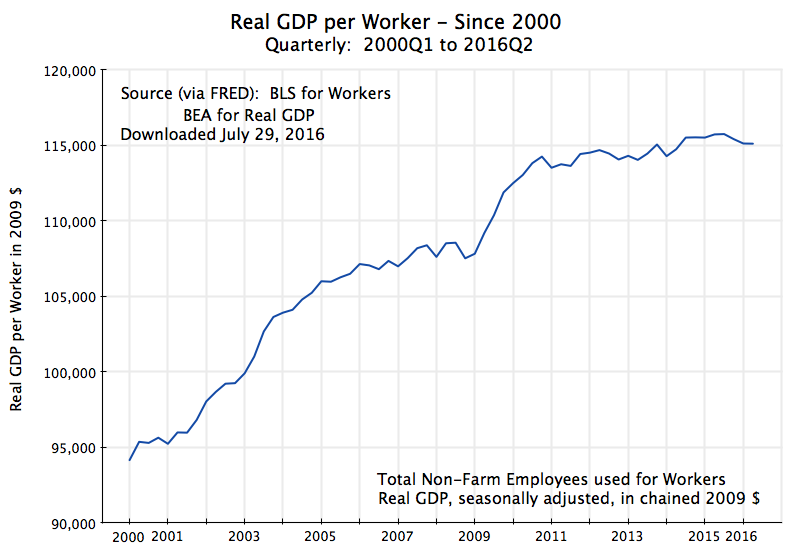
There is also an important question of whether productivity growth has slowed even further in recent years.  This might well still be a business cycle effect, as the economy has recovered from the 2008/09 downturn but only slowly (due to the fiscal drag from cuts in government spending).  The pace of productivity growth has been especially slow since late 2010, as is clear by blowing up the chart from above to focus on the period since 2000:

GDP per Worker, 2000Q1 to 2016Q2,rev

Productivity has increased at a rate of just 0.13% a year since late 2010.  This is slow, and a real problem if it continues.  I would hasten to add that the period here (5 1/2 years) is still too short to say with any certainty whether this will remain an issue.  There have been similar multi-year periods since 1947 when the pace of productivity growth appeared to slow, and then bounced back.  Indeed, as seen in the chart above, one would have found a similar pattern had one looked back in early 2009, with a slow pace of productivity growth observed from about 2005.

There has been a good deal of work done by excellent economists on why productivity growth has been what it was, and what it might be in the future.  But there is no consensus.  Robert J. Gordon of Northwestern University, considered by many to be the “dean in the field”, takes a pessimistic view on the prospects in his recently published magnum opus “The Rise and Fall of American Growth”.  Erik Brynjolfsson and Andrew McAfee of MIT, in contrast, argue for a more optimistic view in their recent work “The Second Machine Age” (although “optimistic” might not be the right word because of their concern for the implication of this for jobs).  They see productivity growth progressing rapidly, if not accelerating.

But such explanations are focused on possible productivity growth as dictated by what is possible technologically.  A separate factor, I would argue, is whether investment in fact takes place that makes use of the technology that is available.  And this may well be a dominant consideration when examining the change in productivity over the short and medium terms.  A technology is irrelevant if it is not incorporated into the actual production process.  And it is only incorporated into the production process via investment.

To understand productivity growth, and why it has fallen in recent decades and perhaps especially so in recent years, one must therefore also look at the investment taking place, and why it is what it is.  The rest of this blog post will do that.

B.  The Slowdown in the Pace of Investment

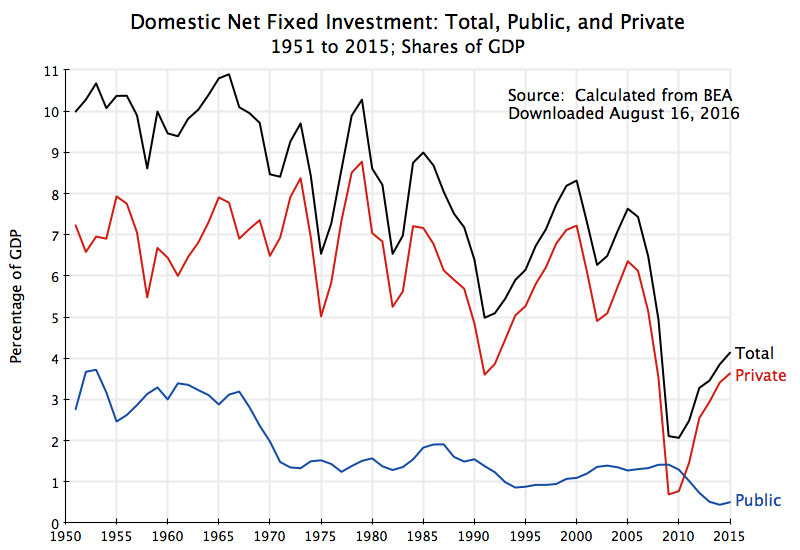
The first point to note is that net investment (i.e. after depreciation) has been falling in recent decades when expressed as a share of GDP, with this true for both private and public investment:

Domestic Fixed Investment, Total, Public, and Private, Net, percentage of GDP, 1951 to 2015, updated Aug 16, 2016

Total net investment has been on a clear downward trend since the mid-1960s.  Private net investment has been volatile, falling sharply with the onset of an economic downturn and then recovering.  But since the late 1970s its trend has also clearly been downward. Net private investment has been less than 3 1/2% of GDP in recent years, or less than half what it averaged between 1951 and 1980 (of over 7% of GDP).  And net public investment, while less volatile, has plummeted over time.  It averaged 3.1% of GDP between 1951 and 1968, but is only 0.5% of GDP now (as of 2015), or less than one-sixth of what it was before.

With falling net investment, the rates of growth of public and private capital stocks (fixed assets) have fallen (where 2014 is the most recent year for which the BEA has released such data):

Rate of Growth In Per Capita Net Stock of Private and Government Fixed Assets, edited, 1951 to 2014

Indeed, expressed in per capita terms, the stock of public capital is now falling.  The decrepit state of our highways, bridges, and other public infrastructure should not be a surprise.  And the stock of private capital fell each year between 2009 and 2011, with some recovery since but still at almost record low growth.

Even setting aside the recent low (or even negative) figures, the trend in the pace of growth for both public and private capital has declined since the mid-1960s.  Why might this be?

C.  Why Has Investment Slowed?

The answer is simple and clear for pubic capital.  Conservative politicians, in both the US Congress and in many states, have forced cuts in public investment over the years to the current low levels.  For whatever reasons, whether ideological or something else, conservative politicians have insisted on cutting or even blocking much of what the United States used to invest in publicly.

Yet public, like private, investment is important to productivity.  It is not only commuters trying to get to work who spend time in traffic jams from inadequate roads, and hence face work days of not 8 1/2 hours, but rather 10 or 11 or even 12 hours (with consequent adverse impacts on their productivity).  It affects also truck drivers and repairmen, who can accomplish less on their jobs due to time spent in jams.  Or, as a consequence of inadequate public investment in computer technology, a greater number of public sector workers are required than otherwise, in jobs ranging from issuing driver’s licenses to enrolling people in Medicare.  Inadequate public investment can hold back economic productivity in many ways.

The reasons behind the fall in private investment are less obvious, but more interesting. An obvious possible cause to check is whether private profitability has fallen.  If it has, then a reduction in private investment relative to output would not be a surprise.  But this has in fact not been the case:

Rate of Return on Produced Assets, 1951 to 2015, updated

The nominal rate of return on private investment has not only been high, but also surprisingly steady over the years.  Profits are defined here as the net operating surplus of all private entities, and is taken from the national account figures of the BEA.  They are then taken as a ratio to the stock of private produced assets (fixed assets plus inventories) as of the beginning of the year.  This rate of return has varied only between 8 and 13% over the period since at least 1951, and over the last several years has been around 11%.

Many might be surprised by both this high level of profitability and its lack of volatility.  I was.  But it should be noted that the measure of profitability here, net operating surplus, is a broad measure of all the returns to capital.  It includes not only corporate profitability, but also profits of unincorporated businesses, payments of interest (on borrowed capital), and payments of rents (as on buildings). That is, this is the return on all forms of private productive capital in the economy.

The real rates of return have been more volatile, and were especially low between 1974 and 1983, when inflation was high.  They are measured here by adjusting the nominal returns for inflation, using the GDP deflator as the measure for inflation.  But this real rate of return was a good 9.6% in 2015.  That is high for a real rate of return.  It was higher than that only for one year late in the Clinton administration, and for several years between the early 1950s and the mid-1960s.  But it was never higher than 11%.  The current real rate of return on private capital is far from low.

Why then has private investment slowed, in relation to output, if profitability is as high now as it has ever been since the 1950s?  One could conceive of several possible reasons. They include:

a)  Along the lines of what Robert Gordon has argued, perhaps the underlying pace of technological progress has slowed, and thus there is less of an incentive to undertake new investments (since the returns to replacing old capital with new capital will be less).  The rate of growth of capital then slows, and this keeps up profitability (as the capital becomes more scarce relative to output) even as the attractiveness of new investment diminishes.

b)  Conservatives might argue that the reduced pace of investment could be due to increased governmental regulations, which makes investment more difficult and raises its cost.  This might be difficult to reconcile with the rate of return on capital nonetheless remaining high, but in principle could be if one argues that the slower pace of new investment keeps up profitability as capital then becomes more scarce relative to output. But note that this argument would require that the increased burden of regulation began during the Reagan years in the early 1980s (when the share of private investment in GDP first started to slow – see the chart above), and built up steadily since then through both Republican and Democratic administrations.  It would not be something that started only recently under Obama.

c)  One could also argue that the reduced investment might be a consequence of “Baumol’s Cost Disease”.  This was discussed in earlier posts on this blog, both for overall government spending and for government investment in infrastructure specifically.  As discussed in those posts, Baumol’s Cost Disease explains why activities where productivity growth may be relatively more difficult to achieve than in other activities, will see their relative costs increase over time.  Construction is an example, where productivity growth has been historically more difficult to achieve than has been the case in manufacturing.  Thus the cost of investing, both public and private, relative to the cost of other items will increase over time.  This can then also be a possible explanation of slowing new investment, with that slower investment then keeping profitability up due to increasing scarcity of capital.

One problem with each of the possible explanations described above is that they all depend on capital investments becoming less attractive than before, either due to higher costs or due to reduced prospective return.  If such factors were indeed critical, one would need to take into account also the effect of taxes on investment returns.  And such taxes have been cut sharply over this same period.  As discussed in an earlier blog post, taxes on corporate profits, for example, are taxed now at an effective rate of less than 20%, based on what is actually paid after all the legal deductions and credits are included.  And this tax rate has fallen steadily over time.  The current 20% rate is less than half the effective rate that applied in the 1950s and 1960s, when the effective rate averaged almost 45%.  And the tax rate on long-term capital gains, as would apply to returns on capital to individuals, fell from a peak of just below 40% in the mid-1970s to just 15% following the Bush II tax cuts and to 20% since 2013.

Such sharp cuts in taxes on profits implies that the after-tax rate of return on assets has risen sharply (the before-tax rate of return, shown on the chart above, has been flat).  Yet despite this, private investment has fallen steadily since the early 1980s as a share of GDP.

Such explanations for the reason behind the fall in private investment since the early 1980s are therefore questionable.  However, the purpose of this blog post is not to debate this. Economists are good at coming up with models, possibly convoluted, which can explain things ex post.  Several could apply here.

Rather, I would suggest that there might be an alternative explanation for why private investment has been declining.  While consistent with basic economics, I have not seen it before.  This explanation focuses on the stagnant real wages seen since the early 1980s, and the impact this would have on whether or not to invest.

D.  The Impact of Low Real Wages

Real wages have stagnated in the US since the early 1980s, as has been discussed in earlier posts on this blog (see in particular this post).  The chart below, updated to the most recent figures available, compares the real median wage since 1979 (the earliest year available for this data series) to real GDP per worker employed:

Real GDP per Worker versus Real Median Wage, 1979Q1 to 2016Q2, rev

Real median wages have been flat overall:  Just 3% higher in 2016 than what they were 37 years before.  But real GDP per worker is almost 60% higher over this same period.  This has critically important implications for both private investment and for productivity growth. To sum up in one line the discussion that will follow below, there is less and less reason to invest in new, productivity enhancing, capital, if labor is available at a stagnant real wage that has changed little in 37 years.

Traditional economics, as commonly taught, would find it difficult to explain the observed stagnation in real wages while productivity has risen (even if at a slower pace than before). A core result taught in microeconomics is that in “perfectly competitive” markets, labor will be paid the value of its marginal product.  One would not then see a divergence such as that seen in this chart between growth in productivity and a lack of growth in the real wage.

(The more careful observers among the readers of this post might note that the productivity curve shown here is for average productivity, and not the marginal productivity of an extra worker.  This is true.  Marginal productivity for the economy as a whole cannot be easily observed, nor indeed even be well defined.  However, one should note that the average productivity curve, as shown here, is rising over time.  This can only happen if marginal productivity on new investments are above average productivity at any point in time.  For other reasons, the real average wage would not rise permanently above average productivity (there would be an “adding-up” problem otherwise), but the theory would still predict a rise in the real wage with the increase in observed productivity.)

There are, however, clear reasons why workers might not be paid the value of their marginal product in the real world.  As noted, the theory applies in markets that are assumed to be perfectly competitive, and there are many reasons why this is not the case in the world we live in.  Perfect competition assumes that both parties to the transaction (the workers and employers) have complete information on not only the opportunities available in the market and on the abilities of the individual worker, but also that there are no costs to switching to an alternative worker or employer.  If there is a job on the other side of the country that would pay the individual worker a bit more, then the theory assumes the worker will switch to it.  But there are, of course, significant costs to moving to the other side of the country.  Furthermore, there will be uncertainty on what the abilities of any individual worker will be, so employers will normally seek to keep the workers they already have to fill their needs (as they know what these workers can do), than take a risk on a largely unknown new worker who might be willing to work for a lower wage.

For these and other reasons, labor markets are not perfectly competitive, and one should not then be surprised to find workers are not being paid the value of their marginal product.  But there is also an important factor coming from the macroeconomy. Microeconomics assumes that all resources, including labor resources, are being fully employed.  But unemployment exists and is often substantial.  Additional workers can then be hired at the current wage, without a need for the firm to raise that wage.  And that will hold whether or not the productivity of those workers has risen.

In such an environment, when unemployment is substantial one should not be surprised to find a divergence between growth in productivity and growth in the real wage.  And while there have of course been sharp fluctuations arising from the business cycle in the rate of unemployment from year to year, the simple average in the rate since 1979 has been 6.4%.  This is well in excess of what is normally considered the full employment rate of unemployment (of 5% or less).  Macro policy (both fiscal and monetary) has not done a very good job in most of the years since 1979 in ensuring there is sufficient demand in the aggregate in the economy to allow all workers who want to be employed in fact to be employed.

In such an environment, of workers being available for hire at a stagnant real wage which over time diverges more and more from their productivity, consider the investment decision a private firm faces.  Suppose they see a market opportunity and can sell more. To produce more, they have two options.  They can hire more labor to work with their existing plant and equipment to produce more, or they can invest in new plant and equipment.  If they choose the latter, they can produce more with fewer workers than they would otherwise need at the new level of production.  There will be more output per unit of labor input, or put another way, productivity will rise if the latter option is chosen.

But in an economy where labor is available at a flat real wage that has not changed in decades, the best choice will often simply be to hire more labor.  The labor is cheap.  New investment has a cost, and if the cost of the alternative (hire more labor) is low enough, then it is more profitable for the firm simply to hire more labor.  Productivity in such a case will then not go up, and may indeed even go down.  But this could be the economically wise choice, if labor is cheap enough.

Viewed in this way, one can see that the interpretation of many conservatives on the relationship between productivity growth and the real wage has it backwards.  Real wages have not been stagnant because productivity growth has been slow.  Labor productivity since 1979 has grown by a cumulative 60%, while real median wages have been basically flat.

Rather, the causation may well be going the other way.  Stagnant and low real wages have led to less and less of an incentive for private firms to invest.  And such a cut-back is precisely what we saw in the chart above on private (as well as public) investment as a share of GDP.  With less investment, the pace of productivity growth has then slowed.

As a reflection of this confusion, conservatives have denounced any effort to raise wages, asserting that if this is done, jobs will be lost as firms choose instead to invest and automate.  They assert that raising the minimum wage, which is currently lower in real terms than what it was when Harry Truman was president, would lead to minimum wage workers losing their jobs.  As a former CEO of McDonalds put it in a widely cited news report from last May, a $15 minimum wage would lead to “a job loss like you can’t believe.”   Fast food outlets like McDonalds would then find it better to invest in robotic arms to bag the french fries, he said, rather than hire workers to do this.

This is true.  The confusion comes from the widespread presumption that this is necessarily bad.  Outlets like McDonalds would then require fewer workers, but they would still need workers (including to operate the robotic arms), and those workers would be more productive.  They could be paid more, and would be if the minimum wage is raised.

The error in the argument comes from the presumption that the workers being employed at the current minimum wage of $7.25 an hour do not and can not possess the skills needed to be employed in some other job.  There is no reason to believe this to be the case.  There was no problem with ensuring workers could be fully employed at a minimum wage which in real terms was higher in 1950, when Harry Truman was president, than what it is now.  And average worker productivity is 2.4 times higher now than what it was then.

Ensuring full employment in the economy as a whole is not a responsibility of private business.  Rather, it is a government responsibility.  Fiscal and monetary policy need to be managed so that labor markets are tight enough to ensure all workers who want a job can get a job, while not so tight at to lead to inflation.

Following the economic collapse at the end of the Bush administration in 2008, monetary policy did all it could to try to ensure sufficient aggregate demand in the economy (interest rates were held at or close to zero).  But monetary policy alone will not be enough when the economy collapsed as far as it did in 2008.  It needs to be complemented by supportive fiscal policy.  While there was the initial stimulus package of Obama which was critical to stabilizing the economy, it did not go far enough and was allowed to run out. And government spending from 2010 was then cut, acting as a drag which kept the pace of recovery slow.  The economy has only in the past year returned to close to full employment.  It is not a coincidence that real wages are finally starting to rise (as seen in the chart above).

E.  Conclusion

Productivity growth is key in any economy.  Over the long run, living standards can only improve if productivity does.  Hence there is reason to be concerned with the slower pace of productivity growth seen since the early 1980s, and especially in recent years.

Investment, both public and private, is what leads to productivity growth, but the pace of investment has slowed since the levels seen in the 1950s and 60s.  The cause of the decline in public investment is clear:  Conservative politicians have slowed or even blocked public investment.  The result is obvious in our public infrastructure:  It is overused, under-maintained, and often an embarrassment.

The cause of the slowdown in private investment is less obvious, but equally important. First, one cannot blame a decline in private investment on a fall in profitability:  Profitability is higher now than it has been in all but one year since the mid-1960s.

Rather, one needs to recognize that the incentive to invest in productivity enhancing tools will not be there (or not there to the same extent) if labor can be hired at a wage that has stagnated for decades, and which over time became lower and lower relative to existing productivity.  It then makes more sense for firms to hire more workers with their existing stock of capital and other equipment, rather than invest in new, productivity enhancing, capital.  And this is what we have observed:  Workers are being hired, but productivity is not growing.

An argument is often made that if firms did indeed invest in capital and equipment that would raise productivity, that workers would then lose their jobs.  This is actually true by definition:  If productivity is higher, then the firm needs fewer workers per unit of output than they would otherwise.  But whether more workers would be employed in the economy as a whole does not depend on the actions of any individual firm, but rather on whether fiscal and monetary policy is managed to ensure full employment.

That is, it is the investment decisions of private firms which determine whether productivity will grow or not.  It is the macro management decisions of government which determine whether workers will be fully employed or not.

To put this bluntly, and in simplistic “bumper sticker” type terms, one could say that private businesses are not job creators, but rather job destroyers.  And that is fine.  Higher productivity means that a firm needs fewer workers to produce what they make than would otherwise have been needed, and this is important for ensuring efficiency.  As a necessary complement to this, however, it is the actions of government, through its fiscal and monetary policies, which “creates” jobs by managing aggregate demand to ensure all workers who want to be employed, are employed.

There is No Reason to Expect Increased Labor Force Participation Rates to be a Source of Spectacular Growth

Labor Force Participation Rate, Ages 25 to 54, All, Male, Female, Jan 1948 to Feb 2016

A.  Introduction

An important issue in the current presidential campaign, although somewhat technical, is whether one should expect that employment could jump to substantially higher levels than where it is now, if only economic policy were better.  The argument is that while the unemployment rate as officially measured (4.9% currently) might appear to be relatively low and within the range normally considered “full employment”, this masks that many people (it is asserted) have given up looking for jobs and make up a large reservoir of “hidden unemployed”.  If only the economy were functioning better, it is said, more jobs would be created and taken up by these hidden unemployed, the economy would then be producing more, and everyone would be better off.

This is important for the Republicans, not only as part of their criticism of Obama, but also as a basis for their tax plans.  As discussed in the previous post on this blog, the Republican tax plans would all cut tax rates sharply, leading to such revenue losses that deficits would rise dramatically even if non-defense discretionary budget expenditures were cut all the way to zero.  The Republican candidates have asserted that deficits would not rise (even with sharply higher spending for defense, which they also want), because the tax cuts would spur such a large increase in growth of GDP that the tax revenues from the higher output would offset the reductions from lower tax rates.  Aside from the fact that there is no evidence to support the theory that such tax cuts would spur growth by any amount, much less the jump they are postulating (see the earlier blog post for a discussion), any rise in GDP of such magnitude would also depend on there being unemployed labor to take on such jobs.  With the economy now at close to full employment (with the unemployment rate of 4.9%), this could only be achieved if a large pool of hidden unemployed exists to enter (or re-enter) the labor force.

Given the huge magnitudes involved, few economists see these Republican tax plans as serious.  One cannot have such massive tax cuts and expect deficits not to rise.  And Democrats have long criticized such Republican plans for being unrealistic (there were similar, although not as extreme, Republican tax plans in the 2012 campaign, and Paul Ryan’s budget plans also relied on completely unrealistic assumptions).

Unfortunately, the Bernie Sanders campaign this year on the Democratic side has similarly set out proposals that are economically unrealistic.  A detailed assessment of the Bernie Sanders economic program by Professor Gerald Friedman of the University of Massachusetts at Amherst concluded that the Sanders program would raise GDP growth rates by more than even the Republicans are claiming.  But even left-wing commentators have criticized it heavily.  Kevin Drum at Mother Jones, for example, said the Sanders campaign had “crossed into neverland”.

A more detailed and technical evaluation from Professors Christina Romer and David Romer of UC Berkeley (with Christina Romer also the first Chair of the Council of Economic Advisers in the Obama Administration), concluded Friedman’s work was “highly deficient”, as they more politely put it.  And an open letter issued by four former Chairs of the Council of Economic Advisers under Obama and Bill Clinton (including Christina Romer) said “the economic facts do not support these fantastical claims”.

This is important.  In recent decades, it was the Republican candidates who have set out economic programs which did not add up or which depended on completely unrealistic assumptions of how the economy would respond.  The analysis by Professor Friedman of the Sanders program is similarly unrealistic.  As the four former Chairs of the CEA put it in their open letter:

“As much as we wish it were so, no credible economic research supports economic impacts of these magnitudes. Making such promises runs against our [Democratic] party’s best traditions of evidence-based policy making and undermines our reputation as the party of responsible arithmetic. These claims undermine the credibility of the progressive economic agenda and make it that much more difficult to challenge the unrealistic claims made by Republican candidates.”

To be fair, the relationship of the Friedman work to the Sanders campaign is not fully clear. At least one news report said the analysis was prepared at the request of Sanders, while others said not.  But upon its release, the Sanders campaign did explicitly say it was “outstanding work” which should receive more attention.  And when the work began to be criticized by economists such as the former chairs of the CEA, the response of the Sanders campaign was that their criticism should be dismissed, as they were of “the establishment of the establishment”.  Rather than engage on the real issues raised, the Sanders campaign simply dismissed the criticisms.  This does not help.

Both the Republican plans and the Sanders program depend on the assumption that so many workers would enter or re-enter the labor force that GDP could take a quantum leap up from what current projections consider to be possible.  (Both depend on other assumptions as well, such as unrealistically high assumptions on what would happen to productivity growth.  But it is not the purpose of this blog post to go into all such issues. Rather, it is to address the single issue of labor force participation.)  Their plans depend on a higher share of the population participating in the labor force than currently choose to do so, leading to an employment to population ratio that would thus rise sharply.  We will look in this post at whether this is possible.  An earlier post on this blog examined similar issues.  This post will come at it from a slightly different direction, and will update the figures to reflect the most recent numbers.

The key chart will be the one shown at the top of this post.  But to get to it, we will first go through a series of charts that set the story.  The data all come from the Bureau of Labor Statistics (BLS), either directly, or via the data set maintained by the Federal Reserve Bank of St. Louis (FRED).

B.  Recent Behavior of the Employment to Population Ratio

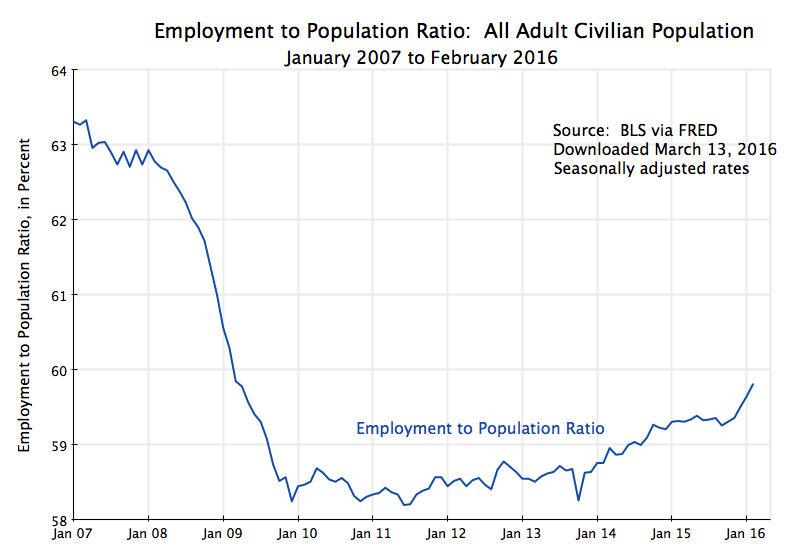
Many observers, from both the left and the right of the political spectrum, have looked at how the employment to population ratio has moved in the recent downturn, and concluded that there must be a significant reservoir of hidden unemployed.  Specifically, they have looked at charts such as the following:

Employment to Popul only, Jan 2007 to Feb 2016

Employment as a share of the population fell rapidly and sharply with the onset of the economic downturn in 2008, in the last year of the Bush Administration, and reached a low point in late 2009.  From about 63% in 2007 to around 58 1/2% in late 2009, it fell by over 7%.  It then remained at such low levels until 2013, rising only slowly, and since then has risen somewhat faster.

But at the current reading of 59.8%, it remains well below the 63% levels of 2007.  And it remains even more below the peak it reached in the history of the series of 64.7% in April 2000.  If this does, in fact, reflect a pool of hidden unemployed, then GDP could be significantly higher than it is now.  Assuming for simplicity that GDP would rise in proportion to the increase in workers employed, annual GDP would be close to a trillion dollars higher if the employment to population ratio rose from the current 59.8% to the 63% that prevailed in 2007.  And annual GDP would be close to $1.5 trillion higher if the ratio could revert to where it was in April 2000.  With a share of about 25% of this accruing in taxes, this would be a significant pot of money, which could be used for many things.

But is this realistic?  The short answer is no.  The population has moved on, with important demographic as well as social changes that cannot be ignored.

C.  Adding the Labor Force Participation Rate

A problem with the employment to population measure is that people will not be employed not just due to unemployment (are looking but cannot find a job), but also because they might not want to be working at the moment.  If older, they might be retired, and happily so.  If younger (the figures are for all adults in the civilian population, defined as age 16 or older), they might be students in high school or college.  And not all those in middle age will want to be working:  Until recent decades, a large share of adult women did not participate in the formal labor force.  Women’s participation in the formal labor force has, however, changed significantly over time, and is one of the key factors underlying the rise seen in the overall labor force participation rate over time.  Such factors should not be ignored, but are being ignored when one looks solely at the employment to population ratio.

The first step is to take into account unemployment.  Unemployment accounts for the difference between the employment to population ratio and the labor force participation rate (which is, stated another way, the labor force to population ratio).  Adding the labor force participation rate to the diagram yields:

Employment to Popul and Labor Force Participation Rate, Jan 2007 to Feb 2016

Note the unemployment rate as traditionally referred to (currently 4.9%) is not the simple difference, in percentage points, between the labor force participation rate (62.9% in February 2016) and the employment to population ratio (59.8% in February 2016).  The unemployment rate is traditionally defined as a ratio to the labor force, not to population, while the two measures of labor force participation rate and employment to population ratio are both defined as shares of the population.  Note that if you take the difference here (62.9% – 59.8% = 3.1% points in February 2016), and divide it by the labor force participation rate (62.9%), one will get the unemployment rate of 4.9% of the labor force. But all this is just arithmetic.

The key point to note for the chart above is that while the employment to population ratio fell sharply in the 2008-2009 downturn, and then recovered only slowly, the labor force participation rate has been moving fairly steadily downward throughout the period.  There is month to month variation for various reasons, including that all these figures are based on surveys of households.  There will therefore be statistical noise.  But the downward trend over the period is clear.  The question is why.  Does it perhaps reflect people dropping out of the labor force due to an inability to find jobs when the labor market is slack with high unemployment (the “discouraged worker” effect)?  Some commentators have indeed noted that the upward bump seen in the figures in the last few months (since last November), with the unemployment rate now low and hence jobs perhaps easier to find, might reflect this.  Or is it something else?

D.  The Longer Term Trend

A first step, then, is to step back and look at how the labor force participation rate has moved over a longer period of time.  Going back to 1948, when the data series starts:

Labor Force Participation Rate, Overall, All Ages, Jan 1948 to Feb 2016

The series peaked in early 2000, at a rate of 67.3%, and has moved mostly downward since.  It was already in 2007 well below where it had been in 2000, and the decline since then continues along largely the same downward path (where the flattening out between 2004 and 2007 was temporary).  Prior to 2000, it had risen strongly since the mid-1960s.

One does see some downward deviation from the trend whenever there was an economic downturn, but then that the series soon returned to trend.  Thus, for example, the labor force participation rate rose rapidly during the years of Jimmy Carter’s presidency in the late 1970s, but then leveled off in the economic downturn of the early 1980s during the Reagan years.  The unemployment rate peaked at 10.8% in late 1982 under Reagan (significantly more than the 10.0% it peaked at in 2009 under Obama), and one can see that the labor force participation rate leveled off in those years rather than continued the rise seen in the years before.  But these are relatively mild “bumps” in the broader long-term story of a rise to 2000 and then a fall.

The long term trend has therefore been a fairly consistent rise over the 35 years from the mid-1960s to 2000, and then a fairly consistent fall in the 16 years since then.  The question to address next is why has it behaved this way.

E.  Taking Account of an Aging Society, Students in School, and Male / Female Differences

As people age, they seek to retire.  Normal retirement age in the US has been around age 65, but there is no rigid rule that it has to be at that precisely that age.  Some retire a few years earlier and some a few years later.  But as one gets older, the share that will be retired (and hence not in the formal labor force) will increase.  And with the demographic dynamics where an increasing share of the US population has been getting older over time (due in part to the baby boom generation, but not just that), one would expect the labor force participation rate to decline over time, and especially so in recent years as the baby boom generation has reached its retirement years.

At the other end of the age distribution, an increasing share of the adult population (defined as those of age 16 or more) in school in their late teens and 20s will have a similar impact.  Over this period, the share of the population (of age 16 or more) in school or college has been increasing.

The other key factor to take into account is male and female differences in labor force participation.  A half century ago, most women did not participate in the formal labor force, and hence were not counted in the labor force participation rate.  Now they do.  This has had a major impact on the overall (male plus female) labor force participation rate, and this change over time has to be taken into account.

The impact of these factors can be seen in the key chart shown at the top of this blog. Male and female rates are shown separately, and to take into account the increasing share of the population in their retirement years or in school, the figures presented are for those in the prime working age span of 25 to 54.  The trends now come out clearly.

The most important trend is the sharp rise in female participation in the formal labor force, from just 34% (of those aged 25 to 54) at the start of 1948 to a peak of over 77% in early 2000.  The male rate for this age group, in contrast, has followed a fairly steady but slow downward trend from 97 to 98% in the early 1950s to about 88% in recent years.  As a result, the combination of the male and female rates rose (for this age group) from 65% in 1948 to a peak of 84% in 2000, and then declined slowly to 81% now.

Seen in this way, the recent movement in the labor force participation rate does not appear to be unusual at all.  Rather, it is simply the continuation of the trends observed over the last 68 years.  The male rate fell slowly but steadily, and the female rate at first rose until 2000, and then followed a path similar to the male rate.  The overall rate reflected the average between these two, and was driven mostly by the rise in the female rate before 2000, and then the similar declines in the male and female rates since then.

F.  The Female Labor Force Participation Rate as a Ratio to the Male Rate

Finally, it is of interest to look at the ratio of the female labor force participation rate to the male rate:

Ratio of Female to Male LFPR, Ages 25 to 54 only, Jan 1948 to Feb 2016

This ratio rose steadily until 2000.  But what is perhaps surprising is how steady this ratio has been since then, at around 83 to 84%.  An increasing share of females entered the labor force until 2000, but since then the female behavior has matched almost exactly the male behavior.  For both, the share of those in the age span of 25 to 54 in the labor force declined since 2000, but only slowly and at the same pace.  The male rate continued along the same trend path it had followed since the early 1950s; the female rate first caught up to a share of the male rate, and then followed a similar and parallel downward path.

Why the female and male rates moved at such a similar and parallel pace since 2000, and at a 83 to 84% proportion, would be interesting issues to examine, but is beyond the scope of this blog post.  One hypothesis is that the parallel downward movements since 2000 reflect increasing enrollment in graduate level education of men and women older than age 25 (and hence included in the 25 to 54 age span).  But I do not know whether good data exists for this.  Another hypothesis might be that very early retirement (at age 54 or before), while perhaps small, has become more common.  And the ratio of the female rate to the male rate of a steady 83 to 84% might reflect dropping out of the labor force temporarily for child rearing, which most affects women.

More data would be required to test any of these hypotheses.  But it appears to be clear that long-term factors are at play, whether demographic, social, or cultural.  And the pattern seen since 2000 has been quite steady for 16 years now.  There is no indication that one should expect it to change soon.

G.  Conclusion

The downward movement in the employment to population ratio in 2008 and 2009 reflected the sharp rise in unemployment sparked by the economic and financial collapse of the last year of the Bush administration.  Unemployment then peaked in late 2009, as the economy began to stabilize soon after Obama took office, with Congress passing Obama’s stimulus program and the aggressive actions of the Fed.  From late 2009, the employment to population ratio was at first flat and then rose slowly, as falling unemployment was offset by a steadily falling labor force participation rate.

But the fall since 2007 in the labor force participation rate did not represent something new.  Rather, it reflected a continuation of prior trends.  Once one takes into account the increasing share of the population either in retirement or in school (by focussing on the behavior of those in the prime working ages of 25 to 54), and most importantly by taking into account female and male differences, the trends are quite steady and clear.  The movement since 2007 in the recent downturn has not been something special, inconsistent with what was observed before.

The implications for the economic programs of the Republican presidential candidates as well as Bernie Sanders on the Democratic side, are clear.  While there will be month to month fluctuation in the data, and perhaps some further increase in the labor force participation rate, one should not assume that there is a large reservoir of hidden unemployed who could be brought into gainful employment and allow there to be a large jump in GDP.

Economic performance can certainly be improved.  The rate of growth of GDP should be higher.  But do not expect a quantum leap.  One should not expect miracles.