The Long-Term Downward Trend in Federal Government Employment Has Continued Under Obama

Fed Govt Employment as % of US Population, Jan 1953 - June 2014


A.  The Long-Term Downward Trend in Federal Government Employment

Previous posts on this blog have reported on the fall in total government employment (federal, state, and local) during Obama’s presidential term, in stark contrast to the increases seen during the term of George W. Bush as well as during the terms of other recent presidents.  The same pattern, of government jobs falling under Obama and rising under other presidents, is seen when one takes as the starting point the beginning of an economic downturn rather than the date of inauguration.  Government jobs have been cut compared to what they were at the start of the most recent downturn, in contrast to the increases approved in previous downturns.  These cuts in government jobs during Obama’s tenure, as well as the cuts in government spending, are of course exactly the opposite of what one should do during an economic downturn.  An earlier post estimated that if government spending been allowed to grow at the pace it had under Reagan, the economy would likely have reached full employment output already in 2011.

In terms of overall fiscal impact on the economy, a focus on total government employment and spending makes sense.  The total impact depends on what is being done at all levels of government – federal, state, and local.  But a president has only limited influence on what is happening at the state and local government levels.  It is federal government employment and spending that a president, together with the congress, determine.  Hence in terms of assessing the direction of policy during different presidential terms, limiting the analysis to the federal level makes sense.  The question to be addressed is whether, as many conservatives charge, the number of federal employees has grown sharply under Obama.

The chart at the top of this post shows federal government employment as a share of the US population going back to January 1953, the month Eisenhower was inaugurated.  The government employment figures come from the Bureau of Labor Statistics.  Note that federal government employment excludes active duty military personnel (but includes civilian employees of the Department of Defense).  The population numbers come from the Census Bureau (most conveniently accessed via FRED).

The chart shows that federal government employment as a share of the US population is now well below what it has been historically, and that it has fallen further during the presidential term of Obama.  Federal government employment is now only 0.85% of the US population, or over a third less than the 1.3% share it averaged from the second half of the 1950s through to the end of the 1980s (more than a third of a century).  There were sharp cuts at the start of the Eisenhower administration as the Korean War came to an end, and significant increases in the mid-1960s due to the Vietnam War and Great Society programs, but the averages, over any of the decades, were each still within round-off of 1.3%.  [Note:  While the government employment figures exclude active duty military, there are still major increases in government civilian employment during times of war in the Department of Defense and elsewhere.]

But since the mid-1960s (with the major exception of most of the Reagan term), federal government employment has been on a downward trend, most sharply during the presidential terms of Clinton and now Obama.  The recent fall during Obama’s term might be less of a concern if it was a reversal from a recent sharp increase, or as a reversal of an upward trend.  But government employment is already a third below (as a share of population) where it was through the 1980s, and is being cut further.  A fall by a third is huge.

B.  Federal Government Employment in Specific Presidential Terms

While government employment as a share of population is most appropriate when examining long term trends, some might want also to see the figures in terms of absolute numbers of employees over the course of presidential terms.  Here are the recent ones:

Number of Federal Government Jobs
       (numbers in thousands) Start  End
Reagan:  Jan 1981 to Jan 1989 2,961 3,158  197
Bush I:  Jan 1989 to Jan 1993 3,158 3,092 -66
Clinton:  Jan 1993 to Jan 2001 3,092 2,753 -339
Bush II:  Jan 2001 to Jan 2009 2,753 2,786  33
Obama:  Jan 2009 to June 2014 2,786 2,713 -73

As has been noted before, federal government employment rose sharply during Reagan’s presidential term.  It then fell during the term of Bush I, although not by enough to offset the increase under Reagan (when Bush was the Vice President).  There was then a sharp fall under Clinton, which was reversed to an increase under Bush II.  But federal government employment is now falling again under Obama.

Reagan and Bush II have been celebrated by Republicans as small government conservatives.  But federal government employment rose during their terms.  Clinton and Obama have been denounced by conservatives as big government liberals.  But federal employment fell sharply during their presidencies.  And federal employment also fell during the term of Bush I, the most moderate of recent Republican presidents.  The facts are simply not consistent with the stories told of these presidents.

C.  An Example of The Adverse Impact on Government Capacity

Federal government employment is thus now at a historic low (as a share of population) over a period of at least six decades.  It should not then be a surprise that government programs may be inadequately administered.  One often simply needs more personnel to do it.  A clear recent example of this is the crisis in the Veterans Administration.  The number of veterans has increased sharply in recent years due to the legacy of the Iraq and Afghanistan wars, and veterans from the Vietnam War are now of the age when they most need health care.  A significant number of aged World War II and Korean War veterans also remain and need care.  But the number of doctors, nurses, and other staff at the VA hospitals have been held back from the number needed to provide good care.  And it cannot be said that the existing staff are lazy.  The doctors are fully booked.

Rather than face up to this, lower level staff have for many years now been falsifying records to make it appear that veterans can see a doctor within a reasonable time, when that is not the case.  This of course has made the problem worse, as no one then faced up to the problem and did something about it.  Senior officials in the VA have stated that they were unaware of what was going on.  Having worked in a large bureaucracy myself for most of my career (the World Bank), I can readily believe this to be true.  Senior officials are often unaware of what is common knowledge among front-line staff.  But covering it up by falsifying records only served to make the problem worse.

A bipartisan deal appears to be close to congressional approval to provide additional funding to the Veterans Administration, to go at least some way to resolving the problem.  An additional $5 billion in funds will be provided to hire more doctors, nurses, and other staff needed to provide the care veterans have a right to, while $10 billion will be provided to allow veterans to go to more expensive private health care providers in those cases where they cannot receive a VA doctor’s appointment within 30 days, or when they live more than 40 miles from a VA hospital or clinic.  Whether this funding will suffice is not clear, and has been questioned.  Earlier estimates on the funding needed were far higher.  But Republicans in Congress have refused to approve more, and as of this writing, a final vote on the proposed measure still awaits.  However, any extra funding will at least help.

The veterans issue illustrates well the fundamental problem.  While it is certainly true in any large organization, private or public, that employees exist who are not providing effective service, there are in practice limits to how much one can cut before service suffers.

America’s Underinvestment in Public Infrastructure

Real per Capita Public Investment vs. GDP, 1950-2013

Public infrastructure in the United States is an embarrassment.  This is clear even to ordinary travelers.  Countries in Europe and in much of East Asia enjoy far better roads, highways, public transit, and other forms of public infrastructure than the US does, even though the real per capita incomes of these countries are lower than that of the US.  And this is backed up by more systematic global comparisons, such as in the Global Competitiveness Report of the World Economic Forum.  The most recent report ranked the US as only number 15 in the world in terms of its infrastructure (transport, power, and telecom).  This put the US behind Canada, the major countries of Western Europe, and such countries as Japan, Korea, Hong Kong, Singapore, and Taiwan in East Asia.

The poor quality of public infrastructure in the US should not, however, be a surprise.  As the chart at the top of this post shows, the US is spending no more now, in real per capita terms, than it did over a half century ago in 1960, in the last year of the Eisenhower administration.  The chart draws on data issued in the standard GDP (NIPA) accounts of the BEA of the US Department of Commerce.  Infrastructure investment is taken to be total government investment (at all levels of government – Federal, State, and Local) in structures, excluding such spending by the military.  Most government infrastructure spending in the US is for transport (primarily roads and associated bridges, but also including investment in mass transit, ports, and airports), with a significant amount also for water and wastewater treatment.

Public infrastructure spending in real per capita terms rose during the Eisenhower administration in the 1950s (when the Interstate Highway system was started) and continued rising during the Kennedy and Johnson administrations in the 1960s.  Indeed, during this period, such spending rose at a somewhat faster pace than real per capita GDP, the blue line in the chart.  But starting in 1969, the year Nixon took office, public infrastructure spending was cut.  By the mid-1970s it was down close to the level seen at the end of the Eisenhower administration (in real per capita terms), and then was cut even further at the start of the Reagan administration.  It then began to increase from 1984 with this continuing to a peak in 2002, after which it fell again.  By 2013 it was 2% lower than it was in 1960.  Over this same period, real per capita GDP almost tripled.

In dollar terms, real per capita spending on public infrastructure (in terms of 2009 prices, the base now used in the GDP accounts) was $793 in 1960 and was 2% lower, at $776, in 2013 (about 1.6% of GDP).  Over this same period, per capita real GDP rose from $17,159 in 1960 to $49,852 in 2013.  The increment in real per capita GDP was $32,693 over this period.  None of this growth went to increased investment in public infrastructure.

It is this stagnation in real per capita spending, and huge lag behind income growth, that has led to bridges and highways that are both congested and in poor condition.  People drive more, fly more, and import and export more goods, as their real incomes grow.  Public infrastructure has not kept up.  A 2009 report issued by the American Association of State Highway and Transportation Officials (AASTO) notes that vehicle miles driven between 1990 and 2007 rose by 41%, about double the increase in the US population over this 17-year period (of 20.6%).  Based on the figures in the chart above (which however covers all public infrastructure, not just highways), spending to build or maintain such infrastructure per mile driven fell by over 20% over that period.

The AASTO report also found (based on an analysis of US Federal Highway Administration data) that one-third (33%) of the nation’s major highways was classified as being only in poor or mediocre condition (as of 2007).   Thirteen percent was classified to be in poor condition, with this rising to over 60% poor in some major urban areas.   And roads in poor or mediocre condition deteriorate quickly, leading to much higher costs when the road eventually has to be repaired.  The AASTO report notes that the cost per mile over 25 years is three times higher if roads are left to be reconstructed, instead of maintained on the regular recommended schedule.

This stagnation in real per capita spending on public infrastructure over more than a half century may be surprising to some.  While many might be aware that infrastructure spending has not kept up with real per capita GDP (which has almost tripled), most people would assume that there has been at least some increase in per capita infrastructure spending.  But that is not the case.

Part of the reason for this mis-conception is that when measured as a share of GDP, it might not appear that public infrastructure spending has fallen so far behind.  As a share of GDP, public infrastructure spending (using the figures cited above for public investment in non-Defense structures, from the BEA accounts) was 39% less in 2013 than it was in 1960.  Put another way, public infrastructure spending would have had to increase by 64% (=1/(1-.39)) between 1960 and 2013, to match the GDP share it had in 1960.  But the figures shown above in the chart indicate that public infrastructure spending would have had to triple over this period to match the increase in GDP.

Why this big difference?  The reason is Baumol’s Cost Disease, which was discussed in an earlier post on this blog.  If the price index for public infrastructure spending over this period had matched the price index for overall GDP, then an increase in infrastructure spending of 64% would suffice to bring it into line with the increase in real GDP over the period.  But the cost of building infrastructure has risen at a faster pace than the cost of making goods generally.  This is not because of increased waste, but rather because building infrastructure is by nature labor intensive and hard to automate.  The relative cost of infrastructure will therefore increase over time relative to the cost of goods whose production can be increasingly automated.

The importance of this is huge, but is often ignored in the debates.  As the chart above shows, investment in public infrastructure has stagnated in real per capita terms over more than a half century, and would need to almost triple at this point to catch up with how much real per capita GDP has grown.  This is far greater than the 64% increase (which is itself not small) that one might assume would be necessary by simply focussing on GDP shares.

The fundamental cause of this stagnation in real spending on public infrastructure has been an unwillingness in Congress to pay for it.  The most important source of funding for highway expenditures has been the gasoline tax, which supports the Highway Trust Fund. But as was discussed in an earlier post on this blog, gasoline taxes have been set as so many cents per gallon and are not adjusted regularly for inflation.  The last time the tax was raised (in nominal terms) was in 1993, over 20 years ago.  Since then, even general inflation has eroded this by over 50%.  If one took into account that prices for infrastructure investments rise at a substantially faster pace than general prices (due to Baumol’s Cost Disease, discussed above), the real erosion has been much greater.  As a result, funds in the Highway Trust Fund are far from adequate.

The result has been repeated crises as the Congress passes one short term patch after another to allow even the overly low on-going highway investments to continue.  One such crisis is underway now, where expenditures would need to be slashed on August 1 if nothing is done.  The Senate is currently expected to vote this week on an extension, although it would only be for a few months at best.  If passed and can then be reconciled with a similar House passed measure (passed two weeks ago), spending on highway investment will be able to continue for a few more months.

To provide the needed funds, given that the Highway Trust Fund is far from sufficient (due to the failure to adjust the tax to reflect inflation), Congress has included again an especially stupid provision in the draft bills.  As it did in an earlier authorization in 2012 (see the blog post cited above), Congress would allow corporations to make assumptions on their pension obligations which will in effect allow them to underfund their pension obligations by even more than currently.  The corporations will then show (on their balance sheets) higher profits, which will generate somewhat higher corporate income tax obligations.  These higher tax obligations will be counted as government revenues.  But those reliant on corporate pensions will be at greater risk of not receiving the pensions they are owed.  Ultimately the government may be obliged to cover these pension obligations (through the Pension Benefit Guarantee Corporation).  But these costs latter costs are being ignored.

Employment Growth During the Presidencies of Obama and Bush

Cumul Private Job Growth from Inauguration to May 2014

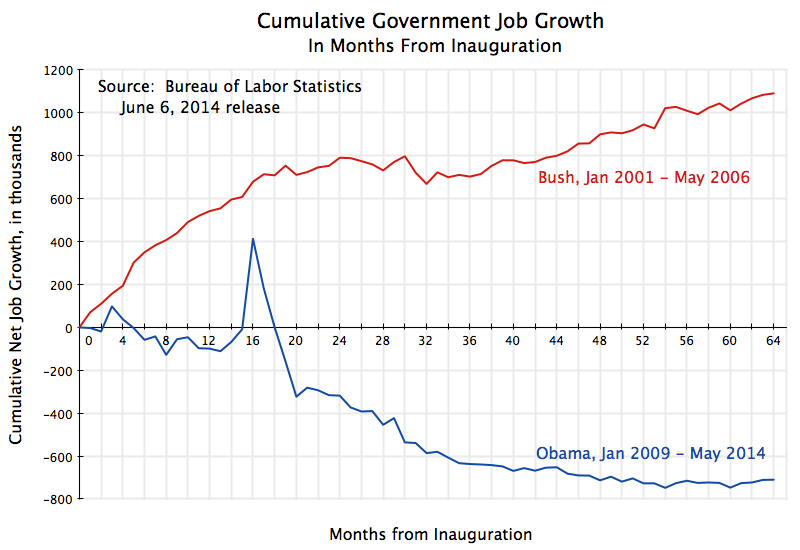
Cumul Govt Job Growth from Inauguration to May 2014

The Bureau of Labor Statistics released its regular monthly jobs report on June 6.  Nonfarm payroll employment rose by 217,000 – a broadly similar pace as in recent months.   But most news reports focussed on noting that total jobs in the US (actually, total nonfarm payroll jobs) have now for the first time exceeded the peak previously reached in January 2008, before the sharp fall that began in the last year of the Bush presidency.  It took the economy six years and four months to get back to the level of employment it had then.

While this is a significant benchmark, it is not all that meaningful by itself.  The labor force has continued to grow over the last six years, so unemployment remains high (at a rate of 6.3% currently).  Conservative critics have charged that the pace of job creation under Obama has been slow, and assert that the slow pace is due to Obama’s anti-business administration (they allege), with high taxes and increased regulation, the negative effects (they assert) of the measures under the Affordable Care Act to make it possible for the uninsured to obtain health insurance coverage, plus an allegation of “increased uncertainty”, as all acting to hold back the private sector from creating new jobs.

To judge such allegations, one might examine the pace of job creation during Obama’s term to the pace during the term of George W. Bush, a conservative Republican who was purportedly pro-business and anti-regulation, and who presided over record tax cuts.  One needs also to separate net job growth in the private sector from net job growth in the public sector to understand the story.

The two charts above do this, and update similar charts in previous posts on the blog that have examined the issue (the most recent from January 2013).  Points to note include:

1)  Net private job growth has been far higher under Obama than under Bush.  As the top chart shows, there were 5.2 million additional private sector jobs in May 2014 compared to when Obama was inaugurated, and an additional 9.4 million private jobs from the trough reached in February 2010, a little over a year after Obama took office.  Private jobs were disappearing at a rate of over 800,000 every month when Obama was taking the oath of office.  This was soon turned around as a result of stimulus measures and the aggressive actions of the Fed, with the rate of decline at first diminishing and then positive job growth appearing a year later.

Under Bush, in contrast, there were only 2.4 million more private jobs at the same point in his presidency relative to when he took office.  A primary reason for this difference is that while the economy was collapsing when Obama took office (which he then turned around within a year), the downturn at the start of the Bush term in 2001 began after he took office.  The economy then began to turn around (in terms of job growth) only two and a half years into Bush’s term in office.  Only then did private jobs begin to grow under Bush.

2)  Once the private job growth began (13 months into Obama’s term, and 30 months into Bush’s term), the pace of that job growth has been remarkably steady in both administrations.  There were month to month variations, of course, particularly in the data as originally announced (but then later revised, in the regular process to incorporate more complete data as it becomes available).  That is, the lines in the chart above for private job growth are both remarkably straight once the turning points were reached.

3)  Not only was the pace of private job growth remarkably steady after the turning points, they are also remarkably similar in terms of that pace for Obama and Bush.  That is, the two lines in the graph above are roughly parallel to each other after the respective troughs.  The pace of private job growth has been 184.5 thousand per month under Obama up to now, and a bit less, at 168.2 thousand per month, under Bush from his trough up to the same point in his presidency.

Thus there is no support in this data for the assertion that private sector job growth has been especially slow under Obama, due to an alleged anti-business administration.  Private sector job growth under Obama has been similar to, and in fact a somewhat higher than, the pace under Bush during the respective recoveries.  And total private job growth is far higher under Obama than it was at the same point in the Bush presidency, as the recovery was earlier under Obama.

4)  Where Obama and Bush do differ, and markedly so, has been in net government job growth.  Government jobs grew strongly under Bush (as they have for all recent presidents other than Obama; see this blog post).  But net government jobs have fallen sharply and consistently under Obama.  Only in the last year or so have they leveled off, but with no recovery in number.  Keep in mind that government jobs include jobs at all levels of government, including state and local government.  It is not just the federal administration that is covered here.  But the impact on the economy is similar whether it is a locally employed school teacher being laid off, or a researcher employed by the National Institutes of Health.

Bush is viewed as the small government conservative.  But government jobs grew by 1.1 million from the month of his inauguration to May 2006.  Government jobs fell by 710,000 over the similar period in Obama’s term.

5)  Thus part of the reason net overall job growth has been disappointing during Obama’s term is not that private job growth has been slow, but rather that government has cut back on those it employs, hence bringing down the overall total.  If government jobs had simply remained flat during Obama’s term in office, rather than fall by 710,000, the direct impact on the unemployment rate would have been to bring that rate down to 5.8% from the current 6.3%.  But that would be the direct impact only.  There would also be indirect impacts.  The now employed school teacher or researcher would spend their newly earned income on what they need, which would lead to increased demand for products and employment of additional workers to make them.  (See this Econ 101 blog post on the multiplier and what it means.)  Assuming a not unreasonable employment multiplier of 2 under current conditions, the impact of simply keeping government employment steady rather than allowing it to fall by 710,000 would have been to bring the unemployment rate down to 5.4%.

Had government employment been allowed to grow under Obama as it had under Bush, the impacts would have been significantly larger.  The direct impact alone (before the multiplier) would have brought the unemployment rate down to 5.1%.  Mechanically applying a multiplier still of 2 would imply an unemployment rate brought down to 4.0%.  But this would have then been at the low end of the range normally taken to represent full employment (of perhaps 4% to 5 1/2%, depending on the assessments of different analysts), and it would no longer be correct to assume a multiplier would have remained at 2.  Rather, and as discussed in the blog post cited above on multipliers, there would have been other reactions, including most likely by the Federal Reserve Board.  With the unemployment rate having been brought down to the full employment range, one would expect that the Fed would have shifted back to a more normal interest rate and monetary policy from its current policy (due to the still high unemployment) of targeting interest rates to as close to zero as possible.

Summary and Conclusion

To conclude,  far more private jobs have been created during the Obama presidential term  than during the same period in the term of George W. Bush.  In part this was due to the more rapid recovery under Obama (due to the stimulus and other measures taken) from the economic collapse he inherited from the last year of the Bush administration, than the recovery under Bush from the downturn that began a few months after he became president in 2001.  But it is interesting to see that once the respective recoveries began, the pace of private job growth was similar during the Obama recovery as under the Bush recovery (and indeed somewhat faster under Obama).  And this is despite the contractionary policies followed by government since 2010.  For the first time since at least the 1970s (I did not look back further in that blog post), government spending has been cut in an economic downturn, rather than allowed to rise to make up for insufficient aggregate demand.

Where the Obama and Bush periods differ, and substantially, is in government employment.  Government employment grew under Bush (as is normal, and as has been the case under every prior president since at least Eisenhower), but has been cut sharply under Obama.  It is because of these cuts that total employment growth under Obama has been disappointing.  Without those cuts, the economy would have returned to full employment some time ago.