The Continued Fall in Government Spending Under Obama

Govt Spending on Goods & Services by Presidential Term, Quarterly

A.  Introduction

Government spending continues to fall under Obama.  As this blog has noted in earlier posts, the fiscal drag from this reduction in demand for the goods and services that unemployed workers could have been producing can fully explain why the recovery from the 2008 has been so slow.  As another blog post noted, if government spending had merely been allowed to grow under Obama at the same pace as it had historically, the economy would by now be back at full employment.  The public debt to GDP ratio would also be lower, as GDP would be higher.  And if government spending had been allowed to grow as it had under Reagan, we would likely have returned to full employment by 2011.

Fiscal drag is therefore important.  Yet it is still not yet commonly recognized that government spending has been falling in real absolute terms for the last several years (and even more so when measured as a share of GDP).  Earlier blog posts have reviewed this.  The trends have unfortunately continued and indeed strengthened over the last year.  Whether this will now change with government spending finally leveling off, and perhaps even start to recover, remains to be seen.  The budget compromise for fiscal years 2014 and 2015 reached by Senator Patty Murray and Congressman Paul Ryan in December, and passed by Congress in January, will reverse part of the impact of the budget sequester.  According to calculations by the Committee for a Responsible Federal Budget (fiscal hawks in favor of budget cuts), the agreement for FY2014 will lead to a small (1.8%) rise in nominal terms in budget authority compared to the FY2013 post-sequester levels.  This would still be flat to negative in real terms, based on inflation of about 2%.  And the FY2014 sum would still represent a 3.7% fall compared to what the FY2013 pre-sequester levels would have been.

Possibly more important would be government spending at the state and local level.  This was cut back as a result of the 2008 collapse and slow recovery, due to lower revenues and the requirement in many states and localities of a balanced budget.  While expenditures were still falling in 2013, revenues have started to grow (due to the positive, though still slow, recovery of GDP) and state and local budgets as a result can now start to recover as well.  But it also remains to be seen if that will happen.

This blog post will update the government spending figures during the Obama term through the fifth year of his administration.  And it will present the figures from a different perspective than before, by tracing the paths during the course of each presidential term (going back to Carter’s) relative to what the spending was at the start of their respective presidencies.

[Note that all the government spending figures used in this post will be in real, inflation-adjusted, terms.]

B.  Government Spending on Consumption and Investment

The graph at the top of this post shows the tracks of real government spending on consumption and investment during each presidential term going back to Carter, as a ratio to what it was at the start of their terms.  The base period is always taken as the last quarter before their inauguration (i.e. in the fourth quarter of the calendar year preceding their January 20 inauguration).  The data is computed from the figures in the standard National Income and Product Accounts (NIPA accounts, also commonly referred to as the GDP accounts) of the Bureau of Economic Analysis (BEA) of the US Department of Commerce, and are seasonally adjusted.  Note that all levels of government are included here – federal, state, and local.  We will examine below spending at the federal level only, as well as spending including transfer payments.

This government spending has fallen by 5 1/2% in real terms by the end of the fifth year (the 20th quarter) of Obama’s term in office.  It rose by 2 1/2% during Obama’s first year, which one might note is similar to the increases seen by that point under Carter, Reagan, and Bush I, and with a significantly greater increase by that point under Bush II.  Spending during Obama’s term has since been falling steadily, leading to the fiscal drag referred to above, to a point where it is now 8% lower in real terms than it was in his first year, or a net 5 1/2% fall from when he took office.

There has been no such fall in government spending under any other presidential term since Carter.  The closest was spending during the Clinton period, but there was still a 3% rise by the end of his fifth year in office.  The increases by the end of the fourth year under Carter and Bush I (single term presidencies) were 8% and 6 1/2% respectively.  And the increases by the end of the fifth year in office were 13% during the term of Bush II, and by a full 21% in real terms under Reagan.  Government spending also continued to grow under Bush II and Reagan, reaching increases of 21% and 33% respectively by the end of their eight years in office.

Yet Reagan and Bush II are seen as small government conservatives, while Obama is deemed by conservatives to be a big spending liberal.  The facts simply do not support this.

C.  Government Spending Including Transfers

Government spending for the direct purchase of goods and services (used for consumption or investment), reviewed above, is a direct component of GDP demand.  When there are substantial unemployed resources (as now), such government spending will have a significant positive impact in spurring economic expansion.  As was discussed in an Econ 101 post on this blog, under such circumstances the fiscal multiplier will be positive and high.  Hence the fiscal drag from the cut-back in government spending during Obama’s term in office has kept the recovery below what it would have been.

But there is also government spending on transfers to households (such as for Social Security, food stamps, or unemployment insurance).  Such transfers are ultimately spent by households for their consumption of goods and services (or will in part be saved, including through the pay-down of debt such as mortgage debt).  It will enter into GDP demand by way of the spending of households for consumption, and the impact on GDP will depend on the behavior of households in deciding what share of those transfers they will spend or save.

Such spending rose more sharply during Obama’s first year in office, as he faced an economy in free fall as he was taking his inaugural oath:

Govt Spending, Total incl Transfers, by Presidential Term, Quarterly

The economy was losing 800,000 jobs per month at that time, pushing the unemployment roles up rapidly and plunging the incomes of many in the population to levels where they qualified for food stamps.  Government spending including transfers therefore rose by almost 9% by the third quarter of 2009, and reached a peak of 9.8% in the third quarter of 2010.  Since then, however, total government spending including transfers has been modestly falling, and is now 7 1/2% above where it was when Obama took office.

[Note all figures are in real terms.  The personal consumption expenditures deflator in the NIPA accounts was used to adjust transfer payments for inflation.]

Only during the Clinton period did one see a modestly smaller increase, of about 6 1/2%.  But there was a 16 1/2% increase in such spending at the same point in the term of Bush II, and an increase of over 22% under Reagan.  It was also higher by the end of their fourth years in office for both Carter and Bush I.

The differences are not small.

D.  Federal Government Spending on Consumption and Investment

What matters to the economy when demand is inadequate and unemployment is high is spending at all levels of government.  Yet while we commonly blame the president in office for the performance of the economy, they at best can only influence the federal budget (and influence it only partially, as Congress decides on the budget).  Hence it may be of interest also to examine the paths of only federal government spending.

Such federal spending on direct consumption and investment at first rose during the Obama term, reaching a peak 8% increase in the third quarter of his second year in office.  It then fell sharply, to a point where it is now 5 1/2% below where it was when Obama took office:

Federal Govt Spending on Goods & Services by Presidential Term, Quarterly

The initial increase in federal spending was in part due to the stimulus package that served to restart the economy (GDP was falling from 2008 through the first half of 2009; it then began to recover).  Note that while federal spending rose by 8% by the third quarter of 2010, overall government spending (including state and local) rose only by 2 1/2% at that point.  State and local government was cutting back, as they were forced to do by the balanced budget requirements of many of them, so federal spending and the stimulus it could provide was partially being offset by their cut-backs.

But after this initial increase in the first two years of the Obama presidency, federal spending has been cut substantially, to the point where it is now 5 1/2% below in real absolute terms where it was when Obama took office.  Federal spending also fell during the Clinton term, by 11% at the same point in his term.  In contrast, federal spending rose sharply under Bush II (by 27% at the same point) and especially under Reagan (by over 31%).

E.  Federal Government Spending Including Transfers

Finally, federal government spending including transfers:

Fed Govt Spending, Total incl Transfers, Quarterly

[Technical Note:  Federal government transfers in the NIPA accounts include transfers to individuals as well as transfers to the states or localities for all purposes, including road construction, for example.  Such intra-government transfers are netted out in the accounts when government as a whole – federal, state, and local – is examined, so that remaining government transfers are then solely transfers to individuals, such as for Social Security.]

Such spending is now lower under Obama than under any of the presidencies examined, including Clinton.  Federal spending including transfers rose to a peak in 2010 of 10% above where it was when Obama took office, but has since declined to just 1% above that level.  It was 4% higher at that point in Clinton’s term, 23% higher at the point in the term of Bush II, and 25 1/2% higher at that point in the term of Reagan.

F.  Conclusion

Republicans in Congress and conservatives generally continue to criticize Obama as being responsible for runaway government spending.  But after an initial modest increase in the first two years of his term, as he sought to stop the economic free fall he inherited on taking office (and succeeded), government spending has come down under any measure one takes.  The resulting fiscal drag has held back the economy, leading to an only slow recovery.  And the fiscal drag during Obama’s term in office is in sharp contrast to the large increases in government spending observed during the terms of George W. Bush and especially Ronald Reagan. Yet they have been viewed as small government conservatives.

Inequality and Poverty in the US: Worse Than Elsewhere Due to Small Government

Gini Before Taxes & Transfers, OECD, 2010

Gini After Taxes and Transfers, OECD, 2010

A.  Introduction

Many observers are aware that the US has the worst income inequality in the world among the more developed high income countries.  But conservatives have attributed this to inequality resulting from what they see as a dynamic market based economy, that rewards entrepreneurs generously for hard work and taking risks.  Government interventions that have sought to compensate for the resulting inequality are seen by these conservatives as ineffective and misguided, and indeed counterproductive.  Thus on the 50th anniversary last week of President Lyndon Johnson declaring a “War on Poverty”, conservatives such as Senator Marco Rubio have asserted that those efforts were a failure, and that we should scale back, and even defund and dismantle, government social programs which have sought to alleviate the conditions of the poor.  They assert “big government” is the problem, and small government the solution.

But the premises on which these criticisms are based are faulty.  Individual anti-poverty programs have in fact worked quite well and poverty rates have come down – see this reference for example.  But more fundamentally, one needs to start with the recognition that the US market system does not itself produce greater inequality or higher poverty rates than elsewhere.  For this, US rates are similar to those for others, as will be seen below.  Where the US differs, however, is in the inequality and poverty rates after one includes the impact of government via taxes and transfer programs, to arrive at what individuals are in fact able to buy and consume.  Such government interventions have reduced inequality and poverty rates in all countries.  But because the US efforts are so much more limited than they are elsewhere, US inequality and poverty rates are the worst in the world once one takes these into account.  And since a person’s living standard depends on what they are able to buy after taking into account taxes and transfer programs (such as Social Security or unemployment compensation), it is the latter which matters.

Thus the assertion from Senator Rubio and others that government efforts to reduce inequality and poverty have failed (since we still have inequality and poverty), and that they therefore should be cut back or eliminated altogether, is misguided. Government interventions through tax and transfer programs have reduced inequality and poverty, but they have done so less in the US than elsewhere because their scale in the US is more limited than elsewhere.  It is due to this limited scale that the US ends up being ranked as the worst in the world among other high income countries in terms of inequality and poverty.

This blog post will review these issues, drawing mostly on data available from the OECD Statistics web site.  We will first focus on the inequality measure called the Gini coefficient, both before and then after taxes and transfers.  The Gini is probably the most widely used measure of inequality (when there is any measure of inequality available, which is not always the case as one needs large and expensive household sample surveys).  It varies from zero to one, with a value of zero indicating perfect equality of incomes (all individuals, or households, in the country earn the same amount), and a value of one indicating complete inequality (all of the nation’s income accrues to one person).  The section of the blog post that then follows will then look at poverty head counts – both before and then after taxes and transfers.

B.  Income Inequality as Measured by the Gini Coefficient

The chart at the top of this blog post shows the Gini coefficient for the US and a set of comparable high income countries (mostly from Western Europe, along with Canada, Japan, Australia, and New Zealand).  Based just on incomes as earned in the market, inequality in the US is in the middle of the range found for the other countries – a bit worse than the average but not by much.  Inequality of market incomes was worse in Ireland, the UK, Portugal, Spain, France, and Italy.  There is no sign here that the US economic structure leads to a distribution of income that is worse than that seen elsewhere among the high income developed countries of the world.

The picture changes markedly once one takes into account the impact of taxes and government transfer programs.  This is shown on the second chart above.  Inequality then falls in all of the countries, as there is at least some degree of progressivity in the tax systems, and government transfer programs are also and more markedly progressive.  Even if the benefits of some transfer program are distributed in equal dollar amounts to all in the population, that level of transfer will be of greater relative importance to a poor person than to a rich person.

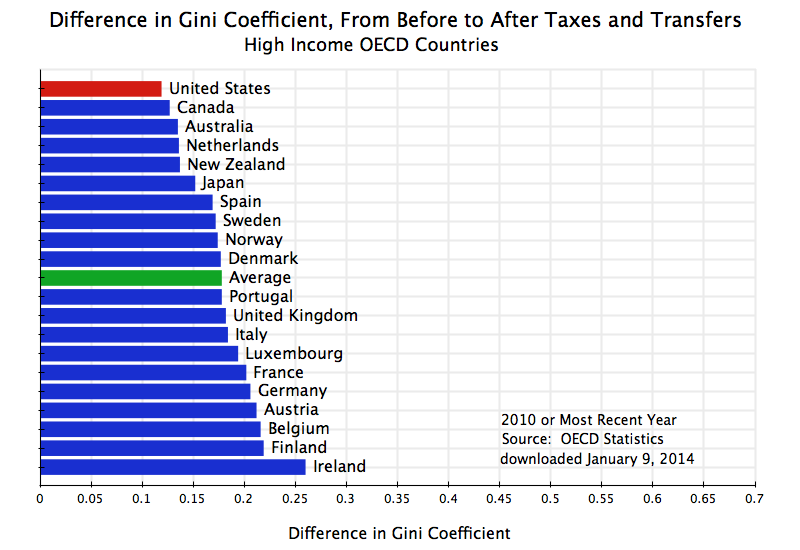
But inequality falls by less in the US than elsewhere once one takes into account taxes and transfers, so that the US moves from the middle of the set of comparator countries to the country with the worst distribution.  The differences in the Gini coefficients are shown explicitly in the following chart:

Gini Coefficient - Dif Before and After Taxes & Transfers, OECD, 2010

Inequality as measured by the Gini coefficient is reduced in each of the countries once one takes into account taxes and transfers.  The reductions are indeed quite significant.  But the reduction in the US is smaller than in any other country, and the result is that the US then ranks worst in terms of inequality once one takes into account taxes and transfers.

An interesting question is whether the reductions in inequality are primarily due to the tax system, or to transfer programs.  Tax systems and transfer programs are both in general progressive.  That is, tax rates are generally higher for those individuals with higher income, and transfer programs are generally designed to benefit the poor more than the rich.  But not all individual tax and transfer programs are progressive.  Flat consumption taxes, such as sales taxes in the US and value-added taxes in Europe, can be regressive, in that they take a higher share from the poor (who must consume almost all of their limited income) than the rich.  The scale of the programs also matter.  One might have an extremely progressive tax structure, for example, but if the size is small (so that little is collected in taxes) then it will have little impact on inequality.

One therefore needs to look at the data.  While the standard OECD files used for the above do not have this, an analysis posted as the Budget Incidence Fiscal Redistribution Database by the research center known as the Luxembourg Income Study (based in Luxembourg and with a US office at the City University of New York), does provide such a breakdown.  The analysis was prepared by Chen Wang and Koen Caminada of the University of Leiden in the Netherlands, and a description is available in this working paper.

Their analysis is drawn from data for 2004 (for most of the countries):

Change in Gini From Before To After Taxes and Transfers
2004 or nearest year
Gini Gini Total From From  Transfers/
Before After Change Taxes Transfers Income
US 0.482 0.372 0.109 0.043 0.066 9.9
Canada 0.433 0.318 0.114 0.038 0.076 10.9
Spain 0.441 0.315 0.126 0.001 0.124 20.7
Switzerland 0.395 0.268 0.128 -0.003 0.130 17.5
UK 0.490 0.345 0.145 0.021 0.124 14.3
Australia 0.461 0.312 0.149 0.047 0.101 11.1
Italy 0.503 0.338 0.165 0.000 0.165 25.4
Average 0.456 0.289 0.167 0.031 0.136 19.6
France 0.449 0.281 0.168 0.017 0.151 26.2
Norway 0.430 0.256 0.174 0.035 0.139 20.2
Ireland 0.490 0.312 0.178 0.046 0.132 17.3
Luxembourg 0.452 0.268 0.184 0.037 0.147 23.4
Austria 0.459 0.269 0.190 0.034 0.156 26.7
Denmark 0.419 0.228 0.191 0.042 0.149 18.9
Netherlands 0.459 0.263 0.196 0.040 0.156 21.3
Sweden 0.442 0.237 0.205 0.037 0.168 24.6
Germany 0.489 0.278 0.210 0.052 0.158 21.2
Finland 0.464 0.252 0.212 0.044 0.168 23.2
Europe only 0.456 0.279 0.177 0.029 0.148 21.5

The first two columns show the Gini coefficient, first before and then after taxes and transfers.  The third column then shows the change in the Gini, with the countries in the table ranked according to this change (from smallest to largest).  While the specific numbers differ from those in the OECD data shown above (the year is different, plus the data may be drawn from different underlying sources), the two are broadly consistent.  In both sets, the US ranks as the most unequal in terms of income after taxes and transfers, with the change in the Gini from before to after also the smallest.  Before taxes and transfers, the Gini for the US is within the range seen for the other countries, with Italy, the UK, Ireland, and Germany all worse.

The authors decompose the change in the Gini according to how much is due to the tax system and how much is due to government transfer programs.  For the US, for example, the total reduction in the Gini was 0.109 points, with 0.043 coming from the tax system and 0.066 coming from the impact of government transfers.

The reduction in the Gini in the US due to the impact of the tax system (of 0.043 points) is within the range seen for the other countries and is indeed even somewhat higher than the average impact across all countries (of 0.031 points).  The US relies mainly on direct income taxes for raising tax revenue, while European countries rely more on value-added taxes.  Income taxes with progressive rates will have a greater impact on reducing inequality than will value-added taxes.  But there are other taxes in all countries, including income taxes in Europe.  More importantly, Europe collects far more in tax revenues than the US does, and hence even if the US tax system has more progressive rates overall, the larger scale in Europe means there can be more of an impact on inequality there.  Based on OECD tax data, the US collected (at all levels of government) just 24% of GDP in tax revenue in 2012, while Western Europe on average collected over 60% more at 39% of GDP.

But more important than the impact of the tax system on inequality was the impact of government transfer programs.  Transfer programs in the US did reduce inequality as measured by the Gini by 0.066 points.  But this was the smallest of any of the countries.  It was less than half the average reduction across all the countries of 0.136 points, and an even smaller share relative to the average for just the European countries of 0.148 points.

The reduction was larger in Europe than in the US primarily because the transfer programs were larger in Europe than in the US.  The final column in the table shows the average level of transfers in each country relative to household incomes.  This was just 9.9% in the US, which was about half of the 19.6% for all the countries, and well less than half of the 21.5% average for just the European countries.

Transfer programs do bring down inequality, and does this in all countries including the US.  But government transfer programs are so much more limited in the US than elsewhere that the US ends up as the worst in the world in inequality once one accounts for them along with taxes.

C.  Poverty Rates

The discussion above was on inequality, using the Gini coefficient as the measure.  But inequality (and the Gini measure), cover the entire income range from rich to poor.  One might also reasonably want to know how the US compares when one focuses exclusively on the poor.  What share of the population is poor, where does the US rank by this measure compared to other countries, and again what is the impact of taxes and transfers?  We will find that the results are basically the same as that found above for the Gini.

A direct measure of the poverty rate is available from the same OECD data base utilized above for the Gini.  The concept used is the share of the population (the head count) with incomes below a poverty line defined as 50% of the median income in the country.  This is a relative measure that takes into account that the standard used for determining who is poor should depend on how rich the country is.

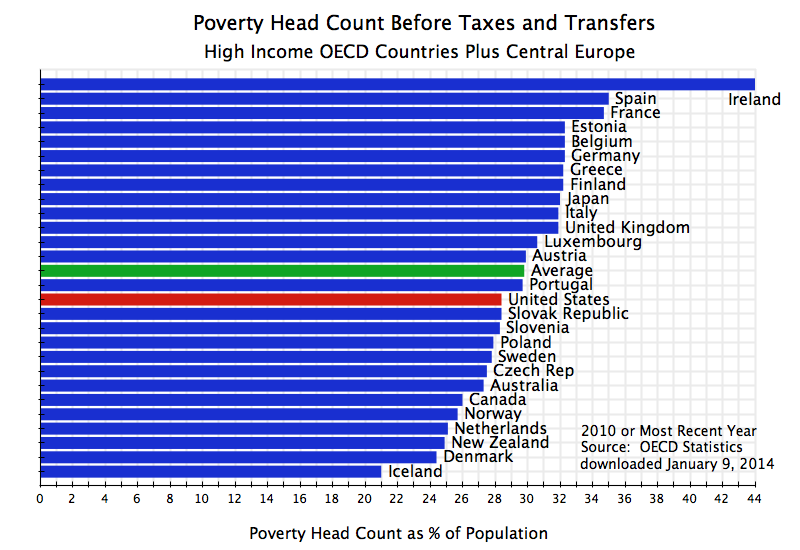
Based on this measure of poverty, the US poverty rate before taxes and transfers is again similar to that for other OECD countries.  It is indeed slightly better than the average for all the OECD countries included here (where there is consistent data also available now for this measure for the countries of Central Europe, so these countries have been added):

Poverty Head Count Before Taxes & Transfers, OECD, 2010

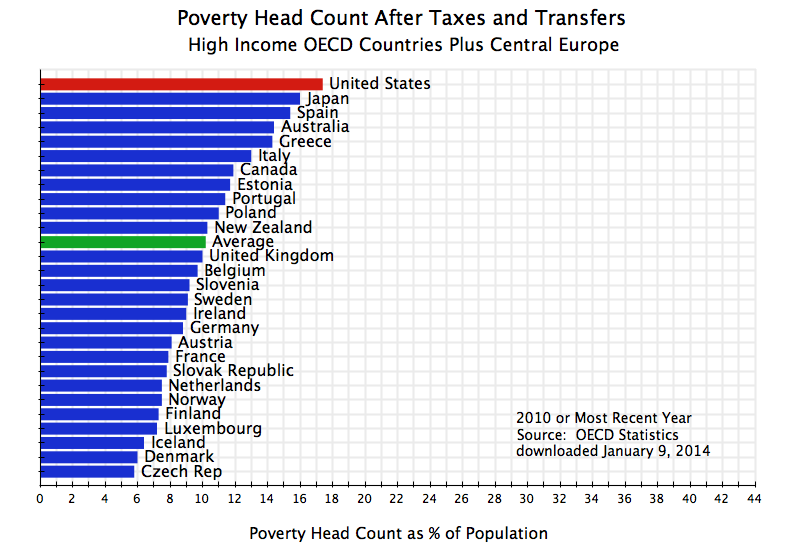
The US market economy therefore does not lead to higher poverty rates than that found in other OECD countries.  But this changes, as it did for the Gini, when one takes into account the system of taxes and transfers:

Poverty Head Count After Taxes & Transfers, OECD, 2010

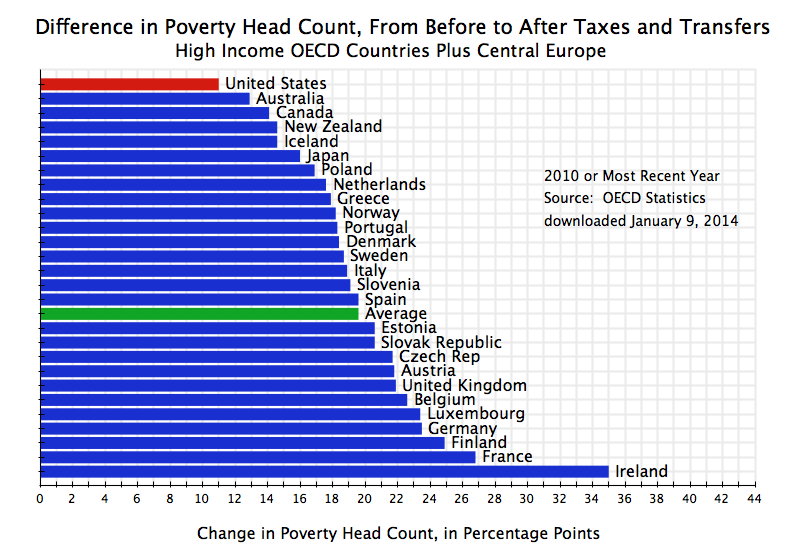
The US then ranks again worst among all OECD countries in terms of the poverty rate, once one includes the impact of taxes and transfers.  The system of taxes and transfers has a positive impact in all of the countries, in that the poverty rates fall in each country once one accounts for taxes paid and transfers received.  Indeed, the impacts in many of the countries are quite large.  But the programs are more limited in the US than elsewhere, so that the net reduction in the US is the smallest:

Dif in Poverty Head Count, Before to After Taxes & Transfers, OECD, 2010

Due to the limited scale of such government programs in the US, poverty rates end up higher in the US than in any other high income OECD country.

D.  Conclusion

Many presume that the US has high inequality and poverty rates because of the market economy system in the US.  While it may be recognized that inequality in the US is higher than elsewhere, and poverty rates also higher, the presumption is that these are unfortunate byproducts of a market system that rewards hard work and risk taking.

But this is not the case.  Inequality and poverty in the US is similar to that found elsewhere among the high income OECD countries, when one takes incomes as determined before accounting for taxes paid and the impact of government transfer programs.  The US is indeed quite close to the average seen elsewhere for these market determined incomes.  Where the US differs, however, is in inequality and poverty rates after one takes into account taxes paid and transfers received.  And since this determines what individuals are in fact able to buy and consume, these incomes after taxes and transfers determine actual living standards.

Once one takes into account taxes and transfers, the US moves from the middle of the range to the worst ranking country.  The tax systems and transfer programs reduce inequality and poverty rates in all countries, including the US.  But the US programs are so much more limited than those found elsewhere, particularly in Europe, that the rest of the OECD world reaches and surpasses the US by these measures.

Inequality and poverty rates in the US, as the worst in the world after accounting for taxes and transfers, are not therefore a consequence of failed government programs, which conservatives such as Senator Rubio want to cut by even more.  Rather, the ranking of the US as the worst in the world is a consequence of the opposite:  that these programs are too small and limited.

We Have a Revenue Problem: Government Debt to GDP Would Fall Without the Bush Tax Cuts

Debt to GDP Ratio, FY1790 to 2038, no Bush Tax Cuts

A.  Debt to GDP Would Fall Without the Bush Tax Cuts

If the Bush tax cuts had not been extended at the start of this year for almost all households, the public debt to GDP ratio would be falling rapidly.  Even though health care costs are rising and Social Security payments will need to increase as baby boomers retire, the US would be generating more than sufficient tax revenues to cover such costs, if we simply had reverted to the tax rates that held prior to the Bush tax cuts.

The figures on this can be calculated from numbers provided by the Congressional Budget Office with its annual Long-Term Budget Outlook, which was published earlier this week.  Most of the attention paid to the report focussed on the base case projection by the CBO of the public debt to GDP ratio if nothing changes in current policy.   The ratio had risen sharply as a consequence of the economic collapse of 2008, in the last year of the Bush administration, and subsequent weak recovery.  But with the economy recovering and with other measures taken, the ratio is now projected to stabilize and indeed fall modestly for several years.  However, the ratio would then start to grow again in fiscal year 2019, and especially after 2023.  As the graph above shows, the CBO projects that, under current policy, the debt to GDP ratio would rise to 100% of GDP by fiscal 2038, reaching levels last seen at the end of World War II.

This has been interpreted by Republicans as a runaway spending problem, and have asserted this calls for further sharp cuts.  But the data issued by the CBO with its report allows one also to work out what the consequences were of allowing most of the Bush tax cuts (primarily – there were also some other tax measures) to be extended from January 1, 2013.  The Bush tax cuts had been scheduled to expire on that date.  They were instead extended and made permanent for all but the extremely rich (those households earning more than $450,000 a year, the richest 0.7% of the population).

Specifically, the CBO provided in the projections it had made last year (in 2012) what public revenues would have been if the tax cuts had expired, as scheduled, at the start of 2013.  The new report provides those figures for comparison, updated to reflect the new methodology for GDP that the BEA adopted in July.  One can combine those revenue projections with CBO’s current projections of non-interest expenditures, along with a calculation of what interest would then be on the resulting (lower) debt, to estimate what the fiscal deficit and debt to GDP figures would then be.

The resulting path of federal government debt to GDP is shown as the green line in the graph above.  The debt to GDP ratio plummets.  Instead of reaching 100% of GDP in fiscal 2038, it instead would fall to just 37% of GDP in that year.  And a simple extrapolation of that line forward would bring the debt all the way to zero in a further 24 years.

The extension of the Bush tax cuts for most households can therefore, on its own, more than fully account for the projected rise in the public debt to GDP ratio.  With tax rates as they had been under Clinton, there would be no debt issue.

B.  A Longer Term Perspective

The CBO report also provides data on the federal government debt to GDP ratio going back to the founding of the republic in 1790.  I have put the projected paths on a graph with the history to put them in that context.  The fall in the debt ratio that would follow if the Bush tax cuts had not been extended is similar to the falls seen in that ratio in the periods following the Revolutionary War, the Civil War, World War I, World War II, and during the Clinton years following the run-up during the Reagan and first Bush presidencies.

Public debt reached a peak of 106% of GDP in fiscal year 1946, at the end of World War II.  The ratio then fell steadily in the 1950s and 1060s, and was just 25% in 1981, at the end of the Carter presidency.  It fell during this period not because there were large budget surpluses, but rather because of generally strong economic growth.  This also shows that strong growth is possible even if the debt ratio is as high as 106%, undermining the argument made by the economists Carmen Reinhart and Ken Rogoff in a 2010 paper, that debt in excess of 90% of GDP will lead to a sharp reduction in growth.  Republican politicians had quickly jumped on the Reinhart and Rogoff conclusion, arguing that this work supported their views.  But aside from numerous counterexamples, such as the US after World War II, researchers later discovered that there had been a coding error in the spreadsheet Reinhart and Rogoff used to assemble their data.  More fundamentally, researchers showed that to the extent there is a relationship between high debt and slow growth, it is that downturns and slow growth lead to a rise in the debt to GDP ratio (as we saw in the US after the 2008 collapse), rather than that a high debt ratio leads to slow growth.

The debt ratio then rose sharply during the Reagan and first Bush presidencies, rising from 25% of GDP in fiscal 1981 to 48% in fiscal 1993.  This was the first such rise in the debt ratio in American history, aside from the times when the country went into war or at the start of the Great Depression.  During the Great Depression the ratio rose during the Hoover years from 15% in fiscal 1929 to 39% in fiscal 1933, and then to 43% in fiscal 1934.  But it is interesting that during the Roosevelt presidency, and in stark contrast to the common view that the New Deal was characterized by big increases in government spending, the ratio then stayed in the range of 40% to 44% until 1942, following the entry of the US into World War II.

The debt ratio then fell during the Clinton presidency, from 48% in fiscal 1993 to 31% in fiscal 2001.  But with the Bush tax cuts and then the 2008 collapse, the ratio rose to 52% in  fiscal 2009, and to 73% this year.   As noted above, the ratio would now start to fall again if the Bush tax cuts had not been extended, reaching a projected 37% in fiscal 2038.  But with most of the Bush tax cuts made permanent, the ratio (with the same government spending levels) is instead projected to rise to 100% in that year.

C.  Conclusion

The first step in addressing some problem is to understand the cause.  The cause of the current fiscal problems, which if not addressed would lead to a public debt rising to 100% of GDP by fiscal 2038, is the Bush tax cuts.

An earlier post on this blog looked at what the debt to GDP ratio would have been had the Bush tax cuts never been enacted (in 2001 and 2003) and the Afghan and Iraq wars had not been launched.  It found that even assuming the 2008 economic downturn would still have occurred, the public debt to GDP ratio would have risen only to about 35% by fiscal 2014, and would then start to fall.  That post also showed that even assuming the cost of the wars and with the Bush tax cuts in place from 2001 to 2013, phasing out the tax cuts starting in fiscal 2014 would have led the public debt to GDP ratio to fall until at least fiscal 2022 (the last year in the CBO figures then available).

The current post has made use of the CBO’s new long term projections, and finds that if the Bush tax cuts had not been extended at the beginning of 2013, the debt to GDP ratio would be on a sharp downward path to at least fiscal 2038.  The current conventional wisdom appears to be that rising health care costs and the increase in the number of retirees as the baby boom generation reaches 65 means that a rise in the debt to GDP ratio is inevitable, unless there are sharp cut-backs in Medicare and Social Security.

But that is not the case.  The debt ratio would be falling rapidly if it were not for the Bush tax cuts.