Covid-19: The US Lags Others in the Recovery Thus Far

In those countries where the spread of Covid-19 was not addressed early, all that policy-makers could then do to break its exponential growth was to lockdown the economy.  Schools were closed; non-essential businesses such as theaters, retail establishments, barbershops and hair salons, and similar were also all closed; workers were told to work from home whenever possible; and travel by other than private means was sharply curtailed.

This did succeed in reversing what had been an exponential rise in the spread of the disease, although at a tremendous cost to the economy.  While figures are not yet available on the extent of the downturn, it is clear that this will be the sharpest fall in the US economy since at least the Great Depression.  And the suddenness of the fall is unprecedented.

But as noted, the lockdowns did stabilize the number each day of new cases and of deaths, and started to bring those numbers down.  The disease was still spreading, but not at the pace of before.  There is now pressure from some quarters to lift or even fully end those lockdowns, and that process has indeed already started in much of the US as well as in other countries.  It is still too early, however, to say whether such easing will lead to a resurgence of the disease.  As was seen in January through March, several weeks will go by before one observes whether the number of daily cases will have been affected, and a further two or three weeks before one will see an impact on the daily number of deaths.

One can, however, at this point examine what the impact was of the lockdowns on the spread of the disease.  For the US, those lockdown measures were introduced starting in mid-March and lasted through end-April before they started to be partially lifted in certain jurisdictions.  And one can compare the US record to that of a number of Western European nations who also failed to stop the spread of the virus early, who then had to impose lockdown measures to break the exponential growth and start to bring it down.

The chart at the top of this post shows how the US record compares to that of a number of Western European countries in terms of the number of daily deaths from Covid-19.  It is not good.  The US is an outlier, with significantly less of a decline in the daily number of deaths than what all of these comparator countries have been able to achieve.

The chart tracks, by days from the peak day in the country, the daily deaths from the disease (using 7-day moving averages to even out the day to day fluctuations in the statistics), with the figures for each country indexed to 100 for the number of deaths on its peak day.  The data cover the period through May 17, and were calculated from the cross-country data assembled by Johns Hopkins.

Thus, for the US there were 29 days (as of May 17) since the peak day in the US of April 18, and by that point the number of daily deaths (using 7-day moving averages) was about 65% of what it was on the peak day.  In terms of absolute numbers, the US had 2,202 deaths (in terms of the 7-day average ending on that day) on April 18, and by May 17 (29 days later) the number of deaths had fallen to 1,434 (or 65% of 2,202).

European countries all did better.  By 29 days after their respective peaks, the number of deaths had fallen to 47% of what it had been in the UK, and to just 13% of what it had been in Austria (with Ireland tracking even lower, but only on its day 22).  The other European countries are all in between.  More could have been added.  I had originally included five other Western European countries in the chart, but it was then hopelessly cluttered.  So I removed those five as they were generally smaller countries (Belgium, the Netherlands, Denmark, Finland, and Portugal), plus their curves all fell in between those of Ireland on the low side and the UK on the high side.

Would the record be different if one drew a similar chart for the number of confirmed cases rather than the number of deaths?  Not really:
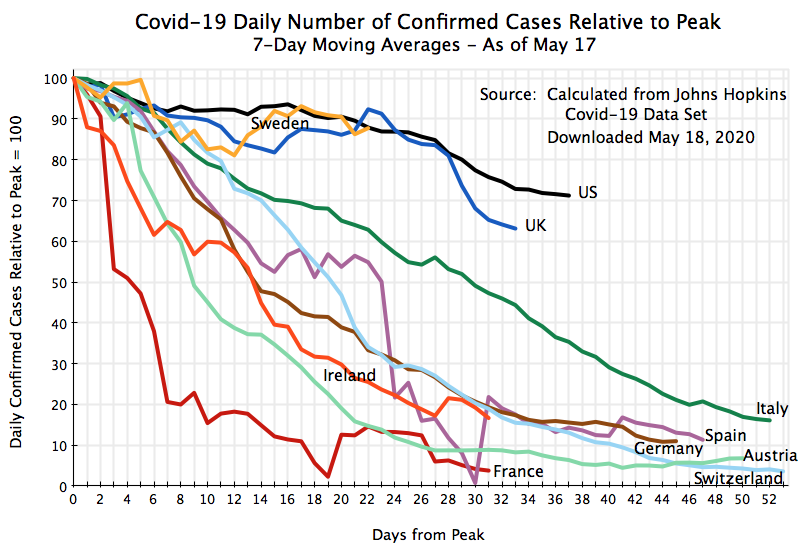
Here the UK curve tracks more closely to the US curve until day 28 from the respective peaks, but then fell below.  While this is speculation, one wonders if those in the UK started to take the social distancing measures more seriously once their prime minister, Boris Johnson, ended up in the intensive care unit of a hospital due to the disease (where one should keep in mind that the number of cases will then be affected only several weeks later).

Sweden may also be of interest.  In contrast to other countries, Sweden never issued legally binding lockdown orders, but rather just guidelines.  The result, however, was that the number of cases has not come down much from its peak (see the chart).  While still early, the number of daily new cases is close to 90% of what it was at its peak.  This is similar to what it was for the US at the same point in terms of the number of days from the respective peaks.  The UK path was also broadly similar at that point.

There is a difference, however, in terms of how far deaths had come down (the chart at the top of this post).  The path for Sweden has been below that of the US and in the range of other European countries.  From these observations alone one cannot say why Sweden has seen a greater reduction in its daily number of deaths (relative to their respective peaks) despite a similar number of cases as the US (relative to their peaks).  It might be because Sweden enjoys a much better health care system than the US (despite the US spending 60% more than Sweden as a share of GDP).  The age composition of those coming down with the disease might also be a factor, if younger people are, on average, a higher share of those being infected in Sweden than in the US.

But overall, the key question is why has the US performed more poorly than all the others in bringing down the number of deaths?  There are a number of possible reasons, and these reasons are not mutually exclusive – they could all be contributory.  They include:

a)  There was no national lockdown order given, but rather different states issued their orders at different times, mostly between mid-March and the beginning of April.  Indeed, a few, generally less populous, states never even issued formal lockdown orders, but simply guidelines.  This would spread out the impact, leading to less of a fall in the number of deaths relative to the national peak for any given day.

b)  Those lockdown orders varied greatly in terms of their degree of strictness.  Some were strong, and some notably lax.  Furthermore, enforcement was typically lax.  The lockdown orders were usually more serious (and much more seriously enforced) in Europe (but with Sweden as an exception).

c)  Cultural factors undoubtedly also entered.  Some Americans took social distancing measures seriously – others did not.  Indeed, some have been especially loud and insistent on not obeying such orders, in a childish display of contrariness.  They assert they have a constitutional right to do as they please (even if this may infect others with a deadly disease).

But perhaps the most important reason for the poor record of the US has been the failure of responsible presidential leadership.  There has been no coherent, and scientifically informed, national policy.  Trump spent two months denying that the virus was a concern, and the US failed to take the critical early actions which could have stemmed the spread (as the developed countries of East Asia and the Pacific were all able to do, and successfully so).  Then, when he was finally forced to admit the obvious (spurred more by a crashing stock market than by the disease itself), he has only reluctantly backed the measures needed to address the crisis.  And he has personally not modeled the behavior that the federal government’s own guidelines call for:

a)  He refused, and continues to refuse, to wear a mask in public.

b)  He continued to shake hands with those close by (leading to awkward, and amusing, moments when the other party had begun some other action of greeting).

c)  Rather than follow the social distancing guidelines at his highly publicized daily press briefings, for several weeks he had for the cameras a large number of officials and assistants all standing shoulder to shoulder around him.

d)  Most recently, Trump confirmed that he has started to take the controversial drug hydroxychloroquine, despite FDA warnings that to do so was dangerous.  Indeed, a recent study found that a higher share of Covid-19 patients who took the drug ended up dying than did those not given the drug.  Along with some of his other suggestions (such as to examine ingesting bleach or some other disinfectant to kill the virus – which health officials hastened to tell everyone not to do as it could kill them), Trump has conveyed to the public a disrespect for science and instead to do what he believes “in his gut”.

Coupled with Trump’s twitter outbursts (including the early encouragement of small, but well-organized, groups of gun-brandishing demonstrators in several states calling for an immediate lifting of the lockdown measures), it should not be a surprise that the US has been a laggard compared to what other nations have been able to accomplish.

Politicizing this public health crisis, as Trump has, will now also make it more difficult to emerge from it.  Guidelines that had been prepared by the CDC on how to safely reopen the economy, and which would have been issued on May 1, were instead suppressed by the White House.  Trump instead announced (following intensive lobbying by affected industries), that he did not want cautions to continue, but rather that everything should be quickly reopened back to “where it was” three months ago.

With such political pressures superseding the recommendation of health professionals, many will approach any opening even more cautiously than they otherwise would have.  With uncertainty as to whether restaurants, say, were re-opened because it was truly safe or because of political pressures, many will hold off on patronizing them for an extended time.  I certainly will.

Covid-19 by State: The Impact of Urbanization on the Spread

A.  Urban Concentration and Covid-19 Cumulative Deaths as of May 3

The virus that causes Covid-19, like other such viruses, spreads person to person.  Thus one should expect that there will be a more rapid pace of spread in urban areas, where people are in closer day-to-day contact.  This is not an indication of what the ultimate spread might be, as catching an infectious disease is a one-time event and contacts with others still add up over time.  It is just that instead of encountering a certain number of people in one day, it might instead take several days or even weeks.  But greater person-to-person contact increases the likelihood that one will catch the disease earlier.

Thus one should expect that at this point in the middle of the spread of Covid-19, those states that are more highly urbanized will have seen a greater number of deaths from the disease (per unit of population) than states that are more rural.  And that is indeed what one finds, although with some interesting exceptions.

The chart above shows the number of deaths in each US state per million of population, plotted against the percentage share of the urban population in the state.  The share of the state’s population that is defined as residing in an “urban” area comes from the US Census Bureau, which applies a very specific (and uniform) definition of what it labels as urban.  The calculations are based on what the Census Bureau defines as “urbanized areas”.  Under this definition, the urban population is the total population in the state living in an area with a dense urban core, including in the surrounding (suburban) areas meeting certain population density requirements, and with a total population within that area of 50,000 or more.  (Note that the Census Bureau also has a broader concept of what it considers “urban” that includes communities down to a population of 2,500.  Statements on urban populations in states are often based on this broader definition.)

While this is the best one can do in defining what it means to be living in an urban area, note that it is still highly imperfect for the purposes here.  Urban areas differ greatly.  The day-to-day contact one would experience in New York is quite different from what would normally find in a city of 50,000.  Even comparing similarly large cities, it will be quite different between New York and, say, Los Angeles.  Still, it is of interest to see whether states with a higher share of their population living in urbanized areas, as defined by the Census Bureau, have at this point in the spread of Covid-19 experienced a higher fatality rate from the disease.

The chart indicates that in general they have.  The data on the number of deaths from Covid-19 comes from the data set maintained by the New York Times, with the figures as of May 3, 2020 (and downloaded in the afternoon of May 4).  The Census Bureau figures on state total populations and on those living within urbanized areas (of 50,000 or more) are all from the 2010 census.  While these are now ten years old and will be updated once the 2020 census is completed, for the purposes of this exercise they more than suffice.  The relative populations across states will not have changed all that much.

At this point in the pandemic, states with urban population shares of up to almost 60% have uniformly relatively low (as compared to other states) death rates from Covid-19 per million of population, with all at about 100 or less (Mississippi is at 102).  Half the states (25 of the 51 including Washington, DC, as a 51st) fall into this category, with their names on the chart crowded and overlapping.  For those interested, the figures for individual states can be found in a table at the bottom of this post.

The states with urban population shares of just below 60% (Indiana) up to 80% then show more variety.  The fatality rates are very low for some (e.g. Hawaii, at 12.5 per million with an urban share of 71.5%) and substantially higher for others (e.g. Louisiana, at 434 per million and an urban share of 61%).

But the most substantial variation is seen in those states with an urban share of 80% or more.  The fatality rate at this point in the pandemic is just 18 per million in Utah despite an urban share of 81%, while it is close to 1,000 per million in the state of New York with an urban share of 83%.  Several other states in this group also have relatively low fatality rates, including California, Arizona, Nevada, and Florida.  Thus while there is a clear association seen between a higher share of a state’s population living in an urbanized area and the deaths per million from Covid-19, that relationship is not fate.  There are important exceptions.

The broad range in cumulative death rates among the states with the higher urban population shares is a consequence of several factors.  While it is not surprising that a higher urban share appears to make a location more vulnerable to a rapid spread of the virus, it is also clear that it is not inevitable.  There are a number of exceptions.  California, while vulnerable, imposed state-wide lockdown orders relatively early, for example.  The Utah public health system has also functioned particularly well.  And the state totals may be consistent with some very limited evidence (but disputed, and far from certain) that the virus that causes Covid-19 might spread less in warmer and moderately humid environments.  This might in part explain the low rates seen, despite high urbanized shares, in Arizona, California, Florida, and Nevada, as well as in Texas and Hawaii.

At the other end, the areas around New York City (in the states of New York, New Jersey, and Connecticut) saw an early and rapid spread of the virus before many were aware of it.  Based on analysis of the genome, researchers have found that the virus found there had in most cases arrived from Europe rather than directly from China.  Furthermore, they found that it was introduced to the New York area from multiple independent sources (i.e. not from just one traveler) and that it may well have arrived already in January.  There has also been a recent report that the virus had already been introduced into Europe as early as late December.  A recent analysis of a sample of bodily fluids taken from a French man living in the Paris region, who went to a local hospital on December 27 with a case of suspected pneumonia, indicated that he in fact had the virus that causes Covid-19.  He had not traveled abroad.

Thus bad luck can also play a role.  A region with a high degree of urban concentration (such as New York), with frequent travelers to and from a region where the disease had spread but where this was not known at the time (Europe), would be particularly susceptible to a highly infectious viral disease such as Covid-19.

Florida may be a surprising case.  It is a state with a relatively high share (87%) of its population residing in urbanized areas (as defined by the Census Bureau measure).  But its cumulative death rate (as of May 3) is also relatively low.  Florida has been criticized for not shutting down the spring break holidays of mid-March when numerous college students from around the country fly to Florida for parties and more.  But while the impact on cases leading to deaths in Florida itself appears to have been limited, outbreaks of the virus in other parts of the US have been traced to the spring break vacationers in Florida then returning to their homes across the US.

B.  Urban Concentration and the Recent Daily Path of Covid-19 Deaths

The picture outlined above is a static one, as it focused on the rate of fatalities from the disease at a particular point in time (May 3).  It is also of interest to review what the path has been in daily deaths from the disease, particularly over the past several weeks.  The social distancing measures that the states imposed in mid to late-March (with a good deal of variation in both when they were imposed and how strong the measures were) would be expected to have an impact on reducing the pace of the spread, with a lag of a few weeks.  They would then hopefully reduce the number of deaths from the disease a further week or so later.

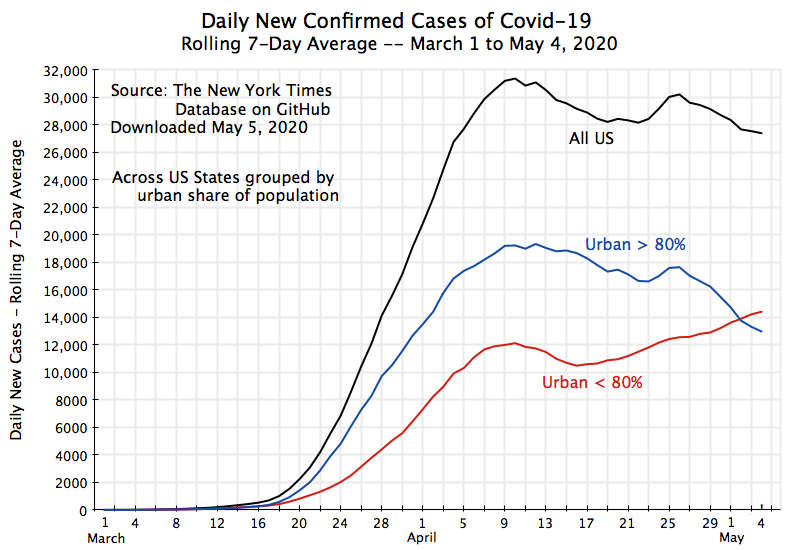
In this, it is clear that the social distancing measures did succeed in flattening and then bringing down the curve, but with an important difference between the more highly urbanized states and the less urbanized ones:

The fatality rate for the US as a whole has come down since reaching a peak of about 2,000 deaths per day in mid-April (using 7-day moving averages to smooth out day-to-day fluctuations, where the dates shown are for the end of each 7-day period).  The number of deaths then fell to just below 1,800 by May 4, a reduction of 10%.  Based in part on this, the Trump administration is now encouraging states to lift their social distancing measures so that economic activity would, they hope, then recover.

But while the number of fatalities from this disease have begun to fall in the US as a whole, this has been entirely in the more urbanized states.  Between the 7-day periods ending on April 17 and on May 4, the number of fatalities in the highly urbanized states fell by 25%.  During that same period, they rose by 15% in the less urbanized states.

While the daily number of deaths remains at this point higher in the more urbanized states than in the less urbanized ones, this might soon change:

The daily number of new confirmed cases of Covid-19 is now higher in the less urbanized states.  While the measurement of confirmed cases has been suspect (it depends on how broadly one is testing), it is better now than it was in March and even early April, when testing supplies were still limited and constrained the availability of testing.  And the chart suggests that with the number of new confirmed cases now higher in the less urbanized states than in the more urbanized ones, and still heading upwards, the number of deaths from the disease in the less urbanized states may soon be higher in absolute number.

C.  What is the Plan? 

The Trump administration, and especially Trump himself, are now encouraging states to lift their social distancing measures.  The stated aim is for the economy then to recover.  However, with all the disruption that has resulted from the failure of the Trump administration to take this pandemic seriously early on, it is far from clear that this will suffice.  The economy has been severely affected, where an astounding 30 million Americans (18% of the labor force) have already applied for unemployment insurance as of the week of April 25.  Such a sharp and rapid collapse is unprecedented.  It did not happen even in the Great Depression.

The Trump administration has argued that with the daily number of deaths from Covid-19 now falling in the US, the time has come to reopen businesses.  And a number of governors, primarily Republicans in the more rural states, have started to do this, arguing that with their more rural spaces there is no longer a need for such social distancing.  But as seen in the charts above, while the accumulated number of deaths per million from Covid-19 has often (but not always) been less in the less urbanized states, the absolute number of deaths in these states has continued to grow over the last several weeks even while they have gone down significantly in the more urbanized states.  And the number of deaths each day may indeed soon be higher in the less urbanized states than in the more urbanized ones.

But what is the plan to address this?  From all I can see, there is no plan.  The Trump administration has not set out any coherent plan to safely reopen the economy.  Rather, it has simply called for the lifting of social distancing measures while hoping for the best.

Could there be a plan?  Certainly.  As public health experts have called for from the start, and as the developed market economies of East Asia and the Pacific have demonstrated is possible, management of a pandemic requires wide testing of those who appear they may have the disease, isolation if the test proves that they do, tracing the contacts of all those found to have the disease, and then testing and quarantining for about two weeks those contacts who might have been exposed to the virus.

This can be most easily done early in the course of a pandemic, when the number of cases is relatively small.  However, in January (and still through February) Trump insisted that all was fine and under control, and little was done.  Now, with over 27,000 new confirmed cases each day (as of the week ending May 4), this will be far more difficult.  The social distancing measures were implemented to stabilize the situation and then bring this number down to more manageable levels.  But while they succeeded in bringing the total number down from its peak (the daily number of new cases had been over 31,000), it is still far too high.

In addition to bringing down the daily number of new cases to more manageable levels, the social distancing measures were also put in place to give the government time to develop the capacity then to carry out the standard public health measures of testing, isolating, contact tracing, and quarantining.  But while some states appear to be building up that capacity to the extent they can, the evidence for others is scant, and for few, if any, does the capacity appear to be anywhere close to adequate.

And what is certainly missing is any leadership at the top – from Trump and his administration.  States have rather been left largely on their own, with some assistance perhaps at the working levels but without a clear nationally-led program to build the necessary capacity.

The economy of course certainly needs to be reopened, with the social distancing measures loosened and eventually lifted.  The issue is not whether this should be done but instead under what conditions.  Rather than lead a national effort to bring down the number of daily new cases through a coherent and consistent program of social distancing measures (which may well differ between urban and rural areas, but not based on political boundaries), and using the time thus gained to ramp up the public health capacity that is required, the Trump administration has floundered, with a response that has been limited, ineffective, and rudderless.


============================================

The data underlying the chart at the top of this post:

Urban population %

Deaths per million

Vermont

17.4%

84.7

Wyoming

24.5%

12.4

Maine

26.2%

42.9

Montana

26.5%

16.2

Mississippi

27.6%

102.1

South Dakota

29.9%

25.8

West Virginia

33.2%

27.0

Arkansas

39.5%

26.1

North Dakota

40.0%

37.2

Kentucky

41.0%

58.8

Iowa

41.7%

60.4

Alaska

44.5%

9.9

Oklahoma

45.8%

63.4

New Hampshire

47.3%

65.3

Alabama

48.7%

60.7

Kansas

50.2%

49.8

Idaho

50.5%

40.8

New Mexico

53.8%

73.3

Nebraska

53.8%

42.7

Tennessee

54.4%

34.7

North Carolina

54.9%

45.7

South Carolina

55.8%

59.5

Wisconsin

55.8%

59.6

Missouri

56.6%

63.1

Minnesota

58.0%

79.0

Indiana

59.2%

174.6

Louisiana

61.3%

434.3

Oregon

62.5%

28.5

Ohio

65.3%

90.0

Georgia

65.4%

120.6

Michigan

66.4%

409.7

Delaware

68.7%

197.1

Virginia

69.8%

82.5

Pennsylvania

70.7%

223.8

Hawaii

71.5%

12.5

Washington

75.0%

124.9

Texas

75.4%

35.4

Colorado

76.9%

167.0

Illinois

80.0%

205.1

Arizona

80.1%

56.6

Utah

81.2%

18.1

New York

82.7%

990.2

Maryland

83.5%

204.7

Connecticut

84.8%

681.6

Nevada

86.5%

97.0

Florida

87.4%

73.3

California

89.7%

60.0

Massachusetts

90.3%

611.5

Rhode Island

90.5%

304.0

New Jersey

92.2%

895.3

District of Columbia

100.0%

417.1


Trump’s Incompetent Management of the Covid-19 Pandemic: The Consequences for Health

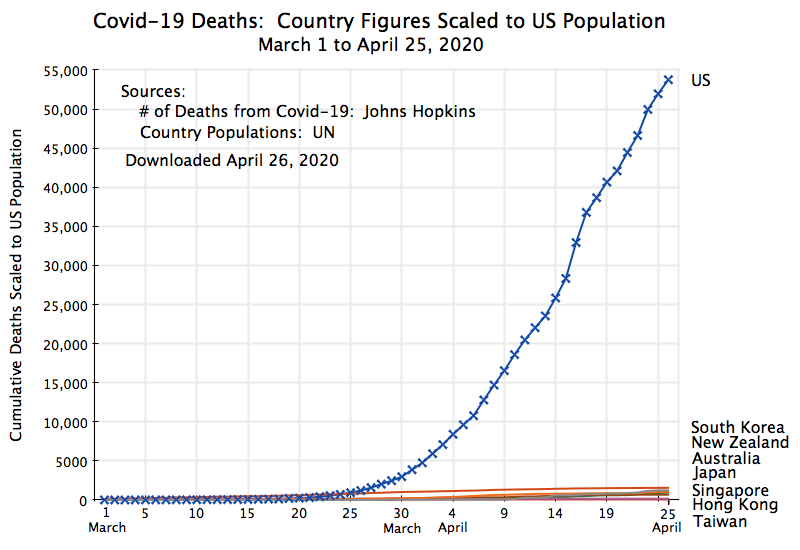
Trump and his administration have utterly mismanaged the Covid-19 pandemic.  The direct result of this ineptitude has been tens of thousands more Americans dying (already) than would have been the case had the US managed the pandemic as well as any of the developed countries of the Asia and Pacific region.  The difference is not small.  This is also not a calculation comparing what the US did to what theoretically might have been possible.  Rather, it is a comparison to what these seven countries actually achieved, facing the same virus as the US.

The chart above shows the cumulative number of deaths from Covid-19 for the US and for seven Asian/Pacific countries between March 1 and April 25, with the numbers all scaled, for comparability, to what they would have been at the US population level.  The data comes from that assembled on an on-going basis by Johns Hopkins University, where a description is available here, and the country data itself available here.  The country population figures to work out the rates per million are those reported by the UN.

US deaths from the virus totaled 53,755 as of April 25.  The figures for each of the seven Asian/Pacific countries are, at this scale, all scrunched up at the bottom of the chart and are almost indistinguishable.  Each and every one has done far better than the US.

Focusing on the figures for April 25 only, one has:

The highest number of deaths among the seven Asian/Pacific countries (when scaled to the US population) would have been South Korea at 1,562.  That is 97% less than the US had.  The levels at all the other countries would have been even lower.  The least would have been Taiwan, with just 83 deaths from the virus (99.8% less than the US), despite far closer links to China.  Not re-scaled for population, the number of deaths so far in South Korea have totaled 242.  In Taiwan, there have been only 6.

US fatalities from Covid-19 have also just passed another significant milestone.  As of April 25 they now exceed the total number of US deaths in combat during World War I:

The figures for combat deaths are all from the Department of Veteran Affairs.  The total number of deaths from Covid-19 surpassed the number of combat deaths during the entire period of the Vietnam War on April 22, and passed the number of combat deaths during the Korean War on April 16.  And Covid-19 deaths of course continue to rise.  Over the most recent week, the daily increase averaged 2,156.

Yet Trump continues to assert that he and his administration have done a superb job of managing this crisis.  If there are any issues, he has at various times asserted the blame is with China, the Chinese President Xi Jinping (whom he, at other times, lauded), the WHO, Obama, Hillary Clinton, Democratic mayors, Democratic governors, Democrats in Congress and the Senate, Democrats more generally, the news media, government civil servants (the “deep state”), and others.

But not himself.  What can he be faulted for?  David Frum (a longtime self-described “conservative Republican” who served as a speechwriter for George W. Bush, but who is now very much a critic of Trump) puts it well in an April 7 article in The Atlantic.  I will quote it at length:

“That the pandemic occurred is not Trump’s fault. The utter unpreparedness of the United States for a pandemic is Trump’s fault. The loss of stockpiled respirators to breakage because the federal government let maintenance contracts lapse in 2018 is Trump’s fault. The failure to store sufficient protective medical gear in the national arsenal is Trump’s fault. That states are bidding against other states for equipment, paying many multiples of the precrisis price for ventilators, is Trump’s fault. Air travelers summoned home and forced to stand for hours in dense airport crowds alongside infected people? That was Trump’s fault too. Ten weeks of insisting that the coronavirus is a harmless flu that would miraculously go away on its own? Trump’s fault again. The refusal of red-state governors to act promptly, the failure to close Florida and Gulf Coast beaches until late March? That fault is more widely shared, but again, responsibility rests with Trump: He could have stopped it, and he did not.

The lying about the coronavirus by hosts on Fox News and conservative talk radio is Trump’s fault: They did it to protect him. The false hope of instant cures and nonexistent vaccines is Trump’s fault, because he told those lies to cover up his failure to act in time. The severity of the economic crisis is Trump’s fault; things would have been less bad if he had acted faster instead of sending out his chief economic adviser and his son Eric to assure Americans that the first stock-market dips were buying opportunities. The firing of a Navy captain for speaking truthfully about the virus’s threat to his crew? Trump’s fault. The fact that so many key government jobs were either empty or filled by mediocrities? Trump’s fault. The insertion of Trump’s arrogant and incompetent son-in-law as commander in chief of the national medical supply chain? Trump’s fault.

For three years, Trump has blathered and bluffed and bullied his way through an office for which he is utterly inadequate. But sooner or later, every president must face a supreme test, a test that cannot be evaded by blather and bluff and bullying. That test has overwhelmed Trump.”

Since April 7 one could add much more to this list, most recently Trump’s comments at his April 23 press briefing on the possible curative effects of injecting disinfectants into the body.  Health professionals around the country scrambled to warn the public not to do this – it could be deadly – and Trump is responsible for this confusion.  Or the ousting in the last week of Dr. Rick Bright, a highly respected medical researcher with a career on vaccine development, who as the head of BARDA (the Biomedical Advanced Research and Development Authority) had a lead role in the urgent development of a vaccine for Covid-19.  The ousting of such an official in the middle of a pandemic is astonishing for any reason.  Dr. Bright, in a statement issued through his lawyers, said it was because he had resisted administration pressure to promote the anti-malarial drugs chloroquine and hydroxychloroquine that Trump had repeatedly touted, even though there was no good evidence of their efficacy.  Indeed, a recent study found that hydroxychloroquine significantly increased the number of deaths of Covid-19 patients compared to those given the usual care.

Trump, however, is unwilling to take responsibility for these repeated failures.  In a March 13 press briefing he famously said “I don’t take responsibility at all” (where this was with specific reference to the lack of adequate testing in the US for a critical two months).  Rather, it was someone else’s fault.

Leadership requires taking responsibility.  Successful presidents do.