Inflation Other Than For Shelter Has Moderated – And Shelter is Special

The Bureau of Labor Statistics released its regular monthly report on the Consumer Price Index today, with data through April 2023.  Most news reports focused – understandably – on the twelve-month change in the overall CPI as well as of the core CPI (the CPI excluding the food and energy components, as the prices of food and energy are volatile and go down as well as up).  But in looking through the figures, I came across an interesting aspect that I have not seen discussed.

Specifically, while the overall CPI index has been declining slowly (the 12-month rate ending in April was 4.9% overall – down from a peak of 8.9% in June 2022), this was mostly due to the shelter portion of the CPI.  If one excludes the shelter component of the CPI, the most recent 12-month rate was 3.4% (down from 10.6% in June 2022 – see the chart above).  Furthermore and of greater interest, the 6-month rates for the CPI excluding shelter have fluctuated between essentially zero and 2.0% since December 2022.  This has been not just a one month fluctuation:  The 6-month changes have been at annualized rates of 2.0% or less for five months now.  And the Fed’s target for inflation is 2%.

The shelter component of the CPI, in contrast, has been steadily going up (until recently) since early 2021.  It is special for a number of reasons.  One is that it is the single most important component of the CPI, with a 35% weight in the index.  In comparison, food accounts for 13% and all energy for 7%.  Second, and importantly, estimating price changes to enter into the CPI for shelter is difficult.  As explained in detail in this factsheet from the BLS, the cost of shelter that enters into the determination of a consumer price index is not (as many mistakenly assume) the cost of buying a home.  Buying a home is an investment.  Rather, what enters into the cost-of-living index is the rental equivalent cost of living there.  The BLS imputes this rental equivalent cost by gathering data on the rents in fact being charged in that geographic area, and then adjusts these to take into account differences in quality and in payments made for associated services (such as for utilities, where payments to utilities are accounted for in a different area of the CPI).

A third and very important aspect of rents (and hence the rental equivalent for owner-occupied homes) is that rents change only periodically – usually annually.  Hence when the BLS surveys what rents are being charged in some geographic zone, the rents they will record will include households whose rents have been constant for close to a year as well as some households whose rents had recently stepped up but which will now be constant for a year.  Suppose, for example, that due to pressure in the markets, rents in some area are all being raised by 12%.  This will then lead to actual changes in the rents being paid month by month as the rental contracts come up for renewal.  With the renewals more or less evenly spread over the course of a year, in the first month roughly one-twelfth of the households will see their rents rise by 12%, but the rents for the other households will remain unchanged.  Hence the overall rise in rents, as then recorded in the CPI (and reflected as well in the rental equivalent cost in owner-occupied homes) will be just 1% in the first month.  In the second month it will rise to 2% (i.e. two-twelfths of the households will be paying 12% more and ten-twelfths will still be paying the same as before), and so on until after 12 months – and only after 12 months – the increase in rents being paid by everyone in the area will be the full 12%.

Thus the shelter component of the CPI – reflecting what people are actually paying in rents (and hence also what rent is imputed to owner-occupied homes) – changes only slowly over time.  This is seen in the chart at the top of this post, and not only with the recent increases since 2021 but also in the far more steady rates seen in the years before when compared to changes in the CPI excluding shelter.  (And note that in the period of 2014 to 2020 the increases in the cost of shelter were around 3 to 4% a year, or well above the prices in the CPI excluding the shelter component:  Housing was becoming steadily more expensive compared to other items in the CPI.)

The cost of shelter then started to rise, as noted above, from early 2021.  And in terms of the 12-month rate, it has risen steadily until very recently, where it has leveled off for three months now at about 8.1%.  But there are signs that it will soon start to come down (i.e. not increase as fast).  Not only has it leveled off, but the 6-month rate (annualized) has come down from 9.0% as of January to 8.1% now.  The 3-month rate is now 7.2%, the 2-month rate is 6.0%, and the 1-month rate is 5.2% (all annualized).

This suggests that the pace of inflation in shelter costs will be declining. There will certainly be bumps up and down, and given how rents are determined, the process will be a slow one.  It built up over a two-year period (from early 2021 to early 2023) and might well take a similar period of time to come down.  There will also certainly be ups and downs in what will happen to other prices in the CPI, especially for food and energy.

But for several months now, what has been driving the CPI above the Fed target of 2% has solely been the cost of shelter.  With increases in the cost of shelter now moderating, while the non-shelter components of the CPI are already at the rates seen prior to 2020, what we are now seeing in the rates for the overall CPI basically reflect the time lags that result from long-term rental contracts.

The Sluggish Recovery: Fiscal Drag Continues to Hold Back the Economy

Recessions - GDP Around Peak, 12Q before to 22Q after

I.  Introduction

The recovery from the 2008 economic collapse remains sluggish, with GDP growing in the first half of 2013 at an annualized rate of only 1.4% (according to recently released BEA estimates).  And based on fourth quarter to fourth quarter figures, GDP grew by only 2.0% in 2011 followed by just 2.0% again in 2012.  As a result, the unemployment rate has come down only slowly, from a peak of 10.0% in 2009 to a still high 7.4% as of July.

Conservatives have asserted that the recovery has been slow due to huge and unprecedented increases in government spending during Obama’s term, and that the answer should therefore be to cut that spending.  But as has been noted in earlier posts on this blog, direct government spending during Obama’s term has instead been falling.  This reduction in demand for what the economy can produce has slowed the recovery from what it would have been.

This blog will update numbers first presented in a March 2012 post on this blog, which compared the paths of GDP, government spending, and other items in the periods before and after the start of each of the recessions the US has faced since the 1970s.  That earlier blog post looked at the paths of GDP and the other items from 12 quarters before the business cycle peak (as dated by the NBER, the entity that organizes a panel of experts to date economic downturns) to 16 quarters after those peaks (when the downturns by definition begin).  The figures were rebased to equal 100.0 at the business cycle peaks.  We now have an additional year and a half of GDP account data, so it is now possible to extend the paths to 22 quarters from the start of the recent downturn in December 2007.  This has therefore been done for all.

The conclusions from the earlier post unfortunately remain, but are even more clear with the additional year and a half of observations.  GDP growth remains sluggish, government spending has fallen by even more, and residential investment remains depressed (although it has finally begun to recover).

II.  The Path of Real GDP

The graph at the top of this post shows the path followed by real GDP in the periods from 12 quarters before to 22 quarters after the onset dates of each of the recessions the US has faced since the 1970s.  The sluggish recovery from the current downturn is clear.

The economy fell sharply in the final year of the Bush administration, and then stabilized quickly after Obama took office.  GDP then began to grow from the third quarter of 2009 and has continued to grow since.  But the pace of recovery has been slow.  By 22 quarters from the previous business cycle peak, real GDP in the current downturn is only 4% above where it had been at that peak.  At the same point in the other downturns since the 1970s, real GDP was between 15% and 20% above where it had been at the previous peak.  This has been a terrible recovery.

 III.  The Path of Government Spending

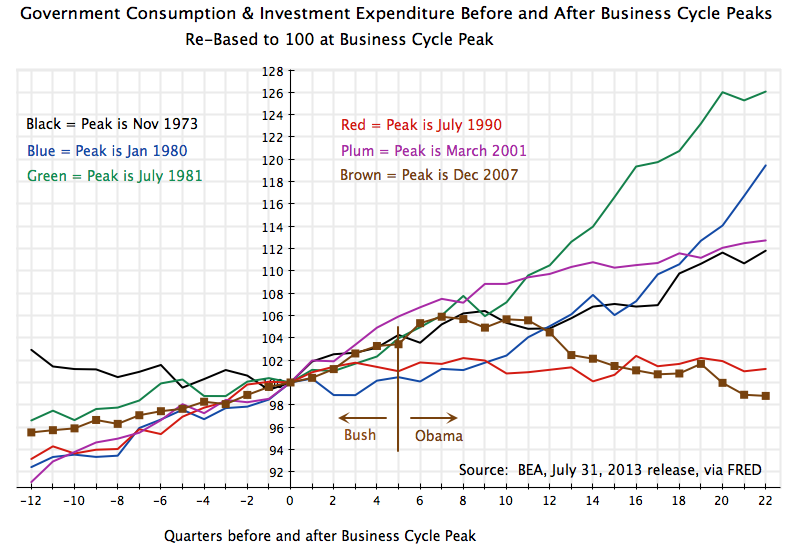
How has this recovery differed from the others?  To start to understand this, look at the path government spending has taken:

Recessions - Govt Cons + Inv Expenditures Around Peak, 12Q before to 22Q after

Direct government spending has fallen in this recovery, in sharp contrast to the increases seen in the other recoveries.  Real government spending was 26% higher by 22 quarters after the onset of the July 1981 recession (the green line) during the Reagan presidency, and 13% higher at the same point in the recovery from the March 2001 recession (the plum colored line) during the Bush II presidency.  While both Reagan and Bush claimed to represent small government conservatism, government spending instead rose sharply during their terms.

In contrast, in the current downturn direct government spending is now 1.2% below what it had been at the start of the recession in December 2007.  Furthermore, it is worth noting that while it rose in the final year of the Bush presidency and then in the first half year after Obama took office (a major reason why the recovery then began), it has since fallen sharply.  Government spending is now almost 7% below where it had been in mid-2009, a half year after Obama took office.  Such a decline (indeed no decline) has ever happened before, going back at least four decades, as the economy has struggled to recover from a recession.  The closest was during the Clinton years, when government spending was essentially flat (a 1% increase at the same point in the recovery).

Note that the measure of government spending shown here is that for total government spending on consumption and investment (i.e. all government spending on goods and services).  This is the direct component of GDP.  Government spending can also be measured by including transfer payments to households (such as for Social Security or unemployment insurance), but as was noted in the earlier blog post from March 2012, the results are similar.  Note also that the government spending figures include spending at the state and local levels, in addition to federal spending.  While we speak of government spending as taking place during some presidential term in office, the decisions are made not simply by the president but also by many others (including state and local officials, and the Congress) in the US system.  But the president at the time is typically assigned the blame (or the credit) for the outcome.

IV.  The Path of Residential Investment

The current downturn and recovery also differs from the others by the scale of the housing collapse, and consequent fall in residential investment:

Recessions - Residential Investment Around Peaks, 12Q before to 22Q after

The build up of the housing bubble from 2002 to 2006 was unprecedented in the US, and the collapse then more severe.  As the graph above shows, there has been a start in the recovery of residential investment from the lows it had reached in 2009 / 2010, but it is still far below the levels seen in previous downturns.

Housing had been overbuilt during the bubble in the Bush years, leaving an oversupply of housing once the bubble burst.  And while supply was in excess, demand for housing was reduced due to the severe recession.  As was discussed in an earlier blog post on the housing crisis, the result was a doubling up of households as well as delays in household formation as young adults continued to live with their parents.  Residential investment therefore collapsed, and has recovered only very slowly.

V.  The Path of Household Debt

The housing bubble also led to over-indebtedness of households.  Nothing of this sort at all close to this scale had ever happened before in the US.  With the lack of regulation and oversight of the financial sector during the Bush administration, banks and other financial entities launched and aggressively marketed and sold financial instruments that led to a bidding up of home prices.  But these new financial instruments were only viable if housing prices continued to rise forever.  When the housing bubble burst, widespread defaults followed.  And those households who did not default struggled to pay down the debts they had taken on, for assets now worth less than the size of the debts tied to them.

The result was a sustained fall in household debt (three-quarters of which is mortgage debt) in the period of the downturn:

Recessions - HH Debt Around Peak, 12Q before to 22Q after

This pay-down of debt had never happened before, and is in stark contrast to the rise in household debt seen in all the other downturns of the last four decades.

VI.  The Path of Personal Consumption Expenditure

Households struggling to pay down their debt have to cut back on their consumption expenditures.  This brings us to the last element of the current recovery I would like to highlight:  the especially slow recovery in household consumption.  That path of consumption during the current downturn stands out again in contrast to the paths followed in the other downturns and recoveries of the last four decades in the US:

Recessions - Personal Consumption Around Peaks, 12Q before to 22Q after

The difference is stark.  Households could spend more in the prior recoveries in part because they could continue to borrow (see the graph on household debt above).  In this recovery, households have instead had to pay down the debts they had accumulated in the housing bubble years, and could increase their household consumption only modestly.

VII.  Conclusion

The recovery in the current downturn has been disappointing.  GDP has grown since soon after Obama took office, but has grown only slowly, and has been on a path well below that seen in other recoveries.

There are a number of reasons for this.  Household consumption has kept to a low path as households have struggled to repay the over-indebtedness they had accumulated during the housing bubble years.  Residential investment collapsed as well following the bubble, is only now starting to recover, and remains far below the levels seen at similar points in other recoveries.
And government spending has been allowed to fall during Obama’s term.  This had never happened before in the previous downturns.  Indeed, while real government spending rose by 26% at the same point in the economic recovery during the Reagan presidency, it has been reduced by over 1% in this recovery (and reduced by 7% from what it had been a half year after Obama took office).
The reduction in government spending reduced the demand for what the economy could have produced.  In this it was similar to the reduced demand resulting from lower residential investment or lower household consumption expenditure.  All these reductions in demand reduced GDP, reduced the demand for workers, and hence increased unemployment.  But while residential investment and household consumption can only be influenced indirectly and highly imperfectly by government policy, government has direct control over how much it spends.  That is, government can decide whether to build a road or a school building, and doing so will employ workers and will lead to an increase in GDP.  Hence government spending is a direct instrument that can be used to raise growth and employment, should the government so choose.
Sadly, and in stark contrast to the sharp increase in government spending during the Reagan period that spurred the recovery to the 1981 downturn, US politics during the Obama presidency have instead led to a cut-back in government spending, with a resulting drag on growth.  The disappointing consequences are clear.

New Housing Starts, While Better, Are Still Depressed

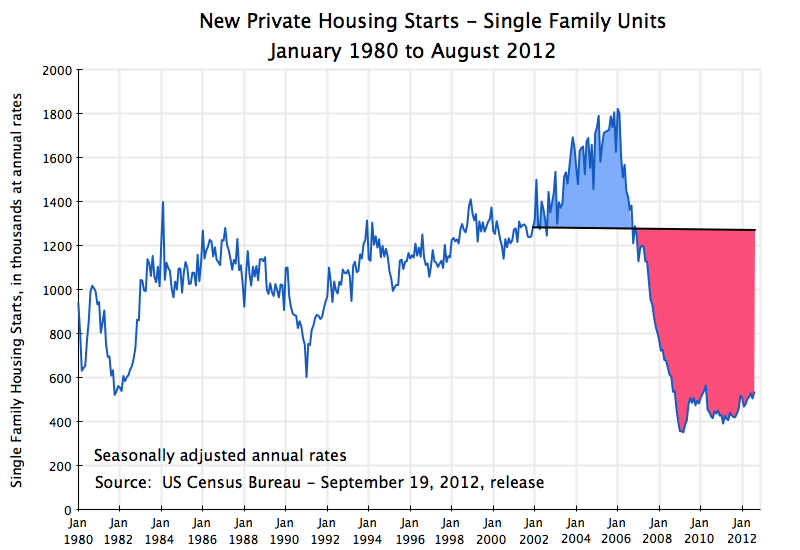
US housing starts, private single family homes, January 1980 to August 2012The US Census Bureau released this morning its regular monthly report on US housing starts.  News reports were positive, noting that housing starts are rising and are now well above where they were.  Starts on private single family homes in August grew by 27% over what they were a year ago to a pace of 535,000 (at a seasonally adjusted annual rate), while starts on all private housing units, including multi-family units such as apartments, grew by 29% over the year ago figure to a pace of 750,000.

Such growth rates are substantial.  But looking at the figures over a longer period than just a year shows that the increases, while welcome, are not as strong as they would appear.  The housing market remains depressed, with housing construction still far below what a more normal level might be, and even further below where it was during the 2002 to 2006 housing bubble.  The graph above puts the recent figures in the longer term context.

The graph shows how new private housing starts (monthly, but at seasonally adjusted annual rates) have moved since 1980.  Housing starts can be volatile, but they have never been so volatile (going back to 1980) as the recent boom and collapse.  The housing bubble started to build in early 2002, and new starts reached an annualized (and seasonally adjusted) peak of over 1.8 million new units in January 2006.  They then fell steadily, and the collapse in the housing market was the major underlying cause of the overall economic collapse in 2008, in the last year of the Bush Administration.  They reached a trough of 358,000 in January 2009, the month Obama was inaugurated, a fall of 80% from the peak.  Since then they have increased, to 535,000 last month, but remain far below what they had been.

A recovery to the previous bubble peak would be unwarranted (on a sustained basis), as it was the build-up of an excess supply of housing which led to the bubble collapsing.  But the American population continues to grow and needs housing, and it is clear that the current pace of construction is insufficient (based on historical patterns).  Prior to 2002, new housing starts was on an upward trend, but at a moderate pace.  But to keep things simple and conservative, one can take as a reasonable floor of where housing starts need to be as the average in 2001, when 1.27 million units were started.

Based on this conservative benchmark, the new housing starts of 535,000 single family homes in August 2012 would need to increase by a factor of  almost 2 1/2 to return to a more normal level.  While this is better than where it was last year in August (when it would have had to triple to reach the benchmark), it still has a long way to go.

But as has been noted previously in this blog (see the posts here and here), the shortfall in home construction since the collapse of the bubble indicates suggests a substantial potential, once housing begins to recover.  (Note that these earlier blog posts focused on new home sales, while the current post focuses on the broader concept of new home starts.  The starts figure includes starts of home units that would not only be sold, but also those which would eventually be rented, whether by original intention or because the new home could not be sold, plus homes which were built by or for a specific owner.)  The need for new homes remains, as the population continues to grow.  In the short-run, families double up, or adult children continue to live with their parents, as was discussed in the blog posts cited above.  But as soon as they are able, these people want to buy their own homes.

Based on a 1.27 million units per year norm, the graph above shows the excess of new homes (shaded in blue) between 2002 and late 2006, and then the deficiency (shaded in red) since then to now.  Based on this norm, the excess of housing started during the bubble totaled 1.3 million units over the full period.  This excess has now been more than worked off.  The cumulative shortfall (shaded in red) comes to 3.9 million units, or triple the previous excess.  Stated another way, there is now a shortfall of a net 2.6 million single family housing units.  There will be pressure to catch up on this once the economy, and the housing market, begins to recover.

Such a catch-up on the accumulated short-fall in new home construction of recent years could serve as a significant stimulus to the economy, as was discussed in the blog posts cited above.  Other commentators, such as Paul Krugman recently, have noted this as well.  But while such a stimulus to demand would be welcome, one needs also to recognize that fiscal drag has been quantitatively more important than the collapse in residential construction in explaining the lack of a strong recovery from the 2008 collapse.  This was discussed in a posting on this blog from last March.  Residential construction is only 2.4% of GDP currently, down from over 6% of GDP at the peak of the bubble, and about 4% of GDP in more normal times.  Government consumption and investment (as in the GDP accounts) is about 20% of GDP, and total government spending (including transfer payments, such as for Social Security or Medicare) is 36% of GDP.  Government is a much larger share of the economy than is residential construction.  Because of this, reversing the fiscal drag resulting from the scaling back of government expenditures in recent years (particularly at the state and local level) and allowing it to grow as it had during the Reagan years, would add more to the economy than a recovery in housing, welcome as a recovery in housing would be.  Numbers are provided in the March post cited above.

In summary, while there have been recent positive signs, housing construction remains depressed.  However, because housing construction has been so depressed for so long, there is now a shortfall in housing units relative to what is needed for a growing population.  Hence a recovery in new home construction should be expected as the economy begins to recover, and could lead to a doubling or tripling of new home construction from where it is now.  This would be a welcome stimulus to the economy.  But welcome as this would be, allowing government expenditures to recover would make an even larger contribution.