Why Wages Have Stagnated While GDP Has Grown: The Proximate Factors

Real GDP per Capita & Median Weekly Earnings, 1980-2013

A.  Introduction

A healthy debate appears to be developing in the run up to the 2016 elections, with politicians of all parties raising the issue of stagnant wages.  Republicans have charged that this is a recent development, and the fault of Obama, but that is certainly not the case.  As the diagram above shows, real median wages have been stagnant since at least 1980, despite real GDP per capita which is 78% higher now than then.  Real median wages are only 5% higher (and in fact unchanged from 1979).  In a normally developing economy, one would expect real GDP per capita and real wages to move together, growing at similar rates and certainly not diverging.  But that has not been the case in the US since at least the early 1980s.

Why has such a large wedge opened up between worker earnings and GDP per capita?  This blog post will look at the immediate factors that lead from one curve to the other.  This will all be data and arithmetic, but will allow one to decompose the separation into several key underlying factors.  A future blog post will look at policies that would address those factors.

B.  Moving from Growth in GDP per Capita to Stagnant Real Wages

The progression from GDP per capita to real wages, with intermediate steps shown, looks as follows:

Going from GDP per Capita to Median Wage, 1947 to 2013:14

The chart here goes back further, to 1947, to show the divergence in recent decades in a longer term perspective.  The data come from the Bureau of Economic Analysis (BEA) or the Bureau of Labor Statistics (BLS).  As one sees, the curves moved together until around the mid-1970s, after which they began to diverge.

1)  Real GDP per Capita

Starting at the top, real GDP per capita (the curve in blue) measures the progression, in real terms, of GDP per person in the US.  GDP captures the value of all goods and services produced in the economy.  Its price index, the GDP deflator, is a price index for all those goods and services.  Although there have been temporary dips with periodic recessions, real GDP per capita has in fact grown at a remarkably stable long term rate of about 1.9% per annum going back all the way to 1870.  The growth rate was in fact a bit higher, at 2.0%, from 1947 to 2014, as the 1947 starting point was somewhat below the long term trend.  With this growth, real GDP per person was 3.75 times higher in 2014 than what it was in 1947.

2)  Real GDP per FTE Worker

But wages are paid to individual workers, and the share of workers in the population can change over time.  The share has in fact grown significantly over the post-war period, and in particular since about the mid-1960s, principally due to women entering the labor force.  There will also be demographic effects leading to changes in the shares of the very young and of retirees.

With a growing share of the population in the labor force, real GDP per full time equivalent (FTE) worker (the measure of the labor force used by the BEA) will grow by less than it will per person in the population.  The path of real GDP per FTE worker (the curve in green in the chart above), will rise more slowly than the path for real GDP per capita.  The curves start to diverge in the mid-1960s, when large numbers of women began to enter the labor force.

It should also be noted that the divergence in the two paths will not necessarily continue forever.  Indeed, the paths have in fact grown broadly in parallel from around 1997 until 2008 (when GDP per capita dipped in the downturn that began in the last year of the Bush administration).  The number of women entering the labor force reached a peak as a share of the labor force around 1997, and a decade later the first of the baby boomers started to retire.

Thus while such demographic factors and labor force participation decisions led to a significant divergence in the two paths (between GDP per capita and GDP per FTE worker) from the mid-1960s to the late-1990s, the impact since then has been broadly neutral, and might in fact go the other way going forward.

3)  Average Real Wages using the GDP Deflator

Next, workers are paid wages, not units of GDP.  Wages and salaries made up roughly half of GDP in 1947, with most of the rest accounted for by profits to capital.  And it stayed in the narrow range of 49 to 51% of GDP continuously until 1974.  The share then fell to 48%, where it held until 1981, and then began to deteriorate much more sharply, to just 42% as of 2013 (the most recent year with this data).

If the share of wages in GDP had remained constant, then the growth of wages per FTE worker would have exactly matched the growth of GDP per FTE worker.  But with a declining share of wages in GDP (with a growing share of profits as the mirror image), the curve (shown in brown in the chart above) of wages per FTE worker will rise by less than the curve of real GDP per FTE worker.

4)  Average Real Wages using the Consumer Price Index

The curves so far have been measured in real terms based on the GDP deflator.  The GDP deflator is a price index that takes into account all goods and services produced in the economy, and the weights in the price index will be in accordance with the shares of each of the goods or services in the overall economy.  But to an individual, what matters is the prices of goods and services that he or she buys.  This is measured by the consumer price index (cpi), where the weights used are in accordance with the expenditures shares of households on each of the items.  These weights can be significantly different than the weights of the items in GDP, as GDP includes more than simply what households consume.

The curve in orange in the chart above is then the average real wage but with the cpi rather than the GDP deflator used to account for inflation.  From 1978 onwards, the average real wage based on the cpi grew by significantly less than the average real wage measured in terms of the GDP deflator.  That is, inflation as measured by the items that make up the cpi grew at a faster rate, from 1978 onwards, than inflation as measured by the items (and their weights) that go into the GDP deflator.  Up until 1978, the cpi and the GDP deflator grew at remarkably similar rates, so the two curves (brown and orange in the chart) follow each other closely up to that year.

What happened after 1978?  The prices of several items whose weight in the cpi is greater than their weight in the GDP deflator began to rise more rapidly than other prices.  Especially important was the rise in medical costs in recent decades, but also important was the rise in housing costs as well as energy (with energy increases already from 1974).

Thus wages expressed in terms of what households buy (the cpi) rose by less, from 1978 onwards, than when expressed in terms of what the economy produces overall (the GDP deflator).

5)  Median Real Wages using the Consumer Price Index

The final step is to note that average wages can be misleading when the distribution of wages becomes more skewed.  If the wages of a few relatively well off wage earners (lawyers, say) rise sharply, the average wage can go up even though the median wage (the wage at which 50% of the workers are earning more and 50% are earning less) has been flat.  And that median wage is what is shown as the red curve in the chart.

[Technical Note:  The median wage series used here is the median weekly earnings of full time workers, adjusted for inflation using the cpi.  The series unfortunately only starts in 1979, but is the only series on the median, as opposed to average, wage I could find that the BLS publishes which goes back even as far as that.  The source comes from the Current Population Survey, which is the same survey of households used to estimate the nation’s unemployment rate, among other statistics.]

Since 1980 (and indeed since 1979, when the series starts), the median real wage has been flat.  This is not a new phenomenon, that only began recently.  But it is a problem nonetheless, and more so because it has persisted over decades.

C.  The Astounding Deterioration in the Distribution of Income Since 1980

Aside from demographic effects (including the impact of women entering the labor force), and the differential impact of certain price increases (medical costs, as well as others), the reason median real wages have been flat since around 1980 despite an increase of real GDP per capita of close to 80% over this period, is distributional.  The share of wages in GDP has been reduced while the share of profits has increased, and the distribution within wages has favored the better off compared to the less well off (leading to a rise in the average wage even though the median wage has been flat).

That is, the US has a distribution problem.  Wages have lost relative to profits (and profits largely accrue to the rich and wealthy), and the wages of lower paid workers have fallen even while the wages of higher paid workers have risen.

There are therefore two reasons for the distribution of income at the household level to have deteriorated since 1980.  And one sees this in the data:

Piketty - Saez 1945 to 2012, Feb 2015

This is an update of a chart presented in an earlier post, with data now available through 2012, and with the period from 1945 to 1980 included on the same chart as well.  The data came from the World Top Incomes Database (now part of the World Inequality Database), which is maintained by Thomas Piketty, Emmanuel Saez, and others.  The data is drawn from individual income tax return filings, and thus the distribution is formally by tax reporting unit (which will normally be households).  The incomes reported are total taxable incomes, whether from wages or from capital.

Over the 33 years from 1947 to 1980, average reported taxable incomes rose in real terms (using the cpi price index to adjust for inflation) by 87%.  The incomes of the bottom 90%, the top 10%, and the top 0.01%, rose by almost exactly the same amount, while the incomes of the top 1% and top 0.1% also rose substantially (by 57% and 63% respectively).  It is amazing how close together all these figures are.

This changed dramatically from 1980.  As the chart above shows, the curves then started to diverge sharply.  Furthermore, the average reported income rose only by 24% over 1980 to 2012, even though real GDP per capita rose by 73% over this period.  The 24% average increase can be compared to the 28% increase over the same years in the average real wage (based on the cpi).  While from two totally different sources of data (income tax returns vs. the national income accounts of the BEA) and measuring somewhat different concepts, these are surprisingly close.

But while average real incomes per household rose by 24%, the bottom 90% saw their real incomes fall by 6%.  Instead, the rich gained tremendously:  by 80% for the top 10%, by 178% for the top 1%, by 312% for the top 0.1%, and by an astounding 431% for the top 0.01%.

The US really does have a distribution problem, and this deterioration in distribution largely explains why real median wages have stagnated since 1980, while real GDP per capita grew at a similar rate to what it had before.

D.  Summary

To summarize, in the post-war period from 1947 to about the mid-1970s, measures of real income per person grew substantially and at similar rates.  Since then, real GDP per capita continued to grow at about the same pace as it had before, but others fell back.  The median real wage has been stagnant.

One can attribute this to four effects, each of which has been broadly similar in terms of the magnitude of the impact:

a)  Real GDP per worker has grown by less than real GDP per capita, as the share of those working the population (primarily women) has grown, with this becoming important from around the mid-1960s.  However, there has been no further impact from this since around 1997 (i.e. the curves then moved in parallel).  It may be close to neutral going forward, but was an important factor in explaining the divergence in the period from the mid-1960s to the late-1990s.

b)  The average real wage (in terms of the GDP deflator) has grown by less than real GDP per worker, as the share of GDP going to wages has gone down while the share going to profits (the mirror image) has gone up, especially since about 1982.

c)  The average real wage measured in terms of the cpi has grown by less than the average real wage measured in terms of the GDP deflator, because of the rising relative price since 1978 of items important in the household consumption basket, including in particular medical costs, but also housing and energy.

d)  The median real wage has grown by less than the average real wage (and indeed has not grown at all since the data series began in 1979), because of increasing dispersion in wage earnings between the relatively highly paid and the rest.

The implication of all this is that if one wants to attack the problem of stagnant wages, one needs to address the sharp deterioration in distribution that has been observed since 1980, and secondly address issues like medical costs.  Medical costs have in fact stabilized under Obama, as was discussed in a recent post on this blog.  But while several of the measures passed as part of the Affordable Care Act (aka ObamaCare) have served to hold down costs, it is too early to say that the previous relentless upward pressure of medical costs has ended.  More needs to be done.

Future blog posts will discuss what policy measures could be taken to address the problem of stagnant real wages and the deterioration in the distribution of income, as well as what can be done to address medical costs.

The Kansas Red State Experiment is Failing: Drastic Tax Cuts Have Not Led to Higher Employment Growth

State Employment Growth Relative to US, Kansas and others, Jan 2011 to Aug 2014

A.  Introduction

Republican Sam Brownback was elected governor of Kansas in 2010 and is now running for re-election.  An extreme Tea Party conservative, he has pursued a radically right-wing agenda in Kansas with little constraint from a Republican controlled state legislature (especially after he led a successful effort to purge relative moderates from his party by more extreme conservatives in the 2012 primaries).

Central to his program were drastic tax cuts enacted in 2012, with a further round of cuts in 2013.  They were one of the largest tax cuts ever enacted by a state in percentage terms, and were labeled by Brownback to be a “real live experiment” of the conservative vision of small government leading to fast growth.  The tax cuts would be like a “shot of adrenaline into the heart of the Kansas economy” he asserted, employment would boom, and the faster growth would lead to greater total tax revenues generated (despite the lower rates) due to a then larger economy.

But it has not happened.  Employment in Kansas has fallen relative to the rest of the US since Brownback took office.  This post will first describe in more detail the tax cut measures, and will then look at the impact on employment.

B.  The Brownback Tax Cuts

The tax cut measures have (so far) come in two major waves.  The first were passed in early 2012 and signed into law by Brownback in May 2012.  The second were passed and signed in mid 2013.  The first were the more important, and included:

a)  Cuts in personal income tax rates, especially for those in the higher brackets:

Income Bracket Old Rate New Rate % change
>$60,000 6.45% 4.90% -24.0%
$30,000 – $60,000 6.25% 4.90% -21.6%
<$30,000 3.50% 3.00% -14.3%

b)  Elimination of state business taxes for most companies in Kansas.  This covered over 200,000 firms in the state, and while purportedly aimed only to benefit small businesses, the definition included at least several of the subsidiaries of Koch Industries (owned by the multi-billionaire Koch brothers, which is based in Kansas and which has provided strong financial support to the campaigns of Brownback and other Tea Party favorites).  No other state has eliminated such taxes.

c)  And partially offsetting the personal income tax cuts, the state sales tax rate was raised.  Such a tax increase affects the poorest the most.

Tax rates were then cut further in 2013.  Among other measures, the rate for the top personal income tax bracket is being phased down from the 4.9% of the 2012 law to just 3.9% by 2018, a cut of over 20%.

The Institute on Taxation & Economic Policy along with the Center on Budget and Policy Priorities has calculated the impact of these tax changes by household income category.  They are hugely regressive.  The figure below (calculated from the ITEP and CBPP figures) shows the impact as a percentage of taxes previously due.  While the combined effect of the tax changes will lead to a 37% reduction in taxes due for the richest 1% in Kansas (whose average household income in 2010 was $1.025 million), the poorest 20% have seen their taxes go up by 14%:

Impact of Kansas 2012 and 2013 Tax Cuts by Income Category

And the regressive tax cuts came on top of a system that already taxes the poor more than the rich.  The poorest 20% will now be paying close to 11% of their income in state and local taxes in Kansas.  Those in the middle (between the 20th to the 80th percentiles) will be paying between 8 and 9%.  But the richest 1% will be paying less than 4%.

The tax cuts have not, however, led to an increase in government revenues.  As will be discussed below, employment has not gone up as a result of the cuts.  Rather, tax cuts have led to cuts in tax revenues received.  While most of us would find this not at all surprising, Brownback was advised by Arthur Laffer, famous for the so-called Laffer Curve, which posits that tax cuts will lead to such an increase in employment and income that tax revenues will rise despite the lower rates.  It has not happened.

A recent report from the Rockefeller Institute of Government found that state tax revenues in Kansas between the second quarter (April to June) of 2013 and the second quarter of 2014 fell by 22% in total, and fell by 43% for the state personal income tax only.  These reductions were larger than in any of the other 50 states.  The 2012 tax cuts went into effect as of January 1, 2013, and the taxes collected in the second quarter of that year will then mostly reflect what was due on incomes earned in 2012.  The reduction in revenues due and collected in the second quarter of 2014 (primarily on incomes earned in 2013) will then represent the first year impact of the 2012 law.

The reduction in tax revenues generated as a consequence of the sharp tax rate cuts should surprise few.  The non-partisan Legislative Research Department of the Kansas state legislature has estimated that, as a consequence of the tax cuts, state revenues will fall by an estimated $730 million in FY14, and by a cumulative $5.2 billion by FY18.  These are large amounts for a small state.  The predictable result has been sharp cuts in the government budget.  Much of this has been borne by education, which is close to inevitable simply because it constitutes such a large share of the state budget.  State funding for K to 12 education has been cut by over 15% during Brownback’s term in office, and he has proposed another 2% cut for FY2015.

Despite such expenditure cuts, the state budgetary situation is now precarious.  This has led to cuts in Kansas government bond ratings by Moody’s and S&P.  It will now be more expensive for Kansas to borrow for public investment and other needs.

C.  Impact on Kansas Employment

Governor Brownback claimed that the massive tax cuts would lead to a boom in Kansas employment.  The chart at the top of this post shows that relative to the United States as a whole, as well as relative to such Democratically controlled states as Colorado, California, Minnesota, and Massachusetts, Kansas has lagged since Brownback was inaugurated (in January 2011).  The data is from the Bureau of Labor Statistics.  The states chosen reflect two near-by states to Kansas with important agricultural sectors and with also Democratic control of the state political machinery (Democratic governors as well as Democratic majorities in both chambers of the state legislatures:  Colorado and Minnesota), and two normally Democratic states from the two coasts who are often charged as having especially high state tax rates (California and Massachusetts)

The chart shows what has happened to employment in each state expressed as a share of total US employment, normalized so that the January 2011 shares are all set to 100.  Thus it will show whether employment in the state grew at a faster, or a slower, pace than overall employment in the US.  The share will go up if employment in the state grows at a faster pace than in the US as a whole, and the share will go down if employment in the state grows more slowly.

Kansas has not performed well.  Its share in US employment has fallen, and more or less consistently fallen, since Brownback took office.  There is no indication that the massive tax cuts, passed into law in May 2012 and expected well before, have led to employers shifting to the state or expanding there.  In contrast, the Blue States of Colorado and California have done especially well, while the Blue States of Minnesota and Massachusetts have seen employment grow at roughly the same pace as the US as a whole.

D.  What This Does and Does Not Say

There is thus no evidence that the massive tax cuts Brownback was able to have enacted have led to the boom in employment he asserted would follow.  It was not a “shot of adrenaline into the heart”, as he asserted it would be.  But it is also important to be clear on what the evidence we have so far does not say:

a)  First, while there is no evidence that the tax cuts led to a boom in employment, there is also no clear evidence that the tax cuts led (at least so far) to major reductions in employment.  Rather, employment in Kansas has trended steadily downwards over this period relative to the rest of the country, with the tax cuts having little effect one way or the other.  State level employment depends on many things, and the state tax regime does not appear to be a terribly important one.  What matters more will likely be state structural issues, such as the mix of particular industries in the state (including agriculture), the age distribution of the population in the state, the mix of high skilled vs. low skilled workers in the state, and so on.

b)  While Kansas performed poorly relative to the other states depicted in the chart above, there were fifteen states that did even more poorly than Kansas over this period.  Overall US employment grew by 6.4% over this period as a whole (1.75% at an annualized rate), while employment in Kansas grew by only 3.7% (1.0% annualized).  But of the 50 states, employment growth was worst in Alaska, with growth of only 1.6% over the period (0.4% annualized).  As noted above, state specific structural issues will matter.

c)  Finally, one should recognize that the period so far has been short.  While Brownback can clearly no longer claim that there will be an immediate or even near-term positive impact on employment, he is (not surprisingly) now claiming that it will take more time.  One can of course not disprove this until more time has passed, but the question is how long does one need before one recognizes the failure.  But we do know that the tax cuts have devastated state finances, leading to the rating downgrades and to budget cuts that are slashing expenditures in important areas such as education.  There is good reason to expect that such cuts in education will have adverse impacts on employment in the longer term.  When the current generation of students graduate, a larger share will not have the level of skills required for good jobs, if any jobs.  Potential employers will shun a state where they cannot hire staff with the skills they need.  I would wager that the long term impact will be negative, not positive.

But what one can say now with confidence is that the evidence is clear that massive tax cuts of this Red State “experiment” have not led to a near term boom in jobs.  It is also clear that such tax cuts do lead to cuts, not increases, in tax revenues.  The experiment has failed to fulfill the claims originally set out for it.

At One Time, You Could Work Your Way Through College – But Not Any More.

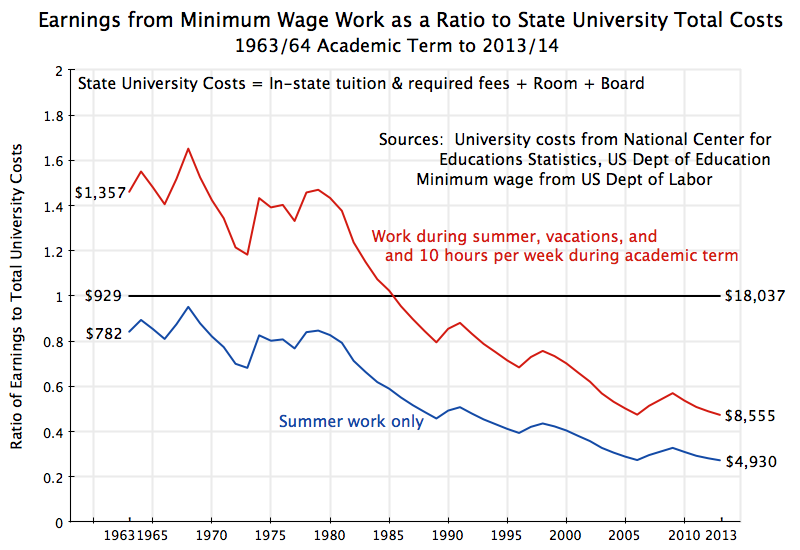
Earnings from Min Wage vs. University Costs, 1963-2013


At one time, not that long ago, a student could work at a minimum wage job over the summers and during holidays, and be able to cover the total cost (including room and board) of attending a four-year state university.  That is now far from possible.

With students now returning to school, it is perhaps a good time to look at what has happened to the affordability of college in recent decades for middle class families.  The chart above provides one indicator.  It compares what a student could earn in a summer job at the minimum wage, or in year-round work at the minimum wage while attending school (i.e. during summers, holidays, and part time during the academic term), as a ratio to what it would cost to attend a four-year state university.

The state university costs are for in-state tuition and required fees, plus the cost of on-campus room and board.  The figures are from the National Center for Education Statistics of the US Department of Education (with figures for 2013 calculated based on the 2012 to 2013 growth in the College Board estimates).  The university cost figures are for four-year, degree granting, state colleges and universities (i.e. they do not include two-year community colleges), and cover all such state schools.  The cost of attending the elite state schools (such as Berkeley, UVA, or the University of Michigan) would be more.  The years shown on the chart are for the beginning of the respective academic years (i.e. 2013 is for the 2013/14 academic year), and the minimum wage rate used is that which was in effect in July of that year.

The chart indicates that one could have covered the cost of attending a state university in the 1960s and 70s solely through minimum wage work.  Based on just a 17 week summer break, one would have earned enough to cover an average of 82% of the full cost of attending school.  An industrious student working full time over the summer and during vacation breaks (such as Christmas), plus 10 hours per week during the academic term, would have been able to cover the full cost and more – an average of 143% of the cost of school.  Hence summer work plus a bit more during vacations would have sufficed to cover the full cost of college.  In terms of dollar figures, the full cost of attending a state university in 1963/64 would have been $929, in the then current dollars.  A student could have earned $782 just from working at minimum wage over the summer, or $1,357 by working at minimum wage over the summer, during vacations, and 10 hours per week during the academic term.

These are, of course, just simple indicators.  One might have been able to earn more than the minimum wage, and/or worked a different number of hours.  But the point is that in the 1960s and 70s, when baby boomers such as myself were going to college, it was possible for the student alone, simply by working at the minimum wage, to have paid for the full cost of attending a four-year state university.

That began to change in the 1980s, as Reagan took office.  The change is indeed striking.  Affordability then began to fall, and it has fallen steadily since, as seen in the chart above.  By 1986, a student working even full time over the summer and during vacation breaks, and 10 hours a week during the academic term, no longer would have been able to cover the full cost of attending school.

The share of schooling costs that could be covered by work then continued to decline (with some bumps up when the minimum wage was sporadically changed) until the present day.  By 2013, summer work would only cover a quarter of the cost of schooling, while more comprehensive work over the entire year would only cover less than half.  In dollar terms, the average cost of attending a state university (for tuition, room, and board) was $18,037 per year in 2013.  But a student working over the summer at the minimum wage would have only been able to earn $4,930, or only a bit over a quarter of the cost of attending school.  Working full time over the summer and during vacations, plus 10 hours per week during the academic term, the student could have only earned $8,555, or less than half the cost of attending school.

As a consequence, students must now rely on their parents (when their parents can afford it), or a scarce number of scholarships (highly limited, especially for state schools), or on student loans.  Otherwise, they must give up on attending university.

The result has been an explosion in student loan debt outstanding.  As of June 30, 2014, student loan debt totaled an estimated $1,275 billion (based on Federal Reserve Board estimates), or five times the level outstanding in 2003 of $250 billion (the earliest figures I could find on a comparable basis; the amounts were so small earlier, that the Fed did not separately break them out).  Student loans have long been common in the US (I had them when I went to school in the early 1970s).  But the amounts outstanding then were relatively small, were at low interest rates, and were for most of us easily manageable.  It is different now.  Student loan debts have exploded in recent years, with a five-fold increase over just the past decade.

The declining affordability of college by this measure is of course a consequence of what has been happening to the two components of the measure.  One has been the unwillingness of Congress to allow the minimum wage to keep up with inflation.  As noted in an earlier post on this blog, the minimum wage in the US has stagnated over the last half century, and is indeed lower now (in real terms) than it was in 1950, when Harry Truman was president.  Real GDP per capita is 3.5 times higher now than it was in 1950, and real labor productivity has increased similarly.  These are not small increases.  I find it amazing (and shameful) that the real minimum wage is lower now than it was then.

For the period since 1963 (the earliest date in the chart), real GDP per capita and real labor productivity are both now 2.7 times higher than what they were then.  But the real minimum wage is close to 20% less now than it was in 1963.

The fall in the real minimum wage fall since the 1960s is half the story.  Note that the inflation measure used for determining the real minimum wage is the general consumer price index (the CPI).  This is the price index for the overall basket of goods and services a US household will purchase.  But the price index is an average over all the goods and services that households buy, and individual items can have price increases that are more than, or less than, this overall average.

In particular, the cost of attending a state university has increased by a good deal more than the overall CPI.  Based on the overall CPI, the real cost of attending a state university (for tuition, room, and board) is now 2.5 times what it was in 1963.  The cost of the tuition component alone is now 4.5 times higher.  The basic cause has been the cutbacks in state budgetary support for their colleges and universities, with tuition and other charges then increased to make up for it.

As a result, the minimum wage has fallen in real terms (based on the overall CPI) since the 1960s, at the same time that the real cost of attending school (relative to the overall CPI) has increased sharply.  The two factors together account for the steep fall in the share of state university costs that one can pay for by working at the minimum wage.  The curves in the chart at the top of this post show that path.

It is important to recognize that this declining affordability of attending state schools was not inevitable, but rather the result of policy choices.  The minimum wage has not been adjusted to reflect general inflation, even though real GDP per capita and labor productivity have both grown substantially.  And as was discussed in another post on this blog, there is no evidence that raising the minimum wage by the modest amounts now being discussed would lead to adverse effects on employment.

Government support for state colleges and universities has also been scaled back, leading to tuition and other cost increases substantially higher than that reflected in the general price index.  This has also been a policy choice.  And it is a policy choice that has prioritized the present generation (with tax cuts a prime example) over the coming generation, that is denying many of the coming generation the educational opportunities we ourselves had.